
Rural Community Development Part 03 Rural Community Planning
- Slides: 31
Rural Community Development Part 03: Rural Community Planning Chapter 07 Rural Development Project Planning © 2010 Seng Theara, MBA--Management 7 -1
Chapter Objectives 1. Problem analysis 2. Log frame 3. Budget planning © 2010 Seng Theara, MBA--Management 7 -2
Introduction • Once a priority community need has been identified, we can start to think about how it can be addressed. Project design consists of: 1. 2. 3. 4. 5. problem analysis log frame risk analysis action planning budgeting © 2010 Seng Theara, MBA--Management 7 -3
Problem Analysis • Before we can start to design the project, we need to analyze the problem identified during project identification. • Problem analysis helps primary stakeholders to identify the causes and effects of the problems they face. • It involves drawing a problem tree, from which project objectives can be identified. © 2010 Seng Theara, MBA--Management 7 -4
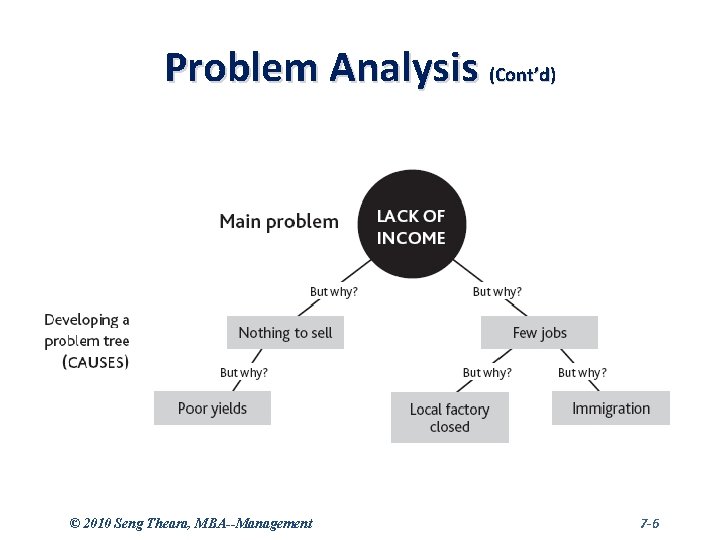
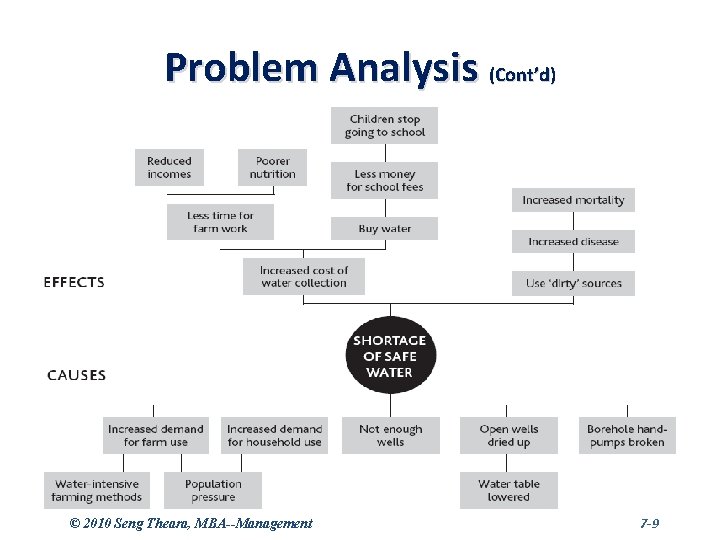
Problem Analysis (Cont’d) • Problem Tree – Problem trees enable stakeholders to get to the root of their priority need and to investigate the effects of the problem. – Step 1: Agree on the main problem, usually the one identified during project identification. What is the most priority problem? – Step 2: Identify the causes of the main problem by asking ‘But why? ’ until we can go no further. © 2010 Seng Theara, MBA--Management 7 -5
Problem Analysis (Cont’d) © 2010 Seng Theara, MBA--Management 7 -6
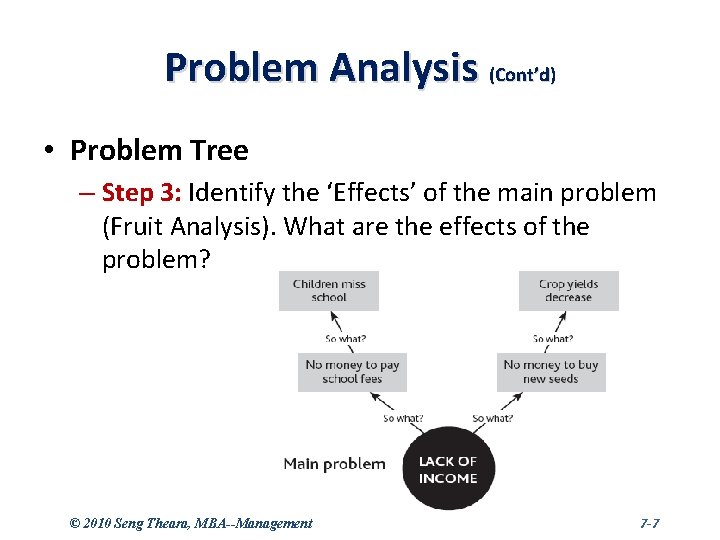
Problem Analysis (Cont’d) • Problem Tree – Step 3: Identify the ‘Effects’ of the main problem (Fruit Analysis). What are the effects of the problem? © 2010 Seng Theara, MBA--Management 7 -7
Problem Analysis (Cont’d) • Problem Tree – Step 4: Copy the problem tree onto a sheet of paper. Draw in vertical links to show the relationship between the causes or effects. Combine the root causes and effects (Full problem tree) i. e. another example: © 2010 Seng Theara, MBA--Management 7 -8
Problem Analysis (Cont’d) © 2010 Seng Theara, MBA--Management 7 -9
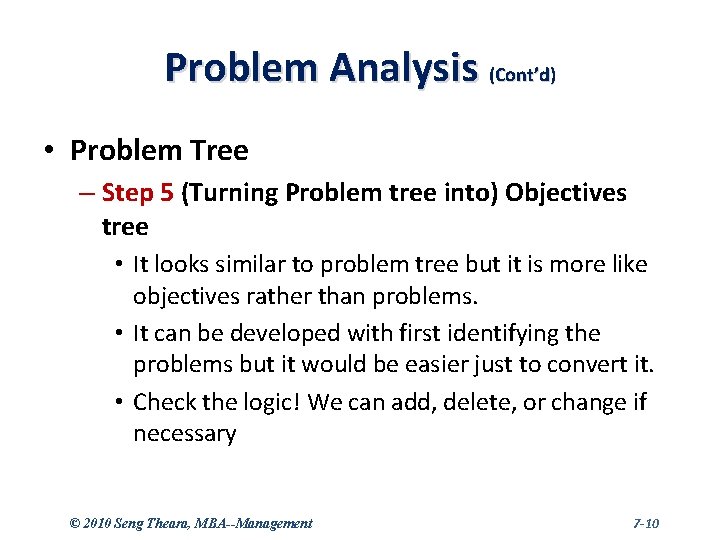
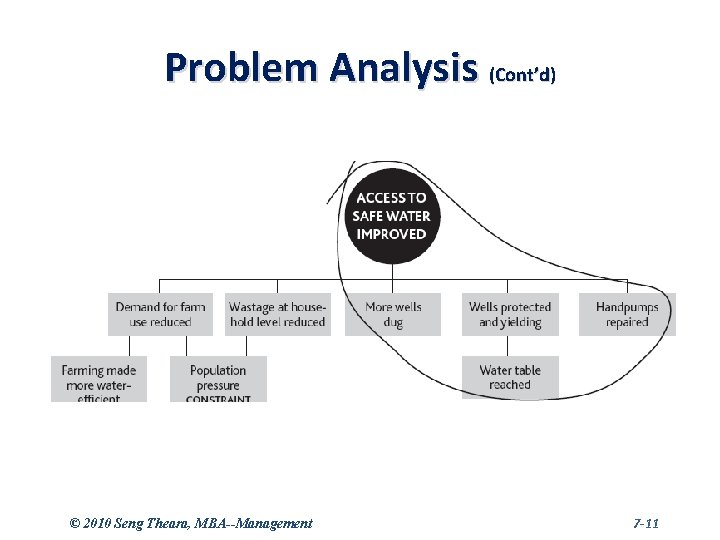
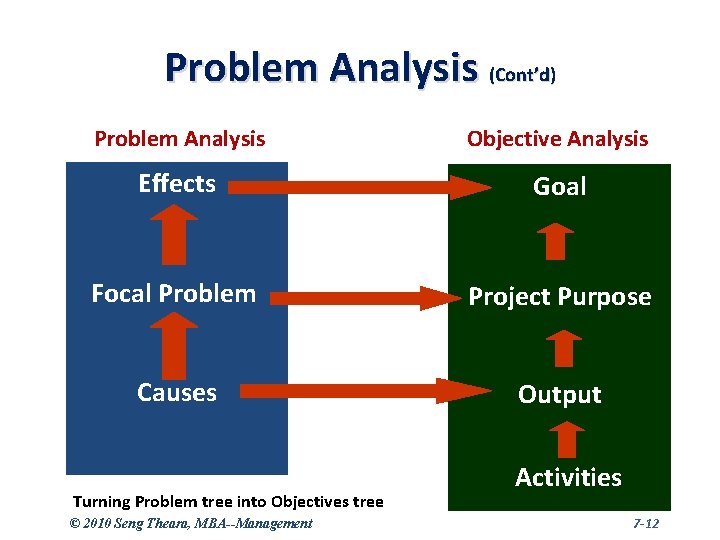
Problem Analysis (Cont’d) • Problem Tree – Step 5 (Turning Problem tree into) Objectives tree • It looks similar to problem tree but it is more like objectives rather than problems. • It can be developed with first identifying the problems but it would be easier just to convert it. • Check the logic! We can add, delete, or change if necessary © 2010 Seng Theara, MBA--Management 7 -10
Problem Analysis (Cont’d) © 2010 Seng Theara, MBA--Management 7 -11
Problem Analysis (Cont’d) Problem Analysis Objective Analysis Effects Goal Focal Problem Project Purpose Causes Output Turning Problem tree into Objectives tree © 2010 Seng Theara, MBA--Management Activities 7 -12
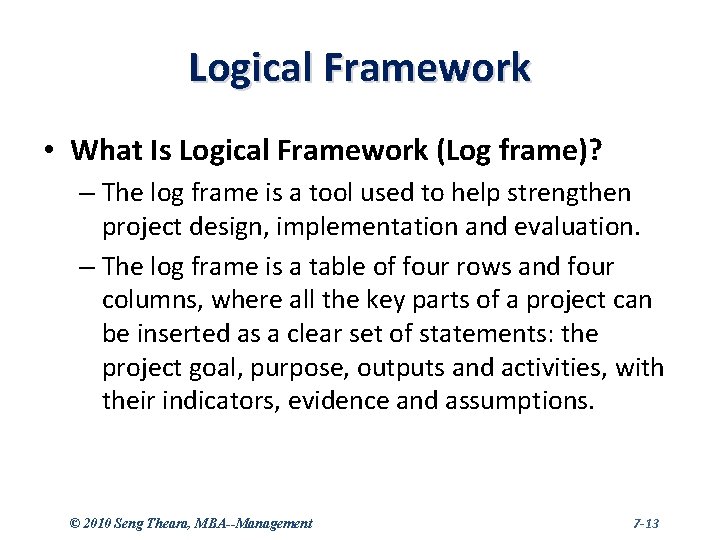
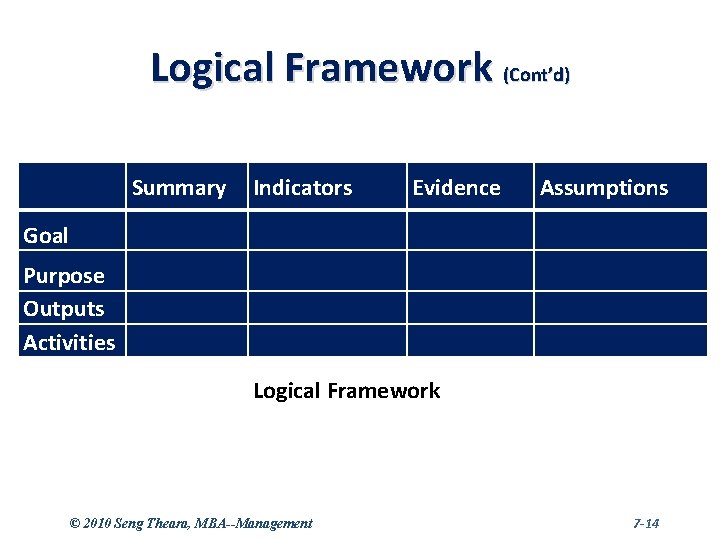
Logical Framework • What Is Logical Framework (Log frame)? – The log frame is a tool used to help strengthen project design, implementation and evaluation. – The log frame is a table of four rows and four columns, where all the key parts of a project can be inserted as a clear set of statements: the project goal, purpose, outputs and activities, with their indicators, evidence and assumptions. © 2010 Seng Theara, MBA--Management 7 -13
Logical Framework (Cont’d) Summary Indicators Evidence Assumptions Goal Purpose Outputs Activities Logical Framework © 2010 Seng Theara, MBA--Management 7 -14
Logical Framework (Cont’d) • Completing Log Frame – Goal • The highest level of objectives is the overall objective, which states the direction the project shall take. • It cannot be expected that this goal will be achieved until possibly some 3 -5 years after the project has ended. • Example 1. Improved health in children. 2. Decreased incidence and impact of diarrhoeal disease. © 2010 Seng Theara, MBA--Management 7 -15
Logical Framework (Cont’d) • Completing Log Frame – Project Purpose • The project purpose is the specific objective that project want to achieve. • It must be written based on S. M. A. R. T: – – – Specific Measureable Achievable Realistic and Time-bound • Ex: Increased access to, and use of, safe water in the diocese. © 2010 Seng Theara, MBA--Management 7 -16
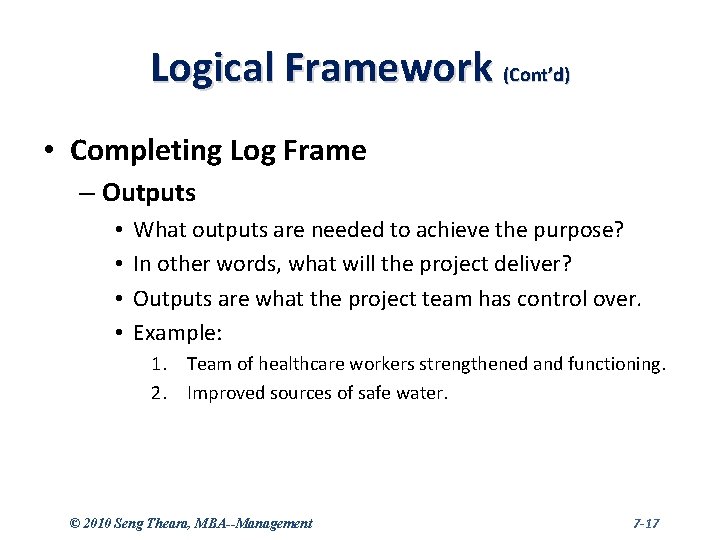
Logical Framework (Cont’d) • Completing Log Frame – Outputs • • What outputs are needed to achieve the purpose? In other words, what will the project deliver? Outputs are what the project team has control over. Example: 1. Team of healthcare workers strengthened and functioning. 2. Improved sources of safe water. © 2010 Seng Theara, MBA--Management 7 -17
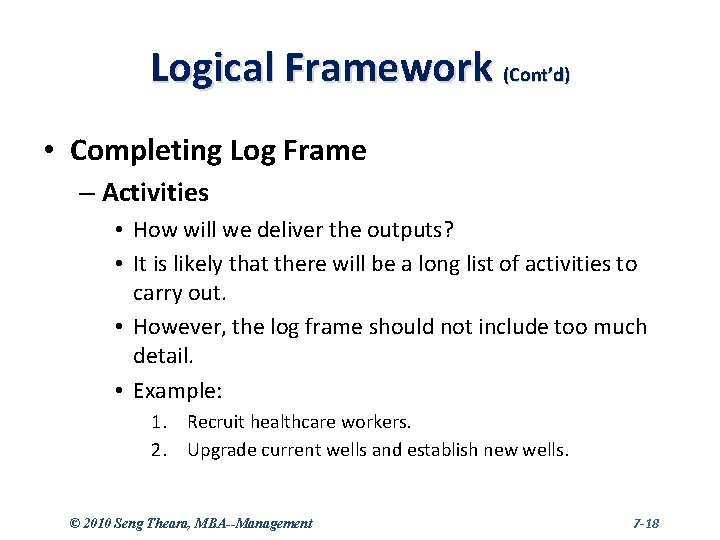
Logical Framework (Cont’d) • Completing Log Frame – Activities • How will we deliver the outputs? • It is likely that there will be a long list of activities to carry out. • However, the log frame should not include too much detail. • Example: 1. Recruit healthcare workers. 2. Upgrade current wells and establish new wells. © 2010 Seng Theara, MBA--Management 7 -18
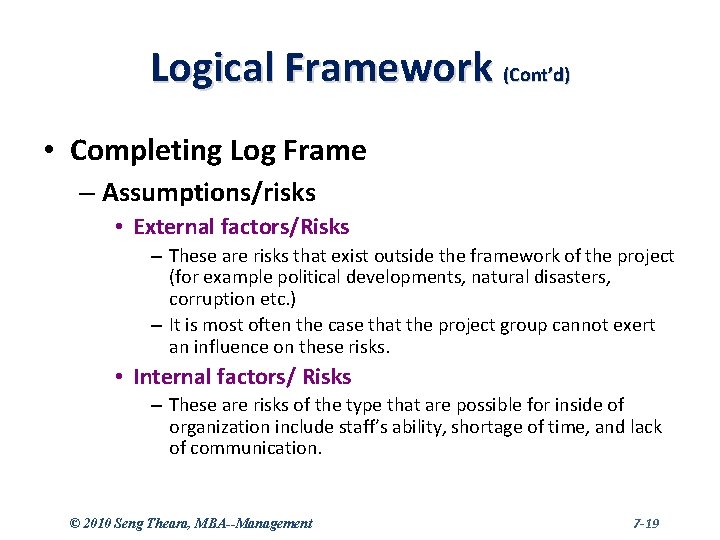
Logical Framework (Cont’d) • Completing Log Frame – Assumptions/risks • External factors/Risks – These are risks that exist outside the framework of the project (for example political developments, natural disasters, corruption etc. ) – It is most often the case that the project group cannot exert an influence on these risks. • Internal factors/ Risks – These are risks of the type that are possible for inside of organization include staff’s ability, shortage of time, and lack of communication. © 2010 Seng Theara, MBA--Management 7 -19
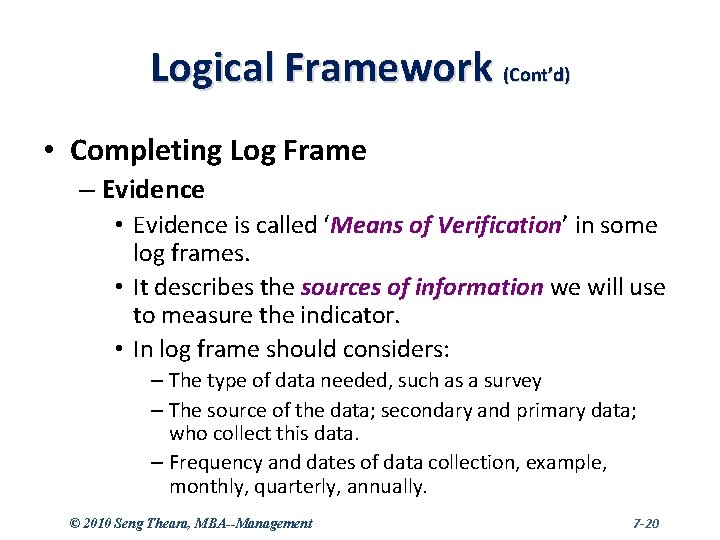
Logical Framework (Cont’d) • Completing Log Frame – Evidence • Evidence is called ‘Means of Verification’ in some log frames. • It describes the sources of information we will use to measure the indicator. • In log frame should considers: – The type of data needed, such as a survey – The source of the data; secondary and primary data; who collect this data. – Frequency and dates of data collection, example, monthly, quarterly, annually. © 2010 Seng Theara, MBA--Management 7 -20
Logical Framework (Cont’d) • Completing Log Frame – Indicators • Is the project achieving its goals? • To answer this question, the project group needs to identify indicators, which make it possible to measure the progress of the project at different levels. • They are signs which measure project performance against objectives and play an important part in monitoring and evaluation. © 2010 Seng Theara, MBA--Management 7 -21
Logical Framework (Cont’d) • Completing Log Frame – Indicators • Measurement can be: – Quantitative: indicators can be analyzed in numerical form: » Number of people involved or affected » Growth rates – Qualitative: indicators measure things that cannot be counted, like: » Satisfaction » Changes in attitude © 2010 Seng Theara, MBA--Management 7 -22
Logical Framework (Cont’d) • Completing Log Frame – Indicators • Measurement can be: – Direct indicator is measure the objective directly. » Numbers of participant » Numbers of children attending school – Indirect indicator is used if direct indicators are not appropriate or possible if, for example: » Quality of life » Tin roofs on house © 2010 Seng Theara, MBA--Management 7 -23
Logical Framework (Cont’d) • Completing Log Frame – Indicators • Types of indicators – Goal level indicators » The indicators at goal level may reach beyond the end of the project. » They might not be measured by our organization, but be included in government statistics some months after the project has ended. – Purpose level indicators » Indicators can be difficult to identify at purpose level. This is because the purpose objective often defines a change in behavior, which can be difficult to measure. © 2010 Seng Theara, MBA--Management 7 -24
Logical Framework (Cont’d) • Completing Log Frame – Indicators • Types of indicators – Output level indicators » Output indicators should be easier to measure than higher level objectives, because we have more control over these objectives. – Activity level indicators » The clearest indication of whether activities have happened successfully is if the outputs have been delivered. © 2010 Seng Theara, MBA--Management 7 -25
Budget Planning • Whether we are seeking donor funding or using funds we already have, it is important to write a budget for the project. • A budget is necessary for transparent financial management. • The donor needs to see a budget before approving the funds. • This means that we must budget very carefully. • If we do not consider all the things we will need to spend money on, then we will find we are unable to carry out some of the activities, and the project may fail. © 2010 Seng Theara, MBA--Management 7 -26
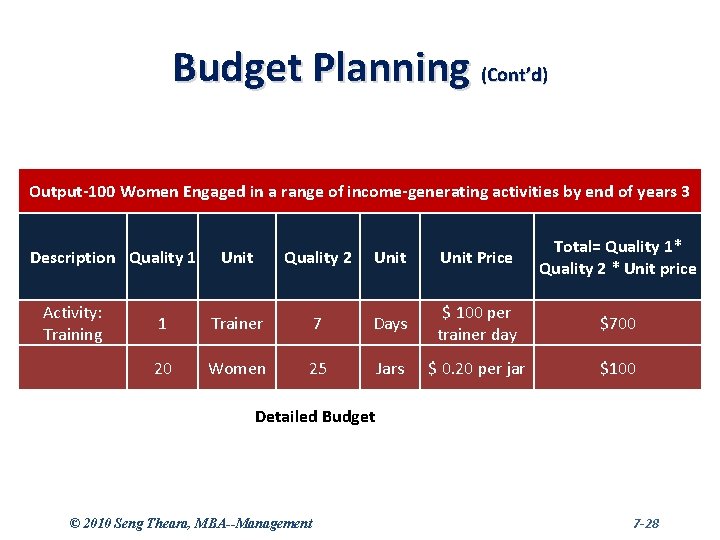
Budget Planning (Cont’d) • Detailed Budget – A detailed budget is usually for internal use only. Donors require only a summary. However, a detailed budget is useful for: • Good financial management and accountability: It shows that we are not spending money unnecessarily. • Monitor our activities: We will know if we have completed each activity if the money has been spent. • Learning: By keeping a record of our budget (and later, what we actually spend), we will know what is realistic for future projects. © 2010 Seng Theara, MBA--Management 7 -27
Budget Planning (Cont’d) Output-100 Women Engaged in a range of income-generating activities by end of years 3 Unit Quality 2 Unit Price Total= Quality 1* Quality 2 * Unit price 1 Trainer 7 Days $ 100 per trainer day $700 20 Women 25 Jars $ 0. 20 per jar $100 Description Quality 1 Activity: Training Detailed Budget © 2010 Seng Theara, MBA--Management 7 -28
Budget Planning (Cont’d) • Project Budget – Donors will require a completed project budget. – Donors will usually provide an outline of what they will and will not fund. – However, try to avoid contingency, because the need to use contingency money is more likely to be due to poor budgeting than price fluctuations. – If something unexpected does arise, extra money can normally be negotiated with the donor anyway. © 2010 Seng Theara, MBA--Management 7 -29
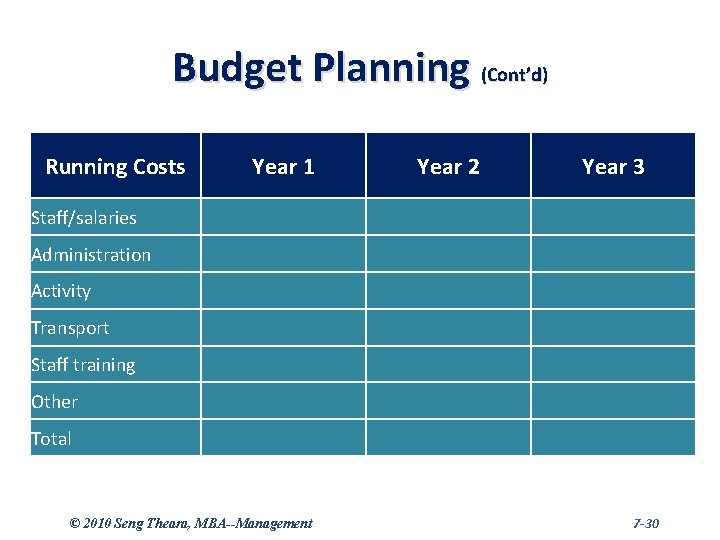
Budget Planning (Cont’d) Running Costs Year 1 Year 2 Year 3 Staff/salaries Administration Activity Transport Staff training Other Total © 2010 Seng Theara, MBA--Management 7 -30
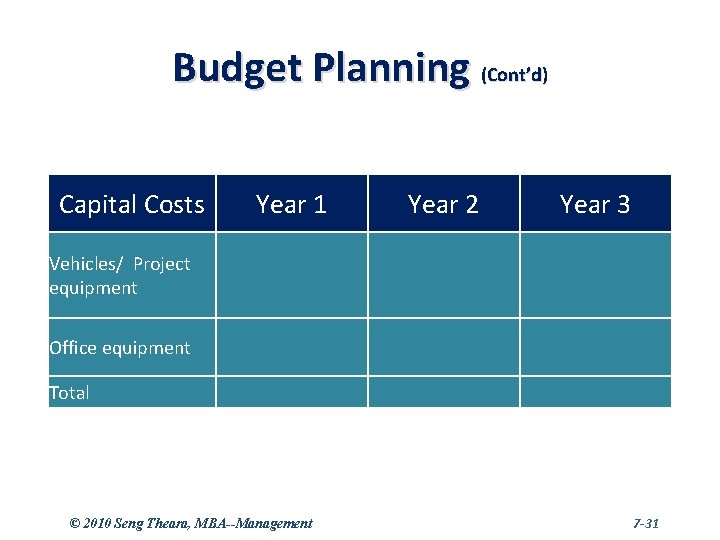
Budget Planning (Cont’d) Capital Costs Year 1 Year 2 Year 3 Vehicles/ Project equipment Office equipment Total © 2010 Seng Theara, MBA--Management 7 -31