
Runtime evaluation of algorithms Philip T L C
- Slides: 16
Runtime evaluation of algorithms Philip T. L. C. Clausen
Measurement of algorithm runtime, big O. Rules for big O notation. 1. Count the number a steps you have to do, in order to get your algorithm from input to output (i. e. from “a” to “b”). 2. Ignore constant values, it’s all about the needed steps not the speed of each step. 3. If your program goes from “a” to “c” through “b”, then the big O is determined as the step with the largest notation. 4. Usually the big O notes the worst case runtime of the algorithm. DTU Food, National Food Institute 2
1. Count the number a steps you have to do, in order to get your algorithm from input to output (i. e. from a to b). Say I have a list of numbers, and I want to search that list. How can I do it? DTU Food, National Food Institute 3
Say I have a list of numbers, and I want to search that list. 1. Linear search. 2. Binary search. 3. Hash search. DTU Food, National Food Institute 4
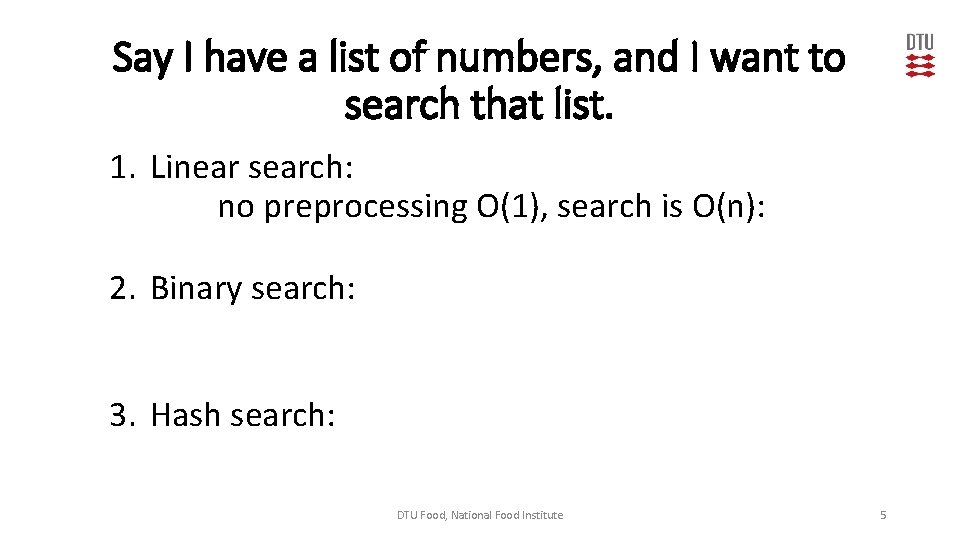
Say I have a list of numbers, and I want to search that list. 1. Linear search: no preprocessing O(1), search is O(n): 2. Binary search: 3. Hash search: DTU Food, National Food Institute 5
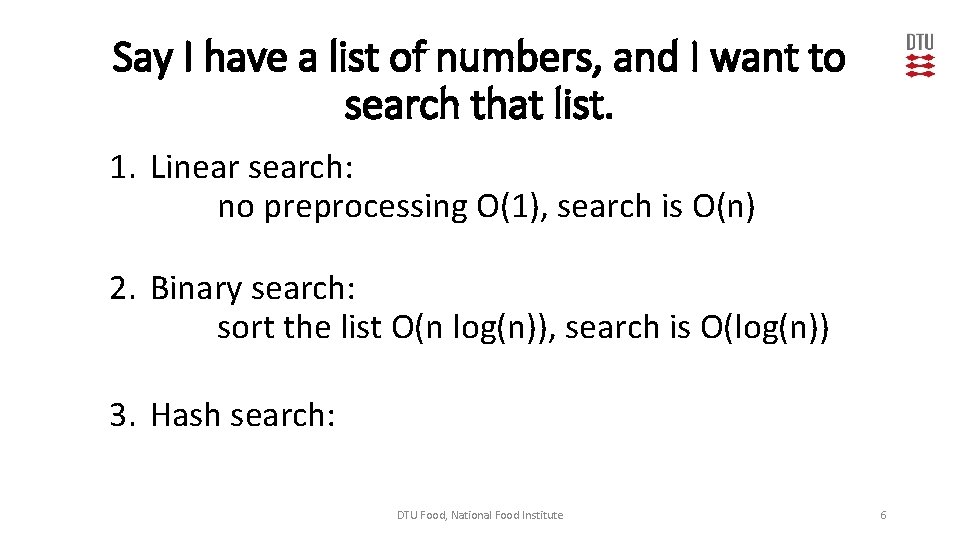
Say I have a list of numbers, and I want to search that list. 1. Linear search: no preprocessing O(1), search is O(n) 2. Binary search: sort the list O(n log(n)), search is O(log(n)) 3. Hash search: DTU Food, National Food Institute 6
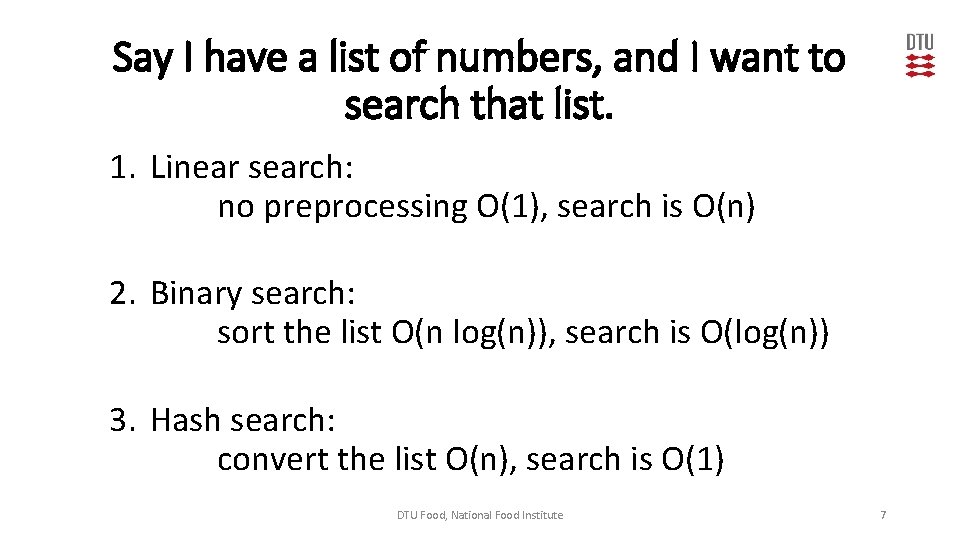
Say I have a list of numbers, and I want to search that list. 1. Linear search: no preprocessing O(1), search is O(n) 2. Binary search: sort the list O(n log(n)), search is O(log(n)) 3. Hash search: convert the list O(n), search is O(1) DTU Food, National Food Institute 7
Say I have a list of numbers, and I want to search that list. 1. Linear search. 2. Binary search. 3. Hash search. DTU Food, National Food Institute 8
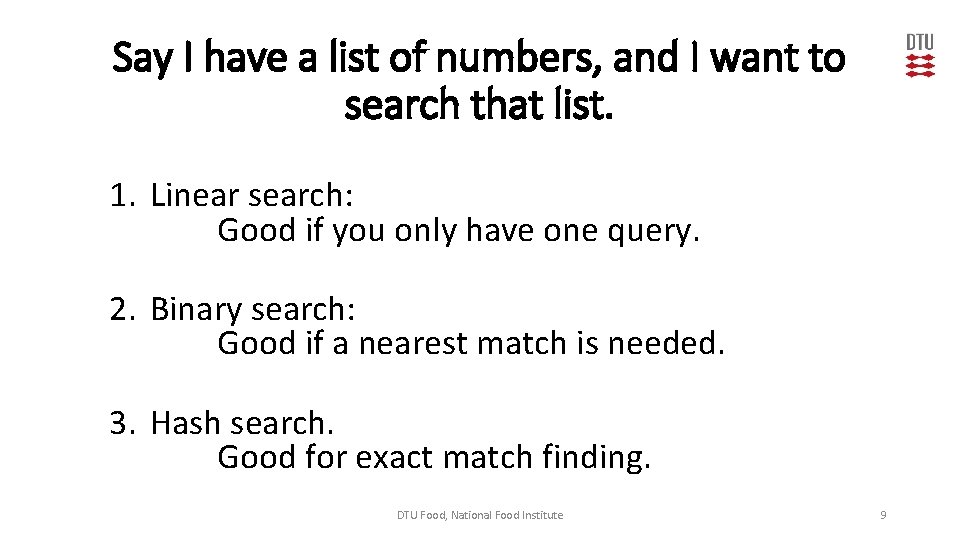
Say I have a list of numbers, and I want to search that list. 1. Linear search: Good if you only have one query. 2. Binary search: Good if a nearest match is needed. 3. Hash search. Good for exact match finding. DTU Food, National Food Institute 9
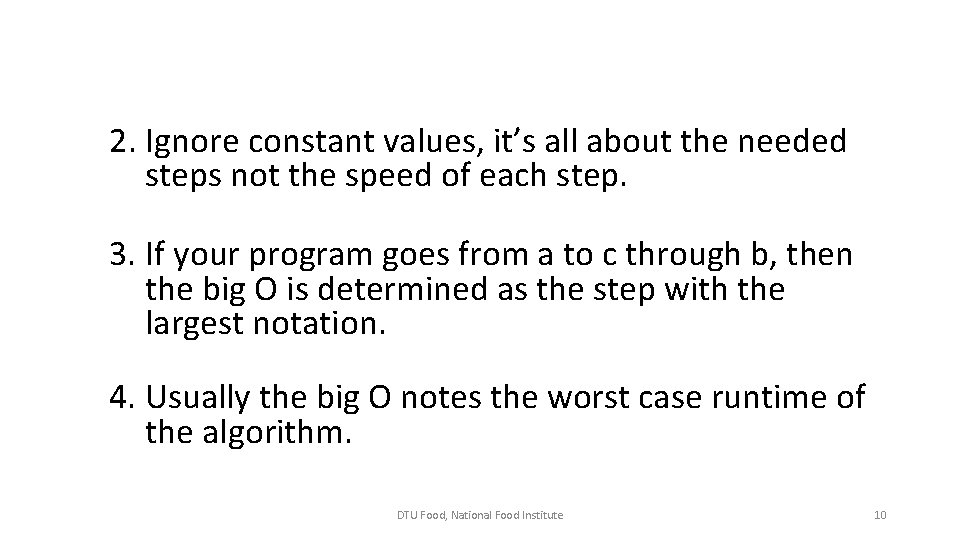
2. Ignore constant values, it’s all about the needed steps not the speed of each step. 3. If your program goes from a to c through b, then the big O is determined as the step with the largest notation. 4. Usually the big O notes the worst case runtime of the algorithm. DTU Food, National Food Institute 10
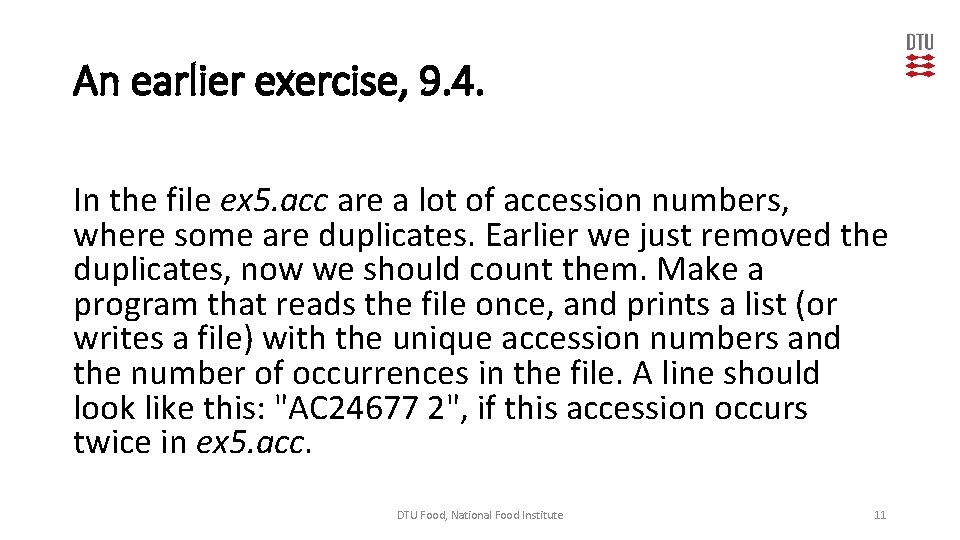
An earlier exercise, 9. 4. In the file ex 5. acc are a lot of accession numbers, where some are duplicates. Earlier we just removed the duplicates, now we should count them. Make a program that reads the file once, and prints a list (or writes a file) with the unique accession numbers and the number of occurrences in the file. A line should look like this: "AC 24677 2", if this accession occurs twice in ex 5. acc. DTU Food, National Food Institute 11
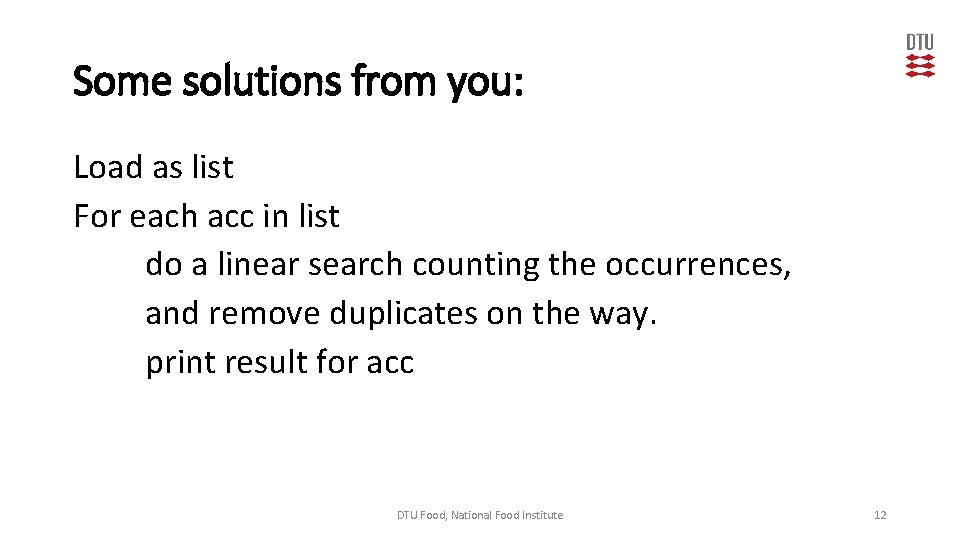
Some solutions from you: Load as list For each acc in list do a linear search counting the occurrences, and remove duplicates on the way. print result for acc DTU Food, National Food Institute 12
Some solutions from you: Load as list Sort list For each acc in list Count and skip consecutive pairs. print result for acc. DTU Food, National Food Institute 13
Some solutions from you: Load as dict with occurrences as values For each acc in dict print result for acc. DTU Food, National Food Institute 14
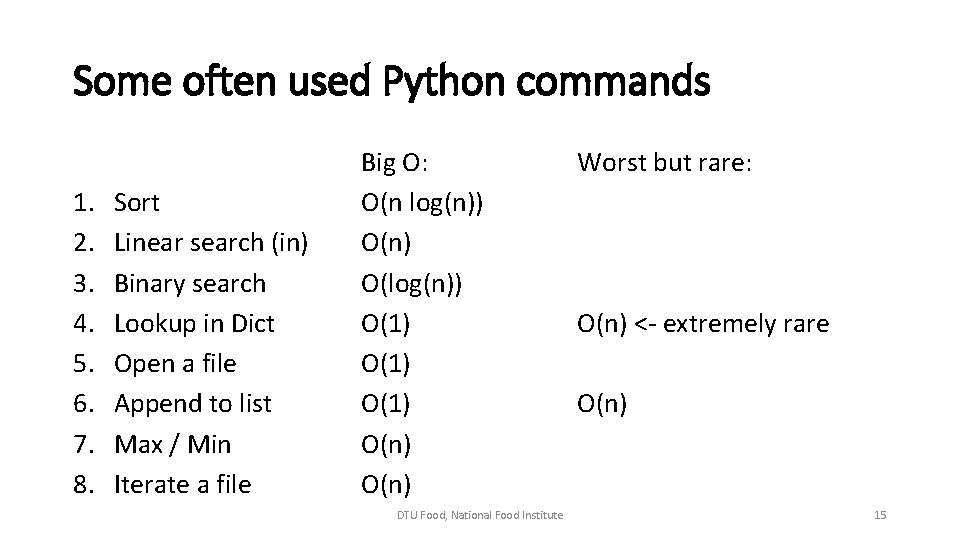
Some often used Python commands 1. 2. 3. 4. 5. 6. 7. 8. Sort Linear search (in) Binary search Lookup in Dict Open a file Append to list Max / Min Iterate a file Big O: O(n log(n)) O(n) O(log(n)) O(1) O(n) DTU Food, National Food Institute Worst but rare: O(n) <- extremely rare O(n) 15
Exercises and / or projects DTU Food, National Food Institute 16