
RunTime Dynamic Linking for Reprogramming Wireless Sensor Networks
- Slides: 30
Run-Time Dynamic Linking for Reprogramming Wireless Sensor Networks Adam Dunkels, Niclas Finne, Joakim Eriksson, Thiemo Voigt Swedish Institute of Computer Science ACM Sen. Sys 2006 1 Run-Time Dynamic Linking for Reprogramming Wireless Sensor Networks Adam Dunkels <adam@sics. se>
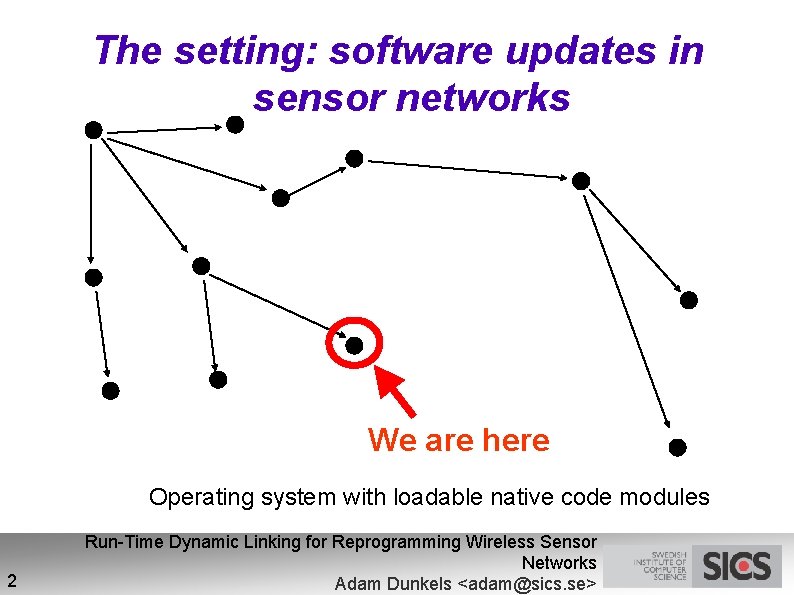
The setting: software updates in sensor networks We are here Operating system with loadable native code modules 2 Run-Time Dynamic Linking for Reprogramming Wireless Sensor Networks Adam Dunkels <adam@sics. se>
We all have our own way of doing loadable modules Contiki [Em. Net. S 2004] ● ● SOS [Mobi. Sys 2005] ● ● Modules with position independent code Why not just do it the standard “Linux” way? ● ● Run-time linking of ELF files ● Availability of tools, knowledge ● Are we compelled to do it our own way? ● Or do we choose to do it our own way? ● Can we even do it the “Linux” way in microsensor networks? ● ● 3 Statically linked modules, relocation at run-time Given the severe resource constraints: 2 k RAM, 60 k ROM If we could, what would the overhead be? Run-Time Dynamic Linking for Reprogramming Wireless Sensor Networks Adam Dunkels <adam@sics. se>
What we’ve done Developed a dynamic linker for Contiki ● ● CVM (Contiki VM) – a virtual machine ● ● Typical, stack-based virtual machine ● Compiler for a subset of Java virtual machine ● ● 4 Link, relocate, load standard ELF files Ported the le. JOS Java VM to Contiki Run-Time Dynamic Linking for Reprogramming Wireless Sensor Networks Adam Dunkels <adam@sics. se>
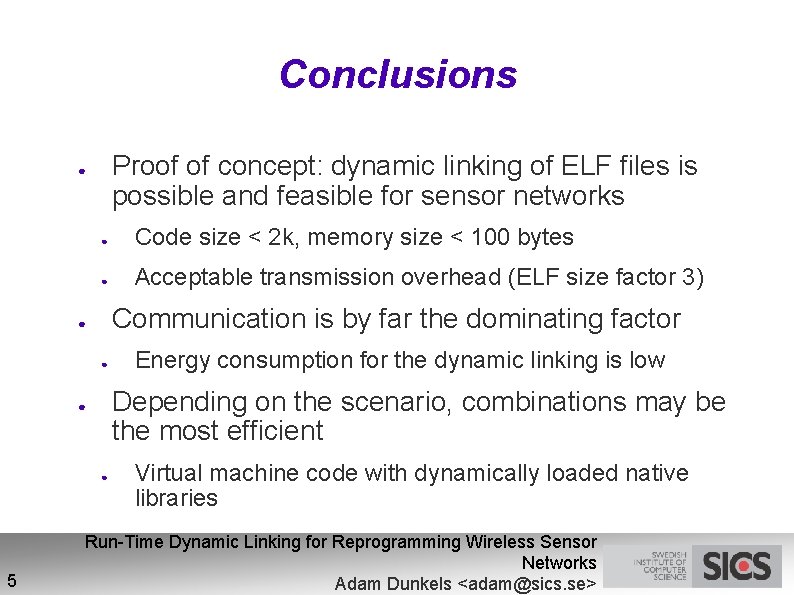
Conclusions Proof of concept: dynamic linking of ELF files is possible and feasible for sensor networks ● ● Code size < 2 k, memory size < 100 bytes ● Acceptable transmission overhead (ELF size factor 3) Communication is by far the dominating factor ● ● Depending on the scenario, combinations may be the most efficient ● ● 5 Energy consumption for the dynamic linking is low Virtual machine code with dynamically loaded native libraries Run-Time Dynamic Linking for Reprogramming Wireless Sensor Networks Adam Dunkels <adam@sics. se>
The details… 6 Run-Time Dynamic Linking for Reprogramming Wireless Sensor Networks Adam Dunkels <adam@sics. se>
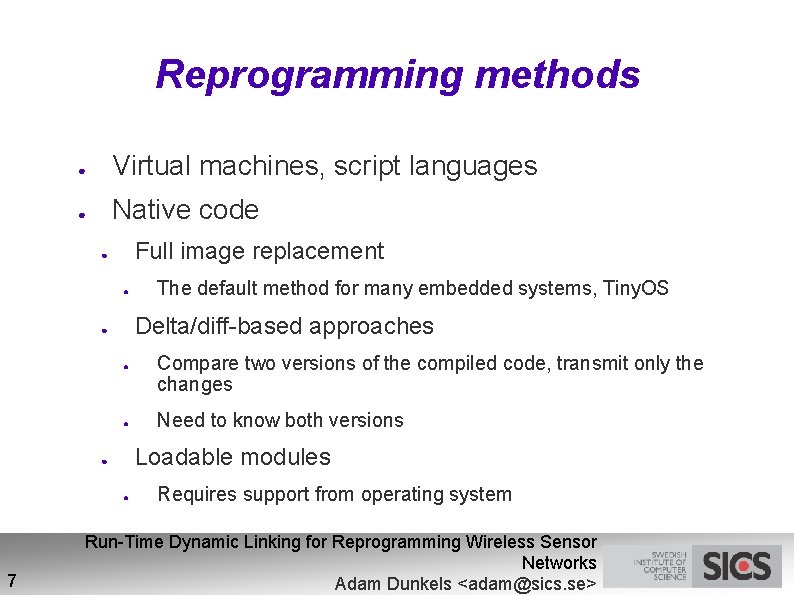
Reprogramming methods ● Virtual machines, script languages ● Native code Full image replacement ● ● Delta/diff-based approaches ● ● ● Compare two versions of the compiled code, transmit only the changes Need to know both versions Loadable modules ● ● 7 The default method for many embedded systems, Tiny. OS Requires support from operating system Run-Time Dynamic Linking for Reprogramming Wireless Sensor Networks Adam Dunkels <adam@sics. se>
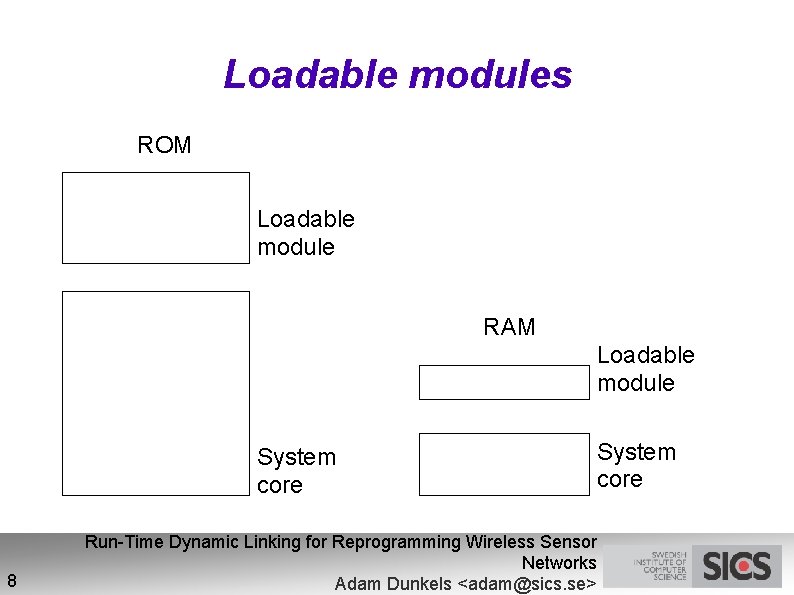
Loadable modules ROM RAM Loadable module System core 8 System core Run-Time Dynamic Linking for Reprogramming Wireless Sensor Networks Adam Dunkels <adam@sics. se>
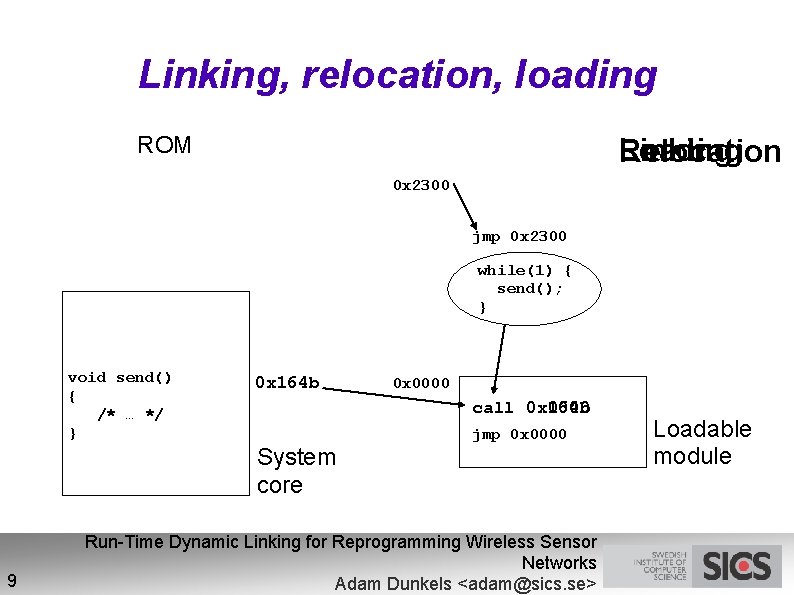
Linking, relocation, loading ROM 0 x 2300 RAM Loading Linking Relocation jmp 0 x 2300 while(1) { send(); } void send() { /* … */ } 0 x 164 b call 0 x 0000 0 x 164 b System core 9 0 x 0000 jmp 0 x 0000 Run-Time Dynamic Linking for Reprogramming Wireless Sensor Networks Adam Dunkels <adam@sics. se> Loadable module
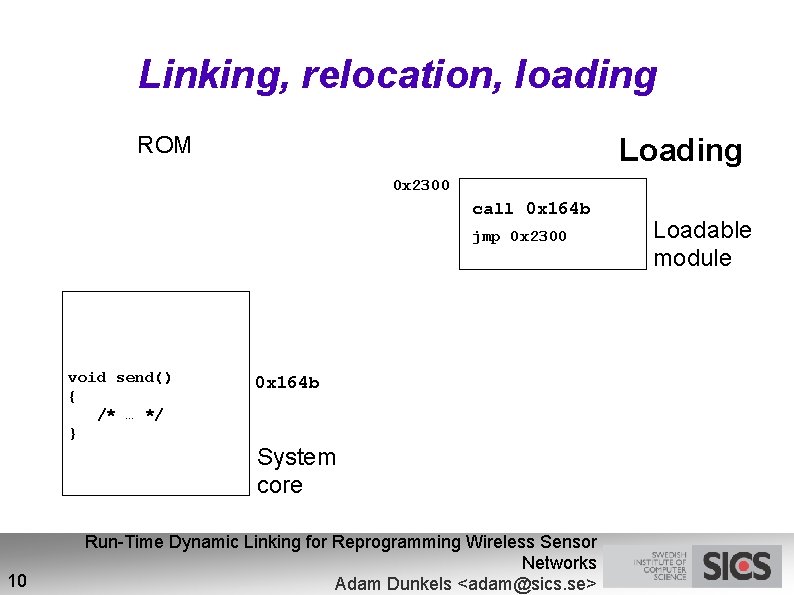
Linking, relocation, loading ROM Loading 0 x 2300 call 0 x 164 b jmp 0 x 2300 void send() { /* … */ } 0 x 164 b System core 10 Run-Time Dynamic Linking for Reprogramming Wireless Sensor Networks Adam Dunkels <adam@sics. se> Loadable module
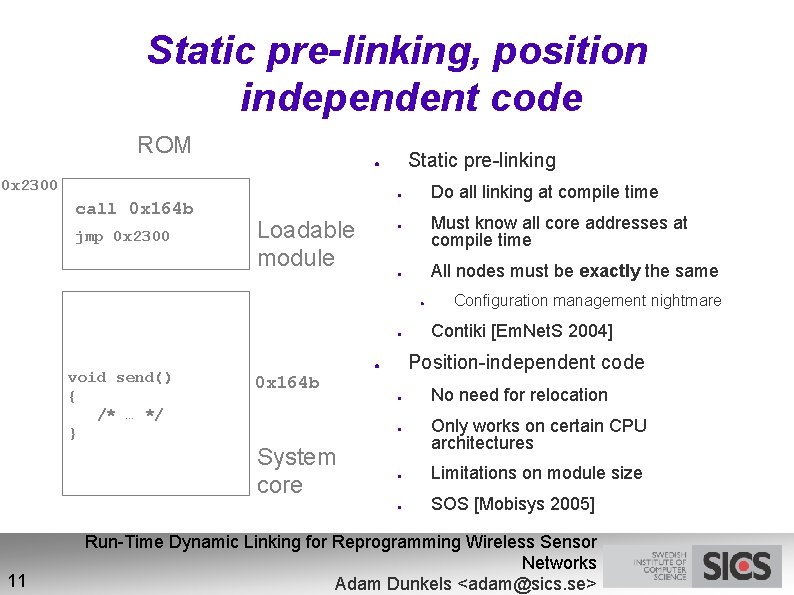
Static pre-linking, position independent code ROM 0 x 2300 call 0 x 164 b jmp 0 x 2300 Static pre-linking ● Do all linking at compile time ● Loadable module Must know all core addresses at compile time ● All nodes must be exactly the same ● ● ● void send() { /* … */ } 11 ● ● System core Contiki [Em. Net. S 2004] Position-independent code ● 0 x 164 b Configuration management nightmare No need for relocation Only works on certain CPU architectures ● Limitations on module size ● SOS [Mobisys 2005] Run-Time Dynamic Linking for Reprogramming Wireless Sensor Networks Adam Dunkels <adam@sics. se>
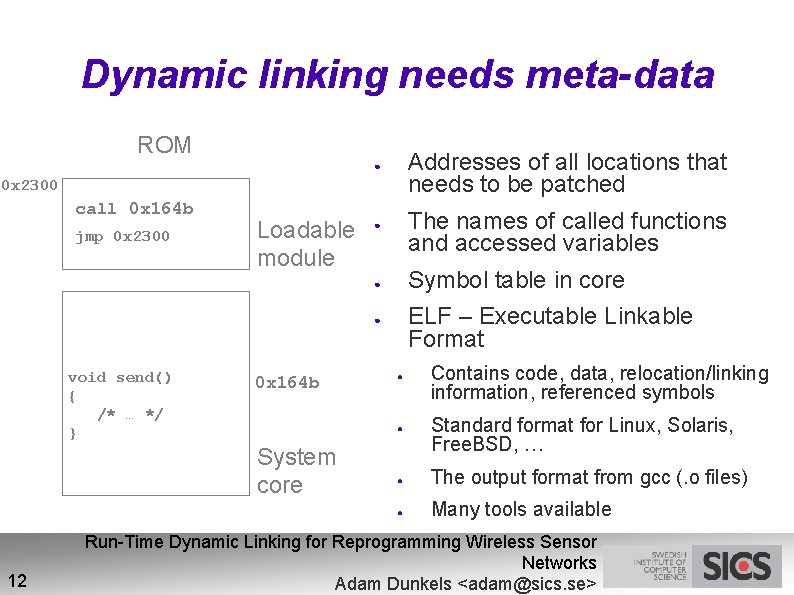
Dynamic linking needs meta-data ROM Addresses of all locations that needs to be patched ● 0 x 2300 call 0 x 164 b jmp 0 x 2300 Loadable module The names of called functions and accessed variables ● Symbol table in core ● ELF – Executable Linkable Format ● void send() { /* … */ } 0 x 164 b ● System core 12 ● Contains code, data, relocation/linking information, referenced symbols Standard format for Linux, Solaris, Free. BSD, … ● The output format from gcc (. o files) ● Many tools available Run-Time Dynamic Linking for Reprogramming Wireless Sensor Networks Adam Dunkels <adam@sics. se>
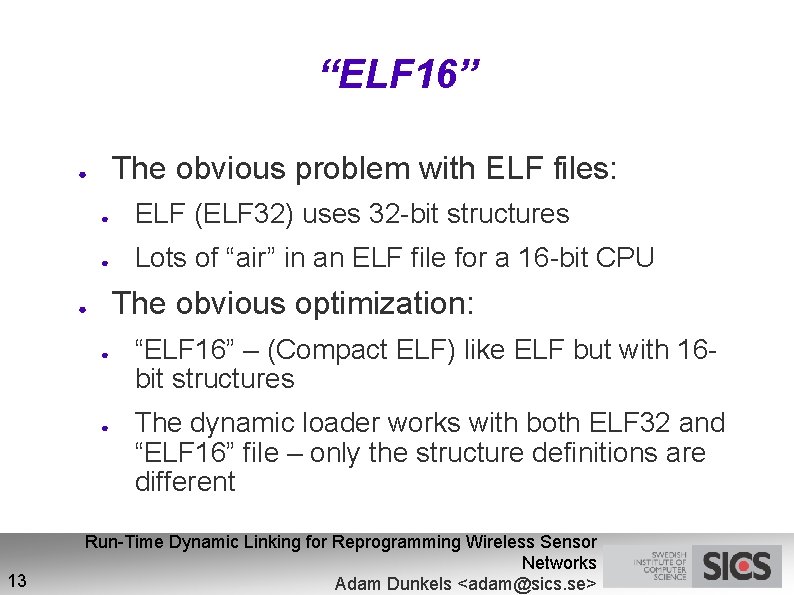
“ELF 16” The obvious problem with ELF files: ● ● ELF (ELF 32) uses 32 -bit structures ● Lots of “air” in an ELF file for a 16 -bit CPU The obvious optimization: ● ● ● 13 “ELF 16” – (Compact ELF) like ELF but with 16 bit structures The dynamic loader works with both ELF 32 and “ELF 16” file – only the structure definitions are different Run-Time Dynamic Linking for Reprogramming Wireless Sensor Networks Adam Dunkels <adam@sics. se>
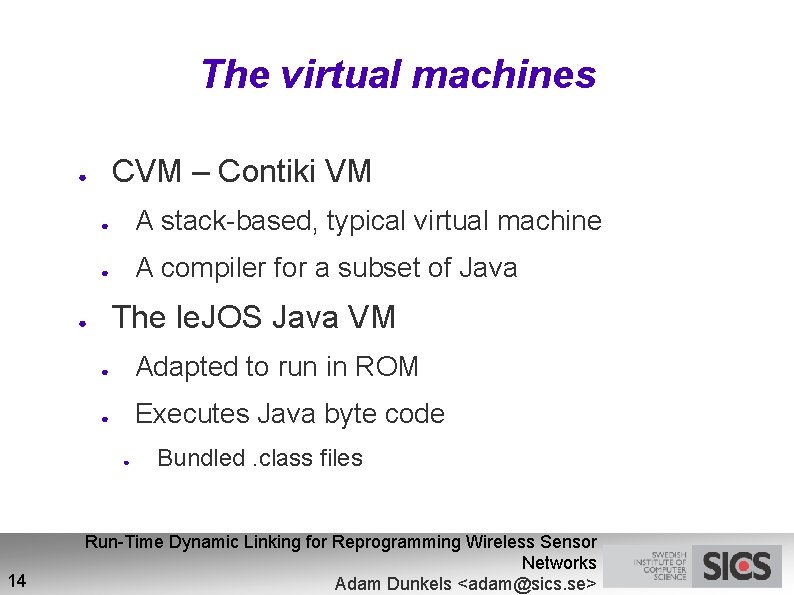
The virtual machines CVM – Contiki VM ● ● A stack-based, typical virtual machine ● A compiler for a subset of Java The le. JOS Java VM ● ● Adapted to run in ROM ● Executes Java byte code ● 14 Bundled. class files Run-Time Dynamic Linking for Reprogramming Wireless Sensor Networks Adam Dunkels <adam@sics. se>
So how well does it work? 15 Run-Time Dynamic Linking for Reprogramming Wireless Sensor Networks Adam Dunkels <adam@sics. se>
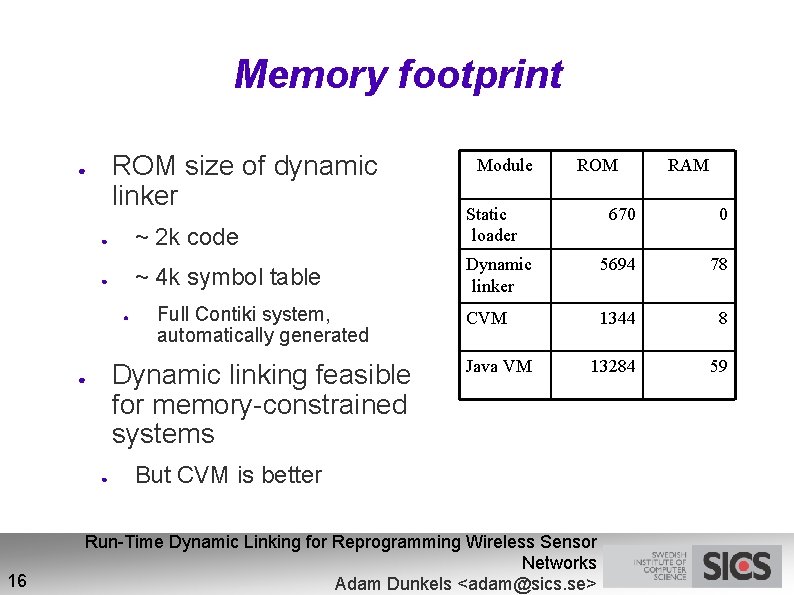
Memory footprint ROM size of dynamic linker ● ● ● 16 ROM RAM ~ 2 k code Static loader ~ 4 k symbol table Dynamic linker 5694 78 CVM 1344 8 13284 59 Full Contiki system, automatically generated Dynamic linking feasible for memory-constrained systems ● Module Java VM But CVM is better Run-Time Dynamic Linking for Reprogramming Wireless Sensor Networks Adam Dunkels <adam@sics. se> 670 0
Quantifying the energy consumption Measure the energy consumption: ● Radio reception, measured on CC 2420, TR 1001 ● ● ● 17 A lower bound, based on average Deluge overhead ● Storing data to EEPROM ● Linking, relocating object code ● Loading code into flash ROM ● Executing the code Two boards: ESB, Telos Sky (both MSP 430) Run-Time Dynamic Linking for Reprogramming Wireless Sensor Networks Adam Dunkels <adam@sics. se>
Receiving 1000 bytes with the CC 2420 18 Run-Time Dynamic Linking for Reprogramming Wireless Sensor Networks Adam Dunkels <adam@sics. se>
Receiving 1000 bytes with the TR 1001 19 Run-Time Dynamic Linking for Reprogramming Wireless Sensor Networks Adam Dunkels <adam@sics. se>
Energy consumption of the dynamic linker 20 Run-Time Dynamic Linking for Reprogramming Wireless Sensor Networks Adam Dunkels <adam@sics. se>
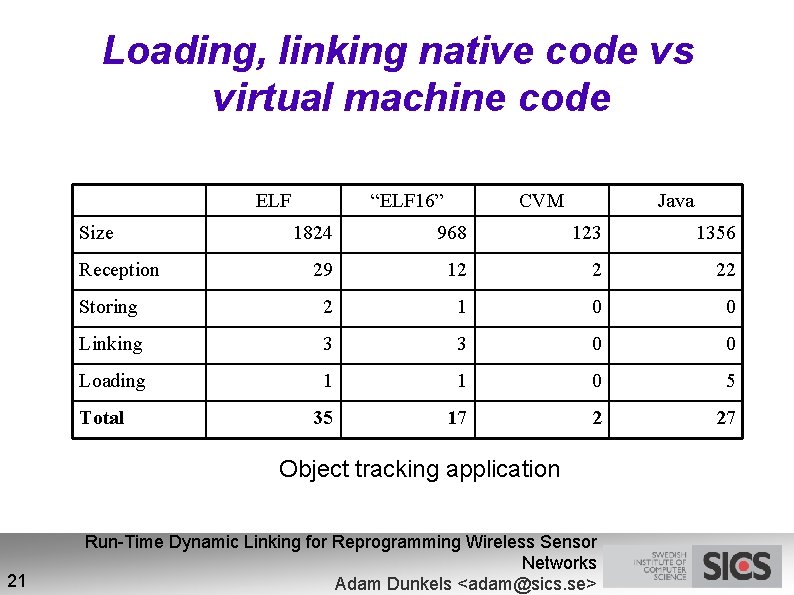
Loading, linking native code vs virtual machine code ELF Size “ELF 16” CVM Java 1824 968 123 1356 29 12 2 22 Storing 2 1 0 0 Linking 3 3 0 0 Loading 1 1 0 5 35 17 2 27 Reception Total Object tracking application 21 Run-Time Dynamic Linking for Reprogramming Wireless Sensor Networks Adam Dunkels <adam@sics. se>
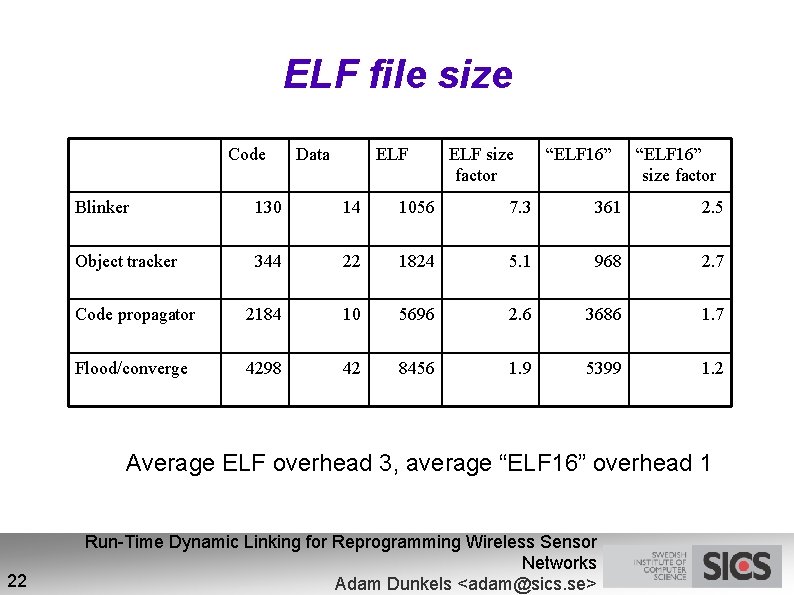
ELF file size Code Data ELF size factor “ELF 16” size factor Blinker 130 14 1056 7. 3 361 2. 5 Object tracker 344 22 1824 5. 1 968 2. 7 Code propagator 2184 10 5696 2. 6 3686 1. 7 Flood/converge 4298 42 8456 1. 9 5399 1. 2 Average ELF overhead 3, average “ELF 16” overhead 1 22 Run-Time Dynamic Linking for Reprogramming Wireless Sensor Networks Adam Dunkels <adam@sics. se>
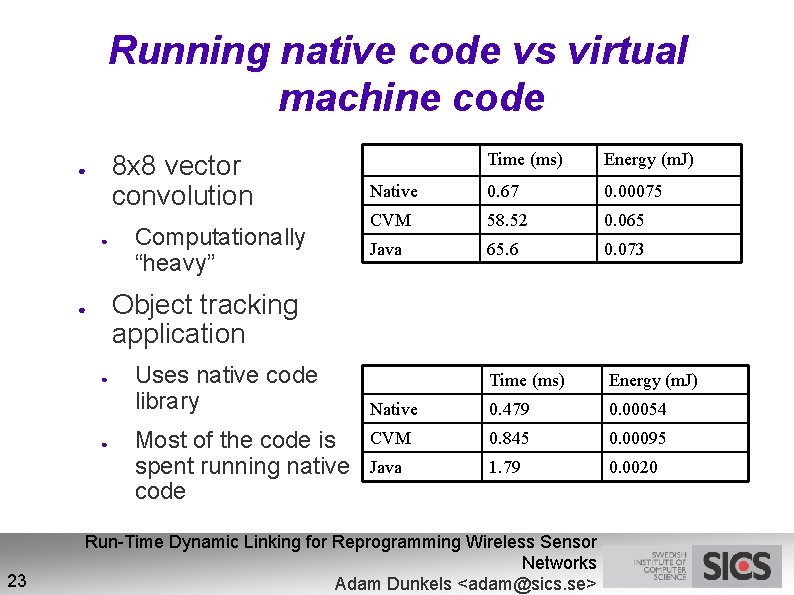
Running native code vs virtual machine code 8 x 8 vector convolution ● ● Energy (m. J) Native 0. 67 0. 00075 CVM 58. 52 0. 065 Java 65. 6 0. 073 Time (ms) Energy (m. J) Native 0. 479 0. 00054 CVM 0. 845 0. 00095 Java 1. 79 0. 0020 Object tracking application ● ● ● 23 Computationally “heavy” Time (ms) Uses native code library Most of the code is spent running native code Run-Time Dynamic Linking for Reprogramming Wireless Sensor Networks Adam Dunkels <adam@sics. se>
Break even points, vector convolution “ELF 16” 24 Run-Time Dynamic Linking for Reprogramming Wireless Sensor Networks Adam Dunkels <adam@sics. se>
Break-even points, object tracking “ELF 16” 25 Run-Time Dynamic Linking for Reprogramming Wireless Sensor Networks Adam Dunkels <adam@sics. se>
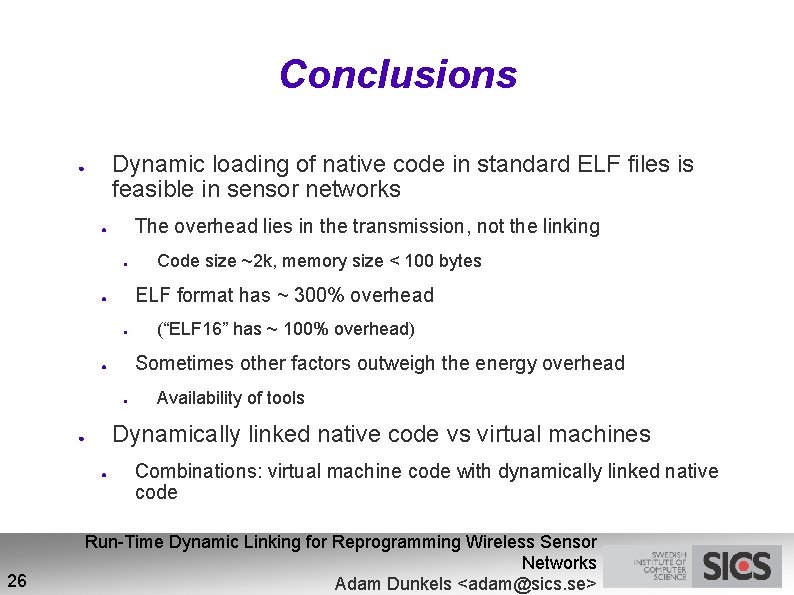
Conclusions Dynamic loading of native code in standard ELF files is feasible in sensor networks ● The overhead lies in the transmission, not the linking ● ● ELF format has ~ 300% overhead ● ● (“ELF 16” has ~ 100% overhead) Sometimes other factors outweigh the energy overhead ● ● Availability of tools Dynamically linked native code vs virtual machines ● ● 26 Code size ~2 k, memory size < 100 bytes Combinations: virtual machine code with dynamically linked native code Run-Time Dynamic Linking for Reprogramming Wireless Sensor Networks Adam Dunkels <adam@sics. se>
Questions? 27 Run-Time Dynamic Linking for Reprogramming Wireless Sensor Networks Adam Dunkels <adam@sics. se>
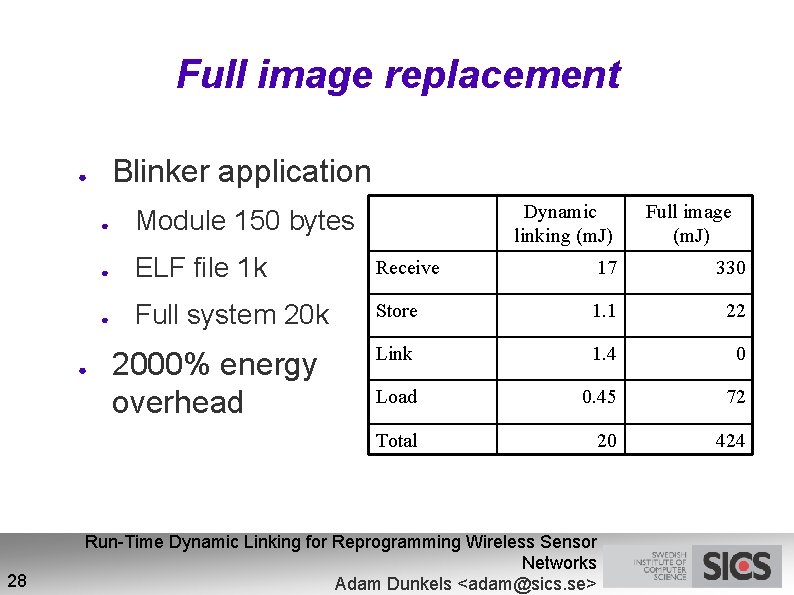
Full image replacement Blinker application ● ● 28 Dynamic linking (m. J) Full image (m. J) ● Module 150 bytes ● ELF file 1 k Receive 17 330 ● Full system 20 k Store 1. 1 22 Link 1. 4 0 Load 0. 45 72 Total 20 424 2000% energy overhead Run-Time Dynamic Linking for Reprogramming Wireless Sensor Networks Adam Dunkels <adam@sics. se>
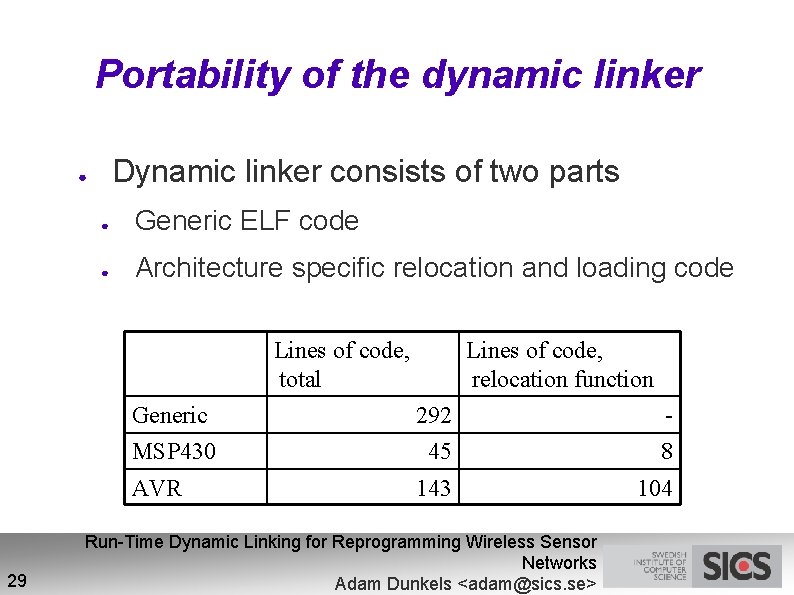
Portability of the dynamic linker Dynamic linker consists of two parts ● ● Generic ELF code ● Architecture specific relocation and loading code Lines of code, total Generic 292 - MSP 430 45 8 143 104 AVR 29 Lines of code, relocation function Run-Time Dynamic Linking for Reprogramming Wireless Sensor Networks Adam Dunkels <adam@sics. se>
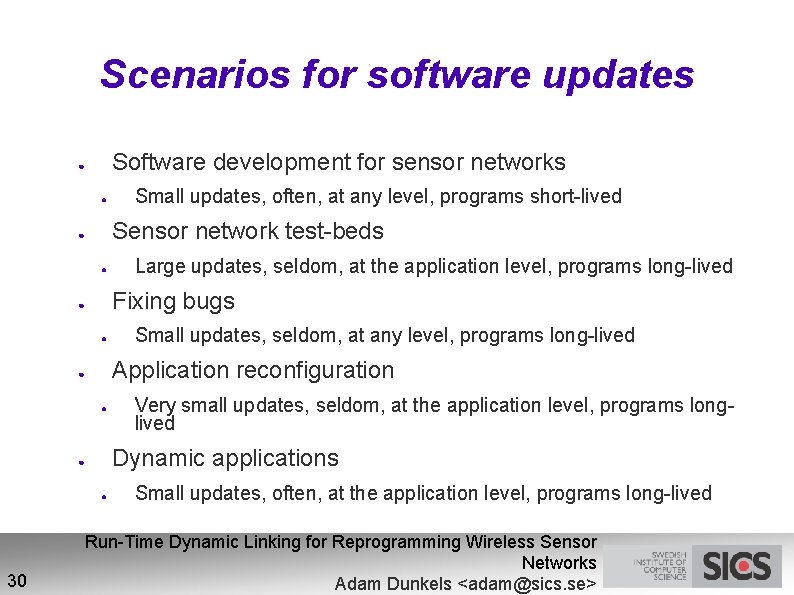
Scenarios for software updates Software development for sensor networks ● ● Sensor network test-beds ● ● Large updates, seldom, at the application level, programs long-lived Fixing bugs ● ● Small updates, seldom, at any level, programs long-lived Application reconfiguration ● ● Very small updates, seldom, at the application level, programs longlived Dynamic applications ● ● 30 Small updates, often, at any level, programs short-lived Small updates, often, at the application level, programs long-lived Run-Time Dynamic Linking for Reprogramming Wireless Sensor Networks Adam Dunkels <adam@sics. se>