
Running WWATCH on triangular meshes Fabrice Ardhuin The
Running WWATCH on triangular meshes Fabrice Ardhuin The friends of WAVEWATCH III Team Marine Modeling and Analysis Branch NOAA / NWS / NCEP / EMC ardhuin@ifremer. fr NCEP. list. waves@NOAA. gov Version 1. 4, Jan. 2013 WW Winter School 2013 Triangles 1/27
Outline Covered in this lecture: Why triangles? Grid structure & running ww 3_grid Time integration & grid optimization Numerical schemes: spatial advection Post-processing Triangles + squares in 2 -way nested runs What is not covered: Hands-on tutorial on grid generation for this : search for “tutorial” on Ifremer's wiki (using Polymesh) https: //forge. ifremer. fr/plugins/mediawiki/ww 3/ Next course at UMD or at Ifremer! Version 1. 4, Jan. 2013 WW Winter School 2013 Triangles 2/27
Background material The basic numerics story is summarized in Aron Roland's Ph. D. Thesis (T. U. Darmstadt 2008). Code identical to WWM See also Roland (2012, ECMWF workshop proceedings) One paper with specific numerics (for coastal reflection) Ardhuin & Roland (JGR 2012) Some other papers with just application Ardhuin & al. (JPO 2009: Stokes drift; JPO 2012: wave-current) All these are at http: //wwz. ifremer. fr/iowaga (just google IOWAGA) And you can find forecasts and hindcasts there http: //www. previmer. org/en/forecasts/waves Version 1. 4, Jan. 2013 WW Winter School 2013 Triangles 3/27
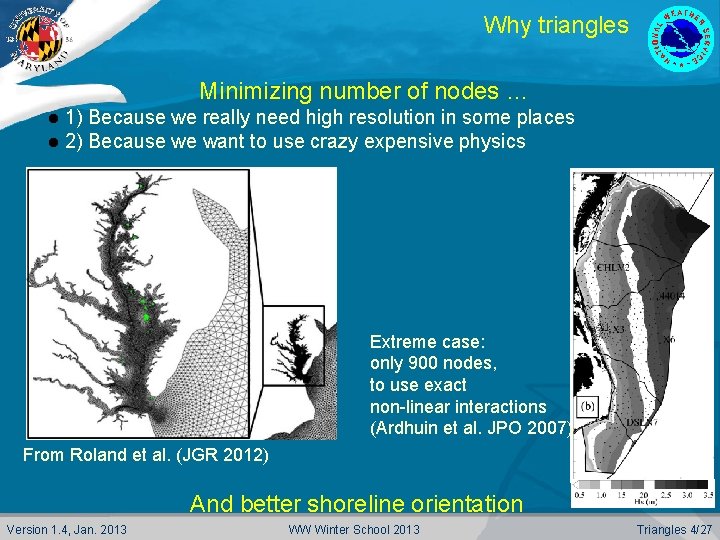
Why triangles Minimizing number of nodes … 1) Because we really need high resolution in some places 2) Because we want to use crazy expensive physics Extreme case: only 900 nodes, to use exact non-linear interactions (Ardhuin et al. JPO 2007) From Roland et al. (JGR 2012) And better shoreline orientation Version 1. 4, Jan. 2013 WW Winter School 2013 Triangles 4/27
Why triangles There are other alternatives 1) Nesting regular grids 2) Curviliear grids 3) Quad-trees or “SMC” grids 4) Hexagons … It is a matter of taste (and practicality and CPU time)… but I do not know how to help you with those. So let's go back to the simplest grid element: a triangle Version 1. 4, Jan. 2013 WW Winter School 2013 Triangles 5/27
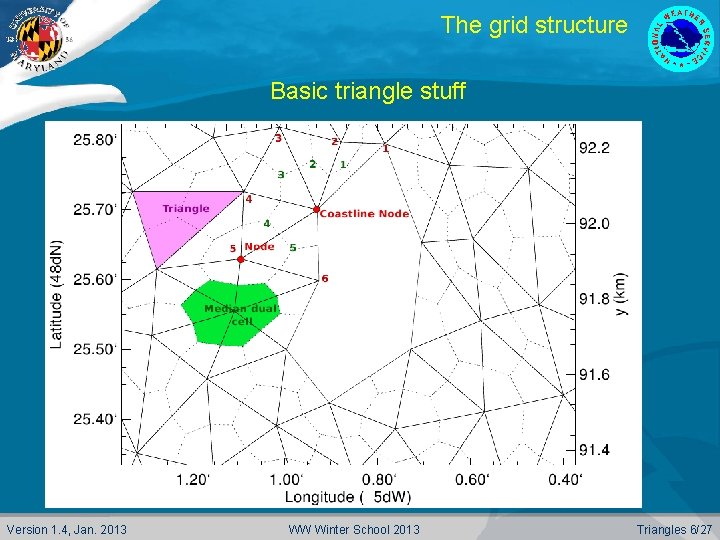
The grid structure Basic triangle stuff Basic numerical solution techniques: Version 1. 4, Jan. 2013 WW Winter School 2013 Triangles 6/27
The grid structure The input file: built on “Gmsh” format 1) Nodes 2) Elements - Active boudary points (element type 15) - Triangles (element type 2) The input file was kept to a minimum, we did not include further info: neighbour lists. . . That extra info is recomputed when running ww 3_grid and stored in mod_def. ww 3 … which can take minutes with more than 100 K nodes ! Internal storage in WWATCH is unchanged, we just have NY = 1 This carries into output files from ww 3_outf & ww 3_ounf Version 1. 4, Jan. 2013 WW Winter School 2013 Triangles 7/27
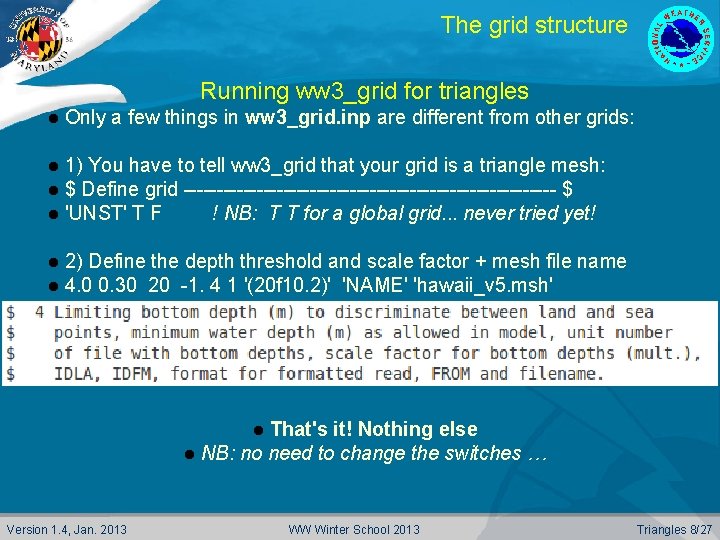
The grid structure Running ww 3_grid for triangles Only a few things in ww 3_grid. inp are different from other grids: 1) You have to tell ww 3_grid that your grid is a triangle mesh: $ Define grid ---------------------------- $ 'UNST' T F ! NB: T T for a global grid. . . never tried yet! 2) Define the depth threshold and scale factor + mesh file name 4. 0 0. 30 20 -1. 4 1 '(20 f 10. 2)' 'NAME' 'hawaii_v 5. msh' That's it! Nothing else NB: Version 1. 4, Jan. 2013 no need to change the switches … WW Winter School 2013 Triangles 8/27
The grid structure Defining list of input boundary points OK, but listing the active input points (MAPSTA=2) is very cludgy! You can do it … but you can also tell ww 3_grid to figure it out. Otherwise, just add these two namelist parameters near the top of ww 3_grid. inp &UG UGOBCAUTO = T, UGOBCDEPTH = -20. ! or any other depth This means that ww 3_grid will turn boundary points into active boundary points if the local depth (before water level added) is more than 20 m (yes, z is positive up in ww 3_grid. inp ) Version 1. 4, Jan. 2013 WW Winter School 2013 Triangles 9/27
Time integration and grid optimization Time integration Because it is not so simple to define the proper advection time step, in the case of 'UNST' grid, the time step is not set to the value defined in ww 3_grid. inp but instead it is dynamically adjusted (for explicit schemes). This time step will be different for each spectral component and will vary with current speed and water level. So if your grid has just one very flat or very tiny triangle this time step could well be 0. 1 s (instead of 10 or 20 s) and the run grinds to a halt! So how do I know about it? Option 1) check the CFL numbers in the model output (not so easy) Option 2) – my choice - Run a version of the code compiled with the “T” switch (for test output). The screen output (or, in the future, some file fort. 994) will list the “bad guys”, the nodes that cause the time step to be so small. Version 1. 4, Jan. 2013 WW Winter School 2013 Triangles 10/27
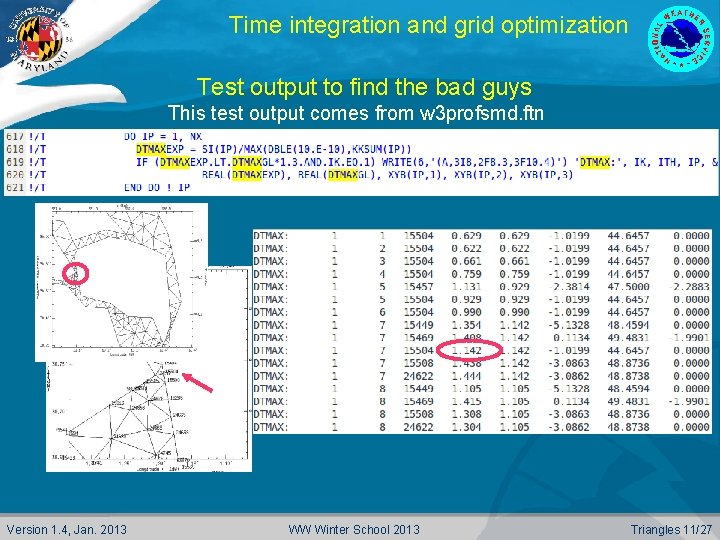
Time integration and grid optimization Test output to find the bad guys This test output comes from w 3 profsmd. ftn Version 1. 4, Jan. 2013 WW Winter School 2013 Triangles 11/27
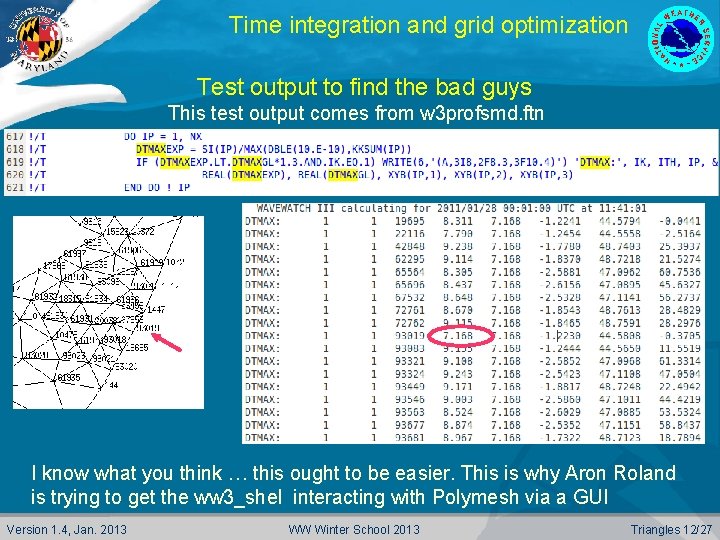
Time integration and grid optimization Test output to find the bad guys This test output comes from w 3 profsmd. ftn I know what you think … this ought to be easier. This is why Aron Roland is trying to get the ww 3_shel interacting with Polymesh via a GUI Version 1. 4, Jan. 2013 WW Winter School 2013 Triangles 12/27
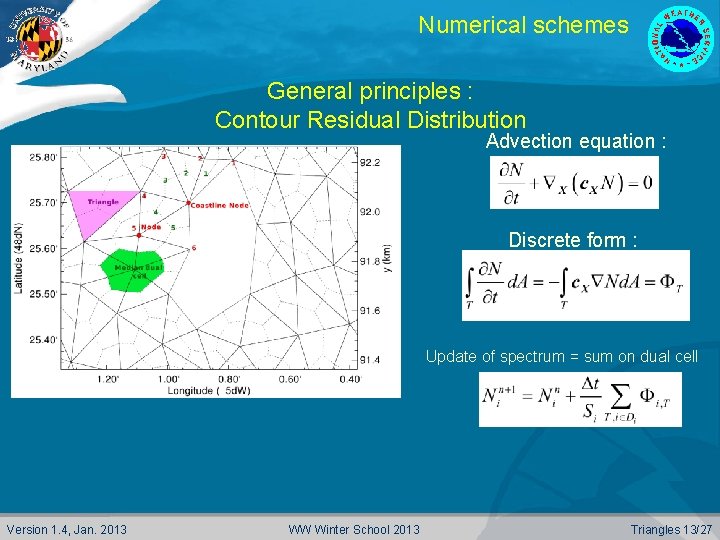
Numerical schemes General principles : Contour Residual Distribution Advection equation : Discrete form : Update of spectrum = sum on dual cell Version 1. 4, Jan. 2013 WW Winter School 2013 Triangles 13/27
Numerical schemes 4 schemes implemented : 1) « Narrow sencil » scheme (N) : EXPFSN (Csik et al. 2002, Roland 2008), CPU cost of full model : 12 2) « Positive Streamline Invariant » EXPFSPSI (Abgrall 2001) CPU cost of full model : 15 3) « Flux Corrected Transport » : EXPFSFCT (Csik et al. 2002, Roland 2008), CPU cost of full model : 29 (Lax-Wendroff kind of scheme) 4) Implicit N scheme : IMPFSIMP Higher order = more expensive and less numerical diffusion Version 1. 4, Jan. 2013 WW Winter School 2013 Triangles 14/27
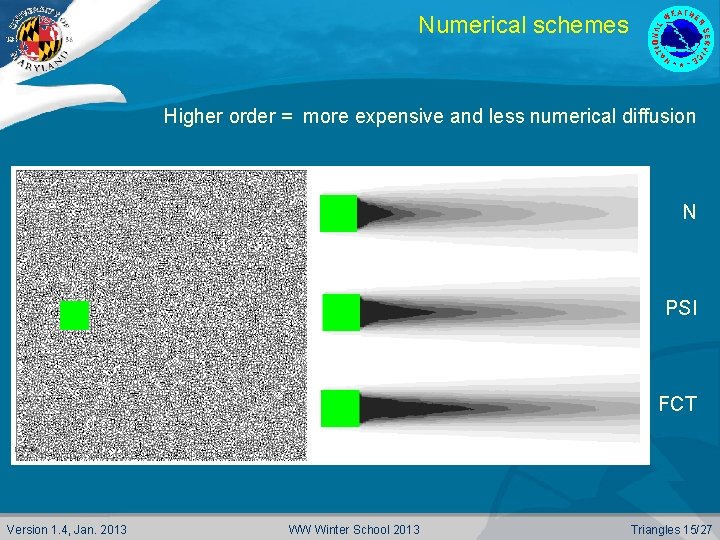
Numerical schemes Higher order = more expensive and less numerical diffusion N PSI FCT Version 1. 4, Jan. 2013 WW Winter School 2013 Triangles 15/27
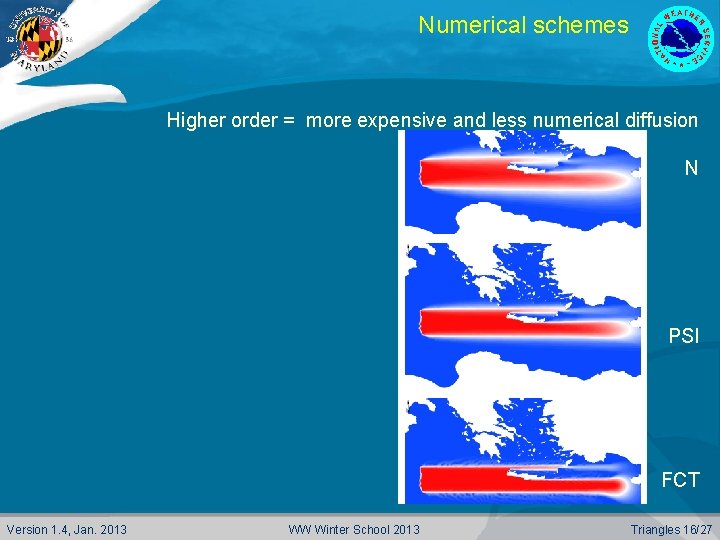
Numerical schemes Higher order = more expensive and less numerical diffusion N PSI FCT Version 1. 4, Jan. 2013 WW Winter School 2013 Triangles 16/27
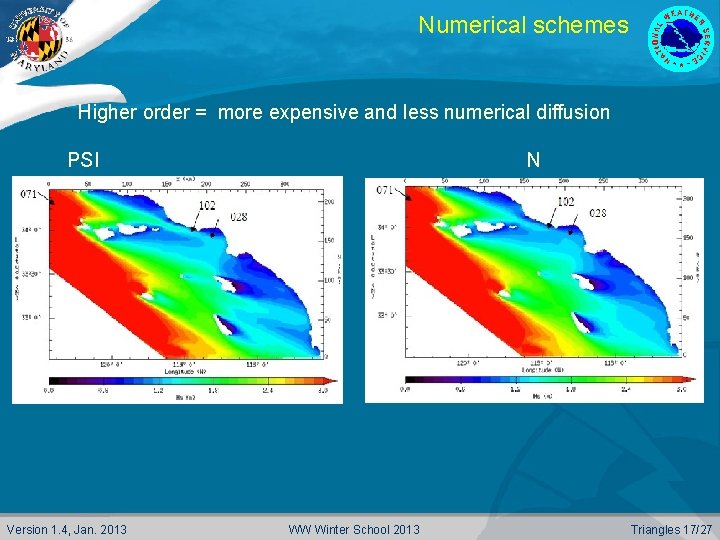
Numerical schemes Higher order = more expensive and less numerical diffusion PSI Version 1. 4, Jan. 2013 N WW Winter School 2013 Triangles 17/27
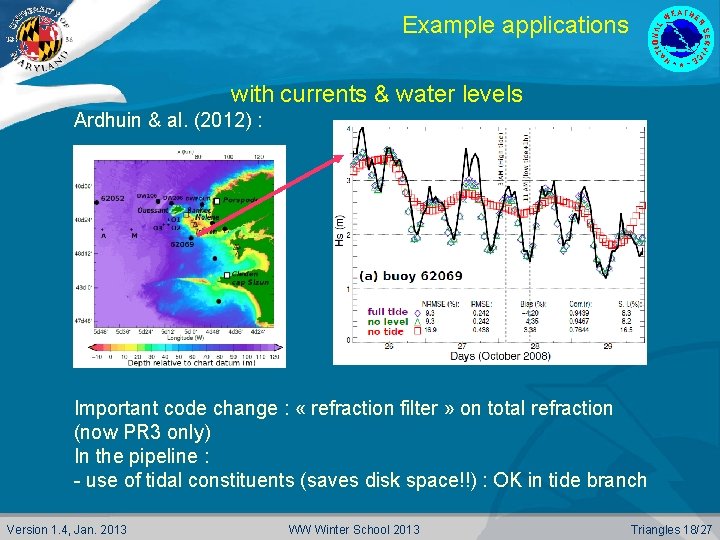
Example applications with currents & water levels Ardhuin & al. (2012) : Important code change : « refraction filter » on total refraction (now PR 3 only) In the pipeline : - use of tidal constituents (saves disk space!!) : OK in tide branch Version 1. 4, Jan. 2013 WW Winter School 2013 Triangles 18/27
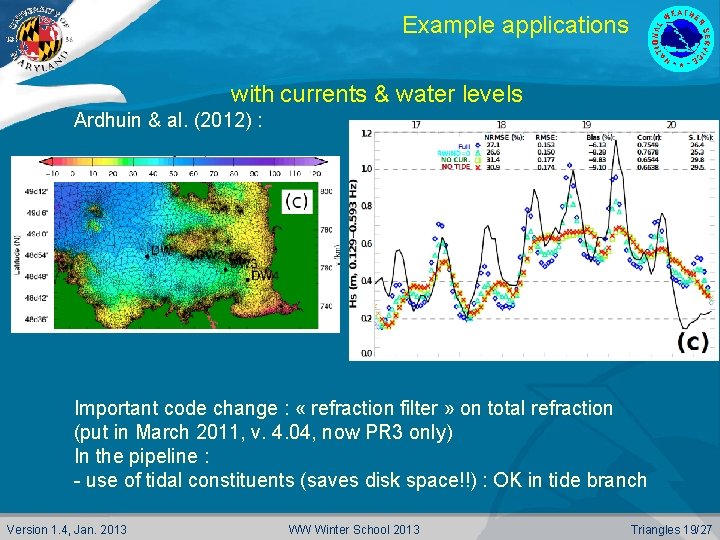
Example applications with currents & water levels Ardhuin & al. (2012) : Important code change : « refraction filter » on total refraction (put in March 2011, v. 4. 04, now PR 3 only) In the pipeline : - use of tidal constituents (saves disk space!!) : OK in tide branch Version 1. 4, Jan. 2013 WW Winter School 2013 Triangles 19/27
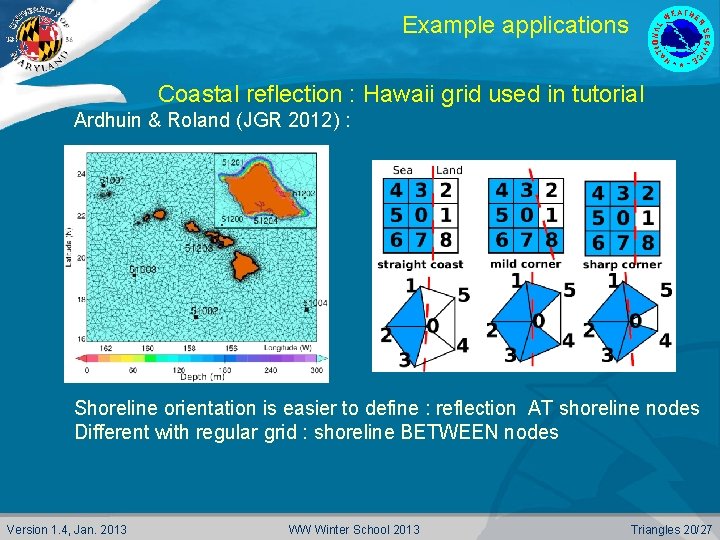
Example applications Coastal reflection : Hawaii grid used in tutorial Ardhuin & Roland (JGR 2012) : Shoreline orientation is easier to define : reflection AT shoreline nodes Different with regular grid : shoreline BETWEEN nodes Version 1. 4, Jan. 2013 WW Winter School 2013 Triangles 20/27
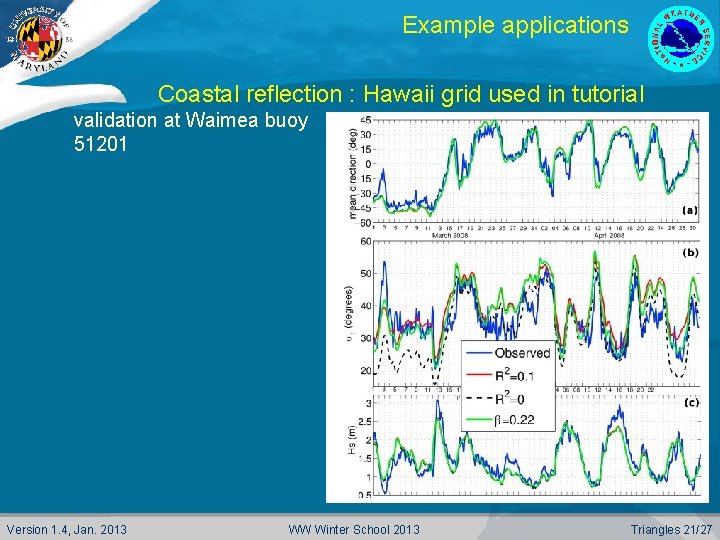
Example applications Coastal reflection : Hawaii grid used in tutorial validation at Waimea buoy 51201 Version 1. 4, Jan. 2013 WW Winter School 2013 Triangles 21/27
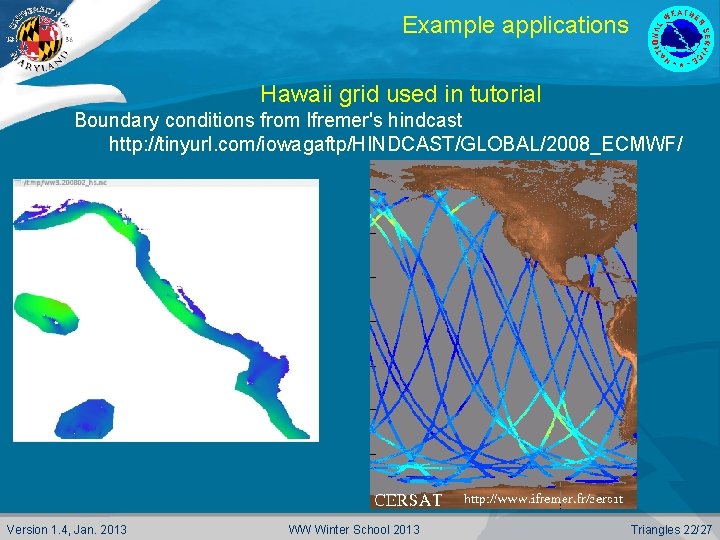
Example applications Hawaii grid used in tutorial Boundary conditions from Ifremer's hindcast http: //tinyurl. com/iowagaftp/HINDCAST/GLOBAL/2008_ECMWF/ Version 1. 4, Jan. 2013 WW Winter School 2013 Triangles 22/27
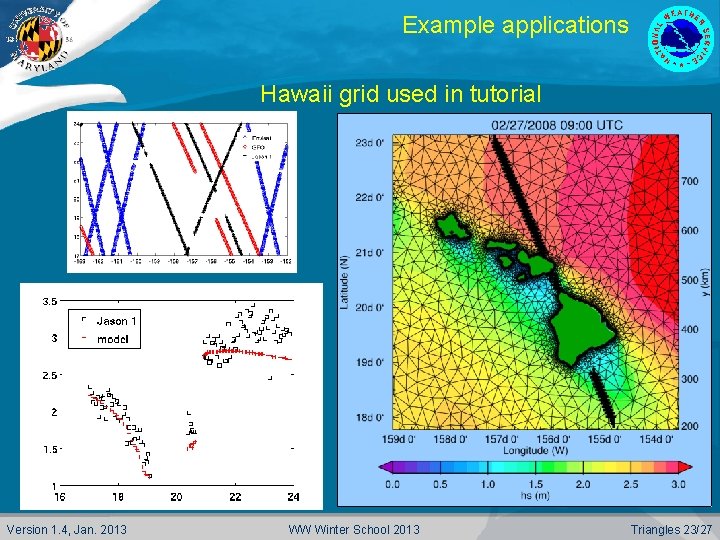
Example applications Hawaii grid used in tutorial Version 1. 4, Jan. 2013 WW Winter School 2013 Triangles 23/27
Summary Advection schemes in WWATCH taken straight from WWM II → several validation and comparison study → 2 year of routine forecasts → 20 year hindcast for test area, now expanding to full France 4 different schemes to chose from. Personally the N scheme works great. If you are a daredevil, maybe the IMP is for you Version 1. 4, Jan. 2013 WW Winter School 2013 Triangles 24/27
- Slides: 24