
RUNNING WATER RUNNING WATER River Systems Streamflow Stream










- Slides: 42
RUNNING WATER
RUNNING WATER • • • River Systems Streamflow Stream Channels Depositional Landforms Floods
GEOL 131: Running Water River Systems
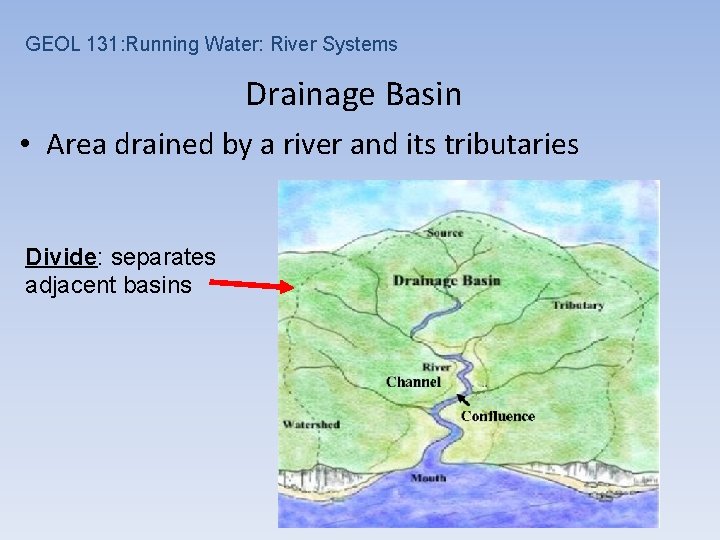
GEOL 131: Running Water: River Systems Drainage Basin • Area drained by a river and its tributaries Divide: separates adjacent basins
GEOL 131: Running Water: River Systems
GEOL 131: Running Water: Drainage Patterns • Arrangement of streams in a drainage basin • Depends on • Topography • Underlying geology (rock types, folding, faulting)
GEOL 131: Running Water: Drainage Patterns
GEOL 131: Running Water: Drainage Patterns Dendritic
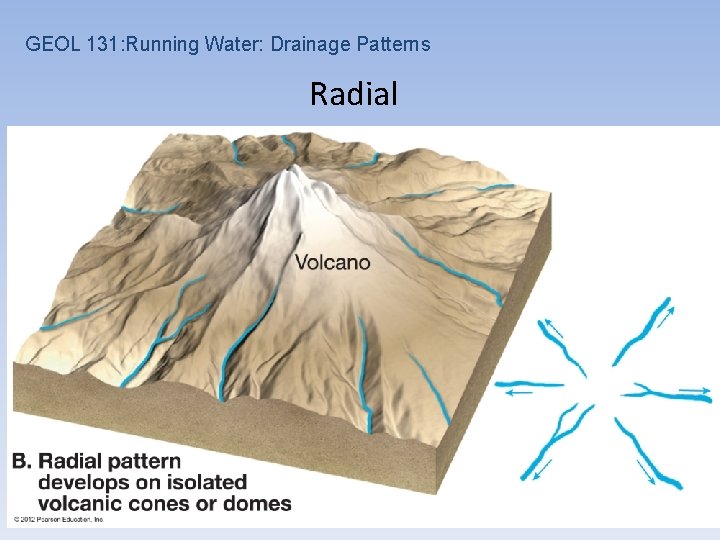
GEOL 131: Running Water: Drainage Patterns Radial
GEOL 131: Running Water: Drainage Patterns Rectangular
GEOL 131: Running Water: Drainage Patterns Trellis
GEOL 131: Running Water Streamflow
GEOL 131: Running Water: Streamflow How Does Water Get Into Rivers? • Precipitation • Melting snow/ice
GEOL 131: Running Water: Streamflow Precipitation and snowmelt can: • Infiltrate – absorbed into ground – becomes part of groundwater • Run off (flow over surface)
GEOL 131: Running Water Streamflow Characteristics • Flow velocity • Channel steepness (gradient) • Channel roughness • Channel size and shape • Discharge
GEOL 131: Running Water: Streamflow Flow Velocity • Speed of water movement • Affects how much and what kind of sediment can be carried
GEOL 131: Running Water: Streamflow: Factors affecting velocity Gradient and Roughness • Gradient: Elevation change per unit distance • E. g. feet per mile – 10 feet per mile means river drops 10 feet for every mile • Gradient tends to decrease away from source • Roughness – Steeper not always faster – Water can be slowed by a rough channel
GEOL 131: Running Water: Streamflow: Factors affecting velocity Channel Size and Shape • Wide, shallow channel slower than narrower, deeper one with same cross-sectional area
GEOL 131: Running Water: Streamflow: Factors affecting velocity Discharge • Volume of water moving through channel • Discharge = width x depth x velocity • Volume units per sec
GEOL 131: Running Water Stream Channels
GEOL 131: Running Water: Stream Channels Two Basic Stream Channel Types • Bedrock – Cut into rock • Alluvial – Cut into sediment or soil – Two types: • Meandering • Braided
GEOL 131: Running Water: Stream Channels Bedrock Channels • Steep-sided • V-shaped • Prone to flash floods Yellowstone River, Yellowstone NP
GEOL 131: Running Water: Stream Channels Alluvium Channels: Meandering Fine to mediumgrained sediment Consistent discharge
GEOL 131: Running Water: Stream Channels: Meandering Meander Migration
GEOL 131: Running Water: Stream Channels: Meandering Meander Migration Bend migrates in direction of erosion, and also slightly downstream
GEOL 131: Running Water: Stream Channels 1 3 Meander Cutoff & Oxbow Lakes 2 4 Oxbow lake
GEOL 131: Running Water: Stream Channels Oxbow Lakes
GEOL 131: Running Water: Stream Channels Alluvium Channels: Braided Coarse-grained sediment Highly variable discharge
GEOL 131: Running Water: Stream Channels Alluvium Channels: Braided • Coarse sediment moves only when discharge is high • Forms bars when discharge is low • Water forced to split around bars
GEOL 131: Running Water: Stream Channels Alluvium Channels: Braided Sand gravel bars
GEOL 131: Running Water Depositional Landforms
GEOL 131: Running Water: Depositional Landforms • Features created by deposition of sediment by rivers • Deltas, alluvial fans
GEOL 131: Running Water: Depositional Landforms Deltas • At river mouths • Fine-grained sed deposited when river enters standing water Mississippi River Delta, Louisiana
GEOL 131: Running Water: Depositional Landforms Delta grows as distributary channels deposit sediment along a wide arc
GEOL 131: Running Water: Depositional Landforms The Mississippi Delta Distributary channel switching: channel becomes plugged with sediment, and water switches to a new channel
GEOL 131: Running Water: Depositional Landforms Alluvial Fans • Similar to a delta, but on land • Base of steep mountain range • Fed by rainfall and snowmelt
GEOL 131: Running Water Floods
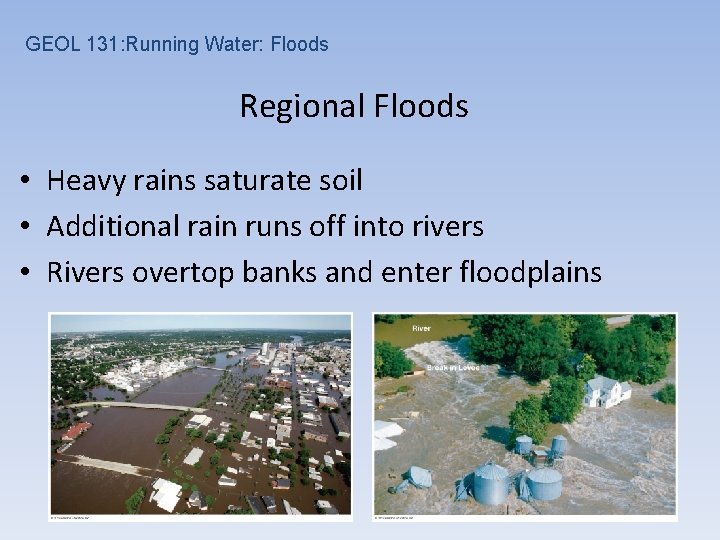
GEOL 131: Running Water: Floods Regional Floods • Heavy rains saturate soil • Additional rain runs off into rivers • Rivers overtop banks and enter floodplains
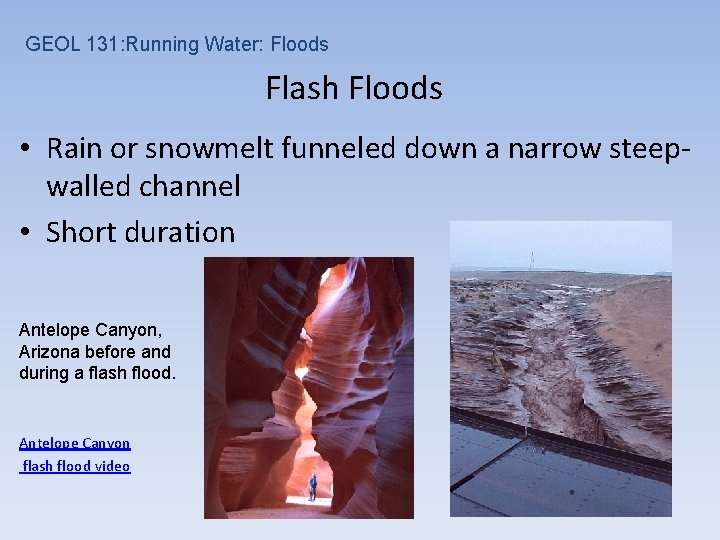
GEOL 131: Running Water: Floods Flash Floods • Rain or snowmelt funneled down a narrow steepwalled channel • Short duration Antelope Canyon, Arizona before and during a flash flood. Antelope Canyon flash flood video
GEOL 131: Running Water: Floods Ice-Jam Floods • During spring breakup of river ice • Ice floes can clog river and cause flooding
GEOL 131: Running Water: Floods Dam Failure Floods • Johnstown, PA, 1889 • South Fork dam failed • 2, 209 deaths
End of Chapter