
Running Shoe Development Daniel Thomas Michael Cannamela Brandon
Running Shoe Development Daniel Thomas Michael Cannamela Brandon Jackson Robin Giannattasio Caroline de Monasterio Philip O’Bannon
Background Running shoes should prevent injury and increase efficiency of a runners gait The complexity of individual biomechanics make it almost impossible to create a universal shoe Most running injuries arise from oversupination or overpronation. Because overpronation is the most common cause of injury, midsole design is the most important component providing cushioning, stability and motion control Most runners are unaware of their running style which makes it difficult to choose the correct shoe

Anatomical Planes & Transverse Motion Sagittal Plane: splits foot vertically into left and right sections. Frontal Plane: splits foot vertically into front and back sections. Transverse Plane: splits foot into top and bottom sections. Abduction: lateral rotation (away from center) Adduction: medial rotation (towards center)
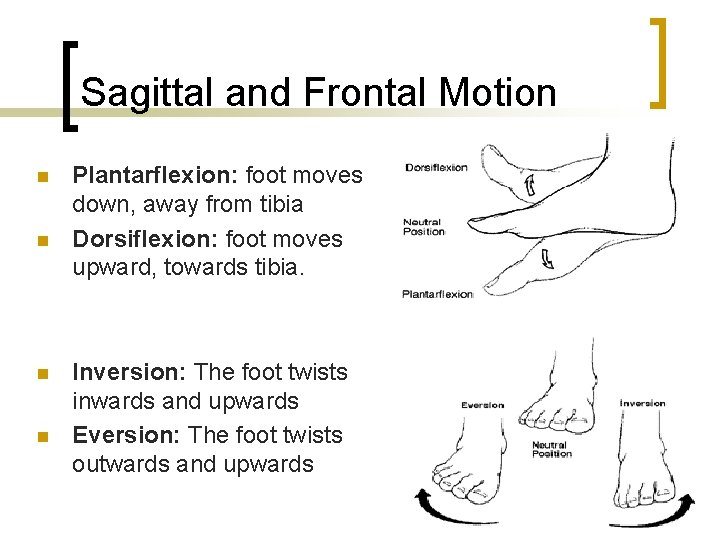
Sagittal and Frontal Motion Plantarflexion: foot moves down, away from tibia Dorsiflexion: foot moves upward, towards tibia. Inversion: The foot twists inwards and upwards Eversion: The foot twists outwards and upwards

Motion of the Foot Pronation: the tri-plane motion of simulatneous eversion, abduction and dorseflexsion Supination: the tri-plane motion of simultaneous inversion, adduction and plantarfelxion
Project Goals Reduce common running injuries such as plantar fasciitis, achilles tendonitis and shin splints/similar stress fractures. Reduce pronation angle in runners who overpronate Achieve this correction by designing an adjustable shoe suspension. Develop a working prototype for our design and test its effectiveness in a motion analysis lab
QFD Product planning matrix key features: -stability control -durability -adjustability -cost effectiveness -lightweight
State of the Art Static designs use medial posts of varying stiffnesses to provide support for overpronators, but these designs are not adjustable. The Adidas 1 uses a motor to modulate stiffness in the midsole according to displacement feedback. Drawbacks are the $250 price tag and weight of 15. 3 oz (where average running shoe is 12 oz)
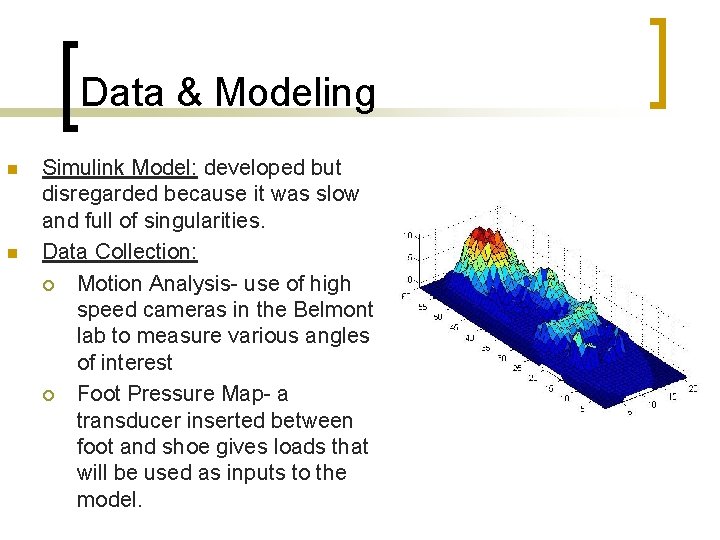
Data & Modeling Simulink Model: developed but disregarded because it was slow and full of singularities. Data Collection: Motion Analysis- use of high speed cameras in the Belmont lab to measure various angles of interest Foot Pressure Map- a transducer inserted between foot and shoe gives loads that will be used as inputs to the model.
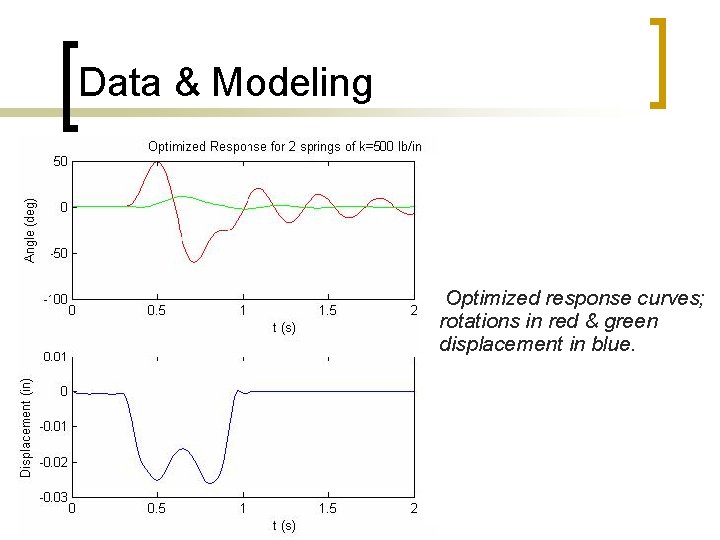
Data & Modeling A n gl e ( d e g) Optimized response curves; rotations in red & green displacement in blue.
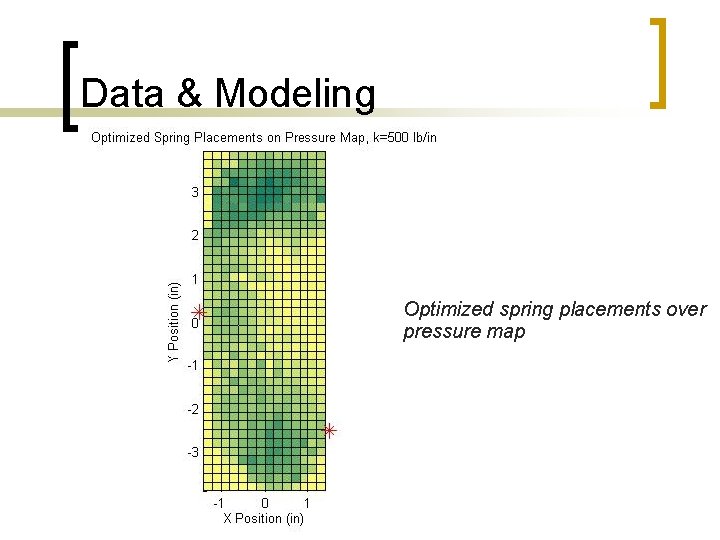
Data & Modeling Optimized spring placements over pressure map
Prototype Plate-and-Spring The upper sole which is above the rigid plate is separated by 3 wave springs that can be interchanged to obtain different rigidity. Static rotational offset is achieved by manually tightening the zip-ties secured to the outer side of the shoe. This design is easy to build and has few variables to control, but it is slightly heavy and unwieldy; merely a proving ground for the adjustable suspension approach.
Costs and Materials Test shoes- free Transducers- free Wave springs- free Glue, tools, etc. - negligible Adidas 1's- $275
Testing and Results The prototype was tested on one subject against the Adidas 1 and his normal running shoe. Magnitude of pronation as well as ground force reactions were measured.
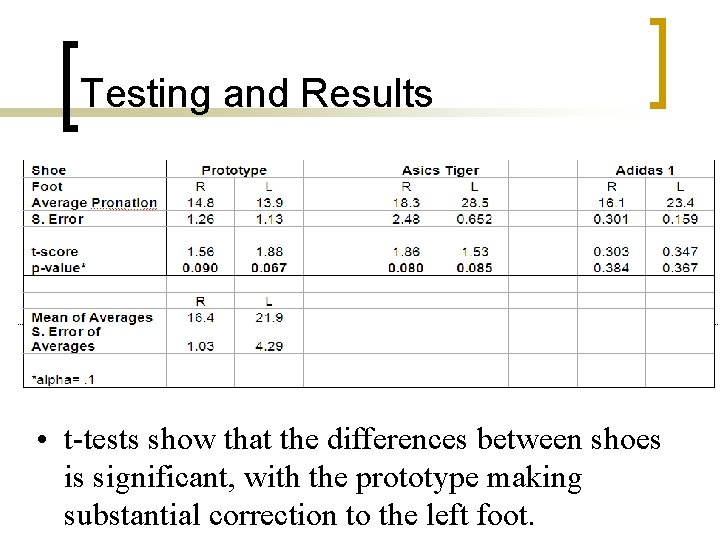
Testing and Results • t-tests show that the differences between shoes is significant, with the prototype making substantial correction to the left foot.
Conclusions Though further tests should be performed, it seems pronation can be controlled through shoe suspension. The success of an adaptive suspension hinges on the development of a variable compliance element and the control thereof.
- Slides: 16