
Run 9 polarized proton Log 9 Jan begin
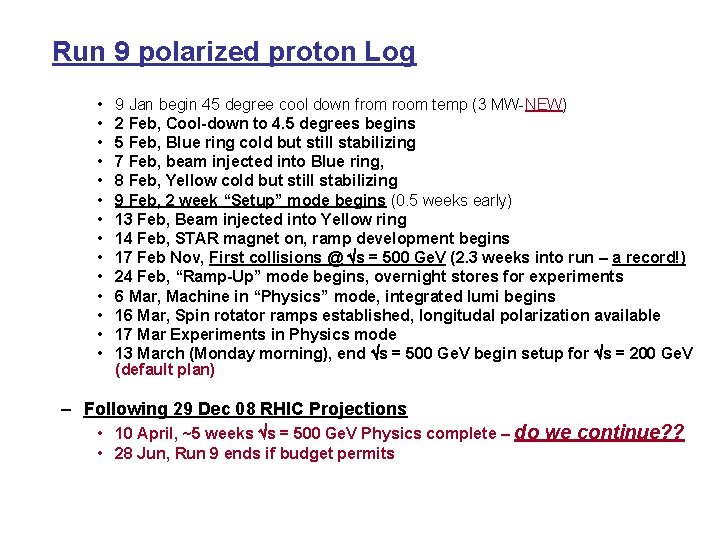
Run 9 polarized proton Log • • • • 9 Jan begin 45 degree cool down from room temp (3 MW-NEW) 2 Feb, Cool-down to 4. 5 degrees begins 5 Feb, Blue ring cold but still stabilizing 7 Feb, beam injected into Blue ring, 8 Feb, Yellow cold but still stabilizing 9 Feb, 2 week “Setup” mode begins (0. 5 weeks early) 13 Feb, Beam injected into Yellow ring 14 Feb, STAR magnet on, ramp development begins 17 Feb Nov, First collisions @ s = 500 Ge. V (2. 3 weeks into run – a record!) 24 Feb, “Ramp-Up” mode begins, overnight stores for experiments 6 Mar, Machine in “Physics” mode, integrated lumi begins 16 Mar, Spin rotator ramps established, longitudal polarization available 17 Mar Experiments in Physics mode 13 March (Monday morning), end s = 500 Ge. V begin setup for s = 200 Ge. V (default plan) – Following 29 Dec 08 RHIC Projections • 10 April, ~5 weeks s = 500 Ge. V Physics complete – do • 28 Jun, Run 9 ends if budget permits we continue? ?
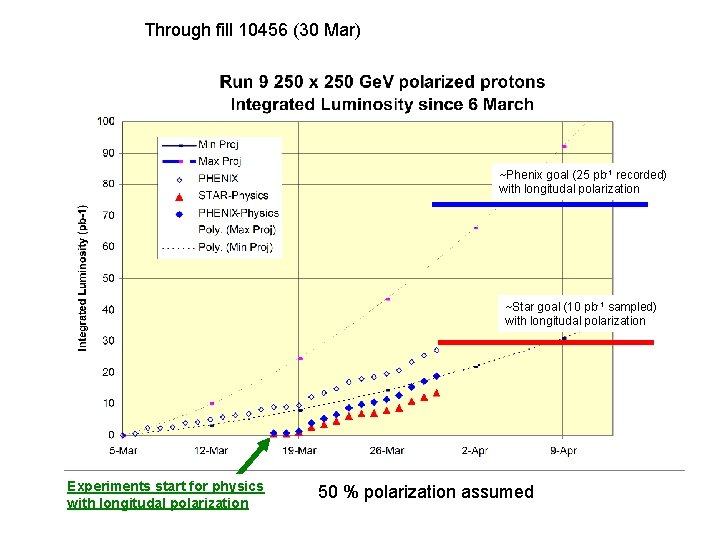
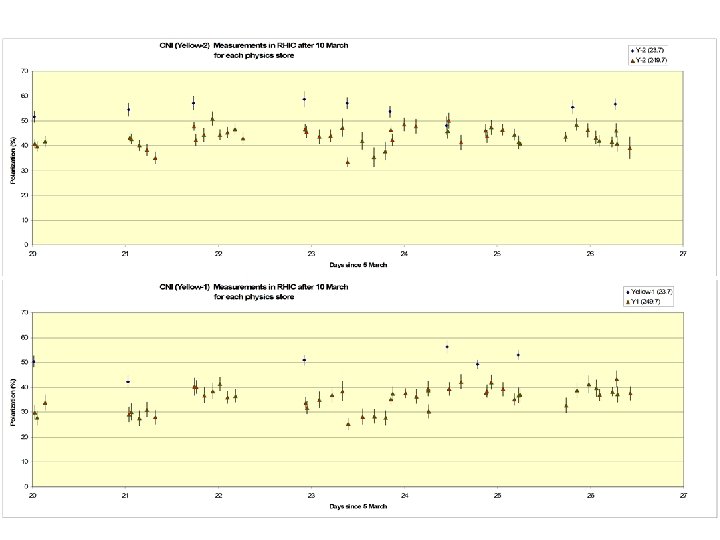
Through fill 10456 (30 Mar) ~Phenix goal (25 pb-1 recorded) with longitudal polarization ~Star goal (10 pb-1 sampled) with longitudal polarization Experiments start for physics with longitudal polarization 50 % polarization assumed
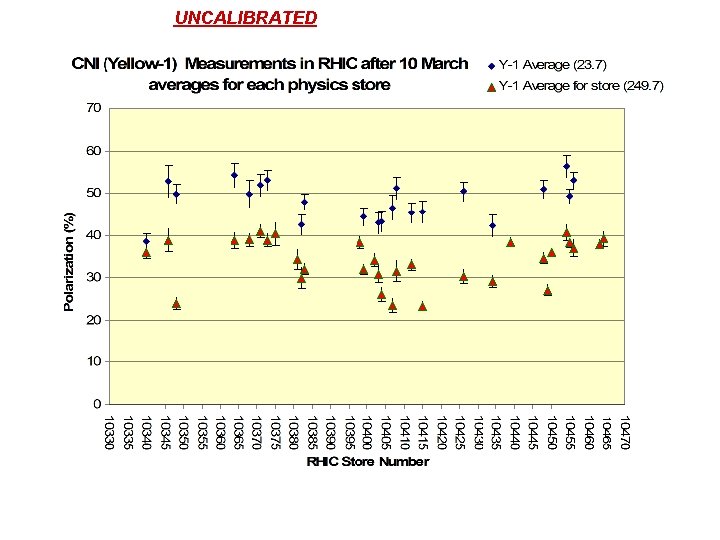
UNCALIBRATED
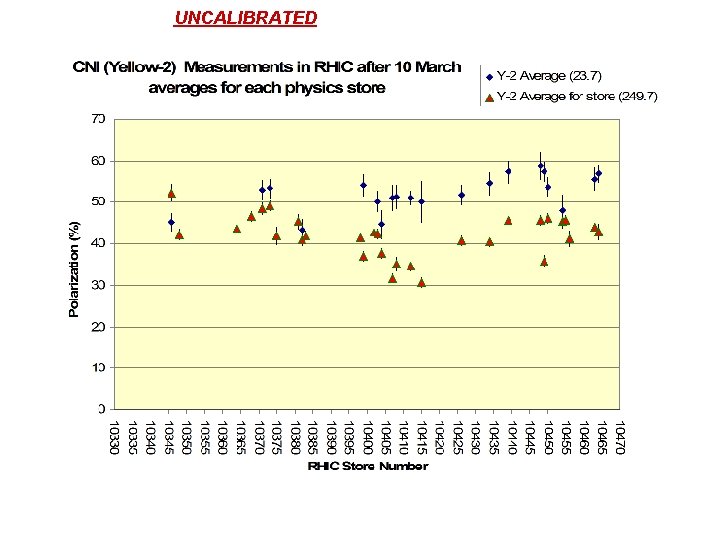
UNCALIBRATED
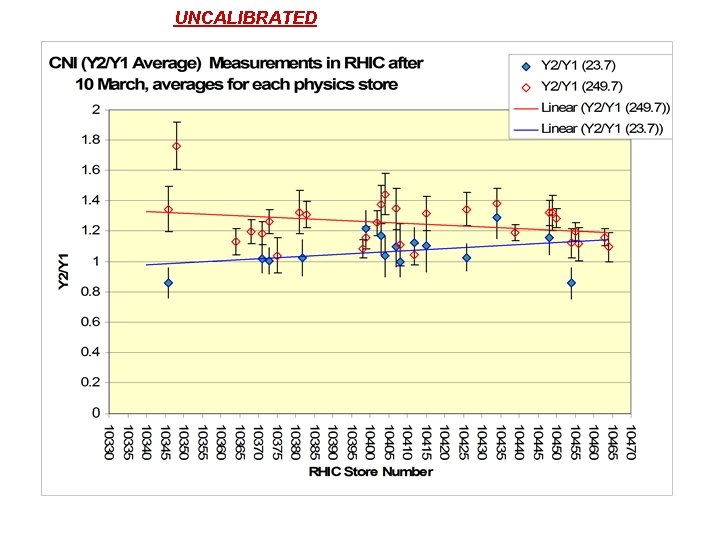
UNCALIBRATED
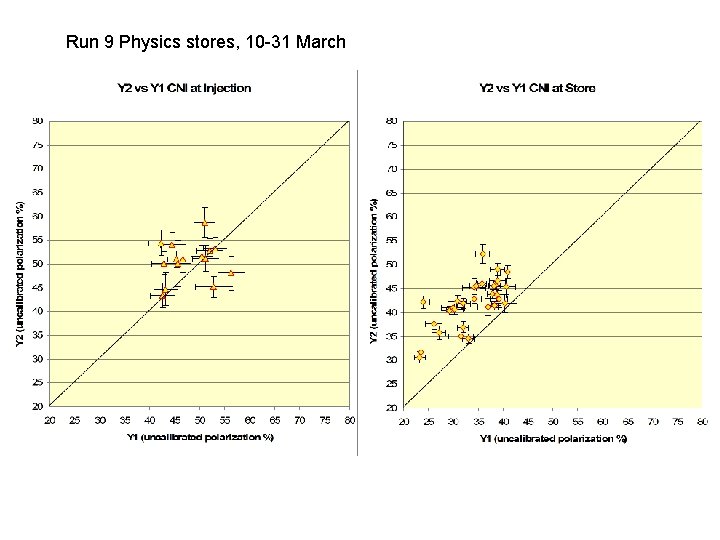
Run 9 Physics stores, 10 -31 March

Archive
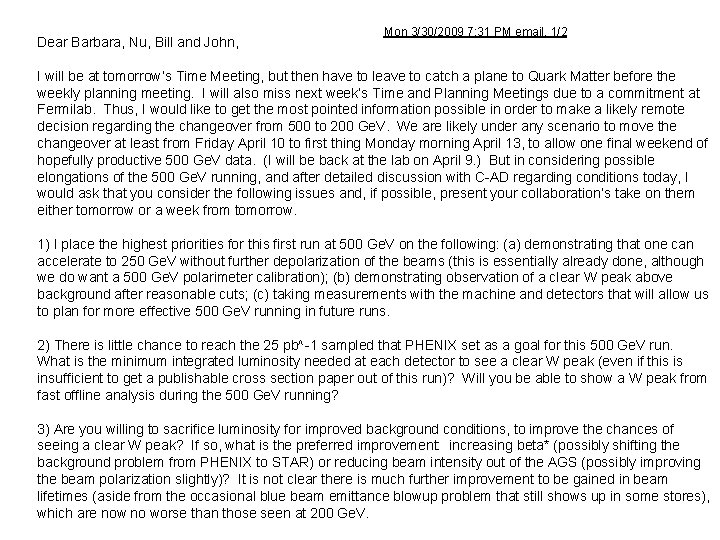
Dear Barbara, Nu, Bill and John, Mon 3/30/2009 7: 31 PM email, 1/2 I will be at tomorrow’s Time Meeting, but then have to leave to catch a plane to Quark Matter before the weekly planning meeting. I will also miss next week’s Time and Planning Meetings due to a commitment at Fermilab. Thus, I would like to get the most pointed information possible in order to make a likely remote decision regarding the changeover from 500 to 200 Ge. V. We are likely under any scenario to move the changeover at least from Friday April 10 to first thing Monday morning April 13, to allow one final weekend of hopefully productive 500 Ge. V data. (I will be back at the lab on April 9. ) But in considering possible elongations of the 500 Ge. V running, and after detailed discussion with C-AD regarding conditions today, I would ask that you consider the following issues and, if possible, present your collaboration’s take on them either tomorrow or a week from tomorrow. 1) I place the highest priorities for this first run at 500 Ge. V on the following: (a) demonstrating that one can accelerate to 250 Ge. V without further depolarization of the beams (this is essentially already done, although we do want a 500 Ge. V polarimeter calibration); (b) demonstrating observation of a clear W peak above background after reasonable cuts; (c) taking measurements with the machine and detectors that will allow us to plan for more effective 500 Ge. V running in future runs. 2) There is little chance to reach the 25 pb^-1 sampled that PHENIX set as a goal for this 500 Ge. V run. What is the minimum integrated luminosity needed at each detector to see a clear W peak (even if this is insufficient to get a publishable cross section paper out of this run)? Will you be able to show a W peak from fast offline analysis during the 500 Ge. V running? 3) Are you willing to sacrifice luminosity for improved background conditions, to improve the chances of seeing a clear W peak? If so, what is the preferred improvement: increasing beta* (possibly shifting the background problem from PHENIX to STAR) or reducing beam intensity out of the AGS (possibly improving the beam polarization slightly)? It is not clear there is much further improvement to be gained in beam lifetimes (aside from the occasional blue beam emittance blowup problem that still shows up in some stores), which are now no worse than those seen at 200 Ge. V.
Mon 3/30/2009 7: 31 PM email, 2/2 4) Right now, the limitations on luminosity are being imposed by the detectors, rather than by the machine. We need to understand if we will see the same limitations in future runs. At the very least, we need auxiliary measurements that will determine answers to the following questions: (a) Does the rate limit imposed on background at PHENIX, via scintillator paddles outside the shielding wall, correspond to the same detector subsystem currents at 500 Ge. V as at 200 Ge. V? Can this correspondence be recalibrated in the next 10 days? (b) Do the current trips experienced by the STAR TPC impose a fundamental limit on 500 Ge. V luminosity? Are there measurements STAR can make to address this question? (c) Is there more background at 500 Ge. V in the detectors due to higher energy spray from the beam leaking through the existing shielding? (I hope that can be answered from simulations. ) Is there space to make the shielding thicker, if this would help? (d) Can STAR determine how much of the TPC current is from real collisions vs. beam background? 5) It is unclear at this point that we will have the 9 MHz cavity operational for this run, and there is a danger that the spin flipper could be ready only for the final several weeks of the (extended) run. Do these issues affect your collaboration’s judgment regarding the split between 500 and 200 Ge. V? 6) Would you suggest additional critical auxiliary measurements to determine how to improve performance in future 500 Ge. V runs? Solving the AGS emittance blowup and polarization loss problems at high bunch intensity would be nice, but may not be critical if detector performance already limits us from increasing luminosity from the present levels. Obviously, any additional information you think is critical for a decision about the switchover is also welcome. Thanks, Steve
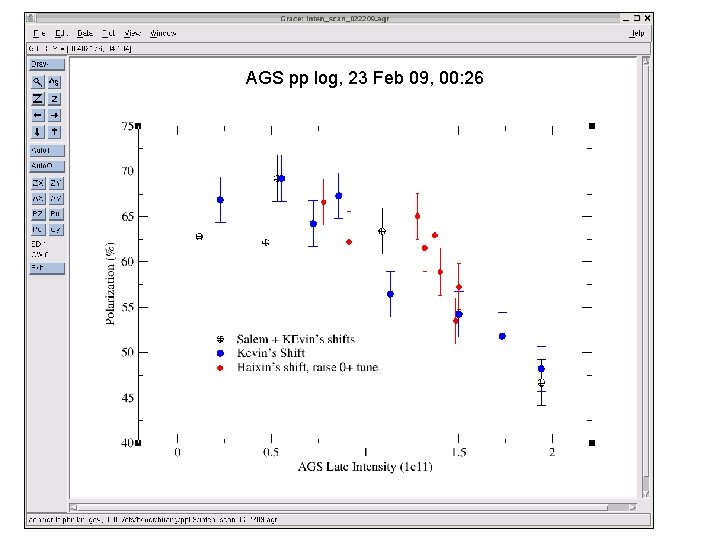
AGS pp log, 23 Feb 09, 00: 26
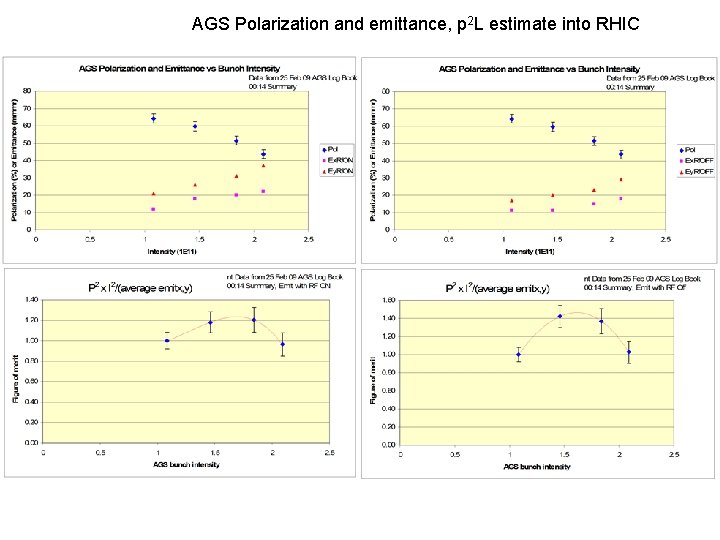
AGS Polarization and emittance, p 2 L estimate into RHIC
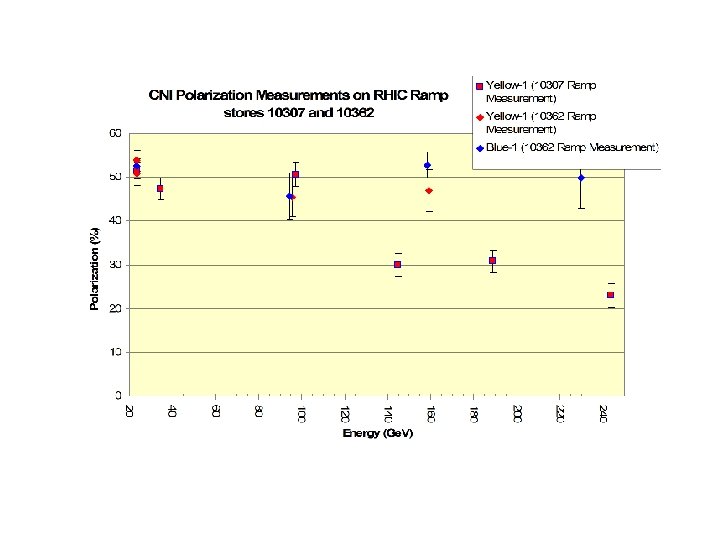
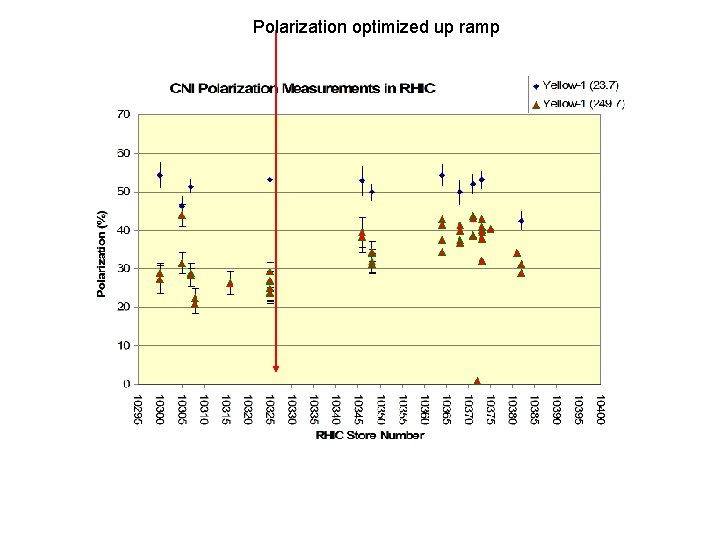
Polarization optimized up ramp
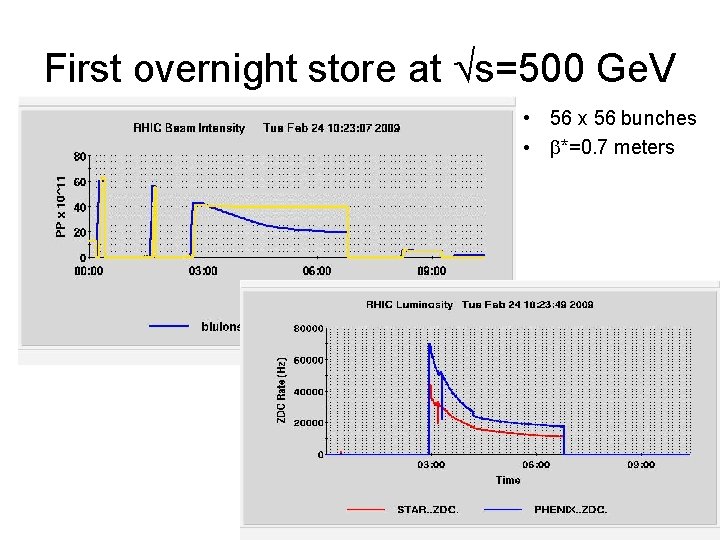
First overnight store at s=500 Ge. V • 56 x 56 bunches • b*=0. 7 meters
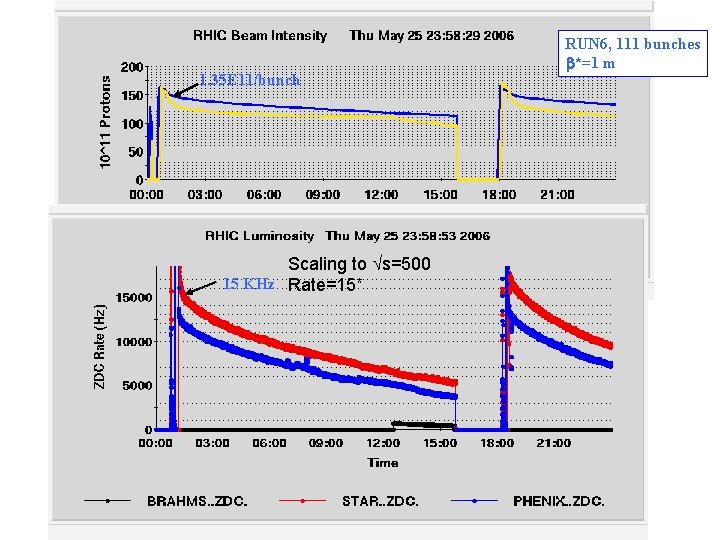
1. 35 E 11/bunch Scaling to s=500 15 KHz Rate=15* RUN 6, 111 bunches b*=1 m
First overnight store at s=500 Ge. V • 56 x 56 bunches • b*=0. 7 meters
- Slides: 17