
Rules vs Constructions A debate on questionacquisition Lucia
Rules vs. Constructions A debate on question-acquisition Lucia Pozzan, Lidiya Tornyova & Virginia Valian IASCL 2011

Special thanks to Language Acquisition Research Center Team Margarita Zeitlin Paul Feitzinger Syelle Graves Erin Quirk Nathan La. Fave 2
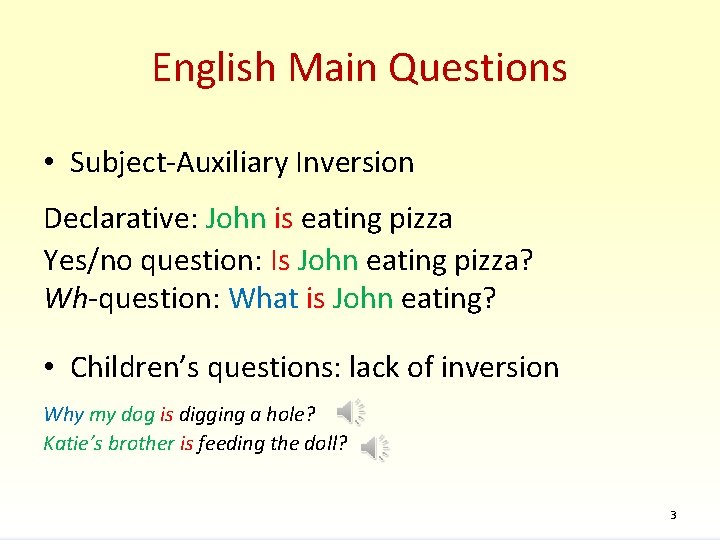
English Main Questions • Subject-Auxiliary Inversion Declarative: John is eating pizza Yes/no question: Is John eating pizza? Wh-question: What is John eating? • Children’s questions: lack of inversion Why my dog is digging a hole? Katie’s brother is feeding the doll? 3
Our View • Input is important but it is not the only factor • Differences in syntactic properties are reflected in the input and, therefore, in inversion patterns across languages • Children analyze input in terms of syntactic features, categories, and operations 4
Research Questions • Study 1 (Tornyova & Valian): Are inversion patterns in acquisition determined by syntactic properties of the adult language (reflected in the target input)? • Study 2 (Pozzan & Valian): Can input frequency alone account for inversion patterns in English-learning children? 5
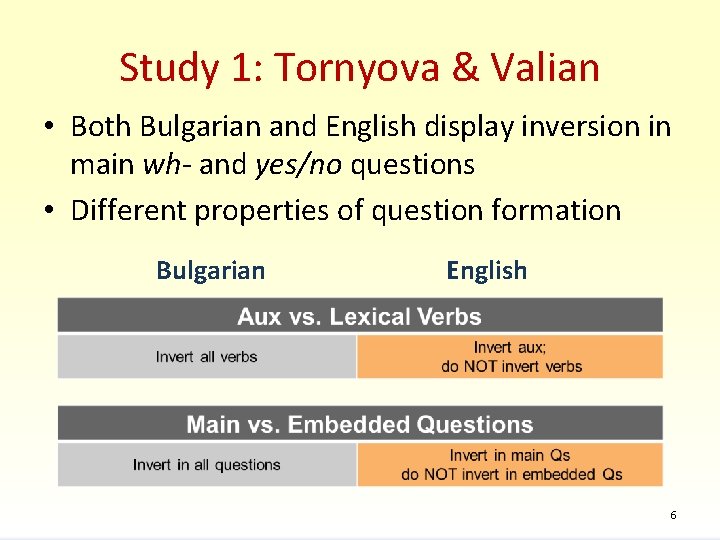
Study 1: Tornyova & Valian • Both Bulgarian and English display inversion in main wh- and yes/no questions • Different properties of question formation Bulgarian English 6
Elicited Imitation 4 groups: • 2 Bulgarian (n=27, ages 2; 2 - 3; 3; Mean 2; 9 ) • 2 English (n=20, ages 2; 4 - 3; 2; Mean 2; 9) • Imitated 24 wh- or yes/no questions 7
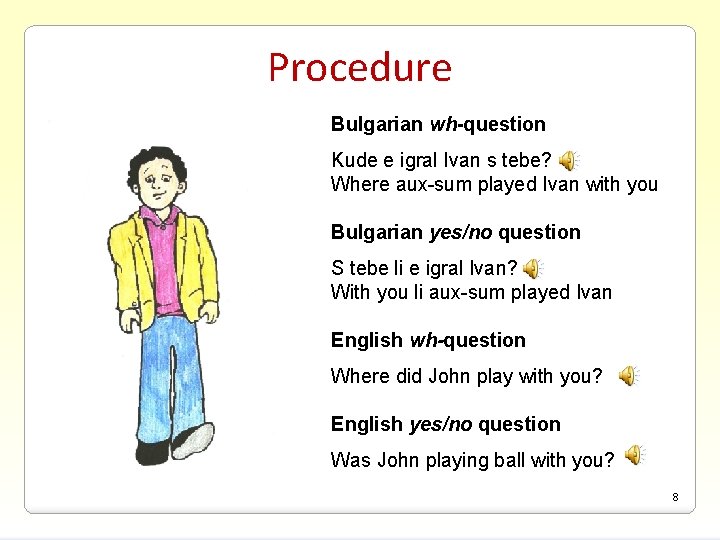
Procedure Bulgarian wh-question Kude e igral Ivan s tebe? Where aux-sum played Ivan with you Bulgarian yes/no question S tebe li e igral Ivan? With you li aux-sum played Ivan English wh-question Where did John play with you? English yes/no question Was John playing ball with you? 8
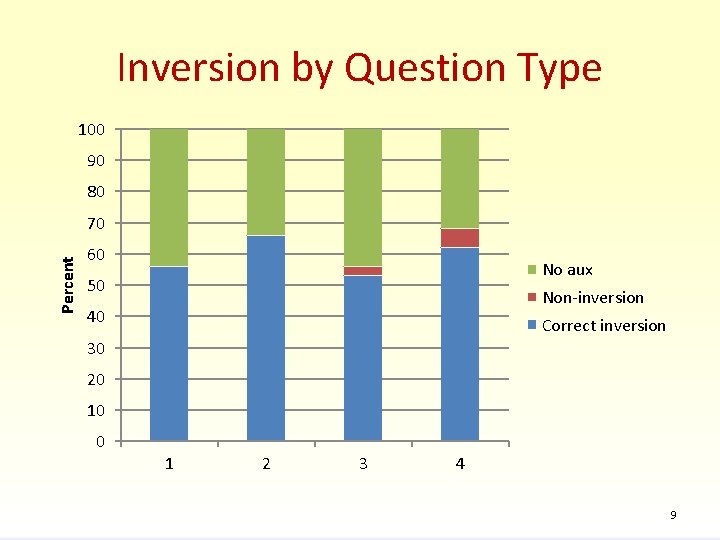
Inversion by Question Type 100 90 80 Percent 70 60 No aux 50 Non-inversion 40 Correct inversion 30 20 10 0 1 2 3 4 9
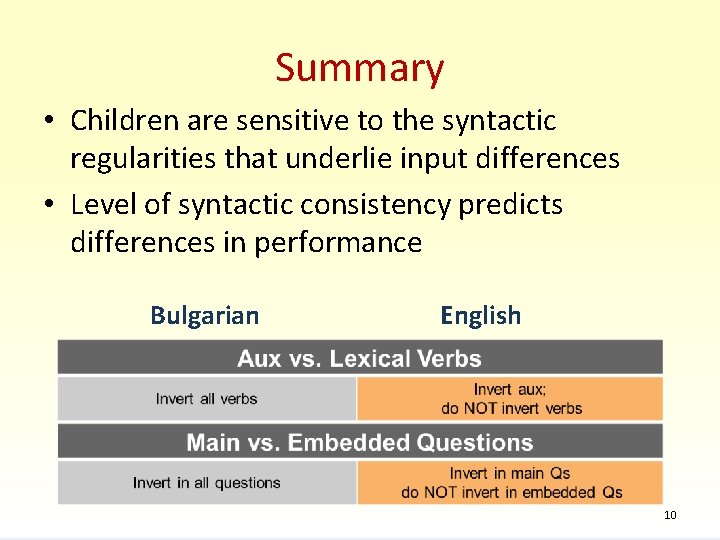
Summary • Children are sensitive to the syntactic regularities that underlie input differences • Level of syntactic consistency predicts differences in performance Bulgarian English 10
Study 2 Elicited Production and Input • Do frequencies of questions in the adult input account for children’s production patterns? • How should frequency of inversion be measured? • Are production patterns better accounted for in terms of abstract categories (e. g. , arguments vs. adjuncts)? 11
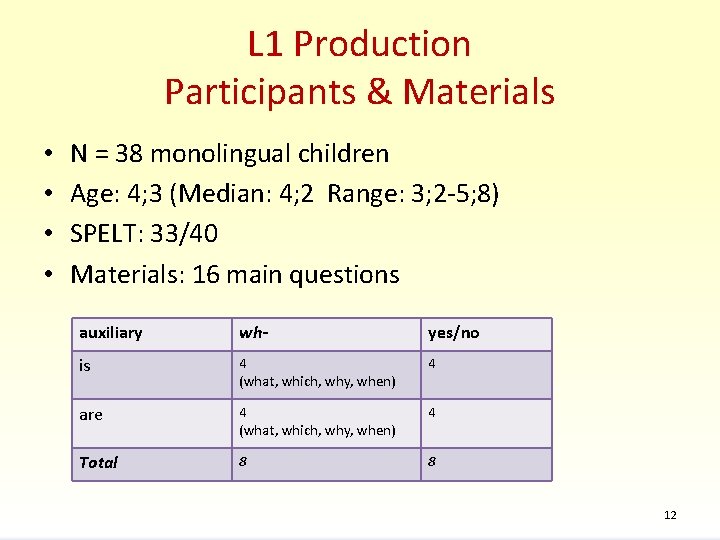
L 1 Production Participants & Materials • • N = 38 monolingual children Age: 4; 3 (Median: 4; 2 Range: 3; 2 -5; 8) SPELT: 33/40 Materials: 16 main questions auxiliary wh- yes/no is 4 (what, which, why, when) 4 are 4 (what, which, why, when) 4 Total 8 8 12

Protocol This is an asking game. This is Katie and this is her mom. Katie wants to know some things. We are going to help her ask her mom questions. “Why my dog is digging a hole? ” 13
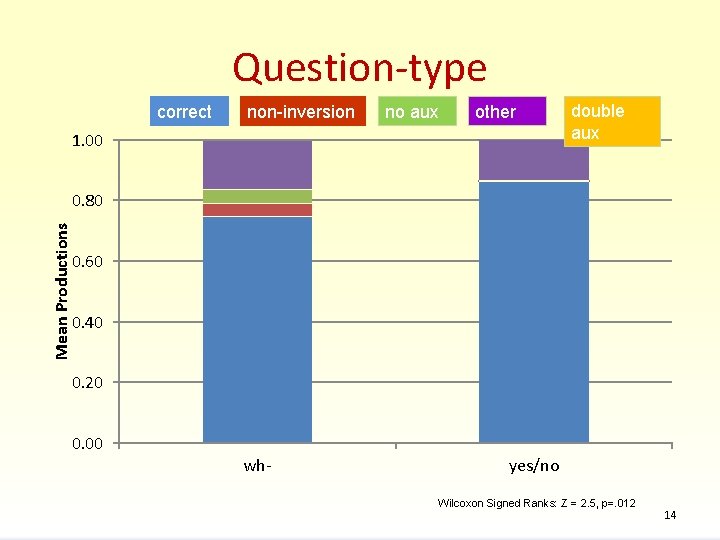
Question-type correct non-inversion no aux other 1. 00 double aux Mean Productions 0. 80 0. 60 0. 40 0. 20 0. 00 wh- yes/no Wilcoxon Signed Ranks: Z = 2. 5, p=. 012 14
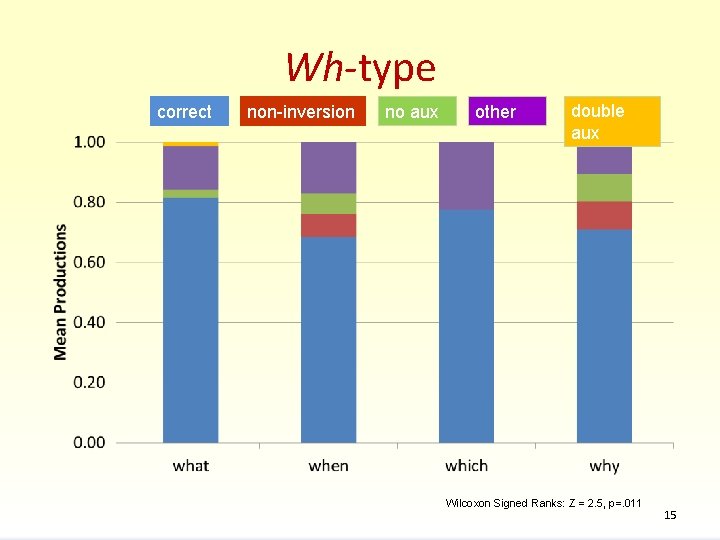
Wh-type correct non-inversion no aux other double aux Wilcoxon Signed Ranks: Z = 2. 5, p=. 011 15
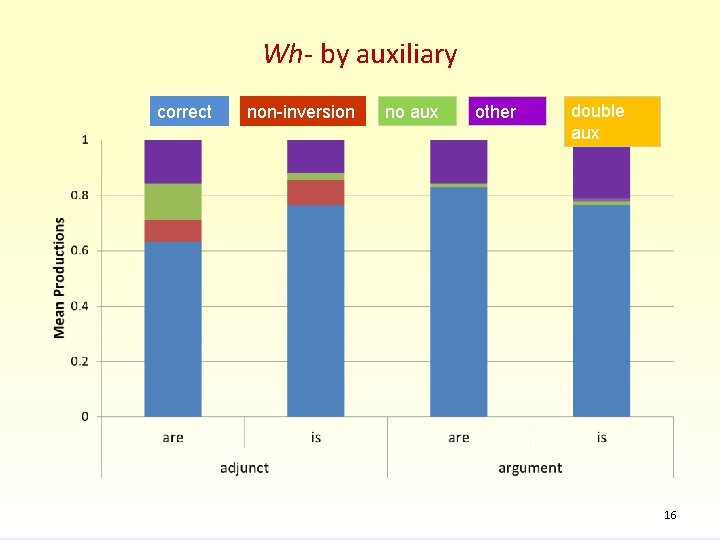
Wh- by auxiliary correct non-inversion no aux other double aux 16
• Can (token) frequency in adult input account for the observed pattern? • No input data on these particular children. Assumption: adult input to children is fairly homogeneous 17
How to measure frequency? • Absolute Frequency (inverted main questions): • Inverted wh-: Why are you laughing? • Inverted yes/no: Are you laughing? • Relative Frequency (inverted main / all questions): • Non inverted wh-: I don’t know why you are laughing. • Non inverted yes/no: You are laughing? 18
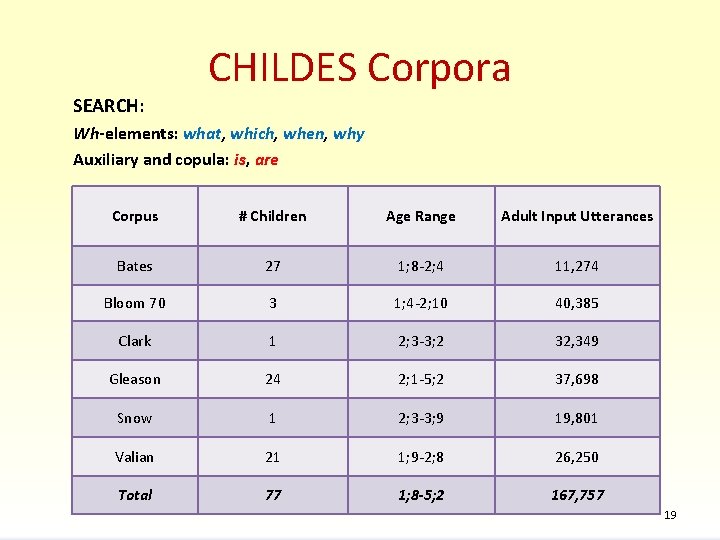
CHILDES Corpora SEARCH: Wh-elements: what, which, when, why Auxiliary and copula: is, are Corpus # Children Age Range Adult Input Utterances Bates 27 1; 8 -2; 4 11, 274 Bloom 70 3 1; 4 -2; 10 40, 385 Clark 1 2; 3 -3; 2 32, 349 Gleason 24 2; 1 -5; 2 37, 698 Snow 1 2; 3 -3; 9 19, 801 Valian 21 1; 9 -2; 8 26, 250 Total 77 1; 8 -5; 2 167, 757 19
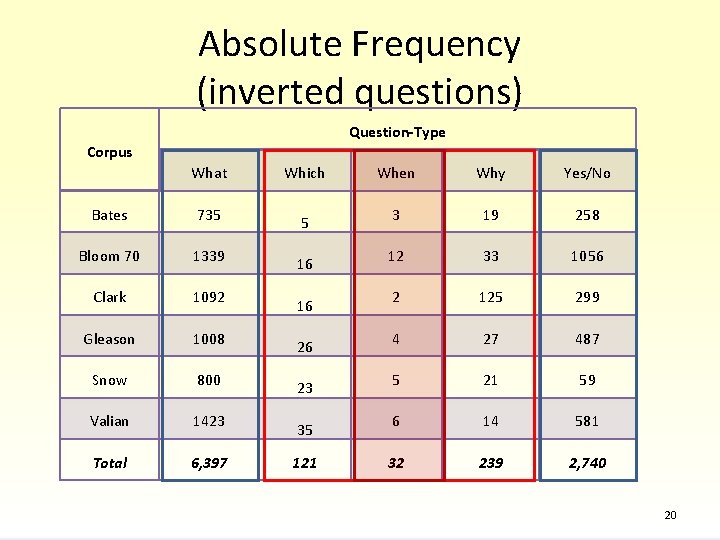
Absolute Frequency (inverted questions) Question-Type Corpus What Bates 735 Bloom 70 1339 Clark 1092 Gleason 1008 Snow 800 Valian 1423 Total 6, 397 Which 5 16 16 26 23 35 121 When Why Yes/No 3 19 258 12 33 1056 2 125 299 4 27 487 5 21 59 6 14 581 32 239 2, 740 20
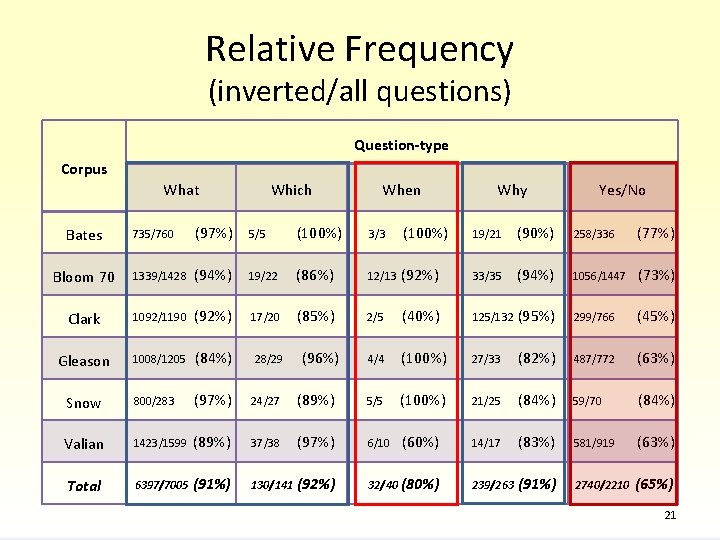
Relative Frequency (inverted/all questions) Question-type Corpus What Which When Why Yes/No 735/760 (97%) 5/5 (100%) 3/3 (100%) 19/21 (90%) 258/336 (77%) Bloom 70 1339/1428 (94%) 19/22 (86%) 12/13 (92%) 33/35 (94%) 1056/1447 (73%) Clark 1092/1190 (92%) 17/20 (85%) 2/5 (40%) 125/132 (95%) 299/766 (45%) Gleason 1008/1205 (84%) 28/29 4/4 (100%) 27/33 (82%) 487/772 (63%) Snow 800/283 (97%) 24/27 (89%) 5/5 (100%) 21/25 (84%) 59/70 (84%) Valian 1423/1599 (89%) 37/38 (97%) 6/10 (60%) 14/17 (83%) 581/919 (63%) Total 6397/7005 (91%) 130/141 (92%) 32/40 (80%) 239/263 (91%) 2740/2210 (65%) Bates (96%) 21
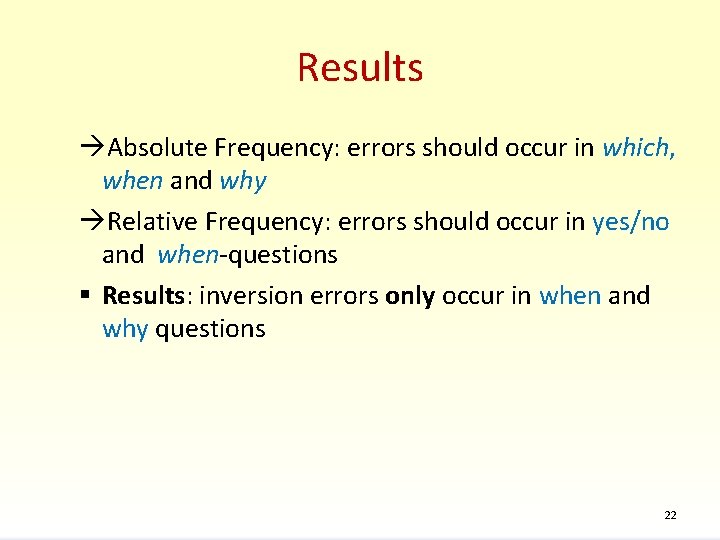
Results àAbsolute Frequency: errors should occur in which, when and why àRelative Frequency: errors should occur in yes/no and when-questions § Results: inversion errors only occur in when and why questions 22
Take-home Message • Study 1: input does matter! A grammar in which operations are implemented uniformly is a ‘simpler’ grammar • Study 2: elements pattern together according to syntactic category, not just (token) frequency • In progress: • Token vs. Type Frequency • Wh- + is/are + NP combinations • Relative frequency (counting all inverted and non-inverted strings) 23
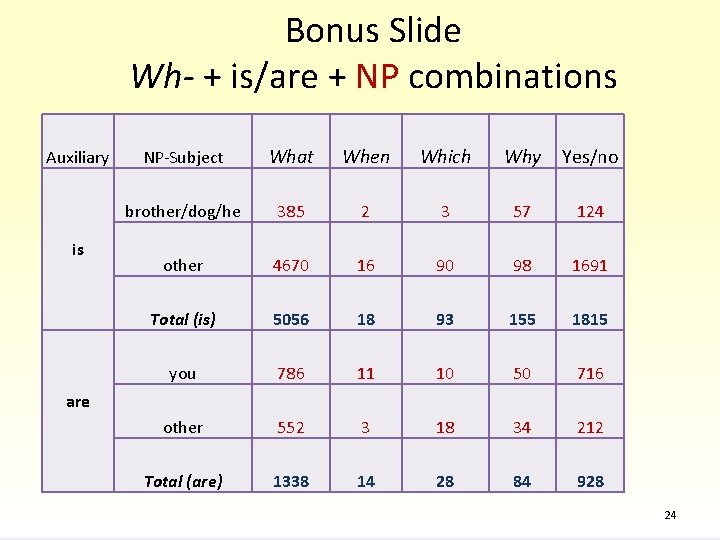
Bonus Slide Wh- + is/are + NP combinations Auxiliary is NP-Subject What When Which Why Yes/no brother/dog/he 385 2 3 57 124 other 4670 16 90 98 1691 Total (is) 5056 18 93 155 1815 you 786 11 10 50 716 other 552 3 18 34 212 Total (are) 1338 14 28 84 928 are 24
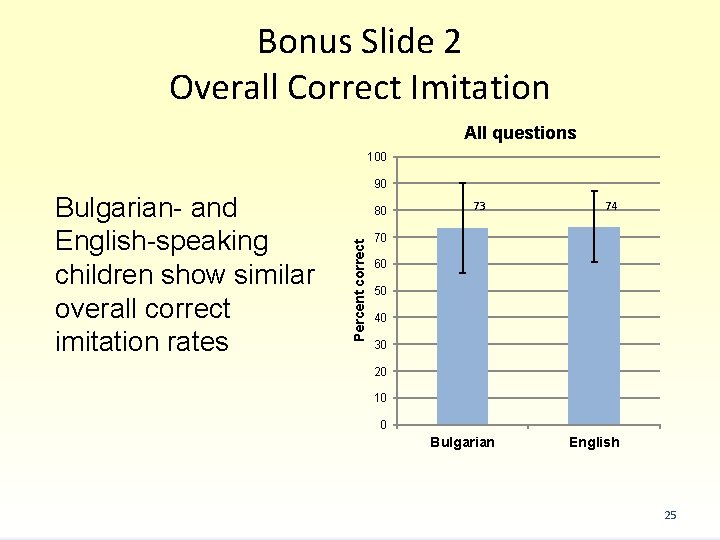
Bonus Slide 2 Overall Correct Imitation All questions 100 90 80 Percent correct Bulgarian- and English-speaking children show similar overall correct imitation rates 73 74 70 60 50 40 30 20 10 0 Bulgarian English 25
- Slides: 25