
Rules for Using Quotations 1 3 Take Notes

- Slides: 3
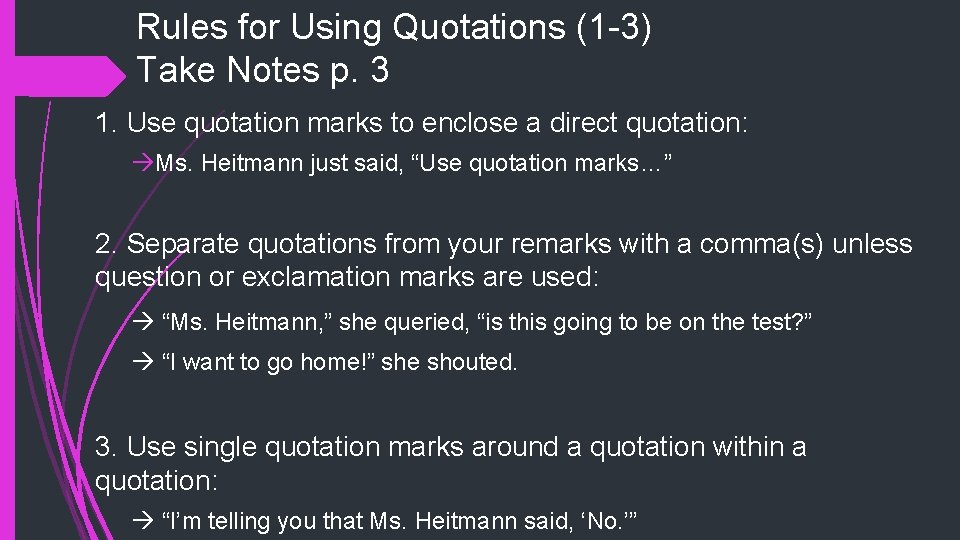
Rules for Using Quotations (1 -3) Take Notes p. 3 1. Use quotation marks to enclose a direct quotation: Ms. Heitmann just said, “Use quotation marks…” 2. Separate quotations from your remarks with a comma(s) unless question or exclamation marks are used: “Ms. Heitmann, ” she queried, “is this going to be on the test? ” “I want to go home!” she shouted. 3. Use single quotation marks around a quotation within a quotation: “I’m telling you that Ms. Heitmann said, ‘No. ’”
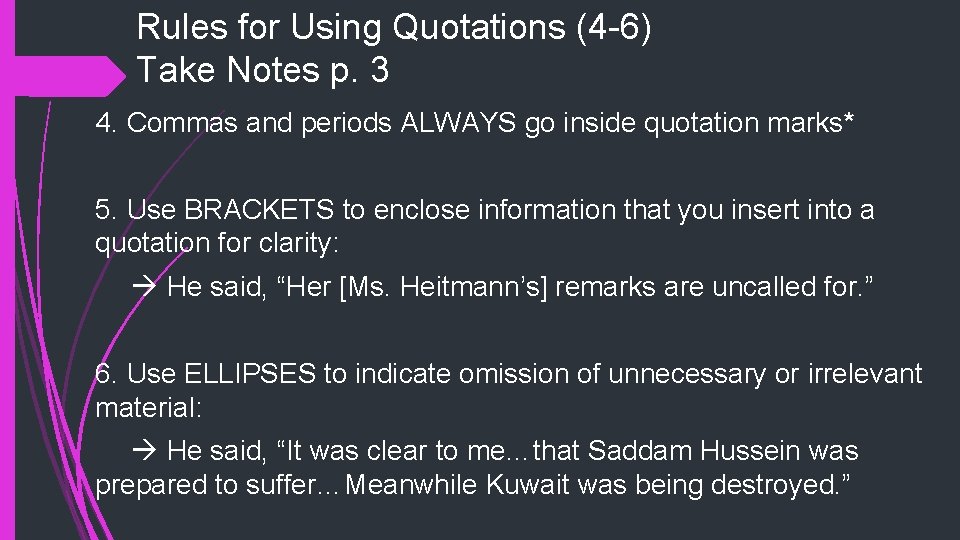
Rules for Using Quotations (4 -6) Take Notes p. 3 4. Commas and periods ALWAYS go inside quotation marks* 5. Use BRACKETS to enclose information that you insert into a quotation for clarity: He said, “Her [Ms. Heitmann’s] remarks are uncalled for. ” 6. Use ELLIPSES to indicate omission of unnecessary or irrelevant material: He said, “It was clear to me…that Saddam Hussein was prepared to suffer…Meanwhile Kuwait was being destroyed. ”
Rules for Using Titles (2) Take Notes p. 3 1. Use QUOTATION MARKS for SHORT WORKS: short stories, poems, articles, specific episodes of TV shows, chapter titles, song titles, essays. 2. UNDERLINE (when handwriting) or use ITALICS (when typing) for LONG WORKS: novels, plays, films, sculptures, newspapers, court cases, long poems, paintings, TV series, long musical works (opus, opera, musical) *even if it’s an excerpt