
Rules for Supporting Part 803 and Part 806

- Slides: 25
Rules for Supporting Part 803 and Part 806 Decision Making Establishing Rules for: Medical Device Reports (803) & Correction and Removal Reports (806) Presented by: Cap Uldriks, FDA Daniel P. Olivier, CCS Page 1
Rules for Supporting Part 803 and Part 806 Decision Making Objectives l Define regulatory reporting rules based on established standards l Simplify regulatory reporting decision making l Establish defensible basis to support compliance with reporting regulations l Reduce risk of non-compliance observations Page 2
Rules for Supporting Part 803 and Part 806 Decision Making AGENDA l Reporting Regulations l Evaluating Safety Risks l Defining the Strategy l Summary Page 3
Rules for Supporting Part 803 and Part 806 Decision Making Reporting+Regulations Page 4
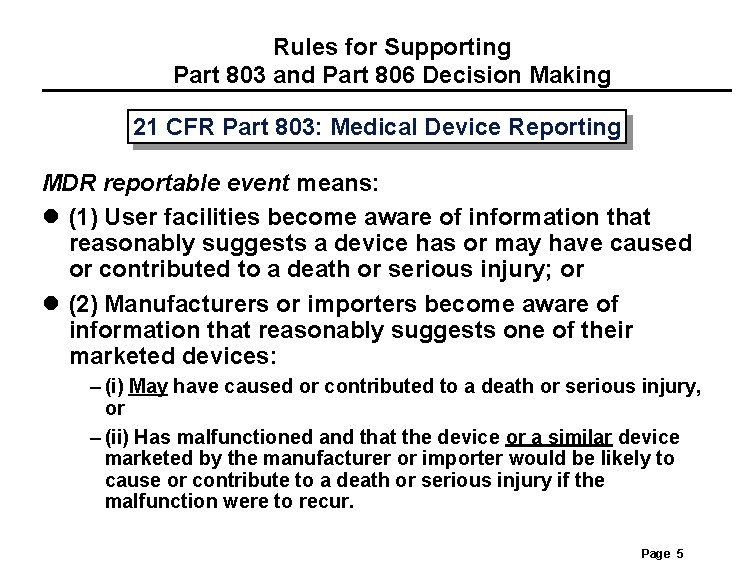
Rules for Supporting Part 803 and Part 806 Decision Making 21 CFR Part 803: Medical Device Reporting MDR reportable event means: l (1) User facilities become aware of information that reasonably suggests a device has or may have caused or contributed to a death or serious injury; or l (2) Manufacturers or importers become aware of information that reasonably suggests one of their marketed devices: – (i) May have caused or contributed to a death or serious injury, or – (ii) Has malfunctioned and that the device or a similar device marketed by the manufacturer or importer would be likely to cause or contribute to a death or serious injury if the malfunction were to recur. Page 5
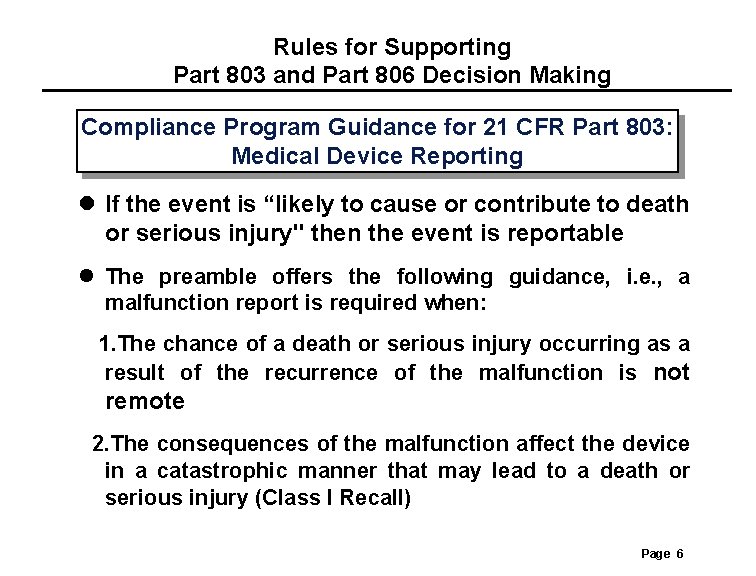
Rules for Supporting Part 803 and Part 806 Decision Making Compliance Program Guidance for 21 CFR Part 803: Medical Device Reporting l If the event is “likely to cause or contribute to death or serious injury" then the event is reportable l The preamble offers the following guidance, i. e. , a malfunction report is required when: 1. The chance of a death or serious injury occurring as a result of the recurrence of the malfunction is not remote 2. The consequences of the malfunction affect the device in a catastrophic manner that may lead to a death or serious injury (Class I Recall) Page 6
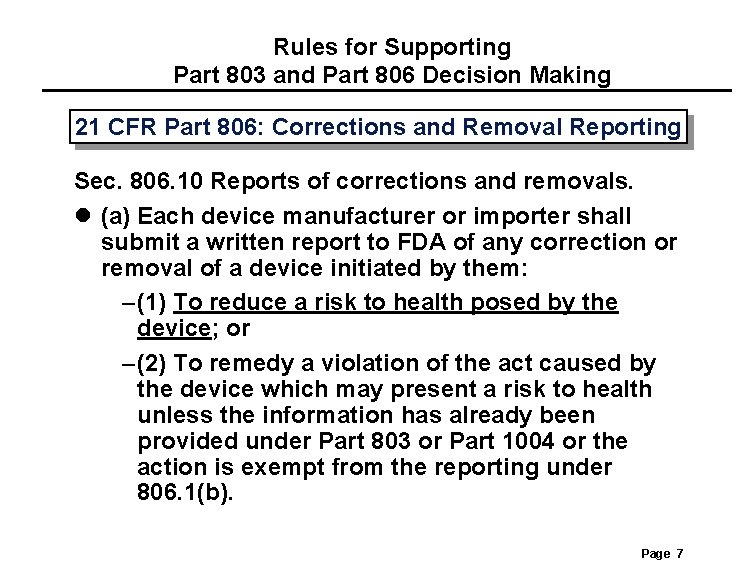
Rules for Supporting Part 803 and Part 806 Decision Making 21 CFR Part 806: Corrections and Removal Reporting Sec. 806. 10 Reports of corrections and removals. l (a) Each device manufacturer or importer shall submit a written report to FDA of any correction or removal of a device initiated by them: – (1) To reduce a risk to health posed by the device; or – (2) To remedy a violation of the act caused by the device which may present a risk to health unless the information has already been provided under Part 803 or Part 1004 or the action is exempt from the reporting under 806. 1(b). Page 7
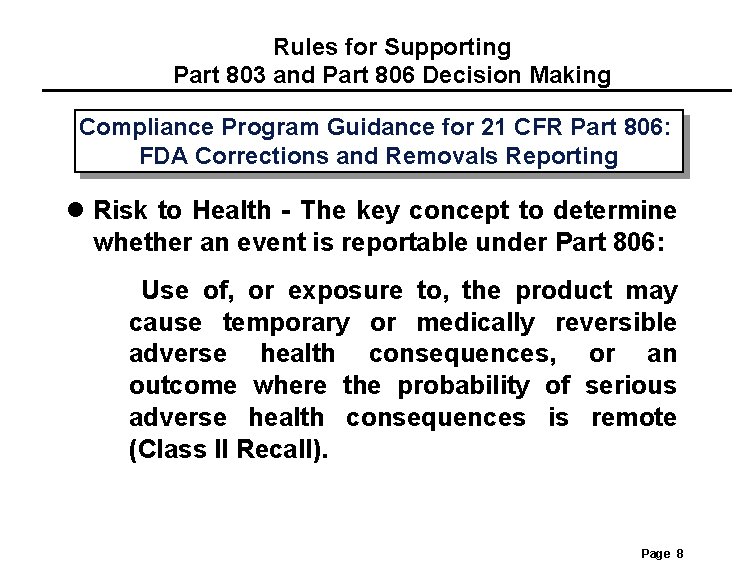
Rules for Supporting Part 803 and Part 806 Decision Making Compliance Program Guidance for 21 CFR Part 806: FDA Corrections and Removals Reporting l Risk to Health - The key concept to determine whether an event is reportable under Part 806: Use of, or exposure to, the product may cause temporary or medically reversible adverse health consequences, or an outcome where the probability of serious adverse health consequences is remote (Class II Recall). Page 8
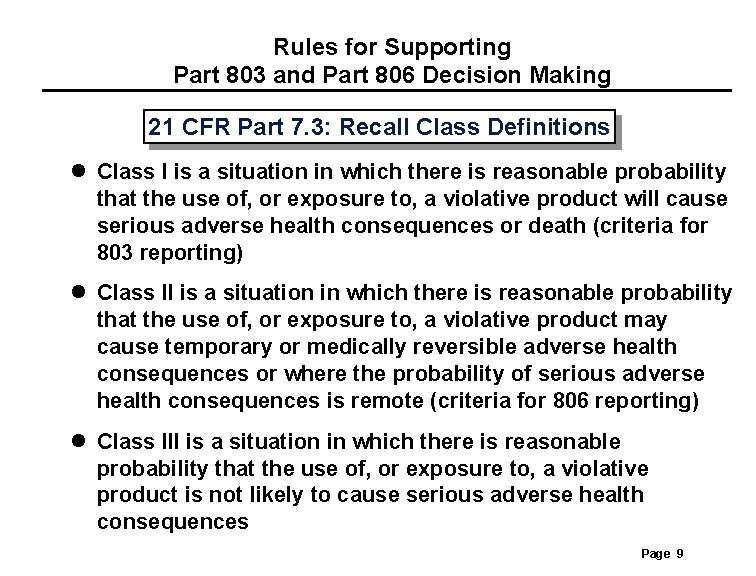
Rules for Supporting Part 803 and Part 806 Decision Making 21 CFR Part 7. 3: Recall Class Definitions l Class I is a situation in which there is reasonable probability that the use of, or exposure to, a violative product will cause serious adverse health consequences or death (criteria for 803 reporting) l Class II is a situation in which there is reasonable probability that the use of, or exposure to, a violative product may cause temporary or medically reversible adverse health consequences or where the probability of serious adverse health consequences is remote (criteria for 806 reporting) l Class III is a situation in which there is reasonable probability that the use of, or exposure to, a violative product is not likely to cause serious adverse health consequences Page 9
Rules for Supporting Part 803 and Part 806 Decision Making Evaluating+ Safety Risk Page 10
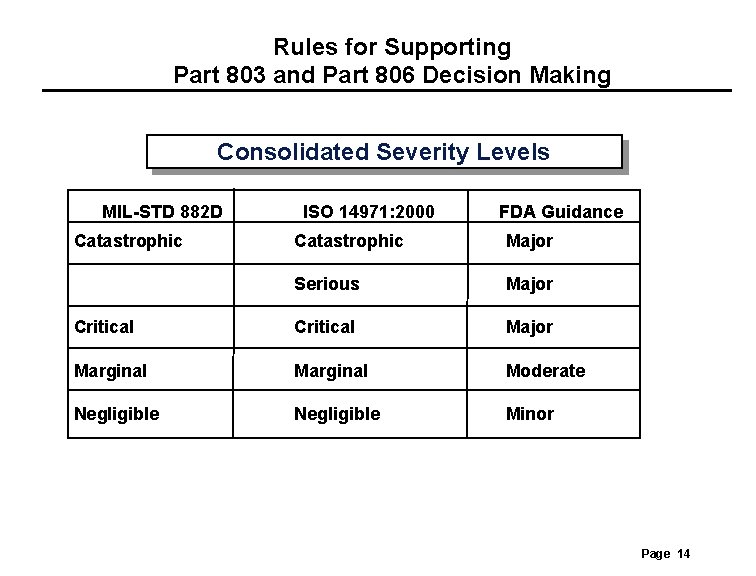
Rules for Supporting Part 803 and Part 806 Decision Making Risk Evaluation, Severity l Severity* - Assess the worst possible consequence, defined by degree of injury or illness that could occur. Severity classification identified as follows: – Major, may cause death or serious injury – Moderate, may cause non-serious injury – Minor, not expected to cause injury *Based on “Levels of Concern” defined in Guidance for the Content of Premarket Submissions for Software Contained in Medical Devices, Food and Drug Administration, May 11, 2005. Page 11
Rules for Supporting Part 803 and Part 806 Decision Making MIL-STD 882 D* Severity Levels l Severity: Suggested mishap categories: – Catastrophic, could result in death, permanent total disability, loss exceeding $1 M – Critical, could result in permanent partial disability, or that may result in hospitalization of at least three people, $200 k-$1 M loss – Marginal, could result in injury resulting in more than one lost work day, $10 K-$200 K loss – Negligible, could result in injury resulting in less than one lost day, less than $10 K * Standard Practice for System Safety, MIL-STD-882 D, Department of Defense, February 10, 2000, Appendix A, Table A-1, page 18 Page 12
Rules for Supporting Part 803 and Part 806 Decision Making ISO 14971: 2000* Severity Levels l Severity: levels may be descriptive, e. g. – Catastrophic – Serious – Critical – Marginal – Negligible * Medical device - Application of safety risk management to medical devices, ANSI/AAMI/ISO 14971: 2000 section E. 2. 2, page 32 Page 13
Rules for Supporting Part 803 and Part 806 Decision Making Consolidated Severity Levels MIL-STD 882 D Catastrophic ISO 14971: 2000 FDA Guidance Catastrophic Major Serious Major Critical Major Marginal Moderate Negligible Minor Page 14
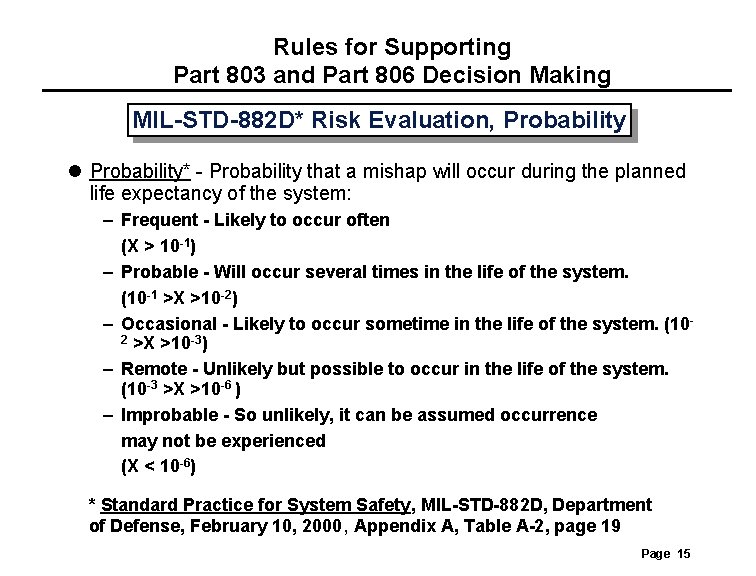
Rules for Supporting Part 803 and Part 806 Decision Making MIL-STD-882 D* Risk Evaluation, Probability l Probability* - Probability that a mishap will occur during the planned life expectancy of the system: – Frequent - Likely to occur often (X > 10 -1) – Probable - Will occur several times in the life of the system. (10 -1 >X >10 -2) – Occasional - Likely to occur sometime in the life of the system. (10 2 >X >10 -3) – Remote - Unlikely but possible to occur in the life of the system. (10 -3 >X >10 -6 ) – Improbable - So unlikely, it can be assumed occurrence may not be experienced (X < 10 -6) * Standard Practice for System Safety, MIL-STD-882 D, Department of Defense, February 10, 2000, Appendix A, Table A-2, page 19 Page 15
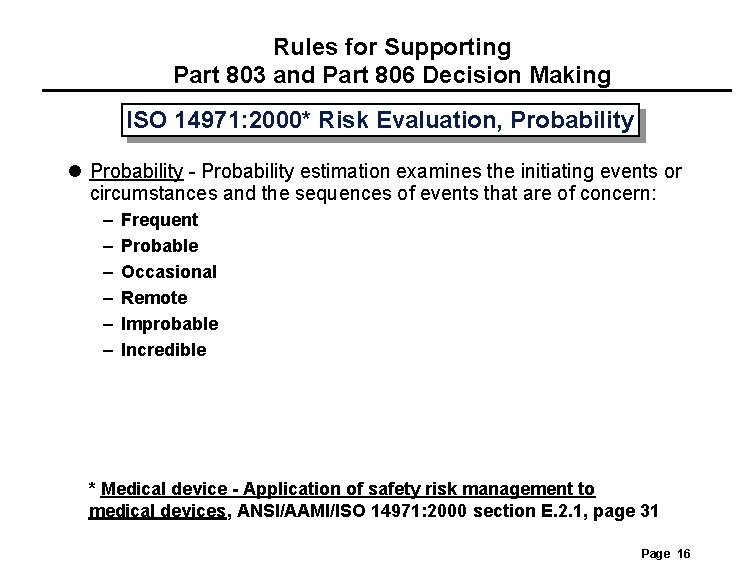
Rules for Supporting Part 803 and Part 806 Decision Making ISO 14971: 2000* Risk Evaluation, Probability l Probability - Probability estimation examines the initiating events or circumstances and the sequences of events that are of concern: – – – Frequent Probable Occasional Remote Improbable Incredible * Medical device - Application of safety risk management to medical devices, ANSI/AAMI/ISO 14971: 2000 section E. 2. 1, page 31 Page 16
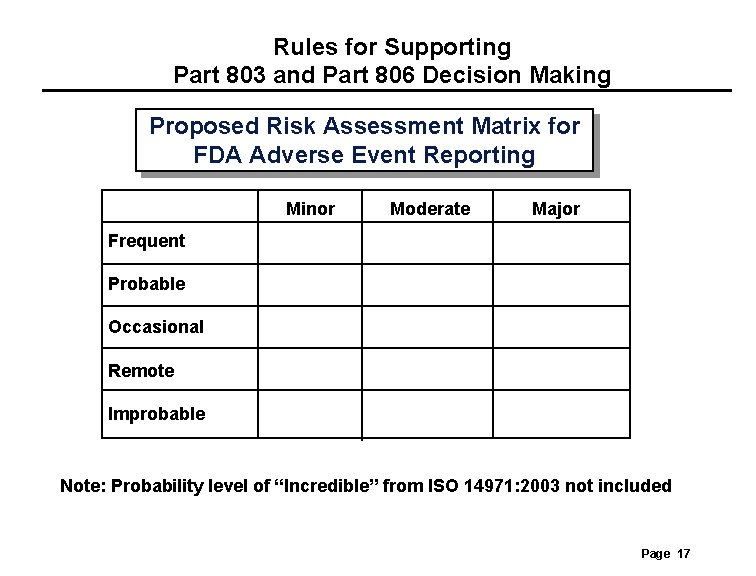
Rules for Supporting Part 803 and Part 806 Decision Making Proposed Risk Assessment Matrix for FDA Adverse Event Reporting Minor Moderate Major Frequent Probable Occasional Remote Improbable Note: Probability level of “Incredible” from ISO 14971: 2003 not included Page 17
Rules for Supporting Part 803 and Part 806 Decision Making Defining the Strategy Page 18
Rules for Supporting Part 803 and Part 806 Decision Making Compliance Program Guidance for 21 CFR Part 803: Medical Device Reporting l If the event is “likely to cause or contribute to death or serious injury" then the event is reportable l The preamble offers the following guidance, i. e. , a malfunction report is required when: 1. The chance of a death or serious injury occurring as a result of the recurrence of the malfunction is not remote; 2. The consequences of the malfunction affect the device in a catastrophic manner that may lead to a death or serious injury Page 19
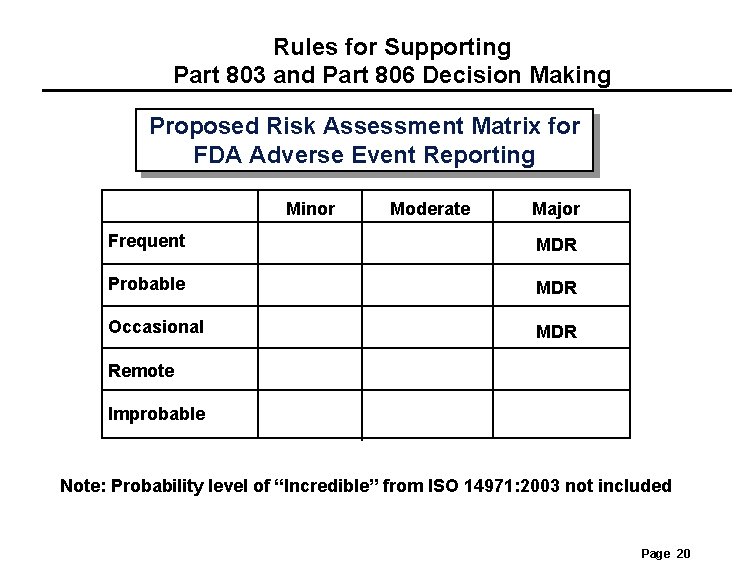
Rules for Supporting Part 803 and Part 806 Decision Making Proposed Risk Assessment Matrix for FDA Adverse Event Reporting Minor Moderate Major Frequent MDR Probable MDR Occasional MDR Remote Improbable Note: Probability level of “Incredible” from ISO 14971: 2003 not included Page 20
Rules for Supporting Part 803 and Part 806 Decision Making Compliance Program Guidance for 21 CFR Part 806: FDA Corrections and Removals Reporting l Reports are NOT required IF: The information has already been reported to FDA under the MDR regulation, 21 CFR Part 803 or under 21 CFR 1004 (Replacement of Electronic Products). l The key concept for determining when an event is reportable is the CAR regulation's definition of risk to health: Use of, or exposure to, the product may cause temporary or medically reversible adverse health consequences, or an outcome where the probability of serious adverse health consequences is remote (Class II Recall). Page 21
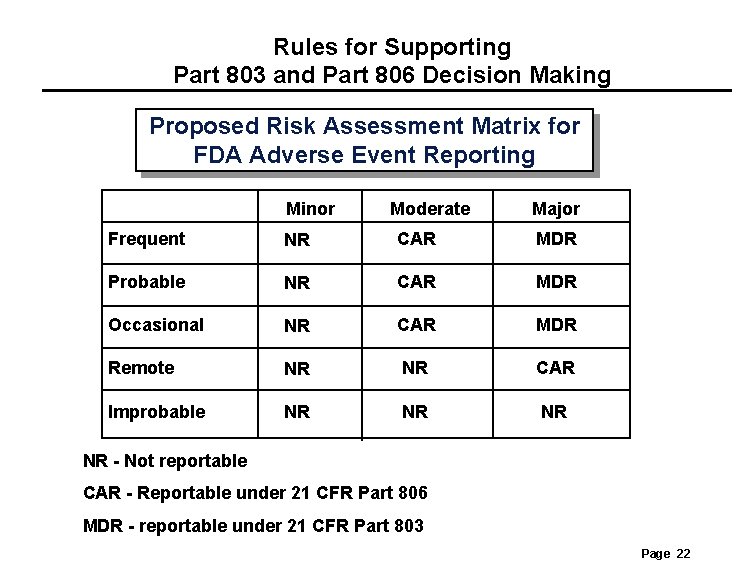
Rules for Supporting Part 803 and Part 806 Decision Making Proposed Risk Assessment Matrix for FDA Adverse Event Reporting Minor Moderate Major Frequent NR CAR MDR Probable NR CAR MDR Occasional NR CAR MDR Remote NR NR CAR Improbable NR NR - Not reportable CAR - Reportable under 21 CFR Part 806 MDR - reportable under 21 CFR Part 803 Page 22
Rules for Supporting Part 803 and Part 806 Decision Making Summary Page 23
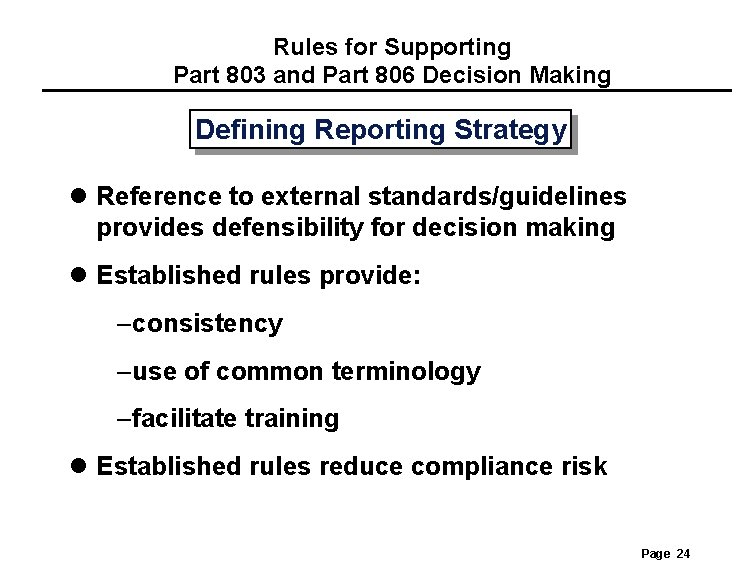
Rules for Supporting Part 803 and Part 806 Decision Making Defining Reporting Strategy l Reference to external standards/guidelines provides defensibility for decision making l Established rules provide: –consistency –use of common terminology –facilitate training l Established rules reduce compliance risk Page 24
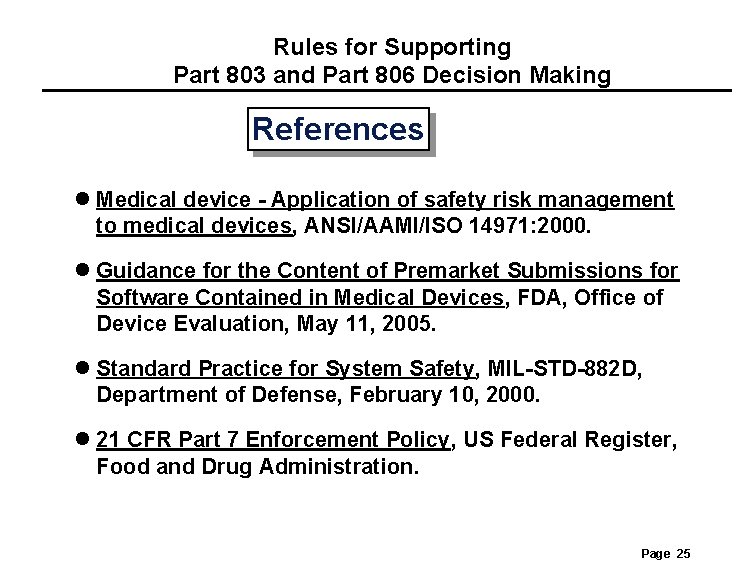
Rules for Supporting Part 803 and Part 806 Decision Making References l Medical device - Application of safety risk management to medical devices, ANSI/AAMI/ISO 14971: 2000. l Guidance for the Content of Premarket Submissions for Software Contained in Medical Devices, FDA, Office of Device Evaluation, May 11, 2005. l Standard Practice for System Safety, MIL-STD-882 D, Department of Defense, February 10, 2000. l 21 CFR Part 7 Enforcement Policy, US Federal Register, Food and Drug Administration. Page 25