
RULES FOR GRAPHING Graphs can be used to
RULES FOR GRAPHING Graphs can be used to visually represent the relationship of data.
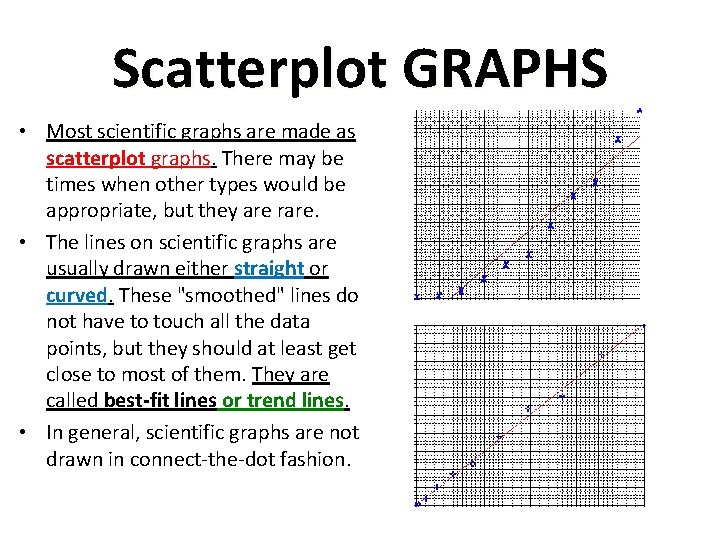
Scatterplot GRAPHS • Most scientific graphs are made as scatterplot graphs. There may be times when other types would be appropriate, but they are rare. • The lines on scientific graphs are usually drawn either straight or curved. These "smoothed" lines do not have to touch all the data points, but they should at least get close to most of them. They are called best-fit lines or trend lines. • In general, scientific graphs are not drawn in connect-the-dot fashion.
Line/Scatter Graphs have Variables • A line graph is a visual representation of a relationship between two variables, x and y. • Remember that a variable is any factor in an experiment - object, event, phenomena, time period, or any other type of category you are trying to measure. There are two types of variablesindependent and dependent. • An independent variable is a variable that stands alone and isn't changed by the other variables you are trying to measure. • The x variable is the independent variable. • A dependent variable is something that depends on other factors. • The y variable is the dependent variable. • A graph displays the x and y variable on two intersecting lines called axes. The x (horizontal) and y (vertical) axes. • The point where the two axes intersect is called the origin.
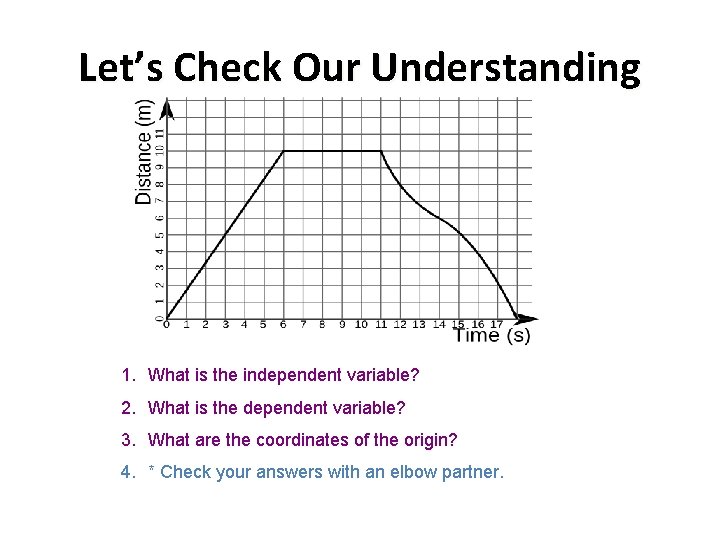
Let’s Check Our Understanding 1. What is the independent variable? 2. What is the dependent variable? 3. What are the coordinates of the origin? 4. * Check your answers with an elbow partner.
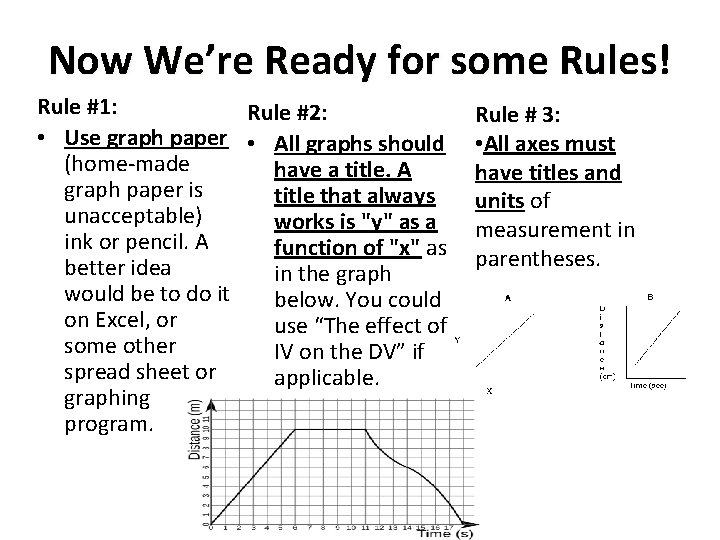
Now We’re Ready for some Rules! Rule #1: Rule #2: • Use graph paper • All graphs should (home-made have a title. A graph paper is title that always unacceptable) works is "y" as a ink or pencil. A function of "x" as better idea in the graph would be to do it below. You could on Excel, or use “The effect of some other IV on the DV” if spread sheet or applicable. graphing program. Rule # 3: • All axes must have titles and units of measurement in parentheses.
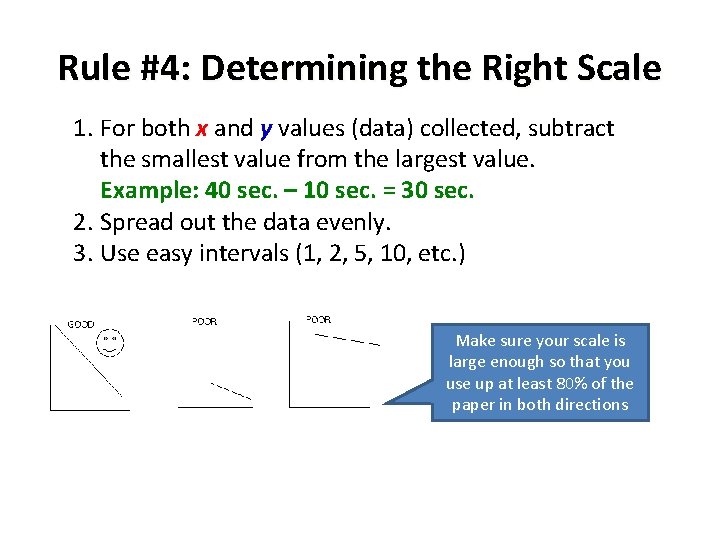
Rule #4: Determining the Right Scale 1. For both x and y values (data) collected, subtract the smallest value from the largest value. Example: 40 sec. – 10 sec. = 30 sec. 2. Spread out the data evenly. 3. Use easy intervals (1, 2, 5, 10, etc. ) Make sure your scale is large enough so that you use up at least 80% of the paper in both directions
Two More Rules and We’re Ready to Graph • Rule #5: Before you plot your data, create a tchart displaying your data in pairs. You may recall in math this called ordered pairs. • Rule #6: Because experimental data are subject to error, data points on a graph are not directly connected. Instead a line-of-best-fit or regression line is used to communicate the general data pattern. • To construct a line-of-best-fit, draw a line about which an equal number of data points fall to either side.
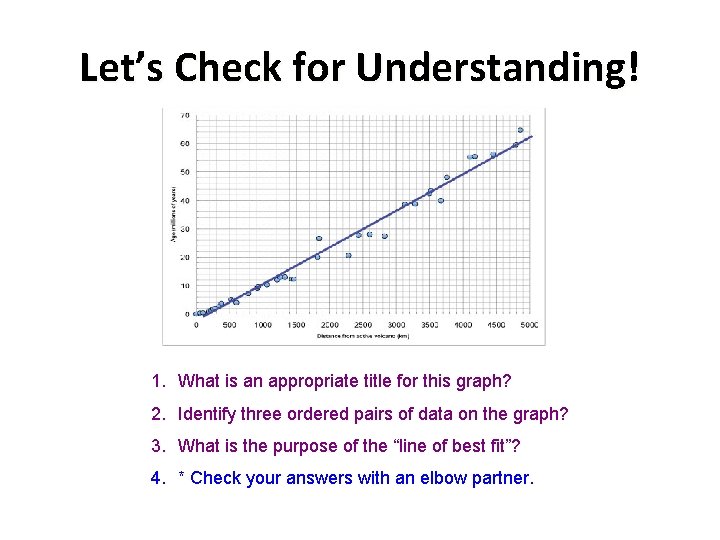
Let’s Check for Understanding! 1. What is an appropriate title for this graph? 2. Identify three ordered pairs of data on the graph? 3. What is the purpose of the “line of best fit”? 4. * Check your answers with an elbow partner.
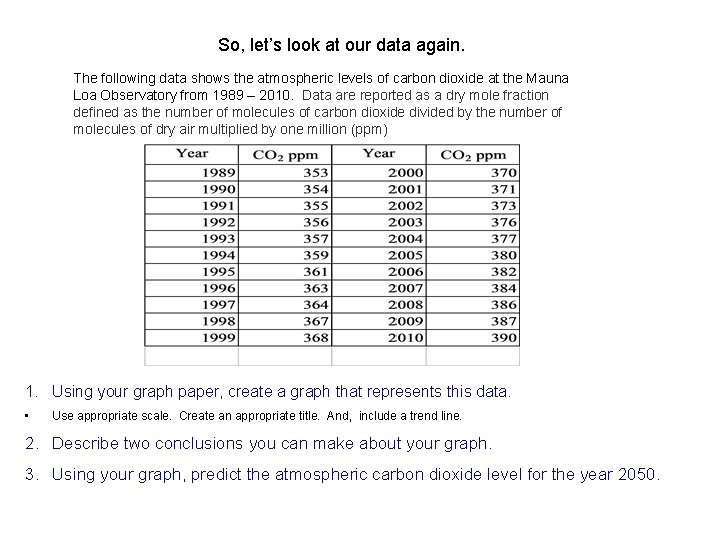
So, let’s look at our data again. The following data shows the atmospheric levels of carbon dioxide at the Mauna Loa Observatory from 1989 – 2010. Data are reported as a dry mole fraction defined as the number of molecules of carbon dioxide divided by the number of molecules of dry air multiplied by one million (ppm) 1. Using your graph paper, create a graph that represents this data. • Use appropriate scale. Create an appropriate title. And, include a trend line. 2. Describe two conclusions you can make about your graph. 3. Using your graph, predict the atmospheric carbon dioxide level for the year 2050.
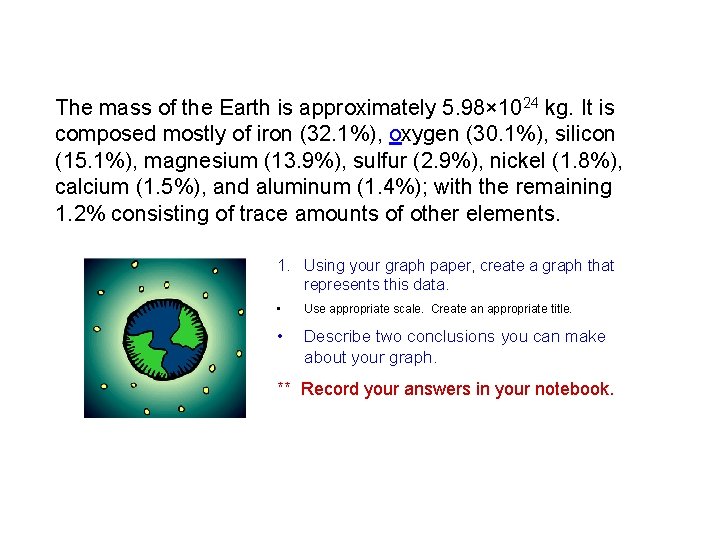
The mass of the Earth is approximately 5. 98× 1024 kg. It is composed mostly of iron (32. 1%), oxygen (30. 1%), silicon (15. 1%), magnesium (13. 9%), sulfur (2. 9%), nickel (1. 8%), calcium (1. 5%), and aluminum (1. 4%); with the remaining 1. 2% consisting of trace amounts of other elements. 1. Using your graph paper, create a graph that represents this data. • Use appropriate scale. Create an appropriate title. • Describe two conclusions you can make about your graph. ** Record your answers in your notebook.
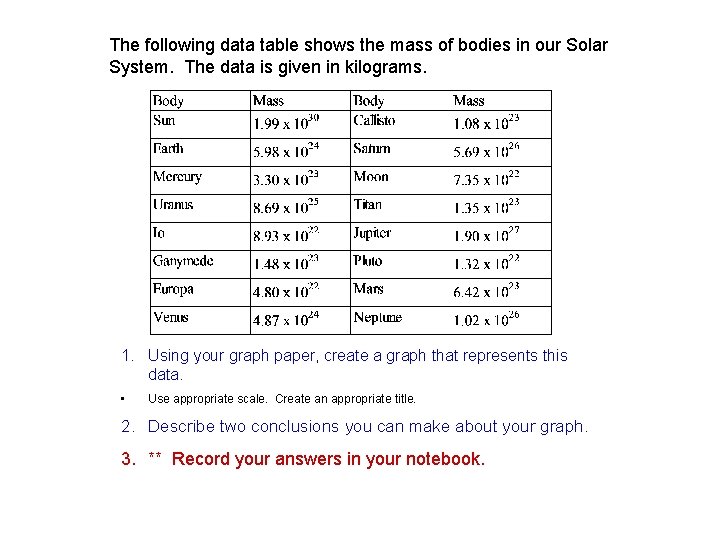
The following data table shows the mass of bodies in our Solar System. The data is given in kilograms. 1. Using your graph paper, create a graph that represents this data. • Use appropriate scale. Create an appropriate title. 2. Describe two conclusions you can make about your graph. 3. ** Record your answers in your notebook.
- Slides: 11