
RULES FOR FUNCTIONS LINEAR OR NONLINEAR Focus 6
- Slides: 10
RULES FOR FUNCTIONS LINEAR OR NON-LINEAR
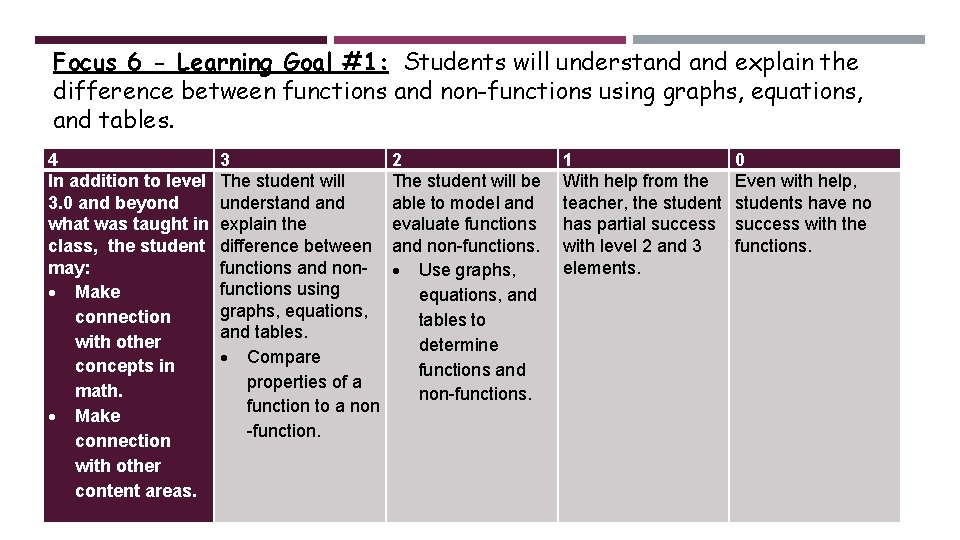
Focus 6 - Learning Goal #1: Students will understand explain the difference between functions and non-functions using graphs, equations, and tables. 4 3 In addition to level The student will 3. 0 and beyond understand what was taught in explain the class, the student difference between may: functions and nonfunctions using Make graphs, equations, connection and tables. with other Compare concepts in properties of a math. function to a non Make -function. connection with other content areas. 2 The student will be able to model and evaluate functions and non-functions. Use graphs, equations, and tables to determine functions and non-functions. 1 With help from the teacher, the student has partial success with level 2 and 3 elements. 0 Even with help, students have no success with the functions.
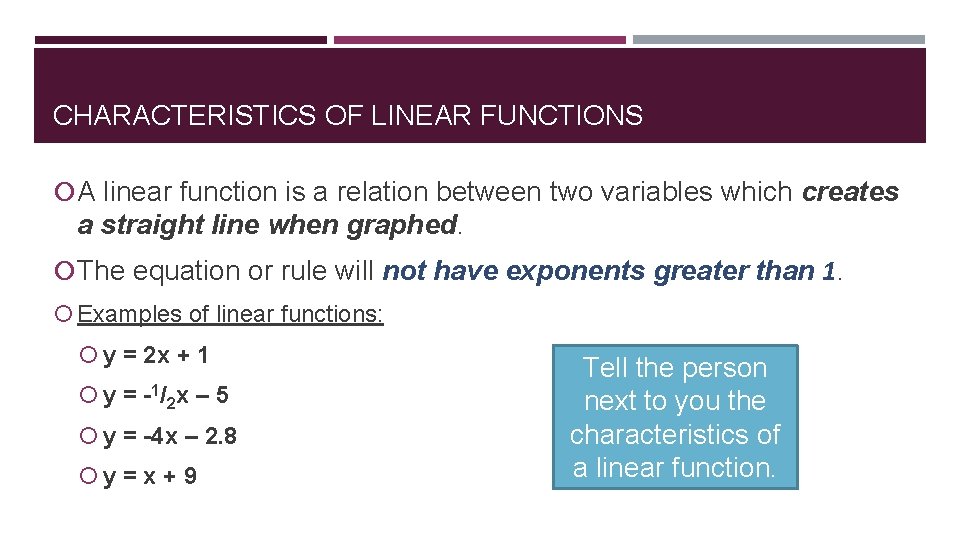
CHARACTERISTICS OF LINEAR FUNCTIONS A linear function is a relation between two variables which creates a straight line when graphed. The equation or rule will not have exponents greater than 1. Examples of linear functions: y = 2 x + 1 y = -1/2 x – 5 y = -4 x – 2. 8 y = x + 9 Tell the person next to you the characteristics of a linear function.
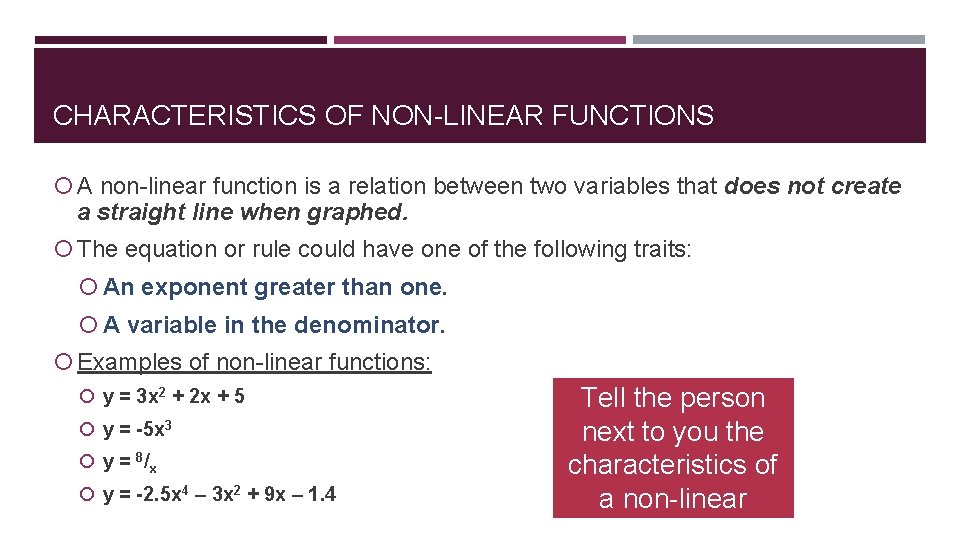
CHARACTERISTICS OF NON-LINEAR FUNCTIONS A non-linear function is a relation between two variables that does not create a straight line when graphed. The equation or rule could have one of the following traits: An exponent greater than one. A variable in the denominator. Examples of non-linear functions: y = 3 x 2 + 2 x + 5 y = -5 x 3 y = 8/x y = -2. 5 x 4 – 3 x 2 + 9 x – 1. 4 Tell the person next to you the characteristics of a non-linear
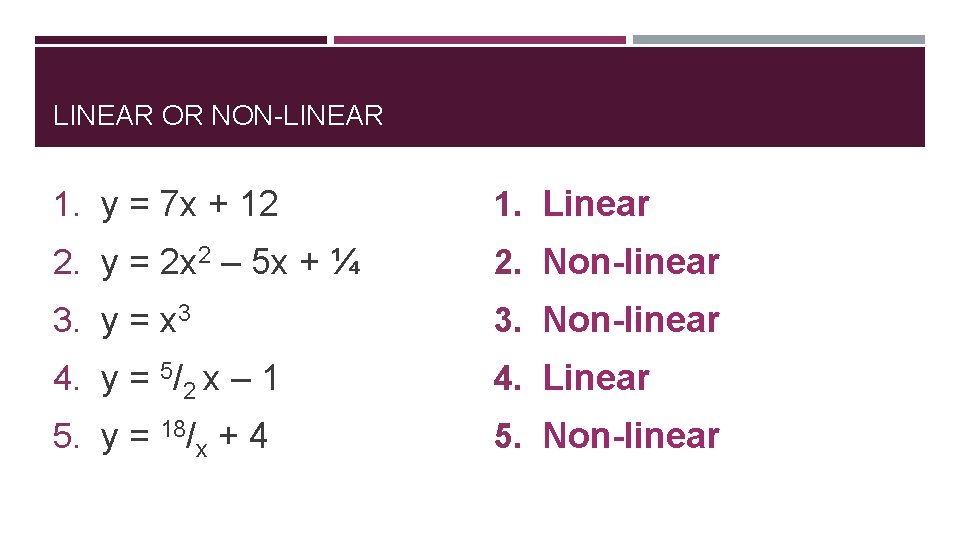
LINEAR OR NON-LINEAR 1. y = 7 x + 12 1. Linear 2. y = 2 x 2 – 5 x + ¼ 2. Non-linear 3. y = x 3 3. Non-linear 4. y = 5/2 x – 1 4. Linear 5. y = 18/x + 4 5. Non-linear
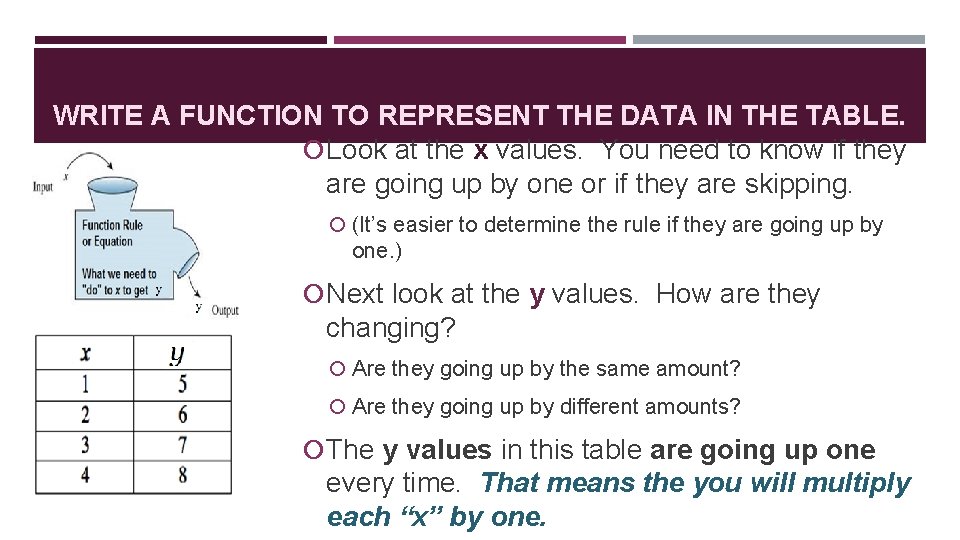
WRITE A FUNCTION TO REPRESENT THE DATA IN THE TABLE. Look at the x values. You need to know if they are going up by one or if they are skipping. (It’s easier to determine the rule if they are going up by one. ) Next look at the y values. How are they changing? Are they going up by the same amount? Are they going up by different amounts? The y values in this table are going up one every time. That means the you will multiply each “x” by one.
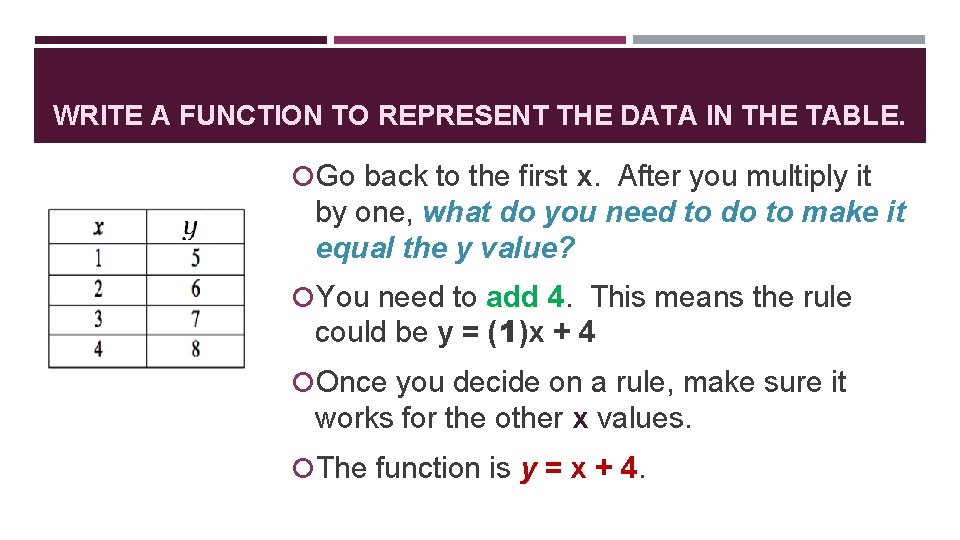
WRITE A FUNCTION TO REPRESENT THE DATA IN THE TABLE. Go back to the first x. After you multiply it by one, what do you need to do to make it equal the y value? You need to add 4. This means the rule could be y = (1)x + 4 Once you decide on a rule, make sure it works for the other x values. The function is y = x + 4.
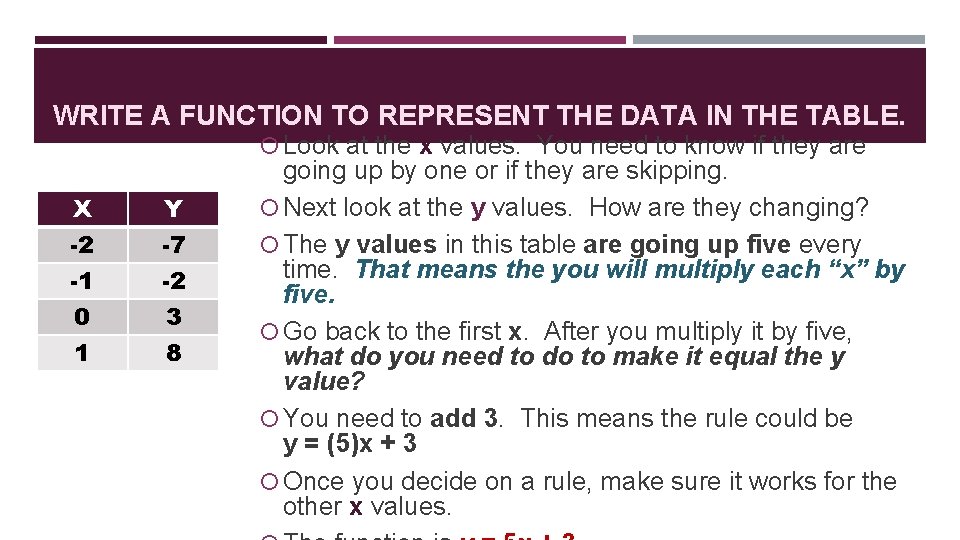
WRITE A FUNCTION TO REPRESENT THE DATA IN THE TABLE. Look at the x values. You need to know if they are X -2 -1 0 Y -7 -2 3 1 8 going up by one or if they are skipping. Next look at the y values. How are they changing? The y values in this table are going up five every time. That means the you will multiply each “x” by five. Go back to the first x. After you multiply it by five, what do you need to do to make it equal the y value? You need to add 3. This means the rule could be y = (5)x + 3 Once you decide on a rule, make sure it works for the other x values.
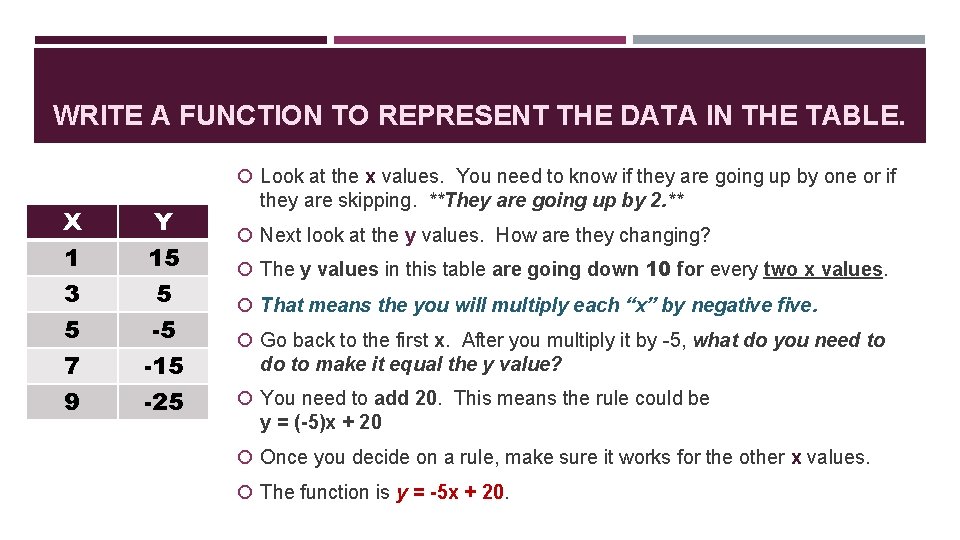
WRITE A FUNCTION TO REPRESENT THE DATA IN THE TABLE. Look at the x values. You need to know if they are going up by one or if X 1 3 5 Y 15 5 -5 7 9 -15 -25 they are skipping. **They are going up by 2. ** Next look at the y values. How are they changing? The y values in this table are going down 10 for every two x values. That means the you will multiply each “x” by negative five. Go back to the first x. After you multiply it by -5, what do you need to do to make it equal the y value? You need to add 20. This means the rule could be y = (-5)x + 20 Once you decide on a rule, make sure it works for the other x values. The function is y = -5 x + 20.
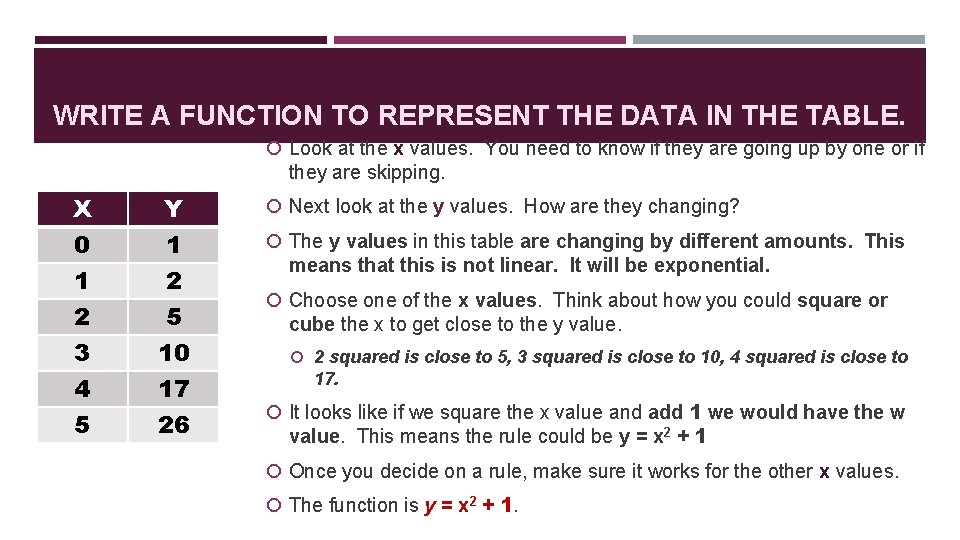
WRITE A FUNCTION TO REPRESENT THE DATA IN THE TABLE. Look at the x values. You need to know if they are going up by one or if they are skipping. X 0 1 2 Y 1 2 5 3 4 5 10 17 26 Next look at the y values. How are they changing? The y values in this table are changing by different amounts. This means that this is not linear. It will be exponential. Choose one of the x values. Think about how you could square or cube the x to get close to the y value. 2 squared is close to 5, 3 squared is close to 10, 4 squared is close to 17. It looks like if we square the x value and add 1 we would have the w value. This means the rule could be y = x 2 + 1 Once you decide on a rule, make sure it works for the other x values. The function is y = x 2 + 1.