
Rules for Determining Significant Figures 1 2 3
- Slides: 6
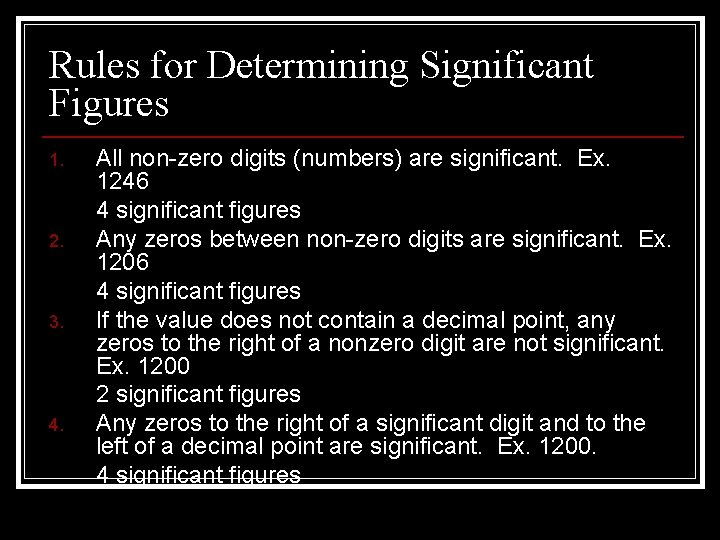
Rules for Determining Significant Figures 1. 2. 3. 4. All non-zero digits (numbers) are significant. Ex. 1246 4 significant figures Any zeros between non-zero digits are significant. Ex. 1206 4 significant figures If the value does not contain a decimal point, any zeros to the right of a nonzero digit are not significant. Ex. 1200 2 significant figures Any zeros to the right of a significant digit and to the left of a decimal point are significant. Ex. 1200. 4 significant figures
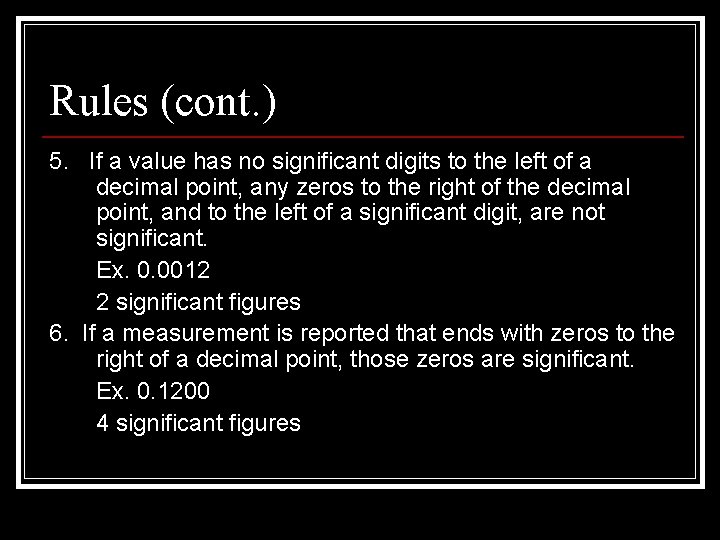
Rules (cont. ) 5. If a value has no significant digits to the left of a decimal point, any zeros to the right of the decimal point, and to the left of a significant digit, are not significant. Ex. 0. 0012 2 significant figures 6. If a measurement is reported that ends with zeros to the right of a decimal point, those zeros are significant. Ex. 0. 1200 4 significant figures
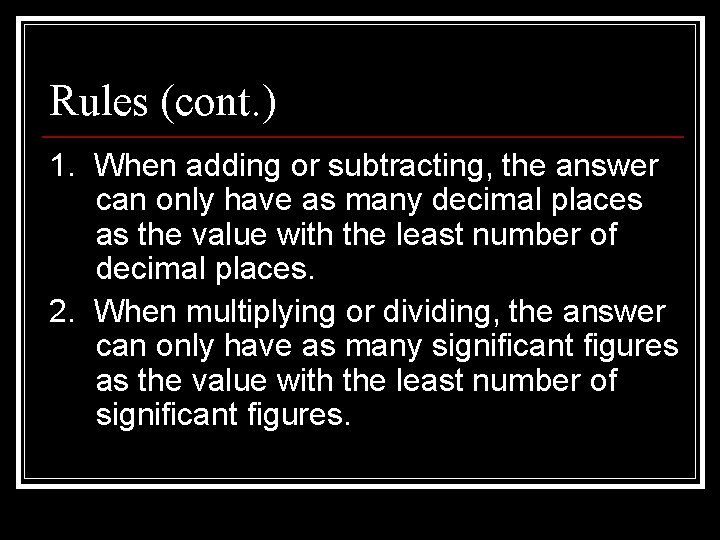
Rules (cont. ) 1. When adding or subtracting, the answer can only have as many decimal places as the value with the least number of decimal places. 2. When multiplying or dividing, the answer can only have as many significant figures as the value with the least number of significant figures.
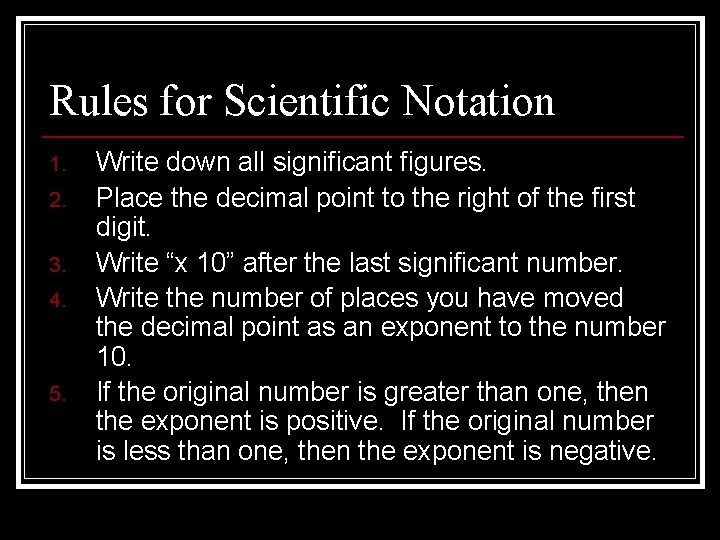
Rules for Scientific Notation 1. 2. 3. 4. 5. Write down all significant figures. Place the decimal point to the right of the first digit. Write “x 10” after the last significant number. Write the number of places you have moved the decimal point as an exponent to the number 10. If the original number is greater than one, then the exponent is positive. If the original number is less than one, then the exponent is negative.
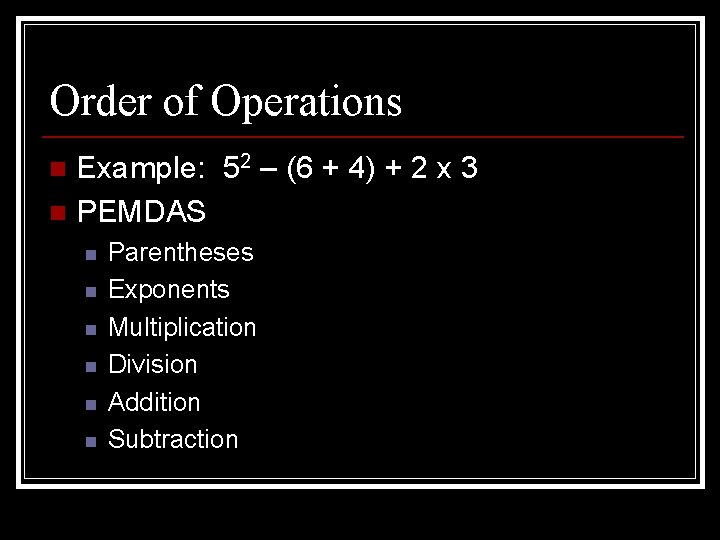
Order of Operations Example: 52 – (6 + 4) + 2 x 3 n PEMDAS n n n n Parentheses Exponents Multiplication Division Addition Subtraction
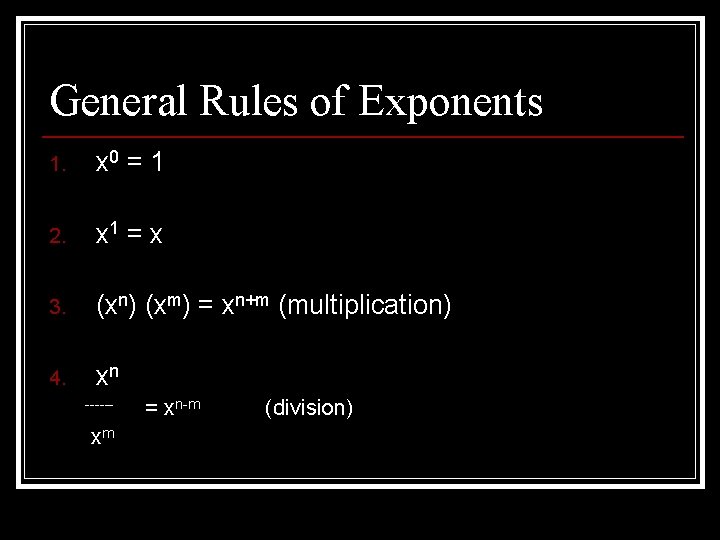
General Rules of Exponents 1. x 0 = 1 2. x 1 = x 3. (xn) (xm) = xn+m (multiplication) 4. xn ------ xm = xn-m (division)