
Rules for Determining Precision 1 If the measurement
- Slides: 16
Rules for Determining Precision 1. If the measurement has a decimal point in it, the precision of the measurement is the furthest place to the right. Example 23. 004 cm Precise to thousandths 2. If the measurement does not have a decimal point in it, the precision is the place where either the rightmost integer is, or where a zero with a line over it is. Example 2300 km Precise to hundreds
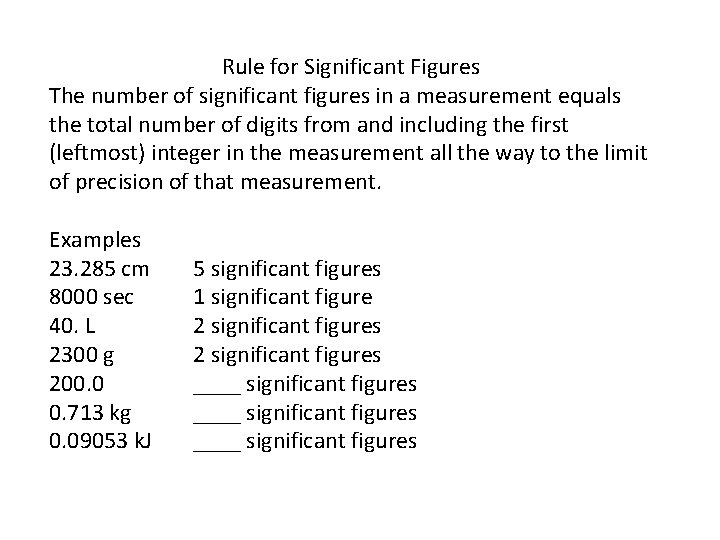
Rule for Significant Figures The number of significant figures in a measurement equals the total number of digits from and including the first (leftmost) integer in the measurement all the way to the limit of precision of that measurement. Examples 23. 285 cm 8000 sec 40. L 2300 g 200. 0 0. 713 kg 0. 09053 k. J 5 significant figures 1 significant figure 2 significant figures ____ significant figures
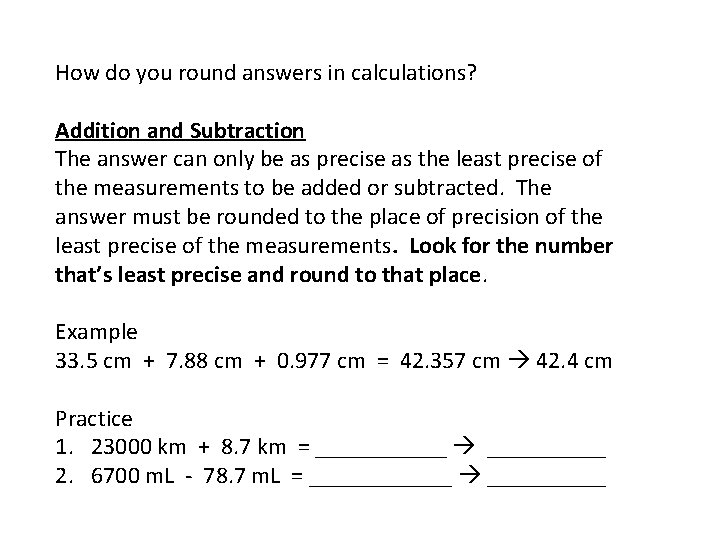
How do you round answers in calculations? Addition and Subtraction The answer can only be as precise as the least precise of the measurements to be added or subtracted. The answer must be rounded to the place of precision of the least precise of the measurements. Look for the number that’s least precise and round to that place. Example 33. 5 cm + 7. 88 cm + 0. 977 cm = 42. 357 cm 42. 4 cm Practice 1. 23000 km + 8. 7 km = ______ 2. 6700 m. L - 78. 7 m. L = ______
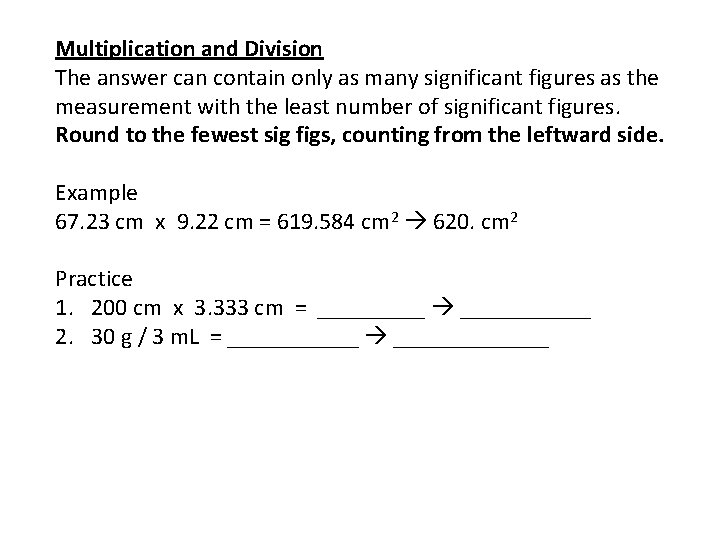
Multiplication and Division The answer can contain only as many significant figures as the measurement with the least number of significant figures. Round to the fewest sig figs, counting from the leftward side. Example 67. 23 cm x 9. 22 cm = 619. 584 cm 2 620. cm 2 Practice 1. 200 cm x 3. 333 cm = ______ 2. 30 g / 3 m. L = _______
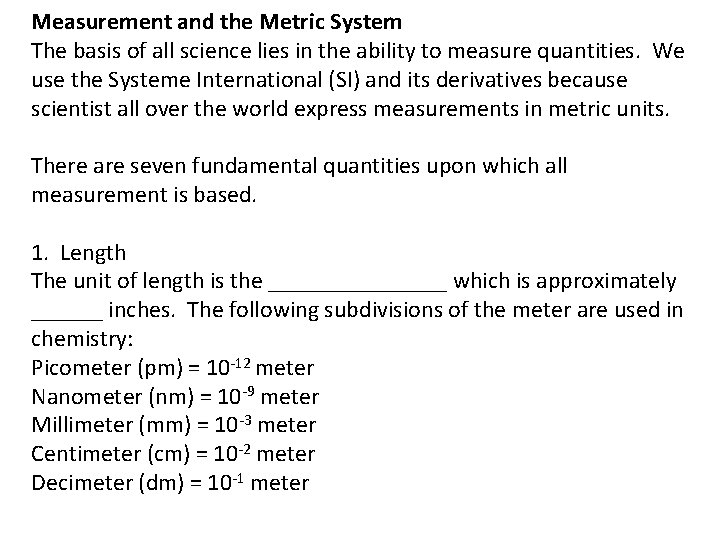
Measurement and the Metric System The basis of all science lies in the ability to measure quantities. We use the Systeme International (SI) and its derivatives because scientist all over the world express measurements in metric units. There are seven fundamental quantities upon which all measurement is based. 1. Length The unit of length is the ________ which is approximately ______ inches. The following subdivisions of the meter are used in chemistry: Picometer (pm) = 10 -12 meter Nanometer (nm) = 10 -9 meter Millimeter (mm) = 10 -3 meter Centimeter (cm) = 10 -2 meter Decimeter (dm) = 10 -1 meter
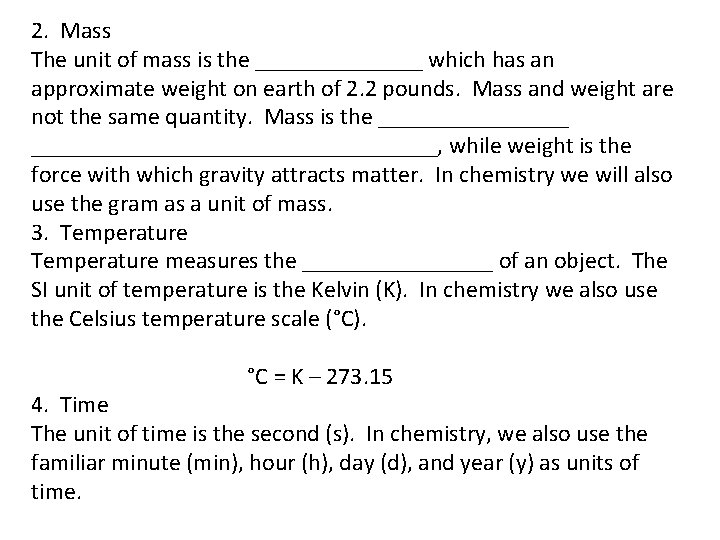
2. Mass The unit of mass is the _______ which has an approximate weight on earth of 2. 2 pounds. Mass and weight are not the same quantity. Mass is the _________________________, while weight is the force with which gravity attracts matter. In chemistry we will also use the gram as a unit of mass. 3. Temperature measures the ________ of an object. The SI unit of temperature is the Kelvin (K). In chemistry we also use the Celsius temperature scale (°C). °C = K – 273. 15 4. Time The unit of time is the second (s). In chemistry, we also use the familiar minute (min), hour (h), day (d), and year (y) as units of time.
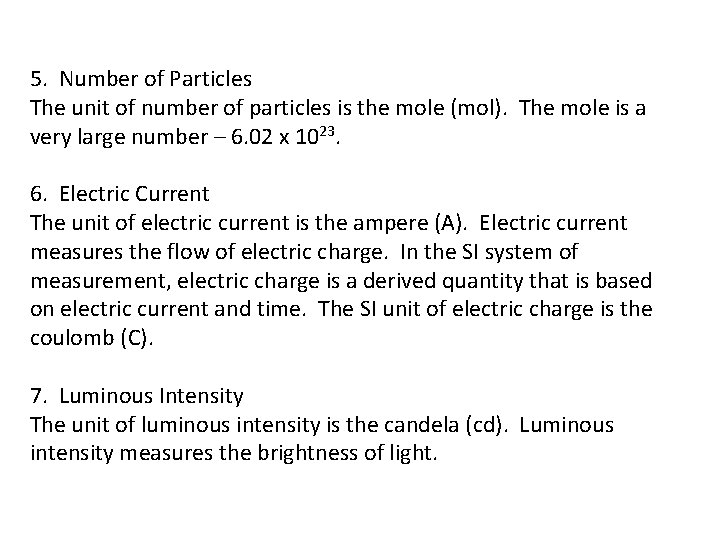
5. Number of Particles The unit of number of particles is the mole (mol). The mole is a very large number – 6. 02 x 1023. 6. Electric Current The unit of electric current is the ampere (A). Electric current measures the flow of electric charge. In the SI system of measurement, electric charge is a derived quantity that is based on electric current and time. The SI unit of electric charge is the coulomb (C). 7. Luminous Intensity The unit of luminous intensity is the candela (cd). Luminous intensity measures the brightness of light.
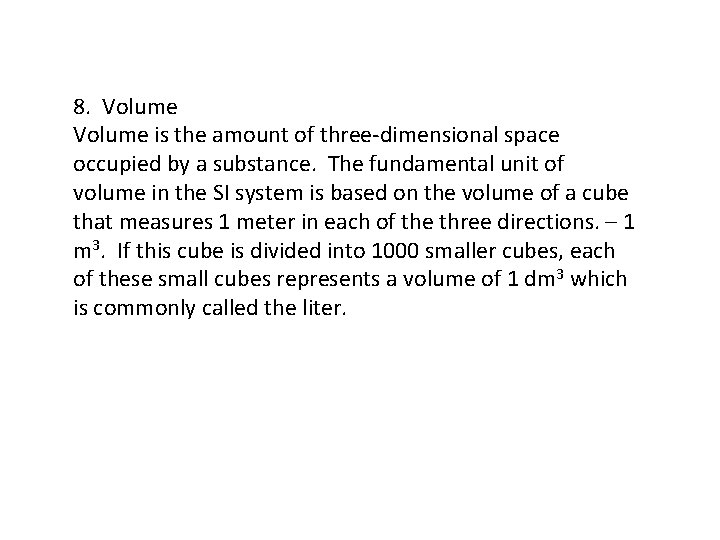
8. Volume is the amount of three-dimensional space occupied by a substance. The fundamental unit of volume in the SI system is based on the volume of a cube that measures 1 meter in each of the three directions. – 1 m 3. If this cube is divided into 1000 smaller cubes, each of these small cubes represents a volume of 1 dm 3 which is commonly called the liter.
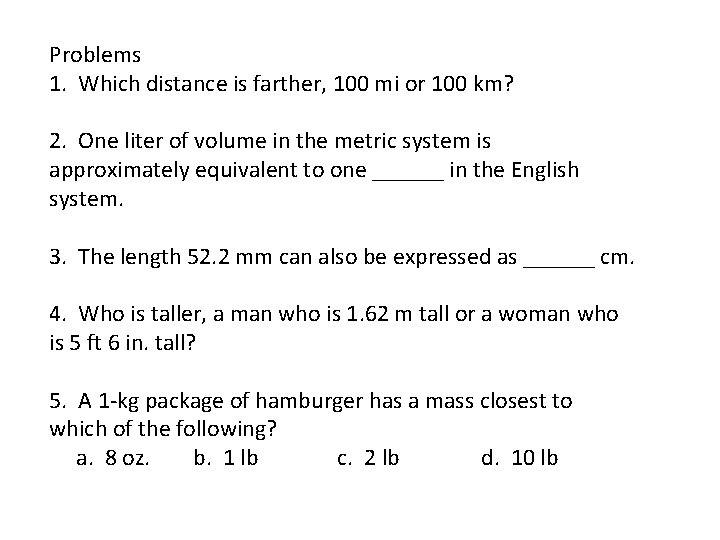
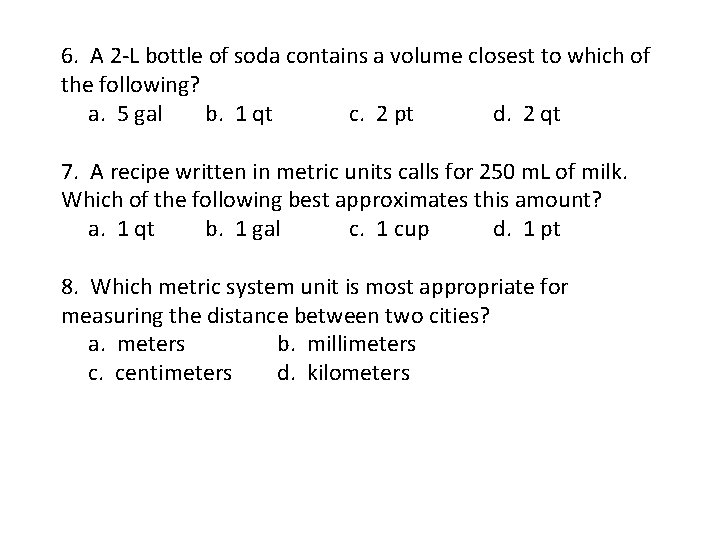
Problems 1. Which distance is farther, 100 mi or 100 km? 2. One liter of volume in the metric system is approximately equivalent to one ______ in the English system. 3. The length 52. 2 mm can also be expressed as ______ cm. 4. Who is taller, a man who is 1. 62 m tall or a woman who is 5 ft 6 in. tall? 5. A 1 -kg package of hamburger has a mass closest to which of the following? a. 8 oz. b. 1 lb c. 2 lb d. 10 lb
6. A 2 -L bottle of soda contains a volume closest to which of the following? a. 5 gal b. 1 qt c. 2 pt d. 2 qt 7. A recipe written in metric units calls for 250 m. L of milk. Which of the following best approximates this amount? a. 1 qt b. 1 gal c. 1 cup d. 1 pt 8. Which metric system unit is most appropriate for measuring the distance between two cities? a. meters b. millimeters c. centimeters d. kilometers
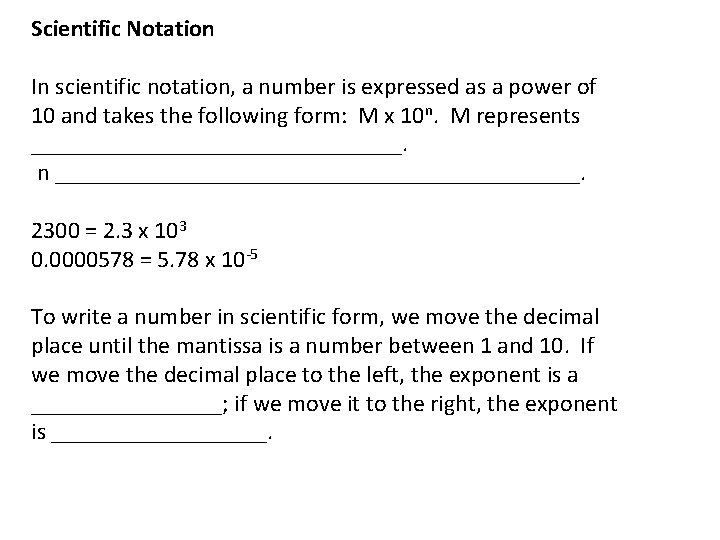
Scientific Notation In scientific notation, a number is expressed as a power of 10 and takes the following form: M x 10 n. M represents ________________. n ______________________. 2300 = 2. 3 x 10³ 0. 0000578 = 5. 78 x 10 -5 To write a number in scientific form, we move the decimal place until the mantissa is a number between 1 and 10. If we move the decimal place to the left, the exponent is a ________; if we move it to the right, the exponent is _________.
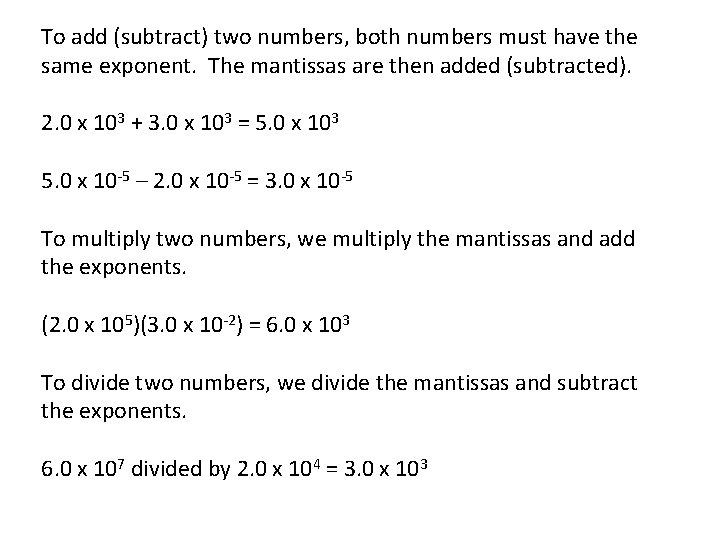
To add (subtract) two numbers, both numbers must have the same exponent. The mantissas are then added (subtracted). 2. 0 x 103 + 3. 0 x 103 = 5. 0 x 103 5. 0 x 10 -5 – 2. 0 x 10 -5 = 3. 0 x 10 -5 To multiply two numbers, we multiply the mantissas and add the exponents. (2. 0 x 105)(3. 0 x 10 -2) = 6. 0 x 103 To divide two numbers, we divide the mantissas and subtract the exponents. 6. 0 x 107 divided by 2. 0 x 104 = 3. 0 x 103
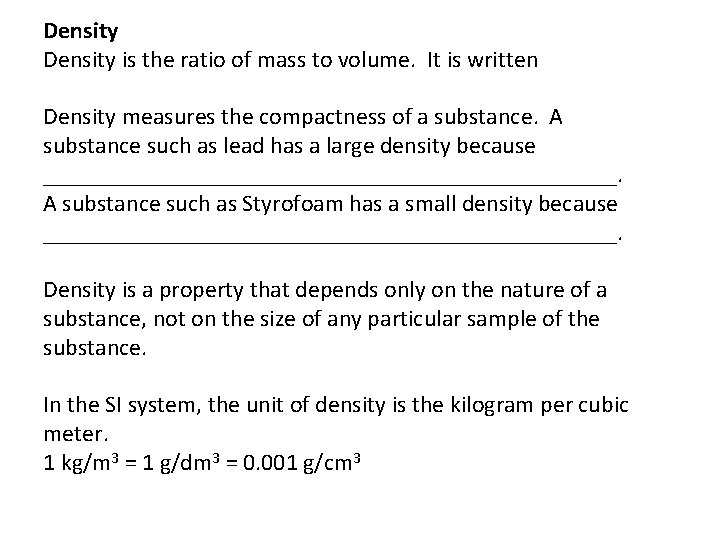
Density is the ratio of mass to volume. It is written Density measures the compactness of a substance. A substance such as lead has a large density because ________________________. A substance such as Styrofoam has a small density because ________________________. Density is a property that depends only on the nature of a substance, not on the size of any particular sample of the substance. In the SI system, the unit of density is the kilogram per cubic meter. 1 kg/m 3 = 1 g/dm 3 = 0. 001 g/cm 3