
RULEBASED CLASSIFIERS Lecture 9 Outline of RuleBased Classification
RULE-BASED CLASSIFIERS Lecture 9
Outline of Rule-Based Classification 1. Overview of the rule based classification 2. Algorithms to build rule-based classification directly 3. Direct Method: RIPPER 4. Build rule-based classification indirectly 5. Contact Lens Example
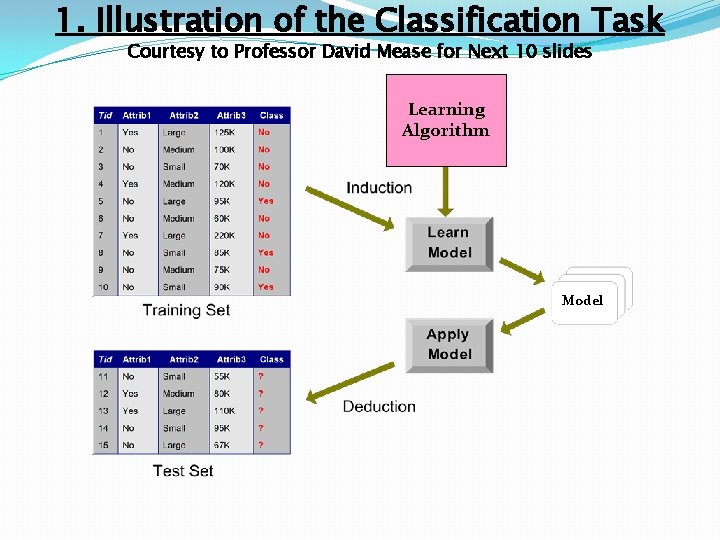
1. Illustration of the Classification Task Courtesy to Professor David Mease for Next 10 slides Learning Algorithm Model
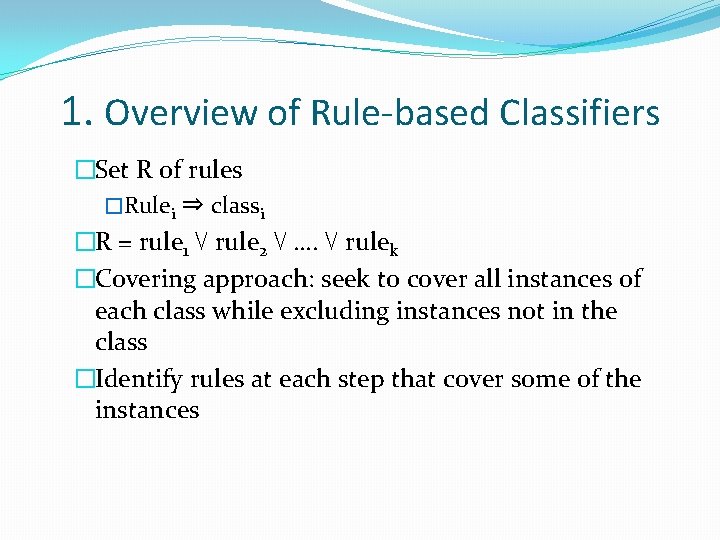
1. Overview of Rule-based Classifiers �Set R of rules �Rulei ⇒ classi �R = rule 1 ⋁ rule 2 ⋁ …. ⋁ rulek �Covering approach: seek to cover all instances of each class while excluding instances not in the class �Identify rules at each step that cover some of the instances
Rule-Based Classifier �Classify records by using a collection of “if…then…” rules �Rule: (Condition) y �where � � Condition is a conjunctions of attributes y is the class label �LHS: rule antecedent or condition �RHS: rule consequent �Examples of classification rules: � (Blood Type=Warm) (Lay Eggs=Yes) Birds � (Taxable Income < 50 K) (Refund=Yes) Evade=No
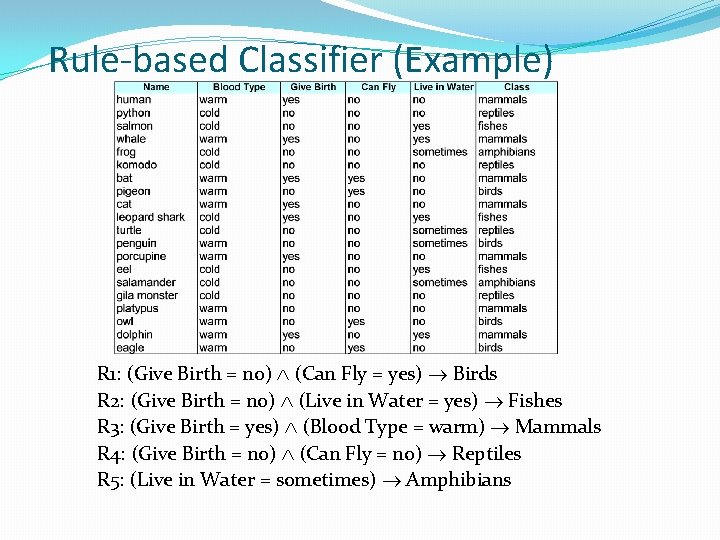
Rule-based Classifier (Example) R 1: (Give Birth = no) (Can Fly = yes) Birds R 2: (Give Birth = no) (Live in Water = yes) Fishes R 3: (Give Birth = yes) (Blood Type = warm) Mammals R 4: (Give Birth = no) (Can Fly = no) Reptiles R 5: (Live in Water = sometimes) Amphibians
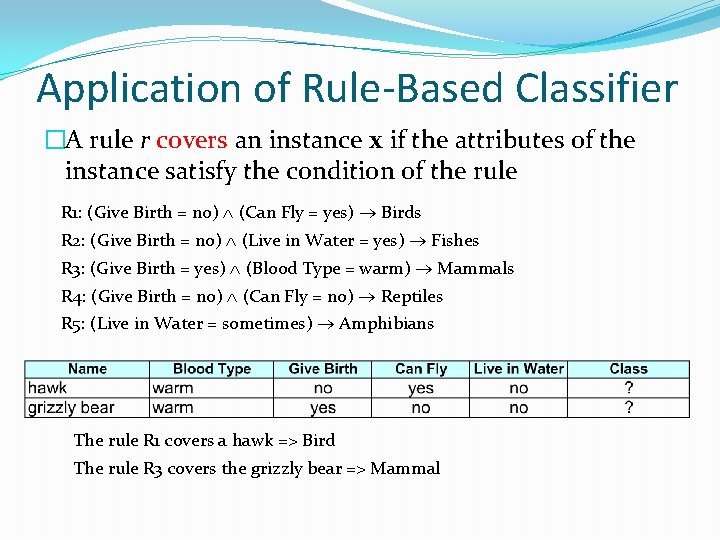
Application of Rule-Based Classifier �A rule r covers an instance x if the attributes of the instance satisfy the condition of the rule R 1: (Give Birth = no) (Can Fly = yes) Birds R 2: (Give Birth = no) (Live in Water = yes) Fishes R 3: (Give Birth = yes) (Blood Type = warm) Mammals R 4: (Give Birth = no) (Can Fly = no) Reptiles R 5: (Live in Water = sometimes) Amphibians The rule R 1 covers a hawk => Bird The rule R 3 covers the grizzly bear => Mammal
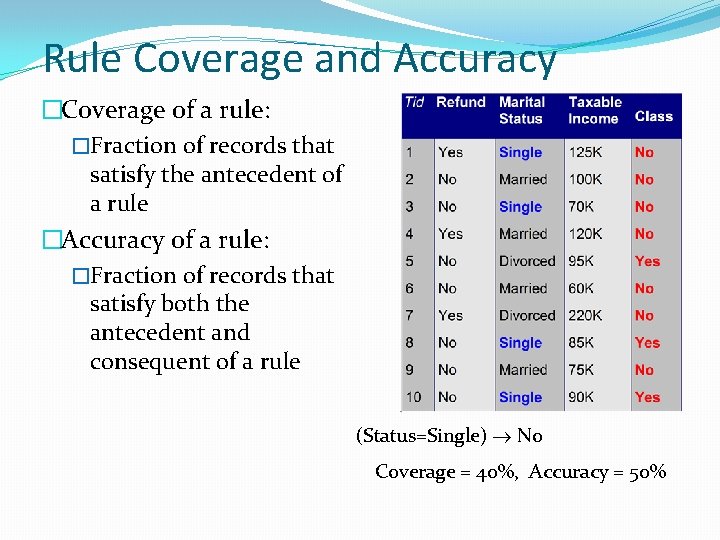
Rule Coverage and Accuracy �Coverage of a rule: �Fraction of records that satisfy the antecedent of a rule �Accuracy of a rule: �Fraction of records that satisfy both the antecedent and consequent of a rule (Status=Single) No Coverage = 40%, Accuracy = 50%
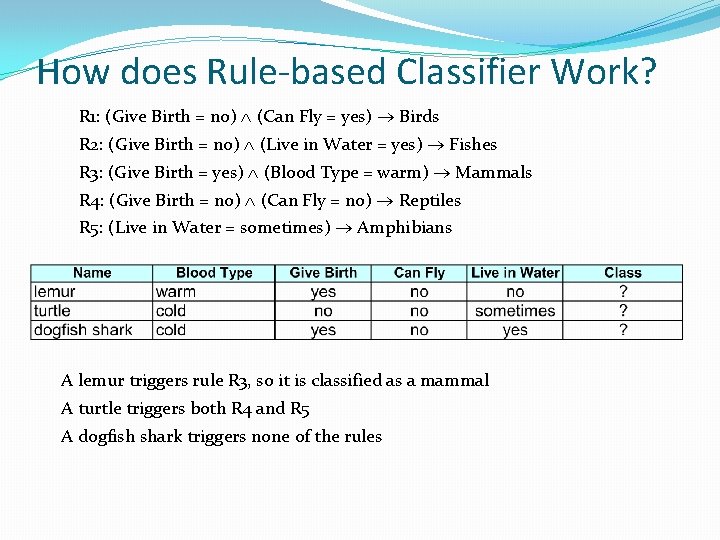
How does Rule-based Classifier Work? R 1: (Give Birth = no) (Can Fly = yes) Birds R 2: (Give Birth = no) (Live in Water = yes) Fishes R 3: (Give Birth = yes) (Blood Type = warm) Mammals R 4: (Give Birth = no) (Can Fly = no) Reptiles R 5: (Live in Water = sometimes) Amphibians A lemur triggers rule R 3, so it is classified as a mammal A turtle triggers both R 4 and R 5 A dogfish shark triggers none of the rules
Characteristics of Rule-Based Classifier �Mutually exclusive rules �Classifier contains mutually exclusive rules if the rules are independent of each other �Every record is covered by at most one rule �Exhaustive rules �Classifier has exhaustive coverage if it accounts for every possible combination of attribute values �Each record is covered by at least one rule
Effect of Rule Simplification �Rules are no longer mutually exclusive �A record may trigger more than one rule �Solution? � � Ordered rule set Unordered rule set – use voting schemes �Rules are no longer exhaustive �A record may not trigger any rules �Solution? � Use a default class
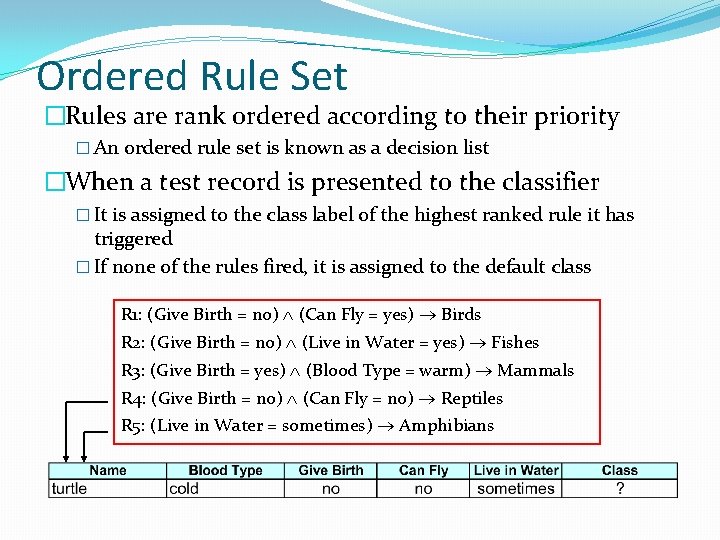
Ordered Rule Set �Rules are rank ordered according to their priority � An ordered rule set is known as a decision list �When a test record is presented to the classifier � It is assigned to the class label of the highest ranked rule it has triggered � If none of the rules fired, it is assigned to the default class R 1: (Give Birth = no) (Can Fly = yes) Birds R 2: (Give Birth = no) (Live in Water = yes) Fishes R 3: (Give Birth = yes) (Blood Type = warm) Mammals R 4: (Give Birth = no) (Can Fly = no) Reptiles R 5: (Live in Water = sometimes) Amphibians
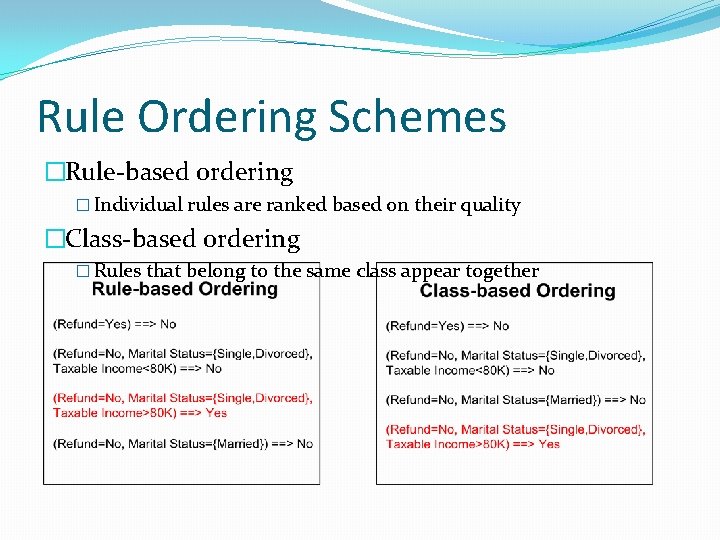
Rule Ordering Schemes �Rule-based ordering � Individual rules are ranked based on their quality �Class-based ordering � Rules that belong to the same class appear together

2. Building Classification Rules �Direct Method: � � Extract rules directly from data e. g. : RIPPER, CN 2, Holte’s 1 R �Indirect Method: � � Extract rules from other classification models (e. g. decision trees, neural networks, etc). e. g: C 4. 5 rules
Direct Method: Sequential Covering 1. 2. 3. 4. Start from an empty rule Grow a rule using the Learn-One-Rule function Remove training records covered by the rule Repeat Step (2) and (3) until stopping criterion is met
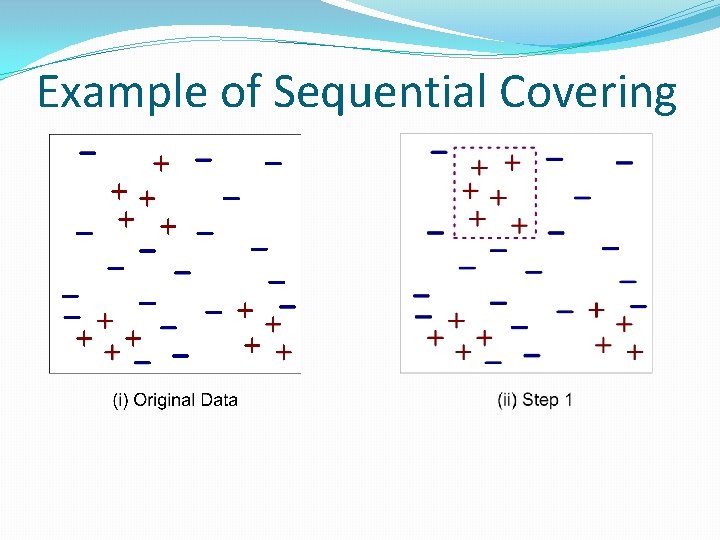
Example of Sequential Covering
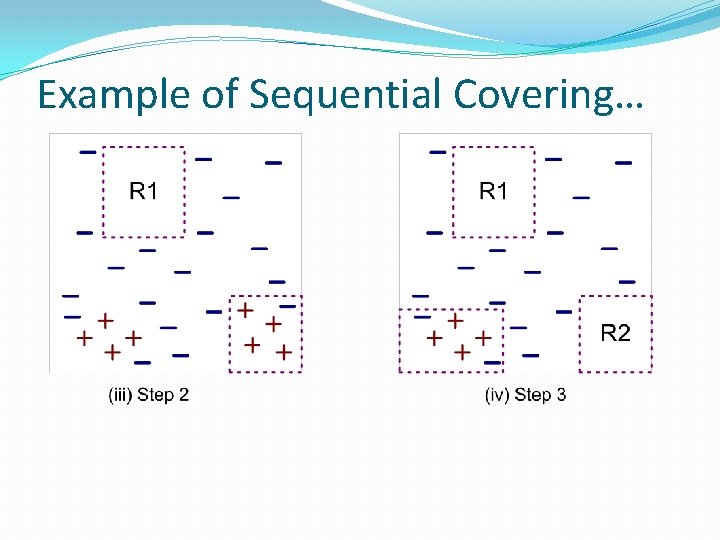
Example of Sequential Covering…
Aspects of Sequential Covering �Rule Growing �Instance Elimination �Rule Evaluation �Stopping Criterion �Rule Pruning
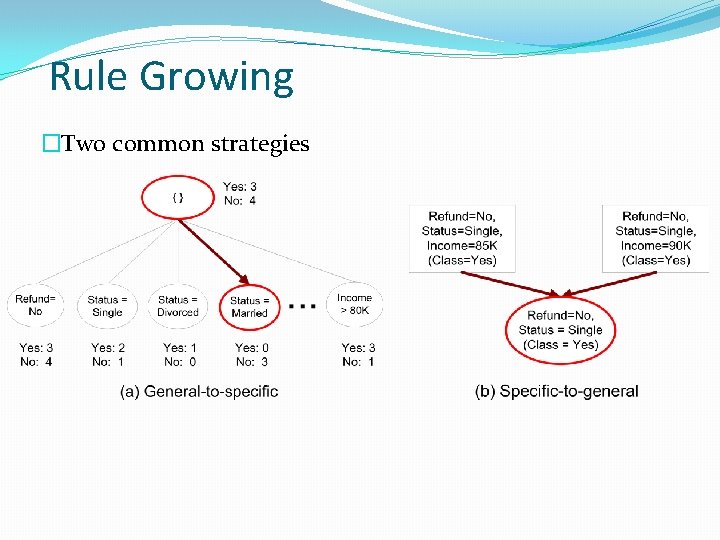
Rule Growing �Two common strategies
Rule Growing (Examples) �CN 2 Algorithm: �Start from an empty conjunct: {} �Add conjuncts that minimizes the entropy measure: {A}, {A, B}, … �Determine the rule consequent by taking majority class of instances covered by the rule
RIPPER Algorithm: �Start from an empty rule: {} => class �Add conjuncts that maximizes FOIL’s information gain measure: � R 0: {} => class (initial rule) � R 1: {A} => class (rule after adding conjunct) � Gain(R 0, R 1) = t [ log (p 1/(p 1+n 1)) – log (p 0/(p 0 + n 0)) ] � where t: number of positive instances covered by both R 0 and R 1 p 0: number of positive instances covered by R 0 n 0: number of negative instances covered by R 0 p 1: number of positive instances covered by R 1 n 1: number of negative instances covered by R 1
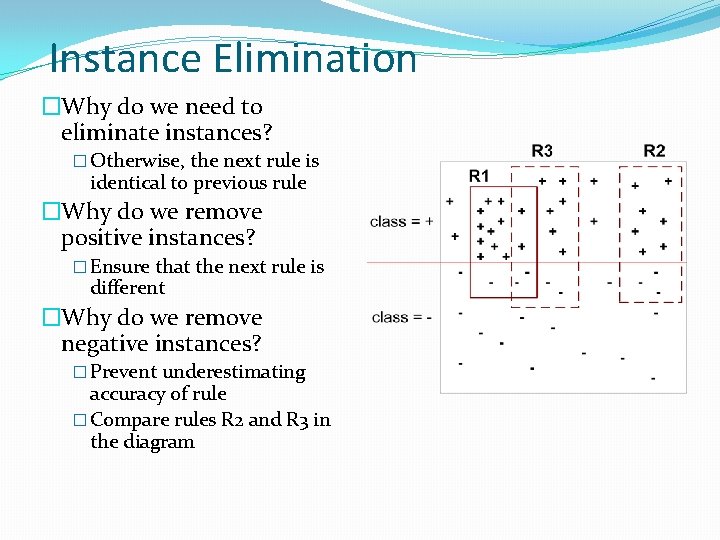
Instance Elimination �Why do we need to eliminate instances? � Otherwise, the next rule is identical to previous rule �Why do we remove positive instances? � Ensure that the next rule is different �Why do we remove negative instances? � Prevent underestimating accuracy of rule � Compare rules R 2 and R 3 in the diagram
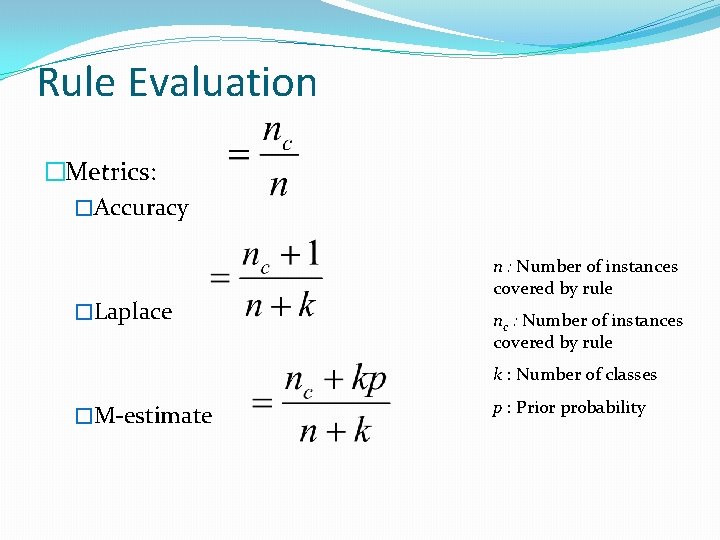
Rule Evaluation �Metrics: �Accuracy �Laplace n : Number of instances covered by rule nc : Number of instances covered by rule k : Number of classes �M-estimate p : Prior probability
Stopping Criterion and Rule Pruning �Stopping criterion �Compute the gain �If gain is not significant, discard the new rule �Rule Pruning �Similar to post-pruning of decision trees �Reduced Error Pruning: Remove one of the conjuncts in the rule � Compare error rate on validation set before and after pruning � If error improves, prune the conjunct �
Summary of Direct Method �Grow a single rule �Remove Instances from rule �Prune the rule (if necessary) �Add rule to Current Rule Set �Repeat
3. Direct Method: RIPPER �For 2 -class problem, choose one of the classes as positive class, and the other as negative class �Learn rules for positive class �Negative class will be default class �For multi-class problem �Order the classes according to increasing class prevalence (fraction of instances that belong to a particular class) �Learn the rule set for smallest class first, treat the rest as negative class �Repeat with next smallest class as positive class
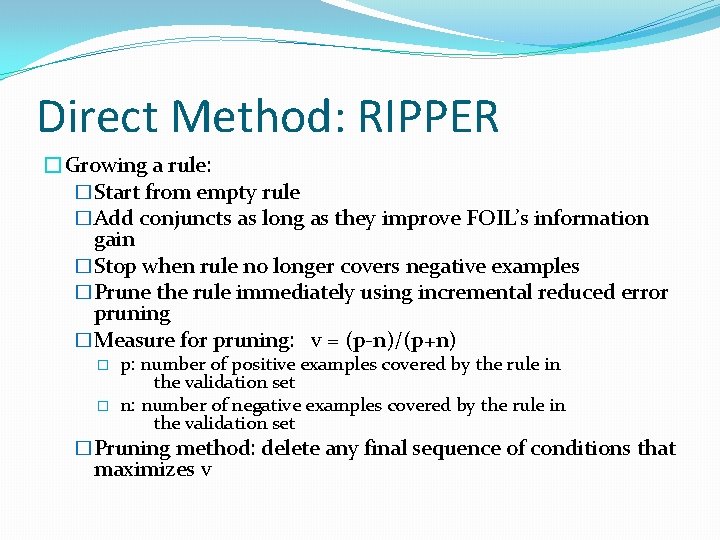
Direct Method: RIPPER �Growing a rule: �Start from empty rule �Add conjuncts as long as they improve FOIL’s information gain �Stop when rule no longer covers negative examples �Prune the rule immediately using incremental reduced error pruning �Measure for pruning: v = (p-n)/(p+n) � � p: number of positive examples covered by the rule in the validation set n: number of negative examples covered by the rule in the validation set �Pruning method: delete any final sequence of conditions that maximizes v
Direct Method: RIPPER �Building a Rule Set: �Use sequential covering algorithm Finds the best rule that covers the current set of positive examples � Eliminate both positive and negative examples covered by the rule � �Each time a rule is added to the rule set, compute the new description length � stop adding new rules when the new description length is d bits longer than the smallest description length obtained so far
Direct Method: RIPPER �Optimize the rule set: �For each rule r in the rule set R � � � Consider 2 alternative rules: � Replacement rule (r*): grow new rule from scratch � Revised rule(r’): add conjuncts to extend the rule r Compare the rule set for r against the rule set for r* and r’ Choose rule set that minimizes MDL principle �Repeat rule generation and rule optimization for the remaining positive examples
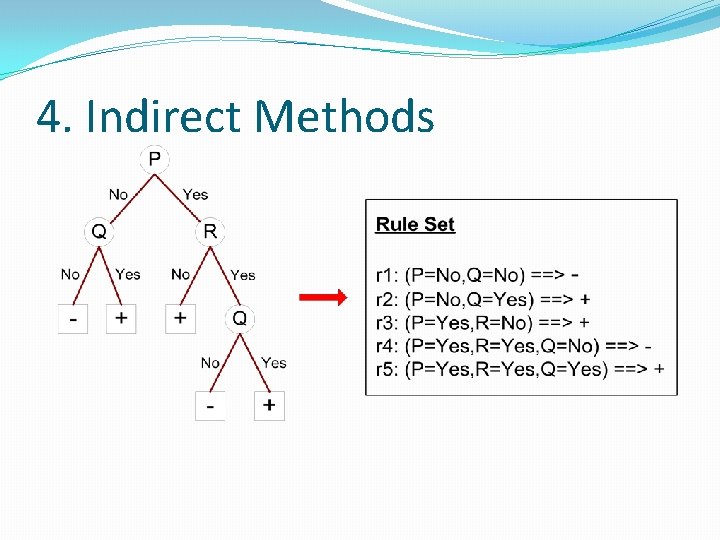
4. Indirect Methods
Indirect Method: C 4. 5 rules �Extract rules from an unpruned decision tree �For each rule, r: A y, �consider an alternative rule r’: A’ y where A’ is obtained by removing one of the conjuncts in A �Compare the pessimistic error rate for r against all r’s �Prune if one of the r’s has lower pessimistic error rate �Repeat until we can no longer improve generalization error
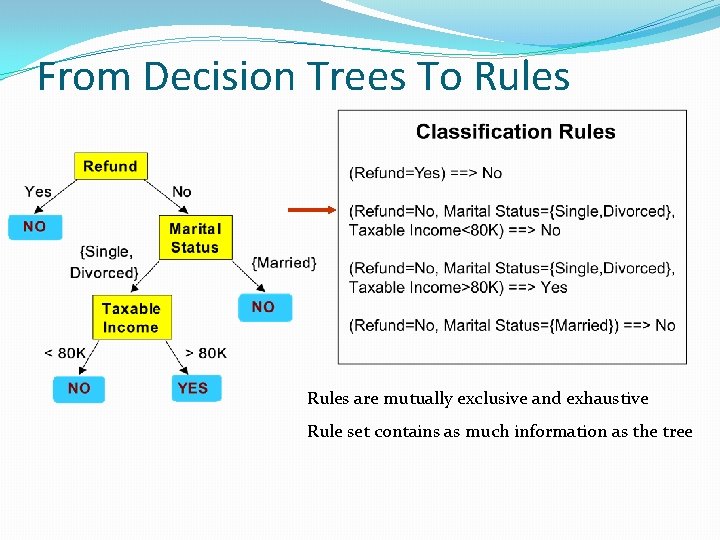
From Decision Trees To Rules are mutually exclusive and exhaustive Rule set contains as much information as the tree
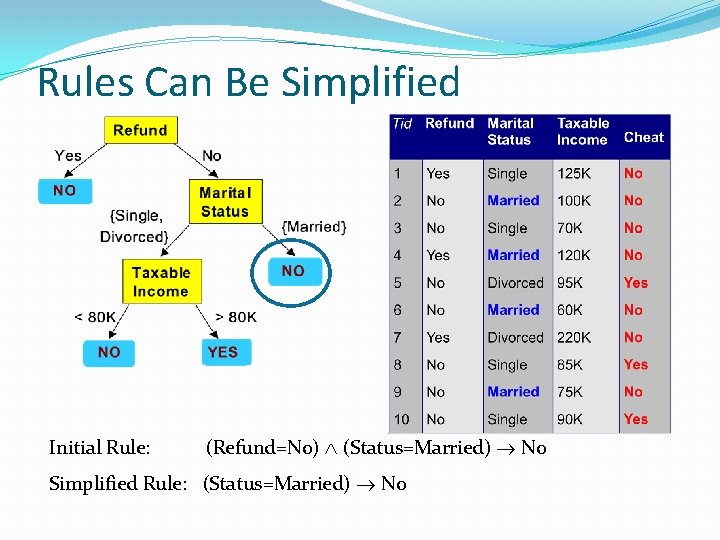
Rules Can Be Simplified Initial Rule: (Refund=No) (Status=Married) No Simplified Rule: (Status=Married) No
Indirect Method: C 4. 5 rules �Instead of ordering the rules, order subsets of rules (class ordering) �Each subset is a collection of rules with the same rule consequent (class) �Compute description length of each subset Description length = L(error) + g L(model) � g is a parameter that takes into account the presence of redundant attributes in a rule set (default value = 0. 5) �
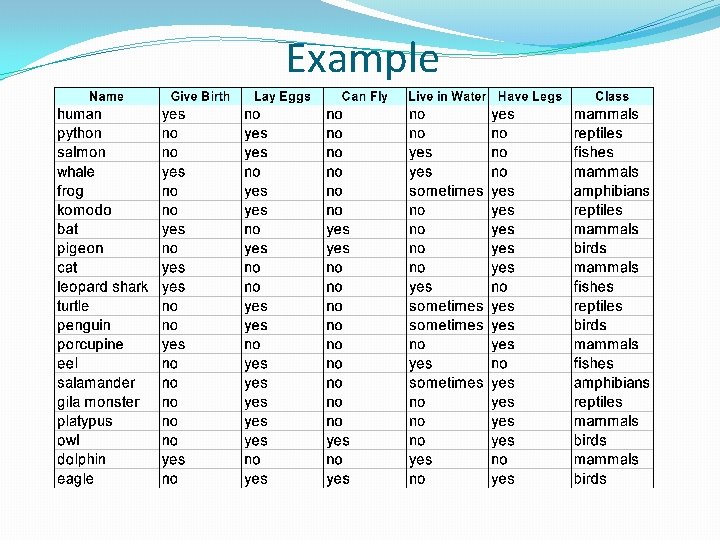
Example
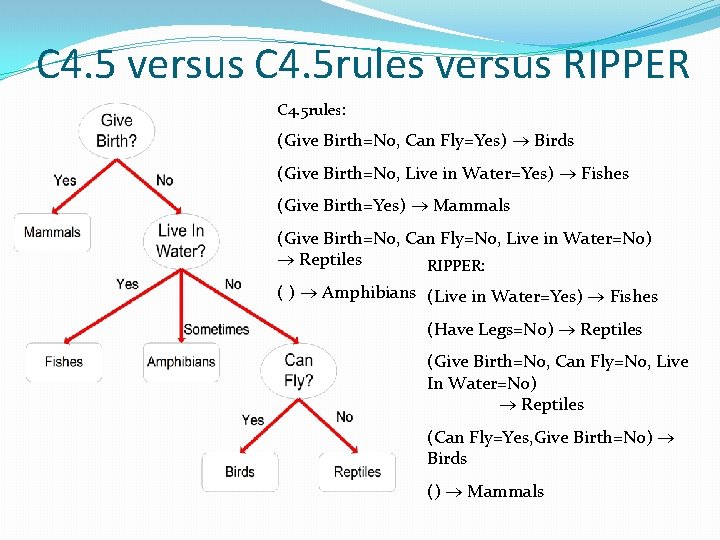
C 4. 5 versus C 4. 5 rules versus RIPPER C 4. 5 rules: (Give Birth=No, Can Fly=Yes) Birds (Give Birth=No, Live in Water=Yes) Fishes (Give Birth=Yes) Mammals (Give Birth=No, Can Fly=No, Live in Water=No) Reptiles RIPPER: ( ) Amphibians (Live in Water=Yes) Fishes (Have Legs=No) Reptiles (Give Birth=No, Can Fly=No, Live In Water=No) Reptiles (Can Fly=Yes, Give Birth=No) Birds () Mammals
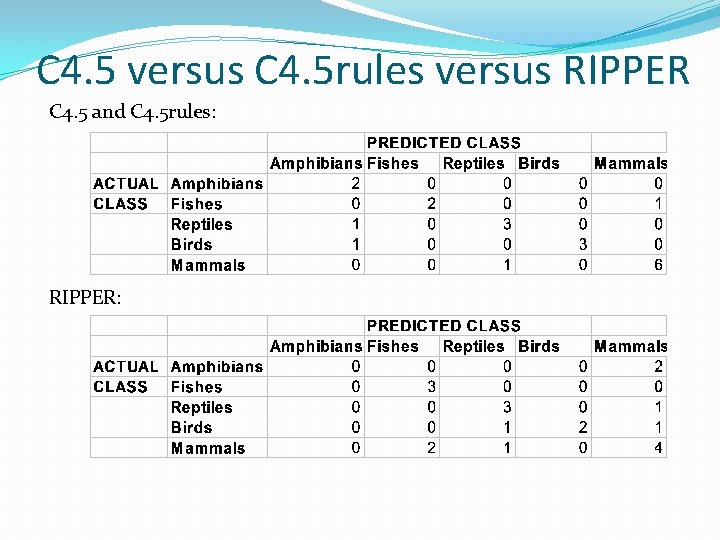
C 4. 5 versus C 4. 5 rules versus RIPPER C 4. 5 and C 4. 5 rules: RIPPER:
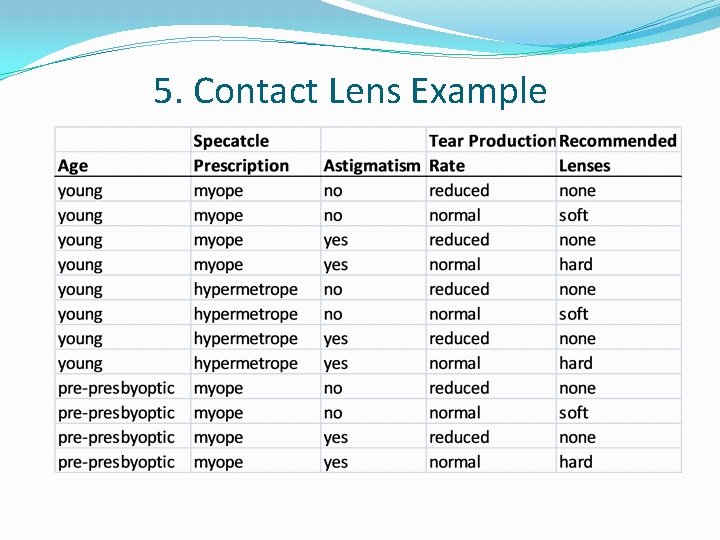
5. Contact Lens Example
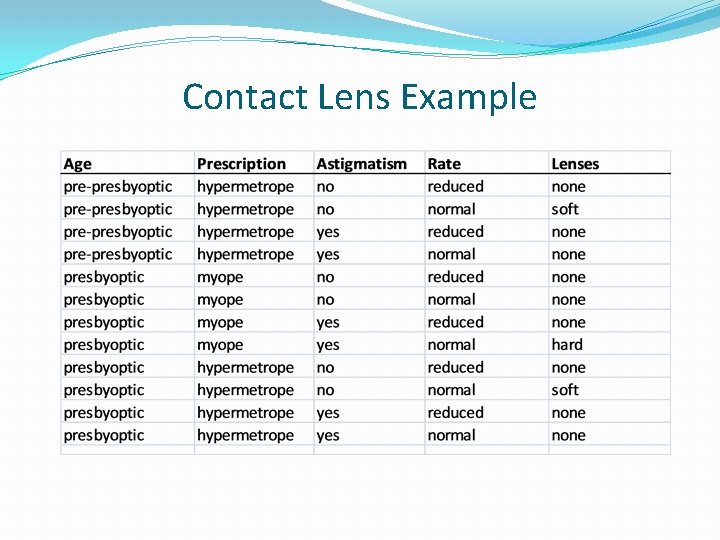
Contact Lens Example
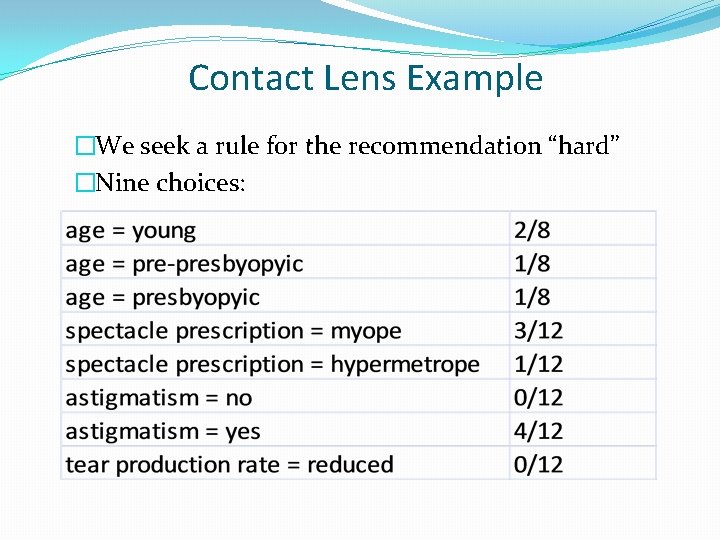
Contact Lens Example �We seek a rule for the recommendation “hard” �Nine choices:
Contact Lens Example �Select largest fraction 4/12 �In cases of ties, select either one at random – we choose astimagatism �Current rule: �If astigmatism = yes �Then recommendation = hard �Desire more accurate rule since our rule gets only 4 instances correct out of 12
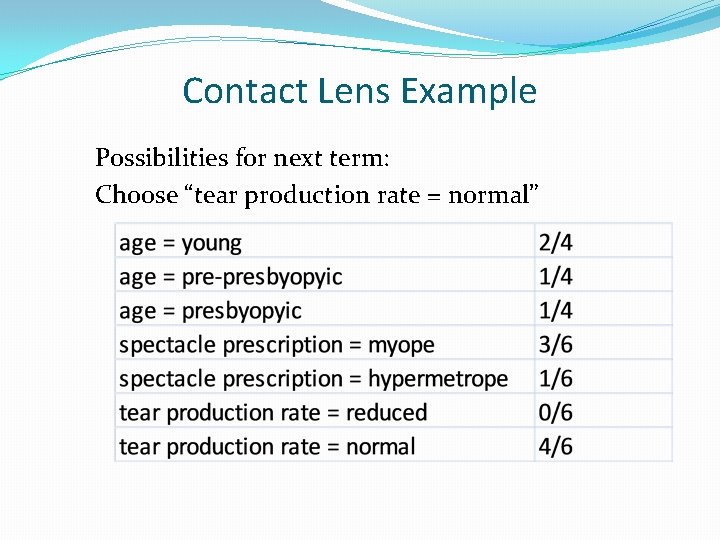
Contact Lens Example Possibilities for next term: Choose “tear production rate = normal”
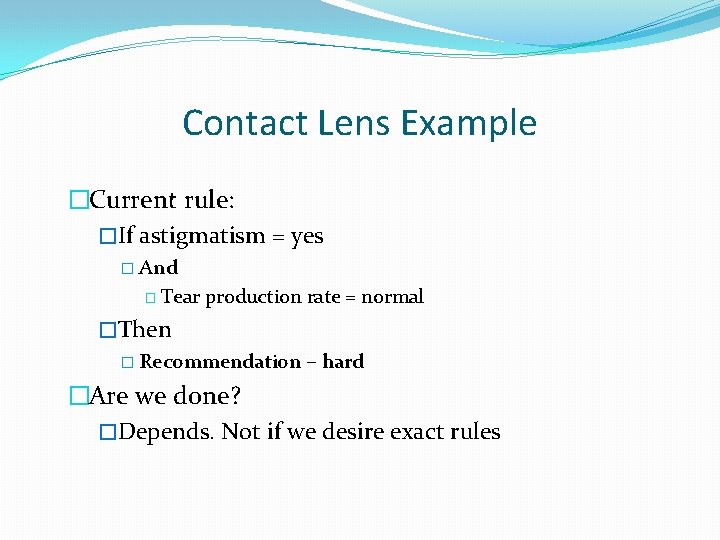
Contact Lens Example �Current rule: �If astigmatism = yes � And � Tear production rate = normal �Then � Recommendation – hard �Are we done? �Depends. Not if we desire exact rules
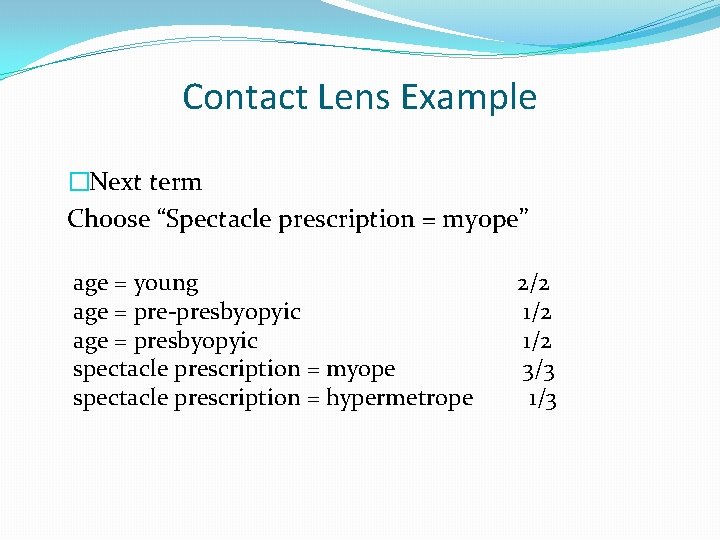
Contact Lens Example �Next term Choose “Spectacle prescription = myope” age = young age = pre-presbyopyic age = presbyopyic spectacle prescription = myope spectacle prescription = hypermetrope 2/2 1/2 3/3 1/3
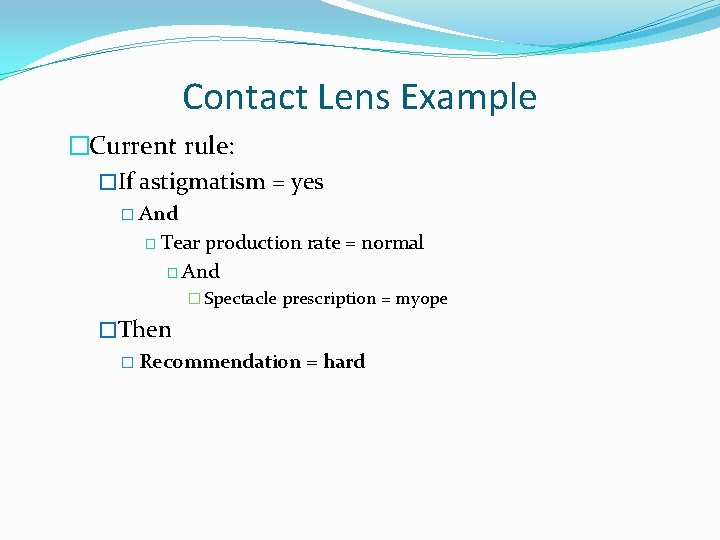
Contact Lens Example �Current rule: �If astigmatism = yes � And � Tear production rate = normal � And � Spectacle prescription = myope �Then � Recommendation = hard
Contact Lens Example �Are we done? �Yes, with this rule, but it does not cover all the instances of hard contact lenses. �We remove three recommendations of hard contact lenses, in our original set, and begin anew seeking another rule for the remaining instance of hard
Contact Lens Example �We obtain �If age = young � And � Astigmatism = yes � And � Tear production rate = normal �Then � Recommendation = hard
Contact Lens Example �Repeat process for soft-lens �And yet again for none �PRISM method �Generates only perfect rules with accuracy 100% �Adds clauses to each rule until it is perfect
Characteristics of Rule-based Classifiers �Similar expressions to those of decision trees �Both rule-based classifiers and decision trees create rectilinear partitions of the attribute space and assign classes to each partition �Divide and conquer (top down) versus separate and conquer (bottom up) �Comparable performance to decision trees
- Slides: 49