
Rule Induction Overview Generic separateandconquer strategy CN 2
- Slides: 14
Rule Induction Overview • Generic separate-and-conquer strategy • CN 2 rule induction algorithm • Improvements to rule induction
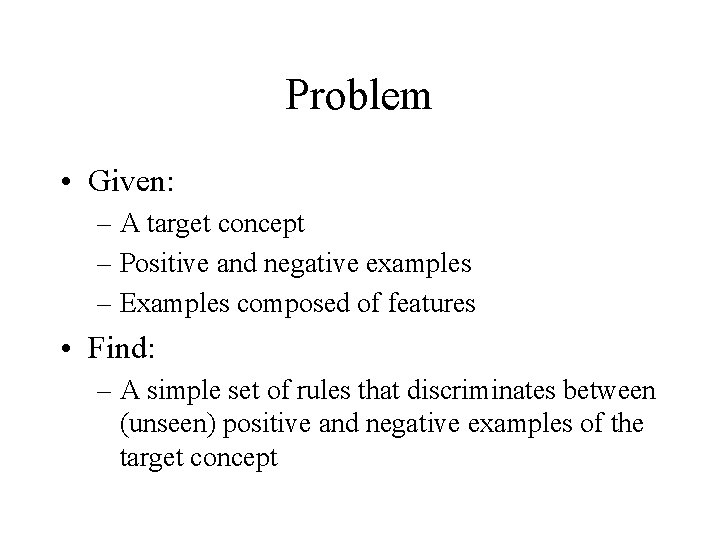
Problem • Given: – A target concept – Positive and negative examples – Examples composed of features • Find: – A simple set of rules that discriminates between (unseen) positive and negative examples of the target concept
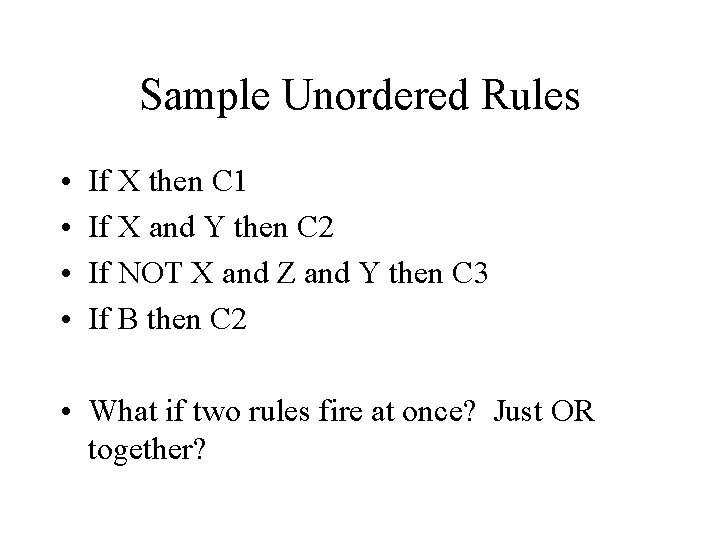
Sample Unordered Rules • • If X then C 1 If X and Y then C 2 If NOT X and Z and Y then C 3 If B then C 2 • What if two rules fire at once? Just OR together?
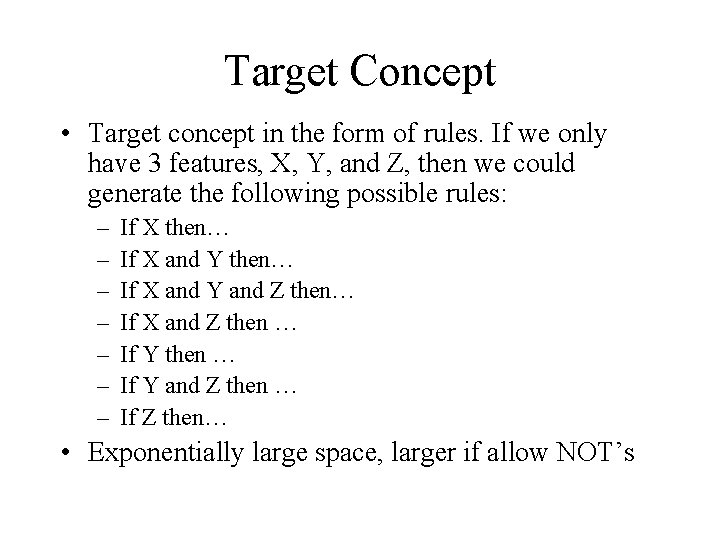
Target Concept • Target concept in the form of rules. If we only have 3 features, X, Y, and Z, then we could generate the following possible rules: – – – – If X then… If X and Y and Z then… If X and Z then … If Y and Z then … If Z then… • Exponentially large space, larger if allow NOT’s
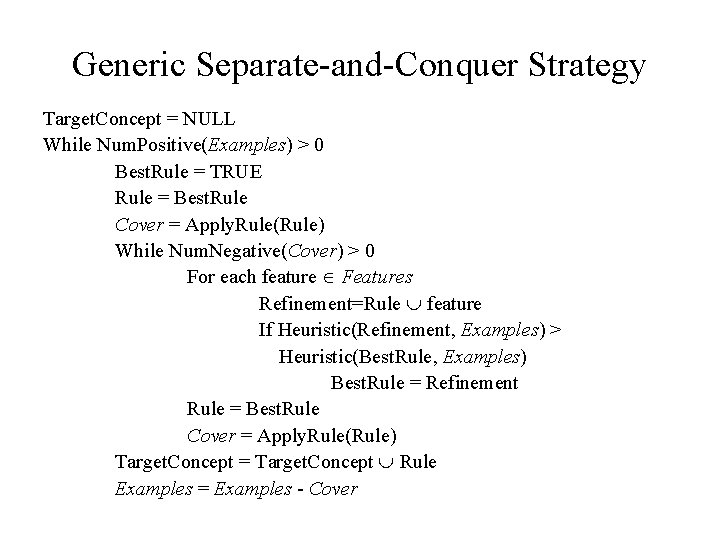
Generic Separate-and-Conquer Strategy Target. Concept = NULL While Num. Positive(Examples) > 0 Best. Rule = TRUE Rule = Best. Rule Cover = Apply. Rule(Rule) While Num. Negative(Cover) > 0 For each feature Î Features Refinement=Rule È feature If Heuristic(Refinement, Examples) > Heuristic(Best. Rule, Examples) Best. Rule = Refinement Rule = Best. Rule Cover = Apply. Rule(Rule) Target. Concept = Target. Concept È Rule Examples = Examples - Cover
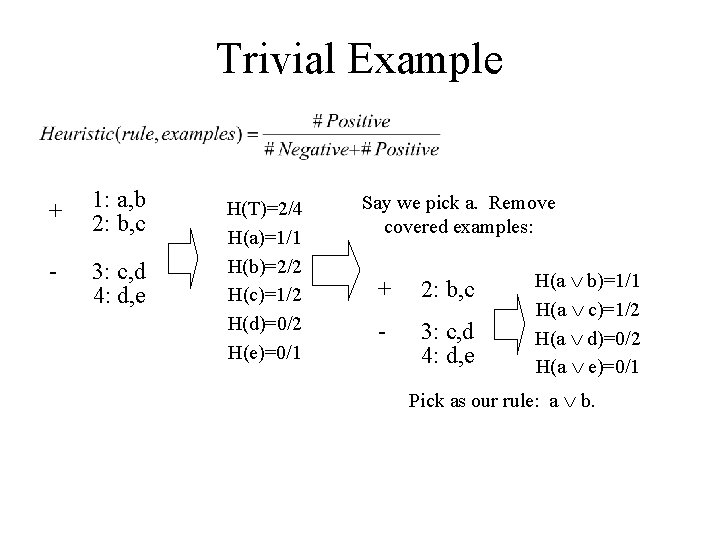
Trivial Example + 1: a, b 2: b, c - 3: c, d 4: d, e H(T)=2/4 H(a)=1/1 H(b)=2/2 H(c)=1/2 H(d)=0/2 H(e)=0/1 Say we pick a. Remove covered examples: + 2: b, c - 3: c, d 4: d, e H(a Ú b)=1/1 H(a Ú c)=1/2 H(a Ú d)=0/2 H(a Ú e)=0/1 Pick as our rule: a Ú b.
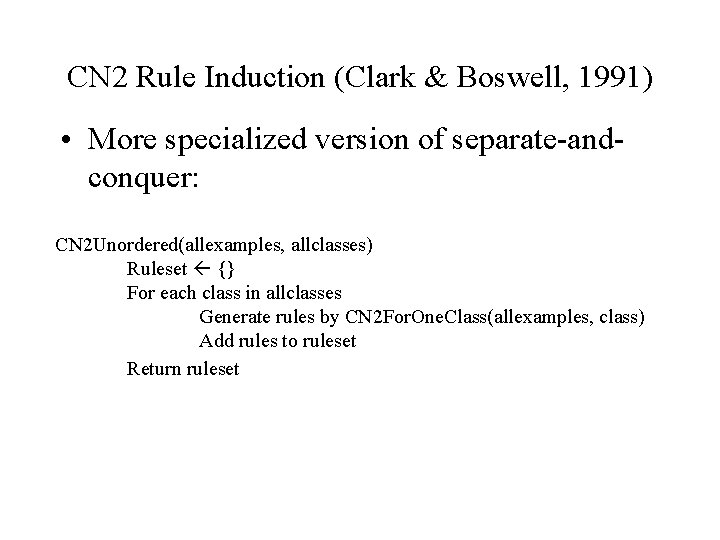
CN 2 Rule Induction (Clark & Boswell, 1991) • More specialized version of separate-andconquer: CN 2 Unordered(allexamples, allclasses) Ruleset {} For each class in allclasses Generate rules by CN 2 For. One. Class(allexamples, class) Add rules to ruleset Return ruleset
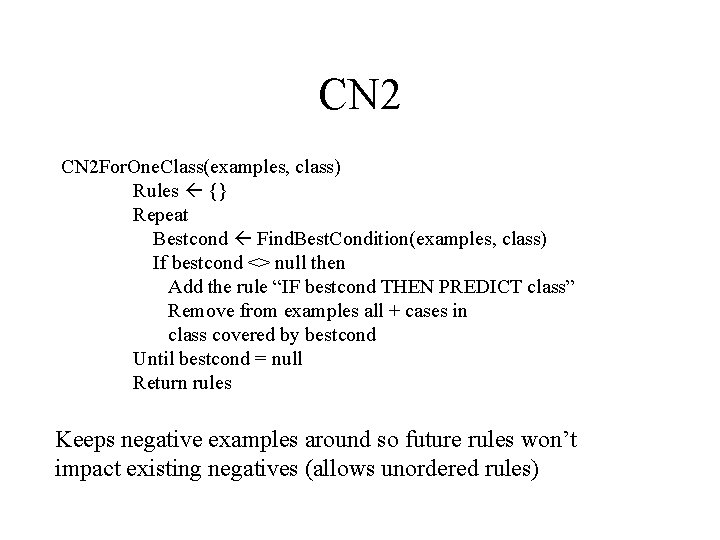
CN 2 For. One. Class(examples, class) Rules {} Repeat Bestcond Find. Best. Condition(examples, class) If bestcond <> null then Add the rule “IF bestcond THEN PREDICT class” Remove from examples all + cases in class covered by bestcond Until bestcond = null Return rules Keeps negative examples around so future rules won’t impact existing negatives (allows unordered rules)
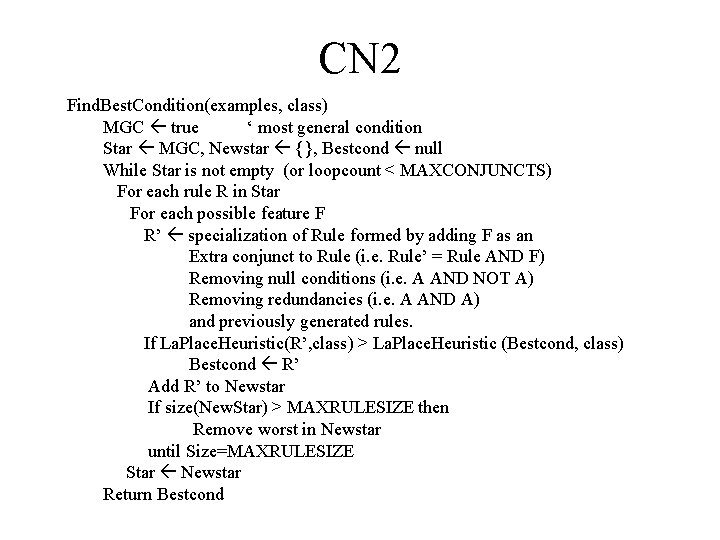
CN 2 Find. Best. Condition(examples, class) MGC true ‘ most general condition Star MGC, Newstar {}, Bestcond null While Star is not empty (or loopcount < MAXCONJUNCTS) For each rule R in Star For each possible feature F R’ specialization of Rule formed by adding F as an Extra conjunct to Rule (i. e. Rule’ = Rule AND F) Removing null conditions (i. e. A AND NOT A) Removing redundancies (i. e. A AND A) and previously generated rules. If La. Place. Heuristic(R’, class) > La. Place. Heuristic (Bestcond, class) Bestcond R’ Add R’ to Newstar If size(New. Star) > MAXRULESIZE then Remove worst in Newstar until Size=MAXRULESIZE Star Newstar Return Bestcond
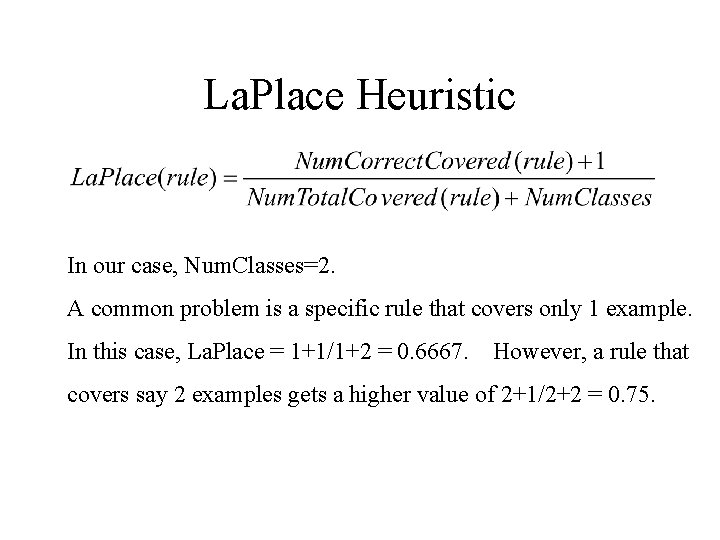
La. Place Heuristic In our case, Num. Classes=2. A common problem is a specific rule that covers only 1 example. In this case, La. Place = 1+1/1+2 = 0. 6667. However, a rule that covers say 2 examples gets a higher value of 2+1/2+2 = 0. 75.
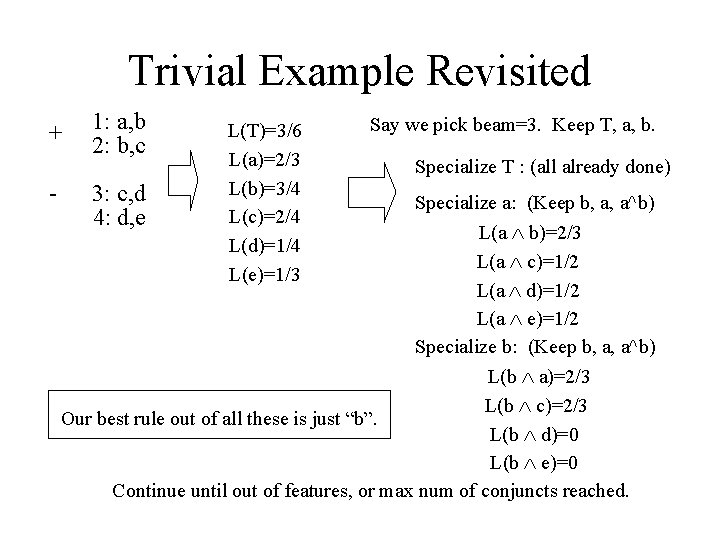
Trivial Example Revisited + - 1: a, b 2: b, c 3: c, d 4: d, e L(T)=3/6 L(a)=2/3 L(b)=3/4 L(c)=2/4 L(d)=1/4 L(e)=1/3 Say we pick beam=3. Keep T, a, b. Specialize T : (all already done) Specialize a: (Keep b, a, a^b) L(a Ù b)=2/3 L(a Ù c)=1/2 L(a Ù d)=1/2 L(a Ù e)=1/2 Specialize b: (Keep b, a, a^b) L(b Ù a)=2/3 L(b Ù c)=2/3 Our best rule out of all these is just “b”. L(b Ù d)=0 L(b Ù e)=0 Continue until out of features, or max num of conjuncts reached.
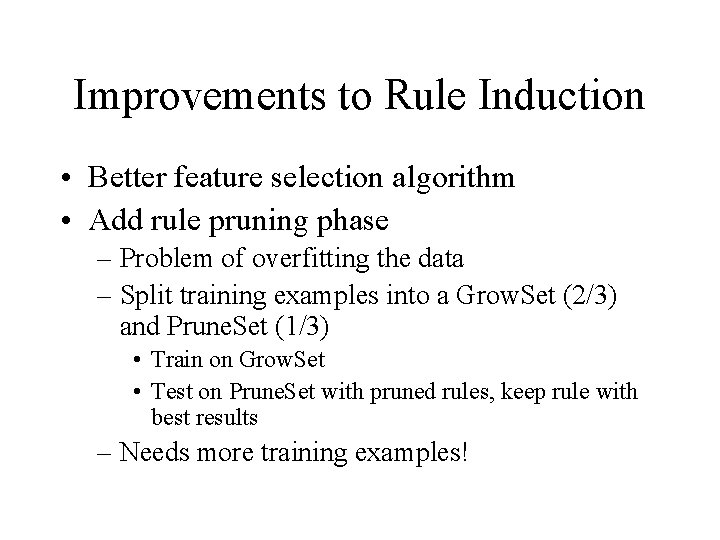
Improvements to Rule Induction • Better feature selection algorithm • Add rule pruning phase – Problem of overfitting the data – Split training examples into a Grow. Set (2/3) and Prune. Set (1/3) • Train on Grow. Set • Test on Prune. Set with pruned rules, keep rule with best results – Needs more training examples!
Improvements to Rule Induction • Ripper / Slipper – Rule induction with pruning, new heuristics on when to stop adding rules, prune rules – Slipper builds on Ripper, but uses boosting to reduce weight of negative examples instead of removing them entirely • Other search approaches – Instead of beam search, genetic, pure hill climbing (would be faster), etc.
In-Class VB Demo • Rule Induction for Multiplexer