
RUBRICS FOR EVALUATI ON Presented by Joshua M
RUBRICS FOR EVALUATI ON Presented by: Joshua M. Repomanta 2009 -41279 B Secondary Education
RUBRICS FOR EVALUATION q TOPIC OUTLINE Rubrics: Structures and Functions Using Rubrics for Educational Purposes q q Creating Rubrics Online Resources for Rubrics q
RUBRICS: STRUCTURES AND FUNCTIONS Rubrics: DEFINITION “Rubrics are performance-based assessments that evaluate student performance on any given task or set of tasks that ultimately leads to a final product, or learning outcome. ” (Why Use Rubrics, 2011)
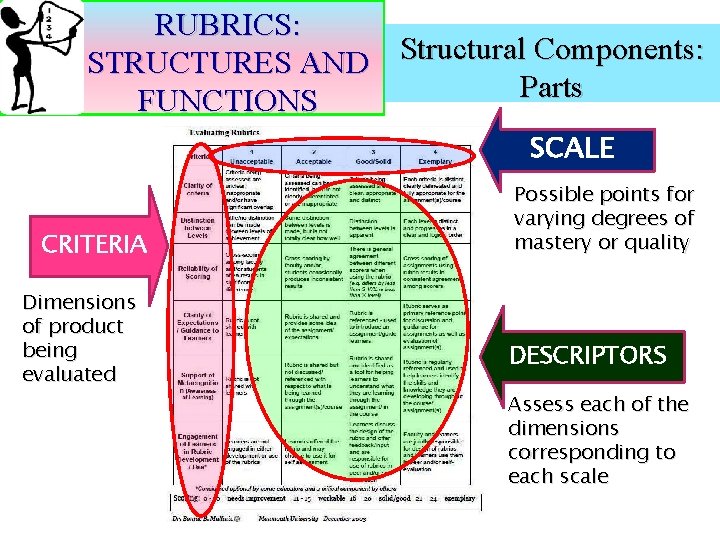
RUBRICS: Structural Components: STRUCTURES AND Parts FUNCTIONS SCALE CRITERIA Dimensions of product being evaluated Possible points for varying degrees of mastery or quality DESCRIPTORS Assess each of the dimensions corresponding to each scale
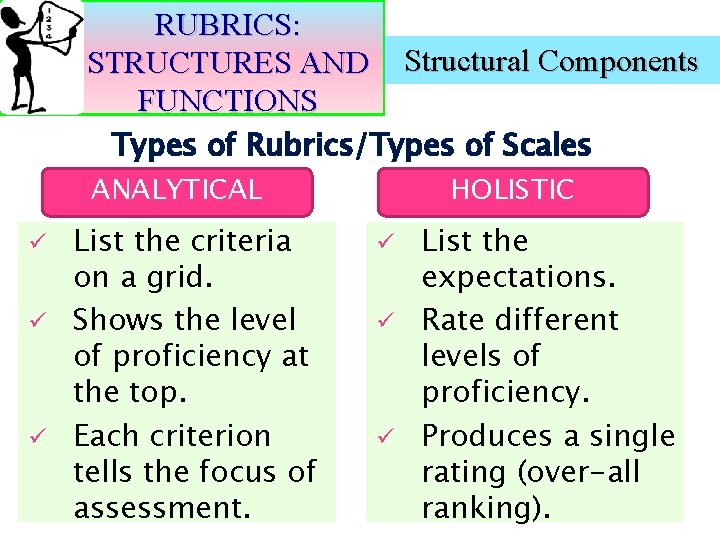
RUBRICS: STRUCTURES AND FUNCTIONS Structural Components Types of Rubrics/Types of Scales ANALYTICAL List the criteria on a grid. ü Shows the level of proficiency at the top. ü Each criterion tells the focus of assessment. ü HOLISTIC List the expectations. ü Rate different levels of proficiency. ü Produces a single rating (over-all ranking). ü
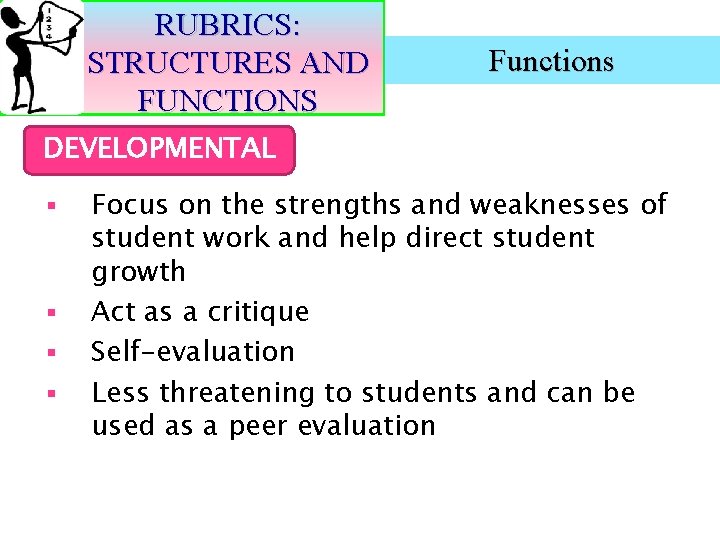
RUBRICS: STRUCTURES AND FUNCTIONS Functions DEVELOPMENTAL § § Focus on the strengths and weaknesses of student work and help direct student growth Act as a critique Self-evaluation Less threatening to students and can be used as a peer evaluation
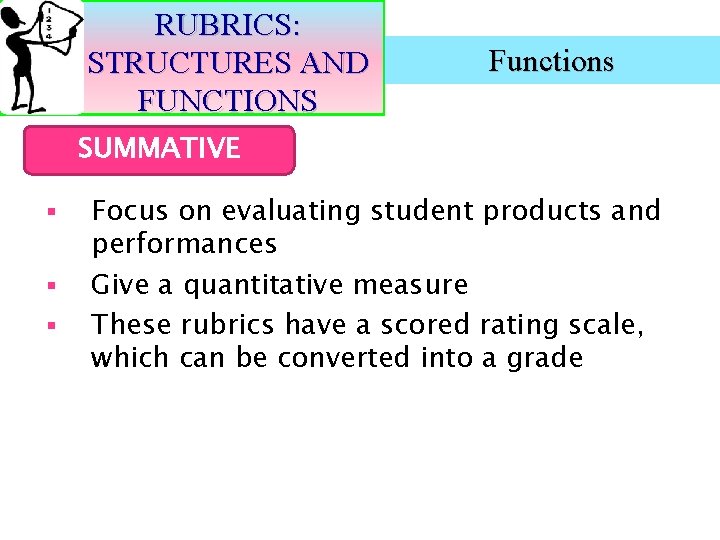
RUBRICS: STRUCTURES AND FUNCTIONS Functions SUMMATIVE § § § Focus on evaluating student products and performances Give a quantitative measure These rubrics have a scored rating scale, which can be converted into a grade
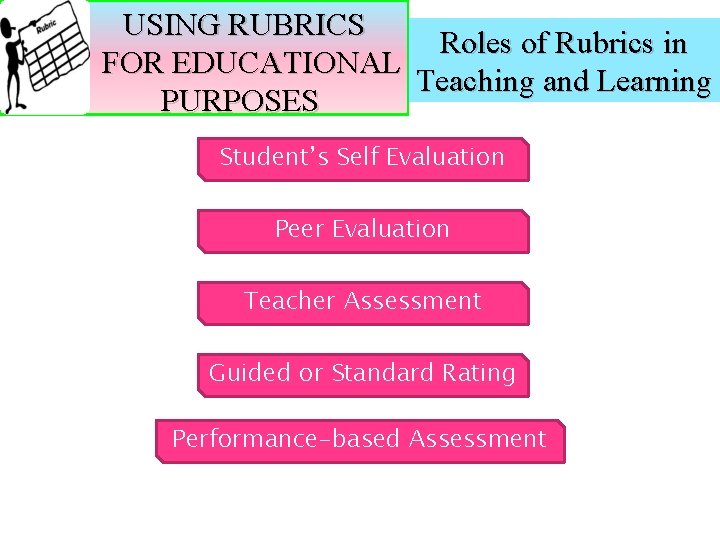
USING RUBRICS Roles of Rubrics in FOR EDUCATIONAL Teaching and Learning PURPOSES Student’s Self Evaluation Peer Evaluation Teacher Assessment Guided or Standard Rating Performance-based Assessment
USING RUBRICS FOR EDUCATIONAL PURPOSES Assessment is a process of information gathering about the characteristics of learners through tests or tasks. § § Roles of Rubrics in Assessment Teachers can evaluate or assess student performance or proficiency in any given task Provide valuable information about the degree to which a student has achieved a defined learning outcome
USING RUBRICS FOR EDUCATIONAL PURPOSES At times, performancebased assessment has been used interchangeably with "authentic assessment" and "alternative assessment. "” Performance-based Assessment Performance-based tasks require performance-based assessments in which the actual student performance is assessed through a product, such as a completed project or work that demonstrates levels of task achievement.
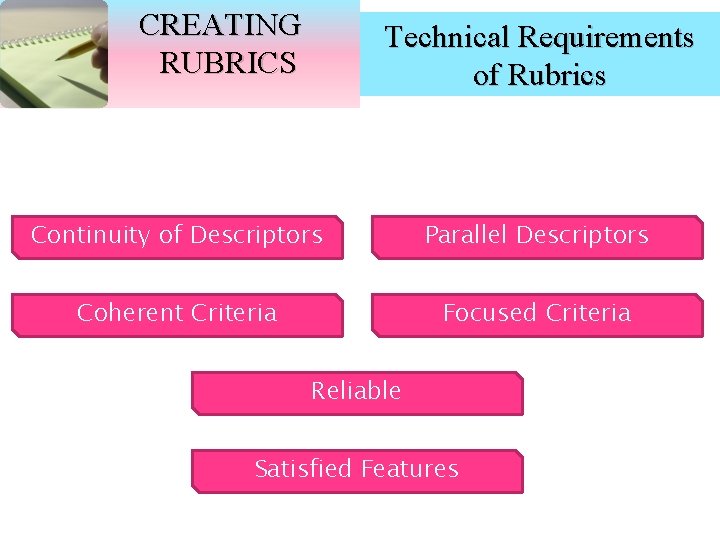
CREATING RUBRICS Technical Requirements of Rubrics Continuity of Descriptors Parallel Descriptors Coherent Criteria Focused Criteria Reliable Satisfied Features
CREATING RUBRICS Features of Rubrics Focus on measuring a stated objective (performance, behavior or quality) ü Use a range to rate performance ü Contain specific performance characteristics arranged in levels indicating the degree to which a standard has been met ü
CREATING RUBRICS Characteristics of Effective Rubrics ü Reflect the most significant elements related to success in a learning task. ü Enable students and teachers to accurately and consistently identify the level of competency or stage of development. ü Help teachers grade students' work more accurately and fairly.
CREATING RUBRICS Characteristics of Effective Rubrics Encourage students' self-evaluation and higher expectations. Are shared with students prior to beginning the task so they know the characteristics of quality work. Provide more information than just a narrow checklist of skills and attributes.
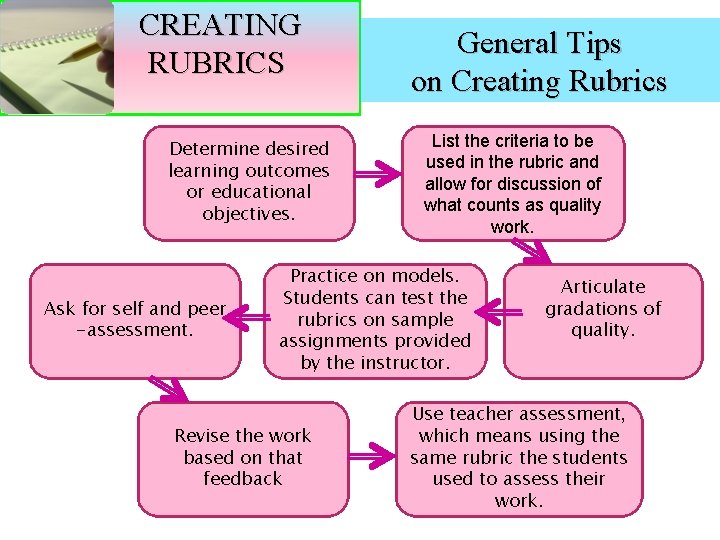
CREATING RUBRICS Determine desired learning outcomes or educational objectives. Ask for self and peer -assessment. General Tips on Creating Rubrics List the criteria to be used in the rubric and allow for discussion of what counts as quality work. Practice on models. Students can test the rubrics on sample assignments provided by the instructor. Revise the work based on that feedback Articulate gradations of quality. Use teacher assessment, which means using the same rubric the students used to assess their work.
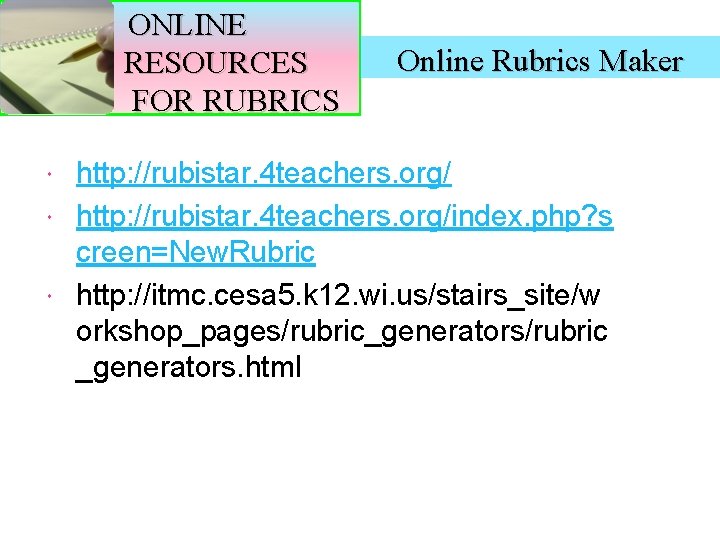
ONLINE RESOURCES FOR RUBRICS Online Rubrics Maker http: //rubistar. 4 teachers. org/index. php? s creen=New. Rubric http: //itmc. cesa 5. k 12. wi. us/stairs_site/w orkshop_pages/rubric_generators/rubric _generators. html
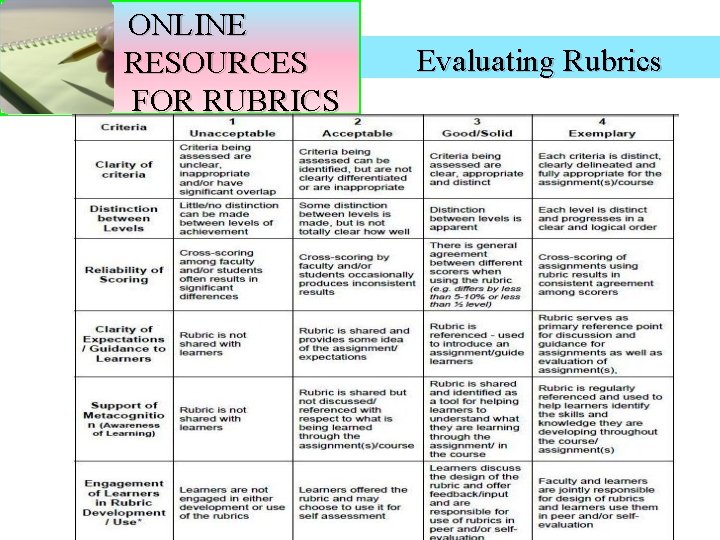
ONLINE RESOURCES FOR RUBRICS Evaluating Rubrics
References Andrade, H. G. (2001). The Effects of Instructional Rubrics on Learning to Write. Current Issues in Education , 4 -21. Coil, Carolyn and Merritt, Dodie. Solving the Assessment Puzzle Piece by Piece, Marion, IL, Pieces of Learning, 2001. (Merritt, 2011) Hayden, K. (2011, January 31). Rubrics in the Classroom. Retrieved January 31, 2011, from Admax Network: G: educ 190rubrics for evaluationrubrics-in-the-classroom-a 31022. htm Merritt, C. C. (2011). Solving the Assessment Puzzle Piece by Piece. Illinois: Pieces of Learning. Rubrics (academic). (2011, January 23). Retrieved January 31, 2011, from Wikipedia The Free Encyclopedia: http: //wikipedia. org/en/rubrics(academic) Why Use Rubrics. (2011, January 30). Retrieved January 31, 2011, from Teachnology: file: ///G: /educ%20190/rubrics%20 for%20 evaluation/Why%20 Rubric s. htm
- Slides: 18