
Rubrics Educ 3100 Performance Assessments Oral reading fluency
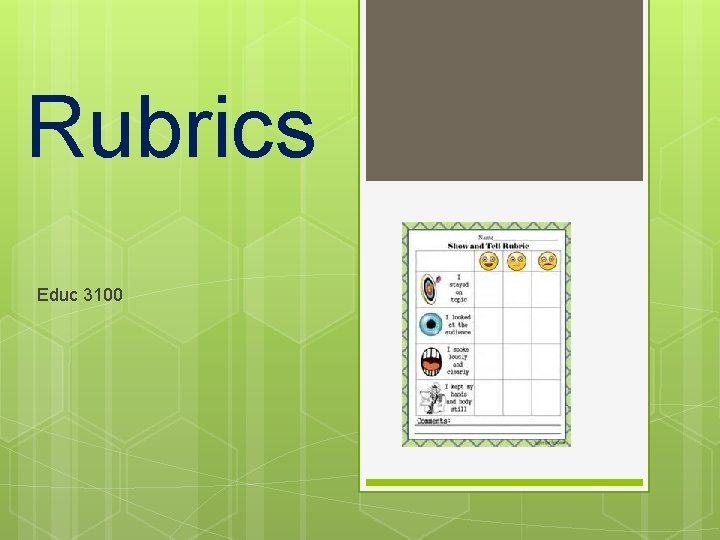
Rubrics Educ 3100
Performance Assessments Oral reading fluency Keyboarding Manipulate objects Lab safety procedures Oral presentation Correct use of artistic materials Artistic performance Athletic performance Social interaction skill
What experience have you had with performance assessments? What are the advantages and disadvantages?

Performance Assessments Use for skill based objectives (things students need to DO) Typically a process Usually DOK Level 3 or 4 Use rubrics or checklists to evaluate
Performance Tasks: Things to Remember Keep task aligned to learning goals. All students must have equal access to resources and equipment. Ensure there is time to conduct the performance assessment. Assess based on learning goals. Establish sound criteria and apply them consistently. (rubrics)
Creating a Performance Assessment Give clear and direct instructions specifying Strategies to use in completing the task Materials and other resources available for the task Logistics (where, when, how, who) Scoring criteria Keep the reading demands at a level that ensures clarity of the task directions.
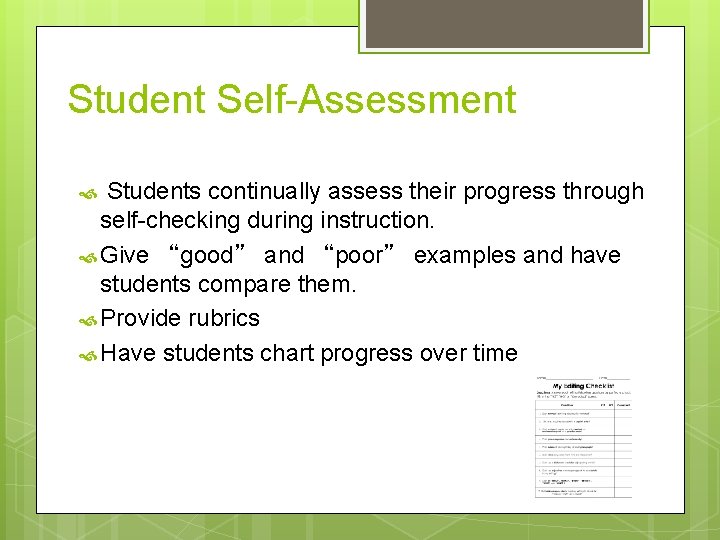
Student Self-Assessment Students continually assess their progress through self-checking during instruction. Give “good” and “poor” examples and have students compare them. Provide rubrics Have students chart progress over time
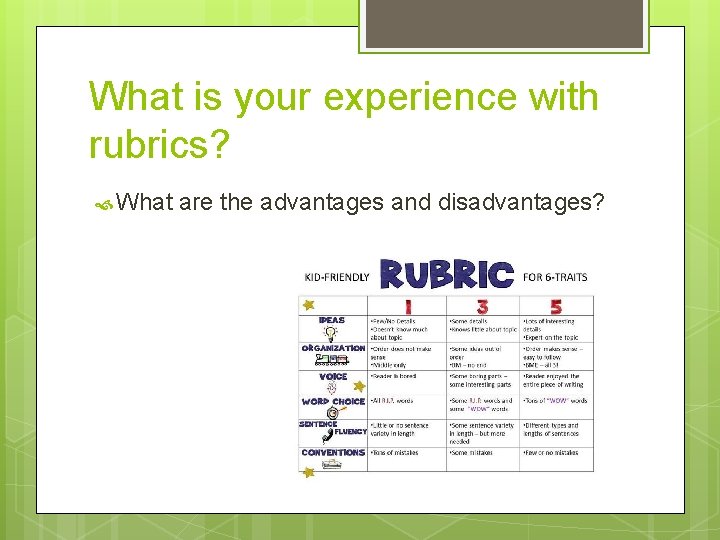
What is your experience with rubrics? What are the advantages and disadvantages?
What is a Rubric? Heidi Goodrich Andrade, a rubrics expert, defines a rubric as "a scoring tool that lists the criteria for a piece of work or 'what counts. '" Rubrics can help students and teachers define "quality". can also help students judge and revise their own work before handing in their assignments.
What is a Rubric? Generally rubrics specify the level of performance expected for several levels of quality. These levels of quality may be written as different ratings (e. g. , Excellent, Good, Needs Improvement) or as numerical scores (e. g. , 4, 3, 2, 1) Some rubrics also specify the level of assistance (e. g. , Independently, With Minimal Adult Help; With Extensive Adult Help) for each quality rating.
What Types of Assessments Need a Rubric? Anything that cannot be scored objectively (correct/incorrect), such as. . . Essays Projects Portfolios Performances Some skills
Analytical Rubrics Identifies criteria to use in reviewing the qualities of a student’s performance. Describes the range of quality for each criteria. Proficiency levels accompany each performance criterion. Words: Excellent, Good, Needs Work, etc. Numbers: 4, 3, 2, 1 Letters: A, B, C, D
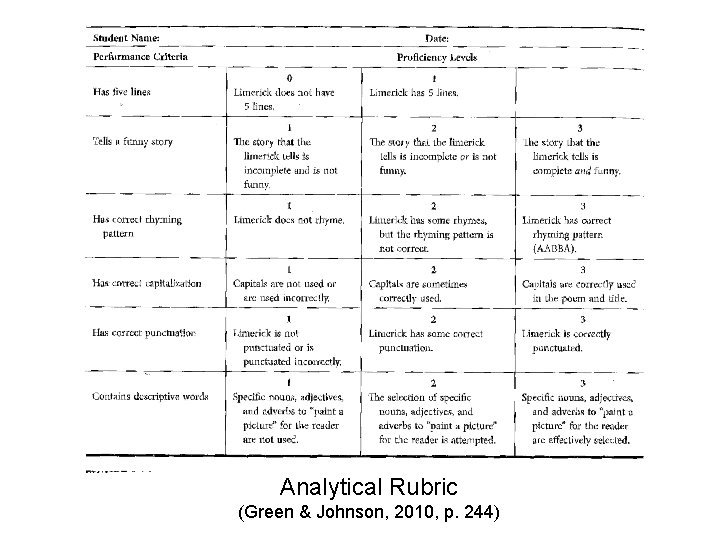
Analytical Rubric (Green & Johnson, 2010, p. 244)
Attributes of Good Rubrics Good rubrics should. . . Specify the important criteria With descriptions of levels of proficiency In an easy to use form And that are fair (valid and reliable)
Specify Important Criteria 1. Determine the criteria that demonstrates what you want students to know and be able to do (align with the objective). Examples: Accurate knowledge and understanding Sound reasoning Matters of form: writing, neatness, etc – carefully evaluate if it matches the objective. If not, only count it for a small amount. For example, a musical performance might be rated for intonation, rhythmic accuracy, and tone quality and an oral presentation might be rated for content, organization, delivery and language.
2. Be sure that your criteria are explicit. "Neatness" would not be a good criterion because the term "neat" is not explicit enough. What is neatness? You may want to look at some actual examples of student work to see if you have omitted any important criteria. 3. Be sure each criteria includes only one concept. (Begin creating cookie rubric)
Descriptions of levels of proficiency Describe the full range of performance in clear language that students understand for each criteria. You may want to start with the best and worst levels of quality, and then fill in the middle levels based on your knowledge of common problems. Try to articulate what makes the good assignments good and the poor assignments poor.
Descriptions of levels of proficiency Decide how much it counts – weight? Examples of performance levels may be: Descriptors (In Progress, Basic, Proficient, Advanced) Numbers (1, 2, 3, 4) Important: Try rubric, evaluate and revise as needed. (Add proficiency levels to cookie rubric)
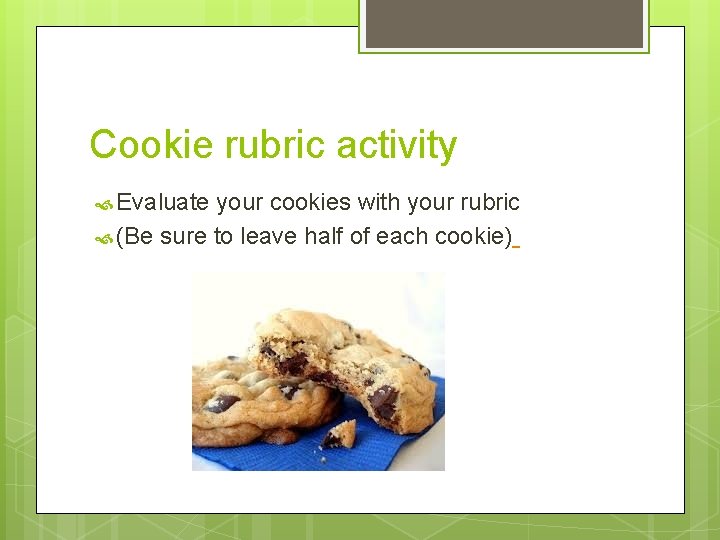
Cookie rubric activity Evaluate your cookies with your rubric (Be sure to leave half of each cookie)
Valid and Reliable Valid: Rubric evaluates the correct objectives What is most important counts the most Reliable: Check interrater reliability if more than one person is rating the performance or project Exchange cookie rubric with someone at a different table.
Holistic Rubrics Provides a single score that represents overall quality of the performance or project. Rubric criteria are not separated into their own categories with points assigned for each.
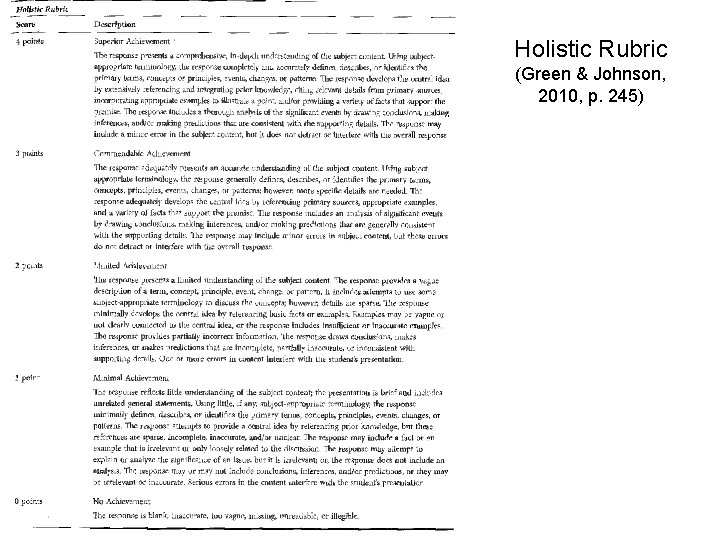
Holistic Rubric (Green & Johnson, 2010, p. 245)
Rubric Exploration Rubistar UEN site
You decide As partners find 3 rubrics on line Evaluate their quality Share with class
- Slides: 24