
RTL Through OS Electrical and Computer Engineering Department
- Slides: 1
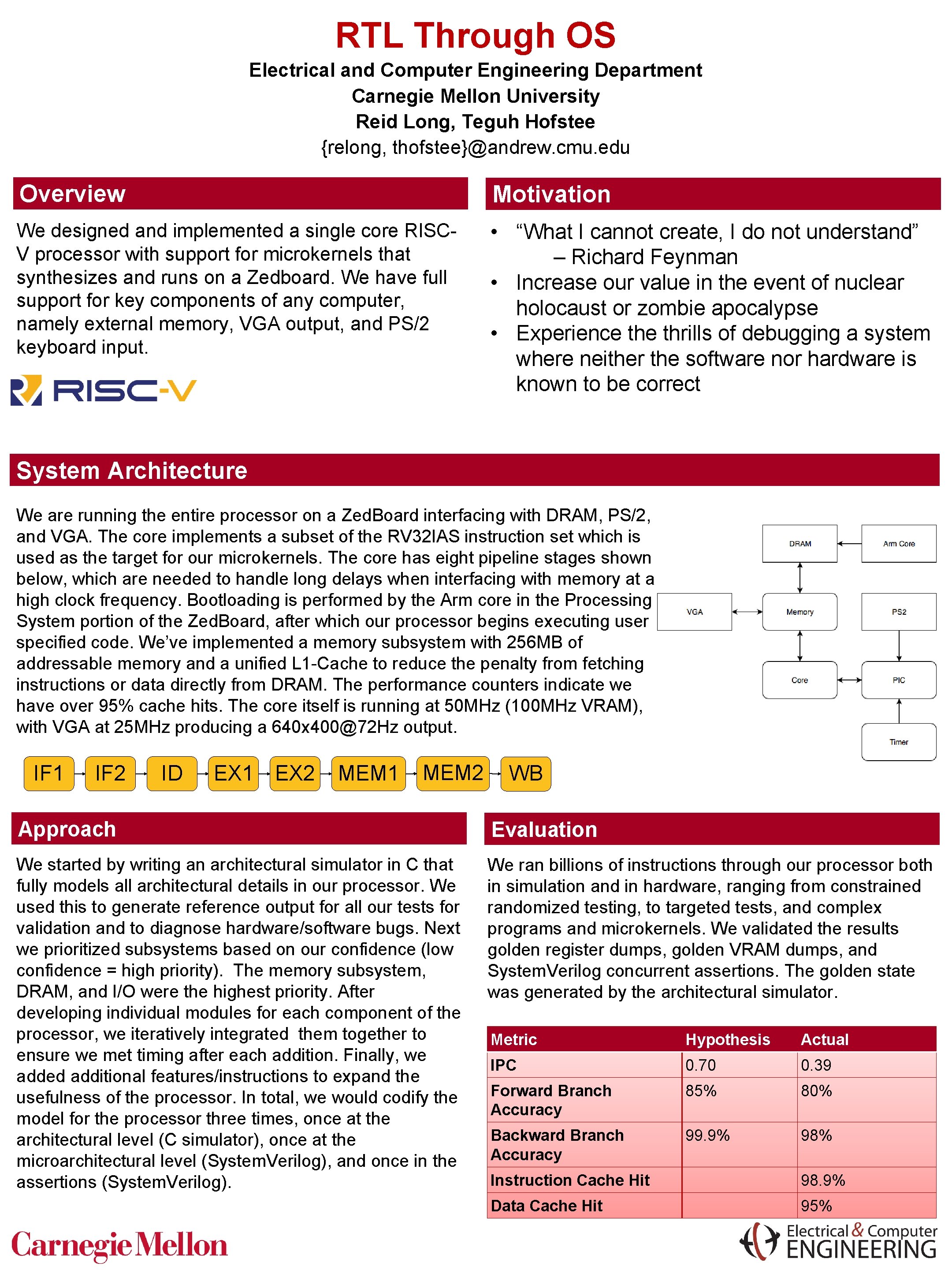
RTL Through OS Electrical and Computer Engineering Department Carnegie Mellon University Reid Long, Teguh Hofstee {relong, thofstee}@andrew. cmu. edu Overview Motivation We designed and implemented a single core RISCV processor with support for microkernels that synthesizes and runs on a Zedboard. We have full support for key components of any computer, namely external memory, VGA output, and PS/2 keyboard input. • “What I cannot create, I do not understand” – Richard Feynman • Increase our value in the event of nuclear holocaust or zombie apocalypse • Experience thrills of debugging a system where neither the software nor hardware is known to be correct System Architecture We are running the entire processor on a Zed. Board interfacing with DRAM, PS/2, and VGA. The core implements a subset of the RV 32 IAS instruction set which is used as the target for our microkernels. The core has eight pipeline stages shown below, which are needed to handle long delays when interfacing with memory at a high clock frequency. Bootloading is performed by the Arm core in the Processing System portion of the Zed. Board, after which our processor begins executing user specified code. We’ve implemented a memory subsystem with 256 MB of addressable memory and a unified L 1 -Cache to reduce the penalty from fetching instructions or data directly from DRAM. The performance counters indicate we have over 95% cache hits. The core itself is running at 50 MHz (100 MHz VRAM), with VGA at 25 MHz producing a 640 x 400@72 Hz output. IF 1 IF 2 ID EX 1 EX 2 MEM 1 MEM 2 WB Approach Evaluation We started by writing an architectural simulator in C that fully models all architectural details in our processor. We used this to generate reference output for all our tests for validation and to diagnose hardware/software bugs. Next we prioritized subsystems based on our confidence (low confidence = high priority). The memory subsystem, DRAM, and I/O were the highest priority. After developing individual modules for each component of the processor, we iteratively integrated them together to ensure we met timing after each addition. Finally, we added additional features/instructions to expand the usefulness of the processor. In total, we would codify the model for the processor three times, once at the architectural level (C simulator), once at the microarchitectural level (System. Verilog), and once in the assertions (System. Verilog). We ran billions of instructions through our processor both in simulation and in hardware, ranging from constrained randomized testing, to targeted tests, and complex programs and microkernels. We validated the results golden register dumps, golden VRAM dumps, and System. Verilog concurrent assertions. The golden state was generated by the architectural simulator. Metric Hypothesis Actual IPC 0. 70 0. 39 Forward Branch Accuracy 85% 80% Backward Branch Accuracy 99. 9% 98% Instruction Cache Hit 98. 9% Data Cache Hit 95%