
RTCA 220 Conventional Tomography Bontrager 19 F Conventional
RTCA 220 Conventional Tomography Bontrager, 19 -F
Conventional Tomography Abstract: This section will deal with the concepts of conventional tomography. Special emphasis will be placed on the different types of tube movement, the factors affecting image blur, and tomographic terms. Included also will be a discussion of other forms of tomography. Objectives: At the end of this section, the student will be able to: • define tomography. • discuss the history of tomographic development. • list and discuss the various types of tomographic motions. • discuss the terminology used in tomographic examinations.
Conventional Tomography • special type of imaging used to obtain a diagnostic image of a specific _____ of tissue or object, which is superimposed by other tissues or objects • requires movement of either the patient (object) or __-______and image _______ (Bucky tray) • objects above and below the fulcrum point are blurred permitting better visualization of the object within the fulcrum

Conventional Tomography: Terminology 1. Tomogram – radiograph of a tomographic exam 2. Fulcrum – _________ point between xray tube and IR 3. Fulcrum level – distance from ____ top to fulcrum

Conventional Tomography • All structures located in the _____ plane and parallel to tube trajectory remain sharp and in focus because they are in the same position on the IR during the exposure • Structures located outside the focal plane will be ______ or distorted because they are projected on different parts of the IR from the beginning of the exposure to the end
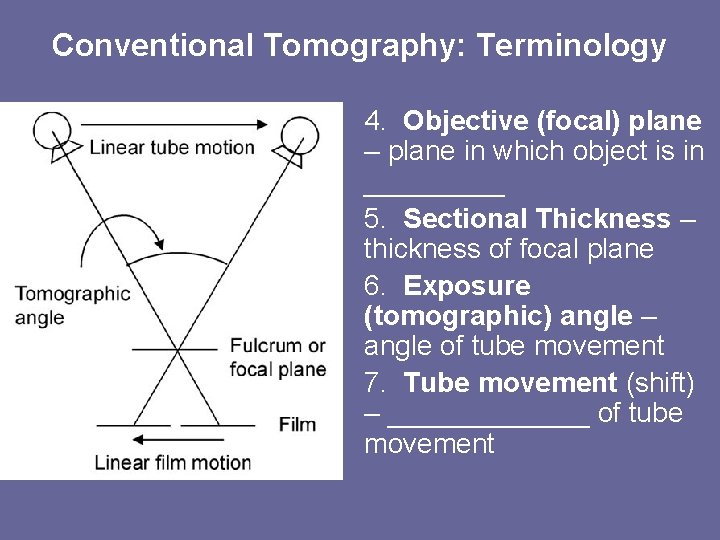
Conventional Tomography: Terminology 4. Objective (focal) plane – plane in which object is in _____ 5. Sectional Thickness – thickness of focal plane 6. Exposure (tomographic) angle – angle of tube movement 7. Tube movement (shift) – _______ of tube movement
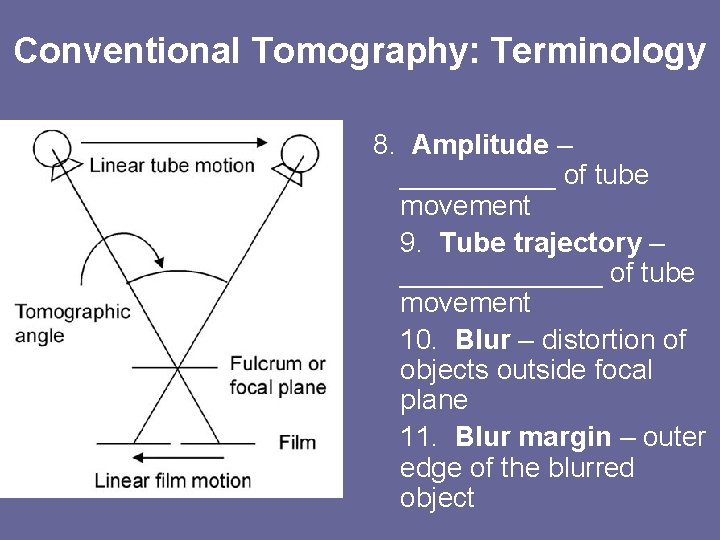
Conventional Tomography: Terminology 8. Amplitude – _____ of tube movement 9. Tube trajectory – _______ of tube movement 10. Blur – distortion of objects outside focal plane 11. Blur margin – outer edge of the blurred object
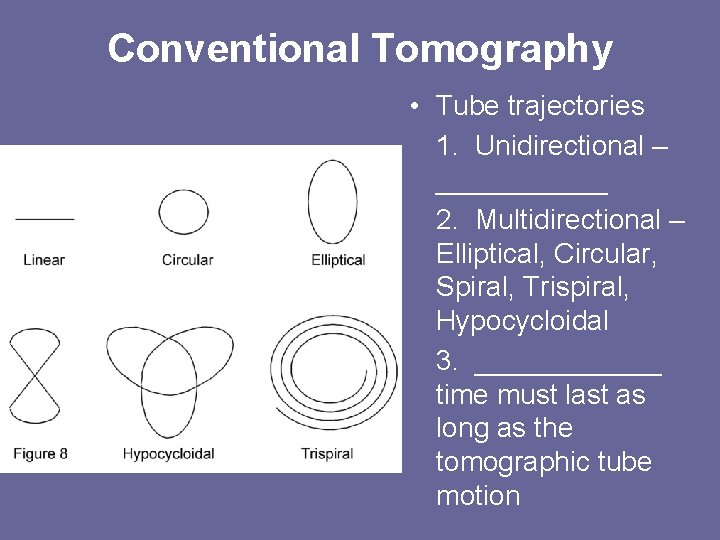
Conventional Tomography • Tube trajectories 1. Unidirectional – ______ 2. Multidirectional – Elliptical, Circular, Spiral, Trispiral, Hypocycloidal 3. ______ time must last as long as the tomographic tube motion

Conventional Tomography • Blur 1. area of _____ of objects outside the focal plane 2. Factors affecting blur – distance the object is from the focal plane – exposure _____ – distance the object is from the film – tube _______

Conventional Tomography • Sectional Thickness 1. thickness of the _______ plane 2. controlled primarily by exposure angle – as the angle increases, the sectional thickness ________ – useful for small objects 3. As sectional thickness decreases, a greater number of slices is required to visualize an entire object, resulting in increased patient ______


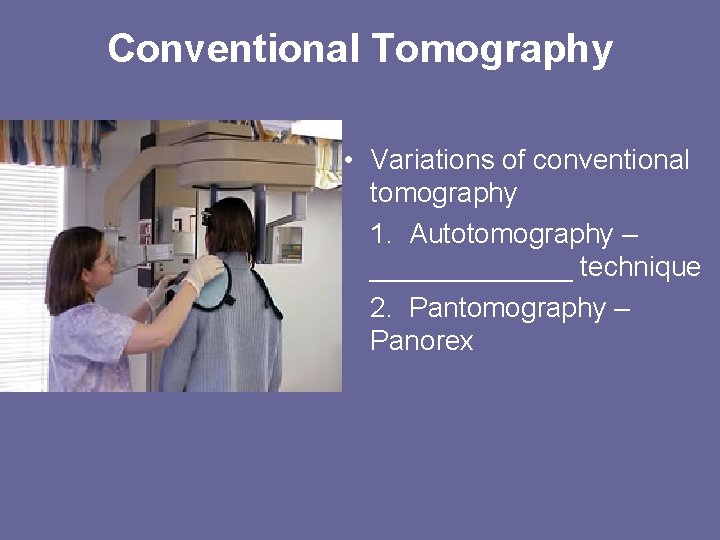
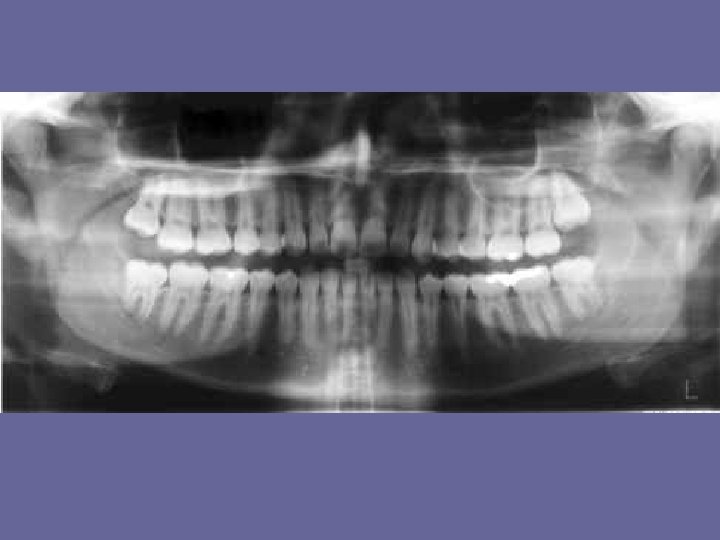
Conventional Tomography • Variations of conventional tomography 1. Autotomography – _______ technique 2. Pantomography – Panorex
- Slides: 15