
RTCA 220 Central Nervous System Digestive System Bontrager
RTCA 220 Central Nervous System & Digestive System Bontrager, 19 -D
Central Nervous System Abstract: This section will cover special radiographic procedures for the central nervous system, primarily the spinal cord. Special emphasis will be placed on myelography—the equipment used, indications and contraindications, radiographic filming, patient preparation and post-procedure care. Film demonstrations will be presented. In addition, alternative modalities of the spinal cord will be discussed. Objectives: At the end of this section, the student will be able: • discuss the gross anatomy of the brain. • list and discuss the protective membranes of the spinal cord. • define myelography. • discuss the contrast media and special equipment used for radiographic examinations of the central nervous system. • list the indications and contraindications for myelography. • list the pathological conditions demonstrated with myelography • list and discuss other radiographic procedures (diskography, chemonucleolysis, pneumonography) used to visualize the central nervous system.
Digestive System Abstract: This section will discuss the special imaging procedures of the gastrointestinal and hepatobiliary systems. Special emphasis will be placed on sialography and ERCP, their indications and contraindications, equipment, and overhead filming. Included also will be discussions on loopography, fistulagraphy, and procedures specific to the gall bladder. Objectives: At the end of this section, the student will be able to: • define and discuss sialography • discuss the indications, contrast media, equipment needed and procedure for sialography • define and discuss loopography, fistulagraphy and alternative special imaging procedures for the upper GI tract
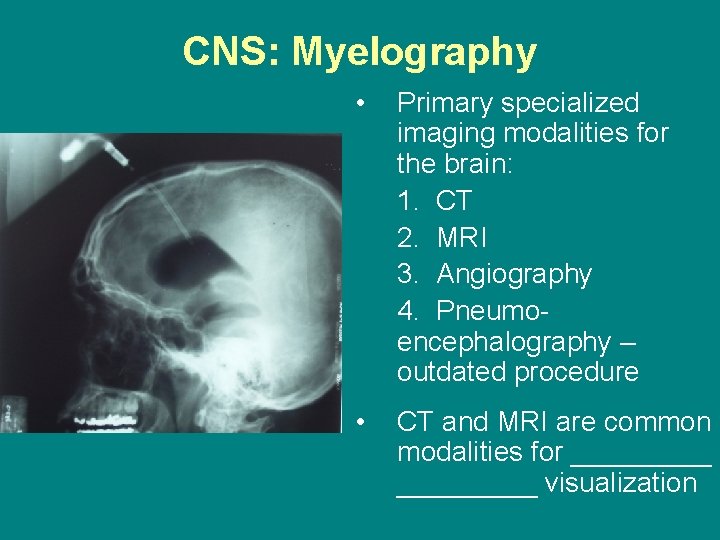
CNS: Myelography • Primary specialized imaging modalities for the brain: 1. CT 2. MRI 3. Angiography 4. Pneumoencephalography – outdated procedure • CT and MRI are common modalities for _________ visualization
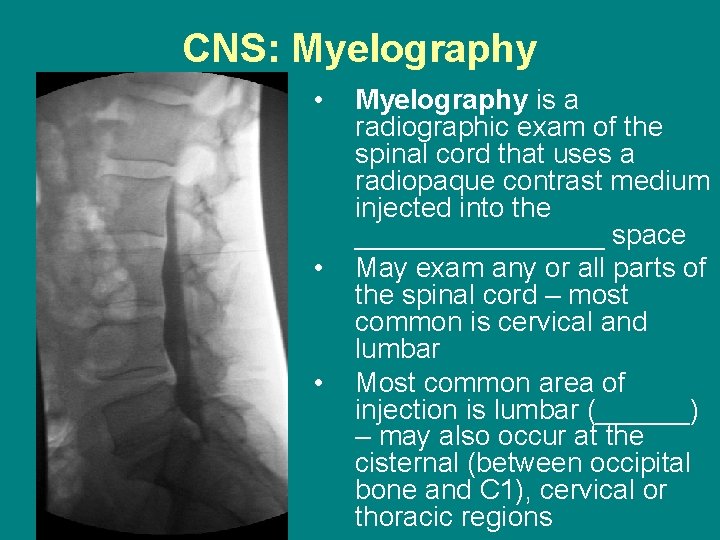
CNS: Myelography • • • Myelography is a radiographic exam of the spinal cord that uses a radiopaque contrast medium injected into the ________ space May exam any or all parts of the spinal cord – most common is cervical and lumbar Most common area of injection is lumbar (______) – may also occur at the cisternal (between occipital bone and C 1), cervical or thoracic regions
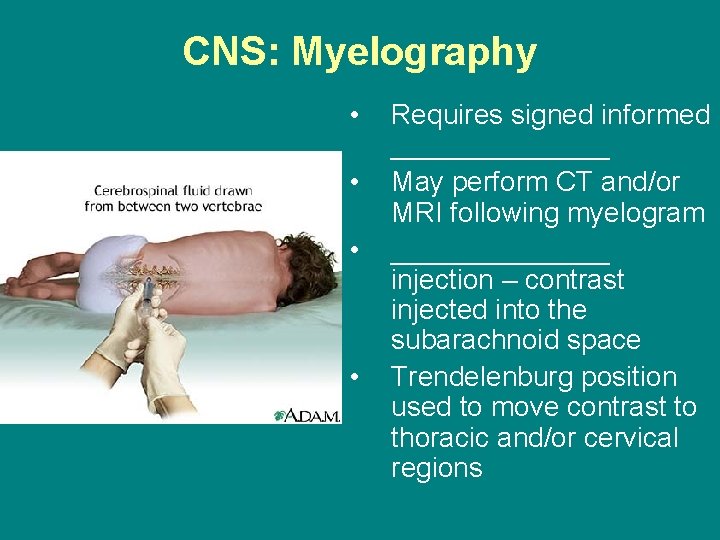
CNS: Myelography • • Requires signed informed _______ May perform CT and/or MRI following myelogram _______ injection – contrast injected into the subarachnoid space Trendelenburg position used to move contrast to thoracic and/or cervical regions
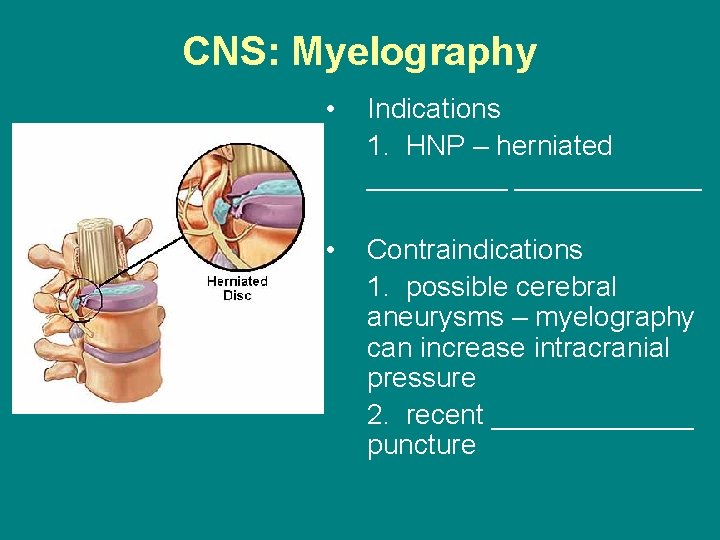
CNS: Myelography • Indications 1. HNP – herniated ____________ • Contraindications 1. possible cerebral aneurysms – myelography can increase intracranial pressure 2. recent _______ puncture
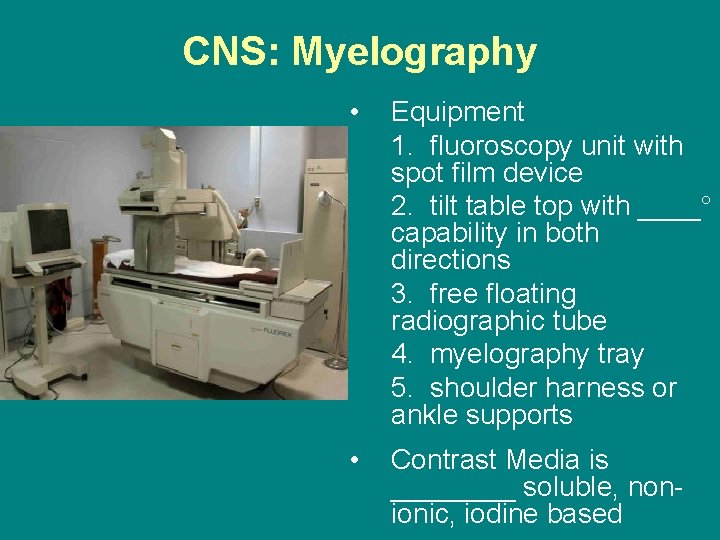
CNS: Myelography • Equipment 1. fluoroscopy unit with spot film device 2. tilt table top with ____ capability in both directions 3. free floating radiographic tube 4. myelography tray 5. shoulder harness or ankle supports • Contrast Media is ____ soluble, nonionic, iodine based
CNS: Myelography • • Preliminary Radiographs 1. Scout films are taken of the spinal region under examination – ______ lateral • Patient Preparation • informed consent signed
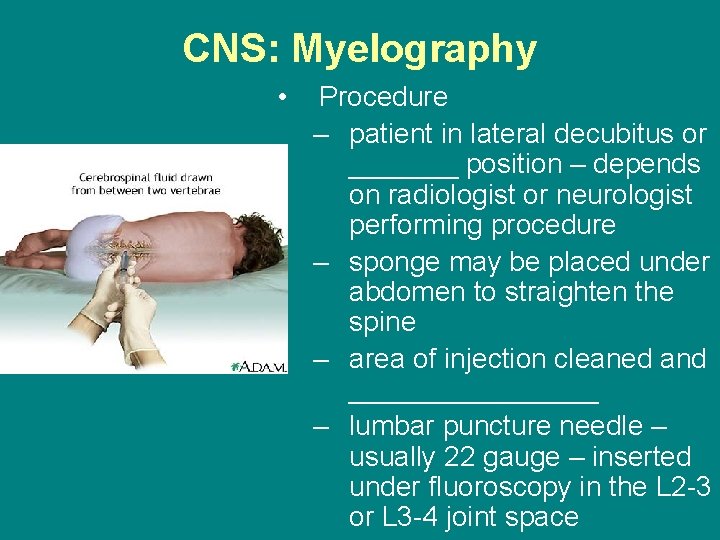
CNS: Myelography • Procedure – patient in lateral decubitus or _______ position – depends on radiologist or neurologist performing procedure – sponge may be placed under abdomen to straighten the spine – area of injection cleaned and ________ – lumbar puncture needle – usually 22 gauge – inserted under fluoroscopy in the L 2 -3 or L 3 -4 joint space
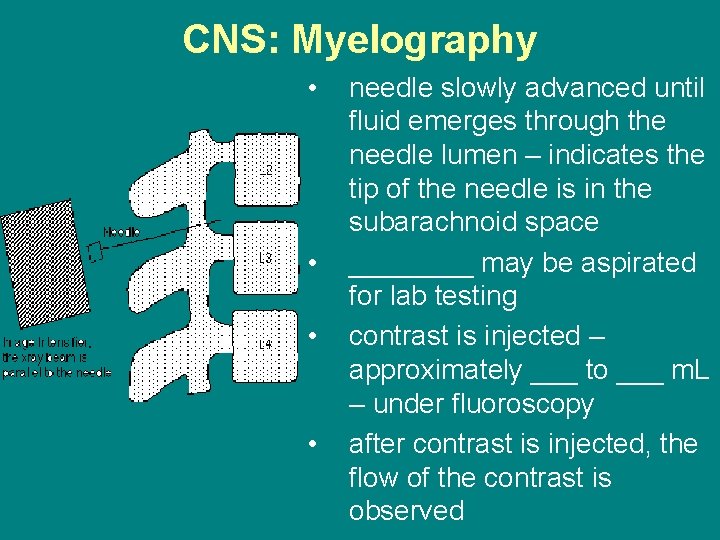
CNS: Myelography • • needle slowly advanced until fluid emerges through the needle lumen – indicates the tip of the needle is in the subarachnoid space ____ may be aspirated for lab testing contrast is injected – approximately ___ to ___ m. L – under fluoroscopy after contrast is injected, the flow of the contrast is observed
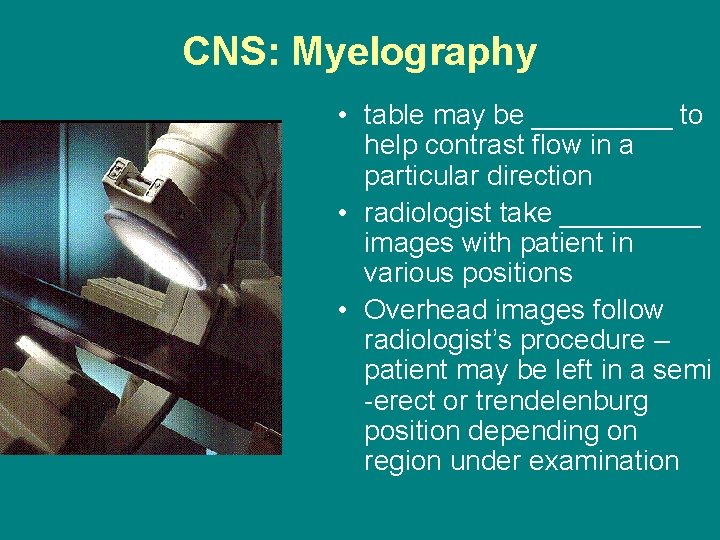
CNS: Myelography • table may be _____ to help contrast flow in a particular direction • radiologist take _____ images with patient in various positions • Overhead images follow radiologist’s procedure – patient may be left in a semi -erect or trendelenburg position depending on region under examination
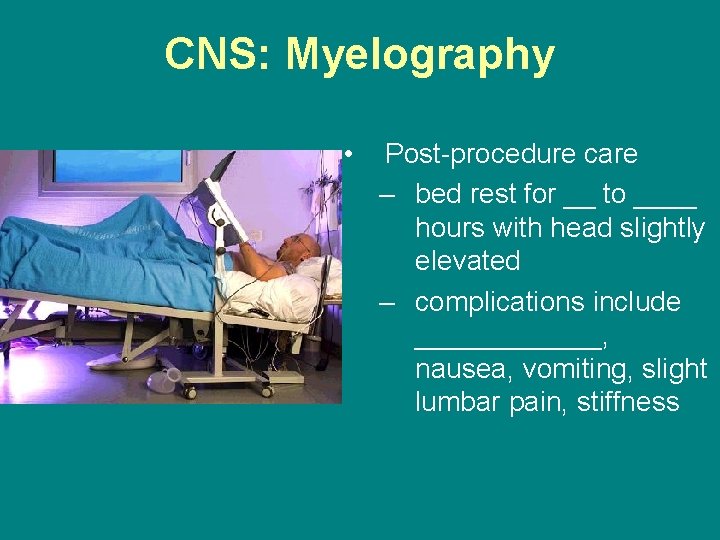
CNS: Myelography • Post-procedure care – bed rest for __ to ____ hours with head slightly elevated – complications include ______, nausea, vomiting, slight lumbar pain, stiffness
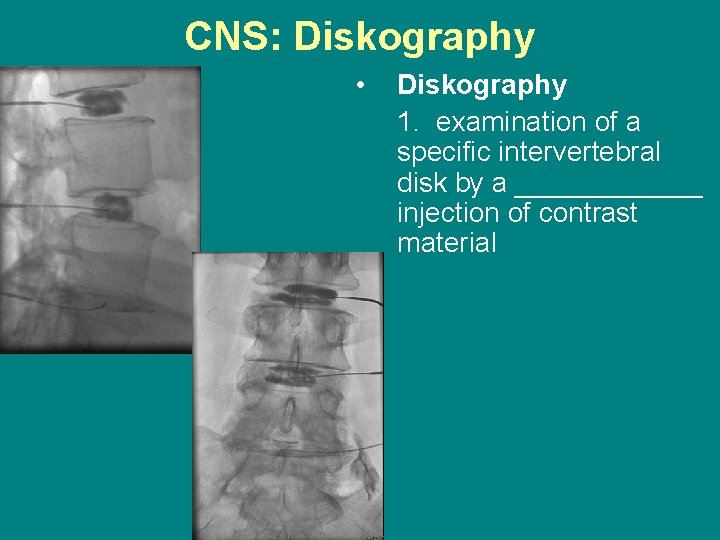
CNS: Diskography • Diskography 1. examination of a specific intervertebral disk by a ______ injection of contrast material
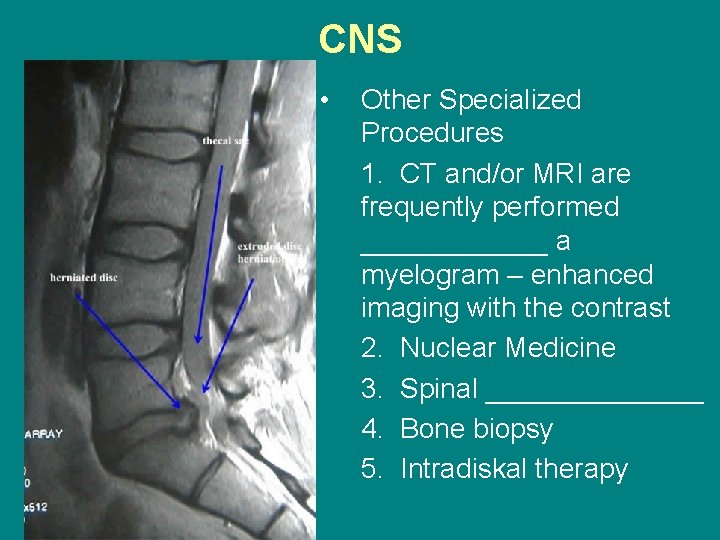
CNS • Other Specialized Procedures 1. CT and/or MRI are frequently performed ______ a myelogram – enhanced imaging with the contrast 2. Nuclear Medicine 3. Spinal _______ 4. Bone biopsy 5. Intradiskal therapy
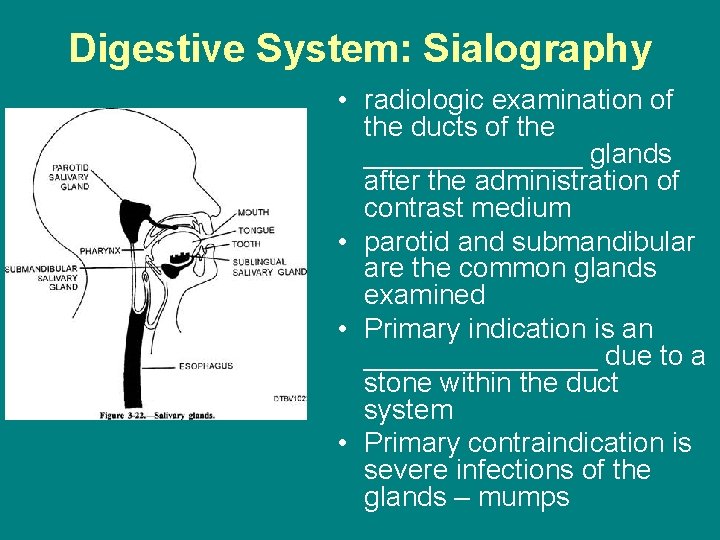
Digestive System: Sialography • radiologic examination of the ducts of the _______ glands after the administration of contrast medium • parotid and submandibular are the common glands examined • Primary indication is an ________ due to a stone within the duct system • Primary contraindication is severe infections of the glands – mumps
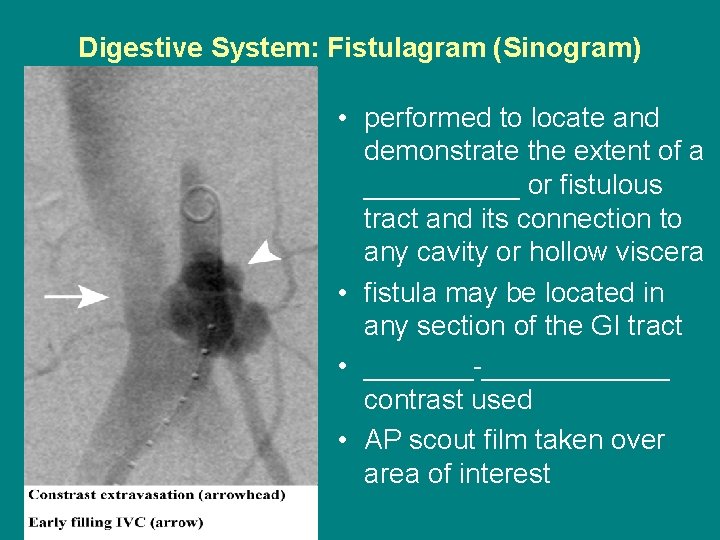
Digestive System: Fistulagram (Sinogram) • performed to locate and demonstrate the extent of a _____ or fistulous tract and its connection to any cavity or hollow viscera • fistula may be located in any section of the GI tract • _______-______ contrast used • AP scout film taken over area of interest
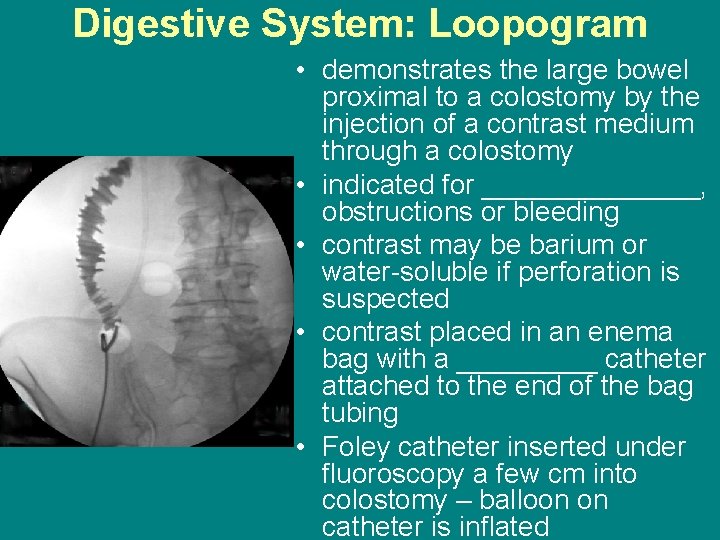
Digestive System: Loopogram • demonstrates the large bowel proximal to a colostomy by the injection of a contrast medium through a colostomy • indicated for _______, obstructions or bleeding • contrast may be barium or water-soluble if perforation is suspected • contrast placed in an enema bag with a _____ catheter attached to the end of the bag tubing • Foley catheter inserted under fluoroscopy a few cm into colostomy – balloon on catheter is inflated
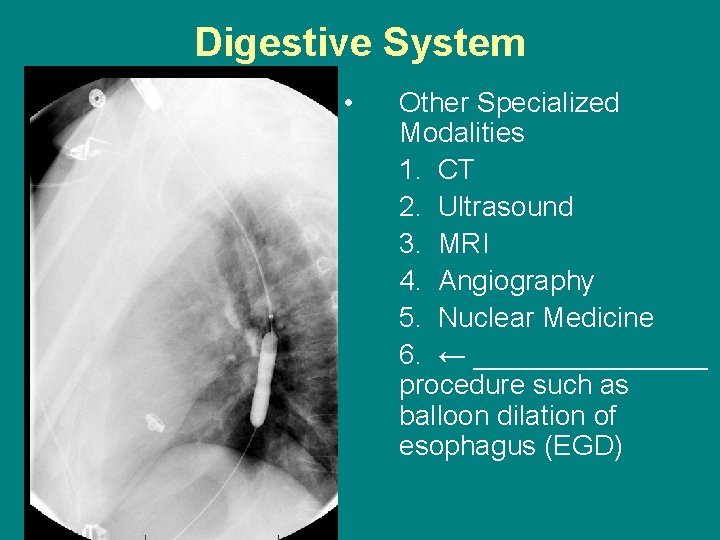
Digestive System • Other Specialized Modalities 1. CT 2. Ultrasound 3. MRI 4. Angiography 5. Nuclear Medicine 6. ← ________ procedure such as balloon dilation of esophagus (EGD)
- Slides: 19