
RTCA 218 The Xray Tube Bushong Chapter 6

RTCA 218 The X-ray Tube Bushong, Chapter 6
The X-ray Tube Abstract: This section will involve discussions of the various parts of a typical x-ray tube. Emphasis will be placed on the construction of the cathode and anode, and how the x-ray tube is integrated into the x-ray unit circuitry. In addition, the line focus principle and anode heel affect and the common causes of x-ray tube failure will be covered. Objectives: At the end of this section, the student should be able to: u list and discuss the support structures of the x-ray tube. u describe and discuss the protective housing of the x-ray tube. u describe and discuss the glass envelope of the x-ray tube. u list and discuss the components of the cathode. u list and discuss the components of the anode. u list and discuss the causes of x-ray tube failure. u discuss the concepts of the anode and housing cooling charts.
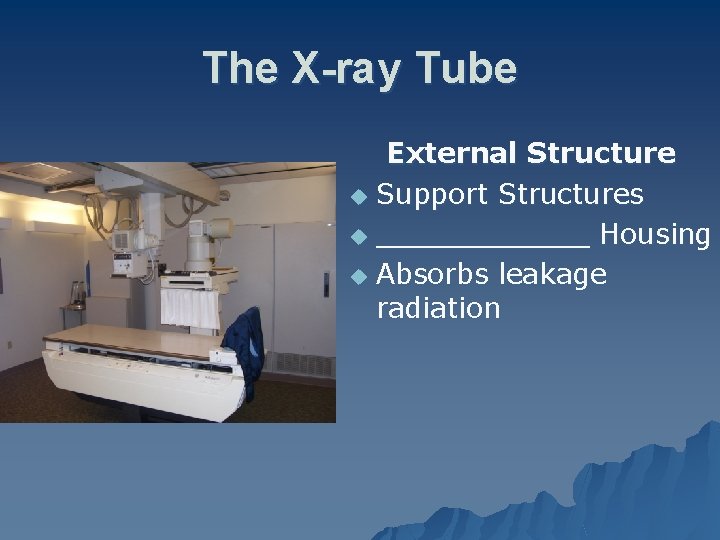
The X-ray Tube External Structure u Support Structures u ______ Housing u Absorbs leakage radiation
The X-ray Tube u Should never be ______ during exposure u Patients arms or legs should not be rested on it u High Voltage cables should never be used as handles for tube positioning u Radiation emitted ________ u High-voltage receptacles – protect against accidental electrical shock
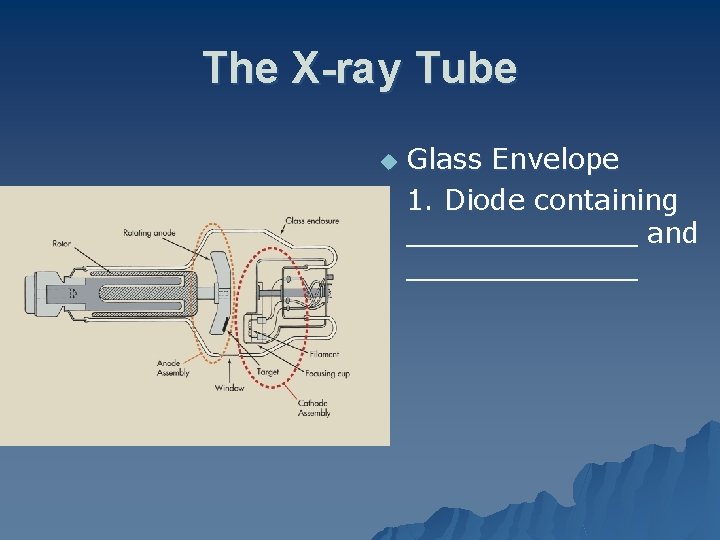
The X-ray Tube u Glass Envelope 1. Diode containing _______ and _______
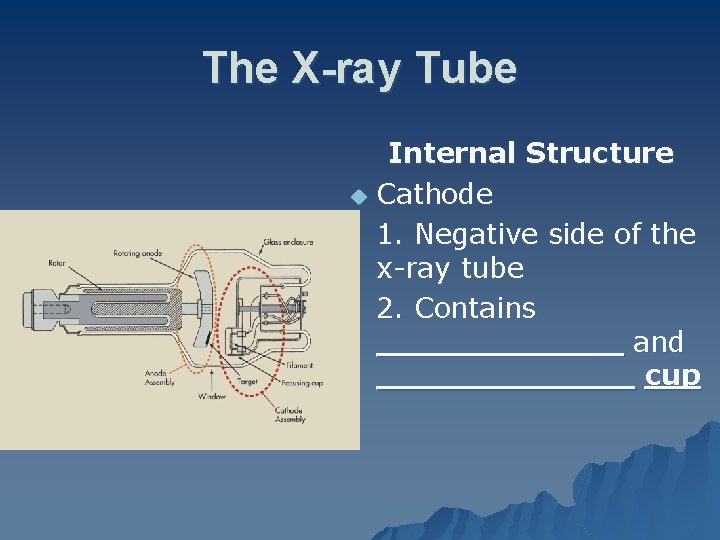
The X-ray Tube Internal Structure u Cathode 1. Negative side of the x-ray tube 2. Contains ______ and _______ cup
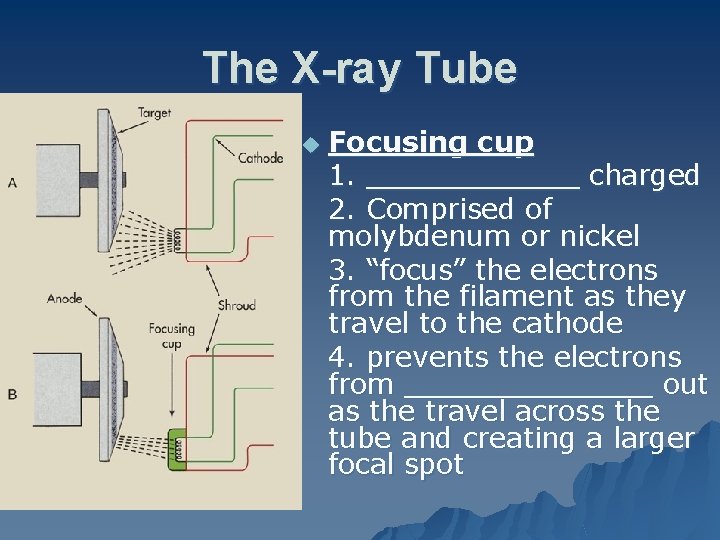
The X-ray Tube u Focusing cup 1. ______ charged 2. Comprised of molybdenum or nickel 3. “focus” the electrons from the filament as they travel to the cathode 4. prevents the electrons from _______ out as the travel across the tube and creating a larger focal spot
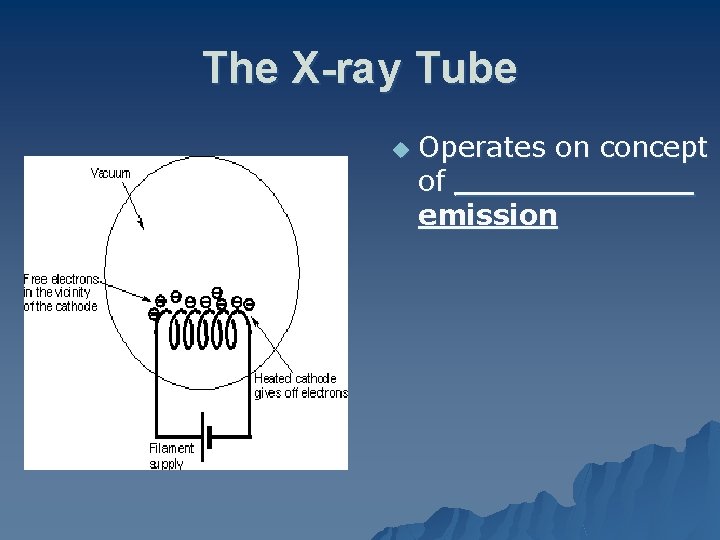
The X-ray Tube u Operates on concept of ______ emission
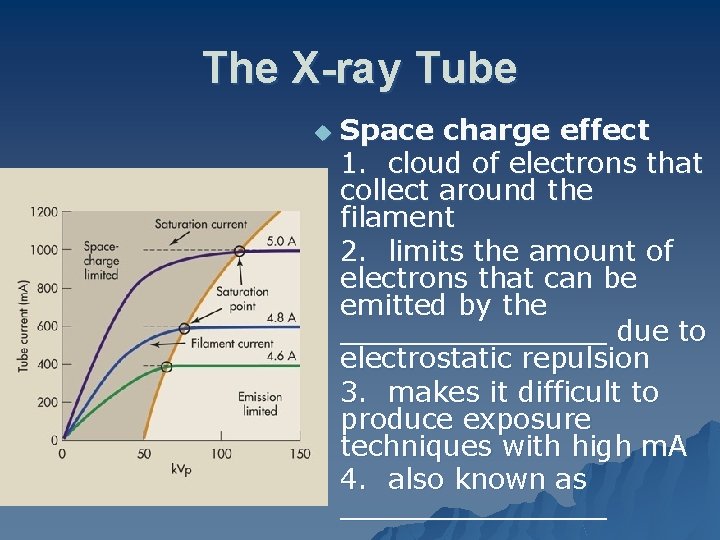
The X-ray Tube u Space charge effect 1. cloud of electrons that collect around the filament 2. limits the amount of electrons that can be emitted by the ________ due to electrostatic repulsion 3. makes it difficult to produce exposure techniques with high m. A 4. also known as ________
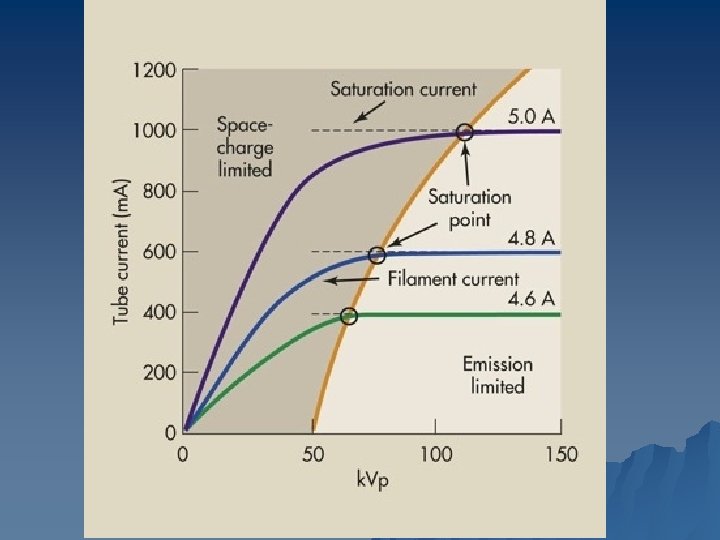
The X-ray Tube u Saturation current 1. occurs when the _______ number of electrons has been produced at the filament 2. increasing k. Vp will increase ______ also, unit the saturation current has been reached
The X-ray Tube u Most modern tubes contain dual filaments —small and large u Both filaments may be used at lower m. A stations— 300 or less u ______ m. A stations—over 300— requires the _____ filament u Small focal spot – 0. 1 to 0. 5 mm u Large focal spot – 0. 4 to 1. 2 mm
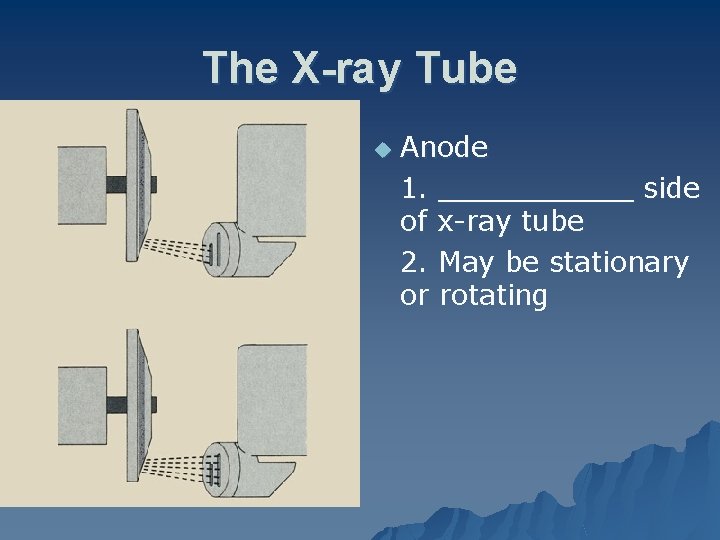
The X-ray Tube u Anode 1. ______ side of x-ray tube 2. May be stationary or rotating
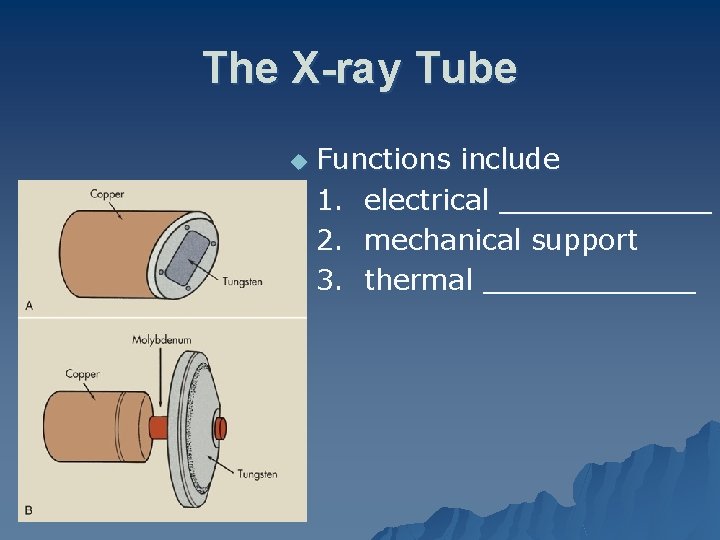
The X-ray Tube u Functions include 1. electrical ______ 2. mechanical support 3. thermal ______
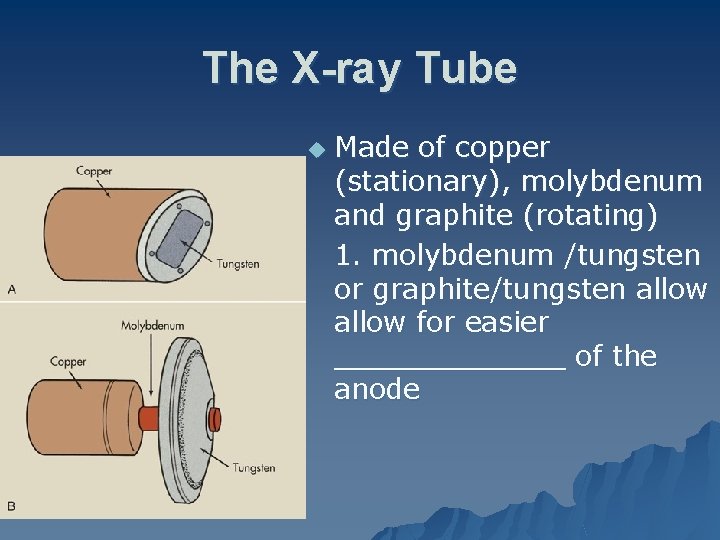
The X-ray Tube u Made of copper (stationary), molybdenum and graphite (rotating) 1. molybdenum /tungsten or graphite/tungsten allow for easier _______ of the anode
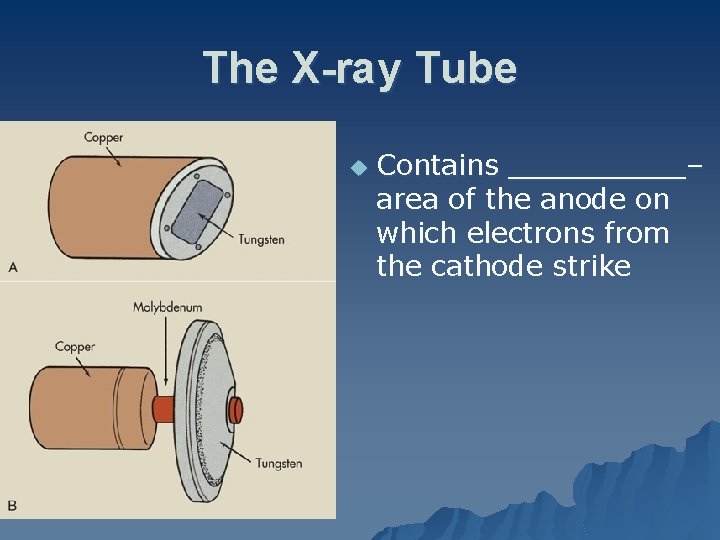
The X-ray Tube u Contains _____– area of the anode on which electrons from the cathode strike
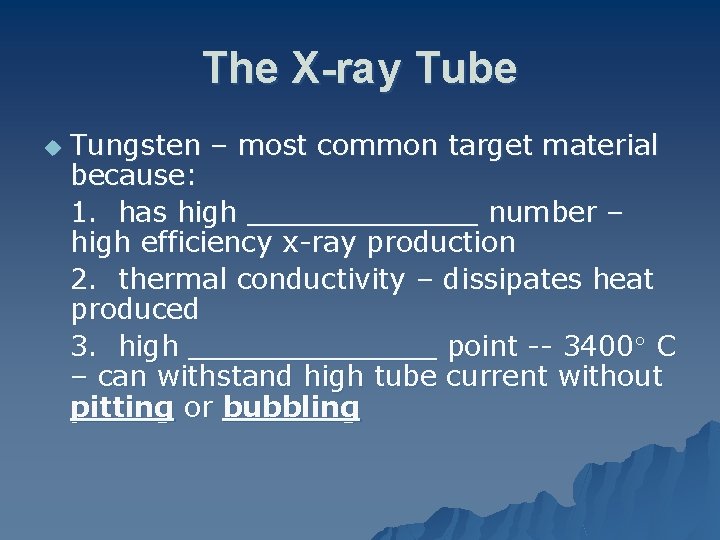
The X-ray Tube u Tungsten – most common target material because: 1. has high _______ number – high efficiency x-ray production 2. thermal conductivity – dissipates heat produced 3. high _______ point -- 3400 C – can withstand high tube current without pitting or bubbling
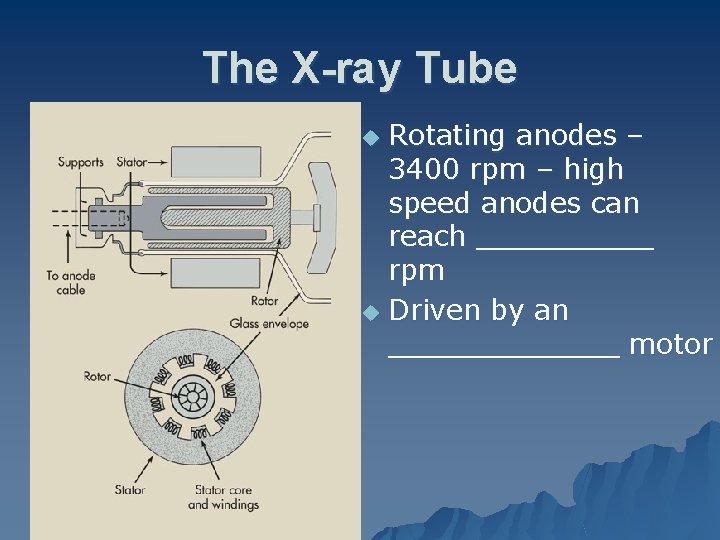
The X-ray Tube Rotating anodes – 3400 rpm – high speed anodes can reach _____ rpm u Driven by an _______ motor u
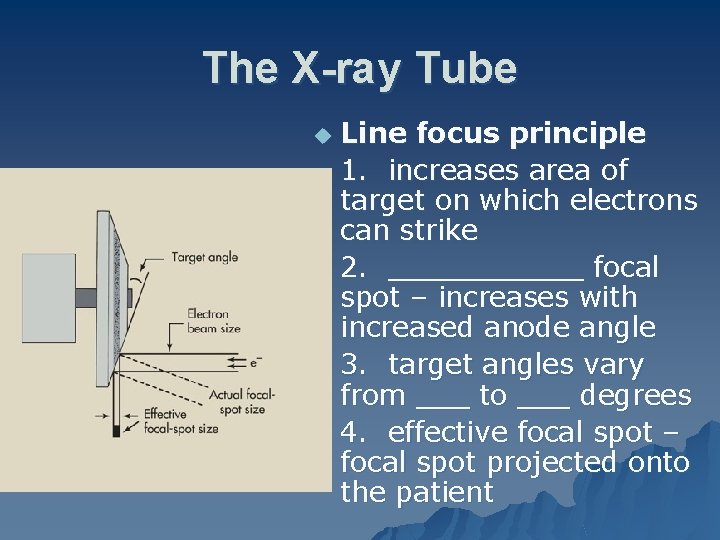
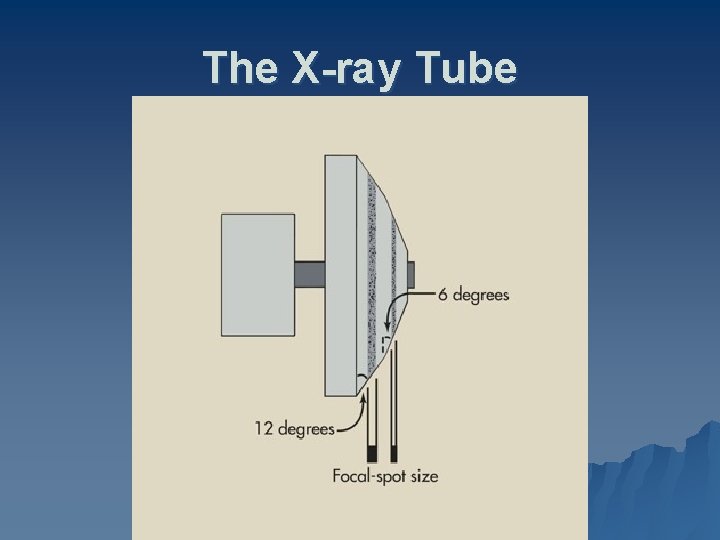
The X-ray Tube u Line focus principle 1. increases area of target on which electrons can strike 2. ______ focal spot – increases with increased anode angle 3. target angles vary from ___ to ___ degrees 4. effective focal spot – focal spot projected onto the patient
The X-ray Tube
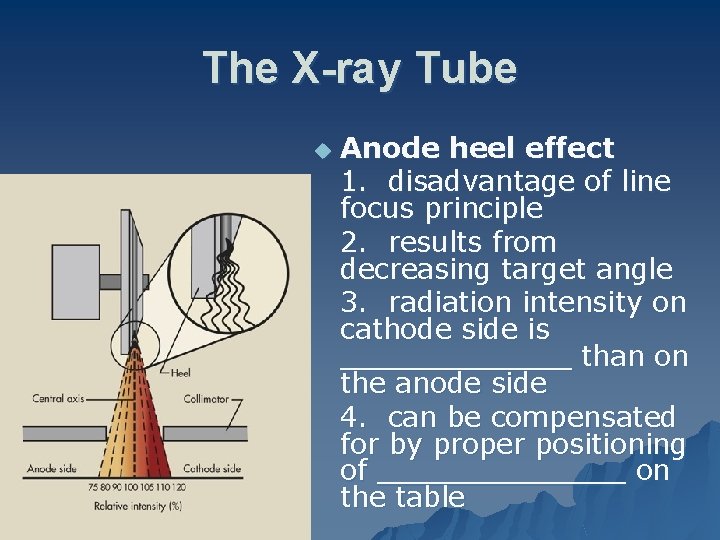
The X-ray Tube u Anode heel effect 1. disadvantage of line focus principle 2. results from decreasing target angle 3. radiation intensity on cathode side is _______ than on the anode side 4. can be compensated for by proper positioning of _______ on the table
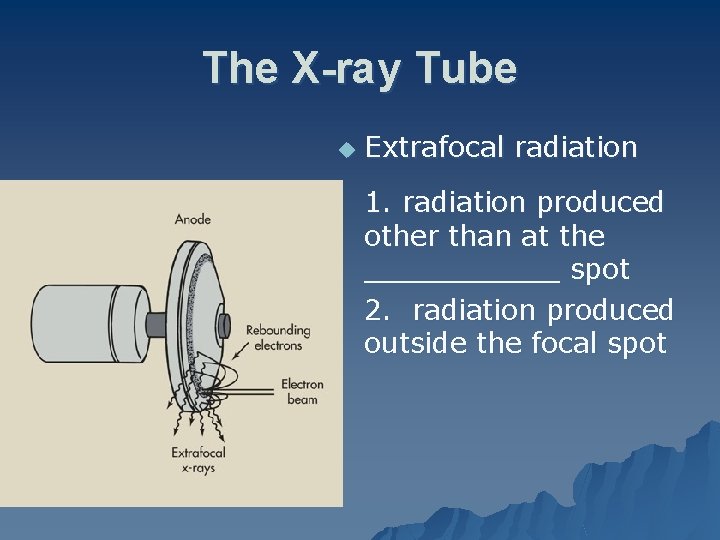
The X-ray Tube u Extrafocal radiation 1. radiation produced other than at the ______ spot 2. radiation produced outside the focal spot
The X-ray Tube Failure u May be caused by: 1. primarily excessive _____ 2. cracking of anode 3. long exposure times 4. filament _________ 5. pitting and bubbling 6. arcing
The X-ray Tube u X-ray tube life controlled by radiographer 1. safe tube _____-____ 2. safe exposure factors 3. never use maximum exposure factors on a _____ anode
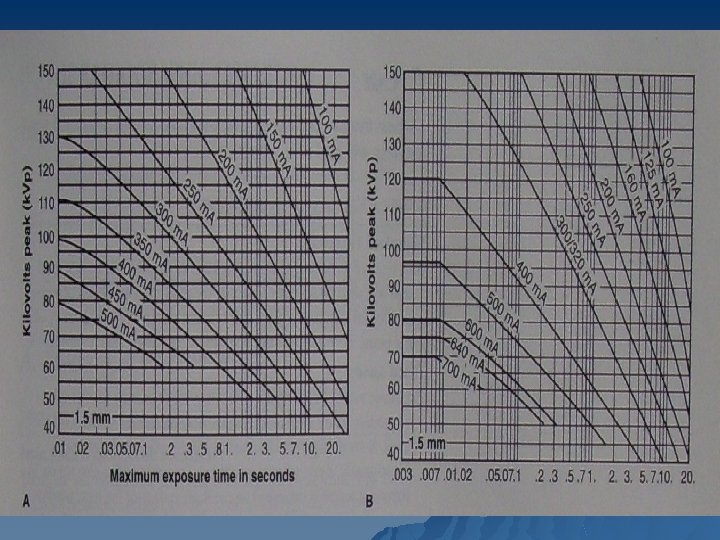
The X-ray Tube u Radiographic rating chart 1. most important of the rating charts 2. will determine if particular _______ are safe for a particular radiographic unit
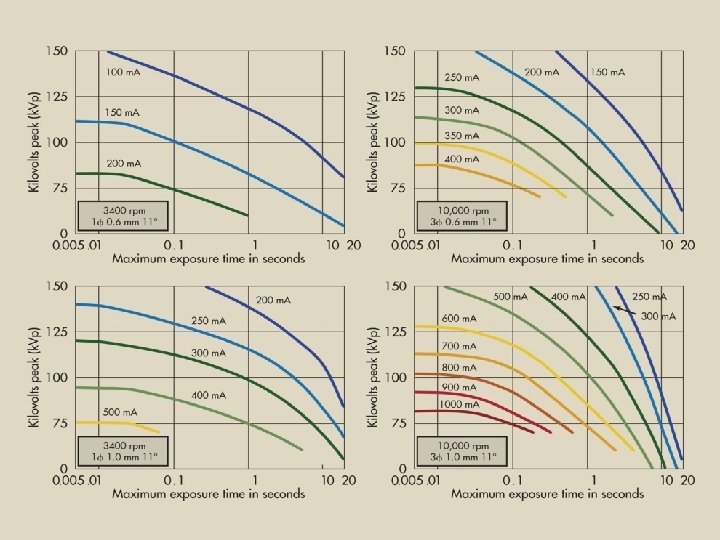
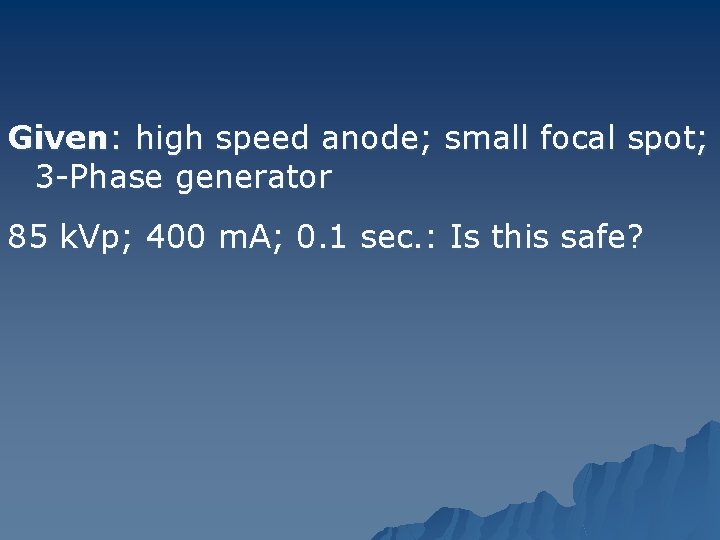
Given: high speed anode; small focal spot; 3 -Phase generator 85 k. Vp; 400 m. A; 0. 1 sec. : Is this safe?
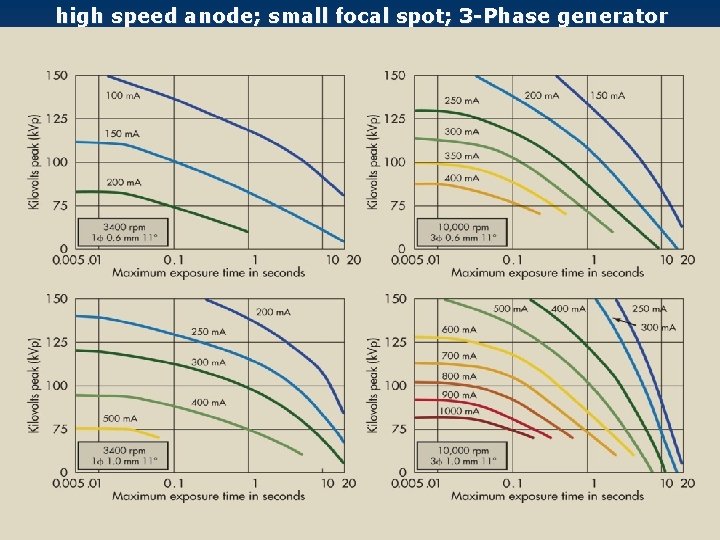
high speed anode; small focal spot; 3 -Phase generator
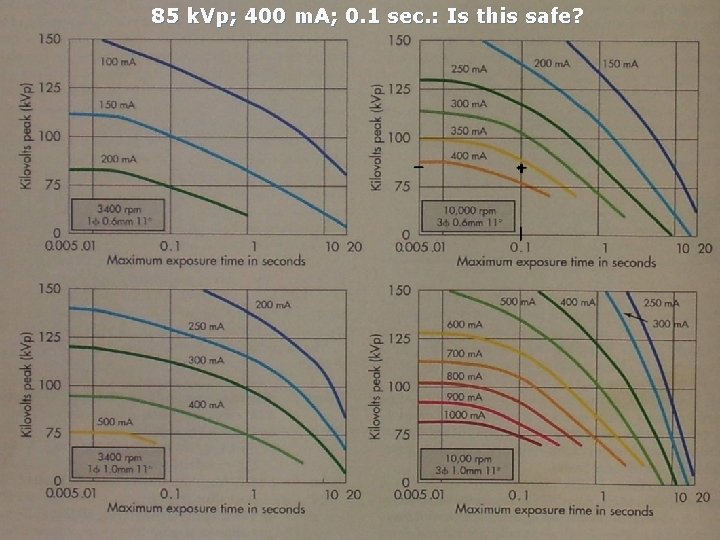
85 k. Vp; 400 m. A; 0. 1 sec. : Is this safe?
Given: high speed anode; small focal spot; 3 -Phase generator 85 k. Vp; 400 m. A; 0. 1 sec. : Is this safe? Given: low speed anode; large focal spot; Single phase generator 80 k. Vp; 400 m. A; 0. 5 sec. : Is this safe?
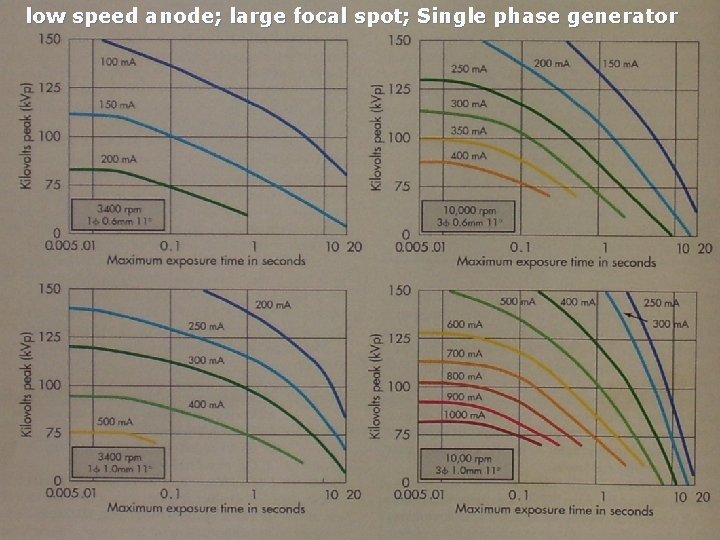
low speed anode; large focal spot; Single phase generator
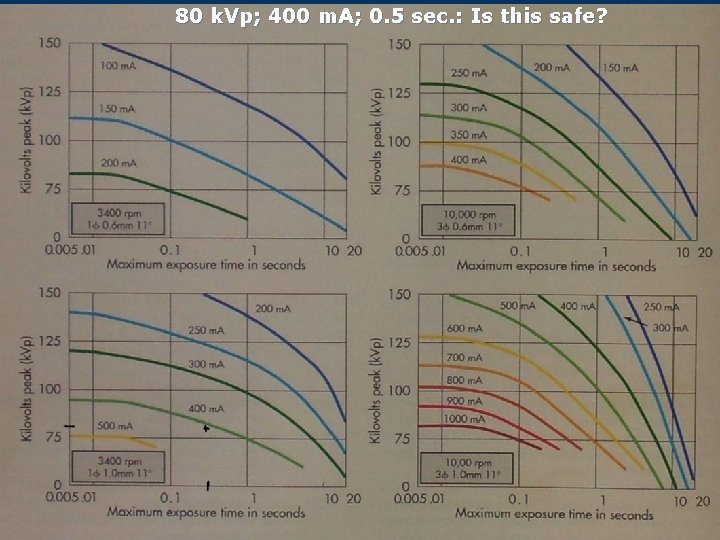
80 k. Vp; 400 m. A; 0. 5 sec. : Is this safe?
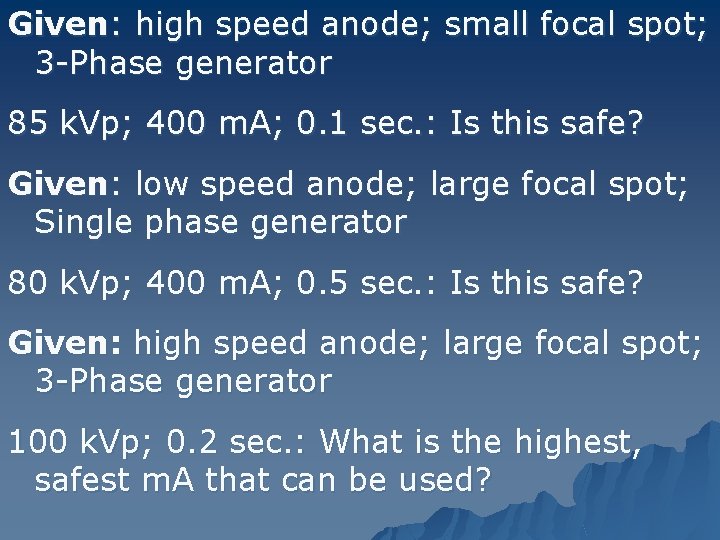
Given: high speed anode; small focal spot; 3 -Phase generator 85 k. Vp; 400 m. A; 0. 1 sec. : Is this safe? Given: low speed anode; large focal spot; Single phase generator 80 k. Vp; 400 m. A; 0. 5 sec. : Is this safe? Given: high speed anode; large focal spot; 3 -Phase generator 100 k. Vp; 0. 2 sec. : What is the highest, safest m. A that can be used?
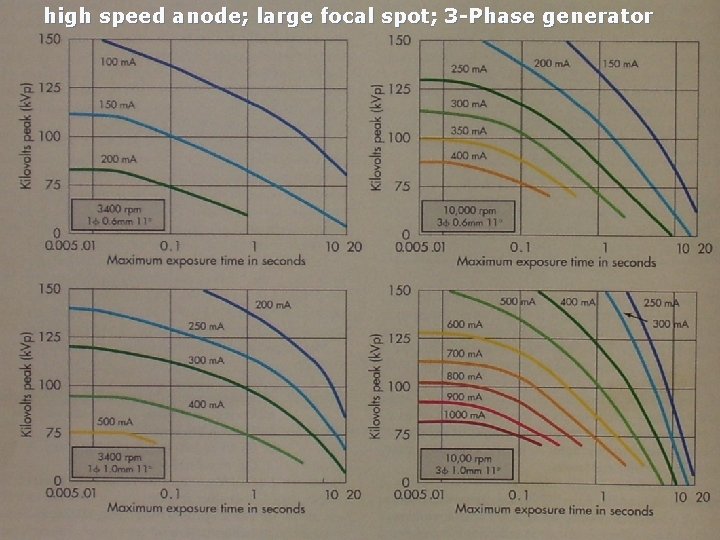
high speed anode; large focal spot; 3 -Phase generator
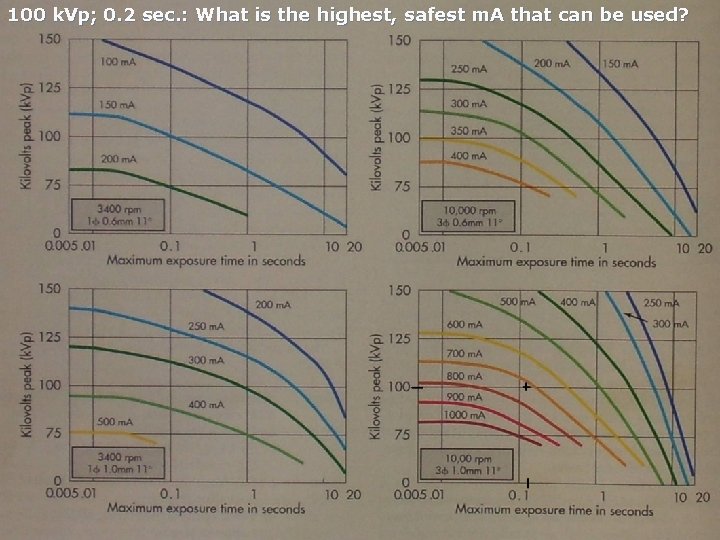
100 k. Vp; 0. 2 sec. : What is the highest, safest m. A that can be used?
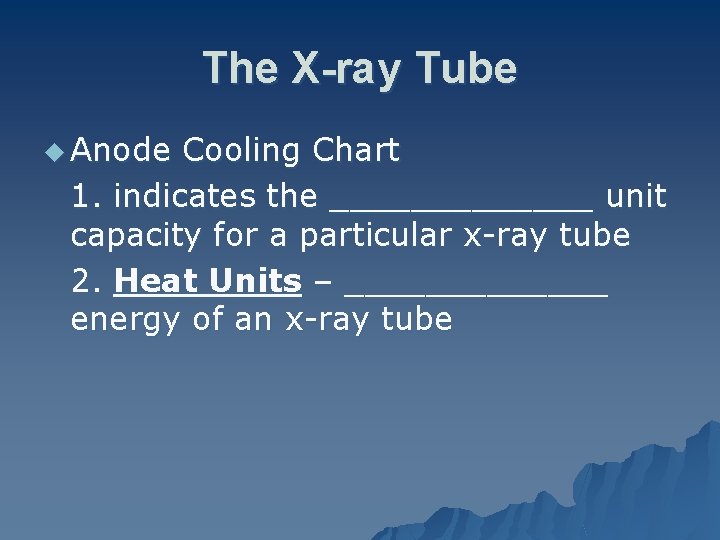
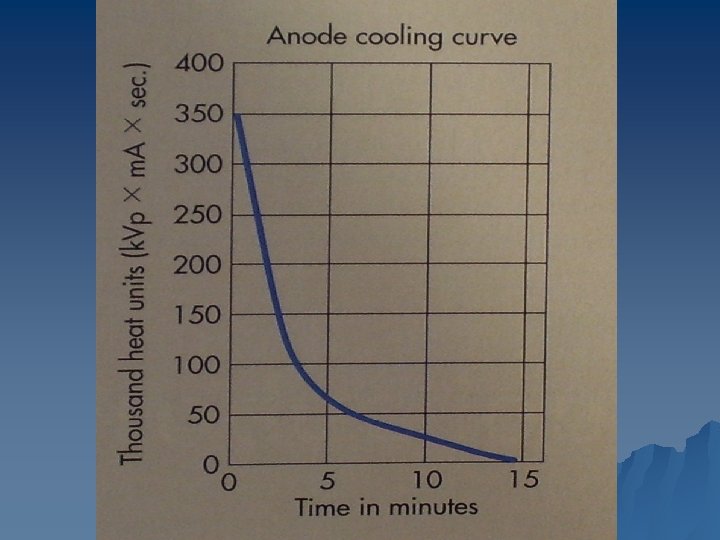
The X-ray Tube u Anode Cooling Chart 1. indicates the _______ unit capacity for a particular x-ray tube 2. Heat Units – _______ energy of an x-ray tube
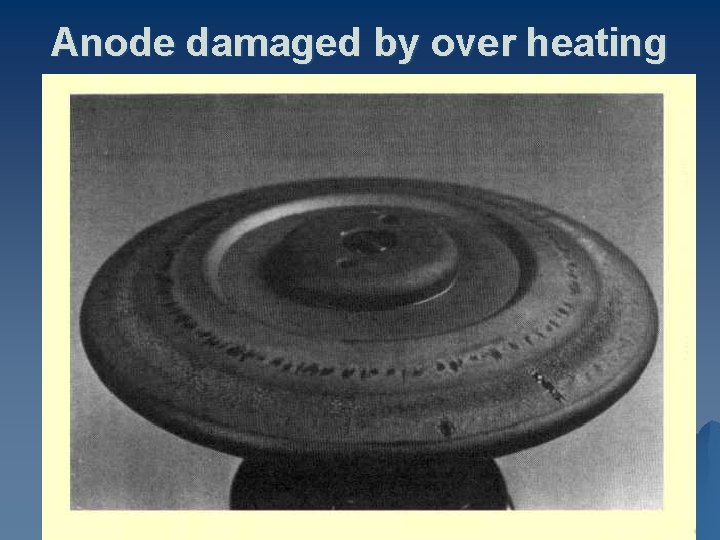
Anode damaged by over heating
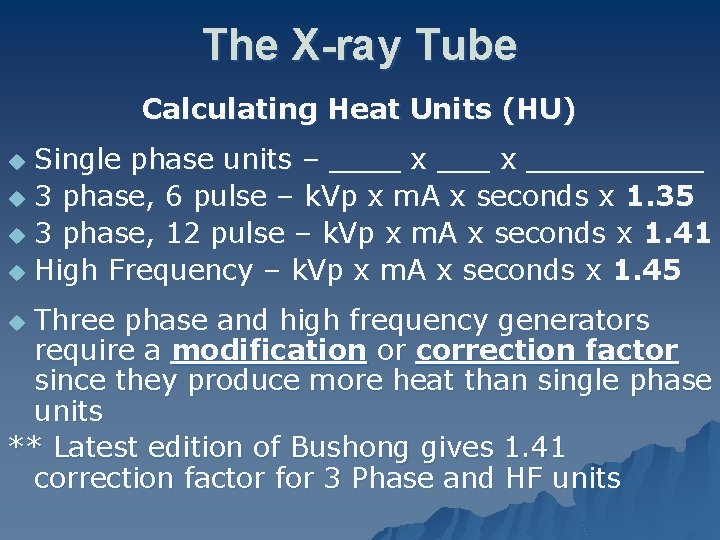
The X-ray Tube Calculating Heat Units (HU) Single phase units – ____ x _____ u 3 phase, 6 pulse – k. Vp x m. A x seconds x 1. 35 u 3 phase, 12 pulse – k. Vp x m. A x seconds x 1. 41 u High Frequency – k. Vp x m. A x seconds x 1. 45 u Three phase and high frequency generators require a modification or correction factor since they produce more heat than single phase units ** Latest edition of Bushong gives 1. 41 correction factor for 3 Phase and HF units u
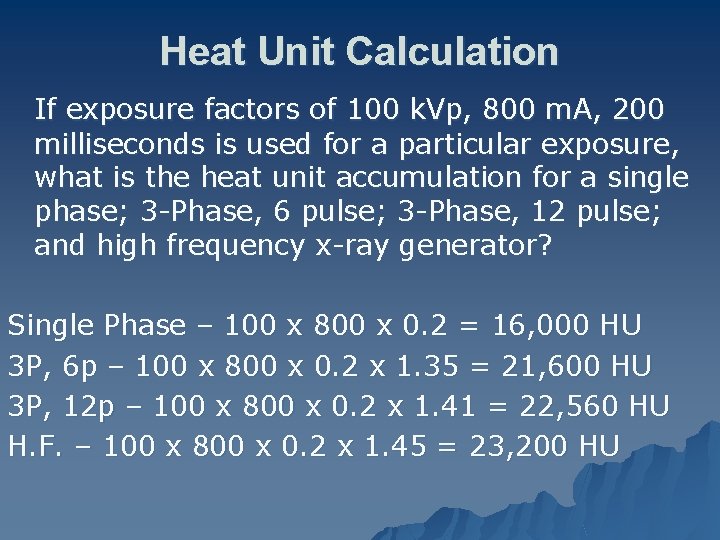
Heat Unit Calculation If exposure factors of 100 k. Vp, 800 m. A, 200 milliseconds is used for a particular exposure, what is the heat unit accumulation for a single phase; 3 -Phase, 6 pulse; 3 -Phase, 12 pulse; and high frequency x-ray generator? Single Phase – 100 x 800 x 0. 2 = 16, 000 HU 3 P, 6 p – 100 x 800 x 0. 2 x 1. 35 = 21, 600 HU 3 P, 12 p – 100 x 800 x 0. 2 x 1. 41 = 22, 560 HU H. F. – 100 x 800 x 0. 2 x 1. 45 = 23, 200 HU
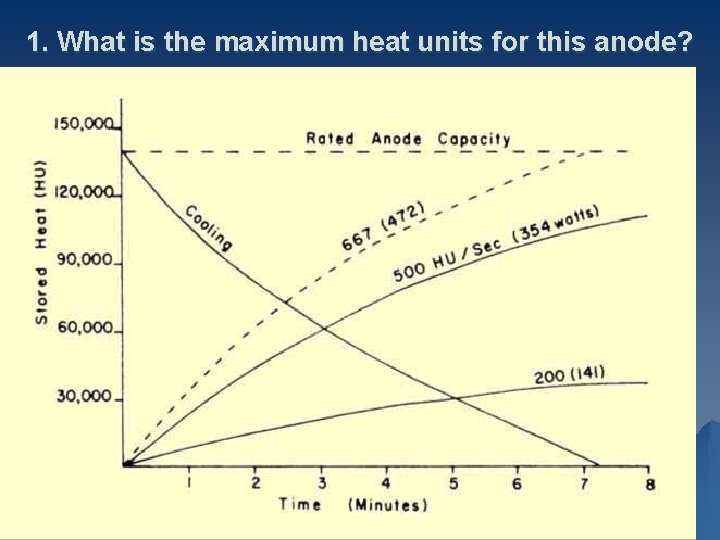
1. What is the maximum heat units for this anode?
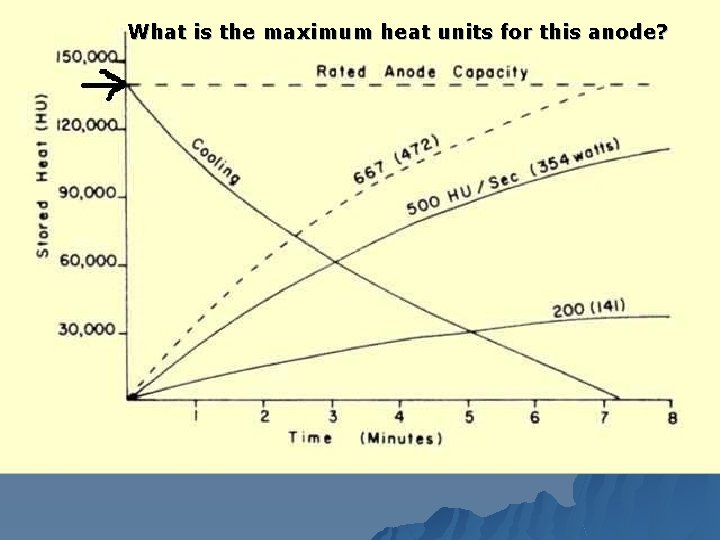
What is the maximum heat units for this anode?
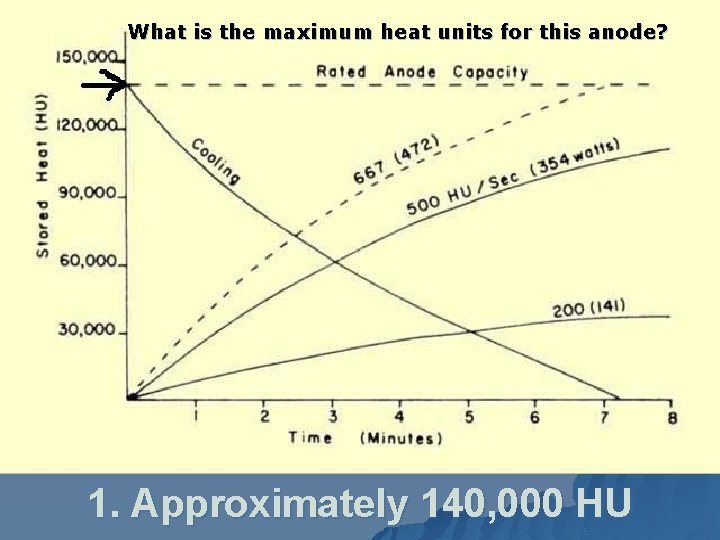
What is the maximum heat units for this anode? 1. Approximately 140, 000 HU
1. What is the maximum heat units for this anode? 2. If the anode has reached its heat maximum, how long will it take to completely cool?
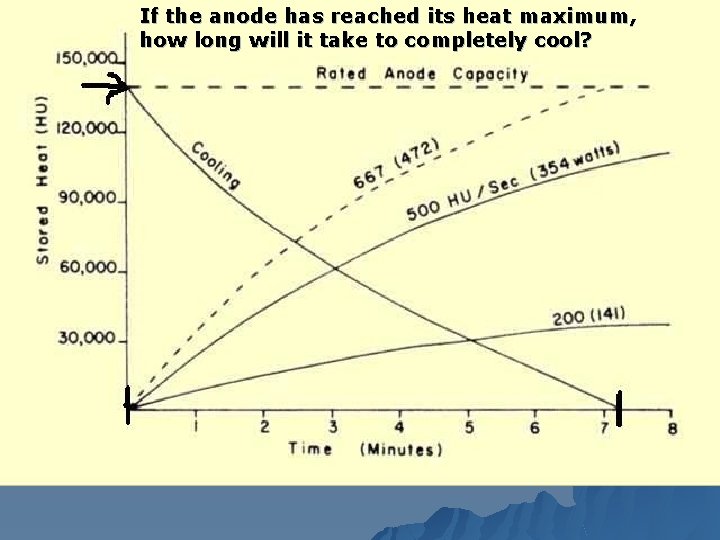
If the anode has reached its heat maximum, how long will it take to completely cool?
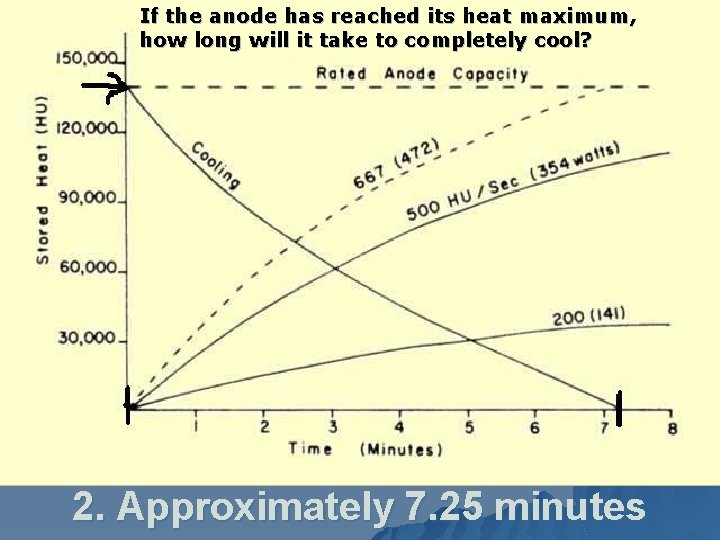
If the anode has reached its heat maximum, how long will it take to completely cool? 2. Approximately 7. 25 minutes
1. What is the maximum heat units for this anode? 2. If the anode has reached its heat maximum, how long will it take to completely cool? 3. If the anode has accumulated 100, 000 HU, how long will it take for the anode to cool to 50, 000 HU?
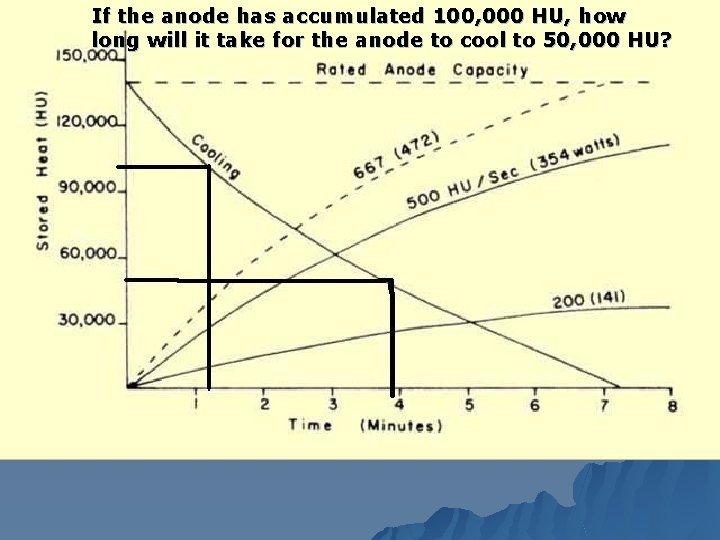
If the anode has accumulated 100, 000 HU, how long will it take for the anode to cool to 50, 000 HU?
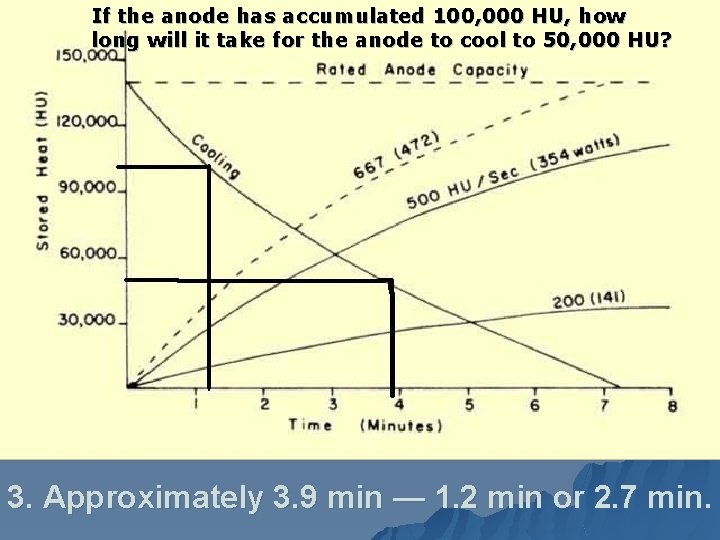
If the anode has accumulated 100, 000 HU, how long will it take for the anode to cool to 50, 000 HU? 3. Approximately 3. 9 min — 1. 2 min or 2. 7 min.
1. What is the maximum heat units for this anode? 2. If the anode has reached its heat maximum, how long will it take to completely cool? 3. If the anode has accumulated 100, 000 HU, how long will it take for the anode to cool to 50, 000 HU? 4. If the anode has accumulated 120, 000 HU, how long must the anode cool before an additional 100, 000 HU can be added?
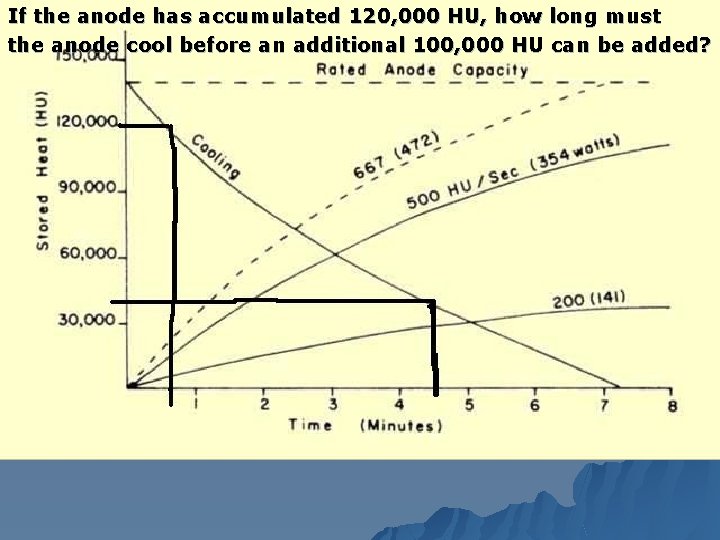
If the anode has accumulated 120, 000 HU, how long must the anode cool before an additional 100, 000 HU can be added?
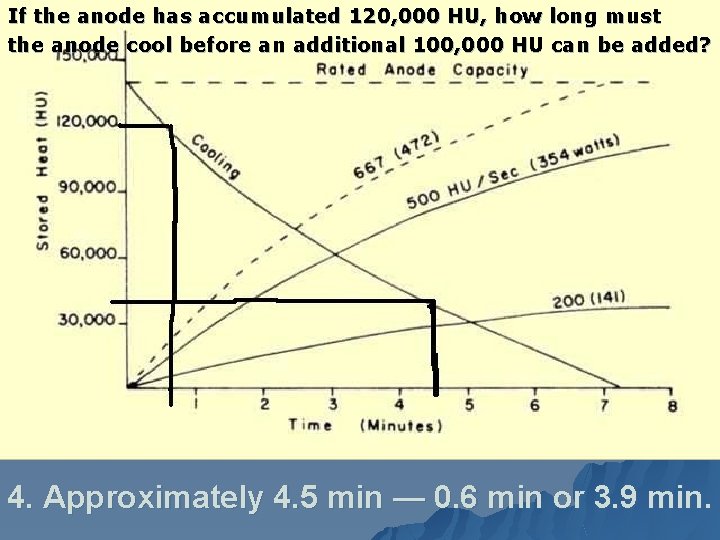
If the anode has accumulated 120, 000 HU, how long must the anode cool before an additional 100, 000 HU can be added? 4. Approximately 4. 5 min — 0. 6 min or 3. 9 min.
1. What is the maximum heat units for this anode? 2. If the anode has reached its heat maximum, how long will it take to completely cool? 3. If the anode has accumulated 100, 000 HU, how long will it take for the anode to cool to 50, 000 HU? 4. If the anode has accumulated 120, 000 HU, how long must the anode cool before an additional 100, 000 HU can be added? 5. If 85 k. Vp, 800 m. A, 100 msec is used on a 3 P, 12 p unit, how many consecutive exposures can be made without exceeding the heat limit? (Assume the exposures begin with a completely cool anode. )
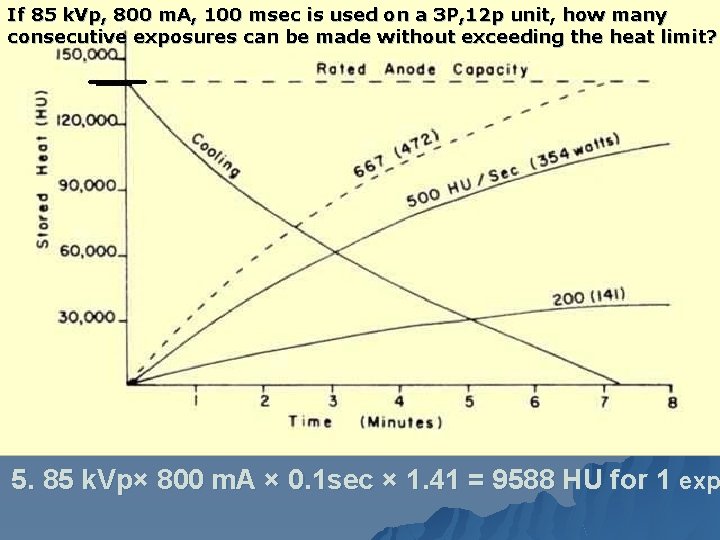
If 85 k. Vp, 800 m. A, 100 msec is used on a 3 P, 12 p unit, how many consecutive exposures can be made without exceeding the heat limit? 5. 85 k. Vp× 800 m. A × 0. 1 sec × 1. 41 = 9588 HU for 1 exp
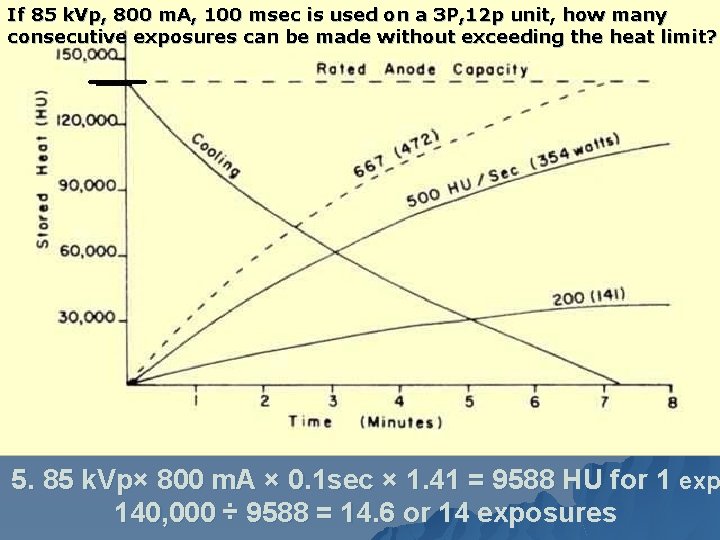
If 85 k. Vp, 800 m. A, 100 msec is used on a 3 P, 12 p unit, how many consecutive exposures can be made without exceeding the heat limit? 5. 85 k. Vp× 800 m. A × 0. 1 sec × 1. 41 = 9588 HU for 1 exp 140, 000 ÷ 9588 = 14. 6 or 14 exposures
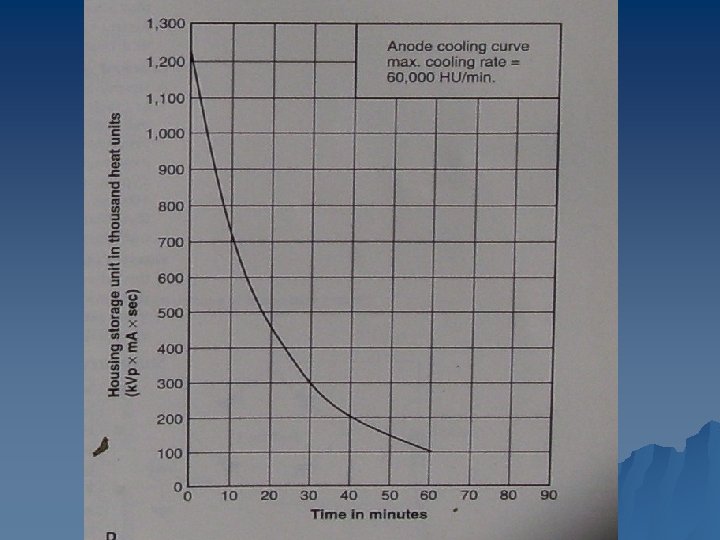
The X-ray Tube u Housing Cooling Chart 1. determines the time it takes for the ________ housing to cool
- Slides: 58