
Rt II Response to Instruction and Intervention Overview
- Slides: 17
Rt. II Response to Instruction and Intervention Overview
Definition Rt. II is a comprehensive multi-tiered prevention model that provides services and interventions as early as possible to meet the instructional needs of all students. IDEA 2004 provides for the use of Rt. II as an alternative to the discrepancy model for the identification of students with learning disabilities. Ernst, Miller, Robinson & Tilly 2005
Key Characteristics of RTII Universal Screening of academics and behavior Multiple tiers of increasingly intensive interventions Differentiated curriculum within each tier Use of scientifically research-based interventions Continuous monitoring of student progress Data driven decision making RTI: A Schoolwide Framework for Student Success Pa. TTAN (2005)
What It Takes Shifts in Thinking ◦ Assessment – from placement-oriented assessment to teaching-oriented assessment focused on what to teach and how to teach it ◦ MY students to OUR students – Shared ownership Professional Development ◦ Administrative groups (district and building level) ◦ Direct service groups (classroom teachers and other instructional staff) ◦ Related service groups (school psychologists, speech therapists, counselors etc. ) ◦ Parents Technical Support ◦ Data Management System (2005) RTI: A Schoolwide Framework for Student Success Pa. TTAN
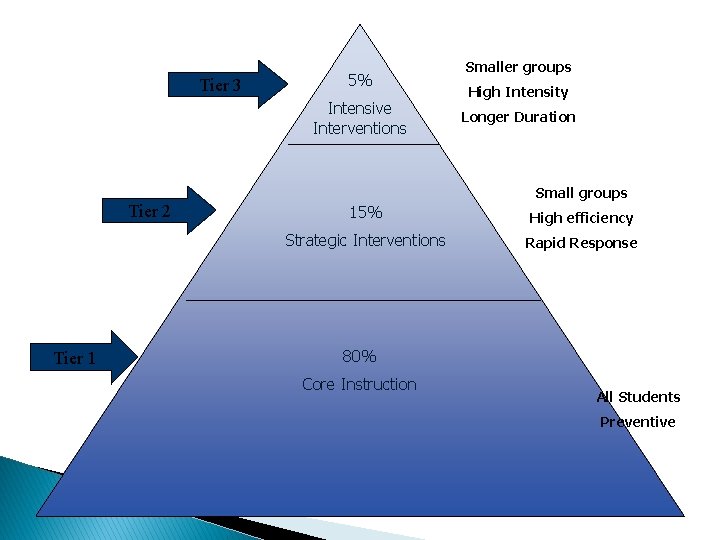
Tier 3 5% Intensive Interventions Smaller groups High Intensity Longer Duration Small groups Tier 2 Tier 1 15% High efficiency Strategic Interventions Rapid Response 80% Core Instruction All Students Preventive
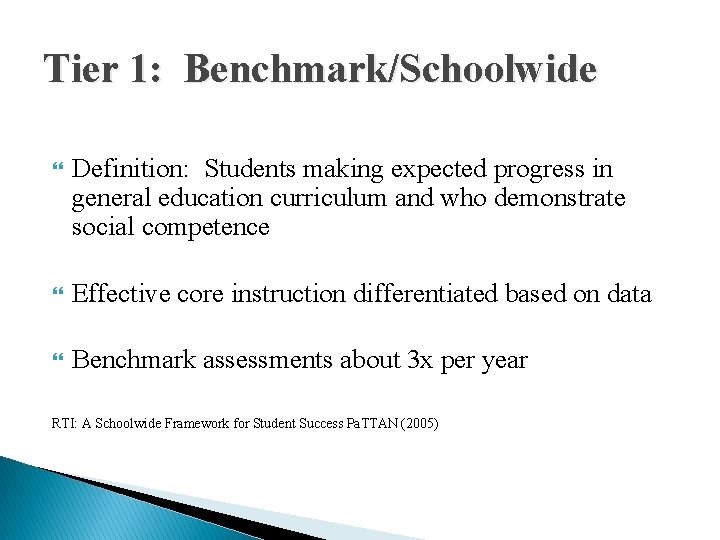
Tier 1: Benchmark/Schoolwide Definition: Students making expected progress in general education curriculum and who demonstrate social competence Effective core instruction differentiated based on data Benchmark assessments about 3 x per year RTI: A Schoolwide Framework for Student Success Pa. TTAN (2005)
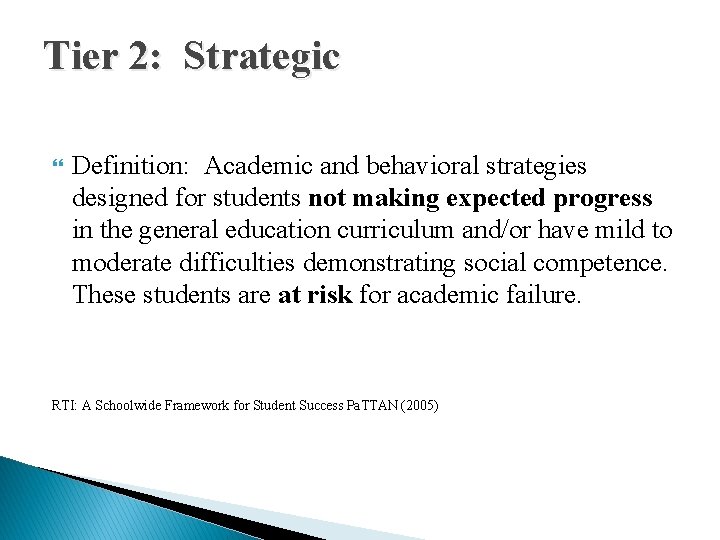
Tier 2: Strategic Definition: Academic and behavioral strategies designed for students not making expected progress in the general education curriculum and/or have mild to moderate difficulties demonstrating social competence. These students are at risk for academic failure. RTI: A Schoolwide Framework for Student Success Pa. TTAN (2005)
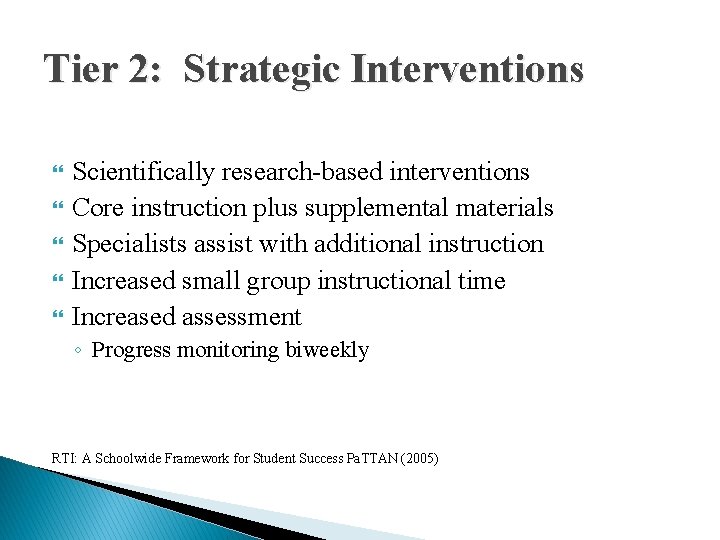
Tier 2: Strategic Interventions Scientifically research-based interventions Core instruction plus supplemental materials Specialists assist with additional instruction Increased small group instructional time Increased assessment ◦ Progress monitoring biweekly RTI: A Schoolwide Framework for Student Success Pa. TTAN (2005)
Tier 3: Intensive Definition: Academic and behavioral strategies designed for students significantly behind established grade-level benchmarks in the general education curriculum or who demonstrate significant difficulties with behavioral and social competence. RTI: A Schoolwide Framework for Student Success Pa. TTAN (2005)
Tier 3: Intensive Interventions Supplemental instructional materials Small intensive groups Increased small group instructional time Increased assessment ◦ Progress monitoring weekly RTI: A Schoolwide Framework for Student Success Pa. TTAN (2005)
What role does Rt. I play in Special Education Eligibility? We must document that the student did not respond to interventions put in place in the general education curriculum AND that the instruction has been delivered with fidelity BEFORE a student can be recommended for an evaluation. IDEA 2004 offers greater flexibility to schools by eliminating the requirement that students must exhibit a severe discrepancy between intellectual ability (IQ) and achievement in order to be found eligible for special education and related services.
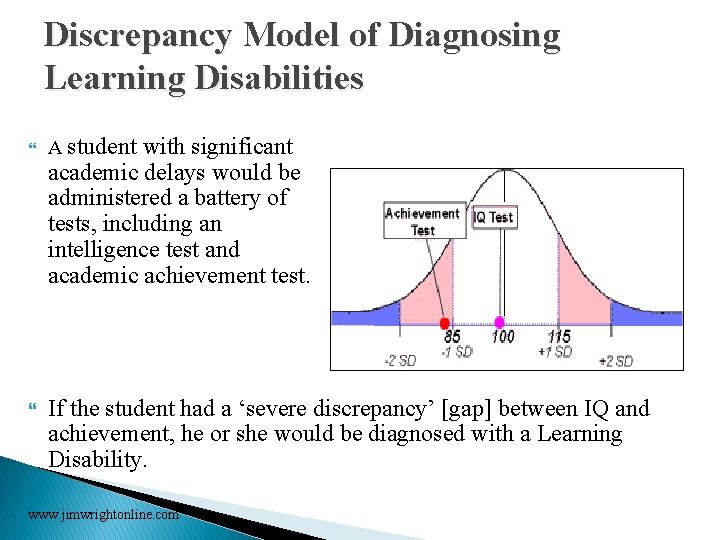
Discrepancy Model of Diagnosing Learning Disabilities A student with significant academic delays would be administered a battery of tests, including an intelligence test and academic achievement test. If the student had a ‘severe discrepancy’ [gap] between IQ and achievement, he or she would be diagnosed with a Learning Disability. www. jimwrightonline. com
Limitations to the Discrepancy Model � Requires chronic school failure BEFORE remedial/special education supports can be given. � Fails to consider that outside factors such as poor or inconsistent instruction may contribute to a child's learning delay. �A ‘severe discrepancy’ between test scores provides no useful information about WHY the student is doing poorly academically. � Different states (and even school districts within the same state) often use different formulas to diagnose LD, resulting in a lack of uniformity in identifying children for special education support. www. jimwrightonline. com
Expected Outcomes of Rt. II Increased expectations for ALL students Shared ownership of ALL students Intervening earlier - No more having to “Crash and Burn” before receiving help! Focus on matching instructional approach to student need Reduced disciplinary referrals Reduced special education referrals
No more “my” kids or “your” kids… …. they are OUR kids.
Questions? Krista Venza Owen J. Roberts School District Instructional Support Facilitator 610 -469 -5522 kvenza@ojrsd. com
For your reading enjoyment… Response to Intervention: A Practical Guide for Every Teacher by William Bender and Cara Shores What Really Matters in Response to Intervention: Research-Based Designs by Richard Allington Pyramid Response to Intervention: Rt. I, Professional Learning Communities, and How to Respond when Kids Don’t Learn by Austin Buffum, Mike Mattos, and Chris Weber