
Rt I 2 Response to Instruction AND Intervention

- Slides: 30
Rt. I 2: Response to Instruction AND Intervention Douglas Fisher & Nancy Frey San Diego State University www. fisherandfrey. com
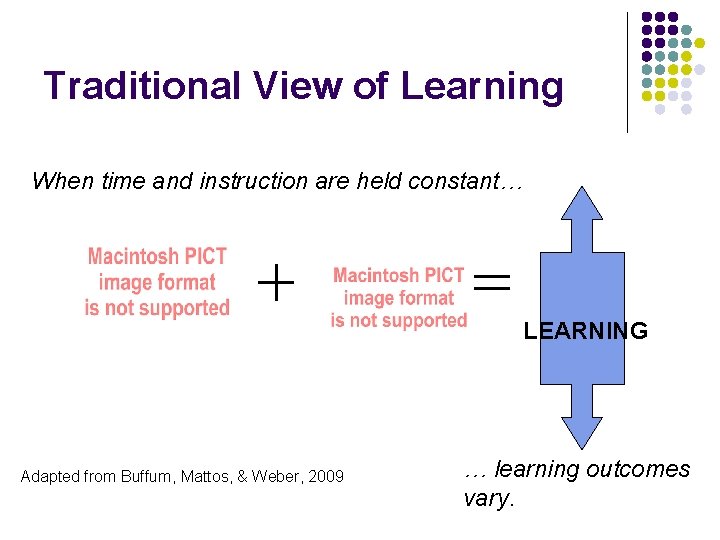
Traditional View of Learning When time and instruction are held constant… LEARNING Adapted from Buffum, Mattos, & Weber, 2009 … learning outcomes vary.
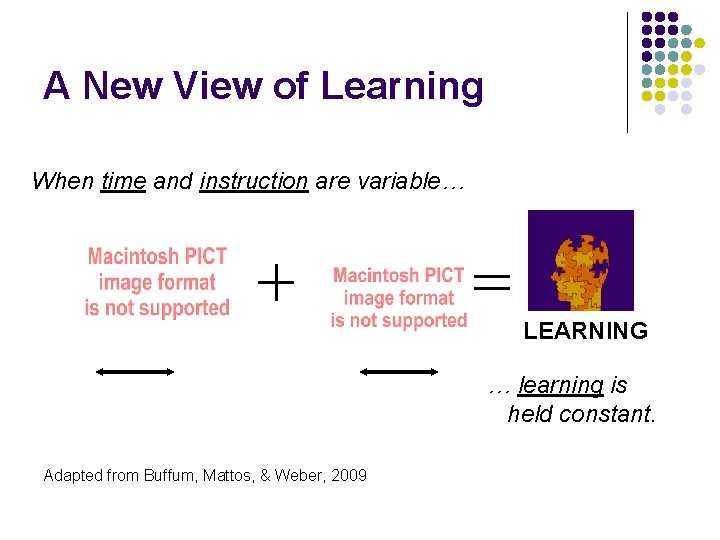
A New View of Learning When time and instruction are variable… LEARNING … learning is held constant. Adapted from Buffum, Mattos, & Weber, 2009
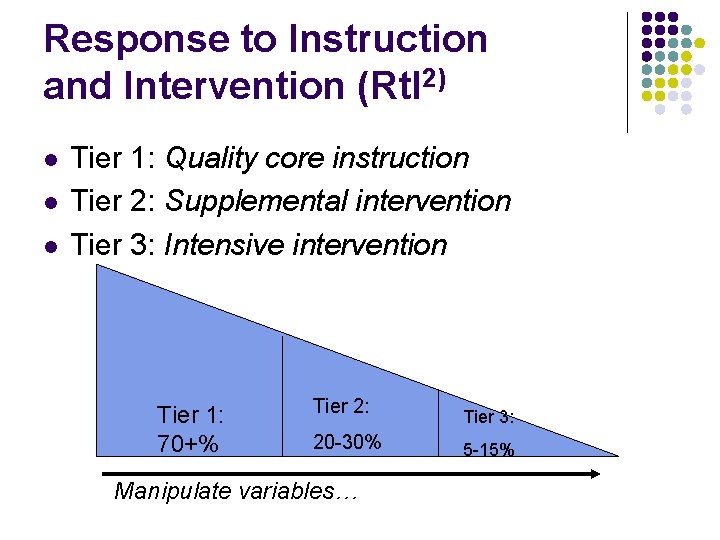
Response to Instruction and Intervention (Rt. I 2) l l l Tier 1: Quality core instruction Tier 2: Supplemental intervention Tier 3: Intensive intervention Tier 1: 70+% Tier 2: 20 -30% Manipulate variables… Tier 3: 5 -15%
What Variables Can You Control? l l l l Frequency (time) Duration (time) Assessment (instruction) Group size (instruction) Access to expertise (instruction) Staff collaboration (instruction) Student Monitoring Team (instruction) Others?
Tier 1: Quality Core Instruction l l l Based on a Gradual Release of Responsibility Formative assessments (feed forward, not just feedback) Push-in supports and incidental benefits
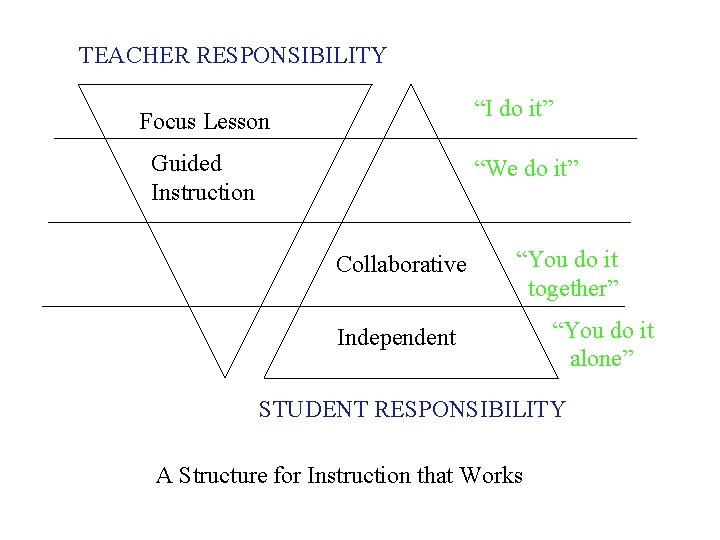
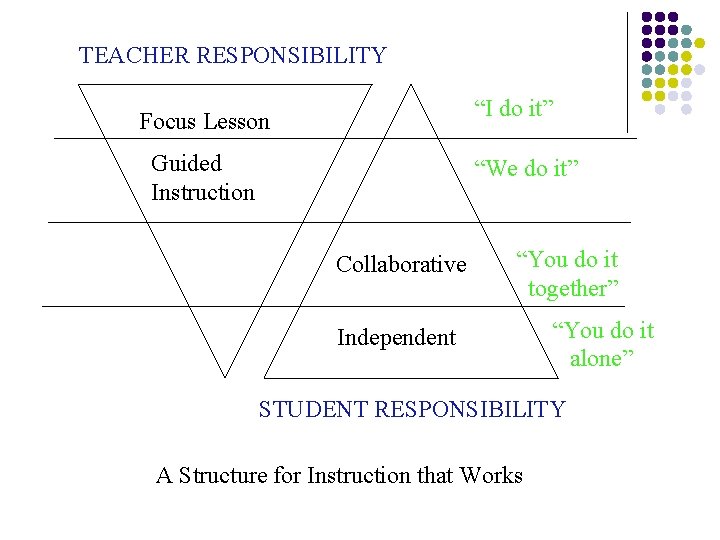
TEACHER RESPONSIBILITY “I do it” Focus Lesson Guided Instruction “We do it” Collaborative “You do it together” Independent “You do it alone” STUDENT RESPONSIBILITY A Structure for Instruction that Works
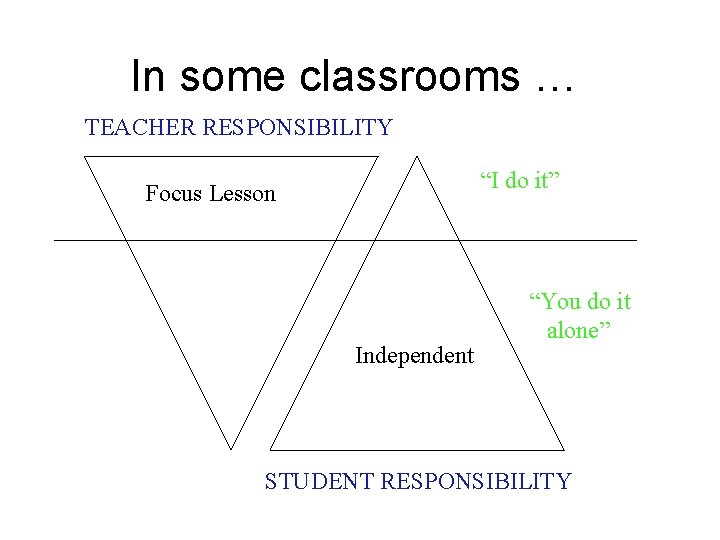
In some classrooms … TEACHER RESPONSIBILITY “I do it” Focus Lesson Independent “You do it alone” STUDENT RESPONSIBILITY
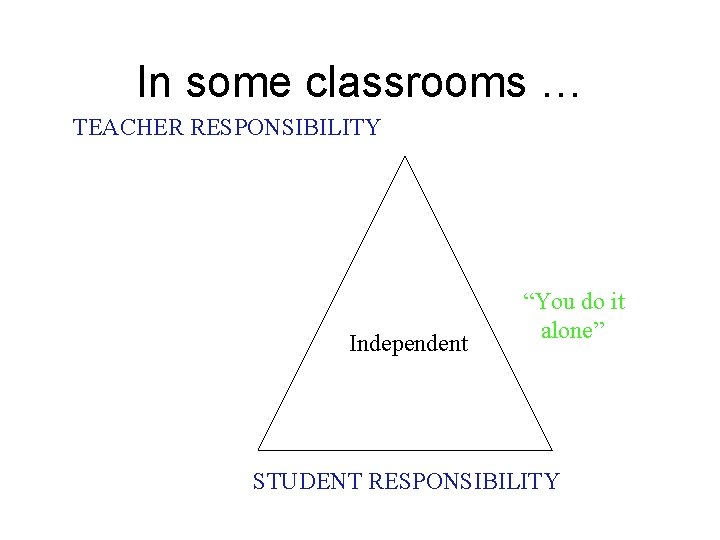
In some classrooms … TEACHER RESPONSIBILITY Independent “You do it alone” STUDENT RESPONSIBILITY
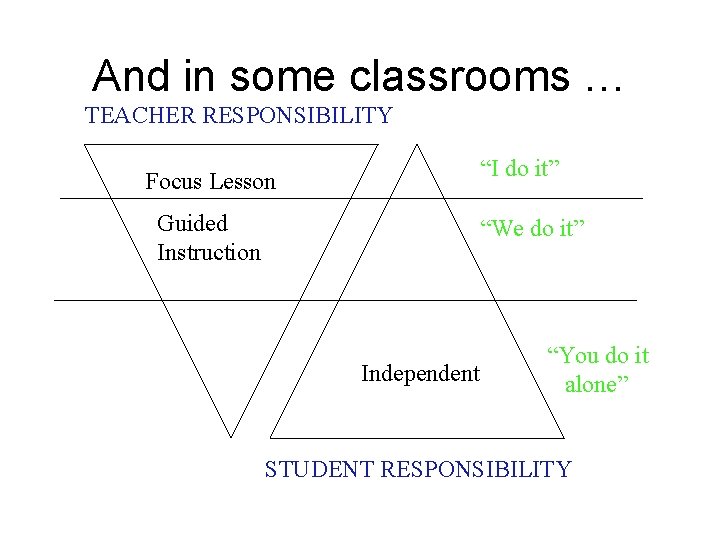
And in some classrooms … TEACHER RESPONSIBILITY “I do it” Focus Lesson Guided Instruction “We do it” Independent “You do it alone” STUDENT RESPONSIBILITY
TEACHER RESPONSIBILITY “I do it” Focus Lesson Guided Instruction “We do it” Collaborative “You do it together” Independent “You do it alone” STUDENT RESPONSIBILITY A Structure for Instruction that Works
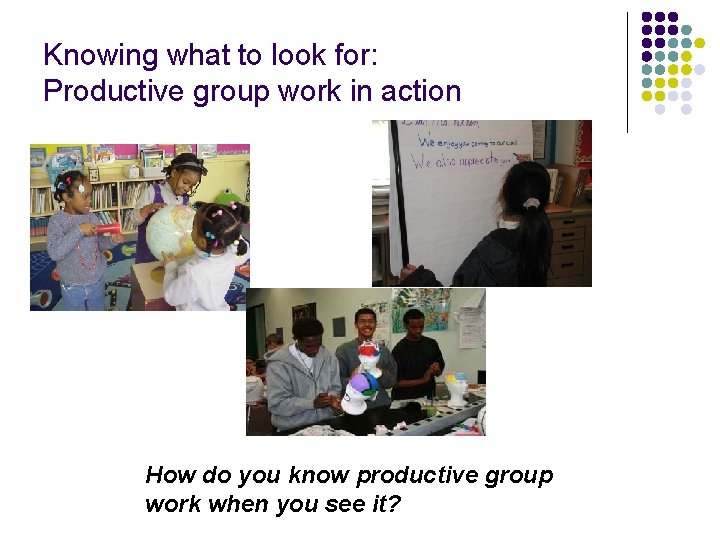
Knowing what to look for: Productive group work in action How do you know productive group work when you see it?
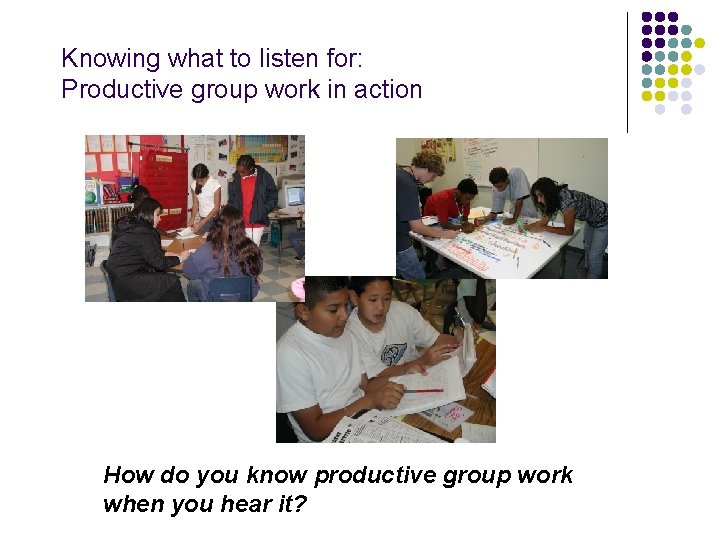
Knowing what to listen for: Productive group work in action How do you know productive group work when you hear it?
Tier 2: Supplemental l l Increase guided instruction within the school day and beyond the school day Small groups (no more than 5) Recruit additional staff members to provide supplemental instruction Increase progress monitoring and assessment
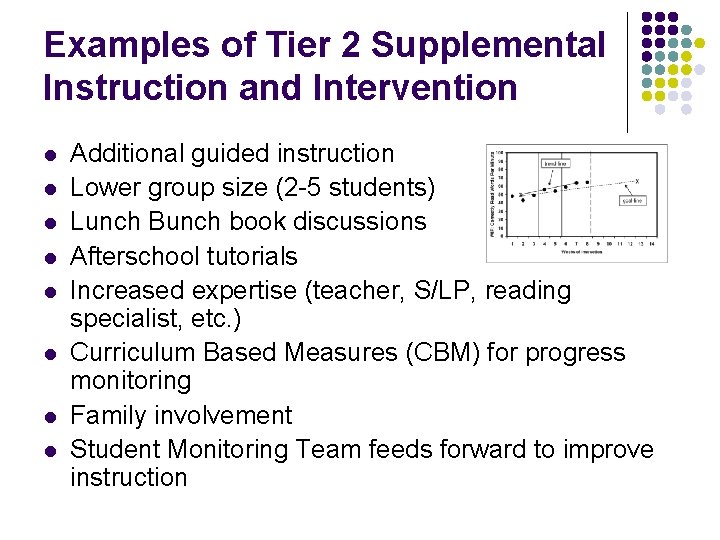
Examples of Tier 2 Supplemental Instruction and Intervention l l l l Additional guided instruction Lower group size (2 -5 students) Lunch Bunch book discussions Afterschool tutorials Increased expertise (teacher, S/LP, reading specialist, etc. ) Curriculum Based Measures (CBM) for progress monitoring Family involvement Student Monitoring Team feeds forward to improve instruction
Roots of Guided Instruction l l Vygotsky’s Zone of Proximal Development l “the distance between the actual developmental level as determined by independent problem solving and the level of potential development as determined through problem solving under adult guidance, or in collaboration with more capable peers” (Vygotsky, 1978, p. 86). Wood, Bruner, and Ross’s �Scaffolding l requires the adult’s “controlling those elements of the task that are initially beyond the learner’s capability, thus permitting him to concentrate upon and complete only those elements that are within his range of competence” (Wood, Bruner, & Ross, 1976, p. 90).
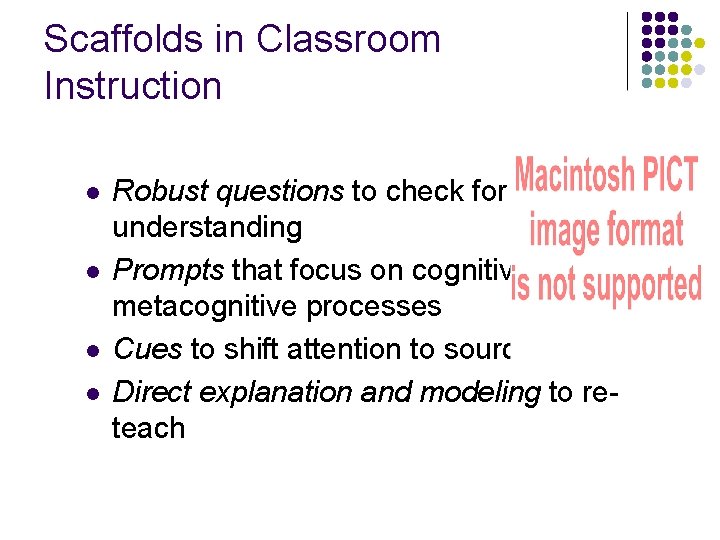
Scaffolds in Classroom Instruction l l Robust questions to check for understanding Prompts that focus on cognitive and metacognitive processes Cues to shift attention to sources Direct explanation and modeling to reteach
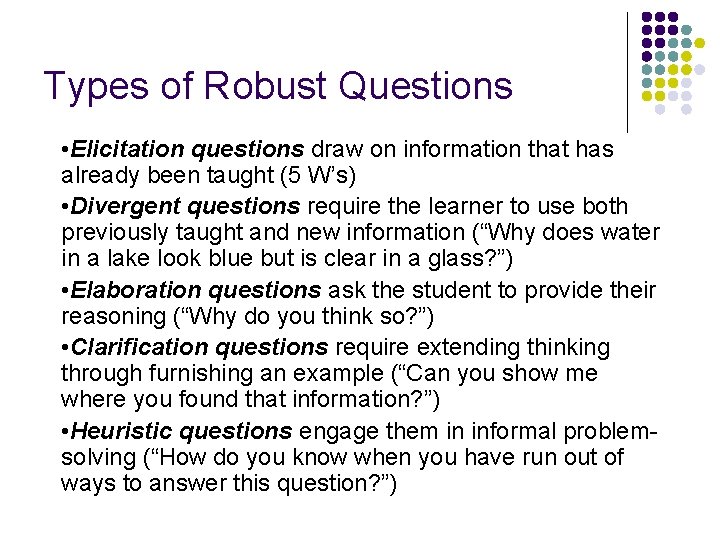
Types of Robust Questions • Elicitation questions draw on information that has already been taught (5 W’s) • Divergent questions require the learner to use both previously taught and new information (“Why does water in a lake look blue but is clear in a glass? ”) • Elaboration questions ask the student to provide their reasoning (“Why do you think so? ”) • Clarification questions require extending thinking through furnishing an example (“Can you show me where you found that information? ”) • Heuristic questions engage them in informal problemsolving (“How do you know when you have run out of ways to answer this question? ”)
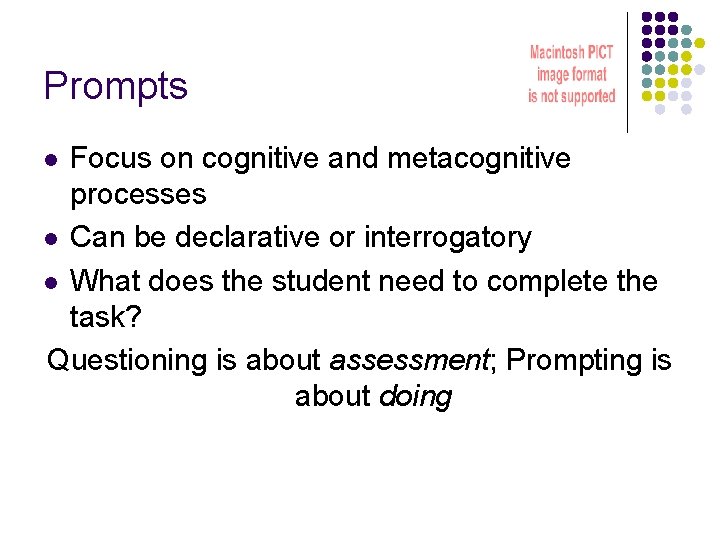
Prompts Focus on cognitive and metacognitive processes l Can be declarative or interrogatory l What does the student need to complete the task? Questioning is about assessment; Prompting is about doing l
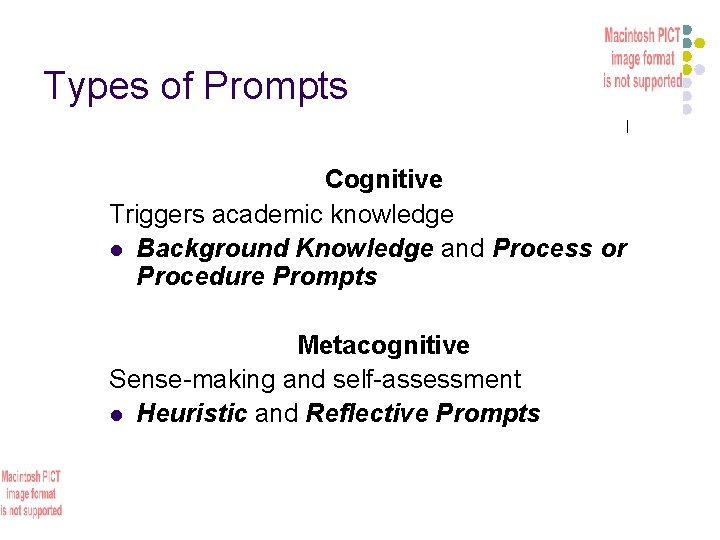
Types of Prompts Cognitive Triggers academic knowledge l Background Knowledge and Process or Procedure Prompts Metacognitive Sense-making and self-assessment l Heuristic and Reflective Prompts
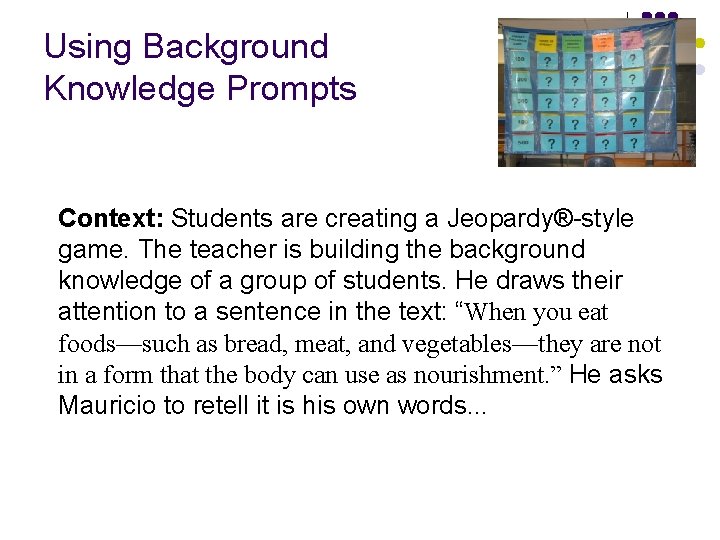
Using Background Knowledge Prompts Context: Students are creating a Jeopardy®-style game. The teacher is building the background knowledge of a group of students. He draws their attention to a sentence in the text: “When you eat foods—such as bread, meat, and vegetables—they are not in a form that the body can use as nourishment. ” He asks Mauricio to retell it is his own words. . .
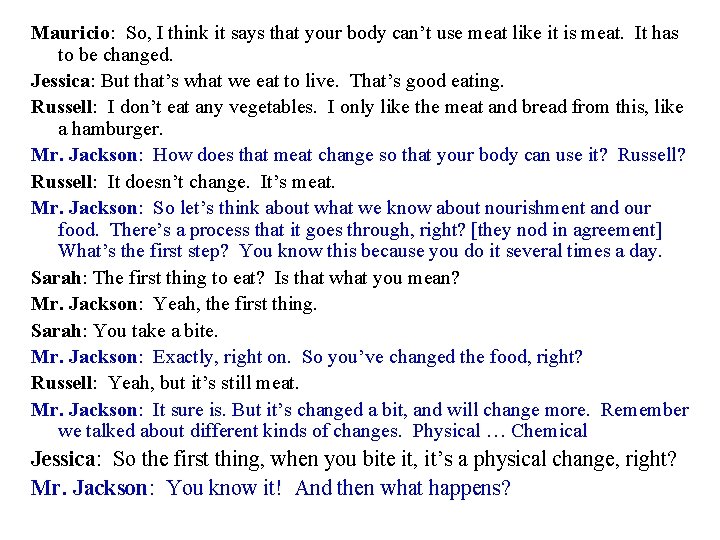
Mauricio: So, I think it says that your body can’t use meat like it is meat. It has to be changed. Jessica: But that’s what we eat to live. That’s good eating. Russell: I don’t eat any vegetables. I only like the meat and bread from this, like a hamburger. Mr. Jackson: How does that meat change so that your body can use it? Russell: It doesn’t change. It’s meat. Mr. Jackson: So let’s think about what we know about nourishment and our food. There’s a process that it goes through, right? [they nod in agreement] What’s the first step? You know this because you do it several times a day. Sarah: The first thing to eat? Is that what you mean? Mr. Jackson: Yeah, the first thing. Sarah: You take a bite. Mr. Jackson: Exactly, right on. So you’ve changed the food, right? Russell: Yeah, but it’s still meat. Mr. Jackson: It sure is. But it’s changed a bit, and will change more. Remember we talked about different kinds of changes. Physical … Chemical Jessica: So the first thing, when you bite it, it’s a physical change, right? Mr. Jackson: You know it! And then what happens?
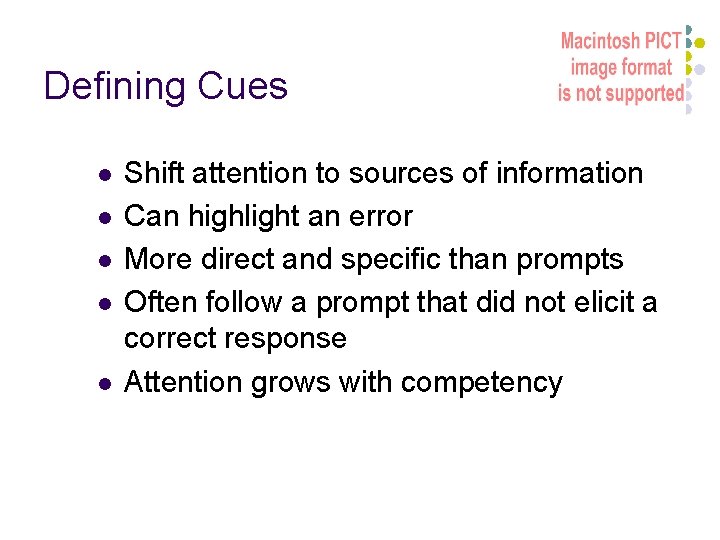
Defining Cues l l l Shift attention to sources of information Can highlight an error More direct and specific than prompts Often follow a prompt that did not elicit a correct response Attention grows with competency
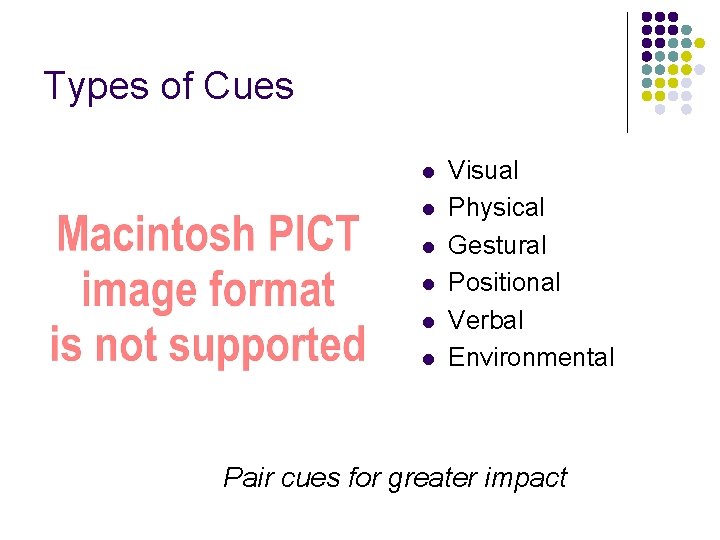
Types of Cues l l l Visual Physical Gestural Positional Verbal Environmental Pair cues for greater impact
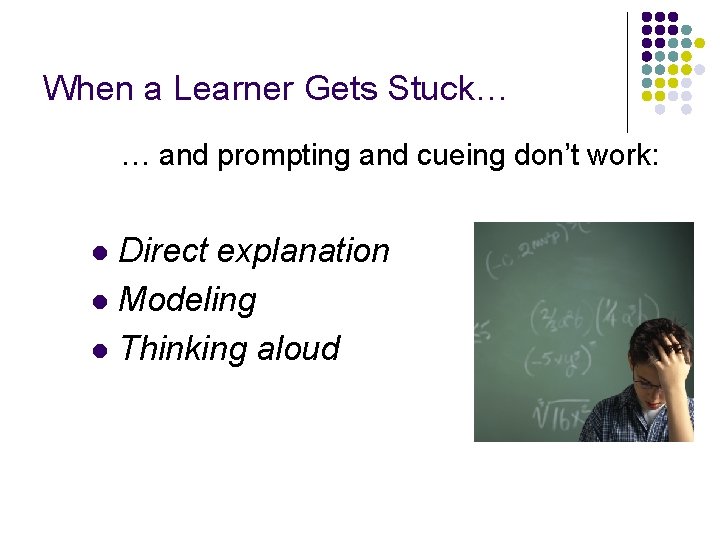
When a Learner Gets Stuck… … and prompting and cueing don’t work: Direct explanation l Modeling l Thinking aloud l
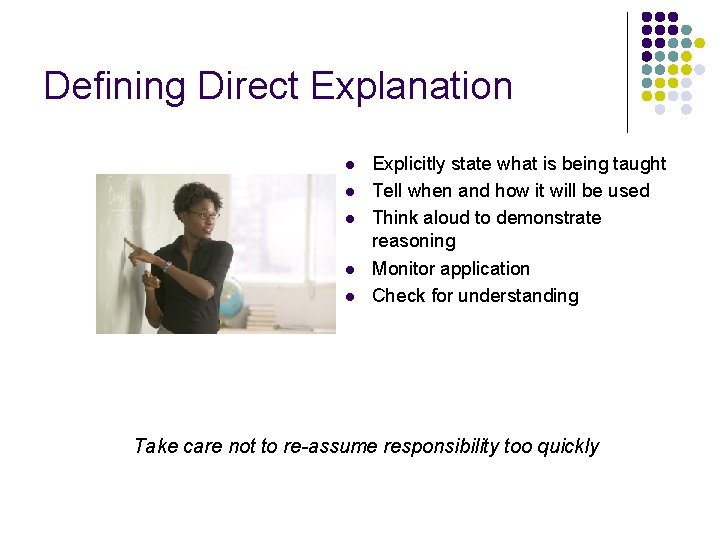
Defining Direct Explanation l l l Explicitly state what is being taught Tell when and how it will be used Think aloud to demonstrate reasoning Monitor application Check for understanding Take care not to re-assume responsibility too quickly
Tier 3: Intensive l l l Individual 30 minutes at least three times per week Increase assessment and monitoring frequency Increase expertise A whole school focus
Examples of Tier 3 Intensive Instruction and Intervention l l l l One-to-one instruction Increased duration and frequency Frequent CBM for progress monitoring Experts provide instruction--every certificated adult on campus has students Specialized assessments Increased family involvement Student Monitoring Team feeds forward to improve programmatic efforts Teacher remains central figure in these efforts
The Takeaway l l Instruction and Intervention are linked Manipulate variables (time, assessment, expertise, instruction) to intensify intervention Build in a feed forward method so that Rt. I 2 results inform classroom instruction and programmatic improvements Keep the teacher and family at the center of communication