
RT 123 Ch 3 Joints Classifications Classification of
- Slides: 25
RT 123 – Ch 3 Joints Classifications
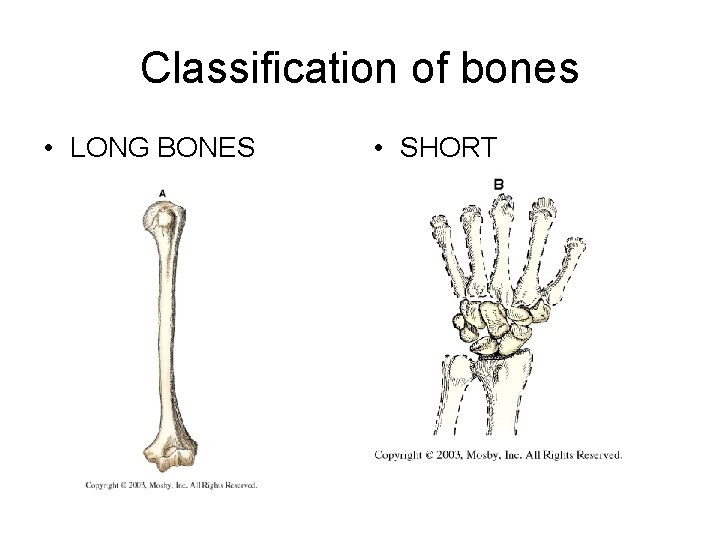
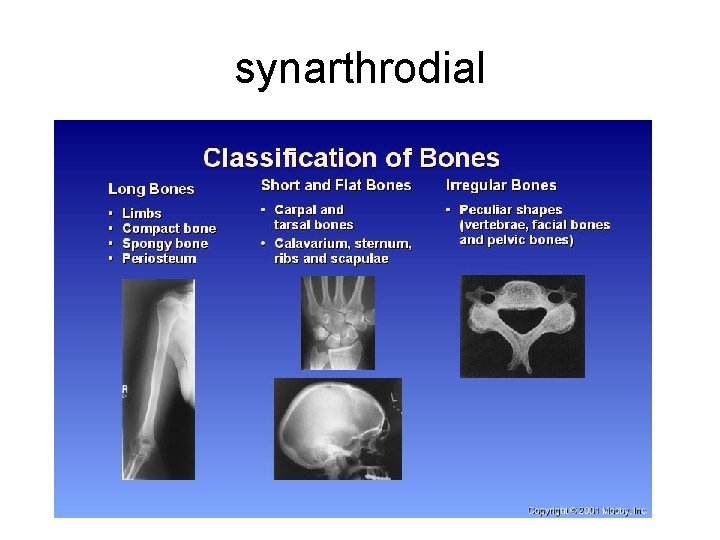
Classification of bones • LONG BONES • SHORT
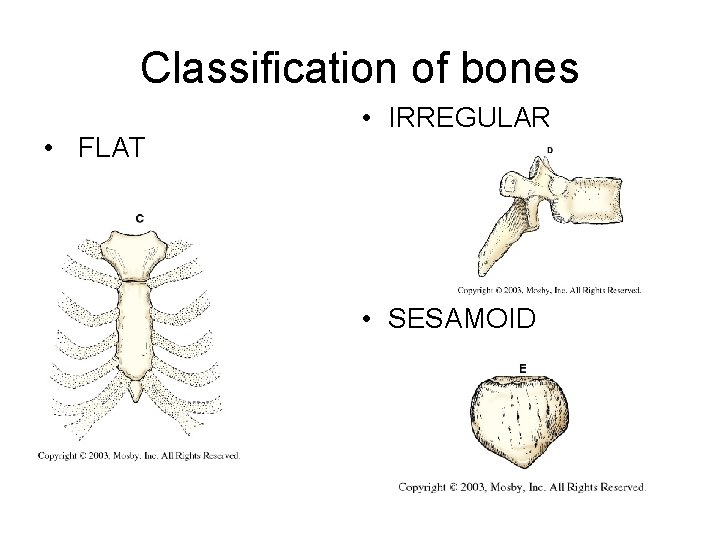
Classification of bones • FLAT • IRREGULAR • SESAMOID
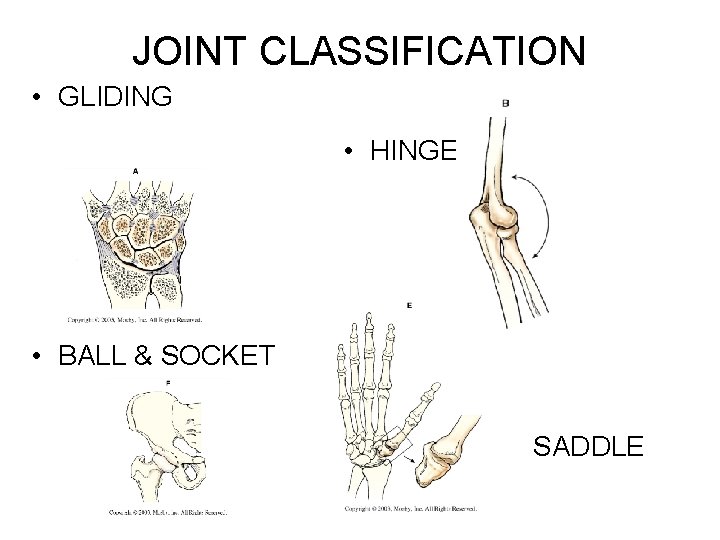
JOINT CLASSIFICATION • GLIDING • HINGE • BALL & SOCKET • • SADDLE
JOINT Classifications
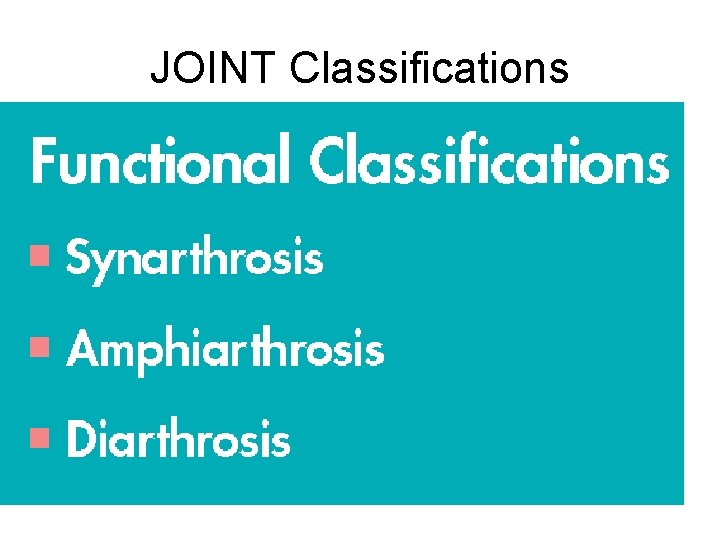
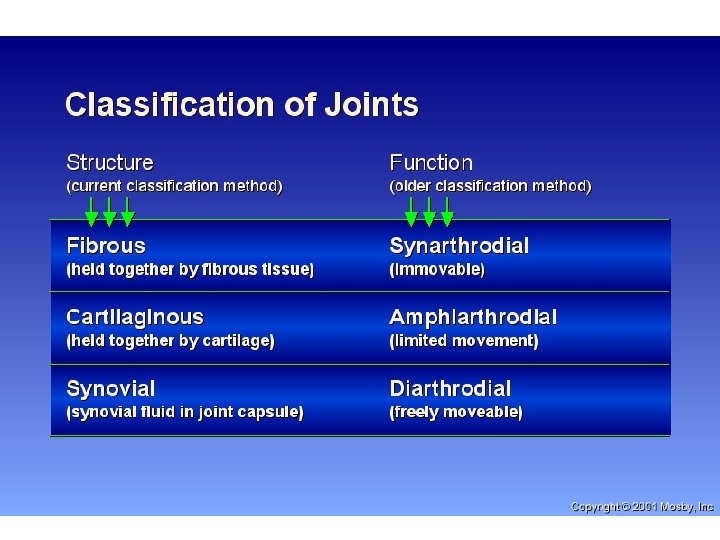
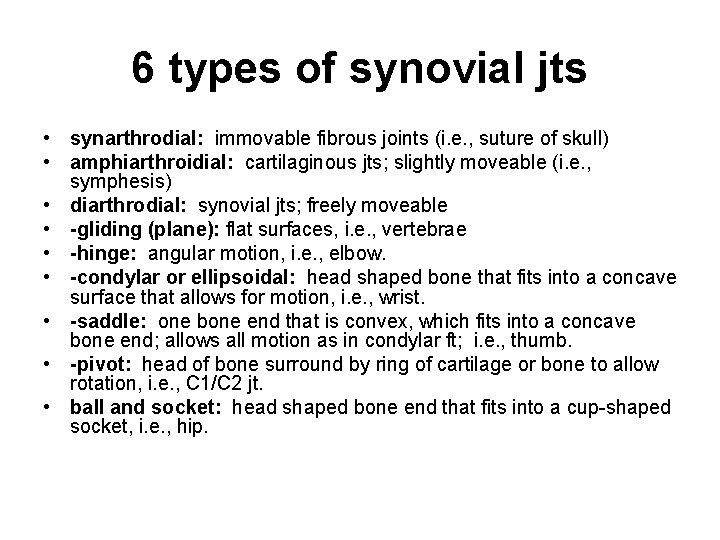
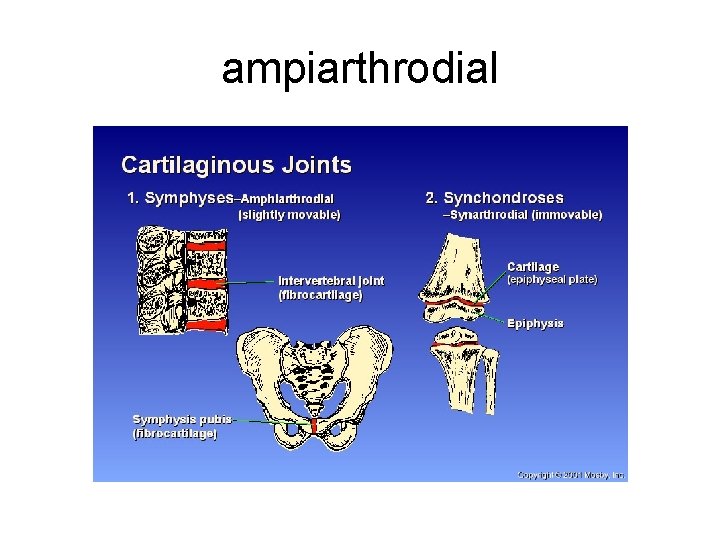
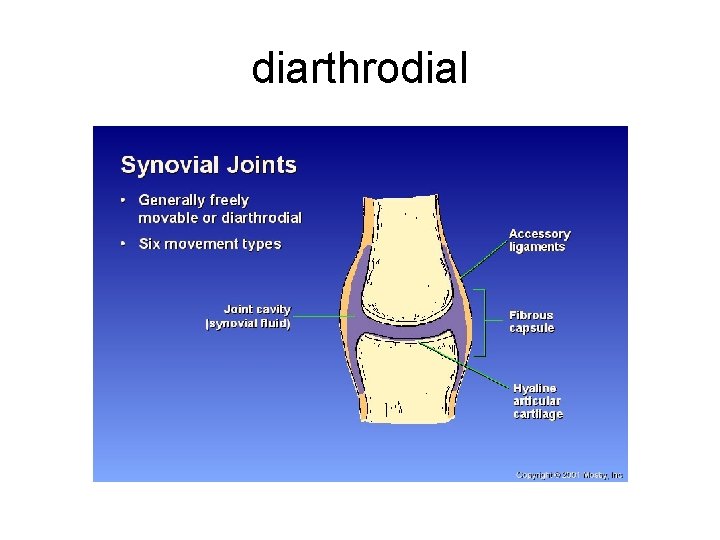
6 types of synovial jts • synarthrodial: immovable fibrous joints (i. e. , suture of skull) • amphiarthroidial: cartilaginous jts; slightly moveable (i. e. , symphesis) • diarthrodial: synovial jts; freely moveable • -gliding (plane): flat surfaces, i. e. , vertebrae • -hinge: angular motion, i. e. , elbow. • -condylar or ellipsoidal: head shaped bone that fits into a concave surface that allows for motion, i. e. , wrist. • -saddle: one bone end that is convex, which fits into a concave bone end; allows all motion as in condylar ft; i. e. , thumb. • -pivot: head of bone surround by ring of cartilage or bone to allow rotation, i. e. , C 1/C 2 jt. • ball and socket: head shaped bone end that fits into a cup-shaped socket, i. e. , hip.
synarthrodial
ampiarthrodial
diarthrodial
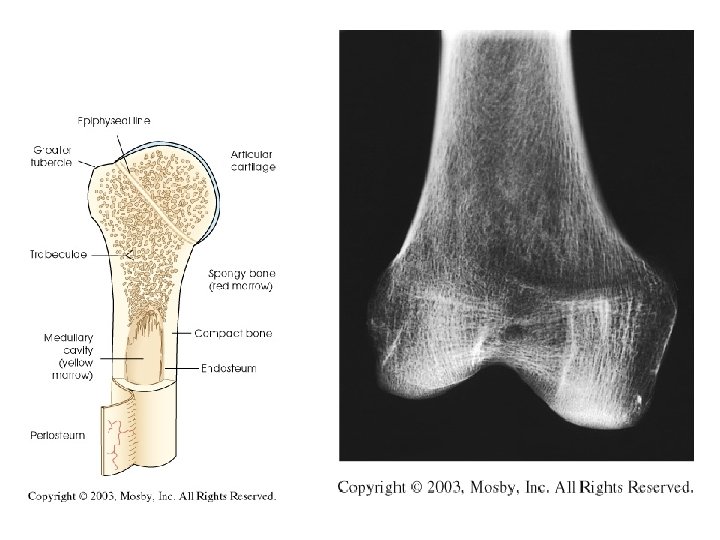
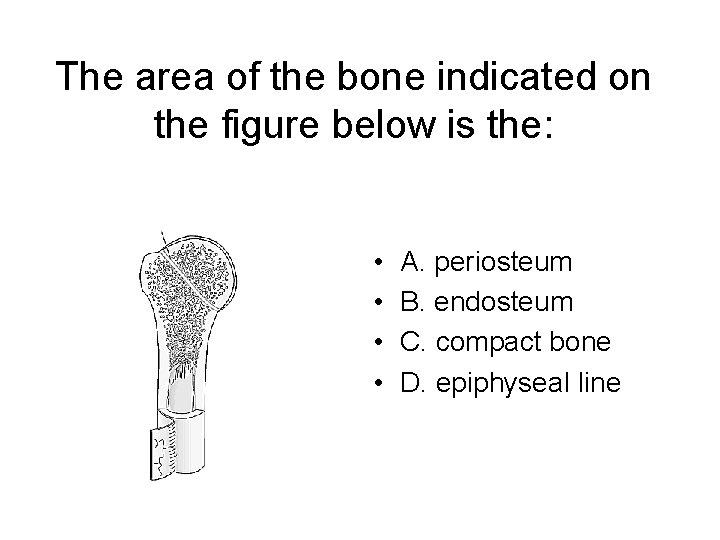
The area of the bone indicated on the figure below is the: • • A. periosteum B. endosteum C. compact bone D. epiphyseal line
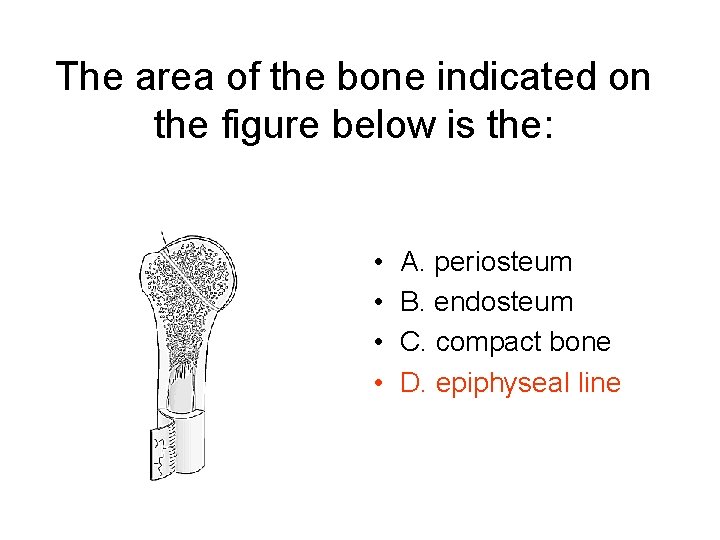
The area of the bone indicated on the figure below is the: • • A. periosteum B. endosteum C. compact bone D. epiphyseal line
OSTEOLOGY • 206 BONES • AXIAL – SUPPORTS HEAD & TRUNK • APPENDICULAR – BOCY MOVEMENT • CHECK OUT CHARTS P. 66
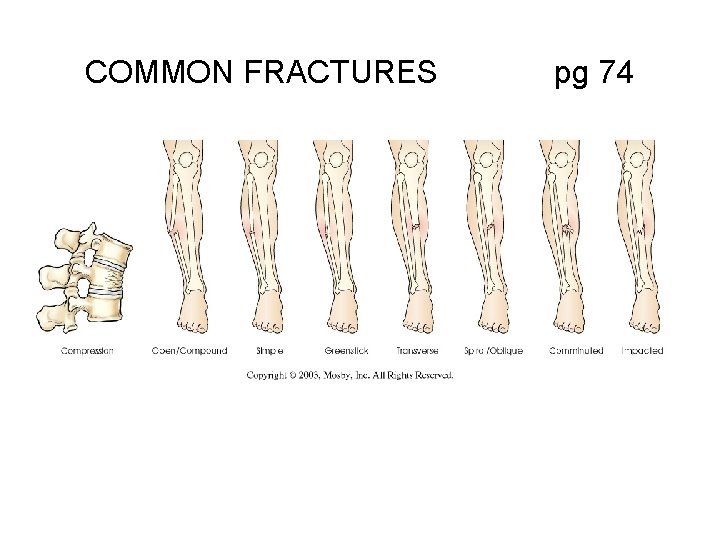
COMMON FRACTURES pg 74
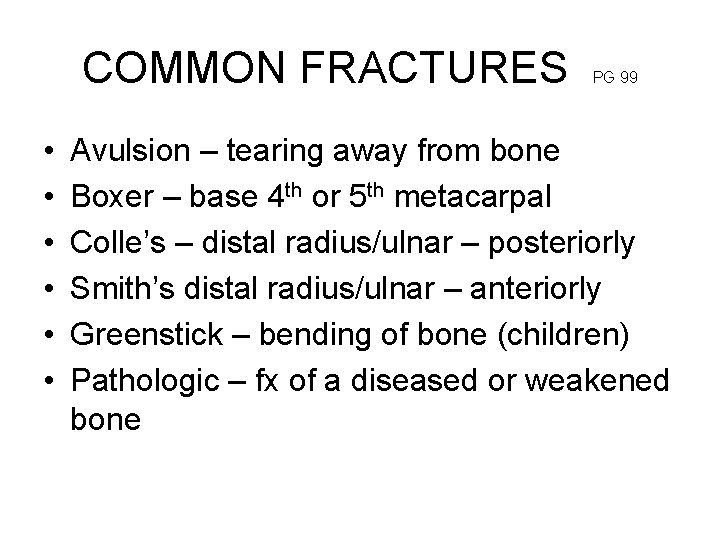
COMMON FRACTURES • • • PG 99 Avulsion – tearing away from bone Boxer – base 4 th or 5 th metacarpal Colle’s – distal radius/ulnar – posteriorly Smith’s distal radius/ulnar – anteriorly Greenstick – bending of bone (children) Pathologic – fx of a diseased or weakened bone
A fracture that does not break through the skin is called a/an • • A. open fracture B. closed fracture C. displaced fracture D. nondisplaced fracture
A fracture that does not break through the skin is called a/an • • A. open fracture B. closed fracture C. displaced fracture D. nondisplaced fracture
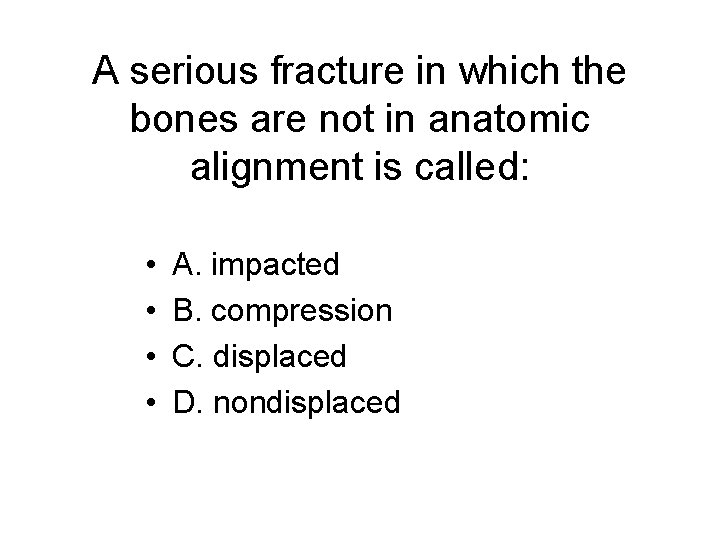
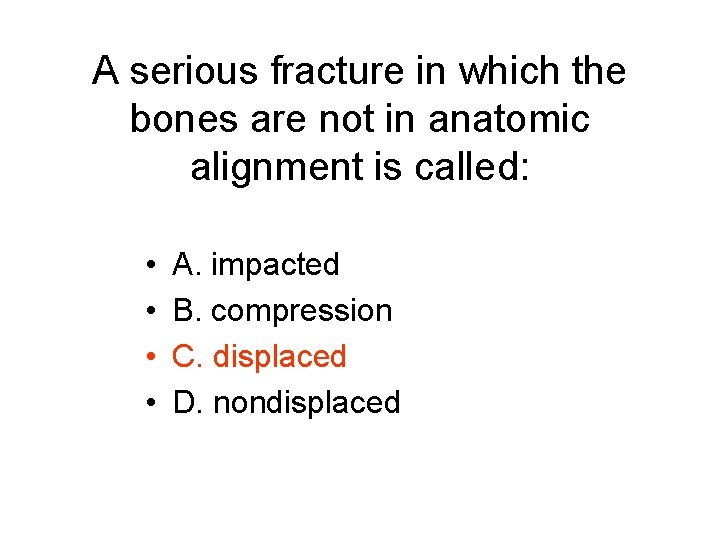
A serious fracture in which the bones are not in anatomic alignment is called: • • A. impacted B. compression C. displaced D. nondisplaced
A serious fracture in which the bones are not in anatomic alignment is called: • • A. impacted B. compression C. displaced D. nondisplaced
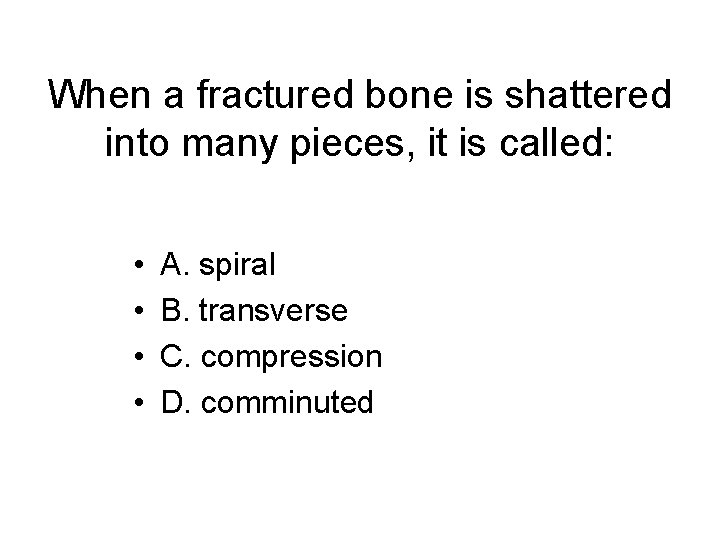
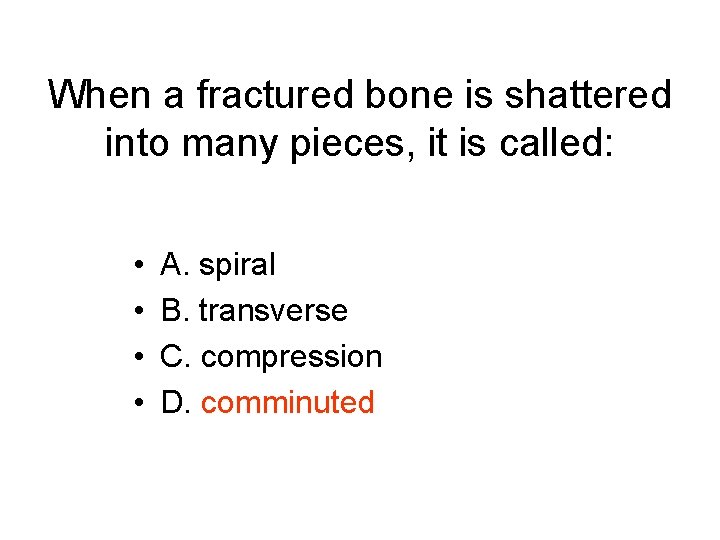
When a fractured bone is shattered into many pieces, it is called: • • A. spiral B. transverse C. compression D. comminuted
When a fractured bone is shattered into many pieces, it is called: • • A. spiral B. transverse C. compression D. comminuted