
RSV CA Rajiv Singh FCA CISAUSA RV LIII

- Slides: 61
RSV CA Rajiv Singh FCA, CISA(USA), RV, LIII Director Union Bank of India Course Director IVCP
BOV, Levels of Value, Valuation Date , Subsequent Date , Valuation Principles , SOW and I & C Session 3 RSV
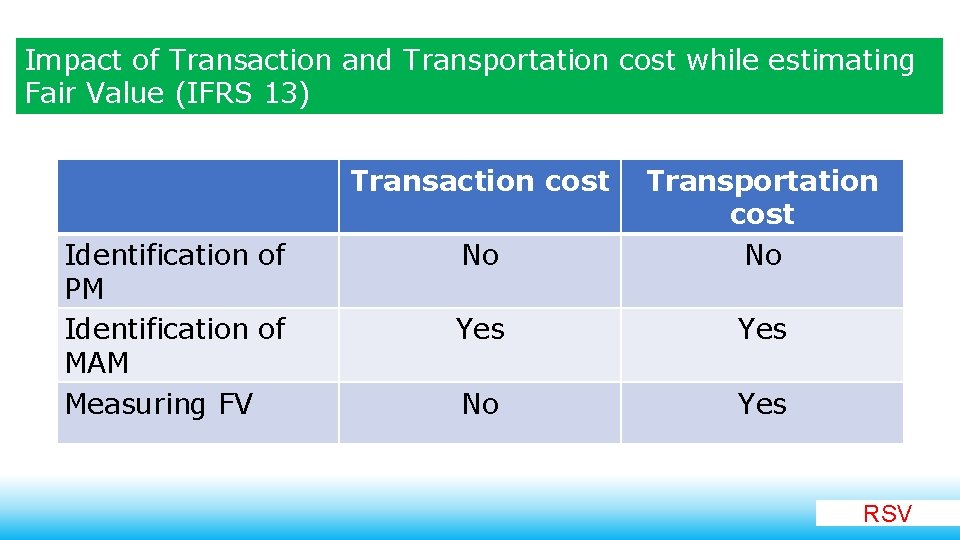
Impact of Transaction and Transportation cost while estimating Fair Value (IFRS 13) Transaction cost Identification of PM Identification of MAM Measuring FV No Transportation cost No Yes RSV
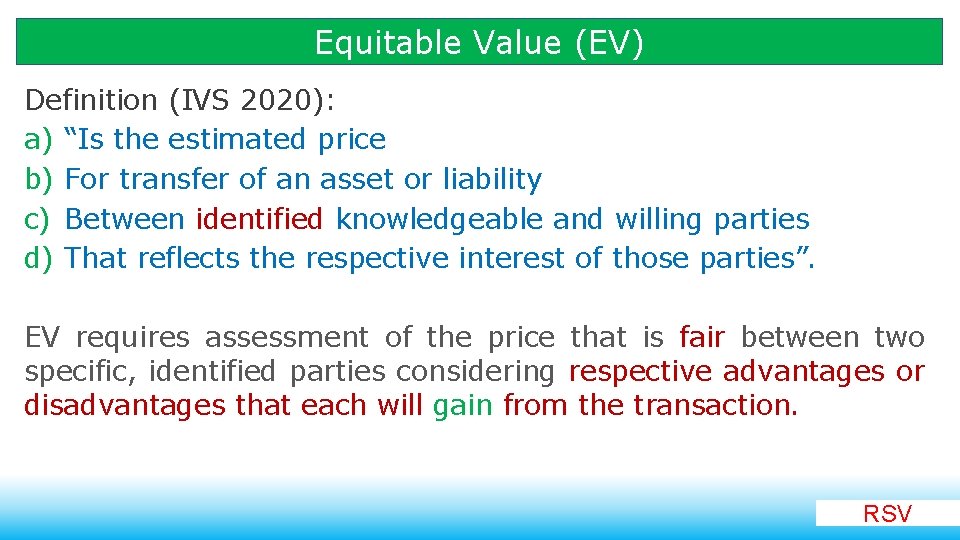
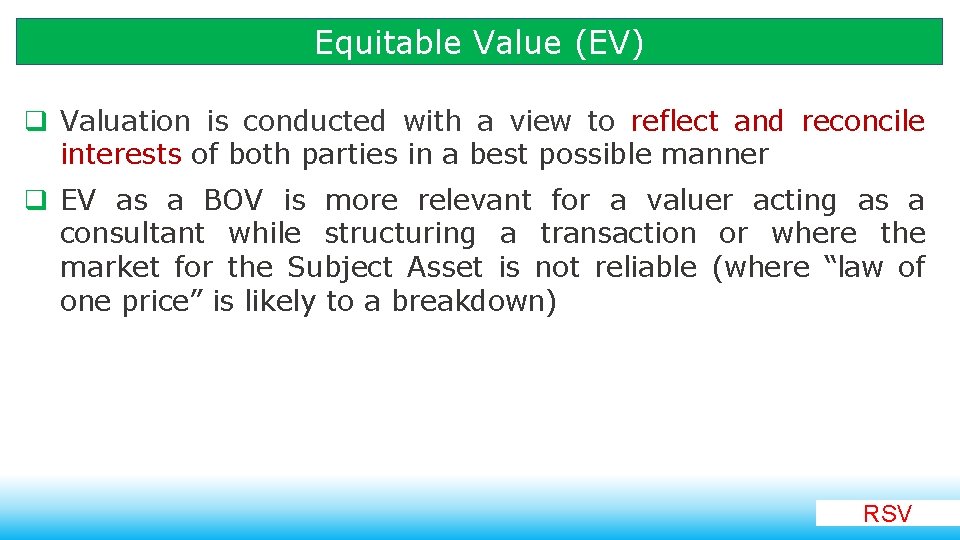
Equitable Value (EV) Definition (IVS 2020): a) “Is the estimated price b) For transfer of an asset or liability c) Between identified knowledgeable and willing parties d) That reflects the respective interest of those parties”. EV requires assessment of the price that is fair between two specific, identified parties considering respective advantages or disadvantages that each will gain from the transaction. RSV
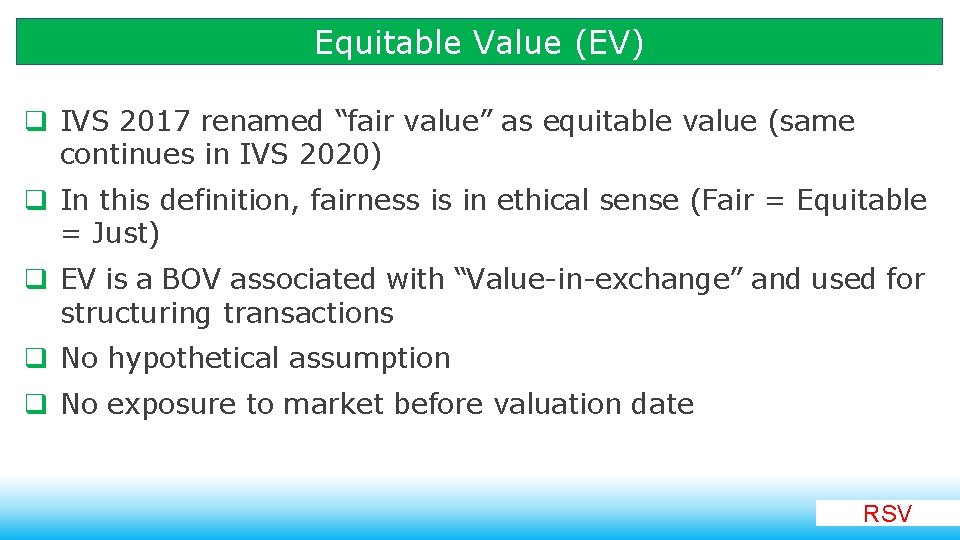
Equitable Value (EV) q IVS 2017 renamed “fair value” as equitable value (same continues in IVS 2020) q In this definition, fairness is in ethical sense (Fair = Equitable = Just) q EV is a BOV associated with “Value-in-exchange” and used for structuring transactions q No hypothetical assumption q No exposure to market before valuation date RSV
Equitable Value (EV) q Valuation is conducted with a view to reflect and reconcile interests of both parties in a best possible manner q EV as a BOV is more relevant for a valuer acting as a consultant while structuring a transaction or where the market for the Subject Asset is not reliable (where “law of one price” is likely to a breakdown) RSV
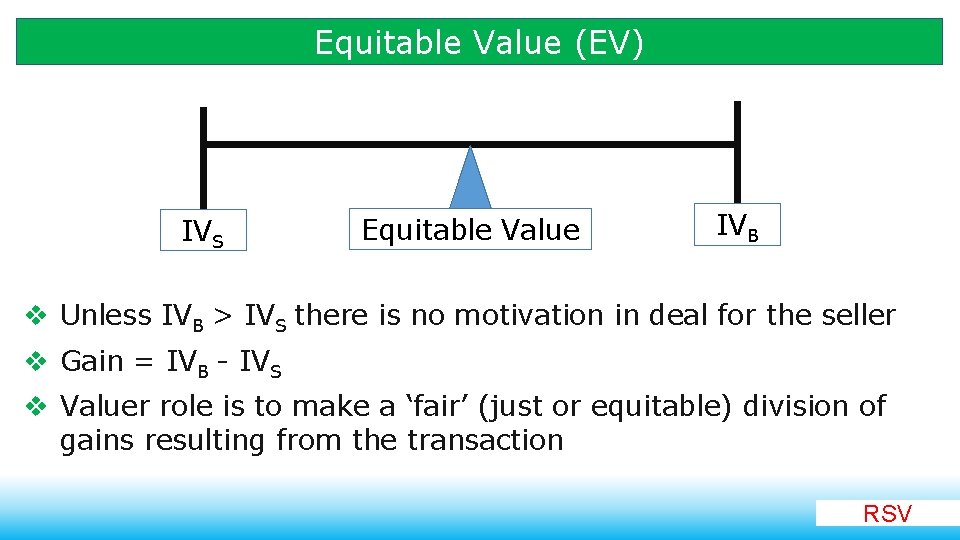
Equitable Value (EV) IVS Equitable Value IVB v Unless IVB > IVS there is no motivation in deal for the seller v Gain = IVB - IVS v Valuer role is to make a ‘fair’ (just or equitable) division of gains resulting from the transaction RSV
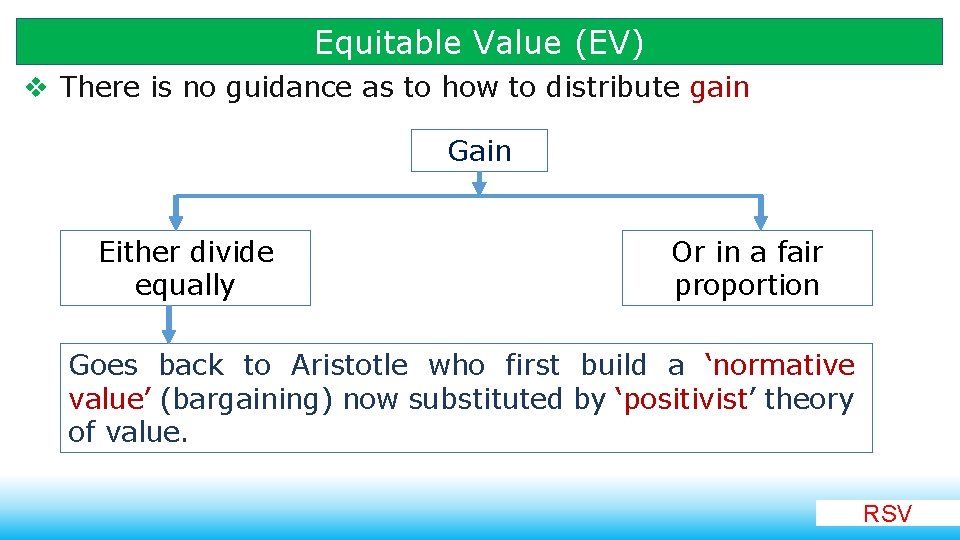
Equitable Value (EV) v There is no guidance as to how to distribute gain Gain Either divide equally Or in a fair proportion Goes back to Aristotle who first build a ‘normative value’ (bargaining) now substituted by ‘positivist’ theory of value. RSV
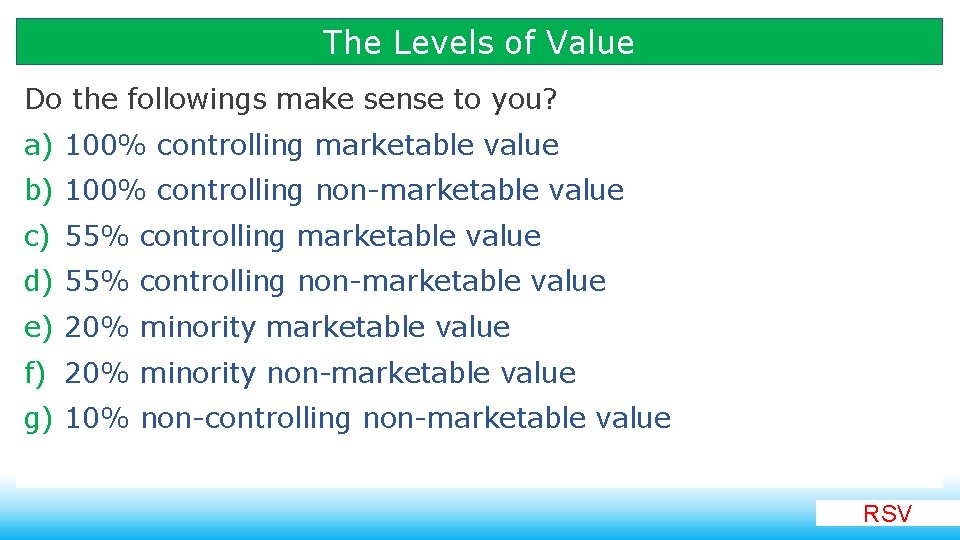
The Levels of Value Do the followings make sense to you? a) 100% controlling marketable value b) 100% controlling non-marketable value c) 55% controlling marketable value d) 55% controlling non-marketable value e) 20% minority marketable value f) 20% minority non-marketable value g) 10% non-controlling non-marketable value RSV
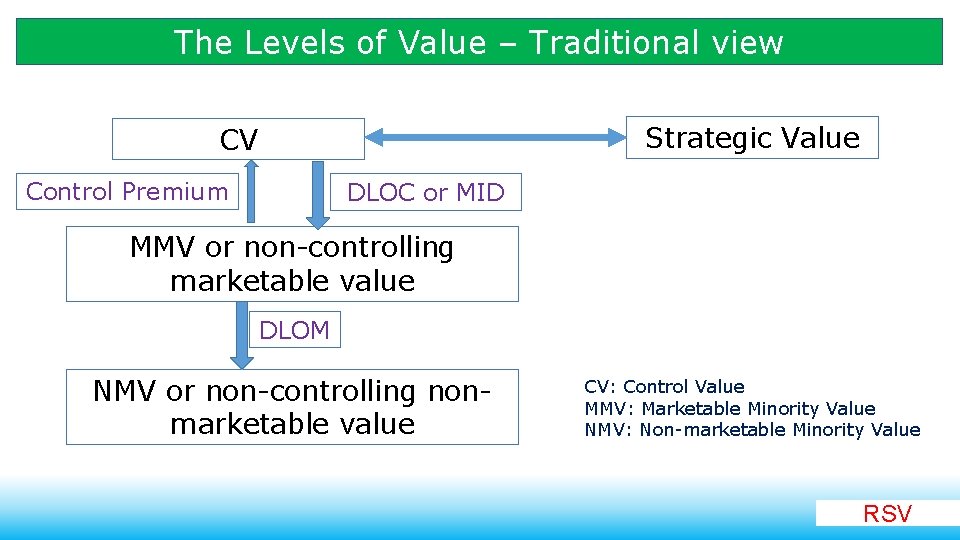
The Levels of Value – Traditional view Strategic Value CV Control Premium DLOC or MID MMV or non-controlling marketable value DLOM NMV or non-controlling nonmarketable value CV: Control Value MMV: Marketable Minority Value NMV: Non-marketable Minority Value RSV
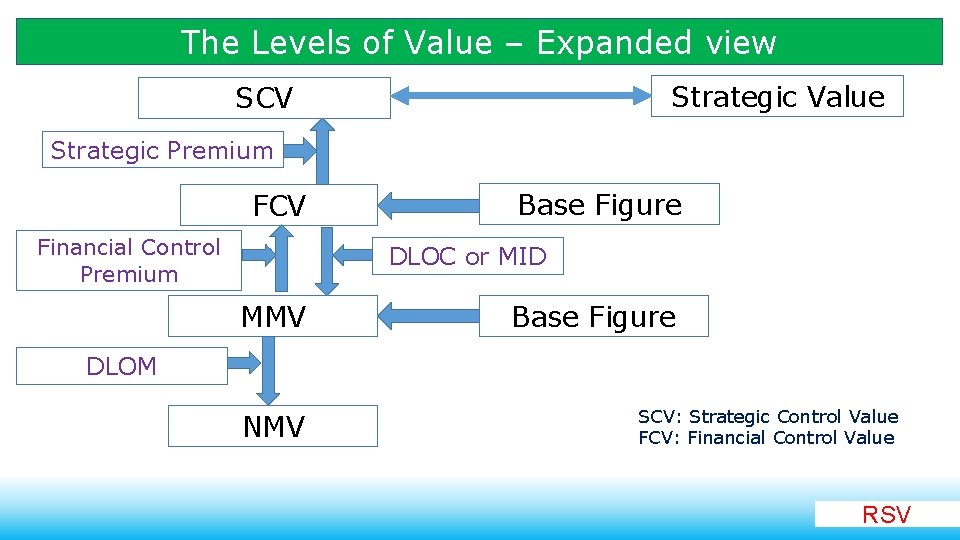
The Levels of Value – Expanded view Strategic Value SCV Strategic Premium FCV Financial Control Premium Base Figure DLOC or MID MMV Base Figure DLOM NMV SCV: Strategic Control Value FCV: Financial Control Value RSV
The Levels of Value – Expanded view • If base figure is the FCV then two discounts will give NMV • If base figure is the MMV then adding control premium gives FCV and deducting DLOM gives NMV RSV
The Levels of Value a) Financial Control: What a financial buyer is able (or perhaps willing) to pay for control of a business. The buy is based on the ability of the buyer to extract a reasonable rate of return. b) Strategic Control: Strategic buyer can (and do) pay more for companies than financial buyers. The buyer is expecting to realize synergies from the acquisition. RSV
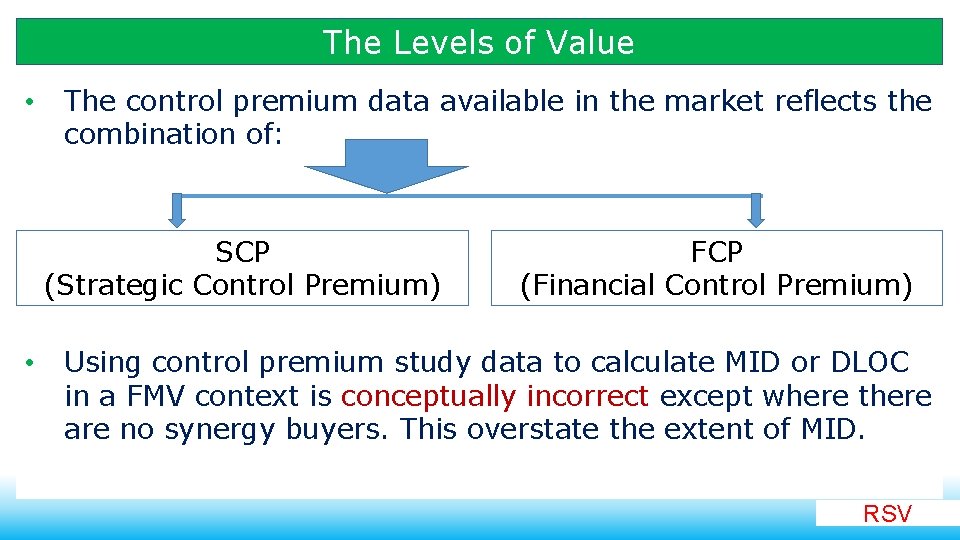
The Levels of Value • The control premium data available in the market reflects the combination of: SCP (Strategic Control Premium) • FCP (Financial Control Premium) Using control premium study data to calculate MID or DLOC in a FMV context is conceptually incorrect except where there are no synergy buyers. This overstate the extent of MID. RSV
The Levels of Value • When MID derived from control premium study and is applied to FCV it will produce a value below MMV (for which no clear definition exists). This will understate the value RSV
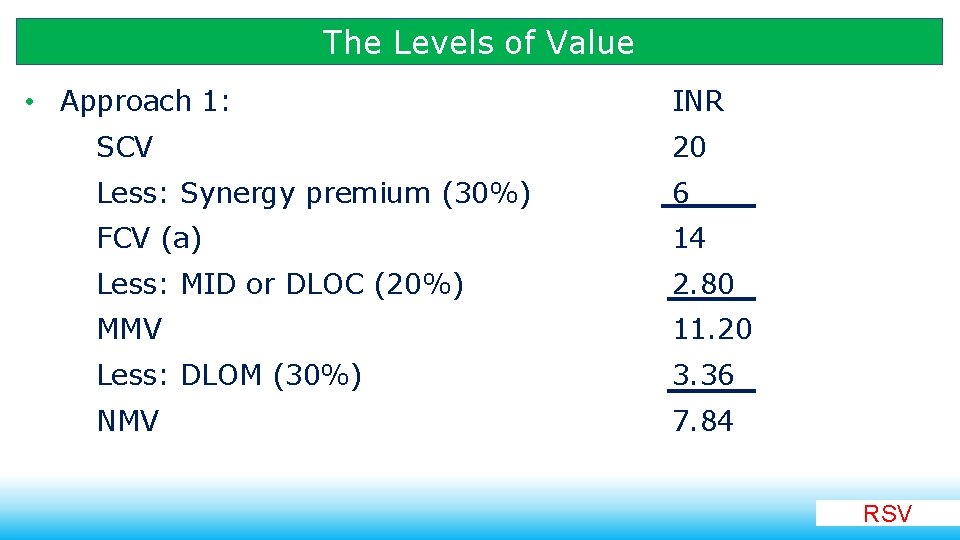
The Levels of Value • Approach 1: INR SCV 20 Less: Synergy premium (30%) 6 FCV (a) 14 Less: MID or DLOC (20%) 2. 80 MMV 11. 20 Less: DLOM (30%) 3. 36 NMV 7. 84 RSV
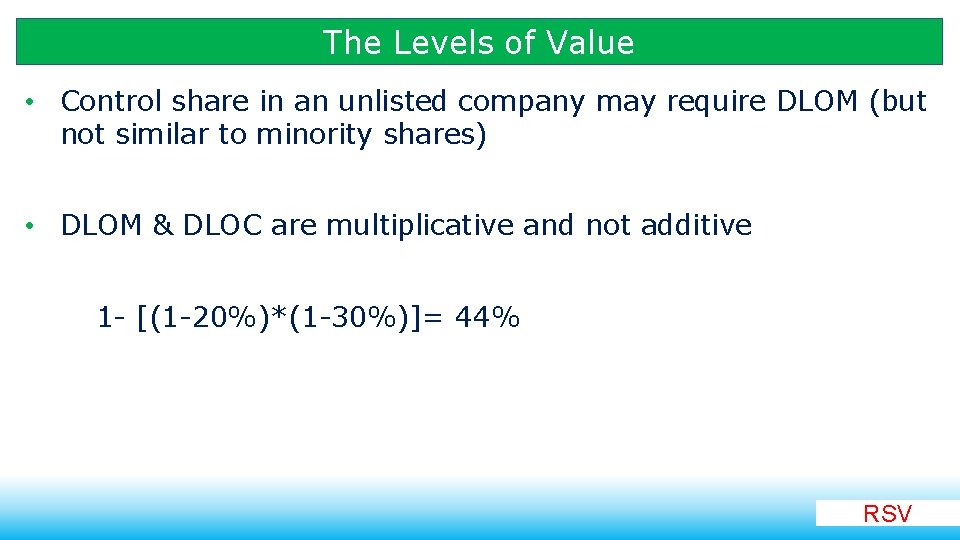
The Levels of Value • Control share in an unlisted company may require DLOM (but not similar to minority shares) • DLOM & DLOC are multiplicative and not additive 1 - [(1 -20%)*(1 -30%)]= 44% RSV
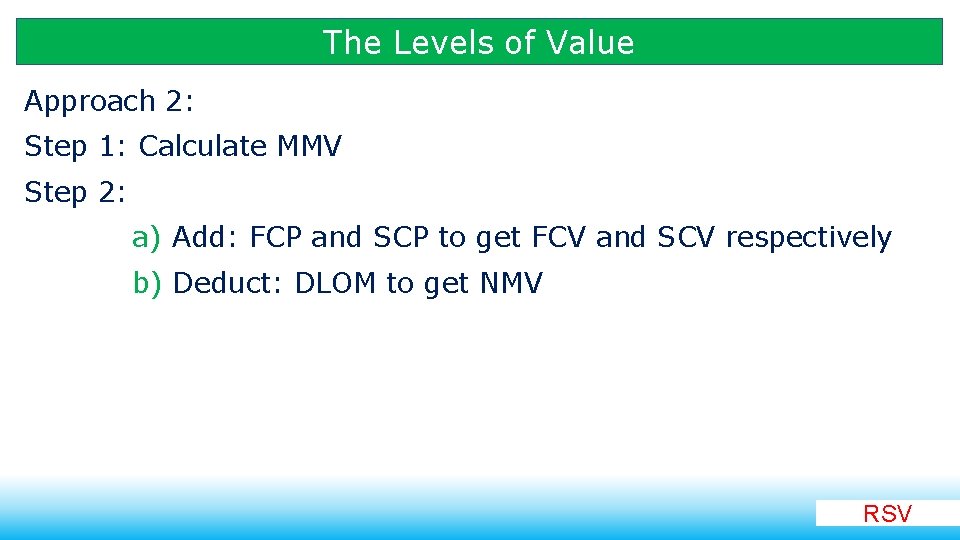
The Levels of Value Approach 2: Step 1: Calculate MMV Step 2: a) Add: FCP and SCP to get FCV and SCV respectively b) Deduct: DLOM to get NMV RSV
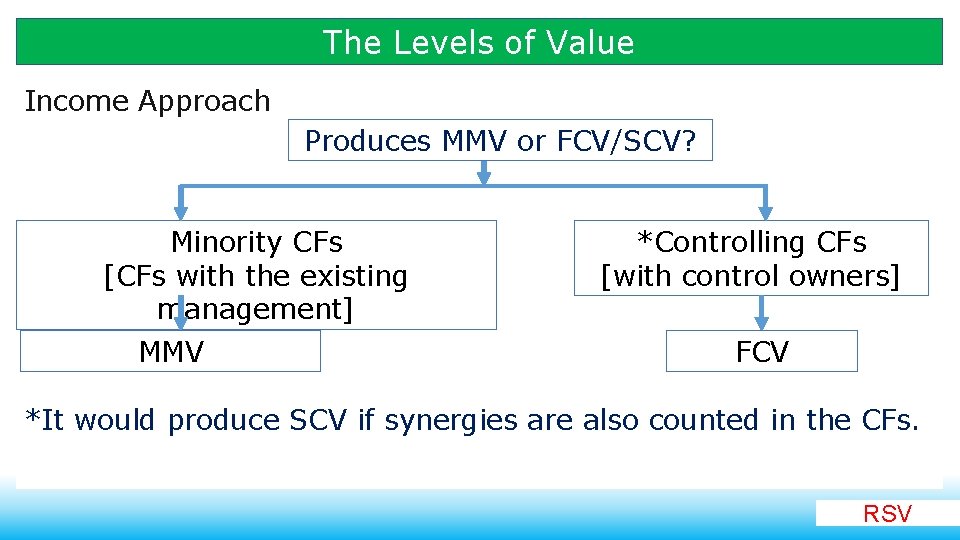
The Levels of Value Income Approach Produces MMV or FCV/SCV? Minority CFs [CFs with the existing management] MMV *Controlling CFs [with control owners] FCV *It would produce SCV if synergies are also counted in the CFs. RSV
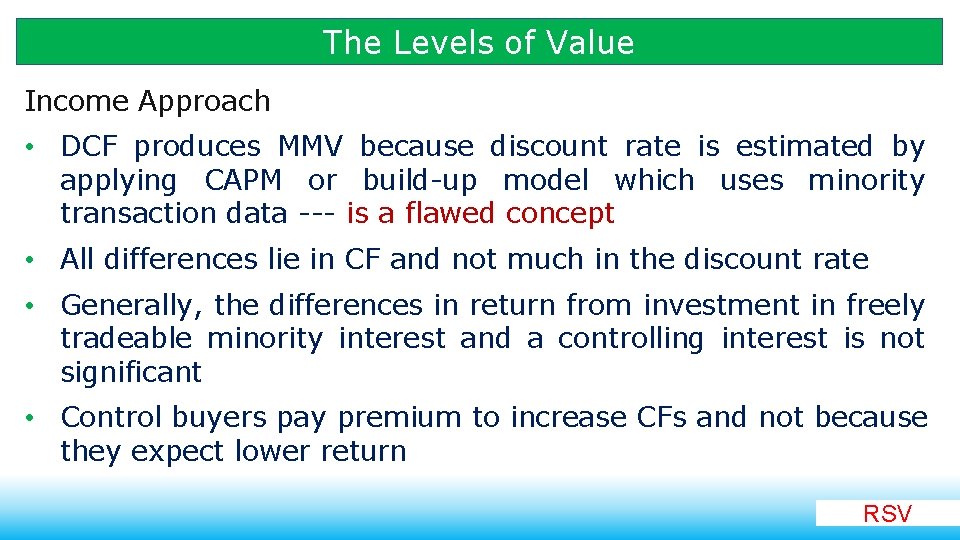
The Levels of Value Income Approach • DCF produces MMV because discount rate is estimated by applying CAPM or build-up model which uses minority transaction data --- is a flawed concept • All differences lie in CF and not much in the discount rate • Generally, the differences in return from investment in freely tradeable minority interest and a controlling interest is not significant • Control buyers pay premium to increase CFs and not because they expect lower return RSV
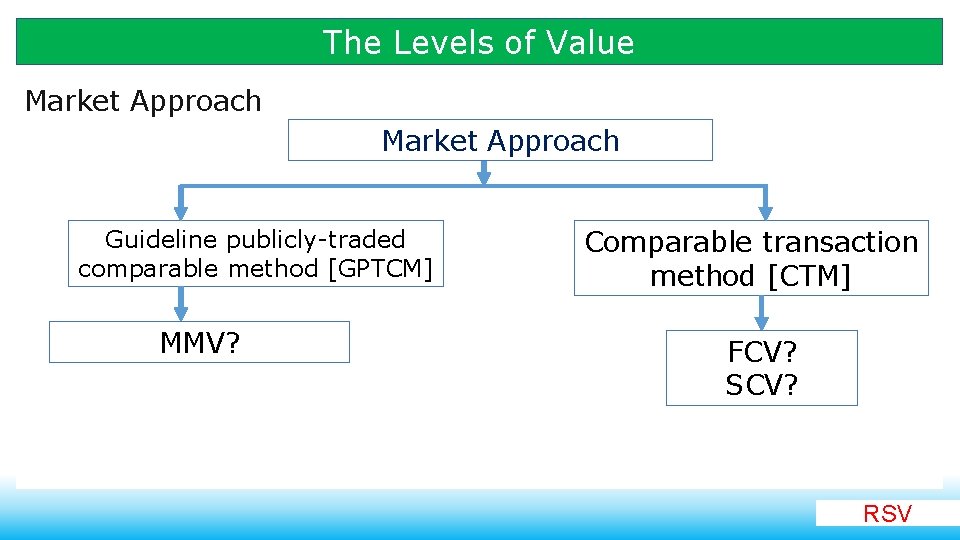
The Levels of Value Market Approach Guideline publicly-traded comparable method [GPTCM] MMV? Comparable transaction method [CTM] FCV? SCV? RSV
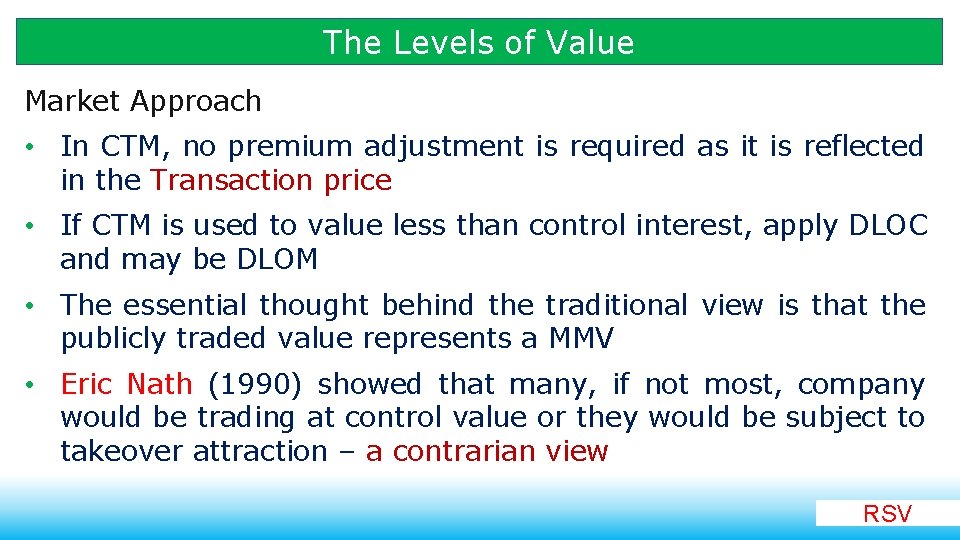
The Levels of Value Market Approach • In CTM, no premium adjustment is required as it is reflected in the Transaction price • If CTM is used to value less than control interest, apply DLOC and may be DLOM • The essential thought behind the traditional view is that the publicly traded value represents a MMV • Eric Nath (1990) showed that many, if not most, company would be trading at control value or they would be subject to takeover attraction – a contrarian view RSV
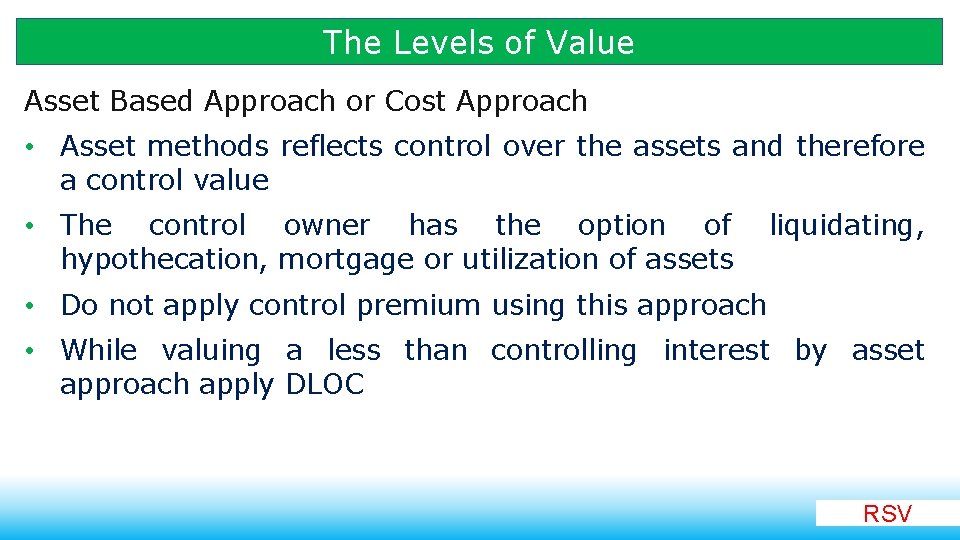
The Levels of Value Asset Based Approach or Cost Approach • Asset methods reflects control over the assets and therefore a control value • The control owner has the option of hypothecation, mortgage or utilization of assets liquidating, • Do not apply control premium using this approach • While valuing a less than controlling interest by asset approach apply DLOC RSV
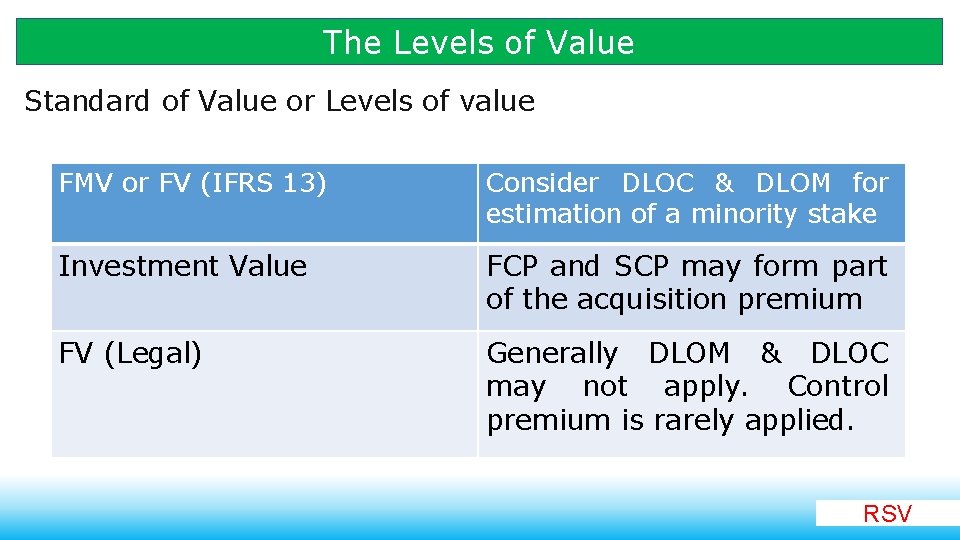
The Levels of Value Standard of Value or Levels of value FMV or FV (IFRS 13) Consider DLOC & DLOM for estimation of a minority stake Investment Value FCP and SCP may form part of the acquisition premium FV (Legal) Generally DLOM & DLOC may not apply. Control premium is rarely applied. RSV
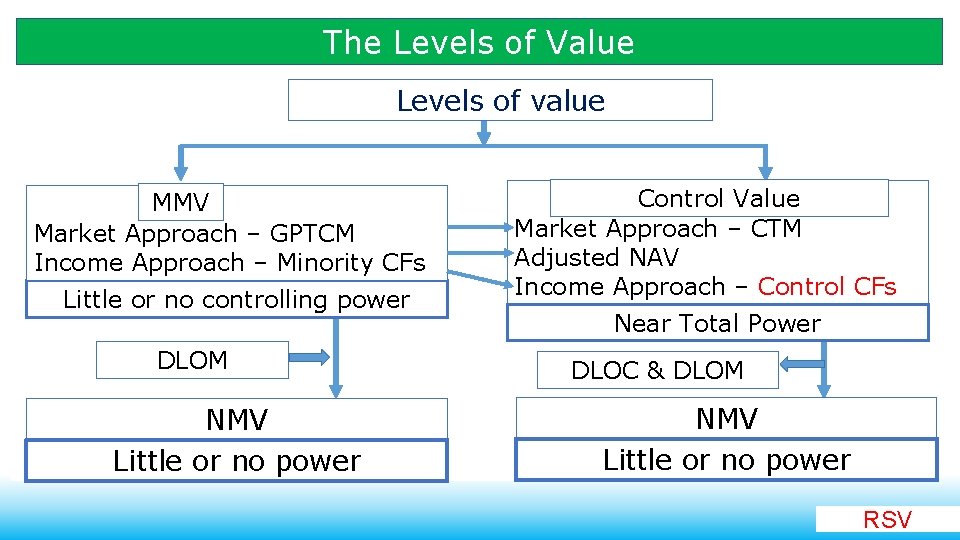
The Levels of Value Levels of value MMV Market Approach – GPTCM Income Approach – Minority CFs Little or no controlling power DLOM NMV Little or no power Control Value Market Approach – CTM Adjusted NAV Income Approach – Control CFs Near Total Power DLOC & DLOM NMV Little or no power RSV
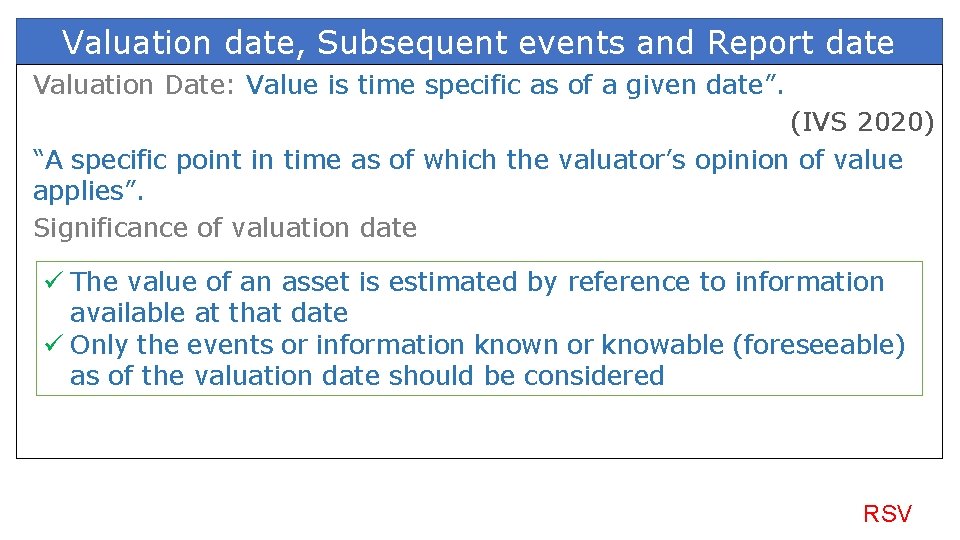
Valuation date, Subsequent events and Report date Valuation Date: Value is time specific as of a given date”. (IVS 2020) “A specific point in time as of which the valuator’s opinion of value applies”. Significance of valuation date ü The value of an asset is estimated by reference to information available at that date ü Only the events or information known or knowable (foreseeable) as of the valuation date should be considered RSV
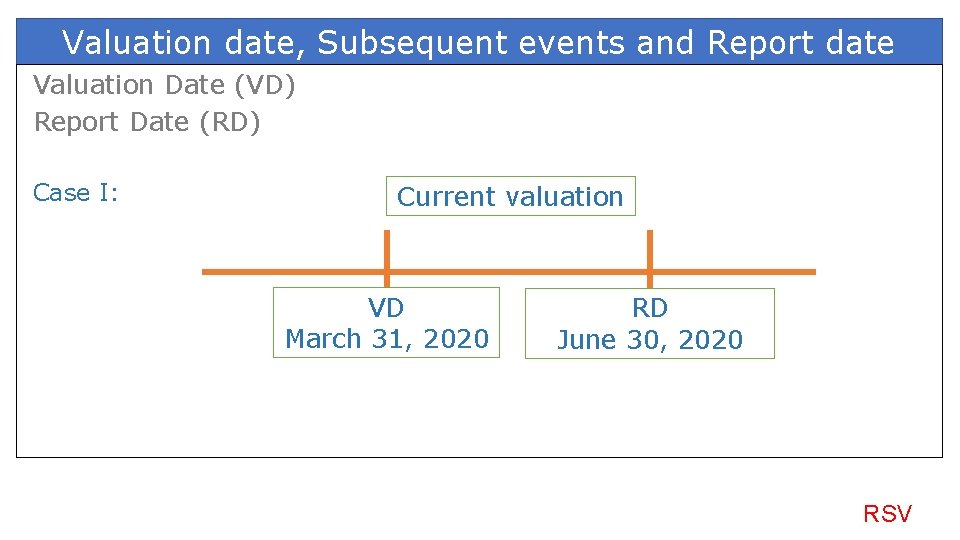
Valuation date, Subsequent events and Report date Valuation Date (VD) Report Date (RD) Case I: Current valuation VD March 31, 2020 RD June 30, 2020 RSV
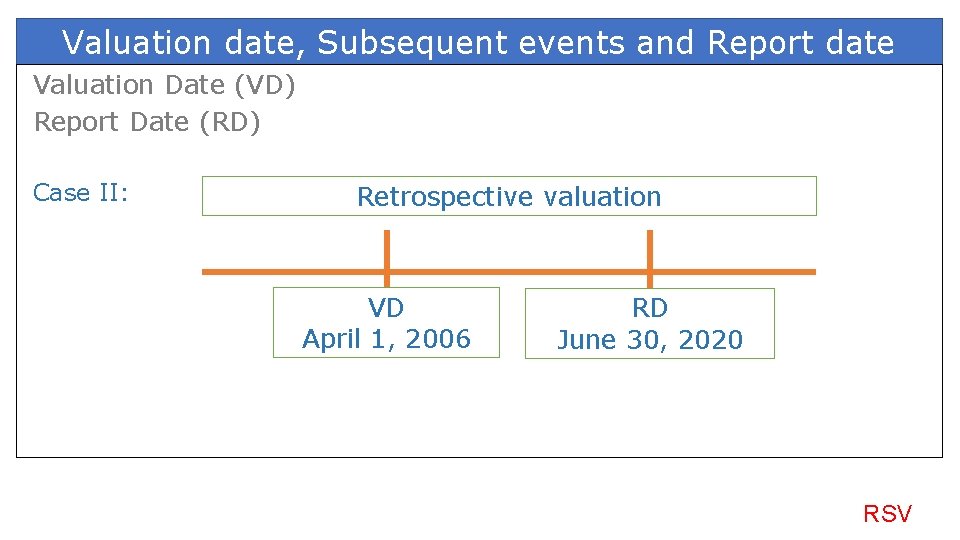
Valuation date, Subsequent events and Report date Valuation Date (VD) Report Date (RD) Case II: Retrospective valuation VD April 1, 2006 RD June 30, 2020 RSV
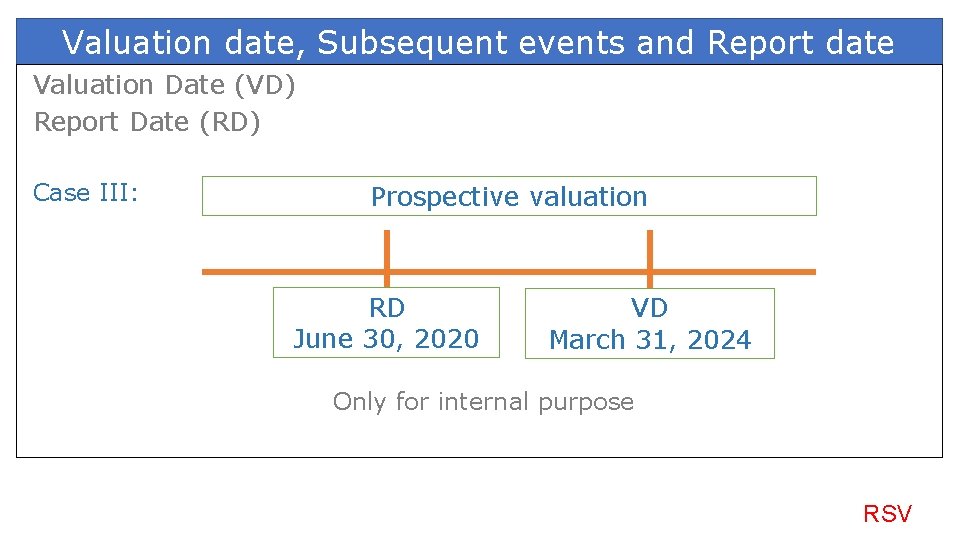
Valuation date, Subsequent events and Report date Valuation Date (VD) Report Date (RD) Case III: Prospective valuation RD June 30, 2020 VD March 31, 2024 Only for internal purpose RSV
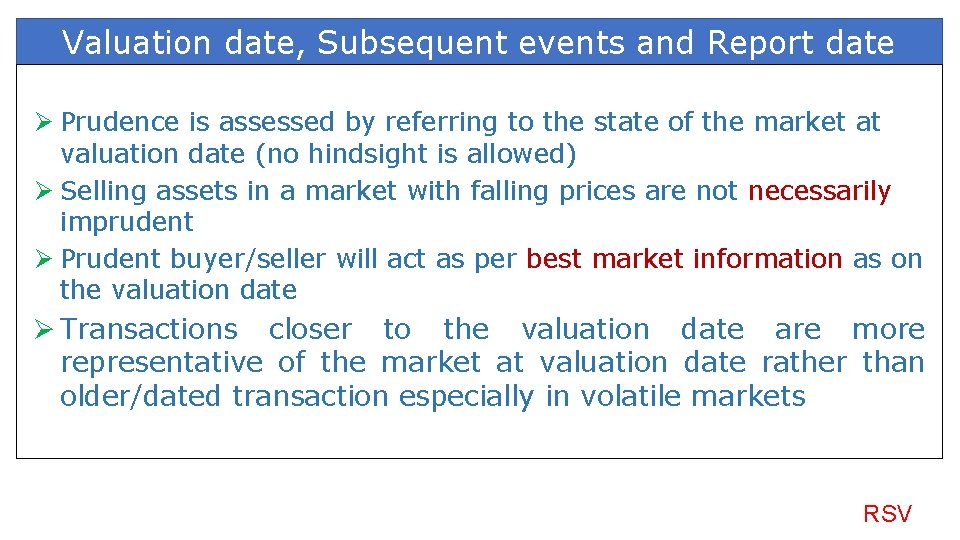
Valuation date, Subsequent events and Report date Ø Prudence is assessed by referring to the state of the market at valuation date (no hindsight is allowed) Ø Selling assets in a market with falling prices are not necessarily imprudent Ø Prudent buyer/seller will act as per best market information as on the valuation date Ø Transactions closer to the valuation date are more representative of the market at valuation date rather than older/dated transaction especially in volatile markets RSV
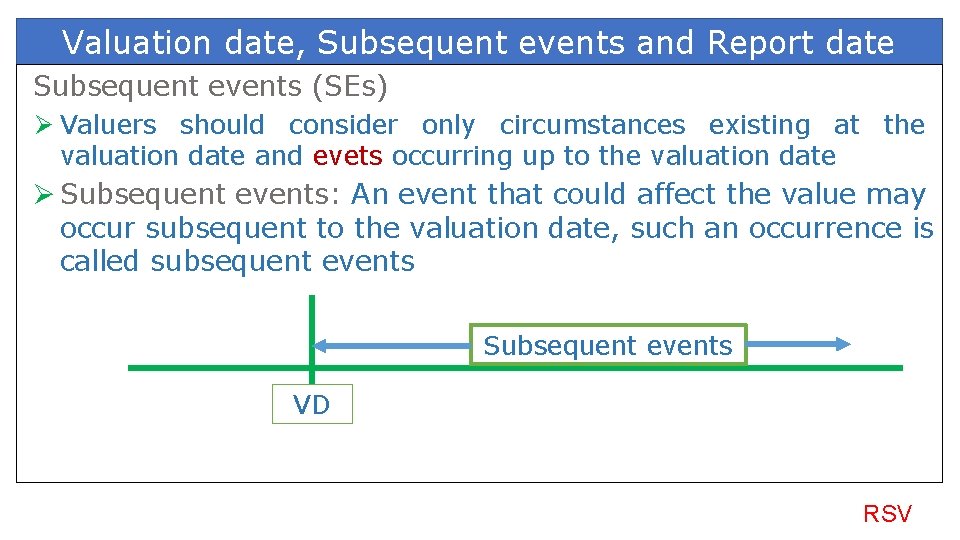
Valuation date, Subsequent events and Report date Subsequent events (SEs) Ø Valuers should consider only circumstances existing at the valuation date and evets occurring up to the valuation date Ø Subsequent events: An event that could affect the value may occur subsequent to the valuation date, such an occurrence is called subsequent events Subsequent events VD RSV
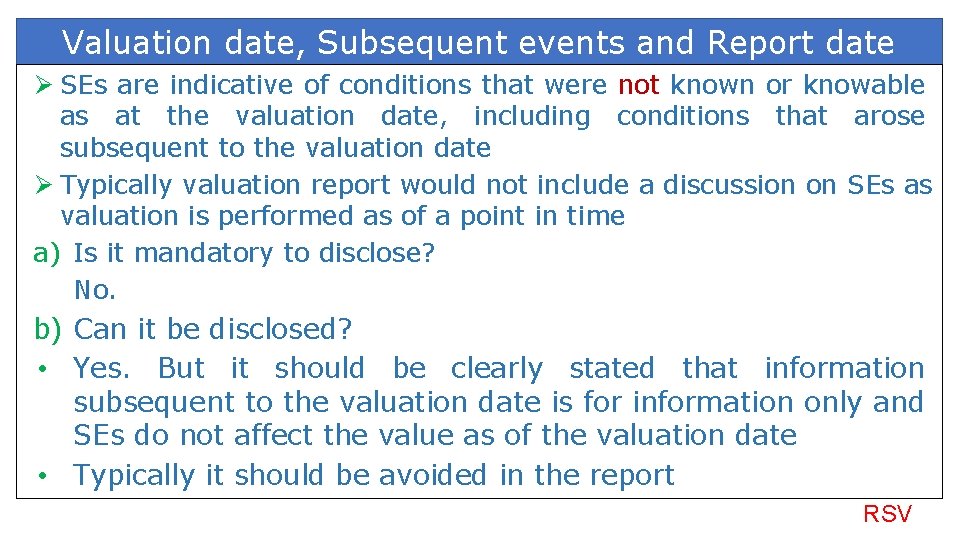
Valuation date, Subsequent events and Report date Ø SEs are indicative of conditions that were not known or knowable as at the valuation date, including conditions that arose subsequent to the valuation date Ø Typically valuation report would not include a discussion on SEs as valuation is performed as of a point in time a) Is it mandatory to disclose? No. b) Can it be disclosed? • Yes. But it should be clearly stated that information subsequent to the valuation date is for information only and SEs do not affect the value as of the valuation date • Typically it should be avoided in the report RSV
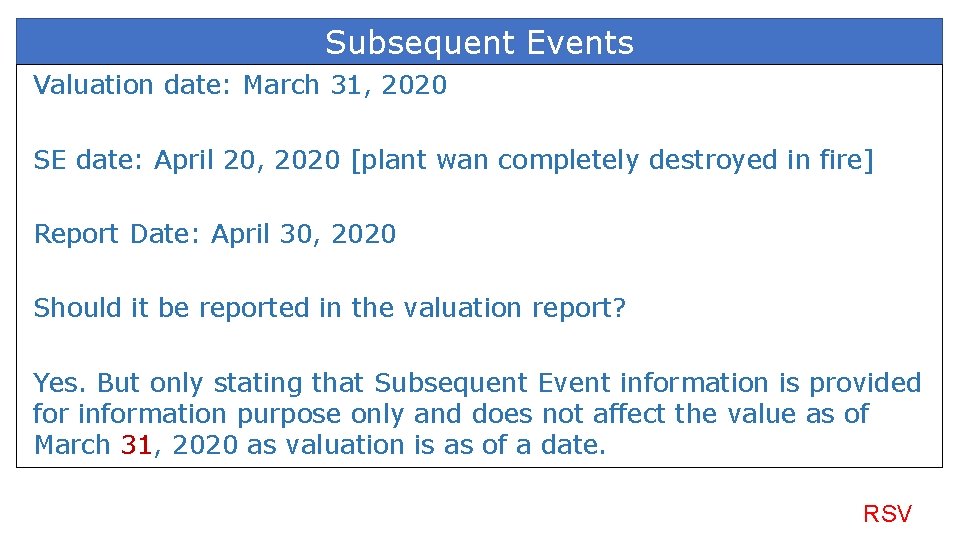
Subsequent Events Valuation date: March 31, 2020 SE date: April 20, 2020 [plant wan completely destroyed in fire] Report Date: April 30, 2020 Should it be reported in the valuation report? Yes. But only stating that Subsequent Event information is provided for information purpose only and does not affect the value as of March 31, 2020 as valuation is as of a date. RSV
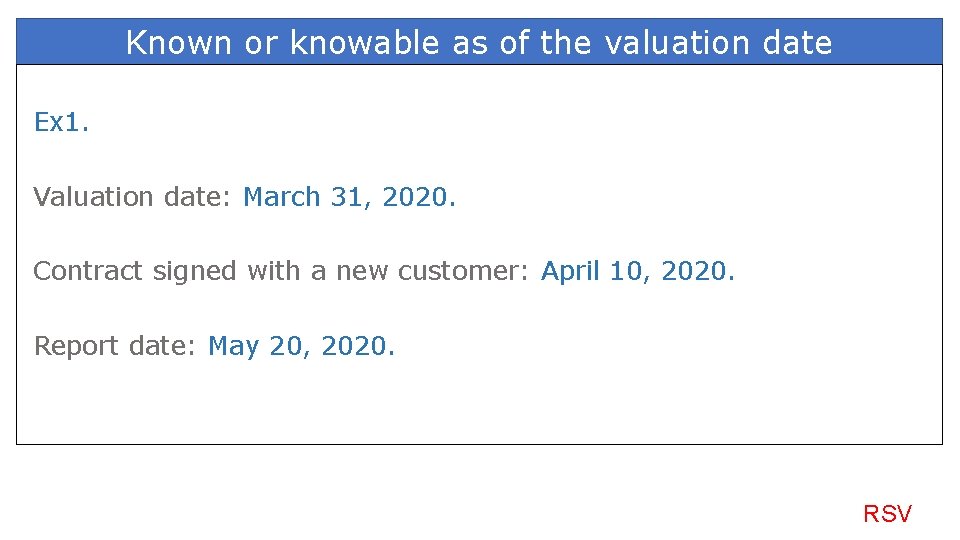
Known or knowable as of the valuation date Ex 1. Valuation date: March 31, 2020. Contract signed with a new customer: April 10, 2020. Report date: May 20, 2020. RSV
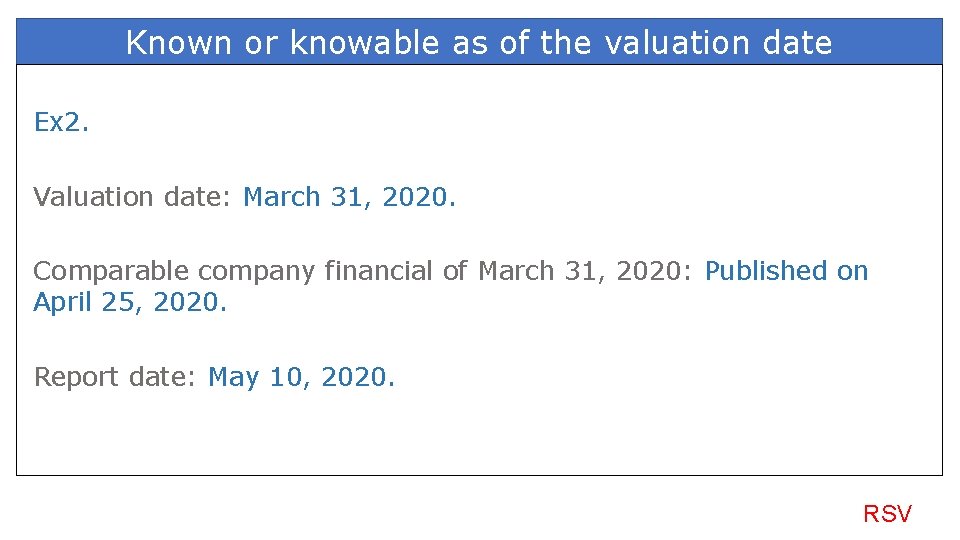
Known or knowable as of the valuation date Ex 2. Valuation date: March 31, 2020. Comparable company financial of March 31, 2020: Published on April 25, 2020. Report date: May 10, 2020. RSV
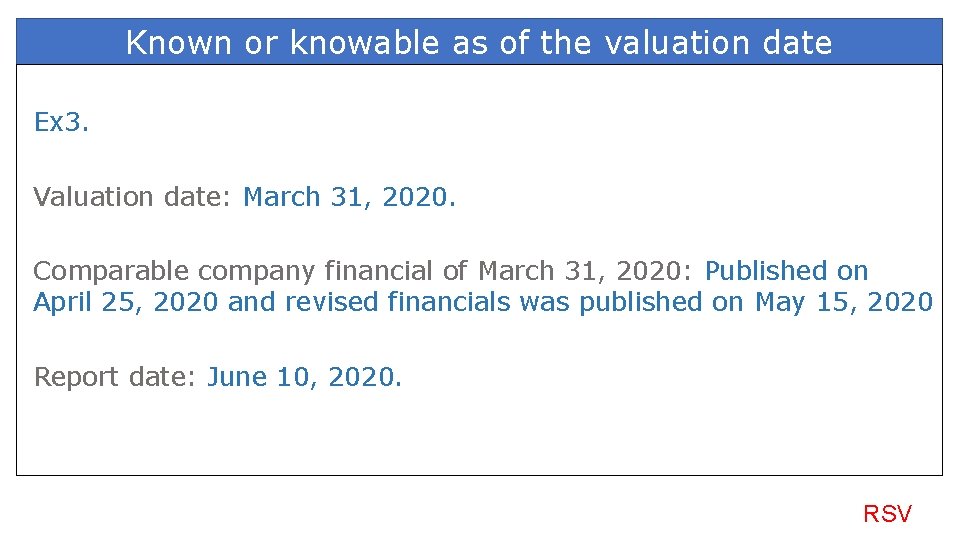
Known or knowable as of the valuation date Ex 3. Valuation date: March 31, 2020. Comparable company financial of March 31, 2020: Published on April 25, 2020 and revised financials was published on May 15, 2020 Report date: June 10, 2020. RSV
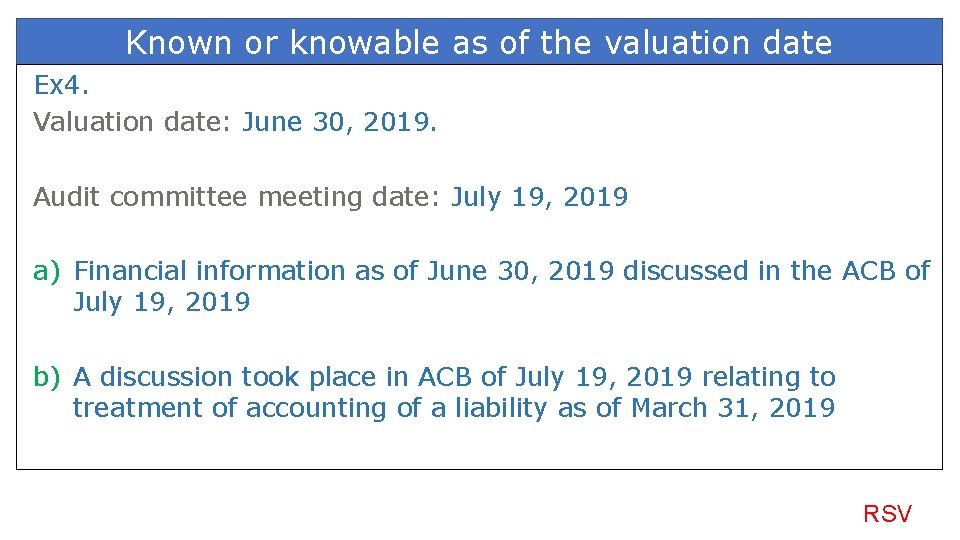
Known or knowable as of the valuation date Ex 4. Valuation date: June 30, 2019. Audit committee meeting date: July 19, 2019 a) Financial information as of June 30, 2019 discussed in the ACB of July 19, 2019 b) A discussion took place in ACB of July 19, 2019 relating to treatment of accounting of a liability as of March 31, 2019 RSV
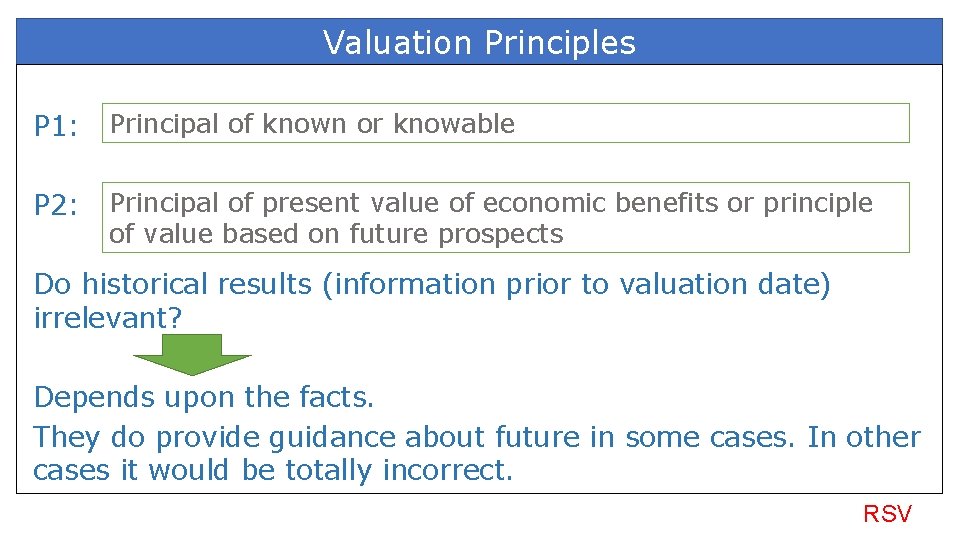
Valuation Principles P 1: Principal of known or knowable P 2: Principal of present value of economic benefits or principle of value based on future prospects Do historical results (information prior to valuation date) irrelevant? Depends upon the facts. They do provide guidance about future in some cases. In other cases it would be totally incorrect. RSV
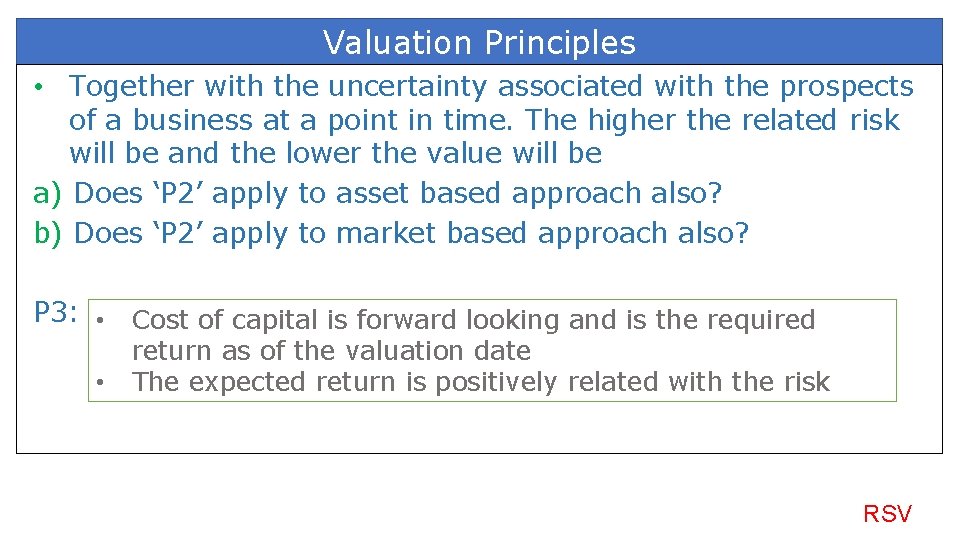
Valuation Principles • Together with the uncertainty associated with the prospects of a business at a point in time. The higher the related risk will be and the lower the value will be a) Does ‘P 2’ apply to asset based approach also? b) Does ‘P 2’ apply to market based approach also? P 3: • Cost of capital is forward looking and is the required • return as of the valuation date The expected return is positively related with the risk RSV
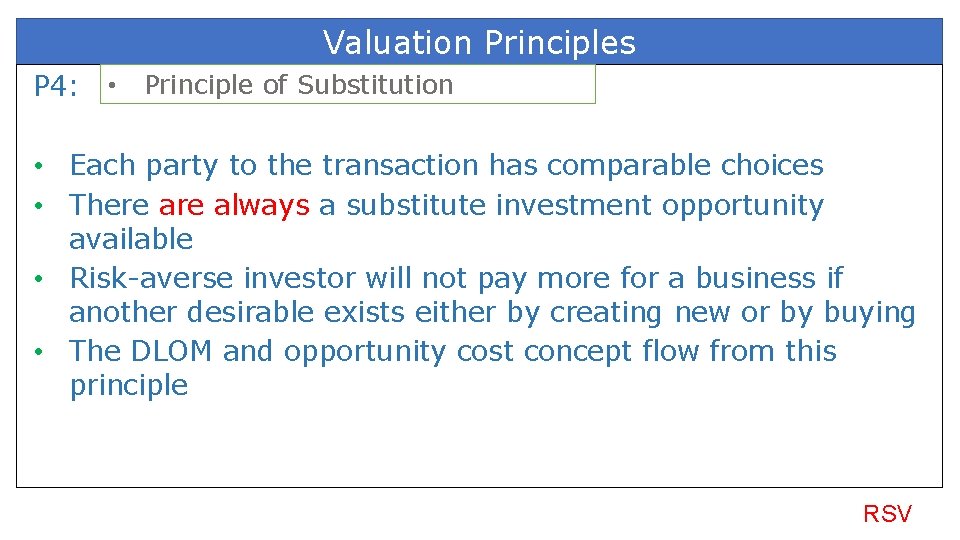
Valuation Principles P 4: • Principle of Substitution • Each party to the transaction has comparable choices • There always a substitute investment opportunity available • Risk-averse investor will not pay more for a business if another desirable exists either by creating new or by buying • The DLOM and opportunity cost concept flow from this principle RSV
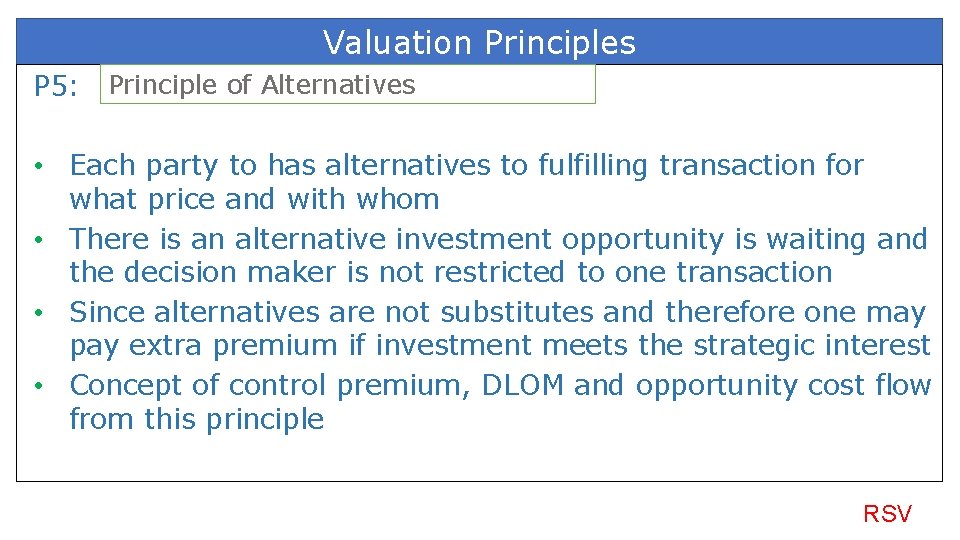
Valuation Principles P 5: Principle of Alternatives • Each party to has alternatives to fulfilling transaction for what price and with whom • There is an alternative investment opportunity is waiting and the decision maker is not restricted to one transaction • Since alternatives are not substitutes and therefore one may pay extra premium if investment meets the strategic interest • Concept of control premium, DLOM and opportunity cost flow from this principle RSV
Valuation Principles P 6: Principle of reasonableness and reconciliation • Review the reasonableness of assumptions about uncertainties and reconcile the value estimates of different methods • Check for i. Inconsistency in judgement, biases in assumptions ii. Conceptual flaws iii. Errors in financial model RSV
Valuation Principles P 6: Principle of reasonableness and reconciliation A sound valuation will be based upon all relevant facts, but the element of common sense, informal judgement and reasonableness must enter into the process of weighing the facts and determining their aggregate influence. RSV
Valuation Principles P 7: The value of minority stake may be less than a value of a controlling interest where each is viewed on per share basis. Primary reasons are: Ø Inability to influence business operations and strategy Ø Inability to dictate the timing of return on his/her investment Remember SHA can reduce or eliminate the disadvantage of a minority. RSV
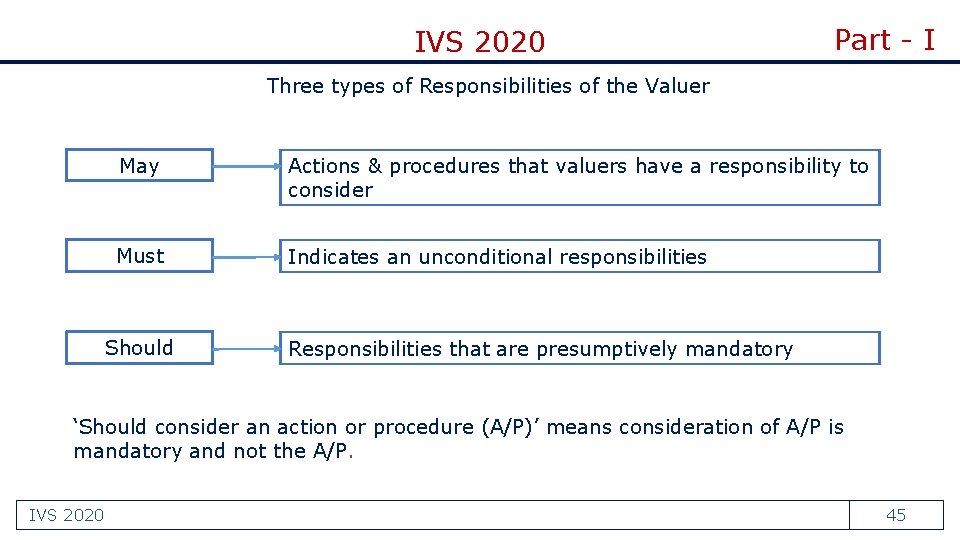
IVS 2020 Part - I Three types of Responsibilities of the Valuer May Actions & procedures that valuers have a responsibility to consider Must Indicates an unconditional responsibilities Should Responsibilities that are presumptively mandatory ‘Should consider an action or procedure (A/P)’ means consideration of A/P is mandatory and not the A/P. IVS 2020 45
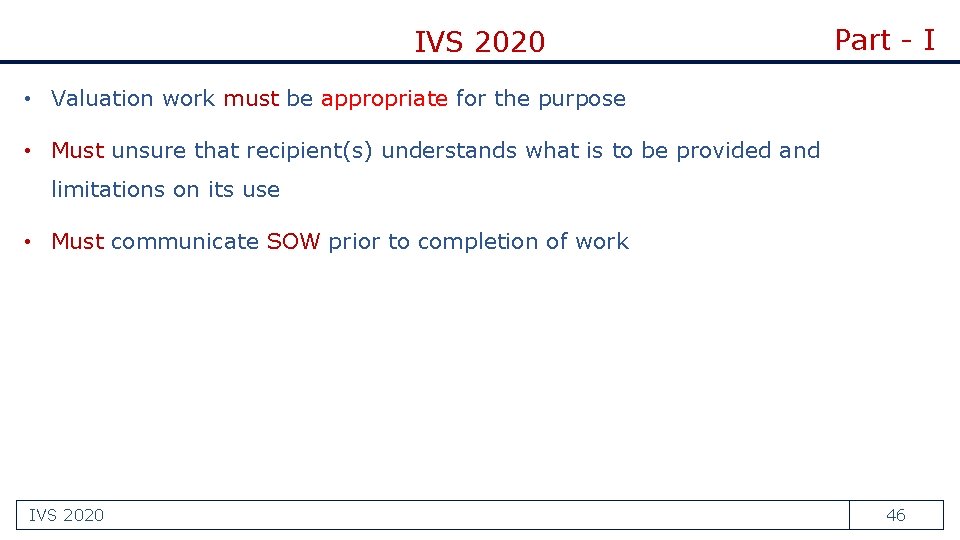
IVS 2020 Part - I • Valuation work must be appropriate for the purpose • Must unsure that recipient(s) understands what is to be provided and limitations on its use • Must communicate SOW prior to completion of work IVS 2020 46
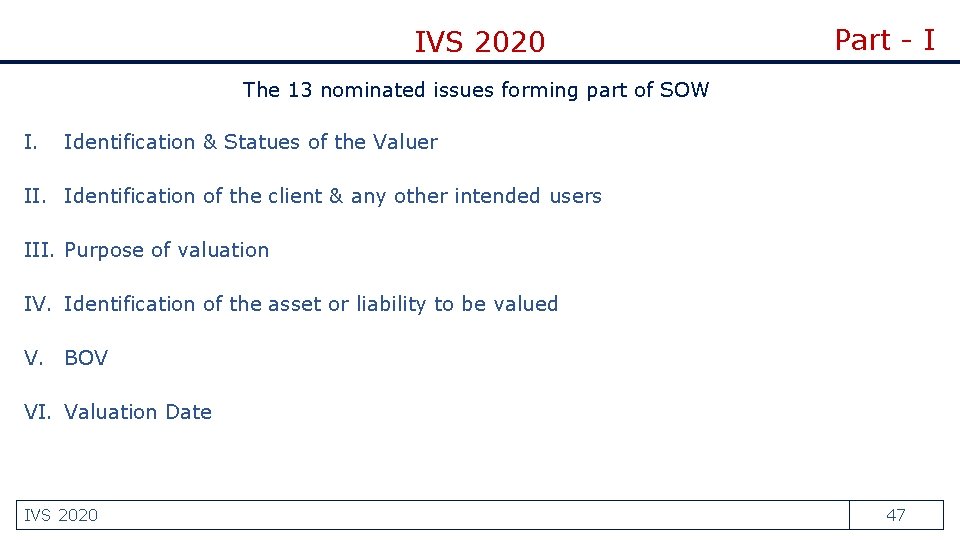
IVS 2020 Part - I The 13 nominated issues forming part of SOW I. Identification & Statues of the Valuer II. Identification of the client & any other intended users III. Purpose of valuation IV. Identification of the asset or liability to be valued V. BOV VI. Valuation Date IVS 2020 47
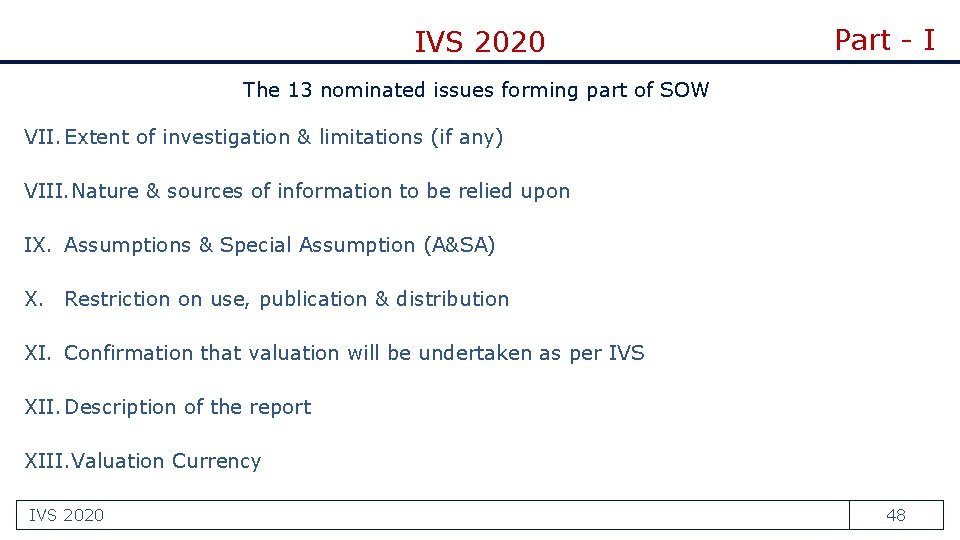
IVS 2020 Part - I The 13 nominated issues forming part of SOW VII. Extent of investigation & limitations (if any) VIII. Nature & sources of information to be relied upon IX. Assumptions & Special Assumption (A&SA) X. Restriction on use, publication & distribution XI. Confirmation that valuation will be undertaken as per IVS XII. Description of the report XIII. Valuation Currency IVS 2020 48
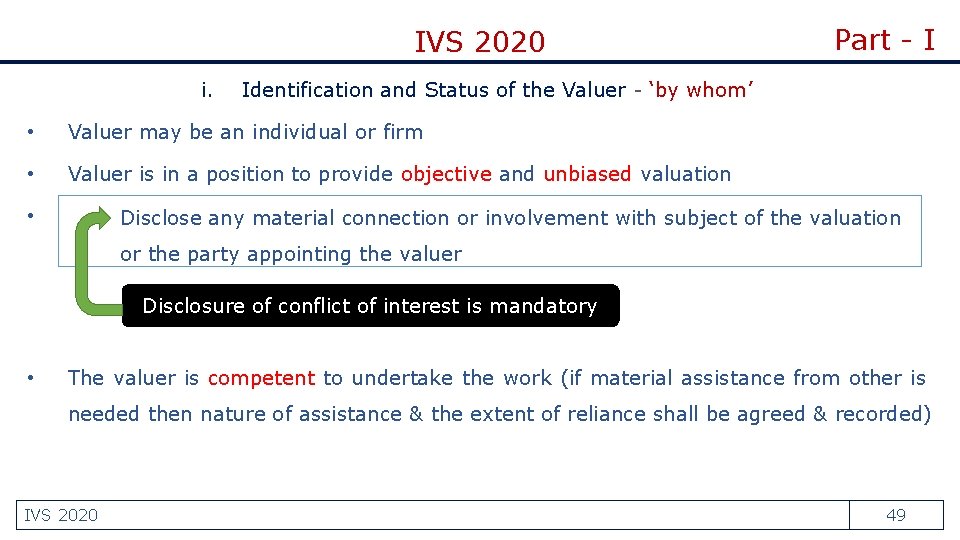
IVS 2020 i. Part - I Identification and Status of the Valuer - ‘by whom’ • Valuer may be an individual or firm • Valuer is in a position to provide objective and unbiased valuation • Disclose any material connection or involvement with subject of theofvaluation or the Disclose any material connection or involvement with subject the valuation partyor appointing valuer the partythe appointing Disclosure of conflict of interest is mandatory • The valuer is competent to undertake the work (if material assistance from other is needed then nature of assistance & the extent of reliance shall be agreed & recorded) IVS 2020 49
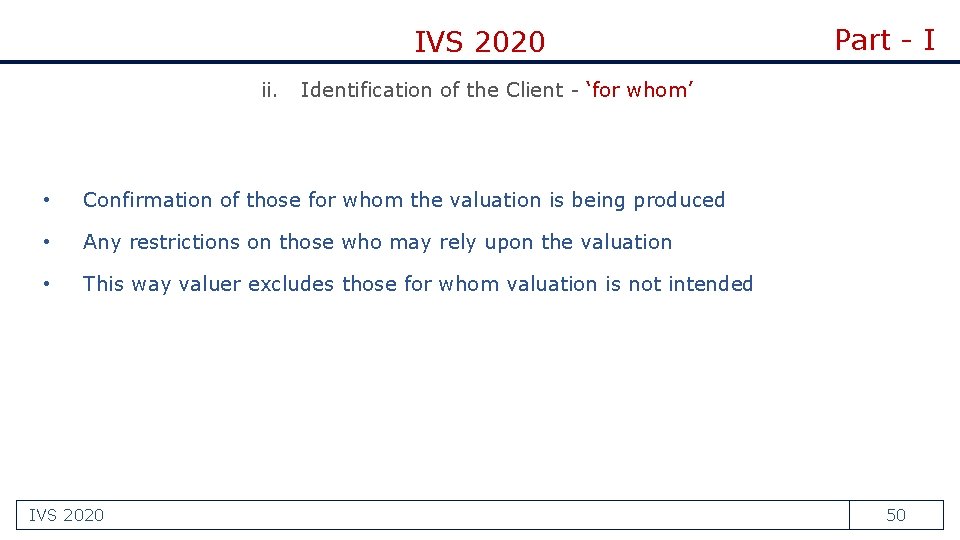
IVS 2020 ii. Identification of the Client - ‘for whom’ • Confirmation of those for whom the valuation is being produced • Any restrictions on those who may rely upon the valuation • This way valuer excludes those for whom valuation is not intended IVS 2020 Part - I 50
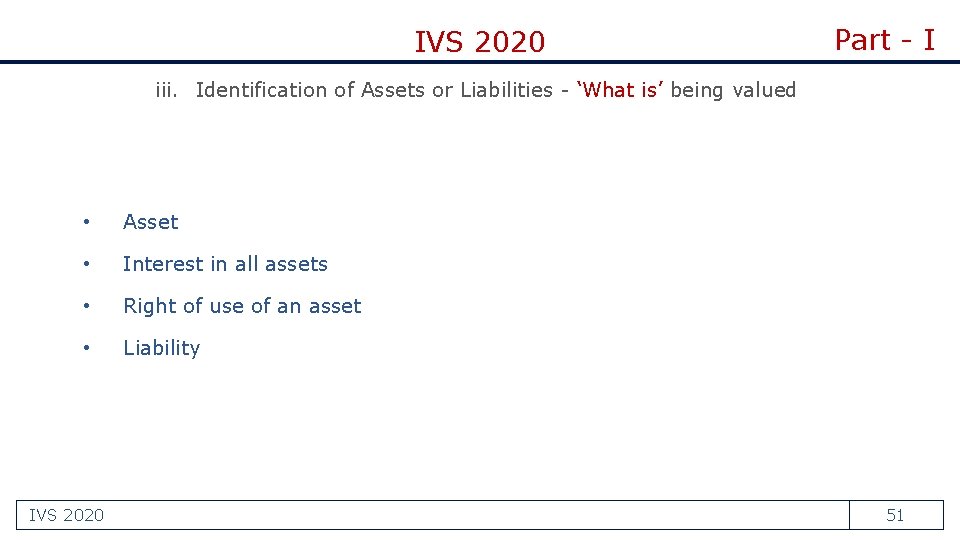
IVS 2020 Part - I iii. Identification of Assets or Liabilities - ‘What is’ being valued • Asset • Interest in all assets • Right of use of an asset • Liability IVS 2020 51
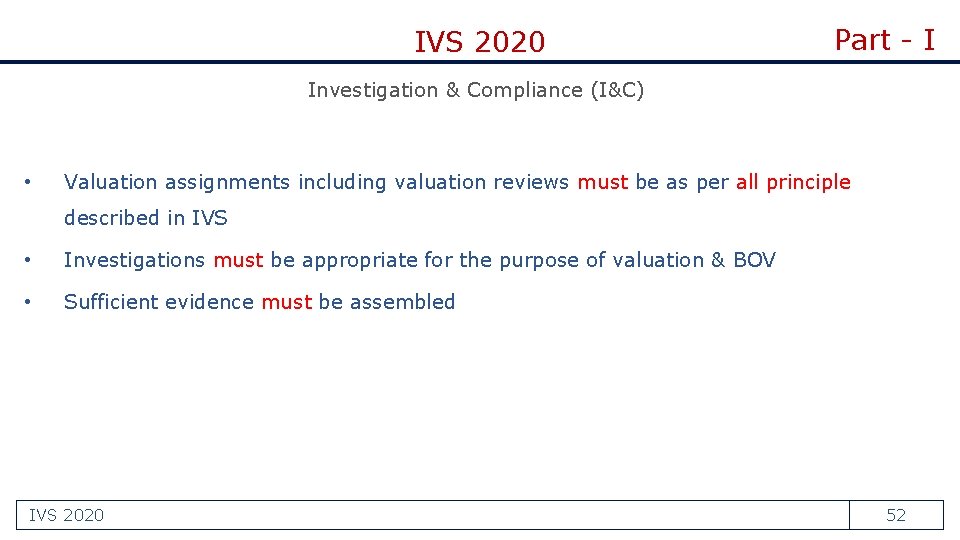
IVS 2020 Part - I Investigation & Compliance (I&C) • Valuation assignments including valuation reviews must be as per all principle described in IVS • Investigations must be appropriate for the purpose of valuation & BOV • Sufficient evidence must be assembled IVS 2020 52
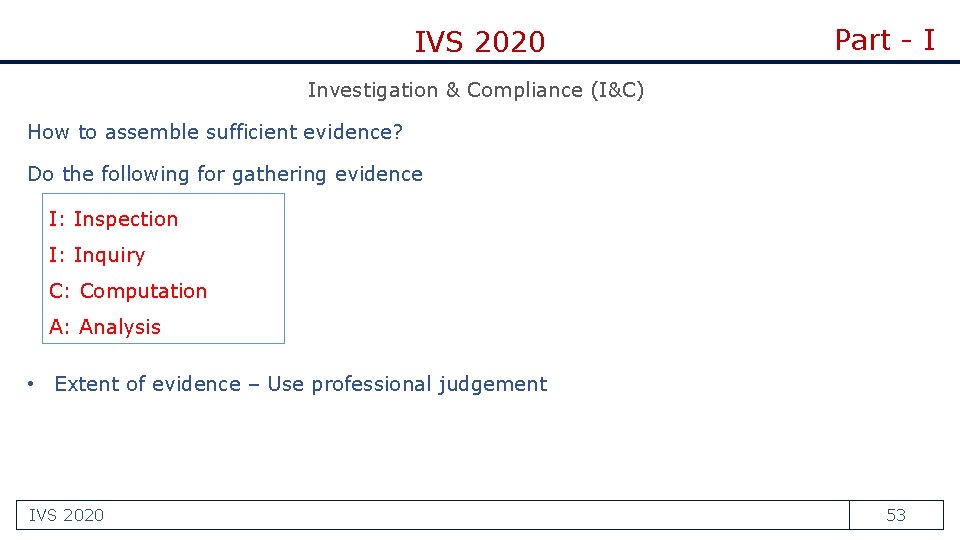
IVS 2020 Part - I Investigation & Compliance (I&C) How to assemble sufficient evidence? Do the following for gathering evidence I: Inspection I: Inquiry C: Computation A: Analysis • Extent of evidence – Use professional judgement IVS 2020 53
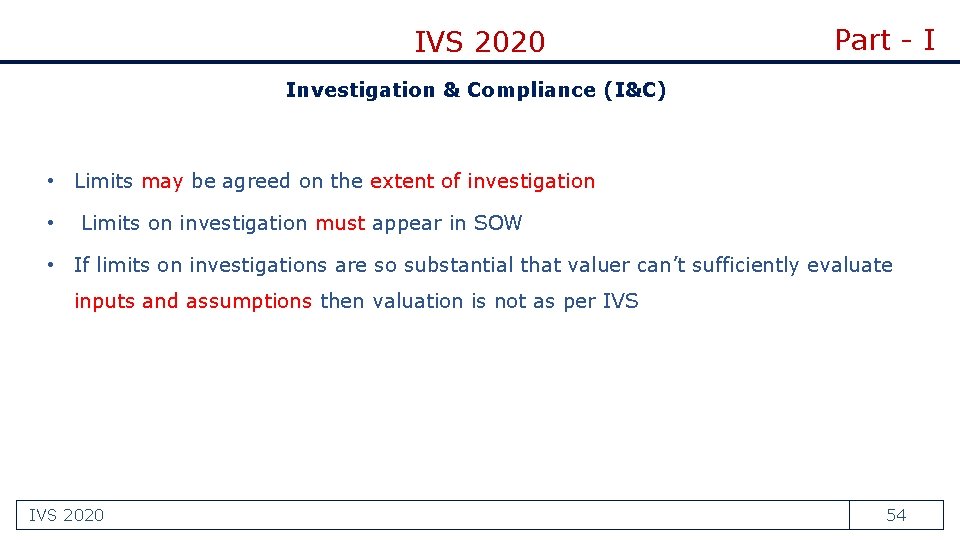
IVS 2020 Part - I Investigation & Compliance (I&C) • Limits may be agreed on the extent of investigation • Limits on investigation must appear in SOW • If limits on investigations are so substantial that valuer can’t sufficiently evaluate inputs and assumptions then valuation is not as per IVS 2020 54
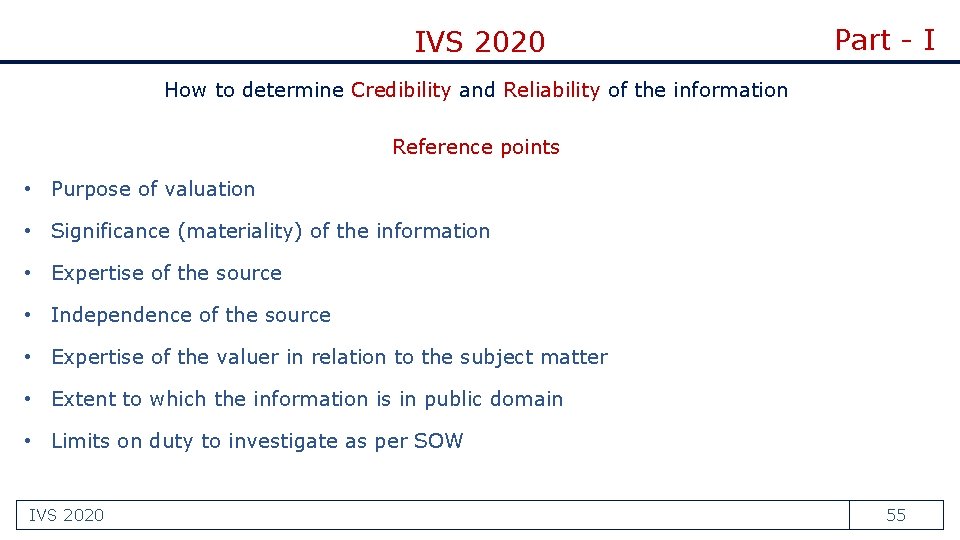
IVS 2020 Part - I How to determine Credibility and Reliability of the information Reference points • Purpose of valuation • Significance (materiality) of the information • Expertise of the source • Independence of the source • Expertise of the valuer in relation to the subject matter • Extent to which the information is in public domain • Limits on duty to investigate as per SOW IVS 2020 55
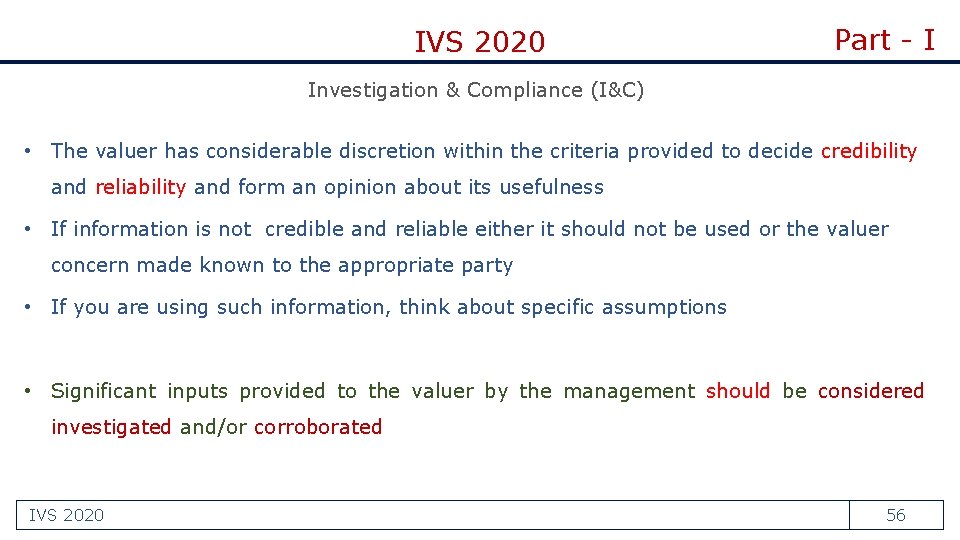
IVS 2020 Part - I Investigation & Compliance (I&C) • The valuer has considerable discretion within the criteria provided to decide credibility and reliability and form an opinion about its usefulness • If information is not credible and reliable either it should not be used or the valuer concern made known to the appropriate party • If you are using such information, think about specific assumptions • Significant inputs provided to the valuer by the management should be considered investigated and/or corroborated IVS 2020 56
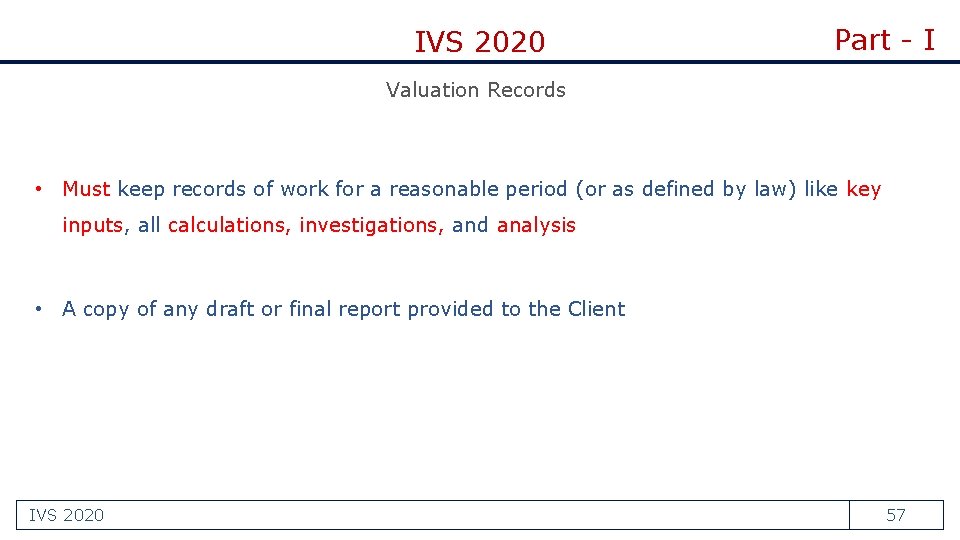
IVS 2020 Part - I Valuation Records • Must keep records of work for a reasonable period (or as defined by law) like key inputs, all calculations, investigations, and analysis • A copy of any draft or final report provided to the Client IVS 2020 57
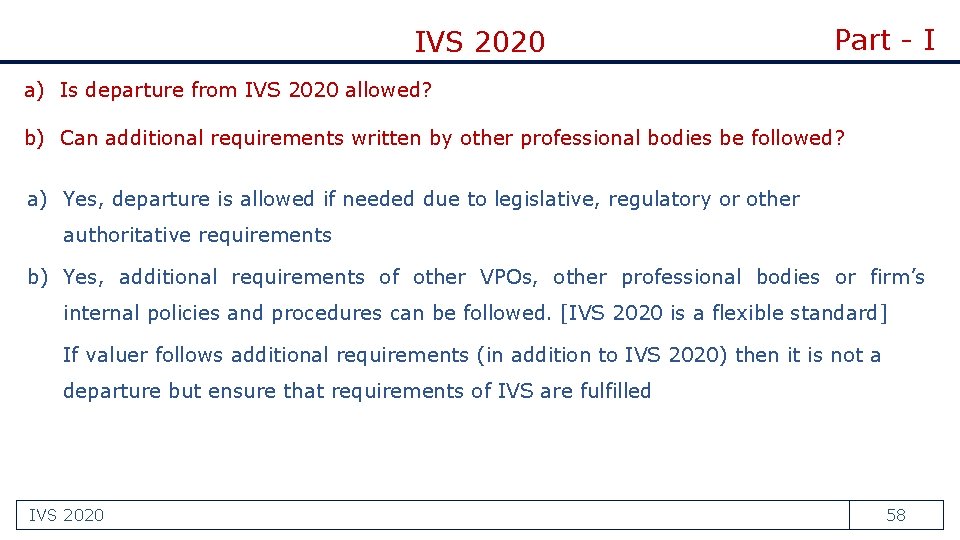
IVS 2020 Part - I a) Is departure from IVS 2020 allowed? b) Can additional requirements written by other professional bodies be followed? a) Yes, departure is allowed if needed due to legislative, regulatory or other authoritative requirements b) Yes, additional requirements of other VPOs, other professional bodies or firm’s internal policies and procedures can be followed. [IVS 2020 is a flexible standard] If valuer follows additional requirements (in addition to IVS 2020) then it is not a departure but ensure that requirements of IVS are fulfilled IVS 2020 58
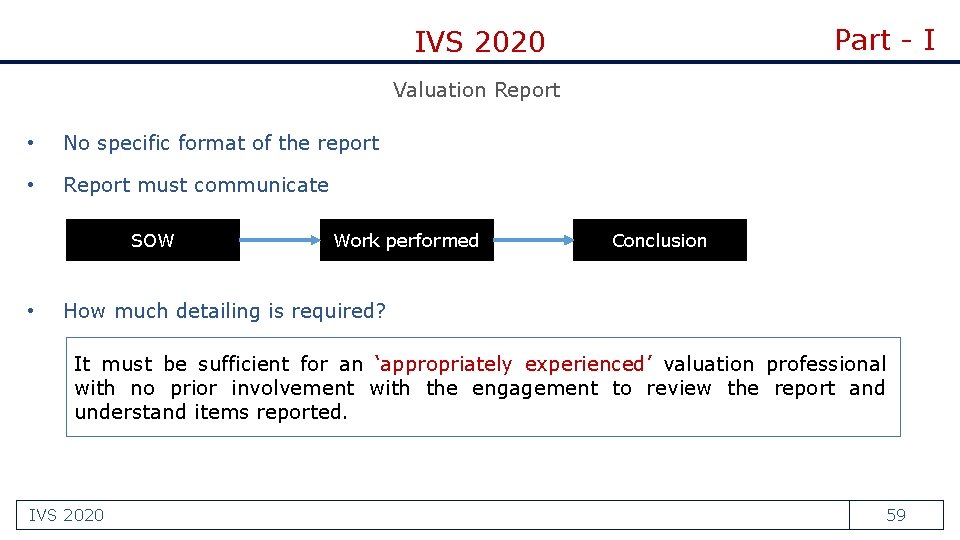
Part - I IVS 2020 Valuation Report • No specific format of the report • Report must communicate SOW • Work performed Conclusion How much detailing is required? It must be sufficient for an ‘appropriately experienced’ valuation professional with no prior involvement with the engagement to review the report and understand items reported. IVS 2020 59
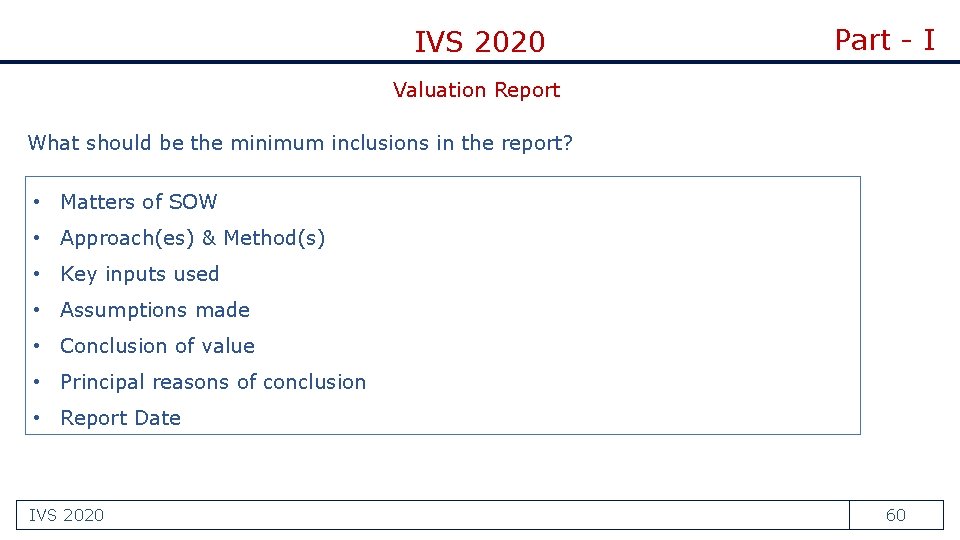
IVS 2020 Part - I Valuation Report What should be the minimum inclusions in the report? • Matters of SOW • Approach(es) & Method(s) • Key inputs used • Assumptions made • Conclusion of value • Principal reasons of conclusion • Report Date IVS 2020 60
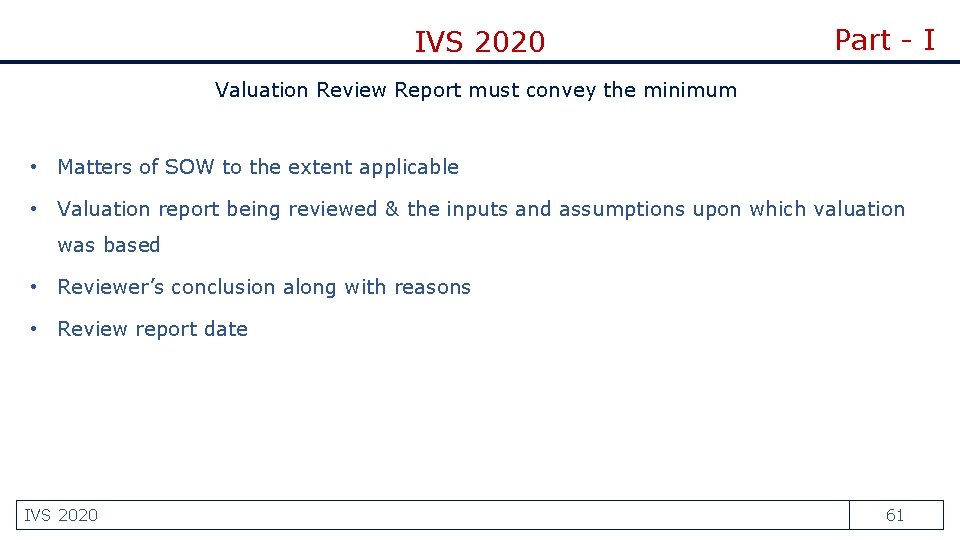
IVS 2020 Part - I Valuation Review Report must convey the minimum • Matters of SOW to the extent applicable • Valuation report being reviewed & the inputs and assumptions upon which valuation was based • Reviewer’s conclusion along with reasons • Review report date IVS 2020 61