
RSRP RSRQ 3 UE Measurements In cellular networks

- Slides: 45
RSRP 與 RSRQ 之量測 3
UE Measurements • In cellular networks, when a mobile device moves from cell to cell and performs cell selection/reselection and handover, it has to measure the signal strength/quality of the neighbor cells. • In LTE network, a UE measures two parameters on reference signal: – RSRP (Reference Signal Received Power) – RSRQ (Reference Signal Received Quality) 4
RSRP Measurements (1/2) RSRP measurements are used for • Cell selection • Cell reselection • Handover • Estimating the path loss for power control calculation 5
RSRP Measurements (2/2) RSRP: the average power received from a single cell specific Reference Signal Resource Element • The average is taken in linear units • The power measurement is based upon the energy received during the useful part of the OFDMA symbol and excludes the energy of the cyclic prefix • The reference point for the RSRP measurement is the antenna connector of the UE 6
Reference Signal Received Power (RSRP) (1/3) • Reference signal received power (RSRP) is defined as the linear average over the power contributions (in [W]) of the resource elements that carry cell-specific reference signals within the considered measurement frequency bandwidth. • For RSRP determination, the cell-specific reference signals R 0, according to 3 GPP TS 36. 211, shall be used. • If the UE can reliably detect that R 1 is available, it may use R 1 in addition to R 0 to determine RSRP. 7
Reference Signal Received Power (RSRP) (2/3) • If higher layers indicate measurements based on discovery signals, the UE shall measure RSRP in the subframes in the configured discovery signal occasions. • If the UE can reliably detect that cell-specific reference signals are present in other subframes, the UE may use those subframes in addition to determine RSRP. • The reference point for the RSRP shall be the antenna connector of the UE. • If receiver diversity is in use by the UE, the reported value shall not be lower than the corresponding RSRP of any of the individual diversity branches. 8
Reference Signal Received Power (RSRP) (3/3) • The number of resource elements within the considered measurement frequency bandwidth and within the measurement period that are used by the UE to determine RSRP is left up to the UE implementation with the limitation that corresponding measurement accuracy requirements have to be fulfilled. • The power per resource element is determined from the energy received during the useful part of the symbol, excluding the CP. 9
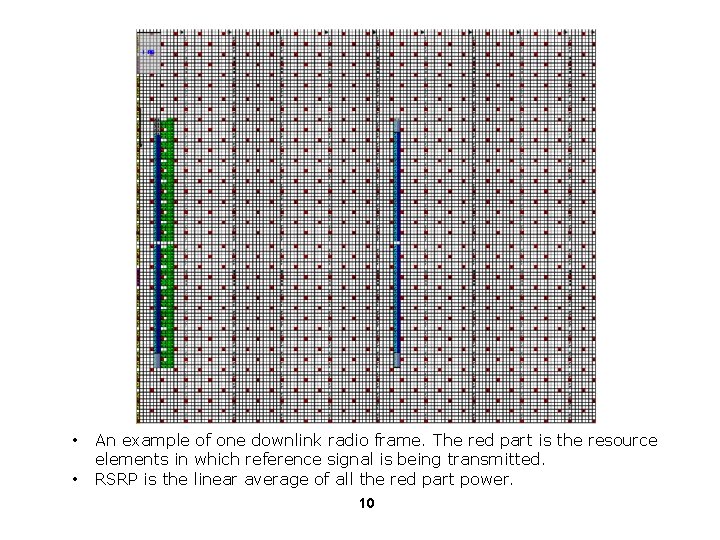
• • An example of one downlink radio frame. The red part is the resource elements in which reference signal is being transmitted. RSRP is the linear average of all the red part power. 10
RSRP Measurement Report Mapping • The reporting range of RSRP is defined from -140 d. Bm to -44 d. Bm with 1 d. B resolution. • UE usually measures RSRP or RSRQ based on the direction (RRC message) from the network and report the value. When it report this value, it does use the real RSRP value. It sends a non-negative value ranging from 0 to 97 and each of these values are mapped to a specific range of real RSRP value. 11
Maximum Reportable RSRP • Based upon the -25 d. Bm maximum input power for a UE (3 GPP TS 36. 101). • The 1. 4 MHz channel bandwidth has 72 Resource Elements in the frequency domain. • RSRP is based upon the power of a single Resource Element, so the maximum RSRP equals – 25 – 10*log(72) = – 44 d. Bm. 12
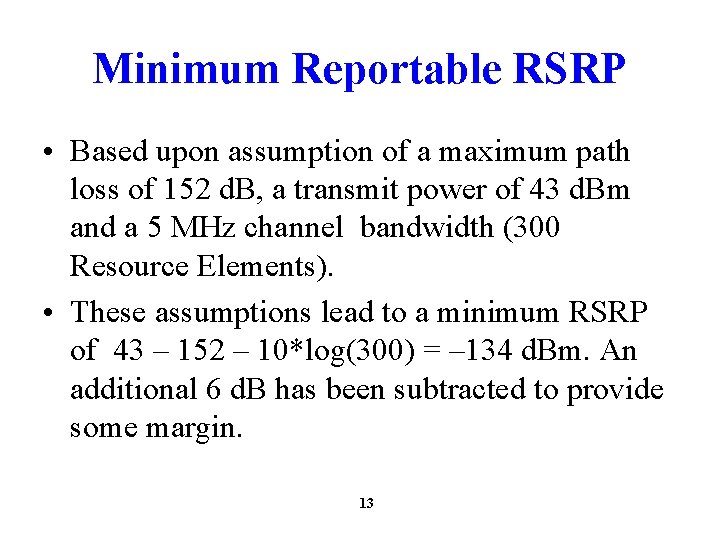
Minimum Reportable RSRP • Based upon assumption of a maximum path loss of 152 d. B, a transmit power of 43 d. Bm and a 5 MHz channel bandwidth (300 Resource Elements). • These assumptions lead to a minimum RSRP of 43 – 152 – 10*log(300) = – 134 d. Bm. An additional 6 d. B has been subtracted to provide some margin. 13
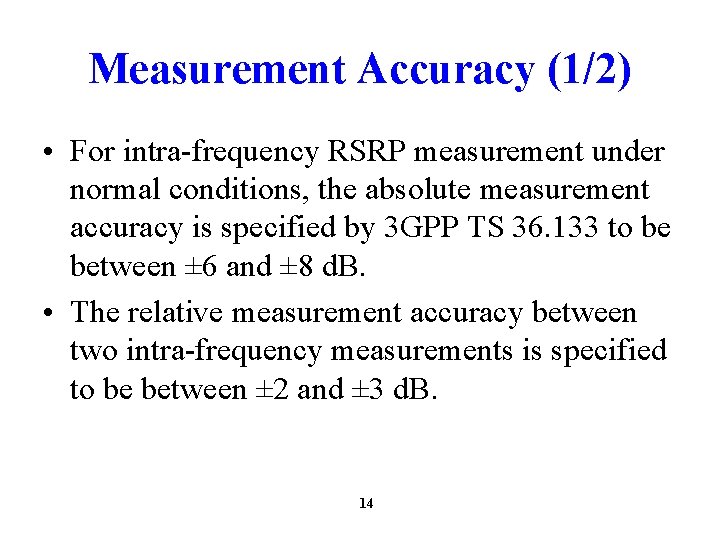
Measurement Accuracy (1/2) • For intra-frequency RSRP measurement under normal conditions, the absolute measurement accuracy is specified by 3 GPP TS 36. 133 to be between ± 6 and ± 8 d. B. • The relative measurement accuracy between two intra-frequency measurements is specified to be between ± 2 and ± 3 d. B. 14
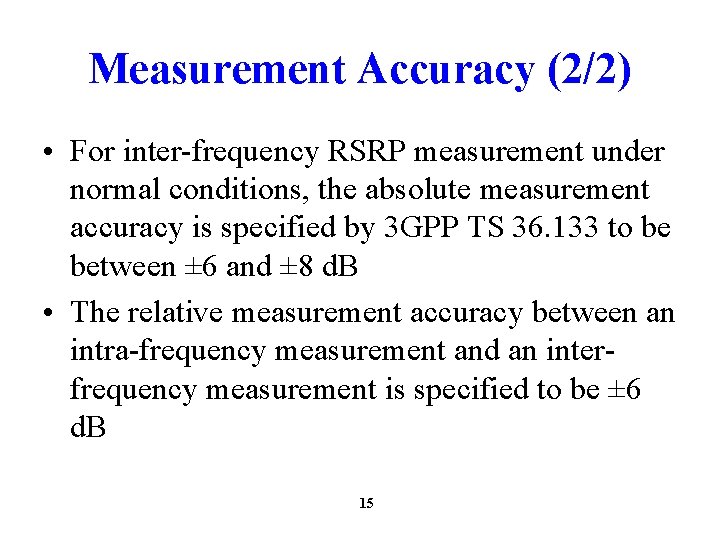
Measurement Accuracy (2/2) • For inter-frequency RSRP measurement under normal conditions, the absolute measurement accuracy is specified by 3 GPP TS 36. 133 to be between ± 6 and ± 8 d. B • The relative measurement accuracy between an intra-frequency measurement and an interfrequency measurement is specified to be ± 6 d. B 15
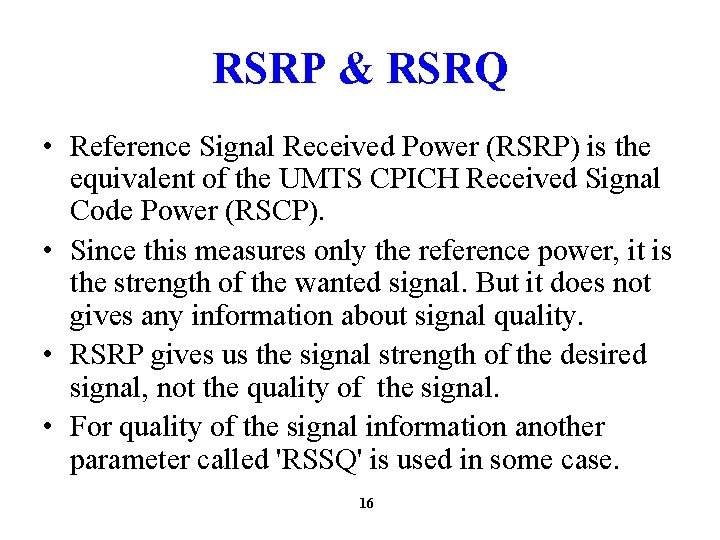
RSRP & RSRQ • Reference Signal Received Power (RSRP) is the equivalent of the UMTS CPICH Received Signal Code Power (RSCP). • Since this measures only the reference power, it is the strength of the wanted signal. But it does not gives any information about signal quality. • RSRP gives us the signal strength of the desired signal, not the quality of the signal. • For quality of the signal information another parameter called 'RSSQ' is used in some case. 16
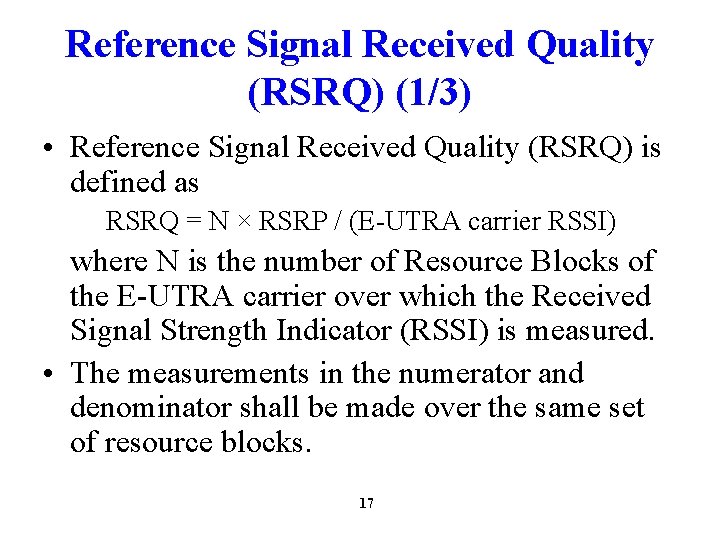
Reference Signal Received Quality (RSRQ) (1/3) • Reference Signal Received Quality (RSRQ) is defined as RSRQ = N × RSRP / (E-UTRA carrier RSSI) where N is the number of Resource Blocks of the E-UTRA carrier over which the Received Signal Strength Indicator (RSSI) is measured. • The measurements in the numerator and denominator shall be made over the same set of resource blocks. 17
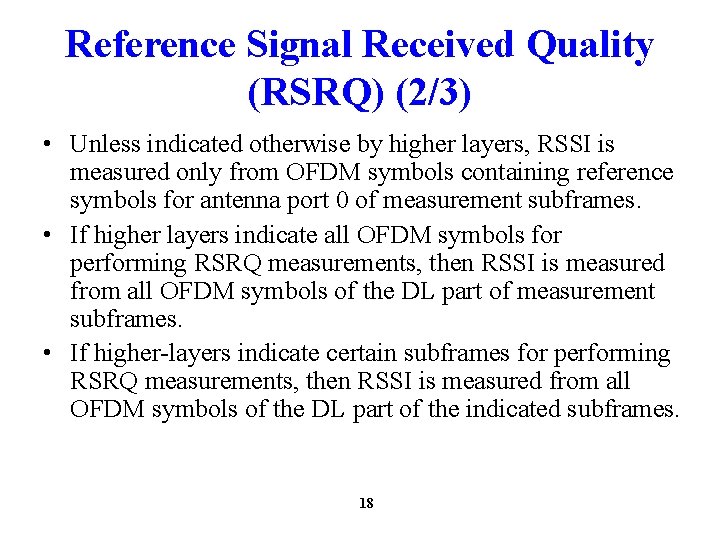
Reference Signal Received Quality (RSRQ) (2/3) • Unless indicated otherwise by higher layers, RSSI is measured only from OFDM symbols containing reference symbols for antenna port 0 of measurement subframes. • If higher layers indicate all OFDM symbols for performing RSRQ measurements, then RSSI is measured from all OFDM symbols of the DL part of measurement subframes. • If higher-layers indicate certain subframes for performing RSRQ measurements, then RSSI is measured from all OFDM symbols of the DL part of the indicated subframes. 18
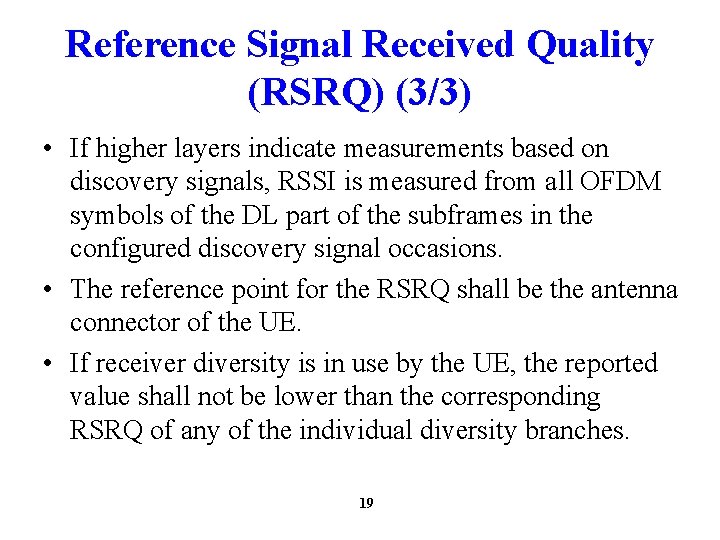
Reference Signal Received Quality (RSRQ) (3/3) • If higher layers indicate measurements based on discovery signals, RSSI is measured from all OFDM symbols of the DL part of the subframes in the configured discovery signal occasions. • The reference point for the RSRQ shall be the antenna connector of the UE. • If receiver diversity is in use by the UE, the reported value shall not be lower than the corresponding RSRQ of any of the individual diversity branches. 19
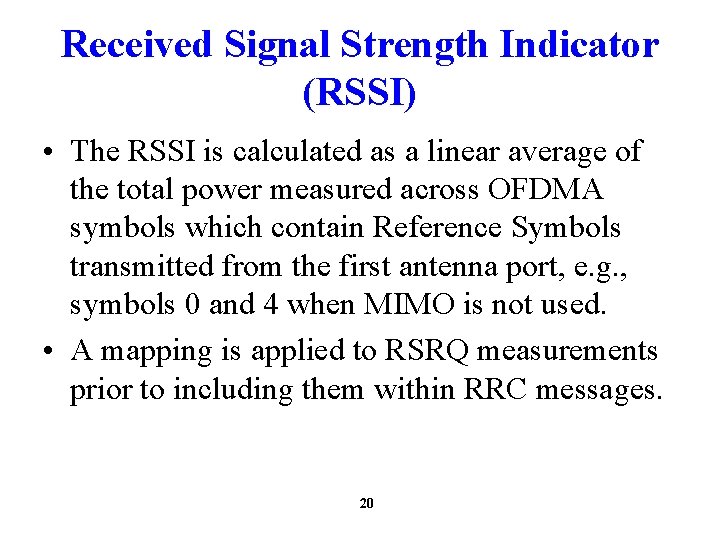
Received Signal Strength Indicator (RSSI) • The RSSI is calculated as a linear average of the total power measured across OFDMA symbols which contain Reference Symbols transmitted from the first antenna port, e. g. , symbols 0 and 4 when MIMO is not used. • A mapping is applied to RSRQ measurements prior to including them within RRC messages. 20
RSRQ Measurement Report Mapping 21
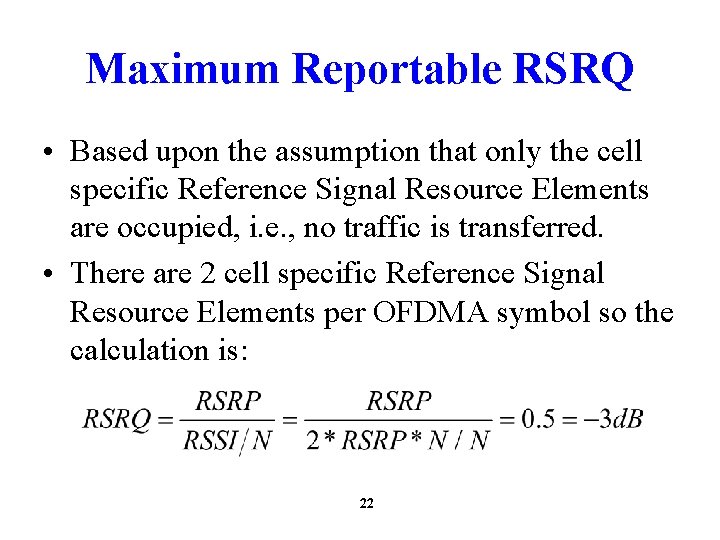
Maximum Reportable RSRQ • Based upon the assumption that only the cell specific Reference Signal Resource Elements are occupied, i. e. , no traffic is transferred. • There are 2 cell specific Reference Signal Resource Elements per OFDMA symbol so the calculation is: 22
Measurement Accuracy (1/2) • For intra-frequency RSRQ measurement under normal conditions, the absolute measurement accuracy is specified by 3 GPP TS 36. 133 to be between ± 2. 5 and ± 3. 5 d. B. • A relative measurement accuracy is not specified for the intra-frequency case. 23
Measurement Accuracy (2/2) • For inter-frequency RSRQ measurement under normal conditions, the absolute measurement accuracy is specified by 3 GPP TS 36. 133 to be between ± 2. 5 and ± 3. 5 d. B • The relative measurement accuracy between an intra-frequency measurement and an interfrequency measurement is specified to be between ± 3 and ± 4 d. B 24
RS-SINR 與 RSSI 25
Reference signal-signal to noise and interference ratio (RS-SINR) • Defined as the linear average over the power contribution (in [W]) of the resource elements carrying cell-specific reference signals divided by the linear average of the noise and interference power contribution (in [W]) over the resource elements carrying cell specific reference signals within the same frequency bandwidth. • For RS-SINR determination, the cell-specific reference signals R 0 according TS 36. 211 shall be used. 26
RS-SINR • The reference point for the RS-SINR shall be the antenna connector of the UE. • If receiver diversity is in use by the UE, the reported value shall not be lower than the corresponding RS-SINR of any of the individual diversity branches. • If higher-layer signaling indicates certain subframes for performing RS-SINR measurements, then RS-SINR is measured in the indicated subframes. 27
RSSI (1/2) • The RSSI is calculated as a linear average of the total power measured across OFDMA symbols which contain Reference Symbols transmitted from the first antenna port, e. g. , symbols 0 and 4 when MIMO is not used. • The reference point for the RSSI shall be the antenna connector of the UE. 28
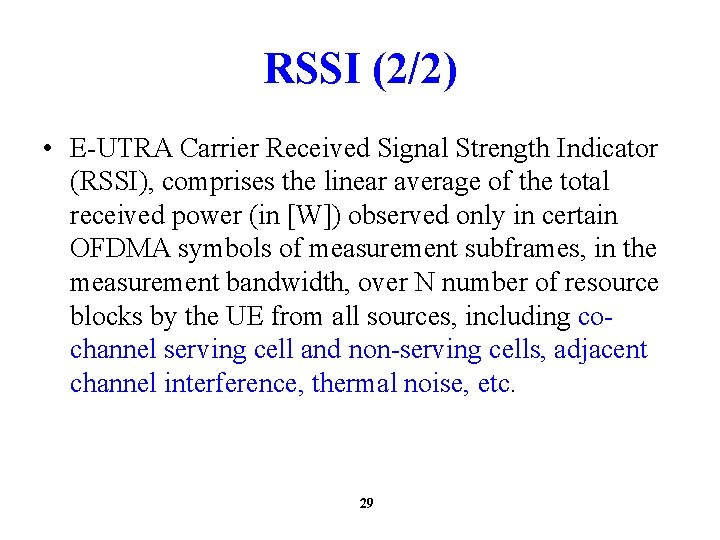
RSSI (2/2) • E-UTRA Carrier Received Signal Strength Indicator (RSSI), comprises the linear average of the total received power (in [W]) observed only in certain OFDMA symbols of measurement subframes, in the measurement bandwidth, over N number of resource blocks by the UE from all sources, including cochannel serving cell and non-serving cells, adjacent channel interference, thermal noise, etc. 29
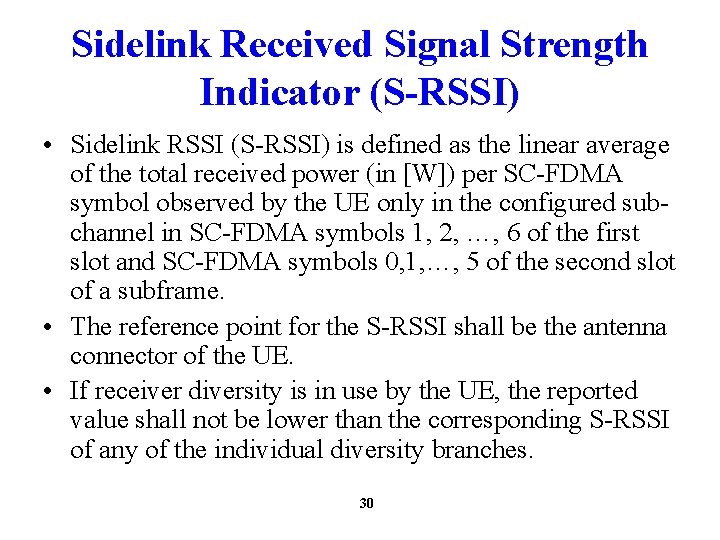
Sidelink Received Signal Strength Indicator (S-RSSI) • Sidelink RSSI (S-RSSI) is defined as the linear average of the total received power (in [W]) per SC-FDMA symbol observed by the UE only in the configured subchannel in SC-FDMA symbols 1, 2, …, 6 of the first slot and SC-FDMA symbols 0, 1, …, 5 of the second slot of a subframe. • The reference point for the S-RSSI shall be the antenna connector of the UE. • If receiver diversity is in use by the UE, the reported value shall not be lower than the corresponding S-RSSI of any of the individual diversity branches. 30
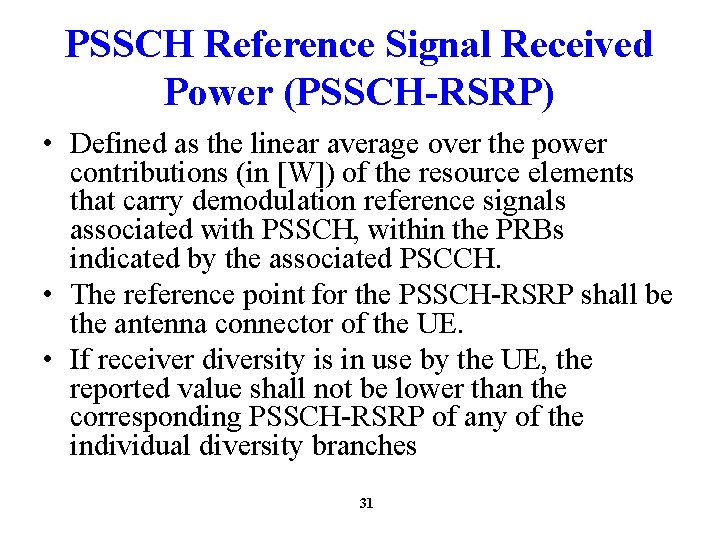
PSSCH Reference Signal Received Power (PSSCH-RSRP) • Defined as the linear average over the power contributions (in [W]) of the resource elements that carry demodulation reference signals associated with PSSCH, within the PRBs indicated by the associated PSCCH. • The reference point for the PSSCH-RSRP shall be the antenna connector of the UE. • If receiver diversity is in use by the UE, the reported value shall not be lower than the corresponding PSSCH-RSRP of any of the individual diversity branches 31
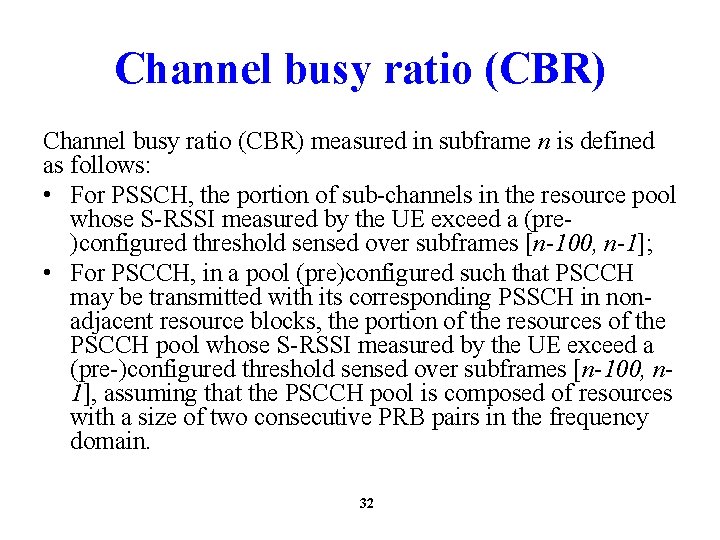
Channel busy ratio (CBR) measured in subframe n is defined as follows: • For PSSCH, the portion of sub-channels in the resource pool whose S-RSSI measured by the UE exceed a (pre)configured threshold sensed over subframes [n-100, n-1]; • For PSCCH, in a pool (pre)configured such that PSCCH may be transmitted with its corresponding PSSCH in nonadjacent resource blocks, the portion of the resources of the PSCCH pool whose S-RSSI measured by the UE exceed a (pre-)configured threshold sensed over subframes [n-100, n 1], assuming that the PSCCH pool is composed of resources with a size of two consecutive PRB pairs in the frequency domain. 32
Channel occupancy ratio (CR) • Channel occupancy ratio (CR) evaluated at subframe n is defined as – the total number of subchannels used for its transmissions in subframes [n-a, n-1] and granted in subframes [n, n+b] divided by the total number of configured sub-channels in the transmission pool over [n-a, n+b]. 33
DL RS TX power • Downlink reference signal transmit power is determined for a considered cell as the linear average over the power contributions (in [W]) of the resource elements that carry cell-specific reference signals which are transmitted by the e. Node B within its operating system bandwidth. • For DL RS TX power determination the cellspecific reference signals R 0 and if available R 1 according TS 36. 211 [3] can be used. • The reference point for the DL RS TX power measurement shall be the TX antenna connector. 34
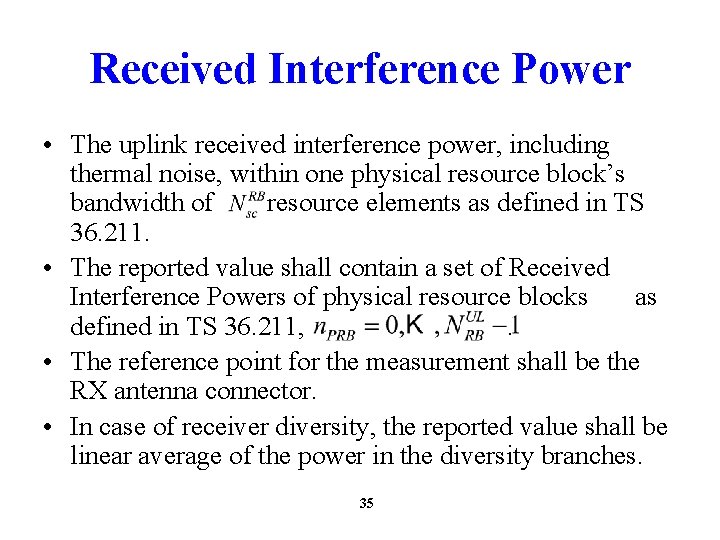
Received Interference Power • The uplink received interference power, including thermal noise, within one physical resource block’s bandwidth of resource elements as defined in TS 36. 211. • The reported value shall contain a set of Received Interference Powers of physical resource blocks as defined in TS 36. 211, . • The reference point for the measurement shall be the RX antenna connector. • In case of receiver diversity, the reported value shall be linear average of the power in the diversity branches. 35
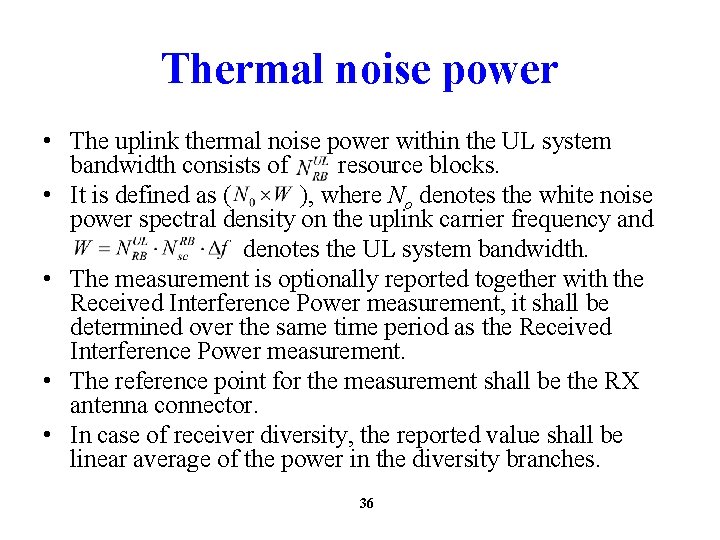
Thermal noise power • The uplink thermal noise power within the UL system bandwidth consists of resource blocks. • It is defined as ( ), where No denotes the white noise power spectral density on the uplink carrier frequency and denotes the UL system bandwidth. • The measurement is optionally reported together with the Received Interference Power measurement, it shall be determined over the same time period as the Received Interference Power measurement. • The reference point for the measurement shall be the RX antenna connector. • In case of receiver diversity, the reported value shall be linear average of the power in the diversity branches. 36
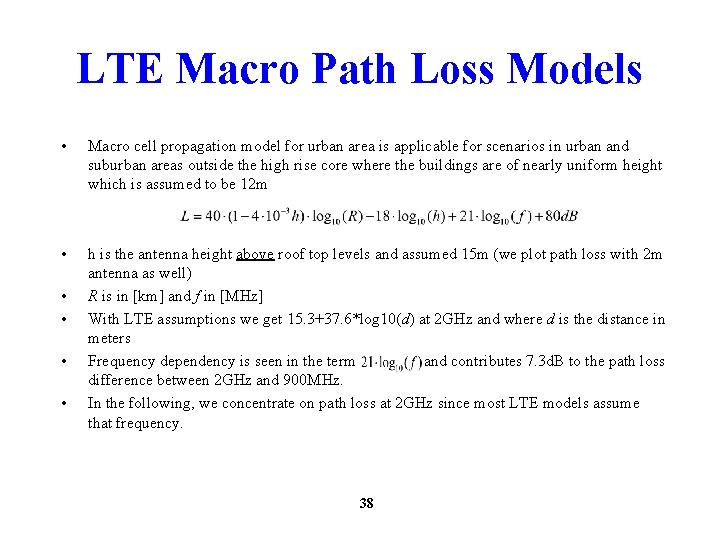
LTE Macro Path Loss Models • Macro cell propagation model for urban area is applicable for scenarios in urban and suburban areas outside the high rise core where the buildings are of nearly uniform height which is assumed to be 12 m • h is the antenna height above roof top levels and assumed 15 m (we plot path loss with 2 m antenna as well) R is in [km] and f in [MHz] With LTE assumptions we get 15. 3+37. 6*log 10(d) at 2 GHz and where d is the distance in meters Frequency dependency is seen in the term and contributes 7. 3 d. B to the path loss difference between 2 GHz and 900 MHz. In the following, we concentrate on path loss at 2 GHz since most LTE models assume that frequency. • • 38
LTE Micro-cell System Parameters 39
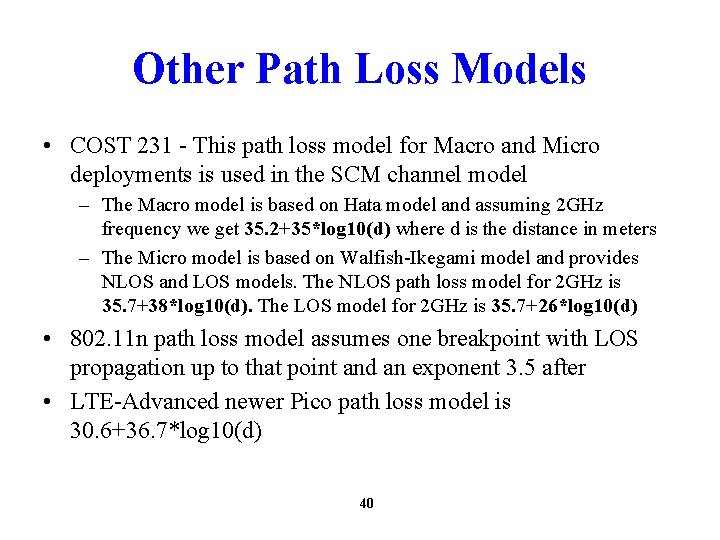
Other Path Loss Models • COST 231 - This path loss model for Macro and Micro deployments is used in the SCM channel model – The Macro model is based on Hata model and assuming 2 GHz frequency we get 35. 2+35*log 10(d) where d is the distance in meters – The Micro model is based on Walfish-Ikegami model and provides NLOS and LOS models. The NLOS path loss model for 2 GHz is 35. 7+38*log 10(d). The LOS model for 2 GHz is 35. 7+26*log 10(d) • 802. 11 n path loss model assumes one breakpoint with LOS propagation up to that point and an exponent 3. 5 after • LTE-Advanced newer Pico path loss model is 30. 6+36. 7*log 10(d) 40
Outdoor Path Loss Models at 2 GHz • Note that Cost 231 Urban Macro, the new LTE-A Pico and LTE Macro with 2 m antenna height exhibit similar path loss 41
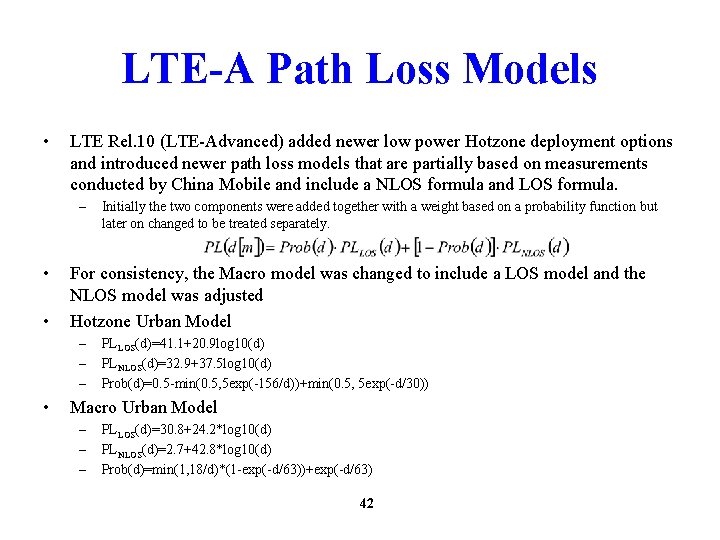
LTE-A Path Loss Models • LTE Rel. 10 (LTE-Advanced) added newer low power Hotzone deployment options and introduced newer path loss models that are partially based on measurements conducted by China Mobile and include a NLOS formula and LOS formula. – • • For consistency, the Macro model was changed to include a LOS model and the NLOS model was adjusted Hotzone Urban Model – – – • Initially the two components were added together with a weight based on a probability function but later on changed to be treated separately. PLLOS(d)=41. 1+20. 9 log 10(d) PLNLOS(d)=32. 9+37. 5 log 10(d) Prob(d)=0. 5 -min(0. 5, 5 exp(-156/d))+min(0. 5, 5 exp(-d/30)) Macro Urban Model – – – PLLOS(d)=30. 8+24. 2*log 10(d) PLNLOS(d)=2. 7+42. 8*log 10(d) Prob(d)=min(1, 18/d)*(1 -exp(-d/63))+exp(-d/63) 42
LTE-A Hotzone Path Loss Models at 2 GHz 43
LTE Channel Models • Several outdoor path loss models are with some variation. • Cost 231 Macro Urban, Cost 231 Micro Urban, LTE Hotzone NLOS, LTE Pico and LTE Macro with an antenna height 2 m are very similar and models from this set can be chosen. • A link budget calculation or system simulation should include the following components: – Adjustment for different frequencies – Shadow fading with 10 d. B standard deviation – Penetration loss for indoor clients 44
References 1. 2. 3 GPP TS 36. 214 LTE Quick Reference – 3. RSRP and RSRQ Measurement in LTE – 4. 5. 6. 7. http: //www. sharetechnote. com/html/Handbook_LTE_RSRP. html/ https: //www. laroccasolutions. com/78 -rsrp-and-rsrq-measurement-in-lte/ http: //veeresht. info/blog/multipath-fading-channels-and-3 gpp-lte-design. html 3 GPP TS 36. 133 3 GPP TS 36. 304 Chris Johnson, “Long term Evolution IN BULLETS, ” 2 nd Ed. , 2012. http: //www. lte-bullets. com/ 45