
RR Platform Implementation Framework The Electricity Balancing Guideline
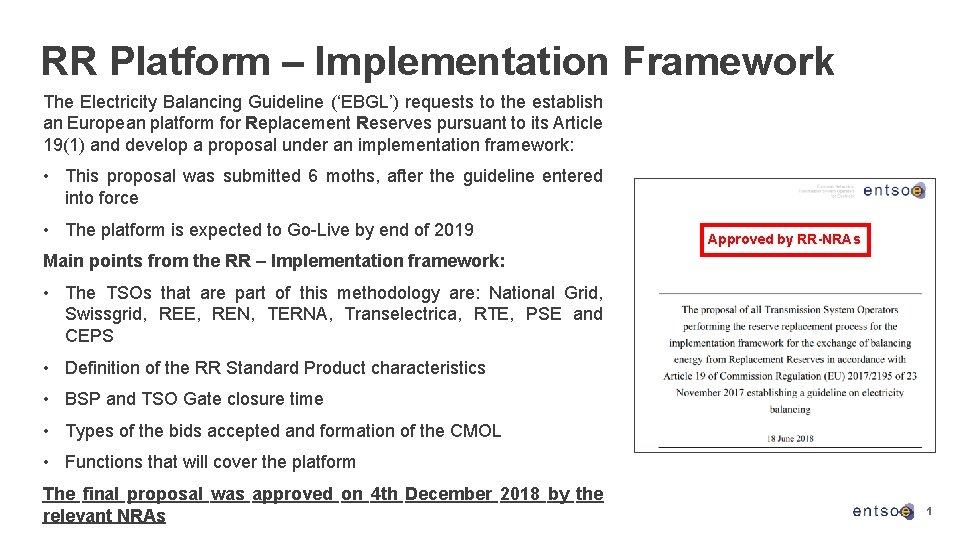
RR Platform – Implementation Framework The Electricity Balancing Guideline (‘EBGL’) requests to the establish an European platform for Replacement Reserves pursuant to its Article 19(1) and develop a proposal under an implementation framework: • This proposal was submitted 6 moths, after the guideline entered into force • The platform is expected to Go-Live by end of 2019 Approved by RR-NRAs Main points from the RR – Implementation framework: • The TSOs that are part of this methodology are: National Grid, Swissgrid, REE, REN, TERNA, Transelectrica, RTE, PSE and CEPS • Definition of the RR Standard Product characteristics • BSP and TSO Gate closure time • Types of the bids accepted and formation of the CMOL • Functions that will cover the platform The final proposal was approved on 4 th December 2018 by the relevant NRAs 1
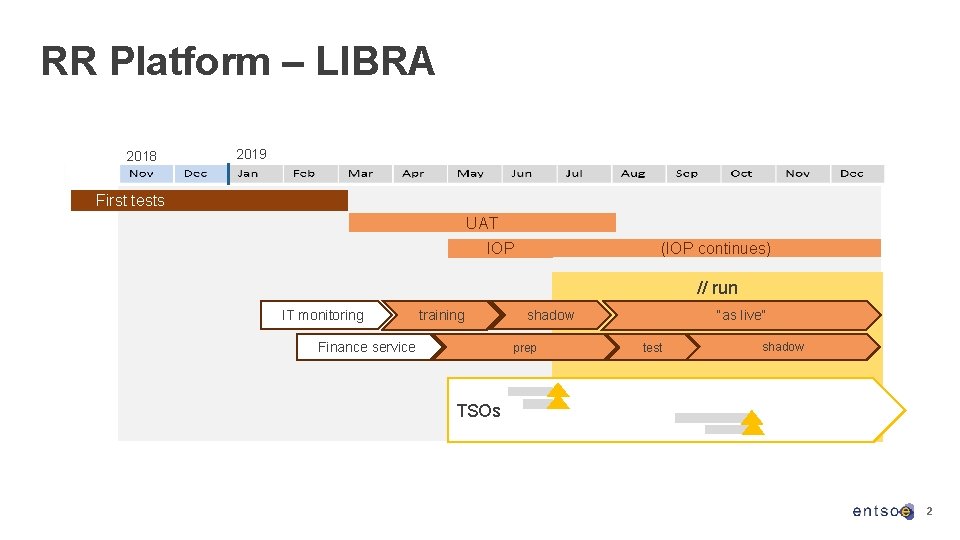
RR Platform – LIBRA 2018 2019 First tests UAT (IOP continues) IOP // run IT monitoring training Finance service shadow prep “as live” test shadow TSOs 2
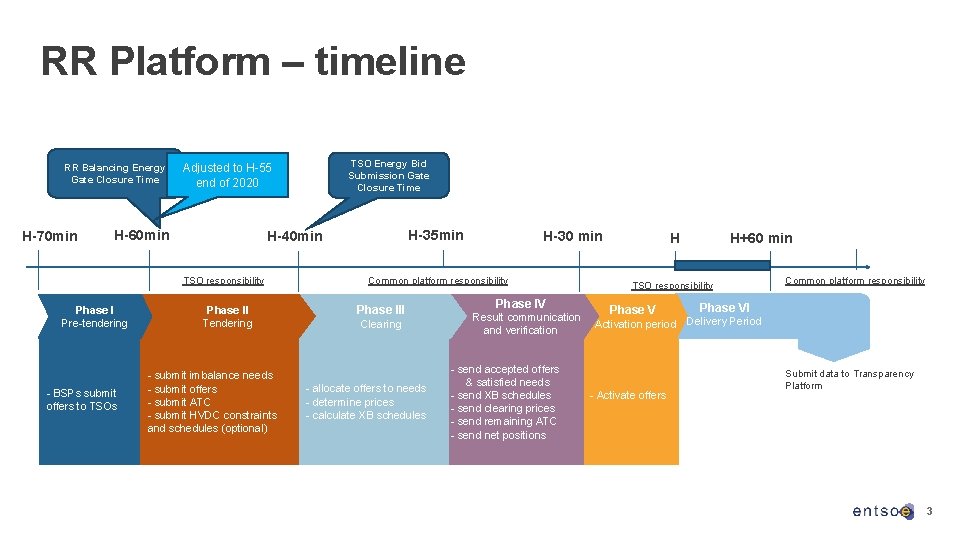
RR Platform – timeline RR Balancing Energy Gate Closure Time H-70 min H-60 min - BSPs submit offers to TSOs H-35 min H-40 min TSO responsibility Phase I Pre-tendering TSO Energy Bid Submission Gate Closure Time Adjusted to H-55 end of 2020 Phase II Tendering - submit imbalance needs - submit offers - submit ATC - submit HVDC constraints and schedules (optional) H-30 min Common platform responsibility Phase III Clearing - allocate offers to needs - determine prices - calculate XB schedules Phase IV Result communication and verification - send accepted offers & satisfied needs - send XB schedules - send clearing prices - send remaining ATC - send net positions H H+60 min TSO responsibility Phase V Common platform responsibility Phase VI Activation period Delivery Period - Activate offers Submit data to Transparency Platform 3
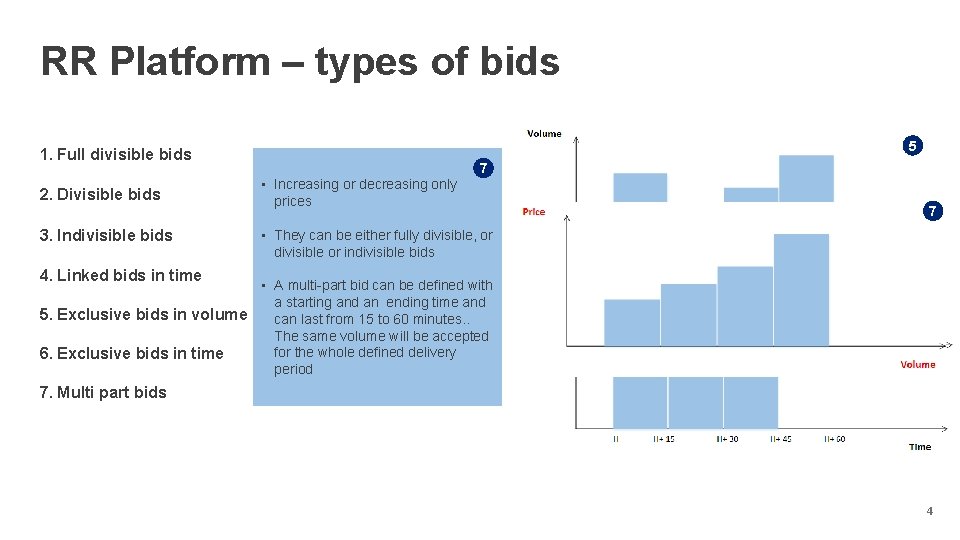
RR Platform – types of bids 1. Full divisible bids 2. 3. 4. 5. 6. 1 34 65 72 They can be either fully divisible, or Increasing or decreasing only divisible or indivisible bids Divisible bids The accepted volume less or or prices They can be either fullyis divisible, The accepted They can be either volume fullyis divisible, less or or equal to or the maximum volume and divisible indivisible bids They can offer different equal to or divisible theindivisible maximumbids volume and Either the whole bid or nothing is or greater or be equal to the minimum They can either fully divisible, Indivisible bids quantities/prices per time step greater or equal to 0 accepted quantity divisible or indivisibletobids Bids corresponding single time Bids explicit corresponding toonly single time The links can link steps only can be exclusive in bids Linked bids in time The bidonly steps is rejected can becorresponding exclusive when the in to (including curve) They correspond towhen single time with The bid is rejected the A multi-part bid can be defined volume accepted volume is equal to 0 different steps, i. e. time to 15 time accepted quantity is equal tosteps zero a starting and anminute ending time and Exclusive bids in volume • can last from to 60 minutes. . Maximum one 15 exclusive bid can be Theysame Maximum correspond one exclusive to single bid time can be • • The percentage ratio α will Theysame The correspond volumetowill single be accepted time accepted steps, accepted i. e. to 15 timevolume steps be accepted: α =minute Accepted steps, for the i. e. whole to 15 defined minutedelivery time steps Exclusive bids in time of each bid/Maximum volume of period each bid • • • • • 5 31 2 467 7. Multi part bids 4

RR Platform – Algorithm optimisation Processing Input data 1. TSO receive bids from BSPs from their local balancing area/bidding zone. Optimization model construction Objectives: • • 2. TSOs put the valid RR bids on the LIBRA platform Maximize Social welfare Maximize inelastic need satisfaction Minimize tolerance band use Maximize desired flow range satisfaction 3. TSOs send their needs and ATC values to the platform. Maximize Social welfare • • V Constraints: Fix bids and need selections Fix social welfare 200 100 200 Maximize inelastic need satisfaction • V Constraints: Fix XB flows -100 -100 Minimize tolerance band use • Constraint : Fix XB price differences Maximize desired flow range satisfaction A ATC= 100 Flow 50 50€/MWh B 50€/MWh A 40€/MWh ATC= 100 Flow 50 B 50€/MWh 5. Communication of accepted offers, satisfied needs and marginal prices 6. Calculation of the bilateral exchanges between balancing areas and TSOTSO settlement. 7. Residual ATC and net positions are communicated to TSOs 5
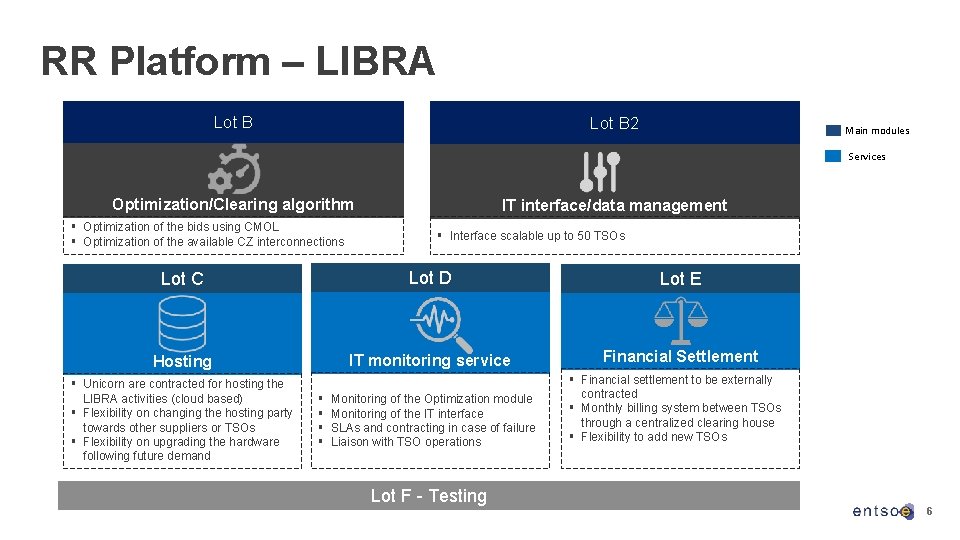
RR Platform – LIBRA Lot B 2 Main modules Services Optimization/Clearing algorithm § Optimization of the bids using CMOL § Optimization of the available CZ interconnections IT interface/data management § Interface scalable up to 50 TSOs Lot C Lot D Lot E Hosting IT monitoring service Financial Settlement § Unicorn are contracted for hosting the LIBRA activities (cloud based) § Flexibility on changing the hosting party towards other suppliers or TSOs § Flexibility on upgrading the hardware following future demand § § Monitoring of the Optimization module Monitoring of the IT interface SLAs and contracting in case of failure Liaison with TSO operations Lot F - Testing § Financial settlement to be externally contracted § Monthly billing system between TSOs through a centralized clearing house § Flexibility to add new TSOs 6
- Slides: 6