
rpole req Earth has an equatorial bulge and
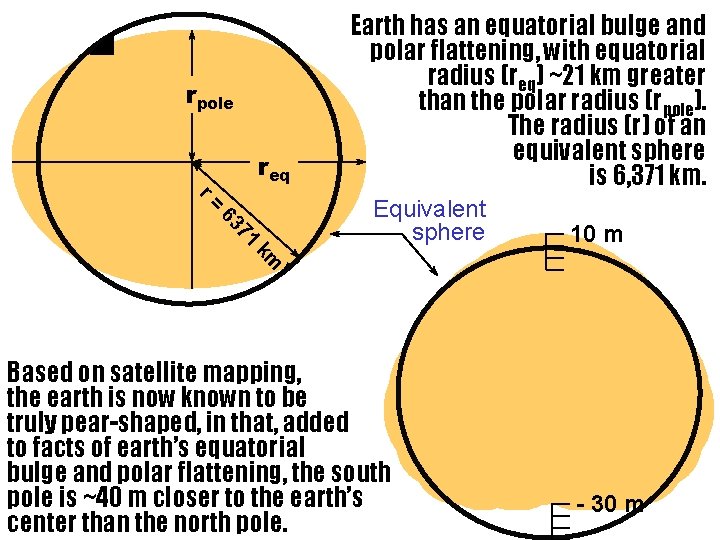
rpole req Earth has an equatorial bulge and polar flattening, with equatorial radius (req) ~21 km greater than the polar radius (rpole). The radius (r) of an equivalent sphere is 6, 371 km. r= 71 63 Equivalent sphere 10 m ) km Based on satellite mapping, the earth is now known to be truly pear-shaped, in that, added to facts of earth’s equatorial bulge and polar flattening, the south pole is ~40 m closer to the earth’s center than the north pole. - 30 m
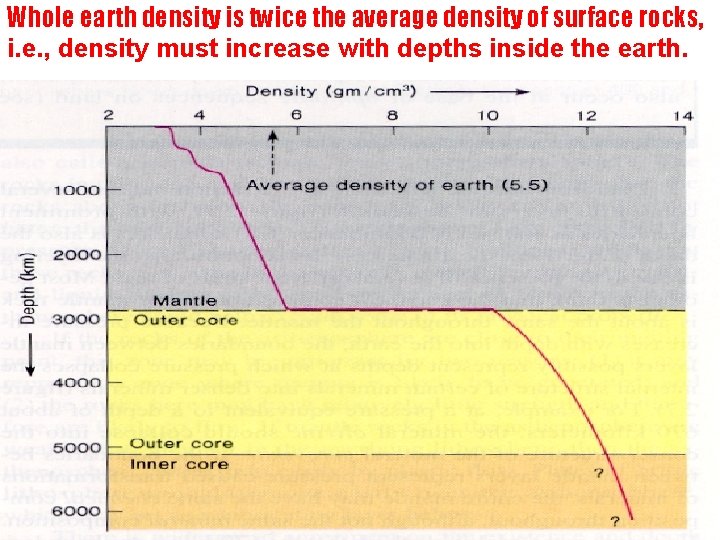
Whole earth density is twice the average density of surface rocks, i. e. , density must increase with depths inside the earth.

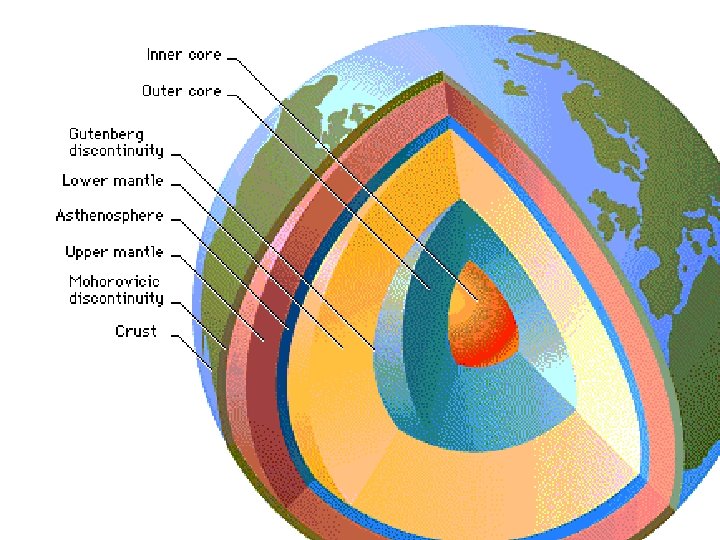

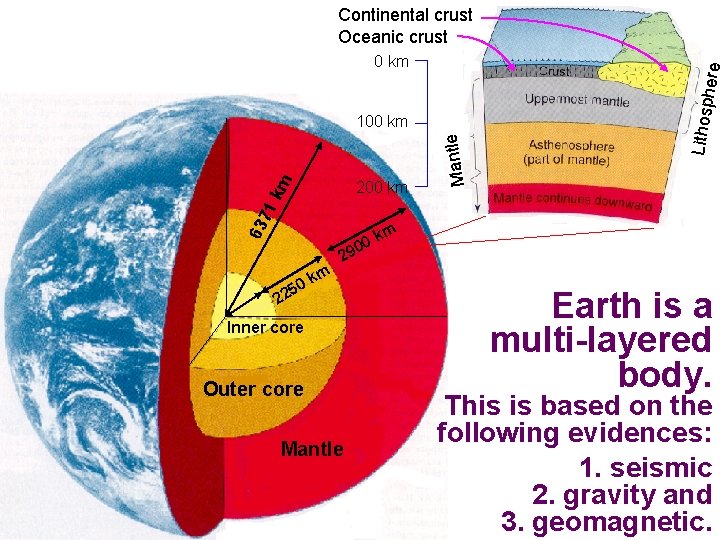
0 km 63 71 200 km Mantle km 100 km Lithosp here Continental crust Oceanic crust m 29 k 00 m k 50 22 Inner core Outer core Mantle Earth is a multi-layered body. This is based on the following evidences: 1. seismic 2. gravity and 3. geomagnetic.
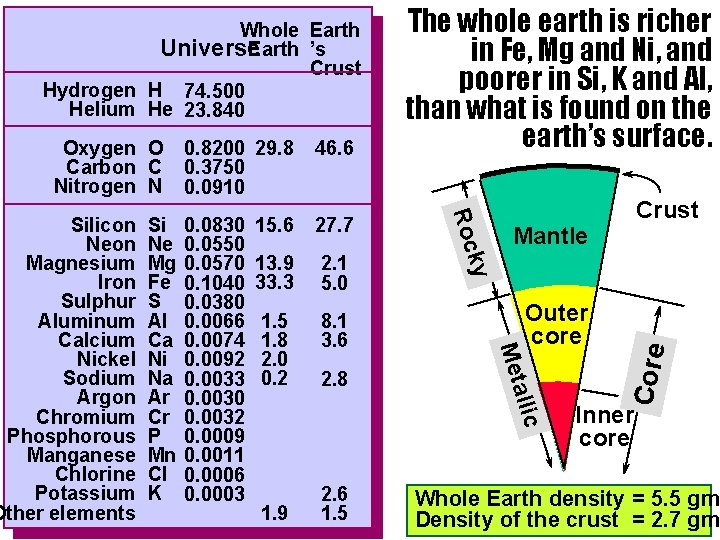
Oxygen O Carbon C Nitrogen N 13. 9 33. 3 2. 1 5. 0 1. 5 1. 8 2. 0 0. 2 8. 1 3. 6 1. 9 2. 8 2. 6 1. 5 Crust Mantle Outer core allic 27. 7 Met 15. 6 0. 0830 0. 0550 0. 0570 0. 1040 0. 0380 0. 0066 0. 0074 0. 0092 0. 0033 0. 0030 0. 0032 0. 0009 0. 0011 0. 0006 0. 0003 ky Si Ne Mg Fe S Al Ca Ni Na Ar Cr P Mn Cl K 46. 6 Roc Silicon Neon Magnesium Iron Sulphur Aluminum Calcium Nickel Sodium Argon Chromium Phosphorous Manganese Chlorine Potassium Other elements 0. 8200 29. 8 0. 3750 0. 0910 The whole earth is richer in Fe, Mg and Ni, and poorer in Si, K and Al, than what is found on the earth’s surface. Core Whole Earth Universe Earth ’s Crust Hydrogen H 74. 500 Helium He 23. 840 Inner core Whole Earth density = 5. 5 gm Density of the crust = 2. 7 gm

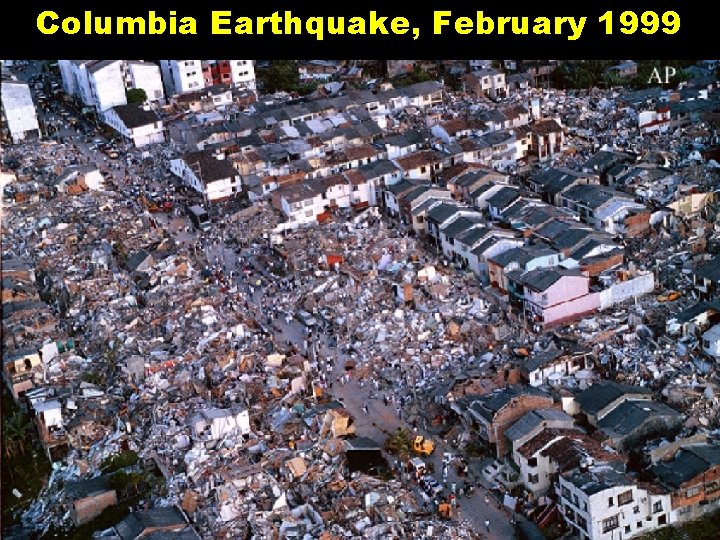
Columbia Earthquake, February 1999
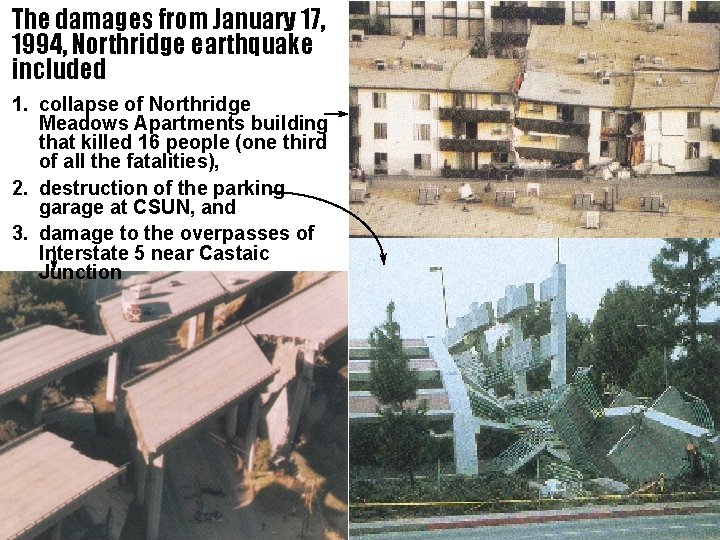
The damages from January 17, 1994, Northridge earthquake included 1. collapse of Northridge Meadows Apartments building that killed 16 people (one third of all the fatalities), 2. destruction of the parking garage at CSUN, and 3. damage to the overpasses of Interstate 5 near Castaic Junction
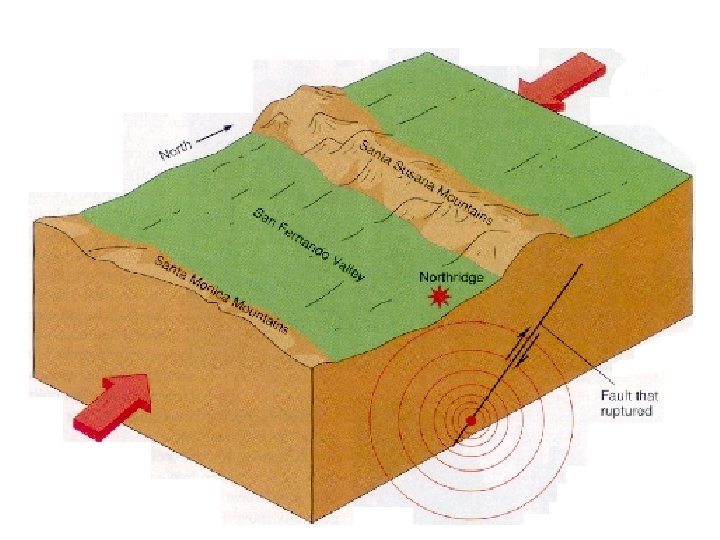
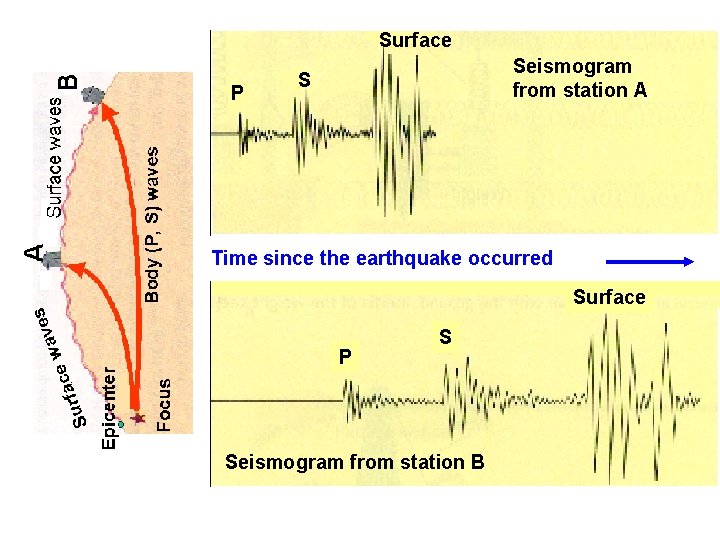
Surface P Seismogram from station A S Time since the earthquake occurred Surface P S Seismogram from station B
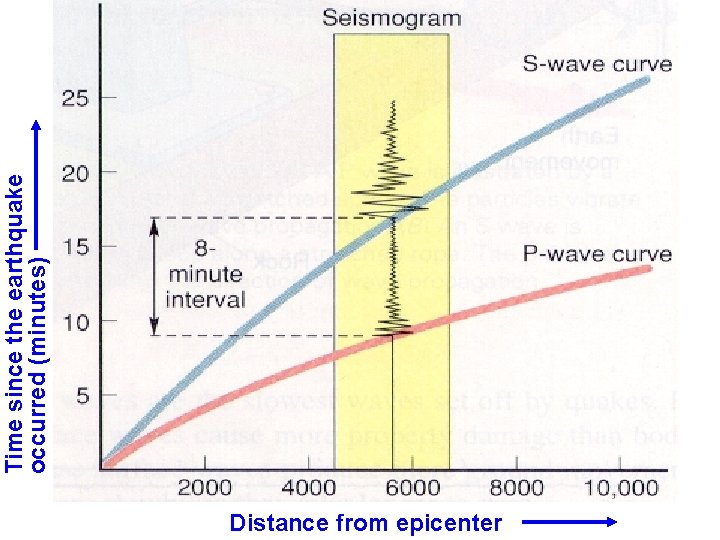
Distance from epicenter Time since the earthquake occurred (minutes)
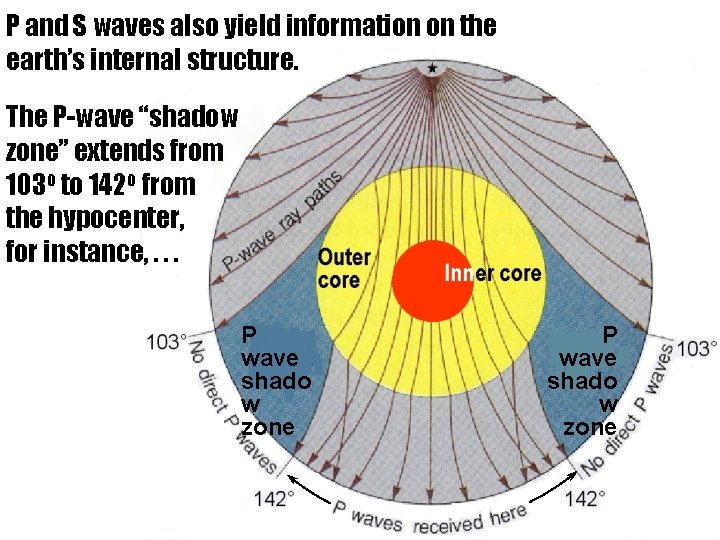
P and S waves also yield information on the earth’s internal structure. The P-wave “shadow zone” extends from 103 o to 142 o from the hypocenter, for instance, . . . P wave shado w zone
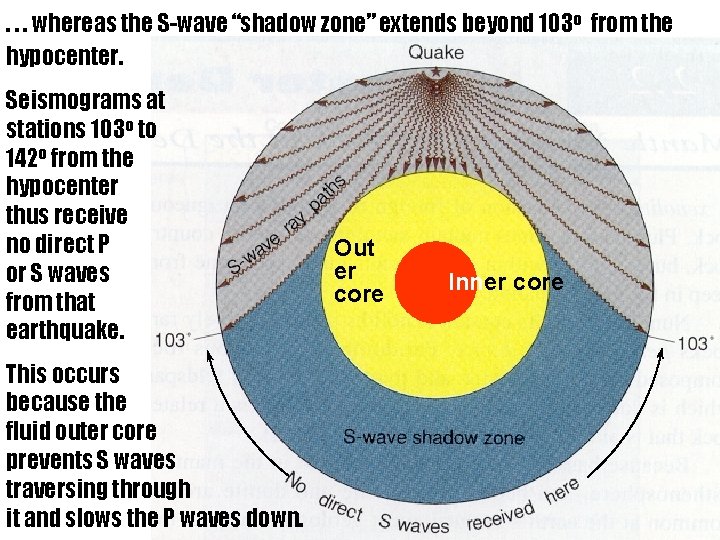
. . . whereas the S-wave “shadow zone” extends beyond 103 o from the hypocenter. Seismograms at stations 103 o to 142 o from the hypocenter thus receive no direct P or S waves from that earthquake. This occurs because the fluid outer core prevents S waves traversing through it and slows the P waves down. Out er core Inner core
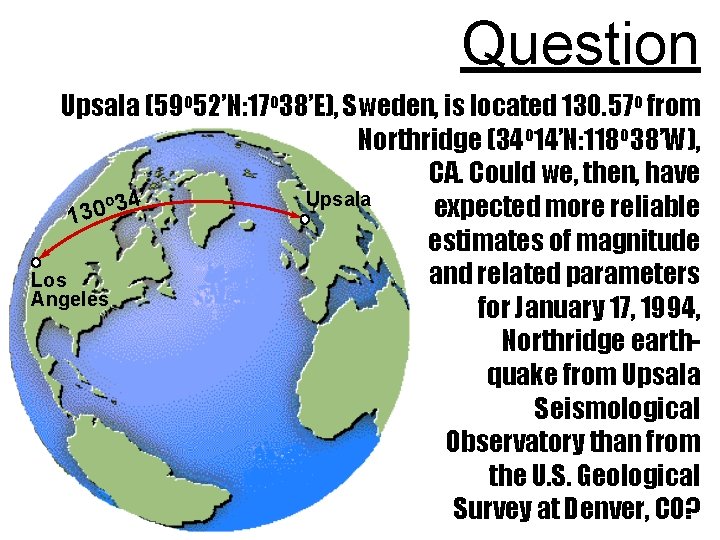
Question Upsala (59 o 52’N: 17 o 38’E), Sweden, is located 130. 57 o from Northridge (34 o 14’N: 118 o 38’W), CA. Could we, then, have Upsala o 34’ expected more reliable 0 13 estimates of magnitude and related parameters Los Angeles for January 17, 1994, Northridge earthquake from Upsala Seismological Observatory than from the U. S. Geological Survey at Denver, CO?
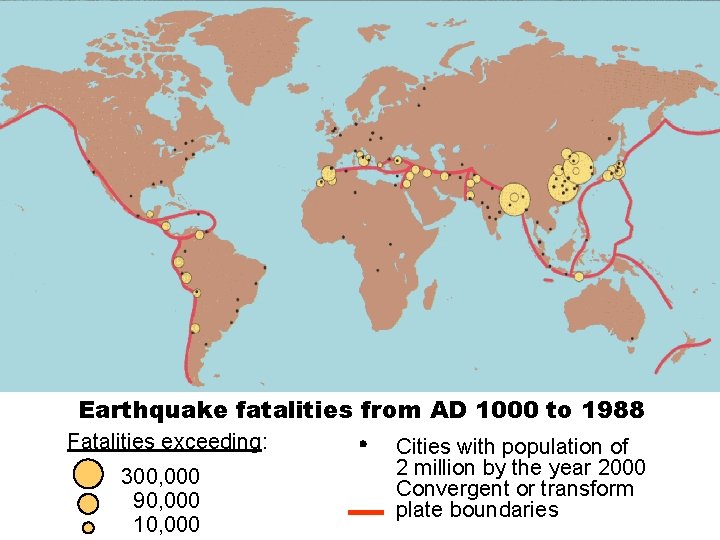
Earthquake fatalities from AD 1000 to 1988 Fatalities exceeding: 300, 000 90, 000 10, 000 Cities with population of 2 million by the year 2000 Convergent or transform plate boundaries
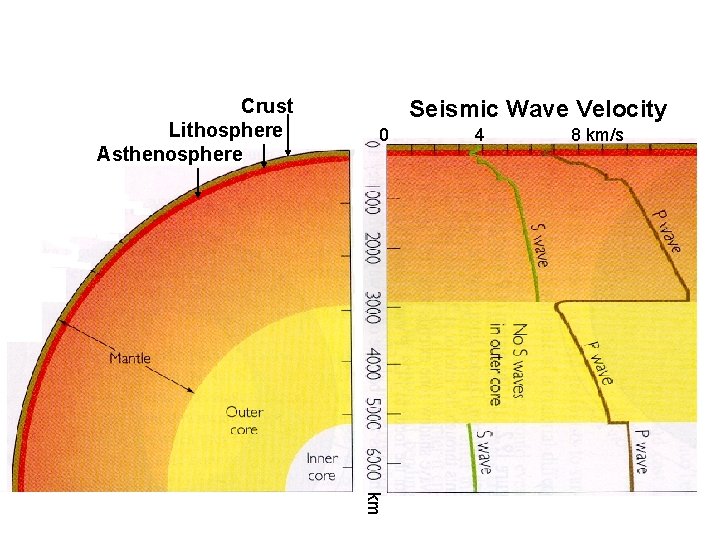
Crust Lithosphere Asthenosphere Seismic Wave Velocity 0 4 8 km/s km
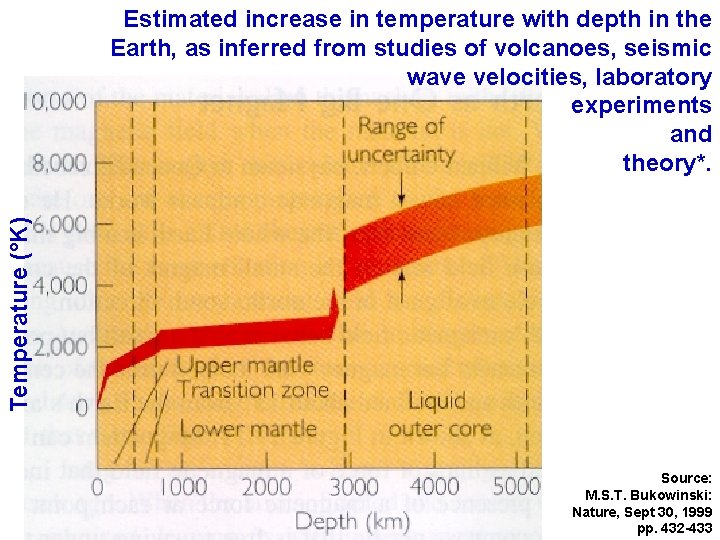
Temperature (°K) Estimated increase in temperature with depth in the Earth, as inferred from studies of volcanoes, seismic wave velocities, laboratory experiments and theory*. Source: M. S. T. Bukowinski: Nature, Sept 30, 1999 pp. 432 -433
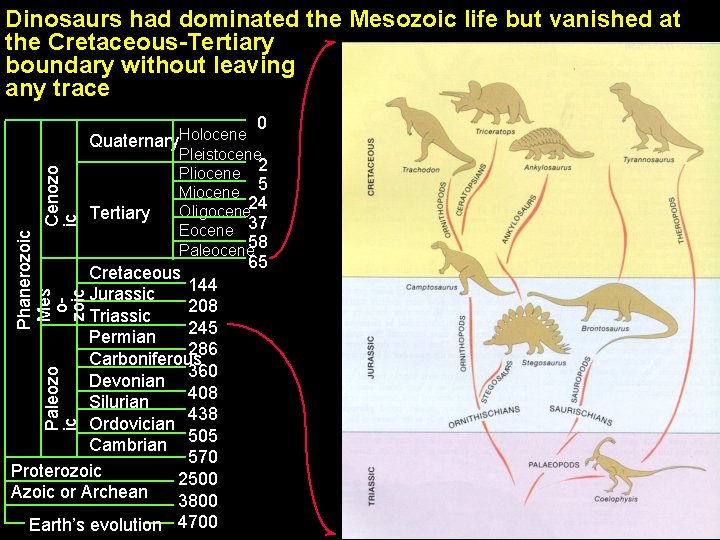
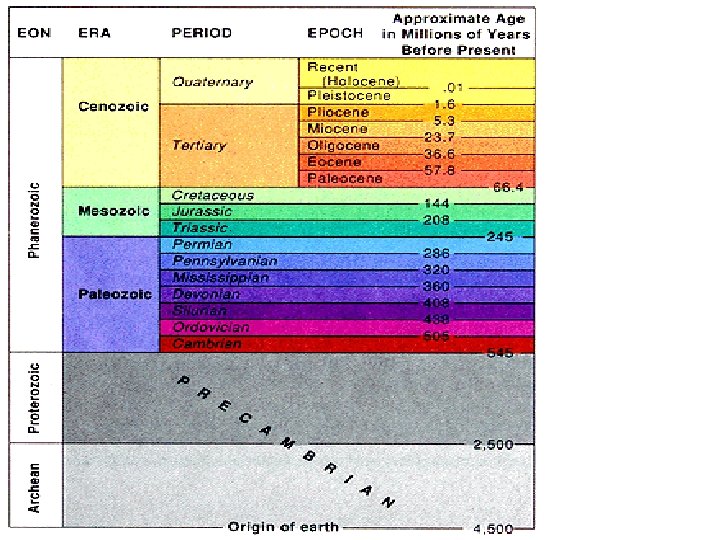
Dinosaurs had dominated the Mesozoic life but vanished at the Cretaceous-Tertiary boundary without leaving any trace Phanerozoic Mes Cenozo oic zoic 0 Quaternary. Holocene Pleistocene 2 Pliocene 5 Miocene Oligocene 24 Tertiary Eocene 37 Paleocene 58 Paleozo ic Cretaceous 144 Jurassic 208 Triassic 245 Permian 286 Carboniferous 360 Devonian 408 Silurian 438 Ordovician 505 Cambrian 570 Proterozoic 2500 Azoic or Archean 3800 Earth’s evolution 4700 65
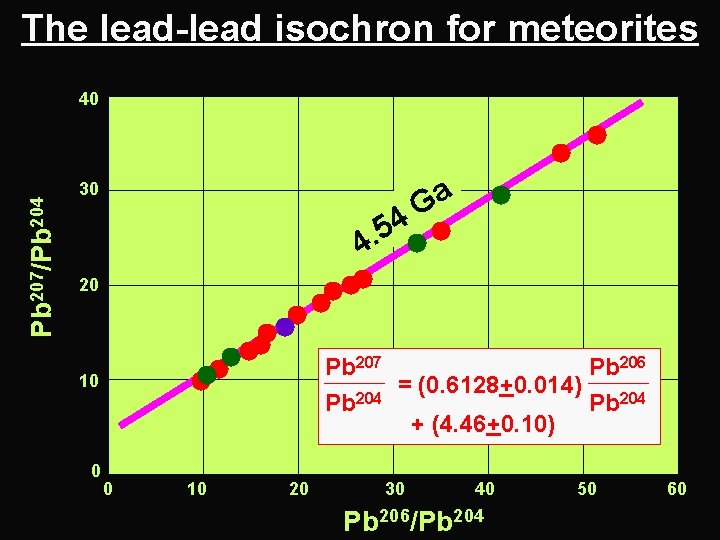
The lead-lead isochron for meteorites Pb 207/Pb 204 40 30 4 5 4. a G 20 Pb 207 Pb 206 = (0. 6128+0. 014) 204 Pb Pb 204 + (4. 46+0. 10) 10 0 0 10 20 30 40 Pb 206/Pb 204 50 60
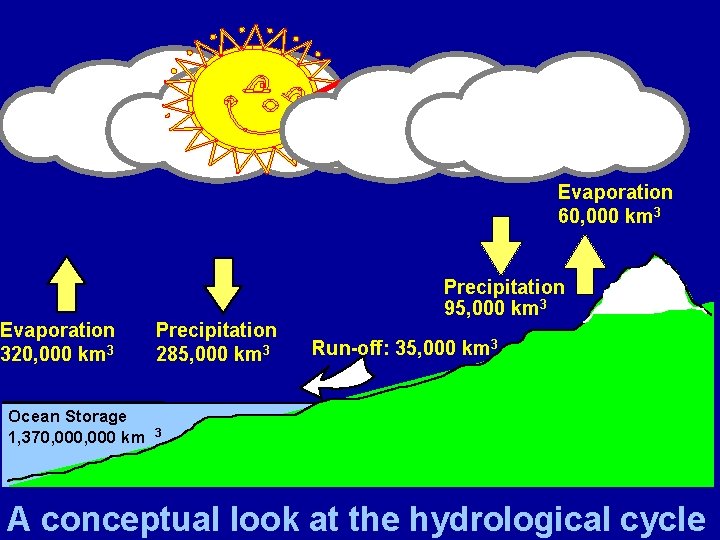
Evaporation 60, 000 km 3 Precipitation 95, 000 km 3 Evaporation 320, 000 km 3 Ocean Storage 1, 370, 000 km Precipitation 285, 000 km 3 Run-off: 35, 000 km 3 3 A conceptual look at the hydrological cycle
- Slides: 27