
RPC Programming with rpcgen Issues Protocol Definition File
- Slides: 28
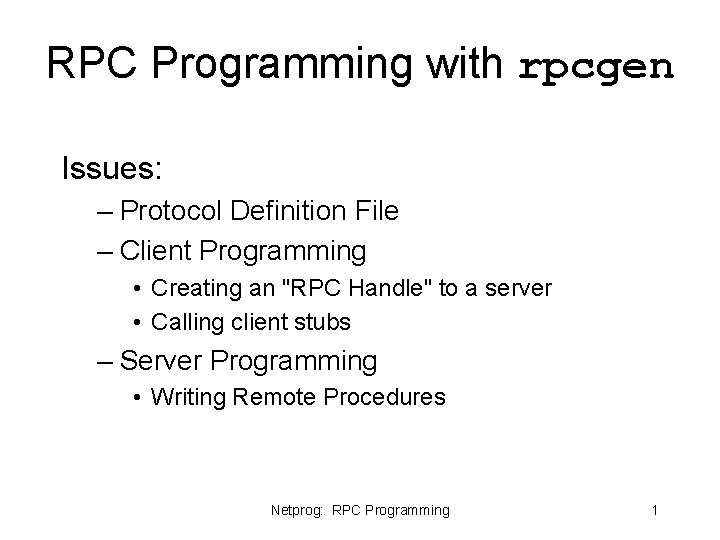
RPC Programming with rpcgen Issues: – Protocol Definition File – Client Programming • Creating an "RPC Handle" to a server • Calling client stubs – Server Programming • Writing Remote Procedures Netprog: RPC Programming 1
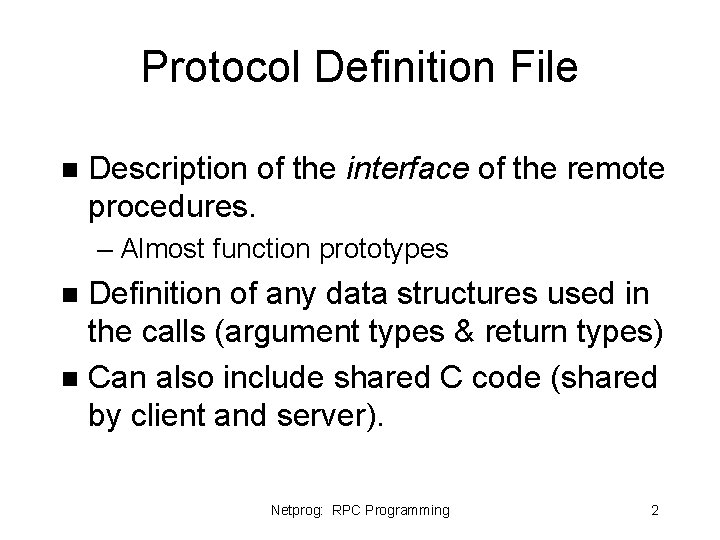
Protocol Definition File n Description of the interface of the remote procedures. – Almost function prototypes Definition of any data structures used in the calls (argument types & return types) n Can also include shared C code (shared by client and server). n Netprog: RPC Programming 2
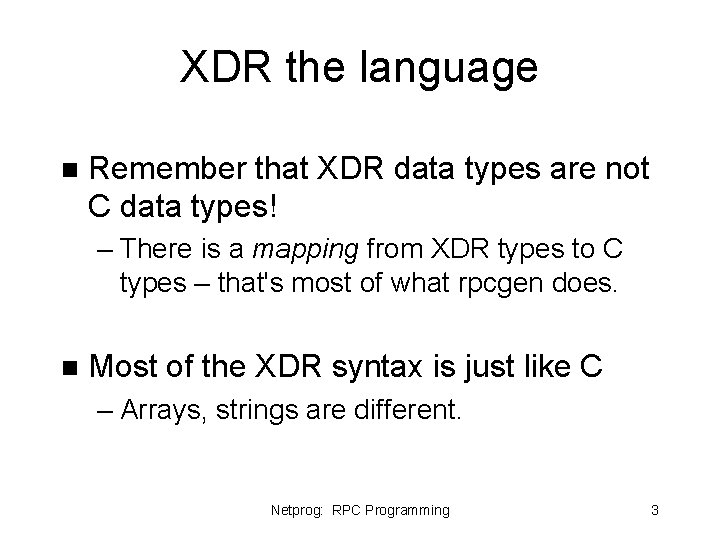
XDR the language n Remember that XDR data types are not C data types! – There is a mapping from XDR types to C types – that's most of what rpcgen does. n Most of the XDR syntax is just like C – Arrays, strings are different. Netprog: RPC Programming 3
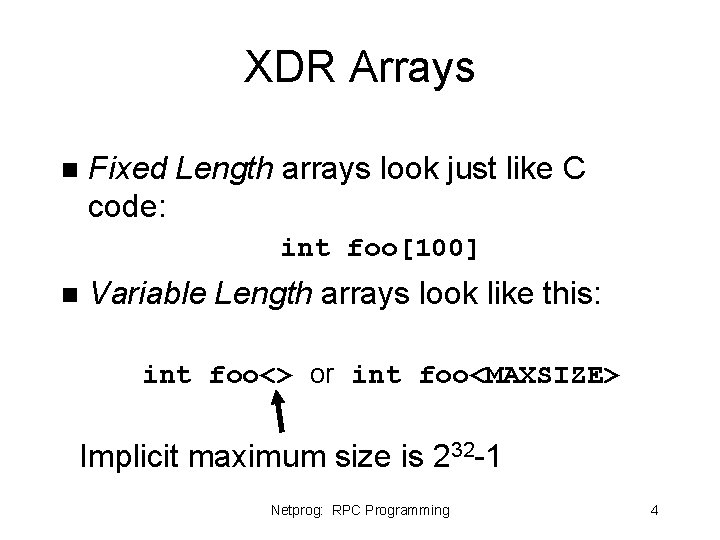
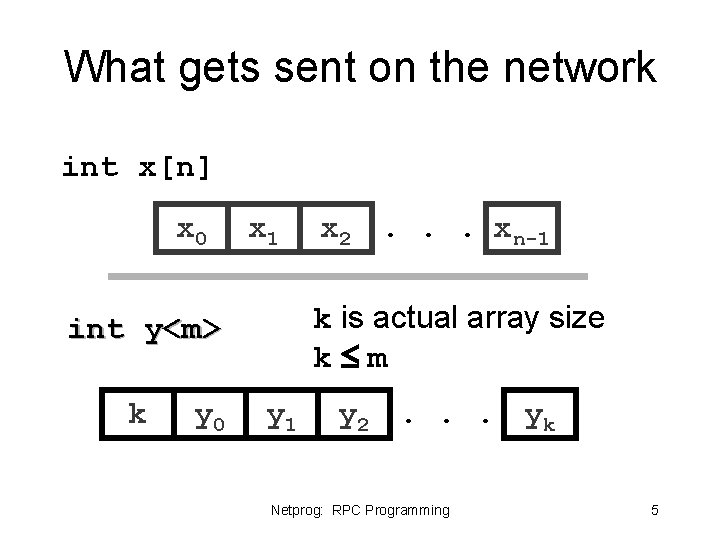
XDR Arrays n Fixed Length arrays look just like C code: int foo[100] n Variable Length arrays look like this: int foo<> or int foo<MAXSIZE> Implicit maximum size is 232 -1 Netprog: RPC Programming 4
What gets sent on the network int x[n] x 0 x 1 k is actual array size k m int y<m> k y 0 x 2. . . xn-1 y 2. . . yk Netprog: RPC Programming 5
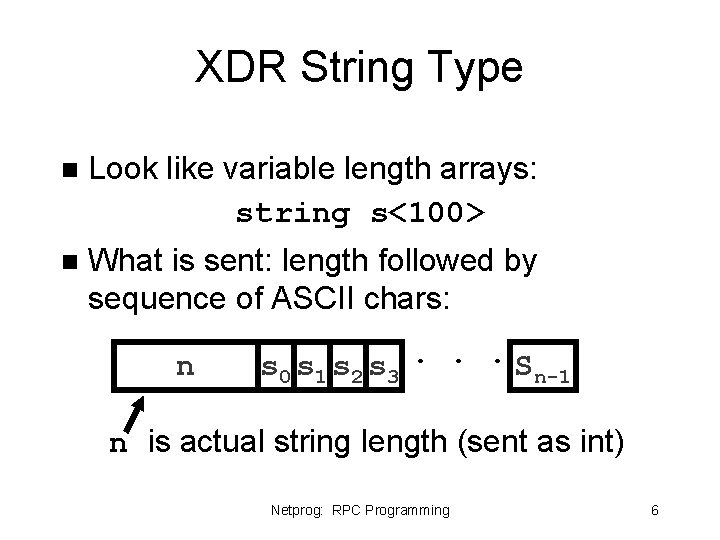
XDR String Type n Look like variable length arrays: string s<100> n What is sent: length followed by sequence of ASCII chars: n s 0 s 1 s 2 s 3. . . Sn-1 n is actual string length (sent as int) Netprog: RPC Programming 6
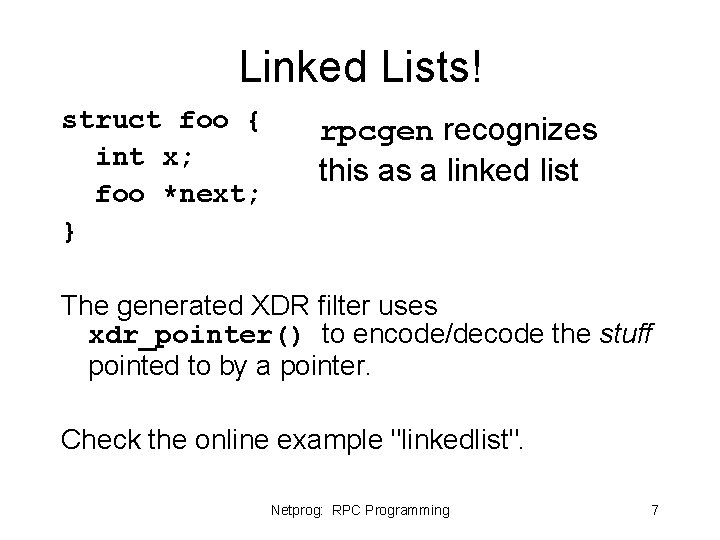
Linked Lists! struct foo { int x; foo *next; } rpcgen recognizes this as a linked list The generated XDR filter uses xdr_pointer() to encode/decode the stuff pointed to by a pointer. Check the online example "linkedlist". Netprog: RPC Programming 7
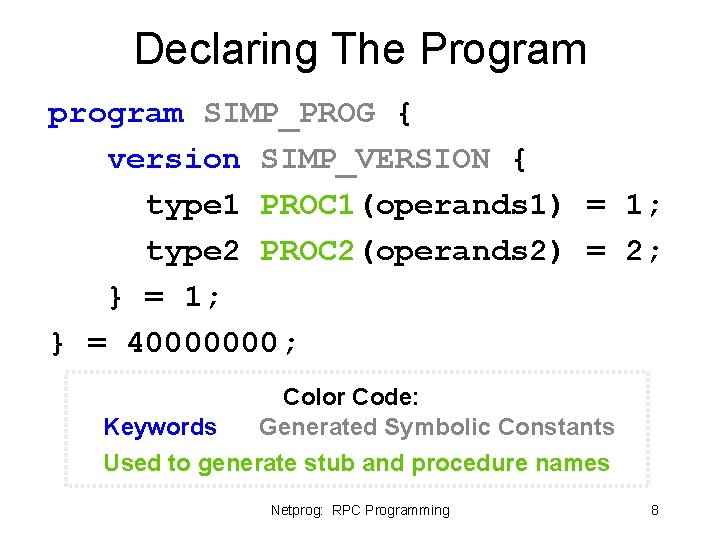
Declaring The Program program SIMP_PROG { version SIMP_VERSION { type 1 PROC 1(operands 1) = 1; type 2 PROC 2(operands 2) = 2; } = 1; } = 40000000; Color Code: Keywords Generated Symbolic Constants Used to generate stub and procedure names Netprog: RPC Programming 8
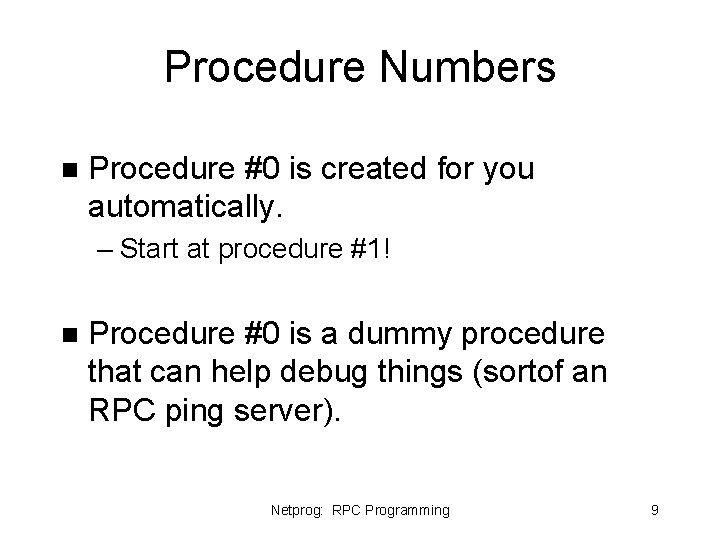
Procedure Numbers n Procedure #0 is created for you automatically. – Start at procedure #1! n Procedure #0 is a dummy procedure that can help debug things (sortof an RPC ping server). Netprog: RPC Programming 9
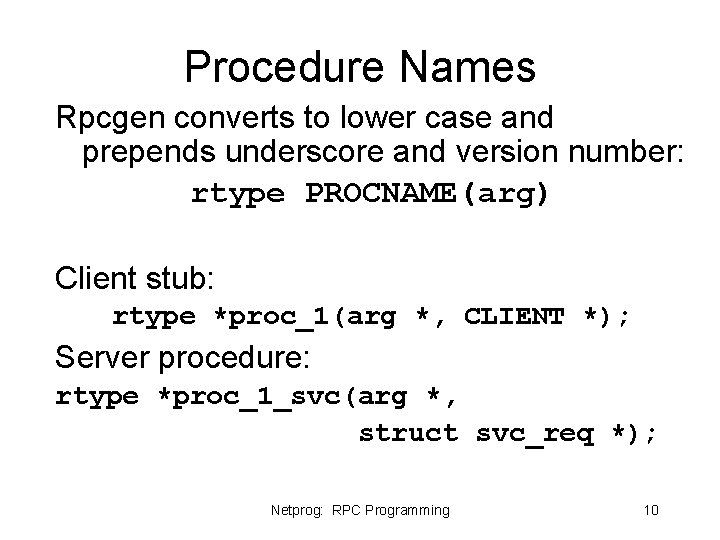
Procedure Names Rpcgen converts to lower case and prepends underscore and version number: rtype PROCNAME(arg) Client stub: rtype *proc_1(arg *, CLIENT *); Server procedure: rtype *proc_1_svc(arg *, struct svc_req *); Netprog: RPC Programming 10
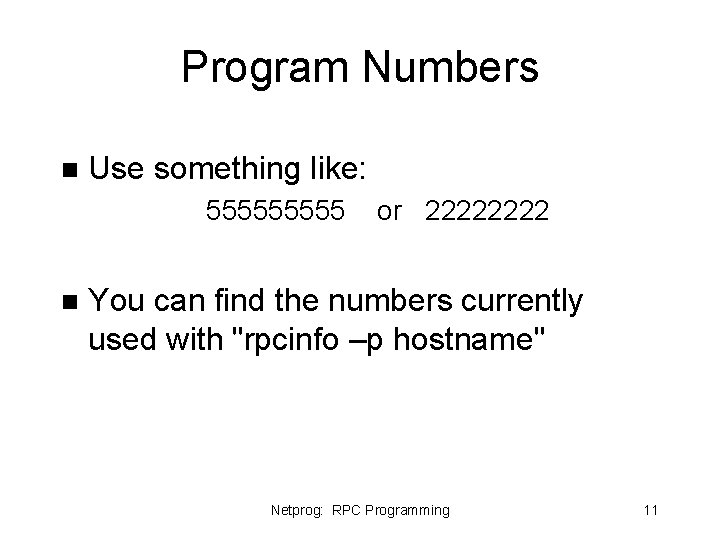
Program Numbers n Use something like: 55555 n or 2222 You can find the numbers currently used with "rpcinfo –p hostname" Netprog: RPC Programming 11
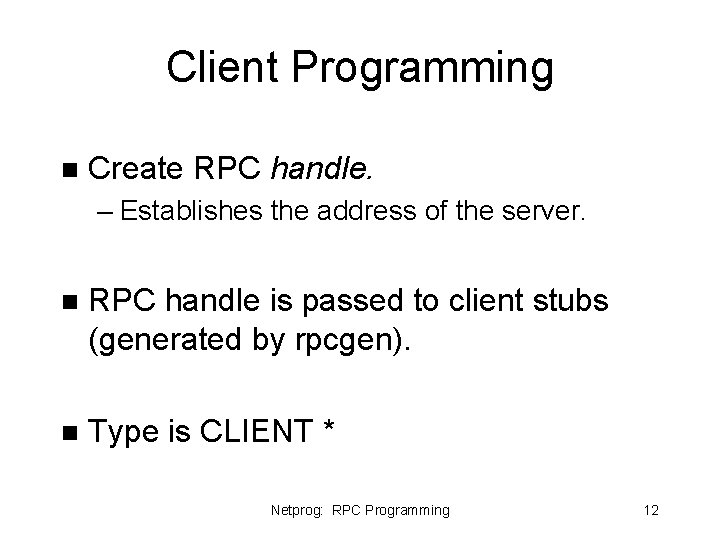
Client Programming n Create RPC handle. – Establishes the address of the server. n RPC handle is passed to client stubs (generated by rpcgen). n Type is CLIENT * Netprog: RPC Programming 12
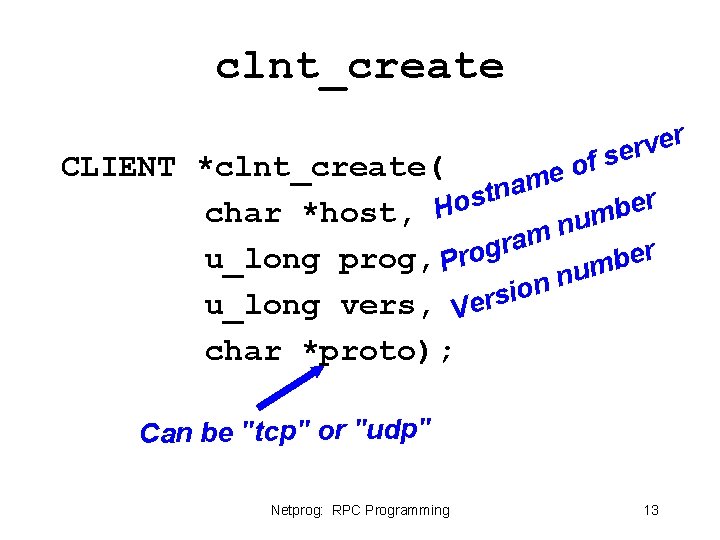
clnt_create r e v r se CLIENT *clnt_create( of e m a n t s r o e H b char *host, um n m a r g r e u_long prog, Pro b m u n n o i s u_long vers, Ver char *proto); Can be "tcp" or "udp" Netprog: RPC Programming 13
Calling Client Stubs n Remember: – Return value is a pointer to what you expect. – Argument is passed as a pointer. – If you are passing a string, you must pass a char** n When in doubt – look at the ". h" file generated by rpcgen Netprog: RPC Programming 14
Server Procedures Rpcgen writes most of the server. n You need to provide the actual remote procedures. n Look in the ". h" file for prototypes. n Run "rpcgen –C –Ss" to generate (empty) remote procedures! n Netprog: RPC Programming 15
Server Function Names n Old Style (includes AIX): Remote procedure FOO, version 1 is named foo_1() n New Style (includes Sun, BSD, Linux): Remote procedure FOO, version 1 is named foo_1_svc() Netprog: RPC Programming 16
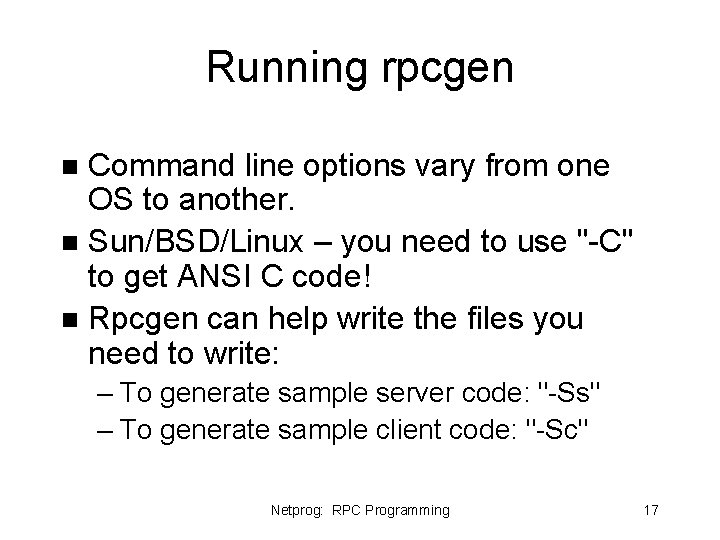
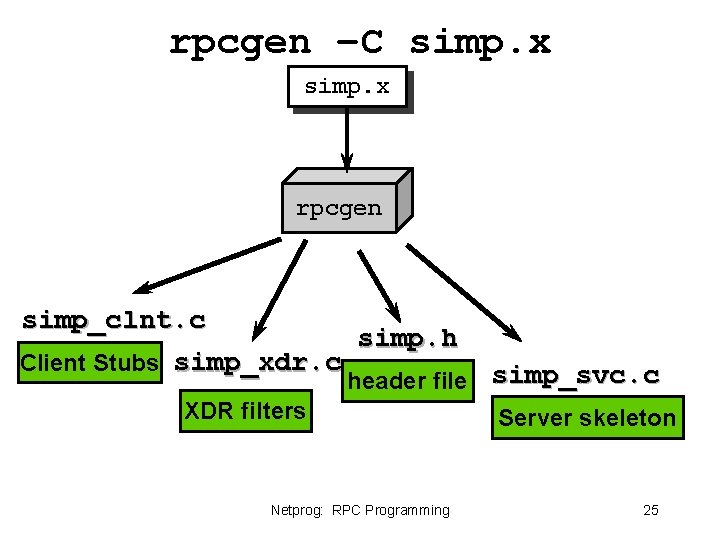
Running rpcgen Command line options vary from one OS to another. n Sun/BSD/Linux – you need to use "-C" to get ANSI C code! n Rpcgen can help write the files you need to write: n – To generate sample server code: "-Ss" – To generate sample client code: "-Sc" Netprog: RPC Programming 17
Other porting issues n Shared header file generated by rpcgen may have: #include <rpc/rpc. h> n Or Not! Netprog: RPC Programming 18
RPC without rpcgen n Can do asynchronous RPC – Callbacks – Single process is both client and server. Write your own dispatcher (and provide concurrency) n Can establish control over many network parameters: protocols, timeouts, resends, etc. n Netprog: RPC Programming 19
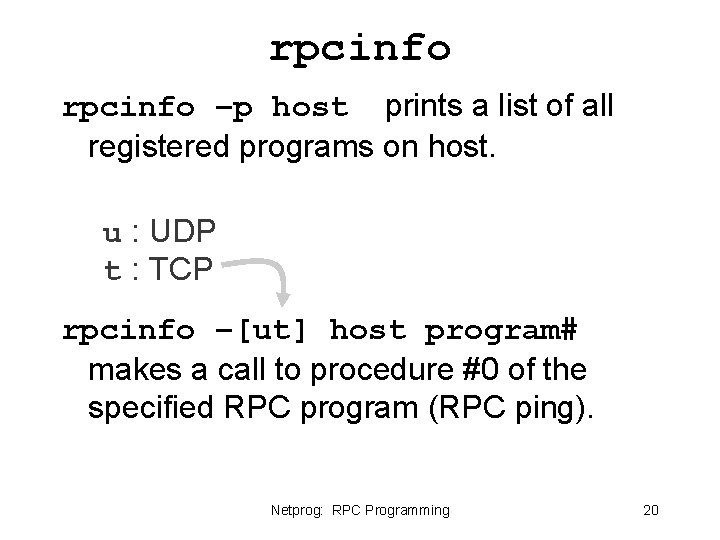
rpcinfo –p host prints a list of all registered programs on host. u : UDP t : TCP rpcinfo –[ut] host program# makes a call to procedure #0 of the specified RPC program (RPC ping). Netprog: RPC Programming 20
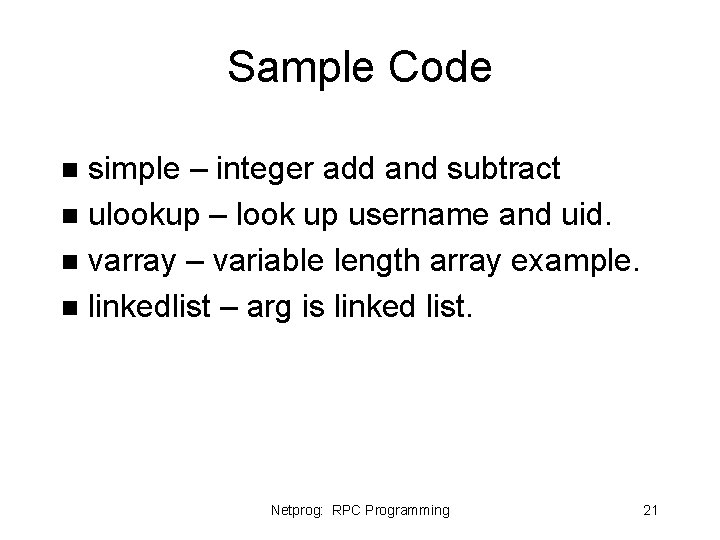
Sample Code simple – integer add and subtract n ulookup – look up username and uid. n varray – variable length array example. n linkedlist – arg is linked list. n Netprog: RPC Programming 21
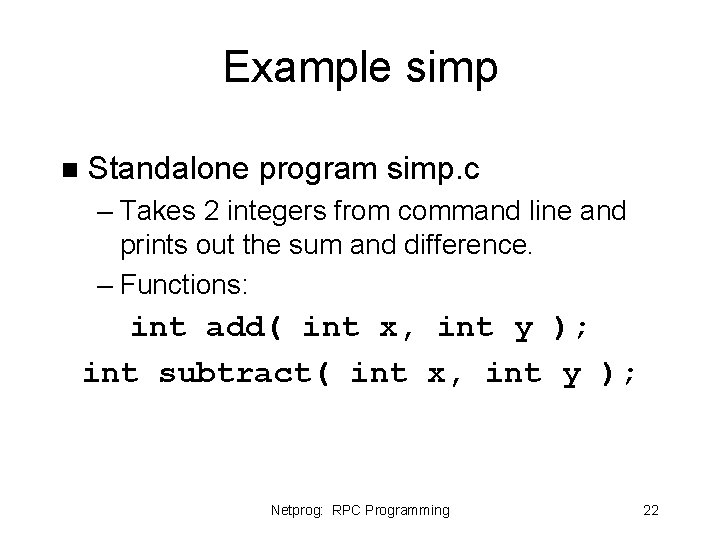
Example simp n Standalone program simp. c – Takes 2 integers from command line and prints out the sum and difference. – Functions: int add( int x, int y ); int subtract( int x, int y ); Netprog: RPC Programming 22
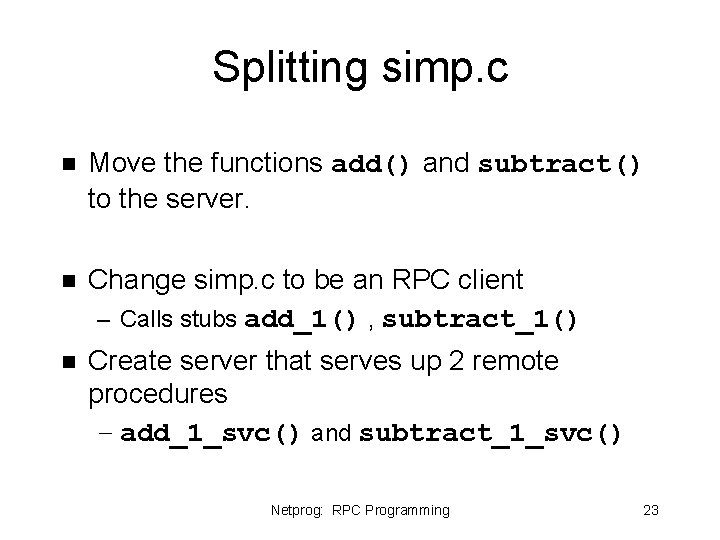
Splitting simp. c n Move the functions add() and subtract() to the server. n Change simp. c to be an RPC client – Calls stubs add_1() , subtract_1() n Create server that serves up 2 remote procedures – add_1_svc() and subtract_1_svc() Netprog: RPC Programming 23
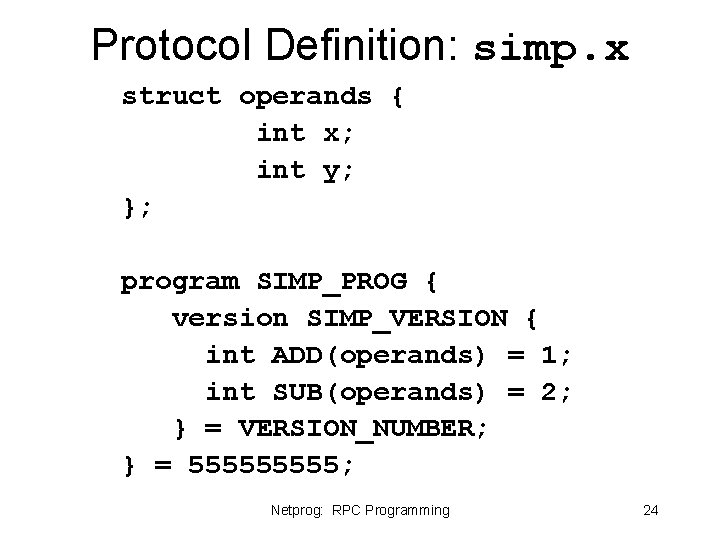
Protocol Definition: simp. x struct operands { int x; int y; }; program SIMP_PROG { version SIMP_VERSION { int ADD(operands) = 1; int SUB(operands) = 2; } = VERSION_NUMBER; } = 55555; Netprog: RPC Programming 24
rpcgen –C simp. x rpcgen simp_clnt. c simp. h Client Stubs simp_xdr. c header file XDR filters Netprog: RPC Programming simp_svc. c Server skeleton 25
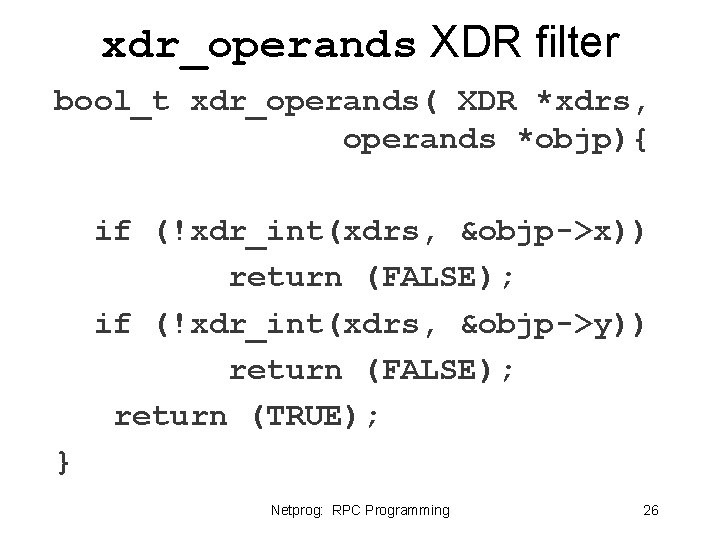
xdr_operands XDR filter bool_t xdr_operands( XDR *xdrs, operands *objp){ if (!xdr_int(xdrs, &objp->x)) return (FALSE); if (!xdr_int(xdrs, &objp->y)) return (FALSE); return (TRUE); } Netprog: RPC Programming 26
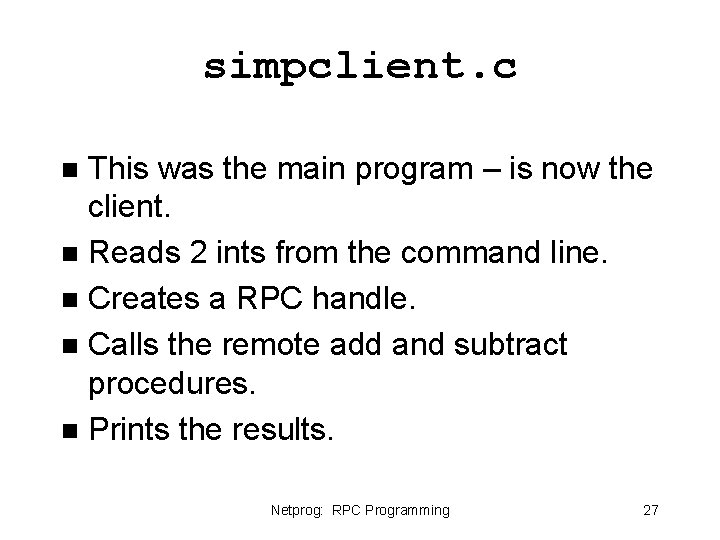
simpclient. c This was the main program – is now the client. n Reads 2 ints from the command line. n Creates a RPC handle. n Calls the remote add and subtract procedures. n Prints the results. n Netprog: RPC Programming 27
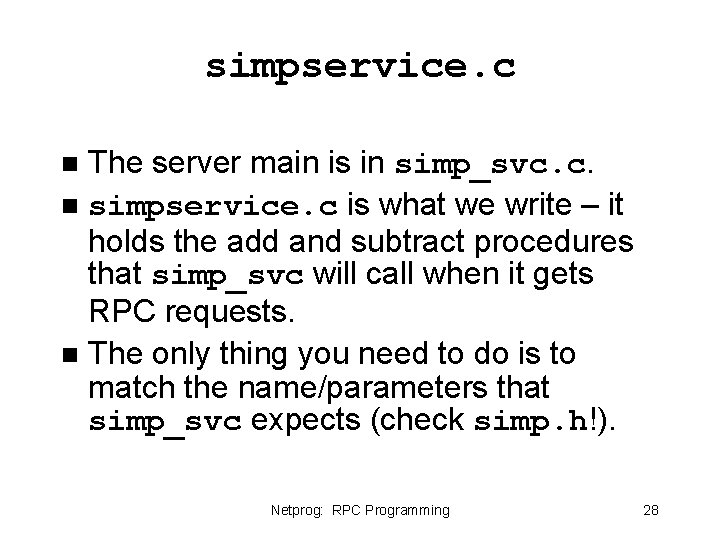
simpservice. c The server main is in simp_svc. c. n simpservice. c is what we write – it holds the add and subtract procedures that simp_svc will call when it gets RPC requests. n The only thing you need to do is to match the name/parameters that simp_svc expects (check simp. h!). n Netprog: RPC Programming 28