
RPC 2010 9 12 February 2010 SPATIAL RESOLUTION
RPC 2010 9 -12 February 2010 SPATIAL RESOLUTION OF HUMAN 3 D RPC-PET SYSTEM M. Couceiro 1, 2, P. Crespo 1, 2, L. Mendes 3, 4, N. Ferreira 3, 4, R. Ferreira Marques 1, 5, P. Fonte 1, 2 1 LIP, Laboratório de Instrumentação e Física Experimental de Partículas, Coimbra, Portugal 2 ISEC, Instituto Superior de Engenharia de Coimbra, Portugal 3 IBILI-FMUC, Instituto Biomédico de Investigação da Luz e Imagem, Faculdade de Medicina da Universidade de Coimbra, Portugal 4 ICNAS, Instituto de Ciências Nucleares Aplicadas à Saúde, Universidade de Coimbra, Portugal 5 Departamento de Física da Universidade de Coimbra, Portugal
RPC 2010 9 -12 February 2010 SPATIAL RESOLUTION OF HUMAN 3 D RPC-PET SYSTEM Summary 1. Introduction to RPC-PET a. Brief PET overview b. RPC-PET vs. crystal PET 2. Spatial Resolution of Human Single-Bed RPC-PET a. Simulation Setup and Methods b. Characterization of Image Spatial Resolution in RPC-PET c. Results 3. Conclusions, and Acknowledgments M. Couceiro
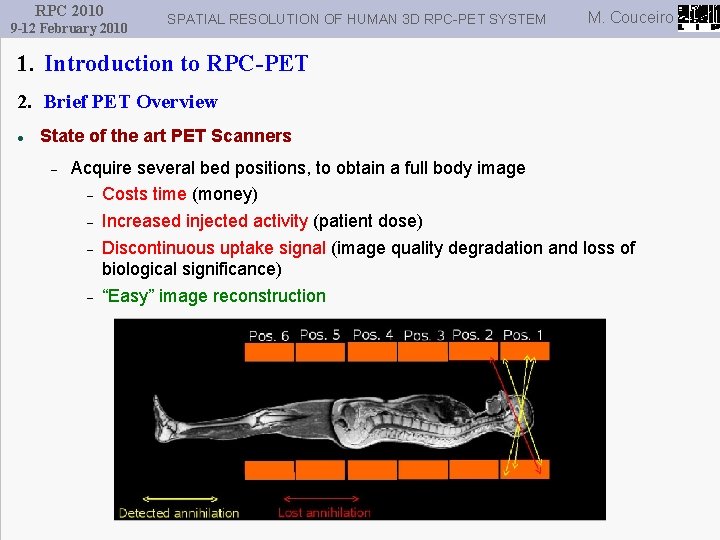
RPC 2010 9 -12 February 2010 SPATIAL RESOLUTION OF HUMAN 3 D RPC-PET SYSTEM M. Couceiro 1. Introduction to RPC-PET 2. Brief PET Overview State of the art PET Scanners Acquire several bed positions, to obtain a full body image Costs time (money) Increased injected activity (patient dose) Discontinuous uptake signal (image quality degradation and loss of biological significance) “Easy” image reconstruction
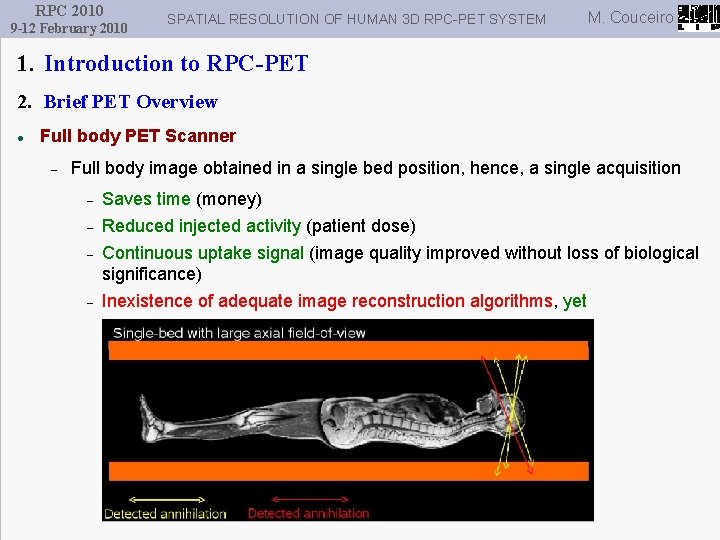
RPC 2010 9 -12 February 2010 SPATIAL RESOLUTION OF HUMAN 3 D RPC-PET SYSTEM M. Couceiro 1. Introduction to RPC-PET 2. Brief PET Overview Full body PET Scanner Full body image obtained in a single bed position, hence, a single acquisition Saves time (money) Reduced injected activity (patient dose) Continuous uptake signal (image quality improved without loss of biological significance) Inexistence of adequate image reconstruction algorithms, yet
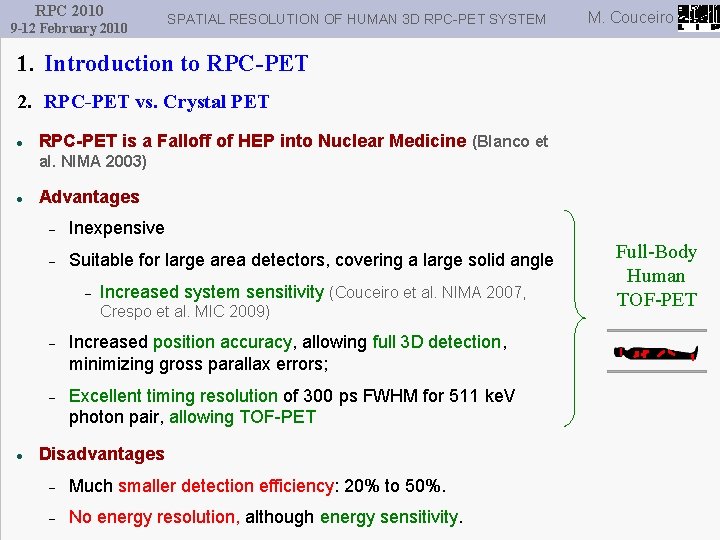
RPC 2010 9 -12 February 2010 SPATIAL RESOLUTION OF HUMAN 3 D RPC-PET SYSTEM M. Couceiro 1. Introduction to RPC-PET 2. RPC-PET vs. Crystal PET RPC-PET is a Falloff of HEP into Nuclear Medicine (Blanco et al. NIMA 2003) Advantages Inexpensive Suitable for large area detectors, covering a large solid angle Increased system sensitivity (Couceiro et al. NIMA 2007, Crespo et al. MIC 2009) Increased position accuracy, allowing full 3 D detection, minimizing gross parallax errors; Excellent timing resolution of 300 ps FWHM for 511 ke. V photon pair, allowing TOF-PET Disadvantages Much smaller detection efficiency: 20% to 50%. No energy resolution, although energy sensitivity. Full-Body Human TOF-PET
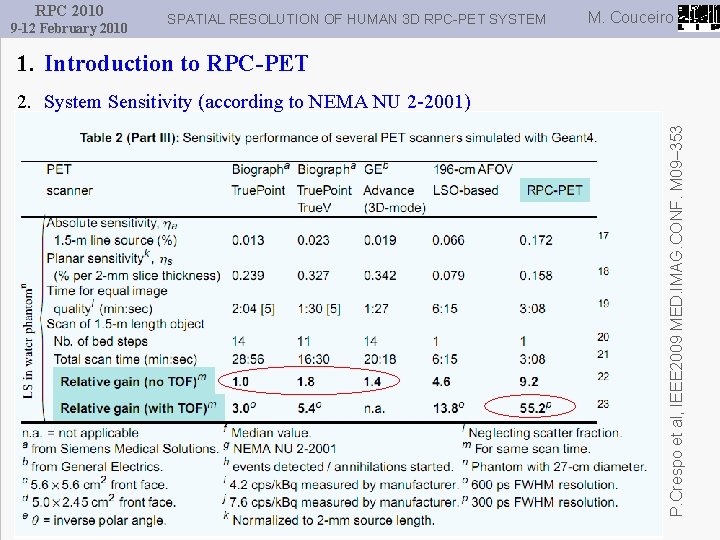
RPC 2010 9 -12 February 2010 SPATIAL RESOLUTION OF HUMAN 3 D RPC-PET SYSTEM M. Couceiro 1. Introduction to RPC-PET P. Crespo et al, IEEE 2009 MED. IMAG. CONF. M 09– 353 2. System Sensitivity (according to NEMA NU 2 -2001)

RPC 2010 9 -12 February 2010 SPATIAL RESOLUTION OF HUMAN 3 D RPC-PET SYSTEM M. Couceiro 2. Spatial Resolution of Human Single-Bed RPC-PET Physical and instrumental effects considered Source Positron range Photon pair non-collinearity Instrumental Photon scatter in detector Compton electron propagation in glass Compton electron propagation in gap Readout granularity
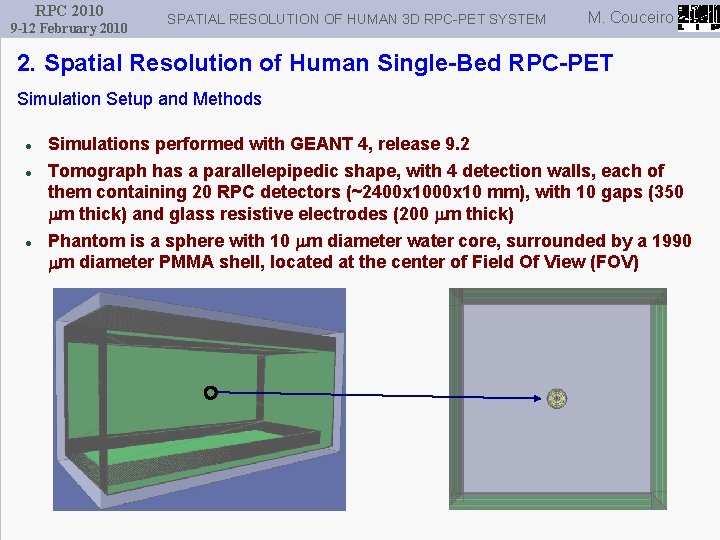
RPC 2010 9 -12 February 2010 SPATIAL RESOLUTION OF HUMAN 3 D RPC-PET SYSTEM M. Couceiro 2. Spatial Resolution of Human Single-Bed RPC-PET Simulation Setup and Methods Simulations performed with GEANT 4, release 9. 2 Tomograph has a parallelepipedic shape, with 4 detection walls, each of them containing 20 RPC detectors (~2400 x 10 mm), with 10 gaps (350 m thick) and glass resistive electrodes (200 m thick) Phantom is a sphere with 10 m diameter water core, surrounded by a 1990 m diameter PMMA shell, located at the center of Field Of View (FOV)
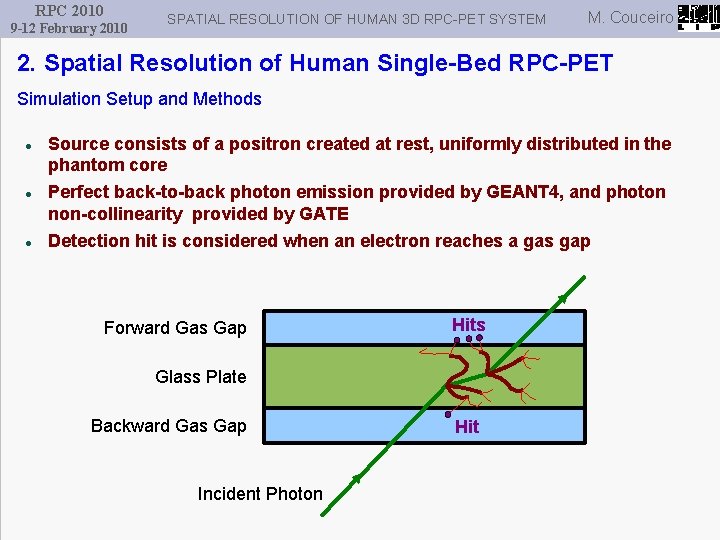
RPC 2010 9 -12 February 2010 SPATIAL RESOLUTION OF HUMAN 3 D RPC-PET SYSTEM M. Couceiro 2. Spatial Resolution of Human Single-Bed RPC-PET Simulation Setup and Methods Source consists of a positron created at rest, uniformly distributed in the phantom core Perfect back-to-back photon emission provided by GEANT 4, and photon non-collinearity provided by GATE Detection hit is considered when an electron reaches a gas gap Forward Gas Gap Hits Glass Plate Backward Gas Gap Incident Photon Hit
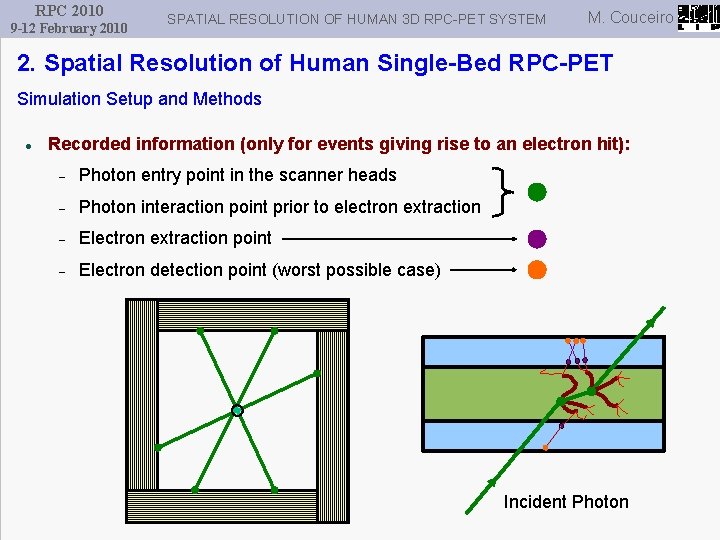
RPC 2010 9 -12 February 2010 SPATIAL RESOLUTION OF HUMAN 3 D RPC-PET SYSTEM M. Couceiro 2. Spatial Resolution of Human Single-Bed RPC-PET Simulation Setup and Methods Recorded information (only for events giving rise to an electron hit): Photon entry point in the scanner heads Photon interaction point prior to electron extraction Electron extraction point Electron detection point (worst possible case) Incident Photon
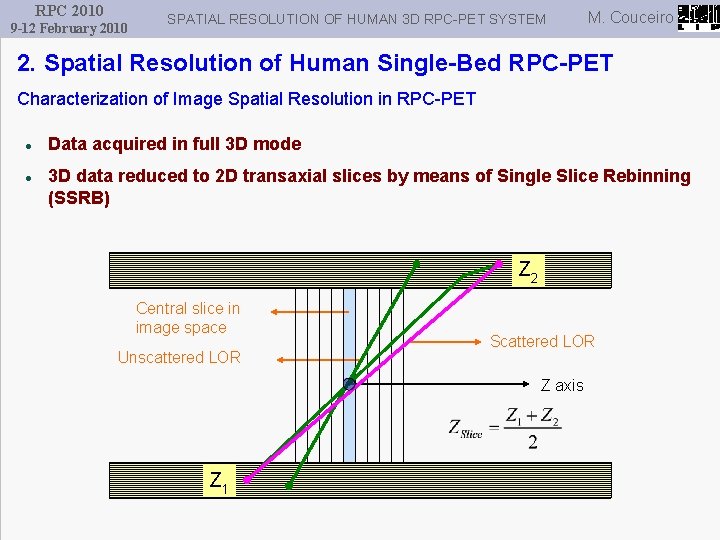
RPC 2010 9 -12 February 2010 SPATIAL RESOLUTION OF HUMAN 3 D RPC-PET SYSTEM M. Couceiro 2. Spatial Resolution of Human Single-Bed RPC-PET Characterization of Image Spatial Resolution in RPC-PET Data acquired in full 3 D mode 3 D data reduced to 2 D transaxial slices by means of Single Slice Rebinning (SSRB) Z 2 Central slice in image space Unscattered LOR Scattered LOR Z axis Z 1
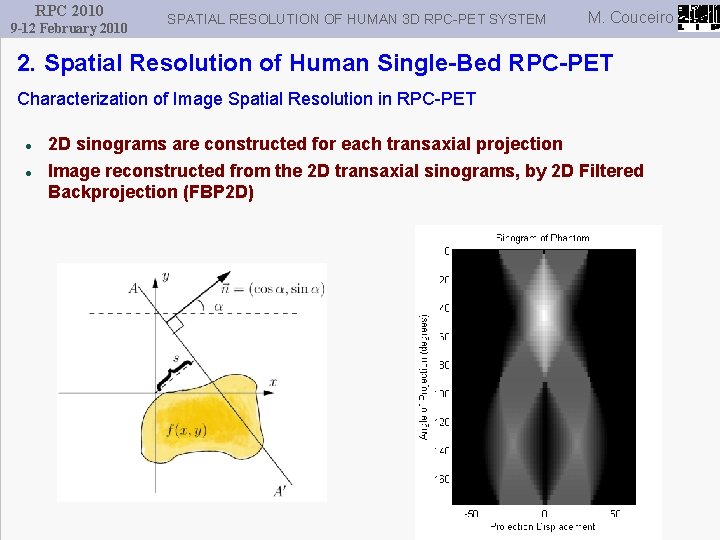
RPC 2010 9 -12 February 2010 SPATIAL RESOLUTION OF HUMAN 3 D RPC-PET SYSTEM M. Couceiro 2. Spatial Resolution of Human Single-Bed RPC-PET Characterization of Image Spatial Resolution in RPC-PET 2 D sinograms are constructed for each transaxial projection Image reconstructed from the 2 D transaxial sinograms, by 2 D Filtered Backprojection (FBP 2 D)
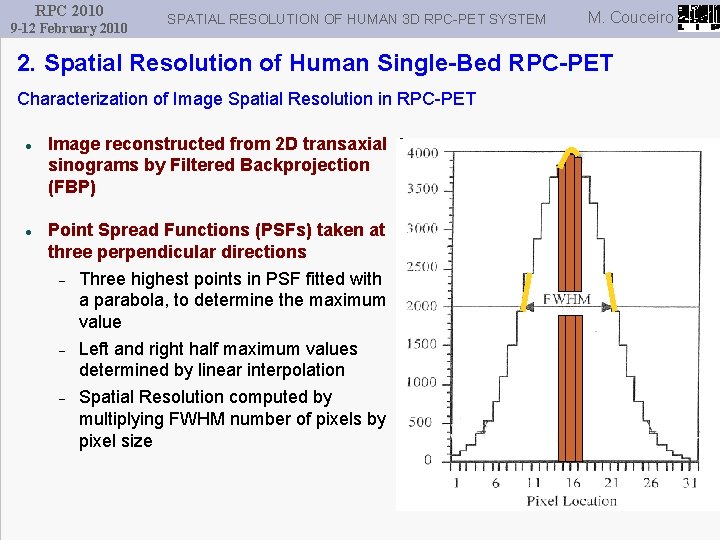
RPC 2010 9 -12 February 2010 SPATIAL RESOLUTION OF HUMAN 3 D RPC-PET SYSTEM M. Couceiro 2. Spatial Resolution of Human Single-Bed RPC-PET Characterization of Image Spatial Resolution in RPC-PET Image reconstructed from 2 D transaxial sinograms by Filtered Backprojection (FBP) Point Spread Functions (PSFs) taken at three perpendicular directions Three highest points in PSF fitted with a parabola, to determine the maximum value Left and right half maximum values determined by linear interpolation Spatial Resolution computed by multiplying FWHM number of pixels by pixel size
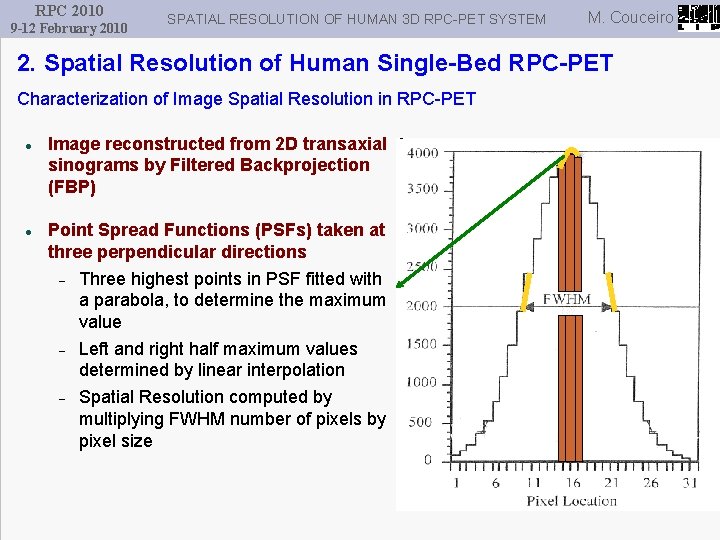
RPC 2010 9 -12 February 2010 SPATIAL RESOLUTION OF HUMAN 3 D RPC-PET SYSTEM M. Couceiro 2. Spatial Resolution of Human Single-Bed RPC-PET Characterization of Image Spatial Resolution in RPC-PET Image reconstructed from 2 D transaxial sinograms by Filtered Backprojection (FBP) Point Spread Functions (PSFs) taken at three perpendicular directions Three highest points in PSF fitted with a parabola, to determine the maximum value Left and right half maximum values determined by linear interpolation Spatial Resolution computed by multiplying FWHM number of pixels by pixel size
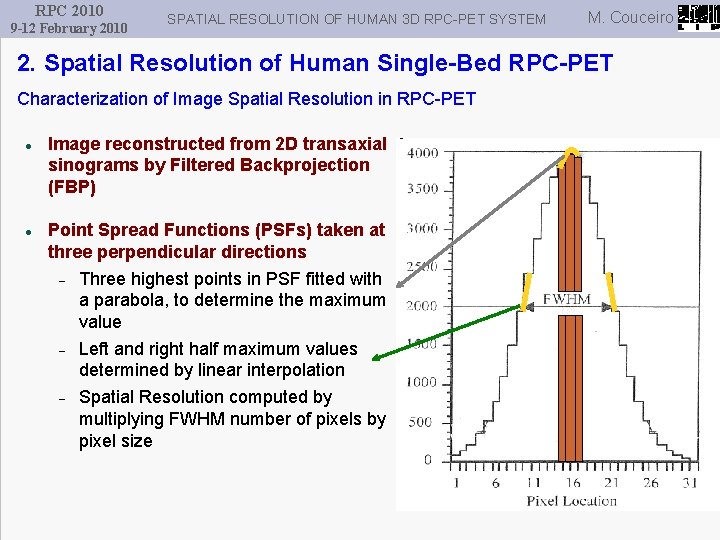
RPC 2010 9 -12 February 2010 SPATIAL RESOLUTION OF HUMAN 3 D RPC-PET SYSTEM M. Couceiro 2. Spatial Resolution of Human Single-Bed RPC-PET Characterization of Image Spatial Resolution in RPC-PET Image reconstructed from 2 D transaxial sinograms by Filtered Backprojection (FBP) Point Spread Functions (PSFs) taken at three perpendicular directions Three highest points in PSF fitted with a parabola, to determine the maximum value Left and right half maximum values determined by linear interpolation Spatial Resolution computed by multiplying FWHM number of pixels by pixel size
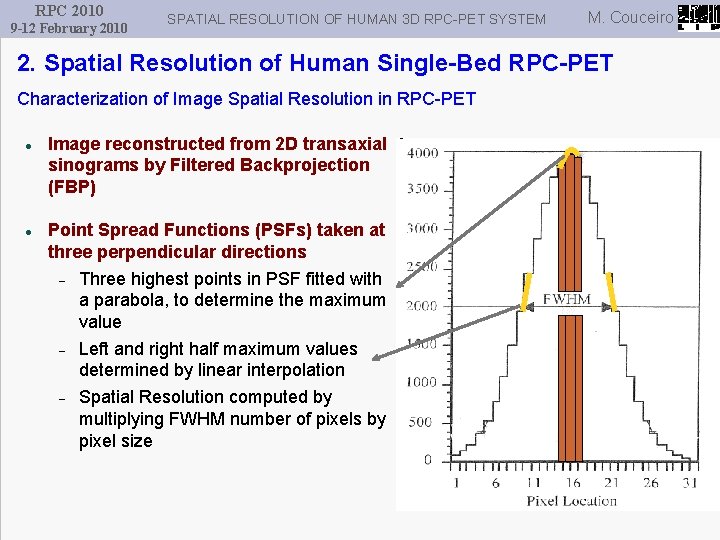
RPC 2010 9 -12 February 2010 SPATIAL RESOLUTION OF HUMAN 3 D RPC-PET SYSTEM M. Couceiro 2. Spatial Resolution of Human Single-Bed RPC-PET Characterization of Image Spatial Resolution in RPC-PET Image reconstructed from 2 D transaxial sinograms by Filtered Backprojection (FBP) Point Spread Functions (PSFs) taken at three perpendicular directions Three highest points in PSF fitted with a parabola, to determine the maximum value Left and right half maximum values determined by linear interpolation Spatial Resolution computed by multiplying FWHM number of pixels by pixel size
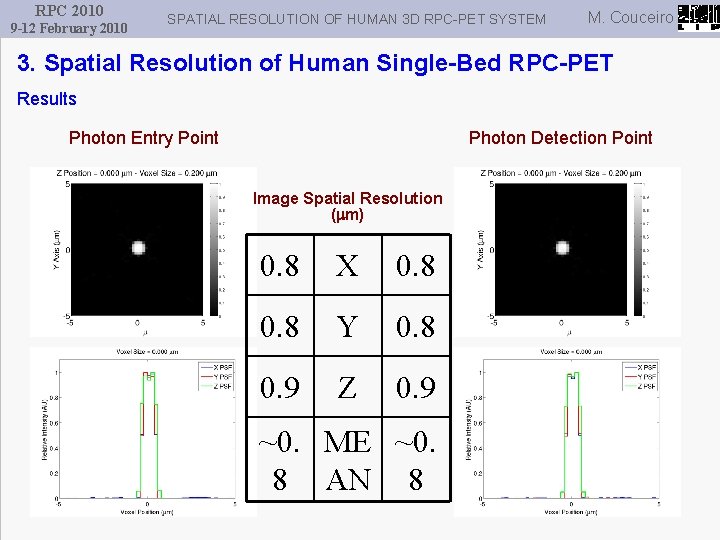
RPC 2010 9 -12 February 2010 SPATIAL RESOLUTION OF HUMAN 3 D RPC-PET SYSTEM M. Couceiro 3. Spatial Resolution of Human Single-Bed RPC-PET Results Photon Entry Point Photon Detection Point Image Spatial Resolution ( m) 0. 8 X 0. 8 Y 0. 8 0. 9 Z 0. 9 ~0. ME ~0. 8 AN 8
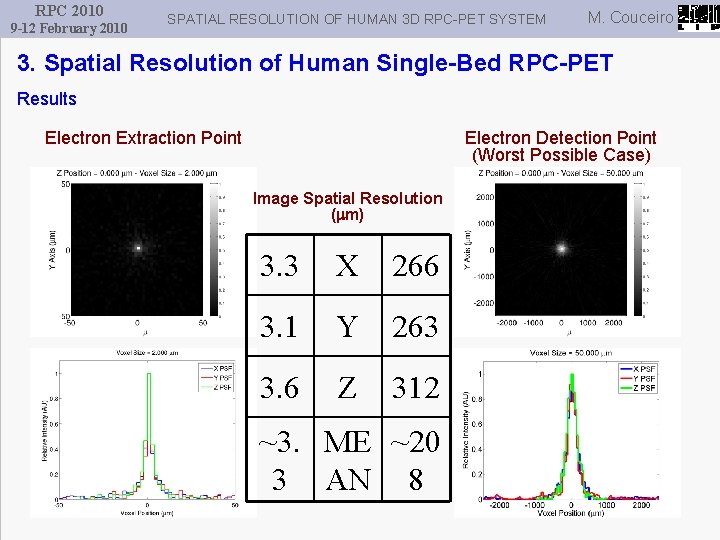
RPC 2010 9 -12 February 2010 SPATIAL RESOLUTION OF HUMAN 3 D RPC-PET SYSTEM M. Couceiro 3. Spatial Resolution of Human Single-Bed RPC-PET Results Electron Extraction Point Electron Detection Point (Worst Possible Case) Image Spatial Resolution ( m) 3. 3 X 266 3. 1 Y 263 3. 6 Z 312 ~3. ME ~20 3 AN 8
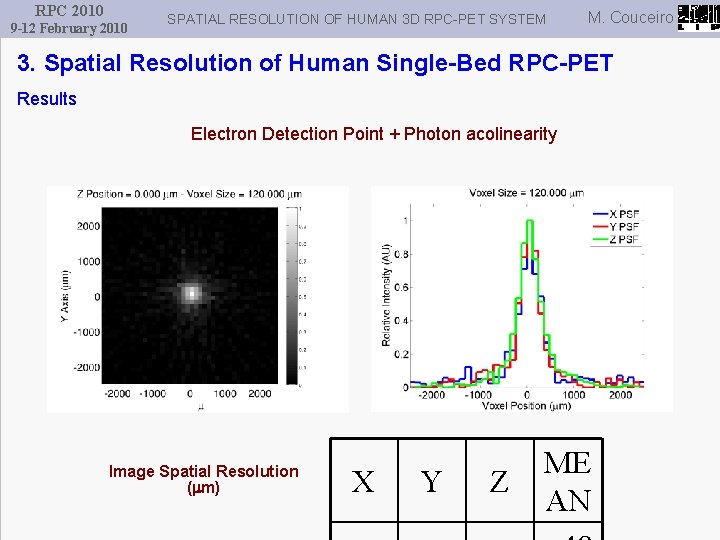
RPC 2010 9 -12 February 2010 SPATIAL RESOLUTION OF HUMAN 3 D RPC-PET SYSTEM M. Couceiro 3. Spatial Resolution of Human Single-Bed RPC-PET Results Electron Detection Point + Photon acolinearity Image Spatial Resolution ( m) X Y Z ME AN
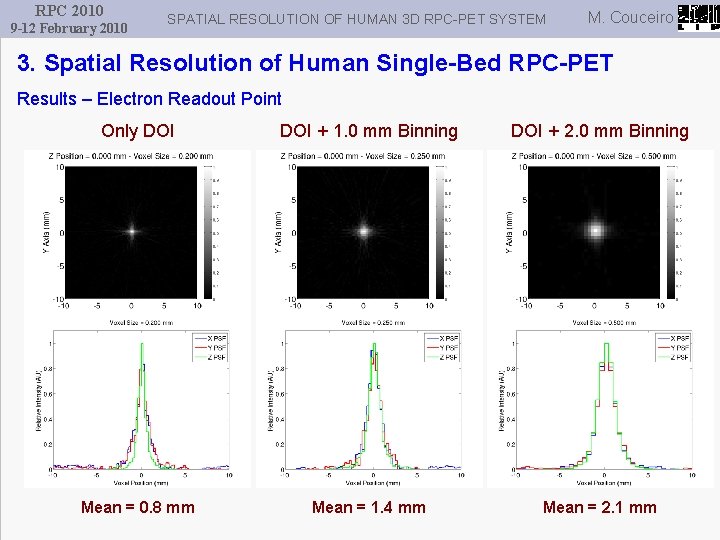
RPC 2010 9 -12 February 2010 SPATIAL RESOLUTION OF HUMAN 3 D RPC-PET SYSTEM M. Couceiro 3. Spatial Resolution of Human Single-Bed RPC-PET Results – Electron Readout Point Only DOI + 1. 0 mm Binning DOI + 2. 0 mm Binning Mean = 0. 8 mm Mean = 1. 4 mm Mean = 2. 1 mm
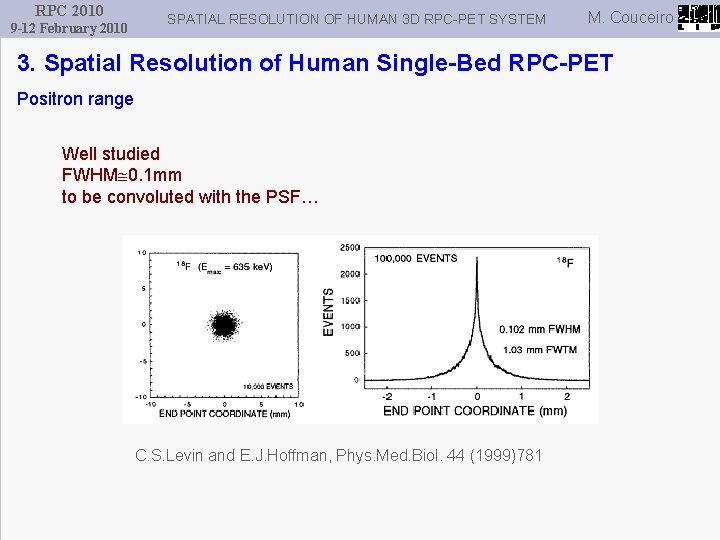
RPC 2010 9 -12 February 2010 SPATIAL RESOLUTION OF HUMAN 3 D RPC-PET SYSTEM M. Couceiro 3. Spatial Resolution of Human Single-Bed RPC-PET Positron range Well studied FWHM 0. 1 mm to be convoluted with the PSF… C. S. Levin and E. J. Hoffman, Phys. Med. Biol. 44 (1999)781
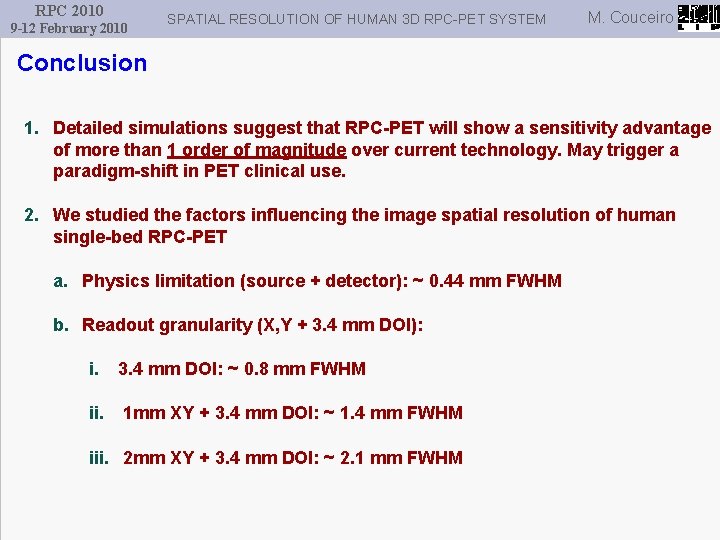
RPC 2010 9 -12 February 2010 SPATIAL RESOLUTION OF HUMAN 3 D RPC-PET SYSTEM M. Couceiro Conclusion 1. Detailed simulations suggest that RPC-PET will show a sensitivity advantage of more than 1 order of magnitude over current technology. May trigger a paradigm-shift in PET clinical use. 2. We studied the factors influencing the image spatial resolution of human single-bed RPC-PET a. Physics limitation (source + detector): ~ 0. 44 mm FWHM b. Readout granularity (X, Y + 3. 4 mm DOI): i. 3. 4 mm DOI: ~ 0. 8 mm FWHM ii. 1 mm XY + 3. 4 mm DOI: ~ 1. 4 mm FWHM iii. 2 mm XY + 3. 4 mm DOI: ~ 2. 1 mm FWHM

RPC 2010 9 -12 February 2010 SPATIAL RESOLUTION OF HUMAN 3 D RPC-PET SYSTEM M. Couceiro Acknowledgments • Portuguese Foundation for Science and Technology • Advanced Computation Laboratory of the University of Coimbra
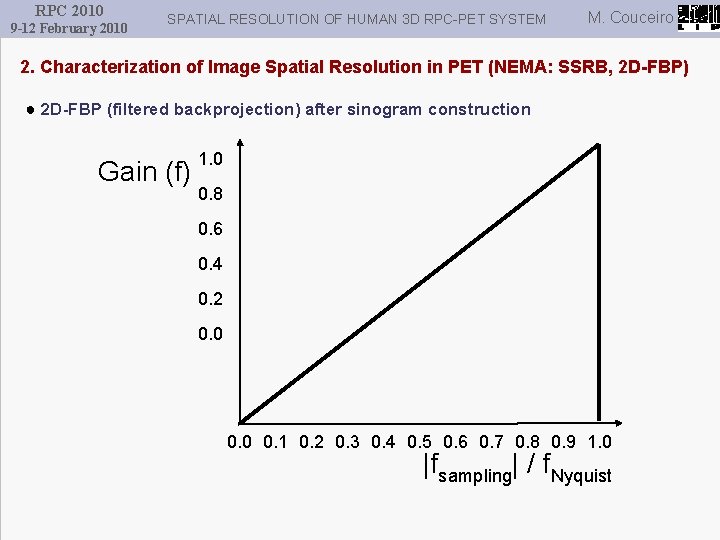
RPC 2010 9 -12 February 2010 SPATIAL RESOLUTION OF HUMAN 3 D RPC-PET SYSTEM M. Couceiro 2. Characterization of Image Spatial Resolution in PET (NEMA: SSRB, 2 D-FBP) ● 2 D-FBP (filtered backprojection) after sinogram construction Gain (f) 1. 0 0. 8 0. 6 0. 4 0. 2 0. 0 0. 1 0. 2 0. 3 0. 4 0. 5 0. 6 0. 7 0. 8 0. 9 1. 0 |fsampling| / f. Nyquist
- Slides: 24