
Royal Oldham Hospital Emergency Medicine Induction Programme Fever

- Slides: 24
Royal Oldham Hospital Emergency Medicine Induction Programme Fever in paediatric patients (hot kids)
Aims n Structured examination of the febrile child n To understand the significance of fever in the infant n Examination and basic management of a child with fever n To revise the differential diagnosis of a baby with fever
What is a fever? n Fever is defined as a temperature > 380 C n Any high temperature noted by an adult must be taken seriously n n even at home Has the child had Anti-pyretics n Paracetamol / Ibuprofen n When & dose
What are the most common presentations of illness in an infant? n Crying n Irritable n Not/ poor feeding n Lethargic or fitting n Vomiting n Floppy n Feverish/ feels hot/ not quite right
Case 1 n It is 2 am, the ED is busy n Baby Sarah is 4 weeks old n Mother thinks she has been unwell for 6 hours n Not feeding well n Irritable n Feels hot n Her triage notes say n Asleep now n Temperature of 38. 5
What other observations do you need to record? n Appearance of the child n Pulse rate + capillary refill n Respiratory rate, oxygen sats n Finger prick glucose n Urgent urine dipstick n Rapid complete visual sweep to check for rash n i. e child needs undressing
What Bearing Does Age Have On Fever? n The younger the child the more concerning the fever n All babies under 3 months must be taken very seriously n n & admitted Most concerning under 1 year particularly under 6 months
Infants less than 3 months old… It is very easy to miss serious bacterial infection in small babies Febrile infants under <3 months generally undergo a complete septic workup Young infants may have serious illness in the absence of signs of toxicity
What Will You Need To Look For In The Examination? n A, B, C, Ds n Fontanelle n Colour n Alertness n n Signs of increased work of breathing n Assess hydration status n ? Rash Activity/ Tone n Vigorous / Drowsy / floppy
What Features Would You Expect In… n A Well Child n Active n Smiling + interacting n An ill child n Pale n Drowsy/ floppy/ poor interaction n Good colour n Drinking and eating n Other observations OK n Bulging/ depressed fontanelle n < 50% of usual fluid intake n Activity decreased n Signs of respiratory distress
Baby Sarah n n Is quite difficult to examine n Sleepy n Clingy n Irritable Looks a bit pale n Observations n n n Feels Hot HR 160 RR 54 CRT 4 Cool Hands
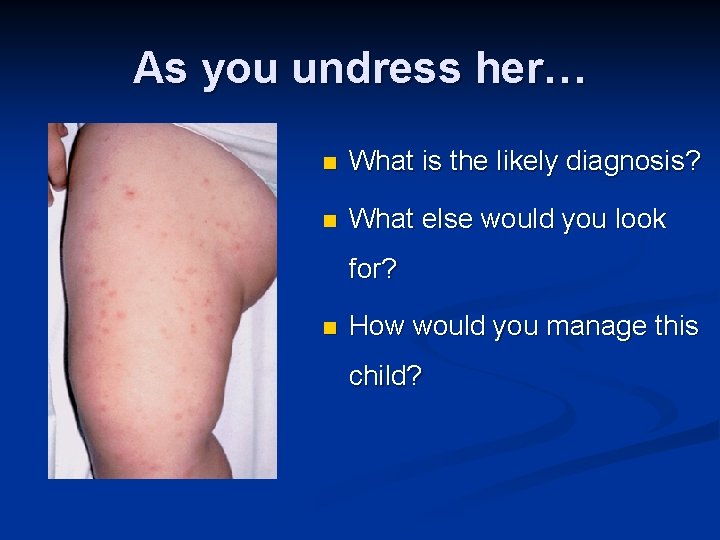
As you undress her… n What is the likely diagnosis? n What else would you look for? n How would you manage this child?
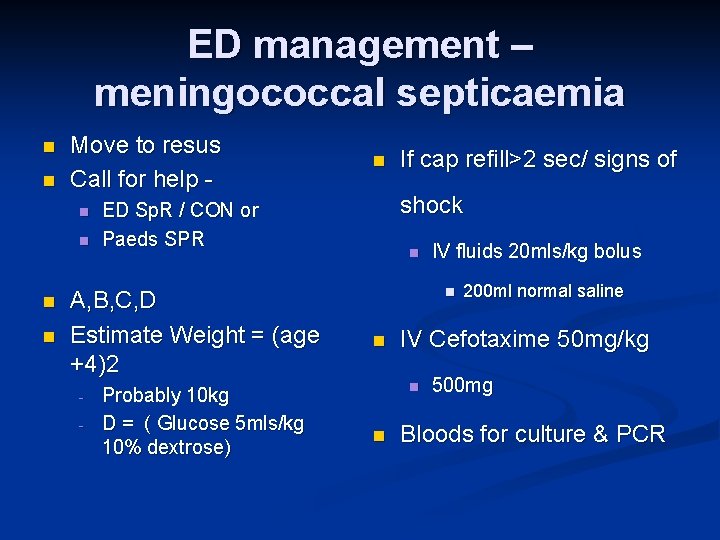
ED management – meningococcal septicaemia n n Move to resus Call for help - n n - Probably 10 kg D = ( Glucose 5 mls/kg 10% dextrose) If cap refill>2 sec/ signs of shock ED Sp. R / CON or Paeds SPR A, B, C, D Estimate Weight = (age +4)2 - n n IV fluids 20 mls/kg bolus n n IV Cefotaxime 50 mg/kg n n 200 ml normal saline 500 mg Bloods for culture & PCR
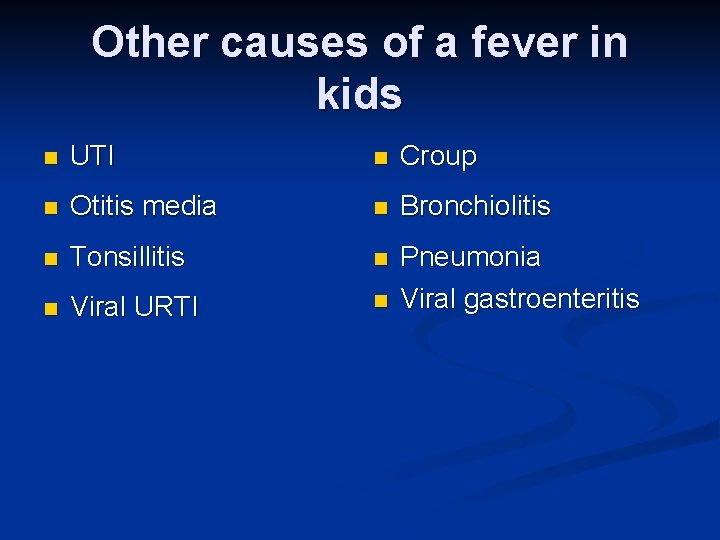
Other causes of a fever in kids n UTI n Croup n Otitis media n Bronchiolitis n Tonsillitis n n Viral URTI n Pneumonia Viral gastroenteritis
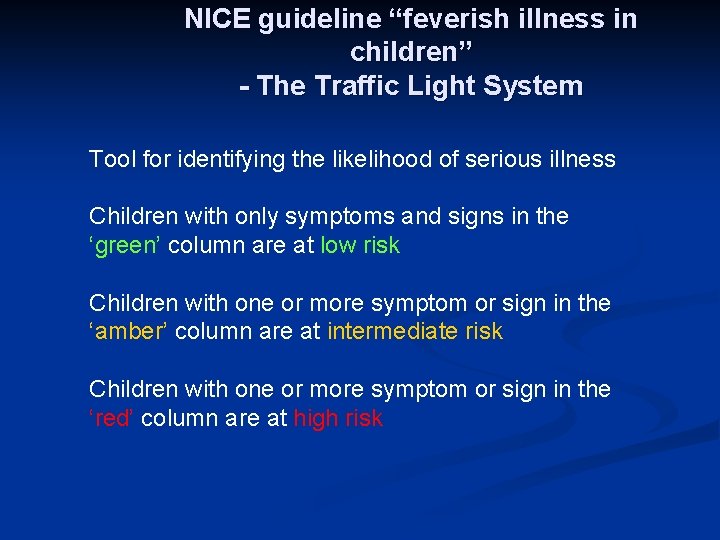
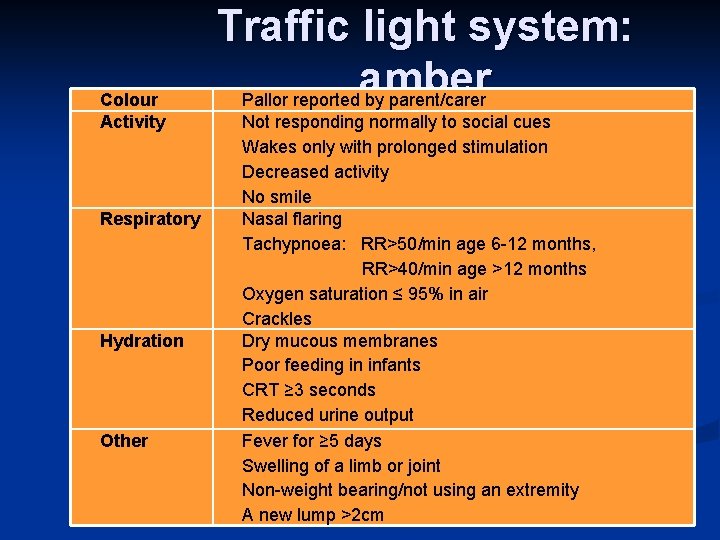
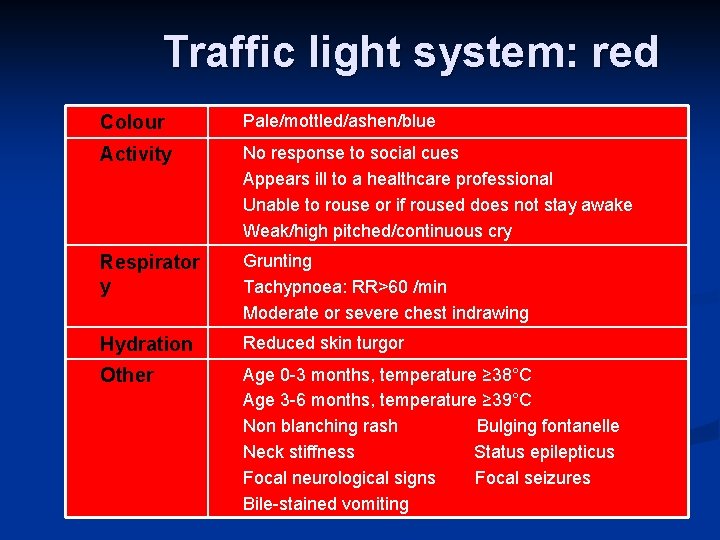
NICE guideline “feverish illness in children” - The Traffic Light System Tool for identifying the likelihood of serious illness Children with only symptoms and signs in the ‘green’ column are at low risk Children with one or more symptom or sign in the ‘amber’ column are at intermediate risk Children with one or more symptom or sign in the ‘red’ column are at high risk
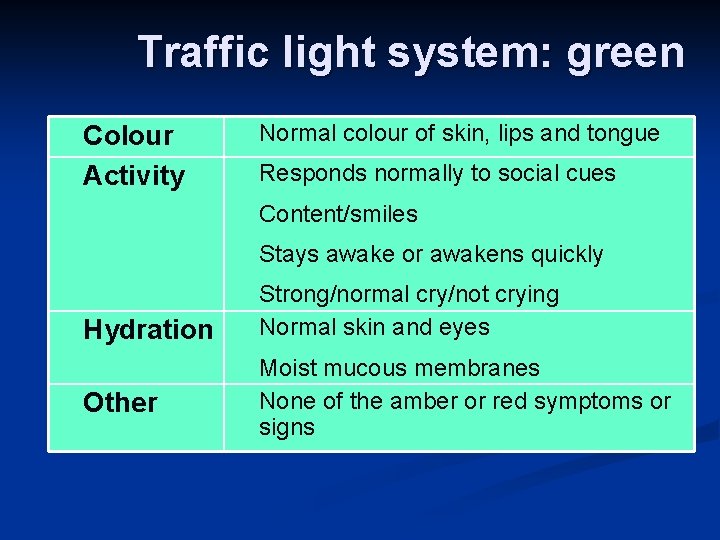
Traffic light system: green Colour Activity Normal colour of skin, lips and tongue Responds normally to social cues Content/smiles Stays awake or awakens quickly Hydration Other Strong/normal cry/not crying Normal skin and eyes Moist mucous membranes None of the amber or red symptoms or signs
Colour Activity Respiratory Hydration Other Traffic light system: amber Pallor reported by parent/carer Not responding normally to social cues Wakes only with prolonged stimulation Decreased activity No smile Nasal flaring Tachypnoea: RR>50/min age 6 -12 months, RR>40/min age >12 months Oxygen saturation ≤ 95% in air Crackles Dry mucous membranes Poor feeding in infants CRT ≥ 3 seconds Reduced urine output Fever for ≥ 5 days Swelling of a limb or joint Non-weight bearing/not using an extremity A new lump >2 cm
Traffic light system: red Colour Pale/mottled/ashen/blue Activity No response to social cues Appears ill to a healthcare professional Unable to rouse or if roused does not stay awake Weak/high pitched/continuous cry Respirator y Grunting Tachypnoea: RR>60 /min Moderate or severe chest indrawing Hydration Reduced skin turgor Other Age 0 -3 months, temperature ≥ 38°C Age 3 -6 months, temperature ≥ 39°C Non blanching rash Bulging fontanelle Neck stiffness Status epilepticus Focal neurological signs Focal seizures Bile-stained vomiting
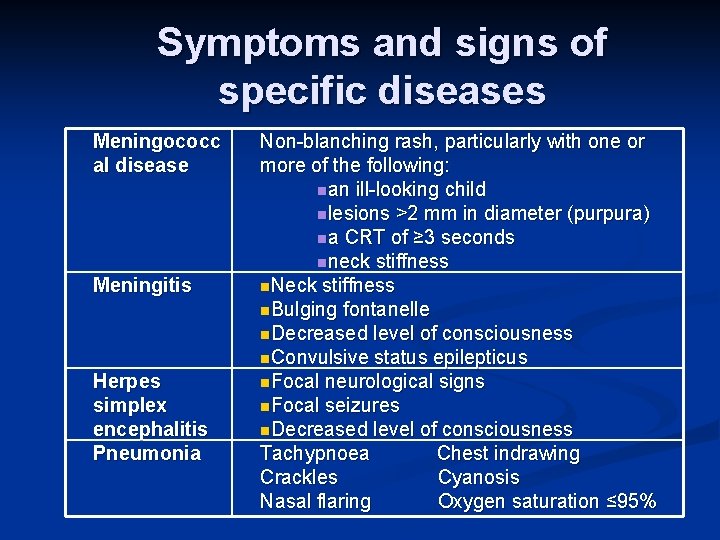
Symptoms and signs of specific diseases Meningococc al disease Meningitis Herpes simplex encephalitis Pneumonia Non-blanching rash, particularly with one or more of the following: nan ill-looking child nlesions >2 mm in diameter (purpura) na CRT of ≥ 3 seconds nneck stiffness n. Neck stiffness n. Bulging fontanelle n. Decreased level of consciousness n. Convulsive status epilepticus n. Focal neurological signs n. Focal seizures n. Decreased level of consciousness Tachypnoea Chest indrawing Crackles Cyanosis Nasal flaring Oxygen saturation ≤ 95%
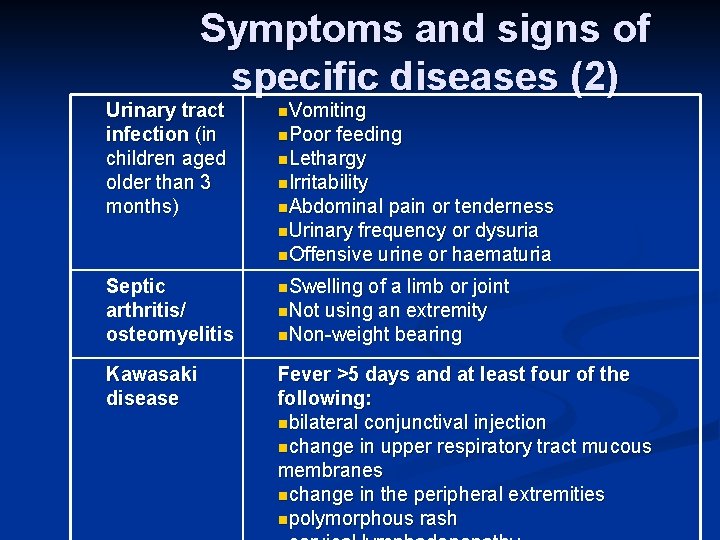
Symptoms and signs of specific diseases (2) Urinary tract infection (in children aged older than 3 months) n. Vomiting n. Poor feeding n. Lethargy n. Irritability n. Abdominal pain or tenderness n. Urinary frequency or dysuria n. Offensive urine or haematuria Septic arthritis/ osteomyelitis n. Swelling of a limb or joint Kawasaki disease Fever >5 days and at least four of the following: nbilateral conjunctival injection nchange in upper respiratory tract mucous membranes nchange in the peripheral extremities npolymorphous rash n. Not using an extremity n. Non-weight bearing
Management by a non-paediatric practitioner Do symptoms and/or signs suggest an immediately lifethreatening illness? Yes No Look for traffic light features and symptoms and signs of specific diseases If all green features and no amber or red Child can be managed at home with appropriate care advice • Obtain immediate Senior A&E +/- Paediatric support • Start resuscitation If any amber features and no diagnosis reached • Senior A&E review • Provide parents/carers with a safety net eg. Children’s Community Team if discharged If any red features • Obtain immediate Senior A&E +/- Paediatric support • Start resuscitation
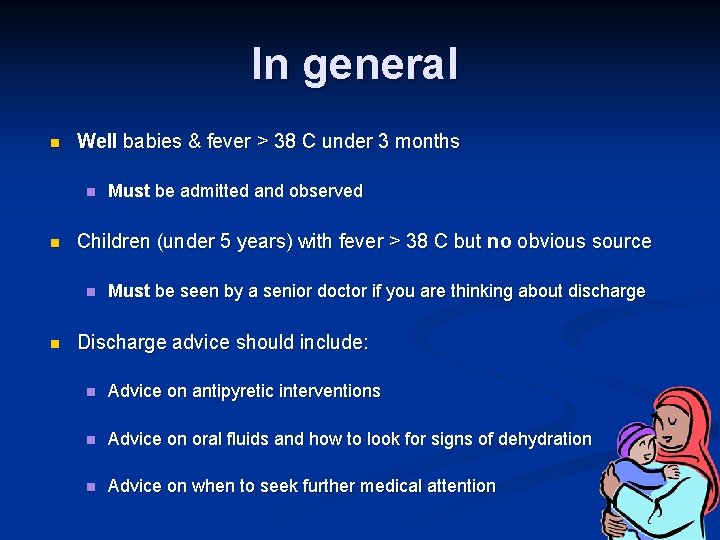
In general n Well babies & fever > 38 C under 3 months n n Children (under 5 years) with fever > 38 C but no obvious source n n Must be admitted and observed Must be seen by a senior doctor if you are thinking about discharge Discharge advice should include: n Advice on antipyretic interventions n Advice on oral fluids and how to look for signs of dehydration n Advice on when to seek further medical attention
Any questions
Summary n Any child with a fever needs n careful top to toe structured A, B, C, D examination n Management of well babies will vary depending on clinical condition and age n If worried/not sure ask for help