
Routing Session 20 INST 346 Technologies Infrastructure and
- Slides: 38
Routing Session 20 INST 346 Technologies, Infrastructure and Architecture
Goals for Today • Shortest-Path Routing • Routers • Border Gateway Protocol • Analysis Group 4
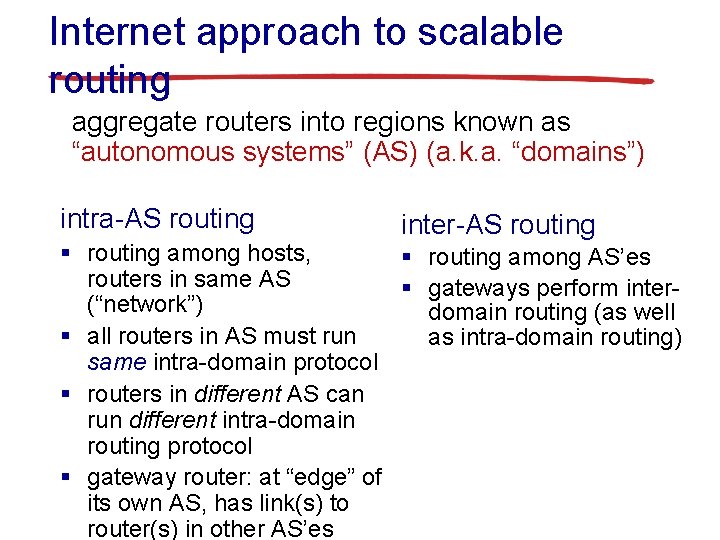
Internet approach to scalable routing aggregate routers into regions known as “autonomous systems” (AS) (a. k. a. “domains”) intra-AS routing inter-AS routing § routing among hosts, § routing among AS’es routers in same AS § gateways perform inter(“network”) domain routing (as well § all routers in AS must run as intra-domain routing) same intra-domain protocol § routers in different AS can run different intra-domain routing protocol § gateway router: at “edge” of its own AS, has link(s) to router(s) in other AS’es
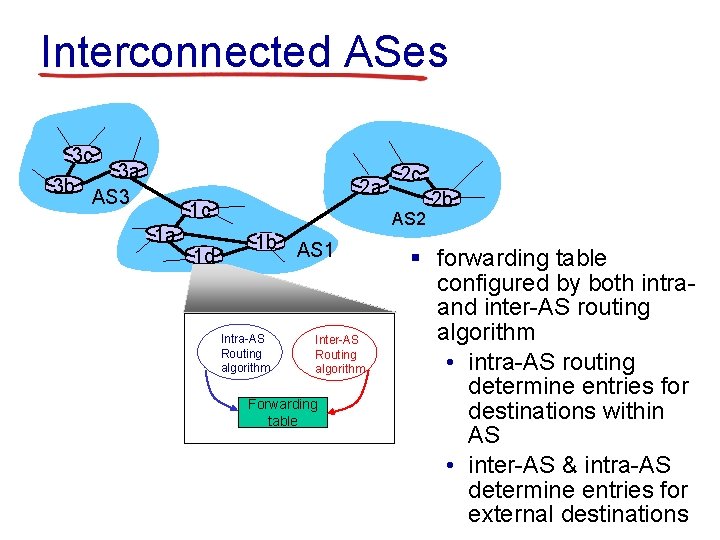
Interconnected ASes 3 c 3 a 3 b AS 3 2 a 1 c 1 a 1 d 2 c AS 2 1 b AS 1 Intra-AS Routing algorithm Inter-AS Routing algorithm Forwarding table 2 b § forwarding table configured by both intraand inter-AS routing algorithm • intra-AS routing determine entries for destinations within AS • inter-AS & intra-AS determine entries for external destinations
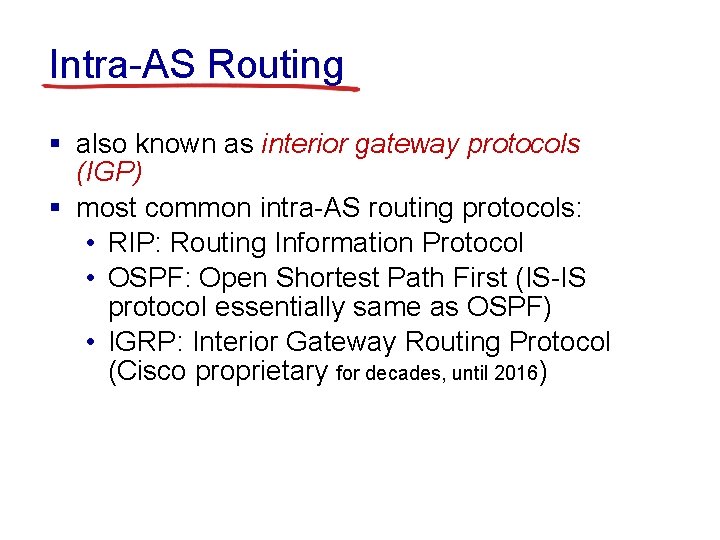
Intra-AS Routing § also known as interior gateway protocols (IGP) § most common intra-AS routing protocols: • RIP: Routing Information Protocol • OSPF: Open Shortest Path First (IS-IS protocol essentially same as OSPF) • IGRP: Interior Gateway Routing Protocol (Cisco proprietary for decades, until 2016)
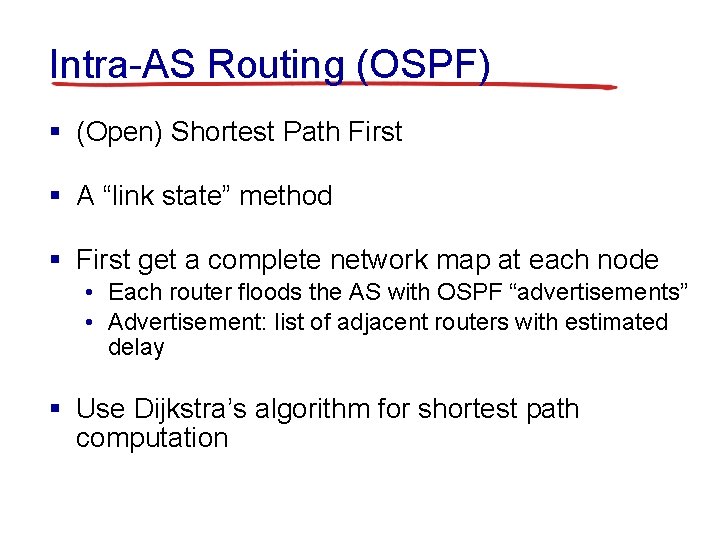
Intra-AS Routing (OSPF) § (Open) Shortest Path First § A “link state” method § First get a complete network map at each node • Each router floods the AS with OSPF “advertisements” • Advertisement: list of adjacent routers with estimated delay § Use Dijkstra’s algorithm for shortest path computation
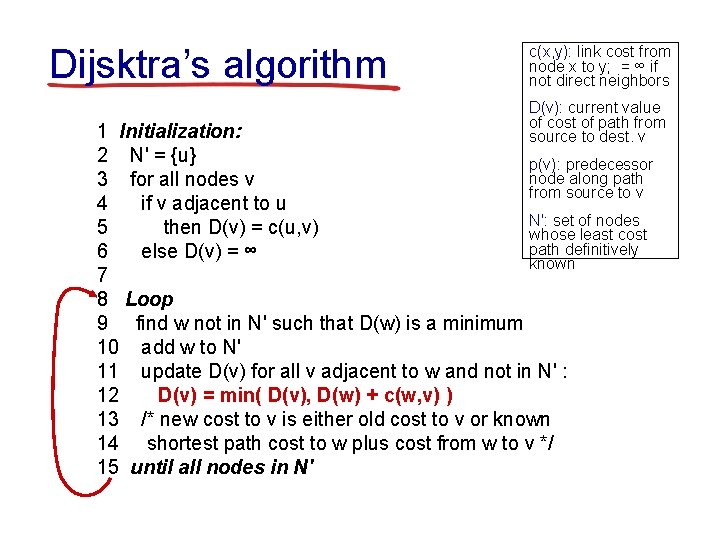
Dijsktra’s algorithm c(x, y): link cost from node x to y; = ∞ if not direct neighbors D(v): current value of cost of path from source to dest. v 1 Initialization: 2 N' = {u} p(v): predecessor node along path 3 for all nodes v from source to v 4 if v adjacent to u N': set of nodes 5 then D(v) = c(u, v) whose least cost path definitively 6 else D(v) = ∞ known 7 8 Loop 9 find w not in N' such that D(w) is a minimum 10 add w to N' 11 update D(v) for all v adjacent to w and not in N' : 12 D(v) = min( D(v), D(w) + c(w, v) ) 13 /* new cost to v is either old cost to v or known 14 shortest path cost to w plus cost from w to v */ 15 until all nodes in N'
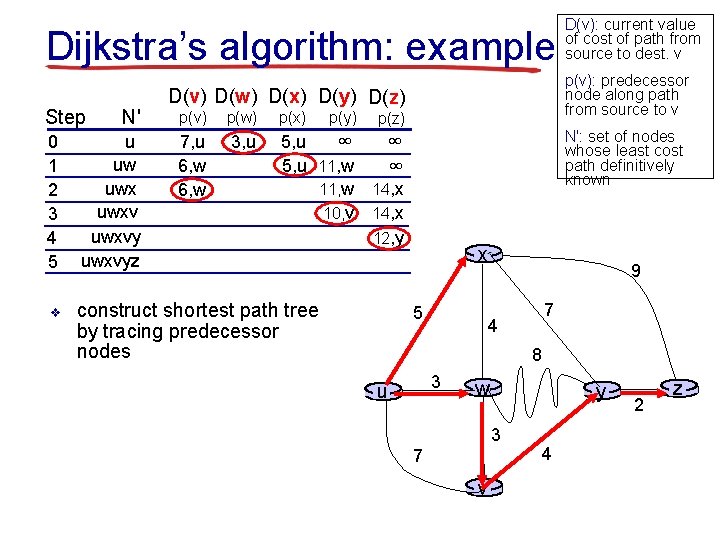
Dijkstra’s algorithm: example Step 0 1 2 3 4 5 v N' u uw uwxvyz p(v): predecessor node along path from source to v D(v) D(w) D(x) D(y) D(z) p(v) p(w) p(x) 7, u 6, w 3, u ∞ ∞ 5, u 11, w 14, x 10, v 14, x 12, y p(y) p(z) construct shortest path tree by tracing predecessor nodes D(v): current value of cost of path from source to dest. v N': set of nodes whose least cost path definitively known x 5 9 7 4 8 3 u w y 3 7 v 4 2 z
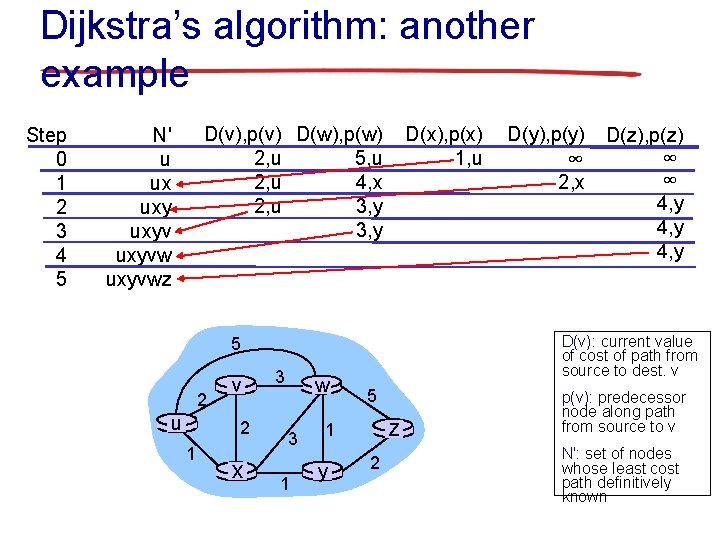
Dijkstra’s algorithm: another example Step 0 1 2 3 4 5 D(v), p(v) D(w), p(w) 2, u 5, u 2, u 4, x 2, u 3, y N' u ux uxyvwz D(x), p(x) 1, u 2 1 x 3 w 3 1 5 z 1 y D(z), p(z) ∞ ∞ 4, y D(v): current value of cost of path from source to dest. v 5 v D(y), p(y) ∞ 2, x 2 p(v): predecessor node along path from source to v N': set of nodes whose least cost path definitively known
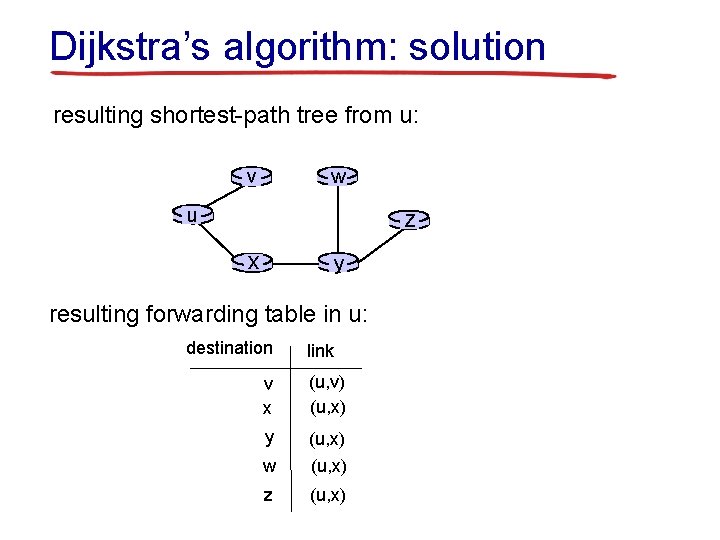
Dijkstra’s algorithm: solution resulting shortest-path tree from u: v w u z x y resulting forwarding table in u: destination link v x (u, v) (u, x) y (u, x) w (u, x) z (u, x)
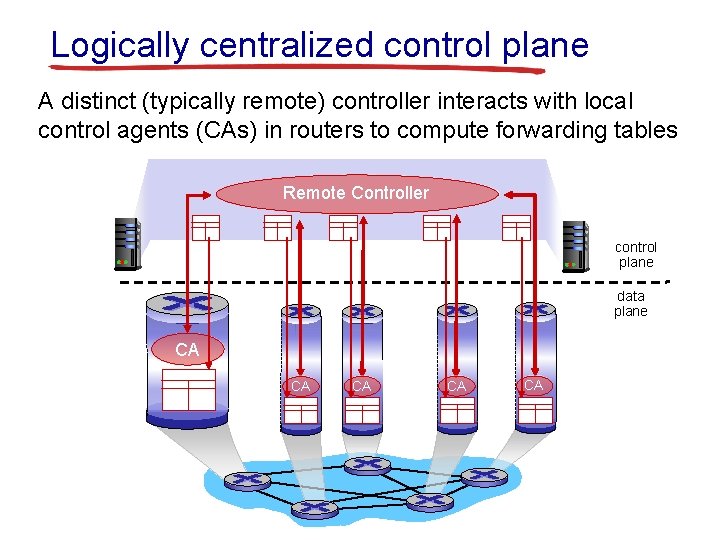
Logically centralized control plane A distinct (typically remote) controller interacts with local control agents (CAs) in routers to compute forwarding tables Remote Controller control plane data plane CA CA CA
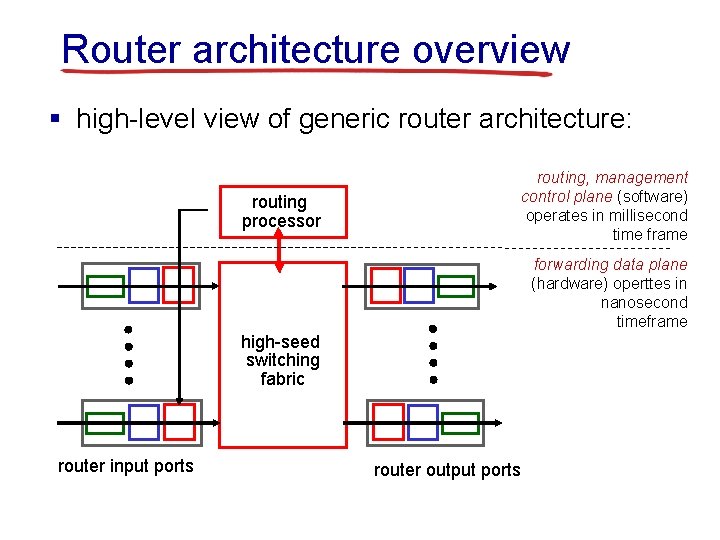
Router architecture overview § high-level view of generic router architecture: routing processor routing, management control plane (software) operates in millisecond time frame forwarding data plane (hardware) operttes in nanosecond timeframe high-seed switching fabric router input ports router output ports
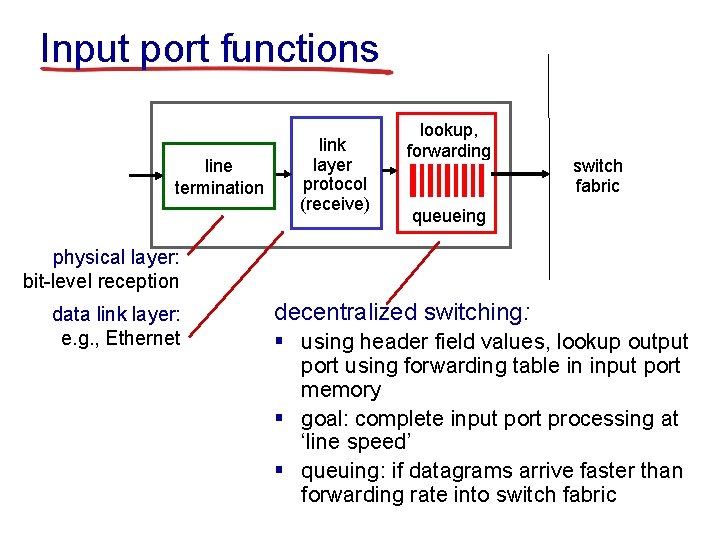
Input port functions line termination link layer protocol (receive) lookup, forwarding switch fabric queueing physical layer: bit-level reception data link layer: e. g. , Ethernet decentralized switching: § using header field values, lookup output port using forwarding table in input port memory § goal: complete input port processing at ‘line speed’ § queuing: if datagrams arrive faster than forwarding rate into switch fabric
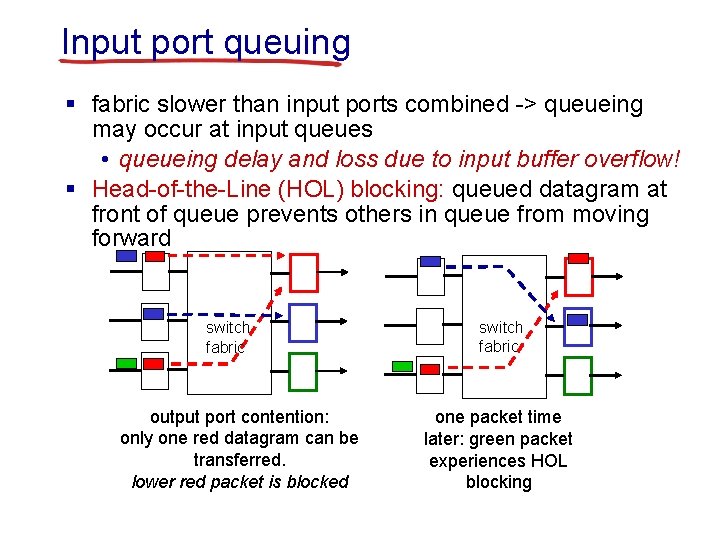
Input port queuing § fabric slower than input ports combined -> queueing may occur at input queues • queueing delay and loss due to input buffer overflow! § Head-of-the-Line (HOL) blocking: queued datagram at front of queue prevents others in queue from moving forward switch fabric output port contention: only one red datagram can be transferred. lower red packet is blocked switch fabric one packet time later: green packet experiences HOL blocking
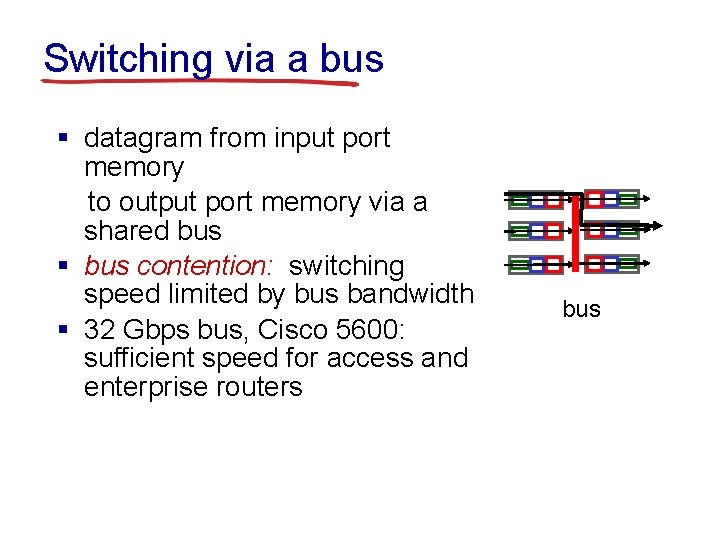
Switching via a bus § datagram from input port memory to output port memory via a shared bus § bus contention: switching speed limited by bus bandwidth § 32 Gbps bus, Cisco 5600: sufficient speed for access and enterprise routers bus
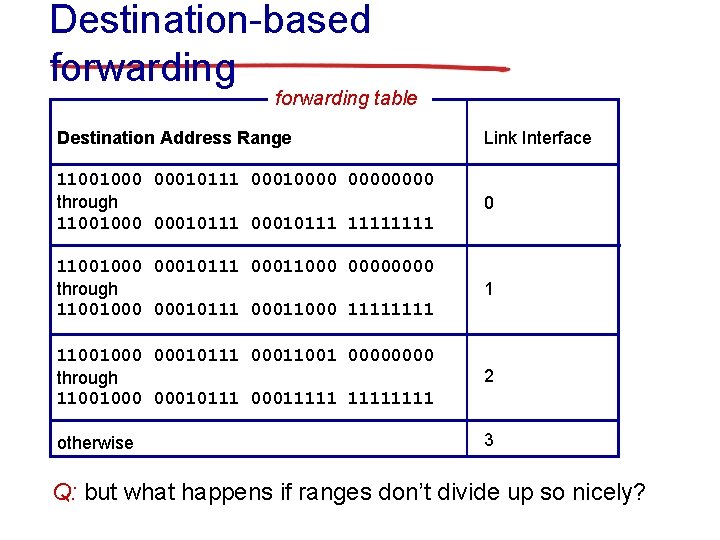
Destination-based forwarding table Destination Address Range Link Interface 11001000 00010111 00010000 through 11001000 00010111 1111 0 11001000 00010111 00011000 0000 through 11001000 00010111 00011000 1111 1 11001000 00010111 00011001 0000 through 11001000 00010111 00011111 2 otherwise 3 Q: but what happens if ranges don’t divide up so nicely?
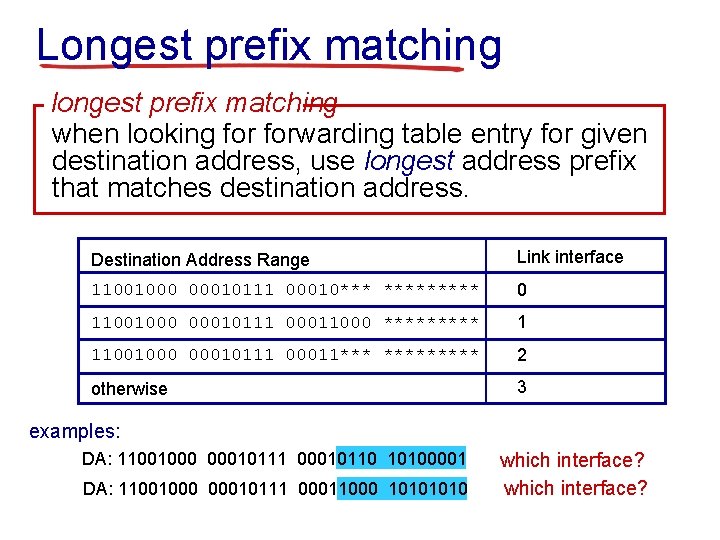
Longest prefix matching longest prefix matching when looking forwarding table entry for given destination address, use longest address prefix that matches destination address. Destination Address Range Link interface 11001000 00010111 00010*** ***** 0 11001000 00010111 00011000 ***** 1 11001000 00010111 00011*** ***** 2 otherwise 3 examples: DA: 11001000 00010111 00010110 10100001 DA: 11001000 00010111 00011000 1010 which interface?
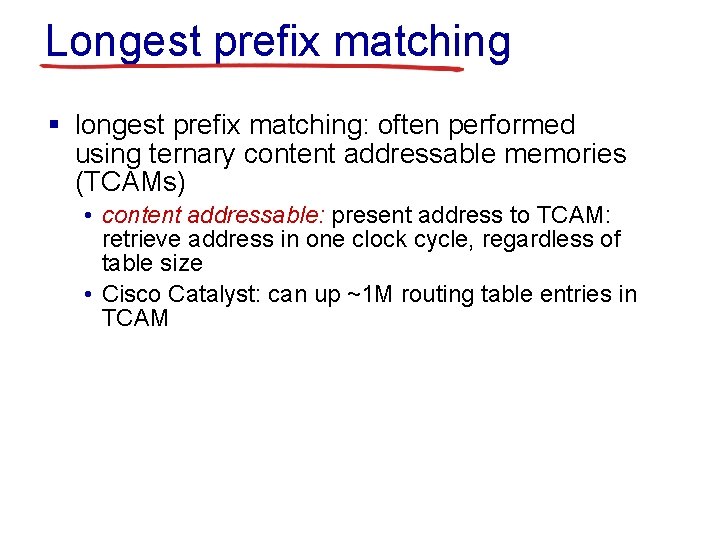
Longest prefix matching § longest prefix matching: often performed using ternary content addressable memories (TCAMs) • content addressable: present address to TCAM: retrieve address in one clock cycle, regardless of table size • Cisco Catalyst: can up ~1 M routing table entries in TCAM
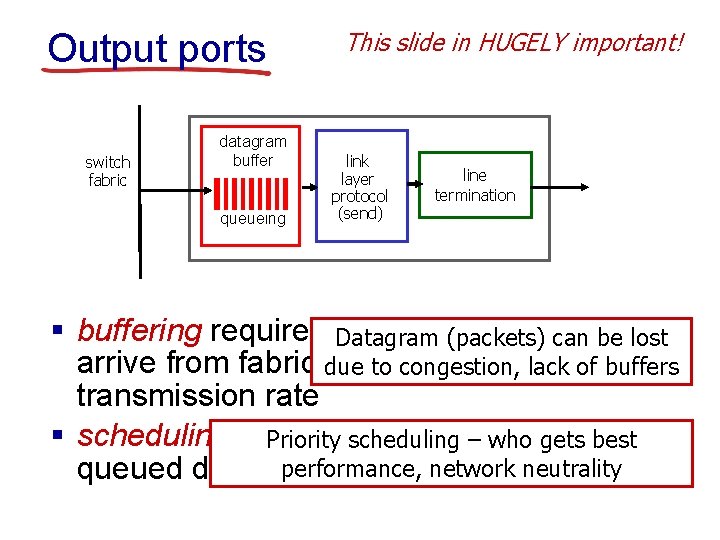
Output ports switch fabric datagram buffer queueing This slide in HUGELY important! link layer protocol (send) line termination § buffering required Datagram when datagrams (packets) can be lost arrive from fabric due faster than thelack of buffers to congestion, transmission rate § scheduling discipline chooses among Priority scheduling – who gets best performance, network neutrality queued datagrams for transmission
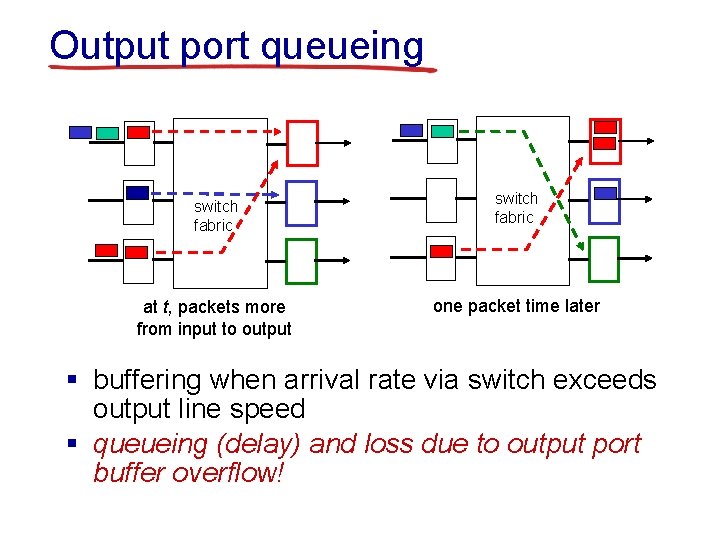
Output port queueing switch fabric at t, packets more from input to output switch fabric one packet time later § buffering when arrival rate via switch exceeds output line speed § queueing (delay) and loss due to output port buffer overflow!
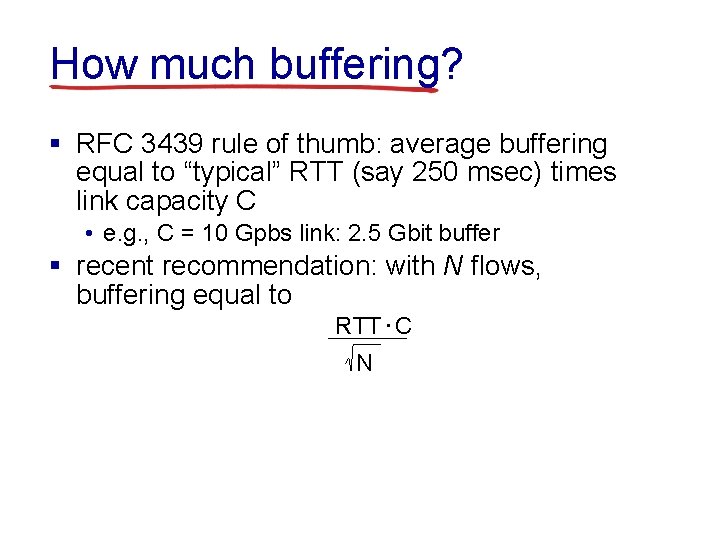
How much buffering? § RFC 3439 rule of thumb: average buffering equal to “typical” RTT (say 250 msec) times link capacity C • e. g. , C = 10 Gpbs link: 2. 5 Gbit buffer § recent recommendation: with N flows, buffering equal to RTT. C N
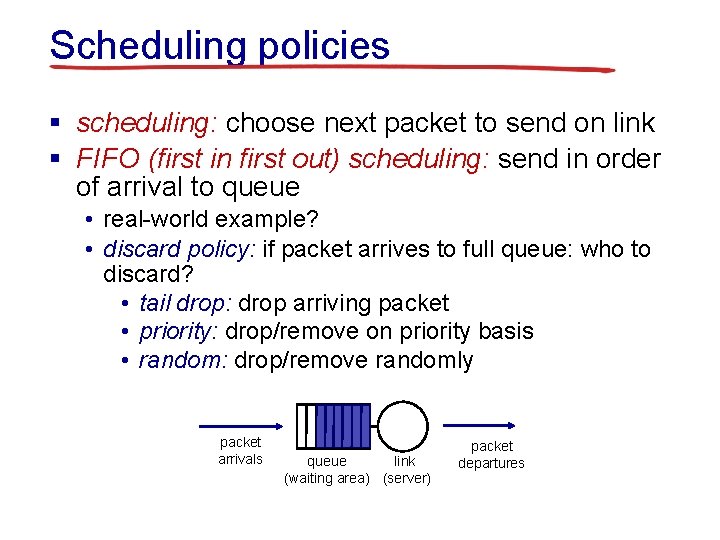
Scheduling policies § scheduling: choose next packet to send on link § FIFO (first in first out) scheduling: send in order of arrival to queue • real-world example? • discard policy: if packet arrives to full queue: who to discard? • tail drop: drop arriving packet • priority: drop/remove on priority basis • random: drop/remove randomly packet arrivals queue link (waiting area) (server) packet departures
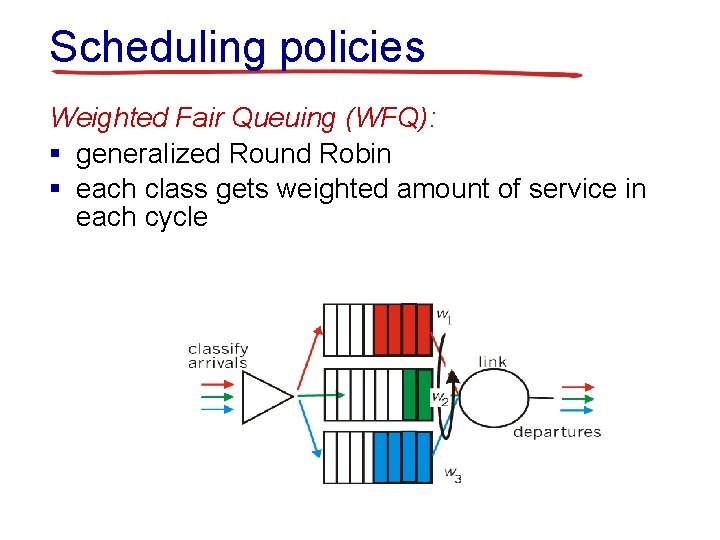
Scheduling policies Weighted Fair Queuing (WFQ): § generalized Round Robin § each class gets weighted amount of service in each cycle
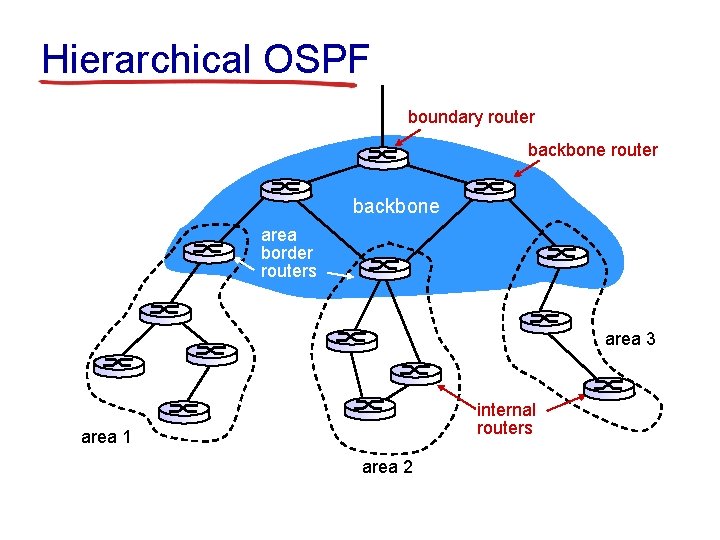
Hierarchical OSPF boundary router backbone area border routers area 3 internal routers area 1 area 2
Hierarchical OSPF § two-level hierarchy: local area, backbone. • link-state advertisements only in area • each nodes has detailed area topology; only know direction (shortest path) to nets in other areas. § area border routers: “summarize” distances to nets in own area, advertise to other Area Border routers. § backbone routers: run OSPF routing limited to backbone. § boundary routers: connect to other AS’es.
Inter-AS routing is different policy: § intra-AS: single admin, so single consistent policy § inter-AS: each admin wants control over how its traffic routed and who routes through its AS performance: § intra-AS: can focus on performance § inter-AS: policy may dominate over performance
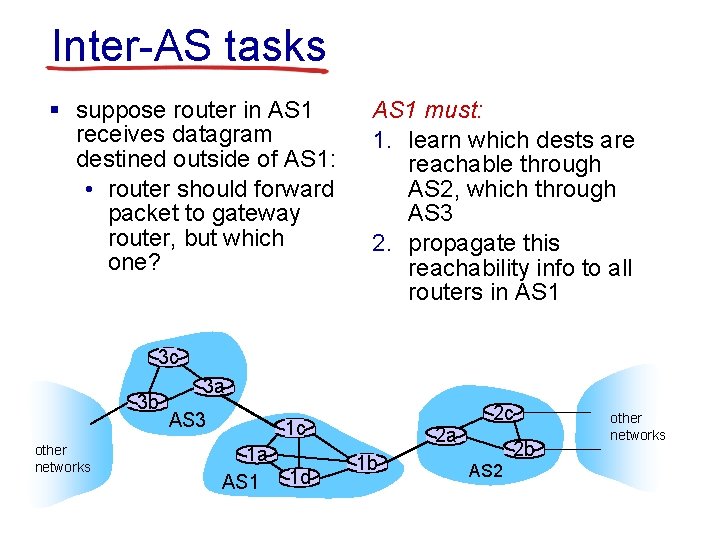
Inter-AS tasks § suppose router in AS 1 receives datagram destined outside of AS 1: • router should forward packet to gateway router, but which one? AS 1 must: 1. learn which dests are reachable through AS 2, which through AS 3 2. propagate this reachability info to all routers in AS 1 3 c 3 b other networks 3 a AS 3 1 c 1 a AS 1 1 d 2 a 1 b 2 c 2 b AS 2 other networks
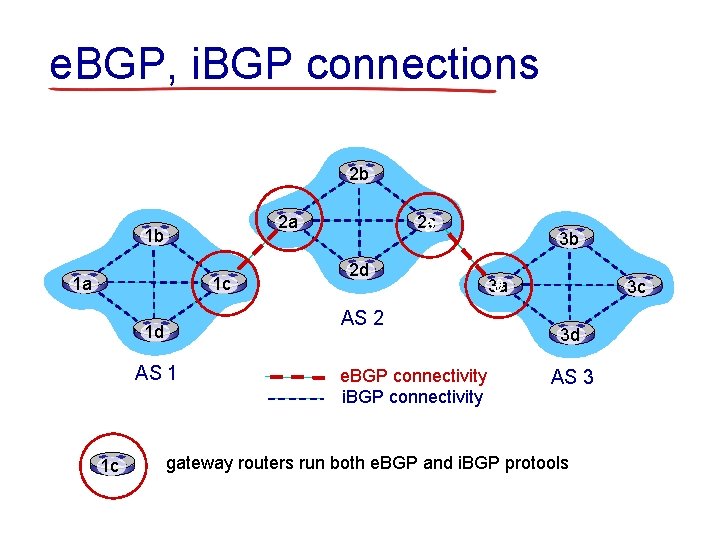
Internet inter-AS routing: BGP § BGP (Border Gateway Protocol): the de facto inter-domain routing protocol • “glue that holds the Internet together” § BGP provides each AS a means to: • e. BGP: obtain subnet reachability information from neighboring ASes • i. BGP: propagate reachability information to all AS-internal routers. • determine “good” routes to other networks based on reachability information and policy § allows subnet to advertise its existence to rest of Internet: “I am here”
e. BGP, i. BGP connections 2 b 2 a 1 b 1 a 1 c 2 d AS 2 1 d AS 1 1 c 2 c ∂ e. BGP connectivity i. BGP connectivity 3 b ∂ 3 a 3 c 3 d AS 3 gateway routers run both e. BGP and i. BGP protools
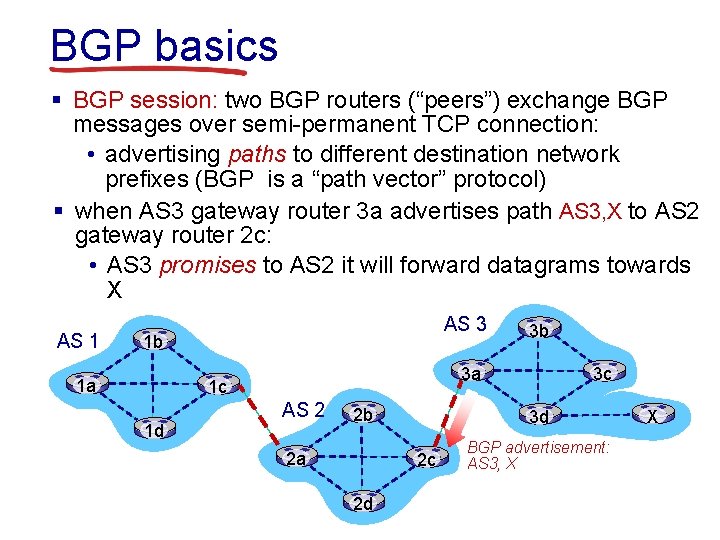
BGP basics § BGP session: two BGP routers (“peers”) exchange BGP messages over semi-permanent TCP connection: • advertising paths to different destination network prefixes (BGP is a “path vector” protocol) § when AS 3 gateway router 3 a advertises path AS 3, X to AS 2 gateway router 2 c: • AS 3 promises to AS 2 it will forward datagrams towards X AS 1 AS 3 1 b 1 a 3 b 3 a 1 c AS 2 1 d 2 b 2 a 3 d 2 c 2 d 3 c BGP advertisement: AS 3, X X
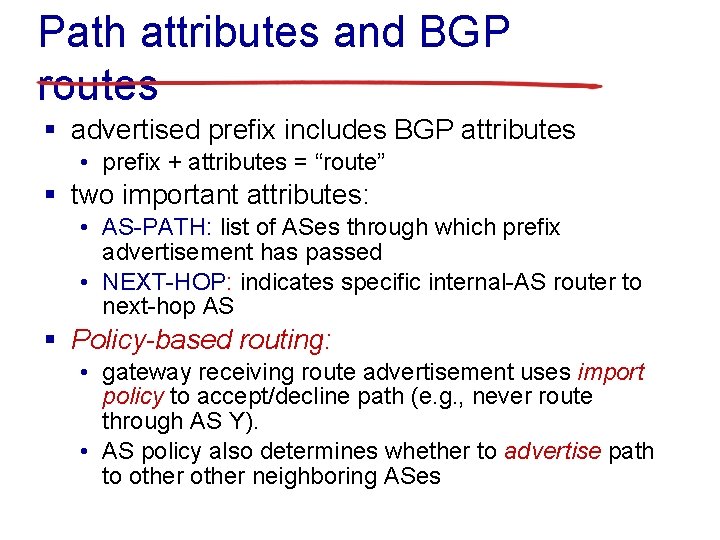
Path attributes and BGP routes § advertised prefix includes BGP attributes • prefix + attributes = “route” § two important attributes: • AS-PATH: list of ASes through which prefix advertisement has passed • NEXT-HOP: indicates specific internal-AS router to next-hop AS § Policy-based routing: • gateway receiving route advertisement uses import policy to accept/decline path (e. g. , never route through AS Y). • AS policy also determines whether to advertise path to other neighboring ASes
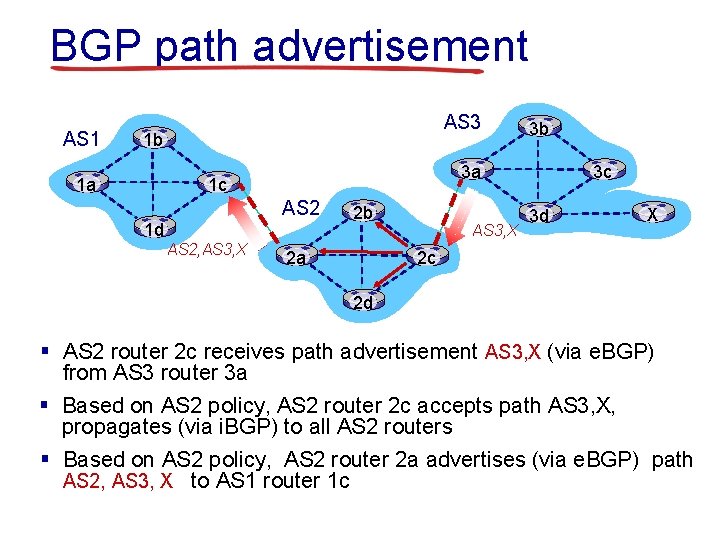
BGP path advertisement AS 1 AS 3 1 b 1 a 3 a 1 c AS 2 1 d AS 2, AS 3, X 3 b 2 b 2 a AS 3, X 3 c 3 d X 2 c 2 d § AS 2 router 2 c receives path advertisement AS 3, X (via e. BGP) from AS 3 router 3 a § Based on AS 2 policy, AS 2 router 2 c accepts path AS 3, X, propagates (via i. BGP) to all AS 2 routers § Based on AS 2 policy, AS 2 router 2 a advertises (via e. BGP) path AS 2, AS 3, X to AS 1 router 1 c
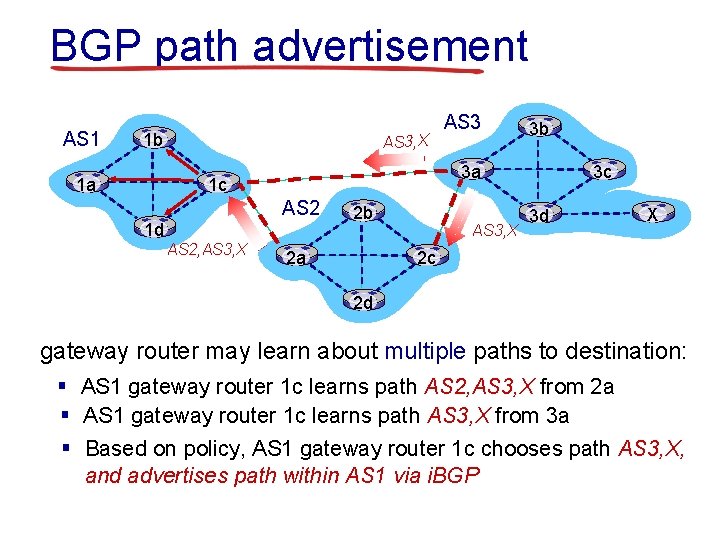
BGP path advertisement AS 1 1 b 1 a AS 3, X 3 b 3 a 1 c AS 2 1 d AS 2, AS 3, X AS 3 2 b 2 a AS 3, X 3 c 3 d X 2 c 2 d gateway router may learn about multiple paths to destination: § AS 1 gateway router 1 c learns path AS 2, AS 3, X from 2 a § AS 1 gateway router 1 c learns path AS 3, X from 3 a § Based on policy, AS 1 gateway router 1 c chooses path AS 3, X, and advertises path within AS 1 via i. BGP
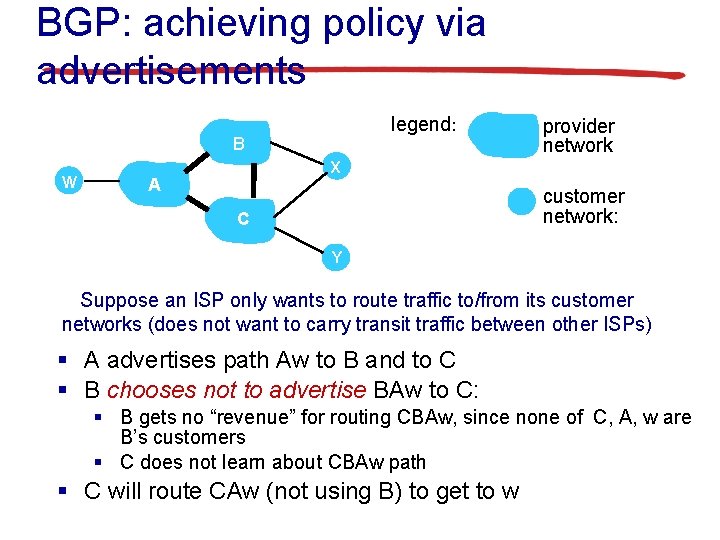
BGP: achieving policy via advertisements legend: B W provider network X A customer network: C Y Suppose an ISP only wants to route traffic to/from its customer networks (does not want to carry transit traffic between other ISPs) § A advertises path Aw to B and to C § B chooses not to advertise BAw to C: § B gets no “revenue” for routing CBAw, since none of C, A, w are B’s customers § C does not learn about CBAw path § C will route CAw (not using B) to get to w
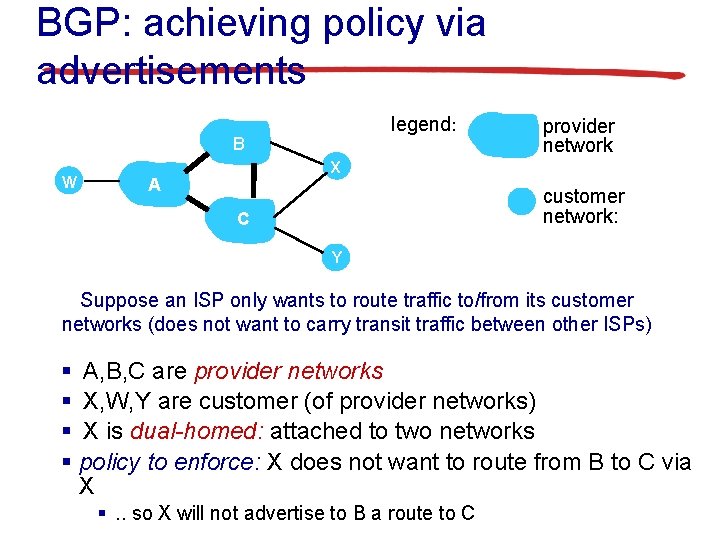
BGP: achieving policy via advertisements legend: B W provider network X A customer network: C Y Suppose an ISP only wants to route traffic to/from its customer networks (does not want to carry transit traffic between other ISPs) § A, B, C are provider networks § X, W, Y are customer (of provider networks) § X is dual-homed: attached to two networks § policy to enforce: X does not want to route from B to C via X §. . so X will not advertise to B a route to C
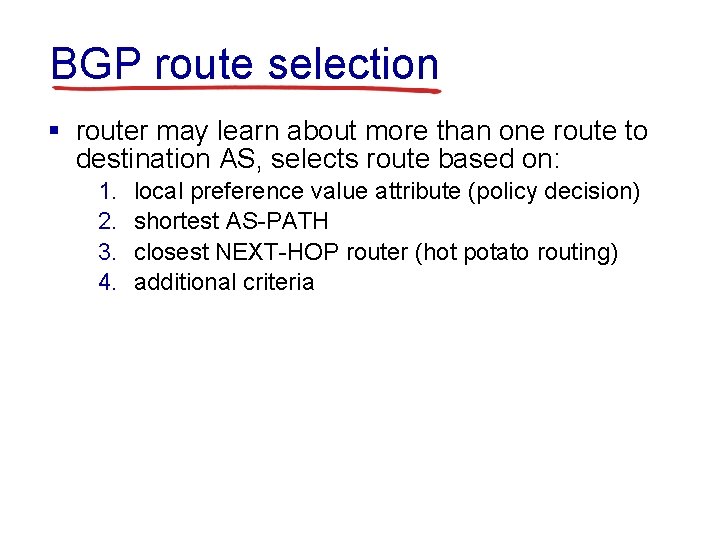
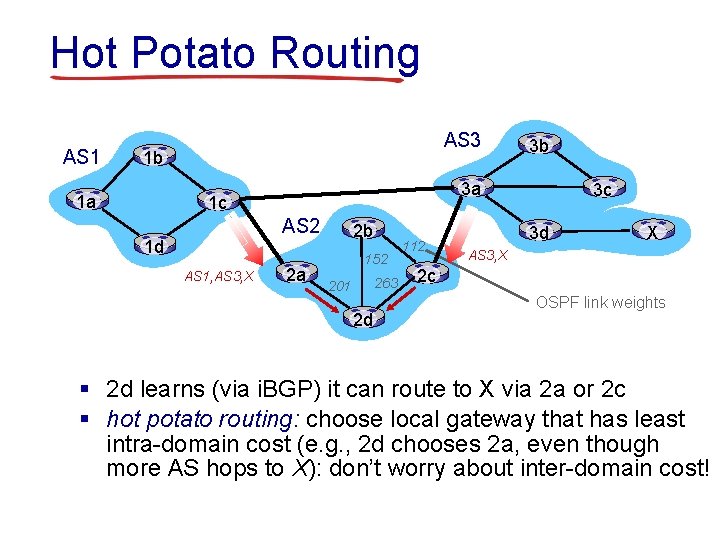
BGP route selection § router may learn about more than one route to destination AS, selects route based on: 1. 2. 3. 4. local preference value attribute (policy decision) shortest AS-PATH closest NEXT-HOP router (hot potato routing) additional criteria
Hot Potato Routing AS 1 AS 3 1 b 1 a 3 a 1 c AS 2 2 b 1 d AS 1, AS 3, X 3 b 2 a 152 263 201 2 d 112 3 c 3 d X AS 3, X 2 c OSPF link weights § 2 d learns (via i. BGP) it can route to X via 2 a or 2 c § hot potato routing: choose local gateway that has least intra-domain cost (e. g. , 2 d chooses 2 a, even though more AS hops to X): don’t worry about inter-domain cost!
Network Layer Summary • IPv 4 addresses – Hierarchical structure (subnet mask) • Routing – Hierarchical structure (Autonomous Systems) • Routers – Structure (input queue, switch, output queue) – Routing tables (hierarchical structure) • Network layer packets – IPv 4, IPv 6