
Routing Information Protocol RIP l Cisco CCNA student

- Slides: 11
Routing Information Protocol RIP l Cisco CCNA student presentation @ Napier University. Why is a Routing Protocol needed? Purpose of Routing information Which route? Metrics Routing tables RIP datagram and RIP port Questions 10/24/2020 Telewest Communications Group user@domain
Why is a routing protocol needed? Early requirements to exchanges data between computers over interconnected networks. l Routing entities had to make a judgement on which path to route traffic to destination. l 10/24/2020 Telewest Communications Group user@domain
Background to RIP dates back to 1969, the early networking days and ARPNET when Xerox and Berkley’s Unix implemented it broadly similar protocols. l RIP distributed through ‘route d’ application, included in early Unix O. S. l RIP uses a single class of routing algorithm known as distance vector - based on a simple hop count algorithm (derived from Bellman’s equation). l Although superseded by more complex algorithms, its simplicity means is still found widely in smaller autonomous systems. l 10/24/2020 user@domain
Purpose of Routing Protocol l l l The purpose of Rout. ING protocols is to supply information needed to do routing of datagrams from router to router. RIP intended for use in IP based network environment. Operating at layer 3 of OSI (Network) RIP makes no formal distinction between networks and hosts. Routers typically provide a gateway for datagrames to leave one network or AS and be forwarded onward to another network. Routers therefore, have to make decisions if there is a choice of forwarding path on offer. 10/24/2020 user@domain
Which way? A path must be found between the source and destination. l Without a direction to follow packet would have to randomly circulate the whole internetwork looking for its destination. l If the networks are not adjacent then the path will be through several routers. l 10/24/2020 user@domain
Routing metrics Routing entities keep a database (look up table) of basic information based on numeric result s (metric) of an algorithm to forward a datagram onward to its next destination. l Each entity participating in routing decisions sends update messages to its neighbour. l In order to provide complete network routing information every router within the AS must participate in the protocol. l Each router has a lookup table which contains one entry for every destination that is reachable. l 10/24/2020 user@domain
How does a metric work? Metrics are the result of a formula based on a choice of measurement criteria. Example, travel cost by taxi: l £ 10 to go by taxi from Edinburgh to Livingston. (P 1) £ 25 to go from Livingston to Glasgow (P 2) £ 15 to go from Edinburgh to Falkirk (P 3) £ 30 to go from Falkirk to Glasgow (P 4) Cost (Edinburgh, Glasgow) = [P 1+P 2] = £ 35 also/or [P 3+P 4] = £ 45 10/24/2020 user@domain
What is in a RIP routing table? l l l Address - IP address (IPv 4) of host or network destination. Router - First router along the route to destination. Interface - The physical network which must be used to reach the next router. Metric - A number indicating the distance to the destination. This number is the sum of the ‘costs’ that have to be transversed to get to the destination. Timers - Time since entry was last updated and others. Flags - Various flags to indicate status of various adjacent routers (for example). 10/24/2020 user@domain
Other entries in the routing table The entries for directly connected networks typically have a value of 1 (a simple hop count). l Initially subnet masks were not included in RIP protocol implementations, but were included later to support feature extensions and to identify different subnets within local and distant networks. l Administrators may also add static routes for example, which are outside the scope of the routing system. l 10/24/2020 user@domain
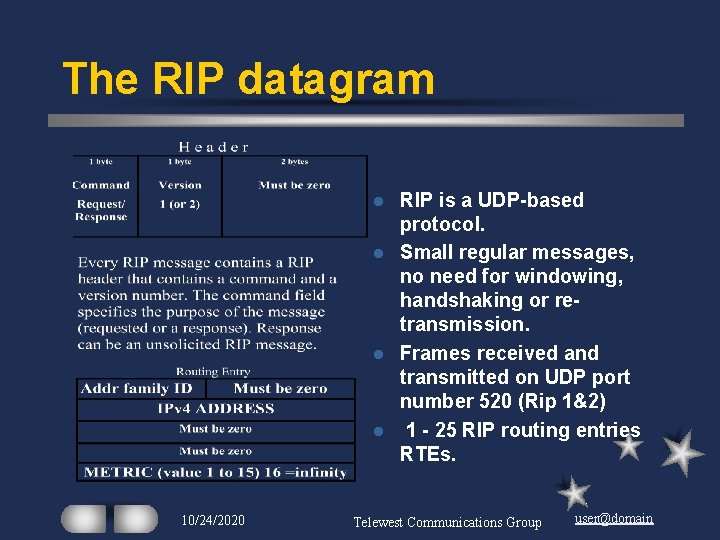
The RIP datagram RIP is a UDP-based protocol. l Small regular messages, no need for windowing, handshaking or retransmission. l Frames received and transmitted on UDP port number 520 (Rip 1&2) l 1 - 25 RIP routing entries RTEs. l 10/24/2020 Telewest Communications Group user@domain
RIP – Stephen Webster – Gino Rigitano – Telewest Communications – 0131 539 0002 10/24/2020 Telewest Communications Group user@domain