
Routing algorithms the routing algorithm is a part
- Slides: 11
Routing algorithms
• the routing algorithm is a part of the network layer software responsible for deciding which output line an incoming packet should be transmitted on. • If the subnet uses datagram, this decision must be made anew for every arriving data packet. • if the subnet uses virtual circuits, routing decision are made only when a new virtual circuit is established. thereafter, data packets just follow the previously established route. This is called session routing. • routing – taking decision of route for a session; updating the routing table. • forwarding – forwarding a packet of that session on the decided output line when arrives.
• Nonadaptive or static – do not base their routing decisions on measurements or estimates of the current traffic and topology. • adaptive or dynamic – change their routing decisions to reflect changes in the topology, and usually the traffic as well.
Flooding • every incoming packet is sent out on every outgoing line except the one it arrive on. • demerits: – vast number of duplicate packets; infinite. • Measures – can be reduce using TTL like measure – keep track of the flooding packet, not to entertain such packet again. – Selective flooding
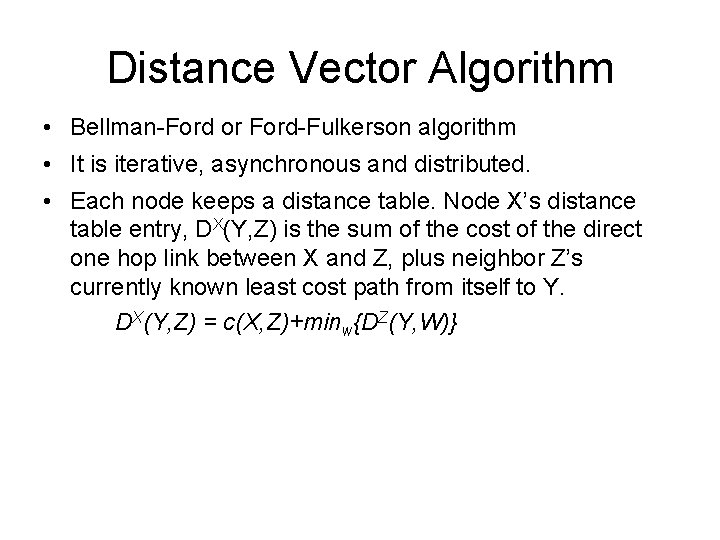
Distance Vector Algorithm • Bellman-Ford or Ford-Fulkerson algorithm • It is iterative, asynchronous and distributed. • Each node keeps a distance table. Node X’s distance table entry, DX(Y, Z) is the sum of the cost of the direct one hop link between X and Z, plus neighbor Z’s currently known least cost path from itself to Y. DX(Y, Z) = c(X, Z)+minw{DZ(Y, W)}
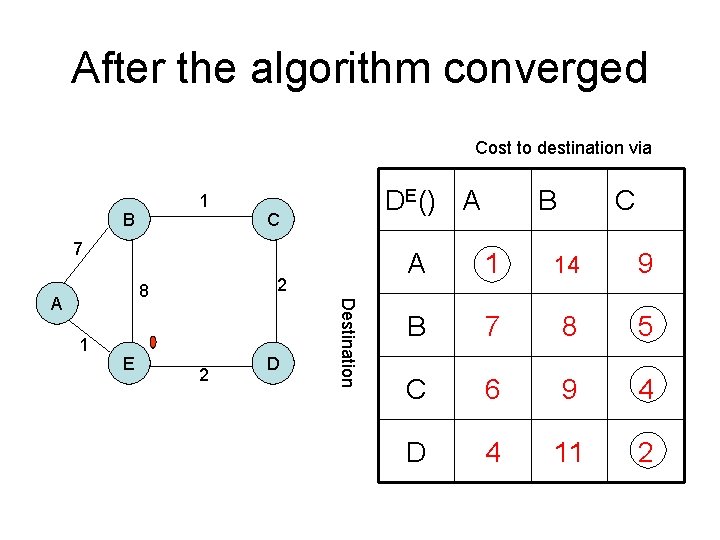
After the algorithm converged Cost to destination via 1 B DE() A C 7 2 A 1 E 2 D Destination 8 B C A 1 14 9 B 7 8 5 C 6 9 4 D 4 11 2
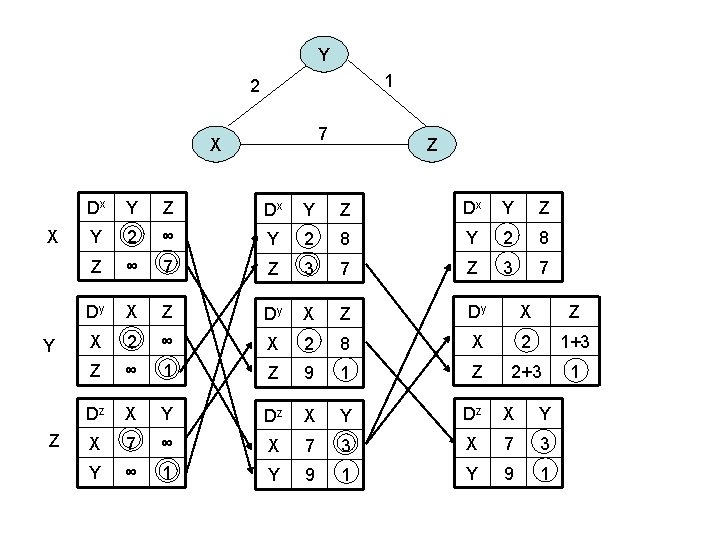
Y 1 2 7 X X Y Z Z Dx Y Z Y 2 ∞ Y 2 8 Z ∞ 7 Z 3 7 Dy X Z X 2 ∞ X 2 8 X 2 1+3 Z ∞ 1 Z 9 1 Z 2+3 1 Dz X Y X 7 ∞ X 7 3 Y ∞ 1 Y 9 1
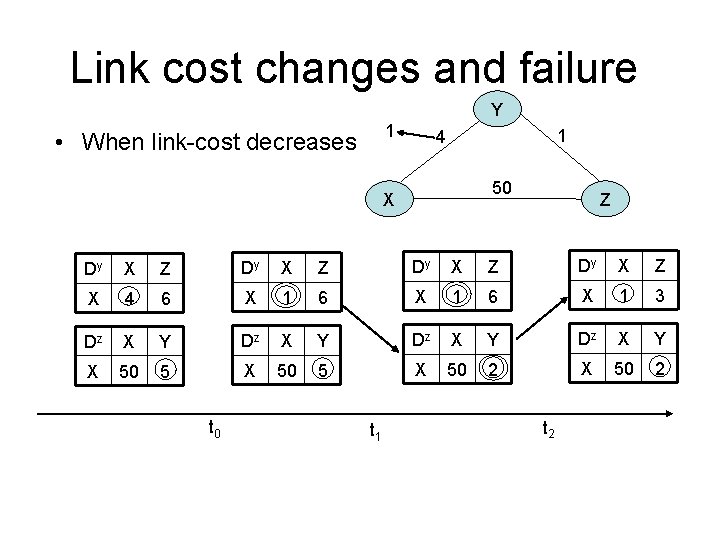
Link cost changes and failure Y 1 • When link-cost decreases 1 4 50 X Z Dy X Z X 4 6 X 1 3 Dz X Y X 50 5 X 50 2 t 0 t 1 t 2
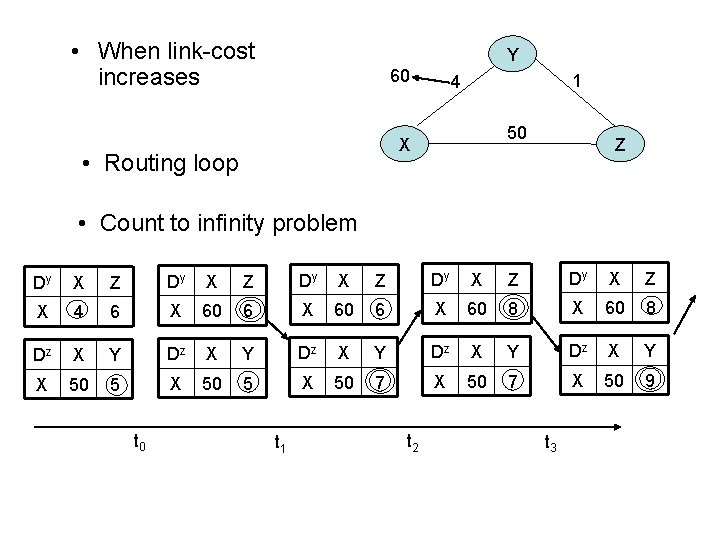
• When link-cost increases Y 60 1 4 50 X • Routing loop Z • Count to infinity problem Dy X Z Dy X Z X 4 6 X 60 8 Dz X Y Dz X Y X 50 5 X 50 7 X 50 9 t 0 t 1 t 2 t 3
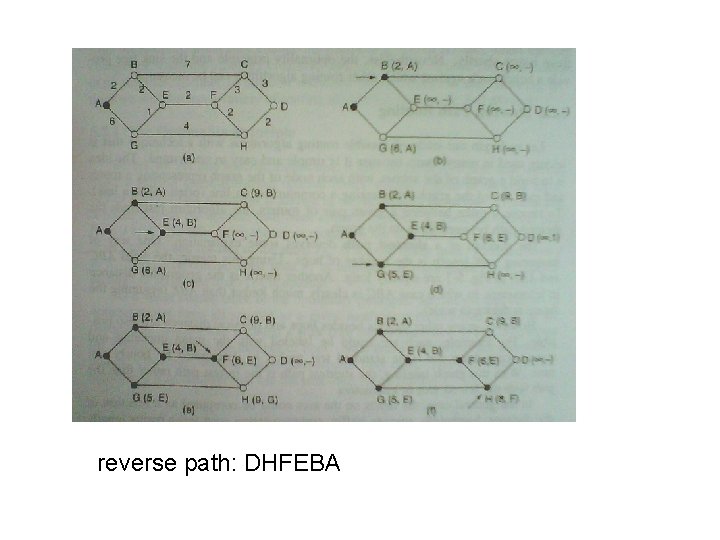
Shortest Path Routing • Build a graph of subnets, with each node of the graph representing a router, and each arc of the graph representing a communication line. to choose a route between a given pair of routes, the algorithm just finds the shortest path between them on the graph. • Dijkstra’s algorithm.
reverse path: DHFEBA