
Routines for Reasoning Capturing Quantities Fraction Division Partitive
- Slides: 12
Routines for Reasoning Capturing Quantities – Fraction Division (Partitive)
Instructional Discussion Standard: 6. NS. 1 SMPs: 2, 3, 4, 6, 1, 7 Learning Target: Students will develop a conceptual understanding of fraction division using a visual representation.
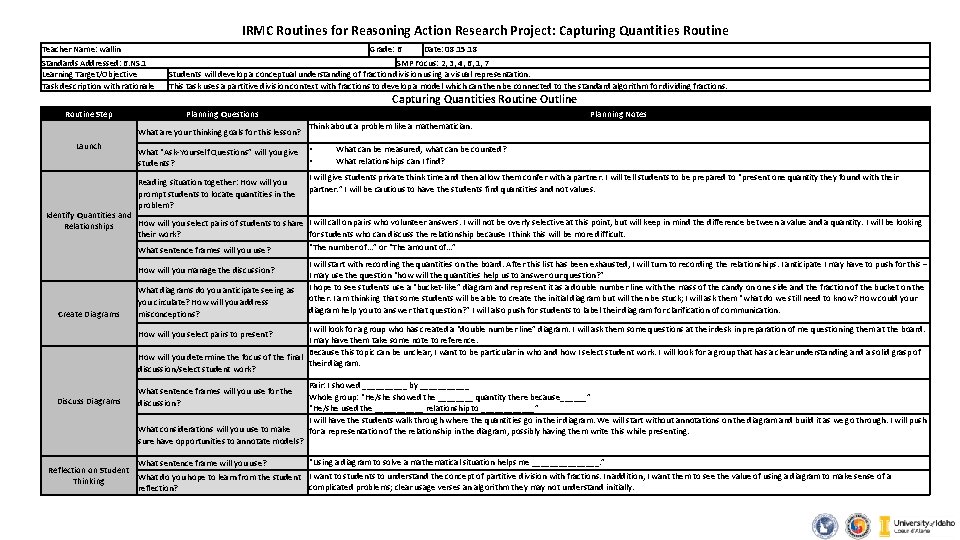
IRMC Routines for Reasoning Action Research Project: Capturing Quantities Routine Teacher Name: wallin Grade: 6 Standards Addressed: 6. NS. 1 Learning Target/Objective Task description with rationale Date: 08. 15. 18 SMP Focus: 2, 3, 4, 6, 1, 7 Students will develop a conceptual understanding of fraction division using a visual representation. This task uses a partitive division context with fractions to develop a model which can then be connected to the standard algorithm for dividing fractions. Capturing Quantities Routine Outline Routine Step Launch Planning Questions Planning Notes Think about a problem like a mathematician. What are your thinking goals for this lesson? What can be measured, what can be counted? What “Ask-Yourself Questions” will you give • • What relationships can I find? students? Reading situation together: How will you prompt students to locate quantities in the problem? I will give students private think time and then allow them confer with a partner. I will tell students to be prepared to “present one quantity they found with their partner. ” I will be cautious to have the students find quantities and not values. Identify Quantities and How will you select pairs of students to share I will call on pairs who volunteer answers. I will not be overly selective at this point, but will keep in mind the difference between a value and a quantity. I will be looking Relationships for students who can discuss the relationship because I think this will be more difficult. their work? “The number of…” or “The amount of…” What sentence frames will you use? How will you manage the discussion? Create Diagrams What diagrams do you anticipate seeing as you circulate? How will you address misconceptions? I will start with recording the quantities on the board. After this list has been exhausted, I will turn to recording the relationships. I anticipate I may have to push for this – I may use the question “how will the quantities help us to answer our question? ” I hope to see students use a “bucket-like” diagram and represent it as a double number line with the mass of the candy on one side and the fraction of the bucket on the other. I am thinking that some students will be able to create the initial diagram but will then be stuck; I will ask them “what do we still need to know? How could your diagram help you to answer that question? ” I will also push for students to label their diagram for clarification of communication. I will look for a group who has created a “double number line” diagram. I will ask them some questions at their desk in preparation of me questioning them at the board. I may have them take some note to reference. Because this topic can be unclear, I want to be particular in who and how I select student work. I will look for a group that has a clear understanding and a solid grasp of How will you determine the focus of the final their diagram. discussion/select student work? How will you select pairs to present? Discuss Diagrams What sentence frames will you use for the discussion? What considerations will you use to make sure have opportunities to annotate models? Pair: I showed _____ by ______ Whole group: “He/she showed the ____ quantity there because______” “He/she used the ______ relationship to ______” I will have the students walk through where the quantities go in their diagram. We will start without annotations on the diagram and build it as we go through. I will push for a representation of the relationship in the diagram, possibly having them write this while presenting. “Using a diagram to solve a mathematical situation helps me ________. ” What sentence frame will you use? Reflection on Student What do you hope to learn from the student I want to students to understand the concept of partitive division with fractions. In addition, I want them to see the value of using a diagram to make sense of a Thinking complicated problems; clear usage verses an algorithm they may not understand initially. reflection?
Capturing Quantities • SMP Focus: Reasoning abstractly and quantitatively • Values vs. Quantities • Contextualizing and Decontextualizing • Creating Diagrams • Essential Strategies • Annotation • Sentence frames and sentence starters
Purpose Today we are learning how to find quantities and relationships in word problems and diagrams. We are going to build diagrams to help us understand a math problem dealing with fractions and decimals. We are going to talk to others to clarify our own thinking about the math problem.
Thinking Goals Think about a problem like a mathematician. • Thinking Questions: • What can be measured, what can be counted? • What relationships can I find? • How can I represent my thinking?
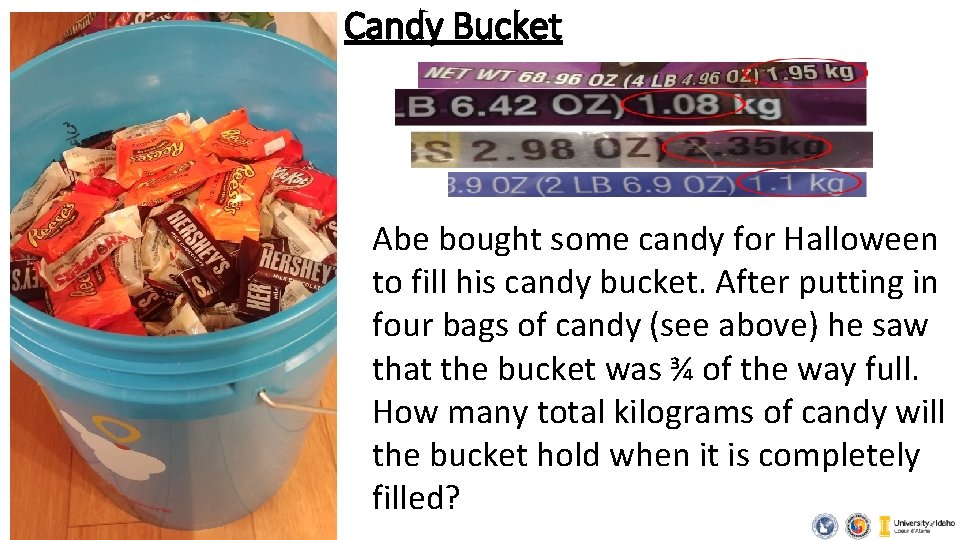
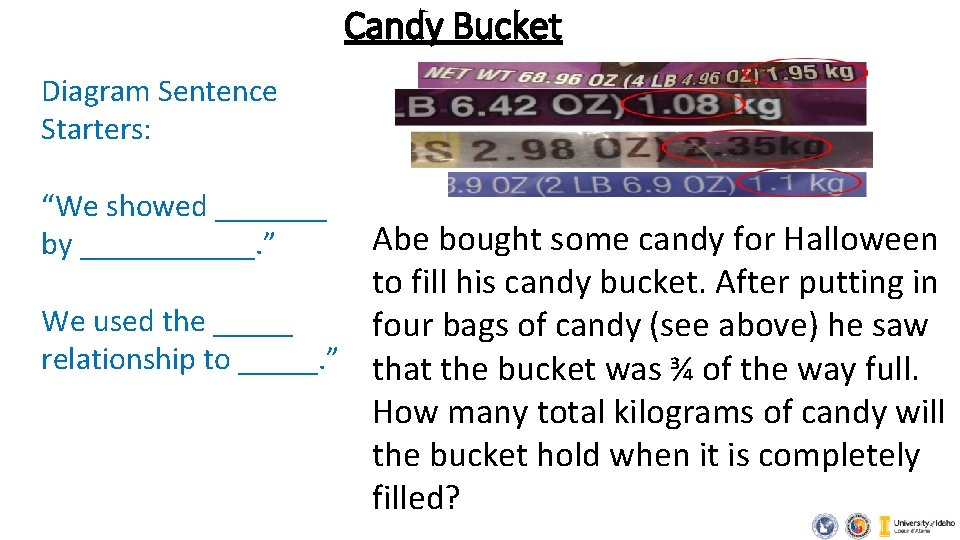
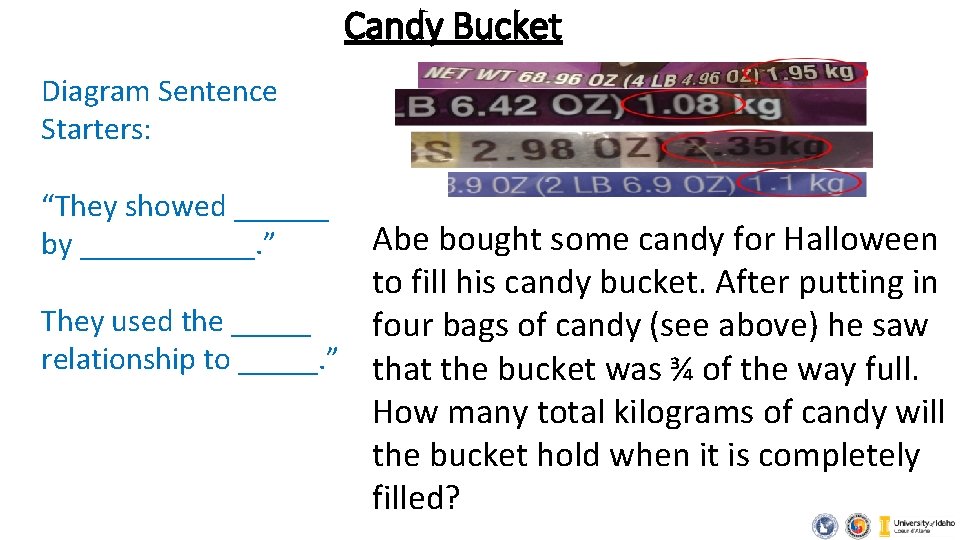
Candy Bucket Abe bought some candy for Halloween to fill his candy bucket. After putting in four bags of candy (see above) he saw that the bucket was ¾ of the way full. How many total kilograms of candy will the bucket hold when it is completely filled?
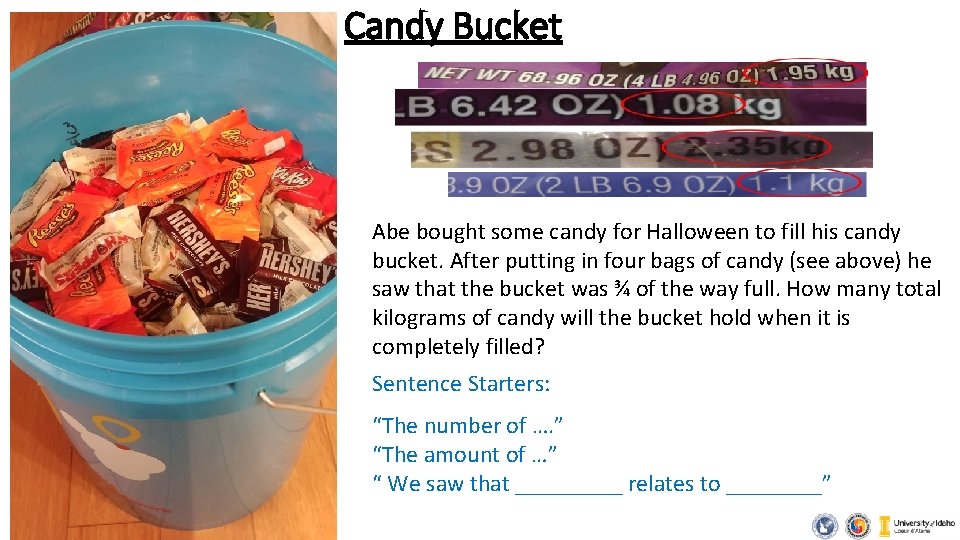
Candy Bucket Abe bought some candy for Halloween to fill his candy bucket. After putting in four bags of candy (see above) he saw that the bucket was ¾ of the way full. How many total kilograms of candy will the bucket hold when it is completely filled? Sentence Starters: “The number of …. ” “The amount of …” “ We saw that _____ relates to ____”
Candy Bucket Diagram Sentence Starters: “We showed _______ by ______. ” Abe bought some candy for Halloween to fill his candy bucket. After putting in We used the _____ four bags of candy (see above) he saw relationship to _____. ” that the bucket was ¾ of the way full. How many total kilograms of candy will the bucket hold when it is completely filled?
Candy Bucket Diagram Sentence Starters: “They showed ______ by ______. ” Abe bought some candy for Halloween to fill his candy bucket. After putting in They used the _____ four bags of candy (see above) he saw relationship to _____. ” that the bucket was ¾ of the way full. How many total kilograms of candy will the bucket hold when it is completely filled?
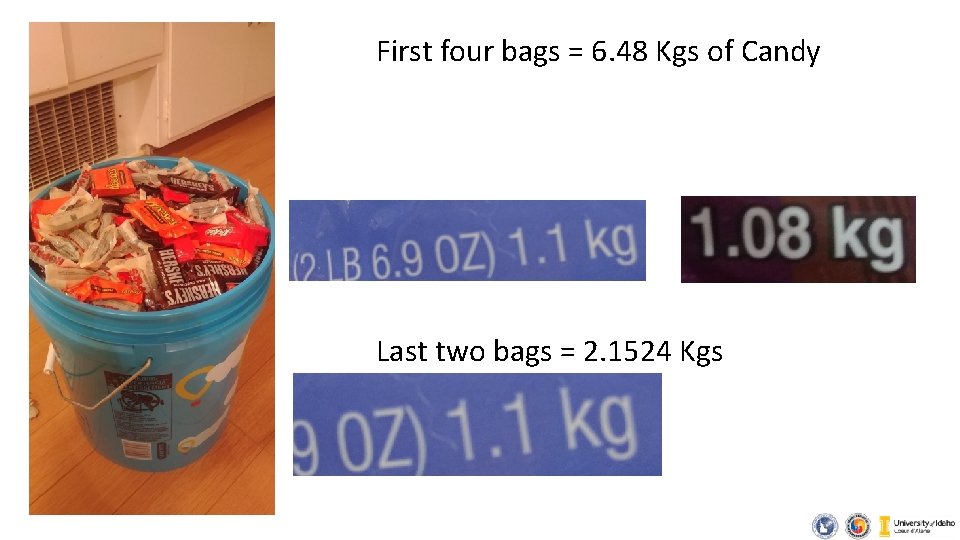
First four bags = 6. 48 Kgs of Candy Last two bags = 2. 1524 Kgs
Reflection “Using a diagram to solve a mathematical situation helps me ________. ”