
Router Design An Overview Lecture 15 Computer Networks


- Slides: 25
Router Design: An Overview Lecture 15, Computer Networks (198: 552) Fall 2019
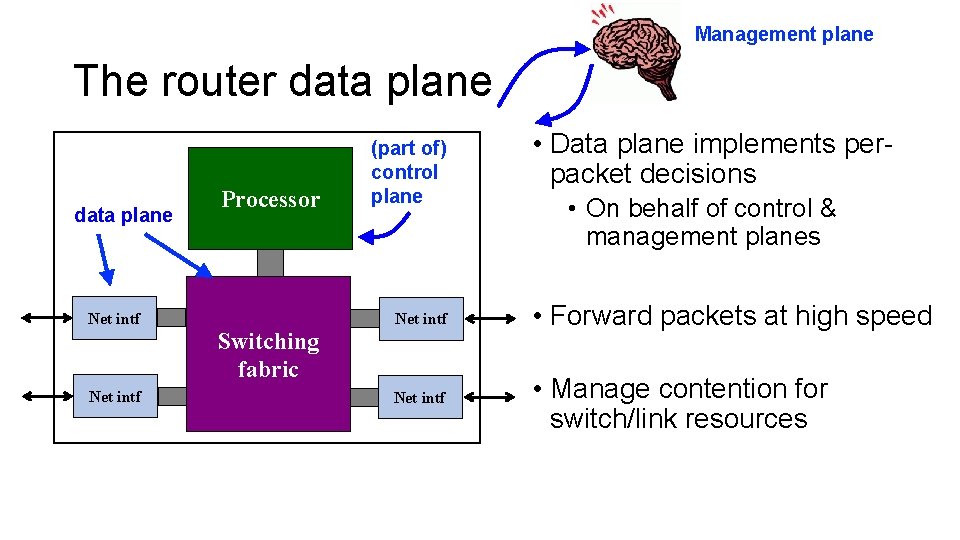
Management plane The router data plane Processor Net intf Switching fabric Net intf (part of) control plane • Data plane implements perpacket decisions • On behalf of control & management planes Net intf • Forward packets at high speed Net intf • Manage contention for switch/link resources
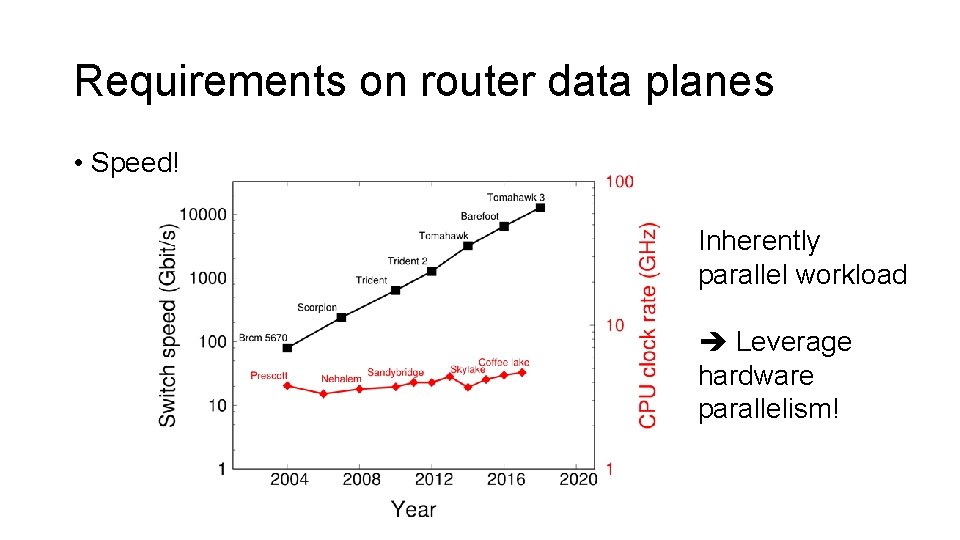
Requirements on router data planes • Speed! Inherently parallel workload Leverage hardware parallelism!
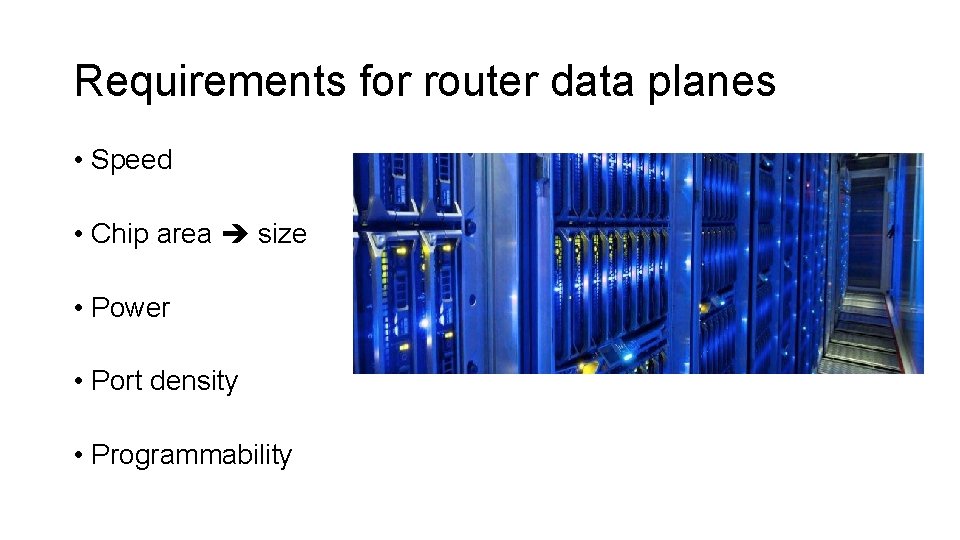
Requirements for router data planes • Speed • Chip area size • Power • Port density • Programmability
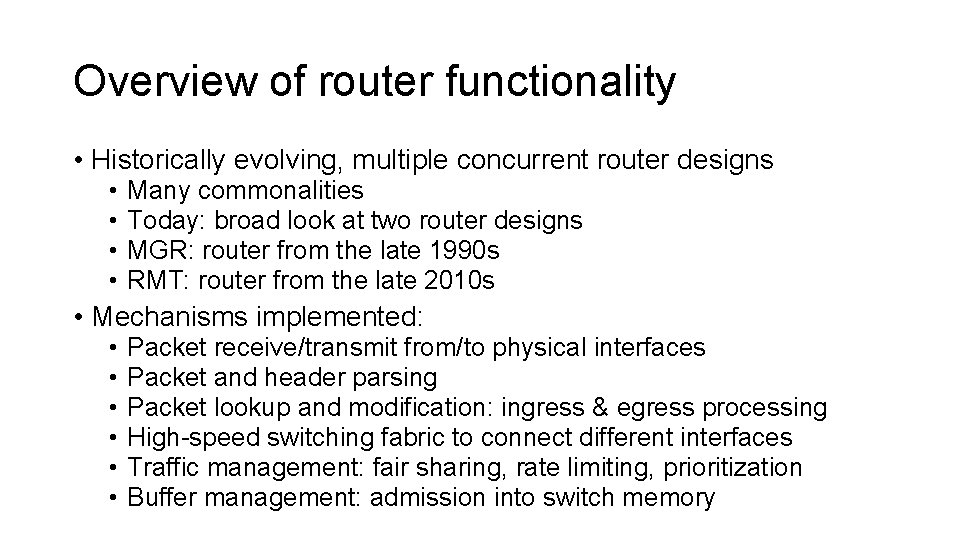
Overview of router functionality • Historically evolving, multiple concurrent router designs • • Many commonalities Today: broad look at two router designs MGR: router from the late 1990 s RMT: router from the late 2010 s • Mechanisms implemented: • • • Packet receive/transmit from/to physical interfaces Packet and header parsing Packet lookup and modification: ingress & egress processing High-speed switching fabric to connect different interfaces Traffic management: fair sharing, rate limiting, prioritization Buffer management: admission into switch memory
Life of a packet
(1) Receive data at line cards • Circuitry to interface with physical medium: Co. Ax, optical • Ser. Des/IO modules: serialize/deserialize data from the wire • Network interfaces keep getting faster: more parallelism • but stay the same size (Moore’s law is alive here, for now) • Multiple network interfaces on a single line card • Component detachable from the rest of the switch • Ex: upgrade multiple 10 Gbit/s interfaces to 40 Gbit/s in one shot • Preliminary header processing possible • MGR: convert link-layer headers to standard format
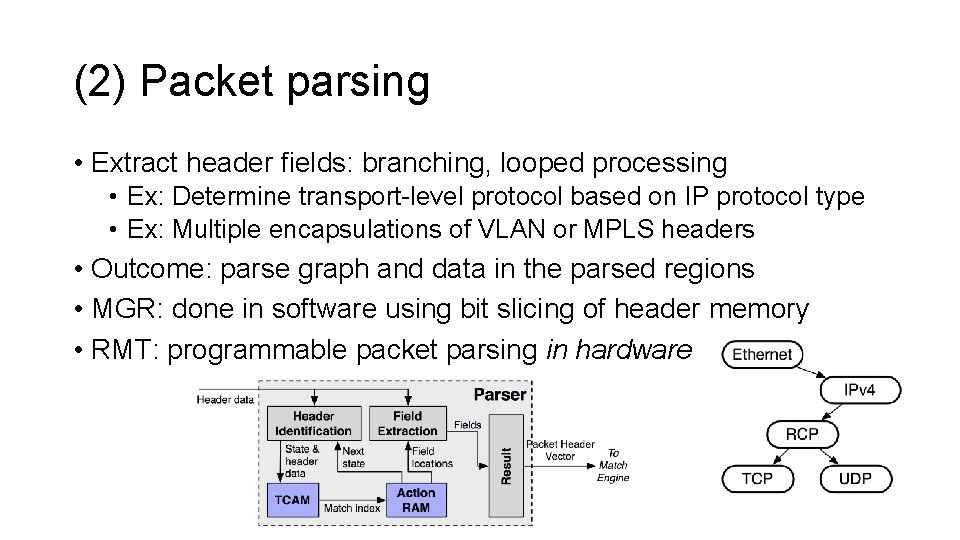
(2) Packet parsing • Extract header fields: branching, looped processing • Ex: Determine transport-level protocol based on IP protocol type • Ex: Multiple encapsulations of VLAN or MPLS headers • Outcome: parse graph and data in the parsed regions • MGR: done in software using bit slicing of header memory • RMT: programmable packet parsing in hardware
(2) Packet parsing • Key principle: Separate the packet header and payload • Conserve bandwidth for data read/written inside switch! • Header continues on to packet lookup/modification • Payload sits on a buffer until router knows what to do with the packet • Buffer could be on the ingress line card (MGR) • But more commonly a buffer shared between line cards (RMT)
Things that routers are expected to do… • RFC 1812: Forward pkts using route lookup, but also … • Update TTL: ttl -= 1 • Update IP checksum (Q: why? ) • IP to link layer mappings across networks (why? ) • Rewrite link layer source address • Special processing (IP options): source route, record route, … • Fragmentation of packets • Multicast • Handle Qo. S assurances, if any
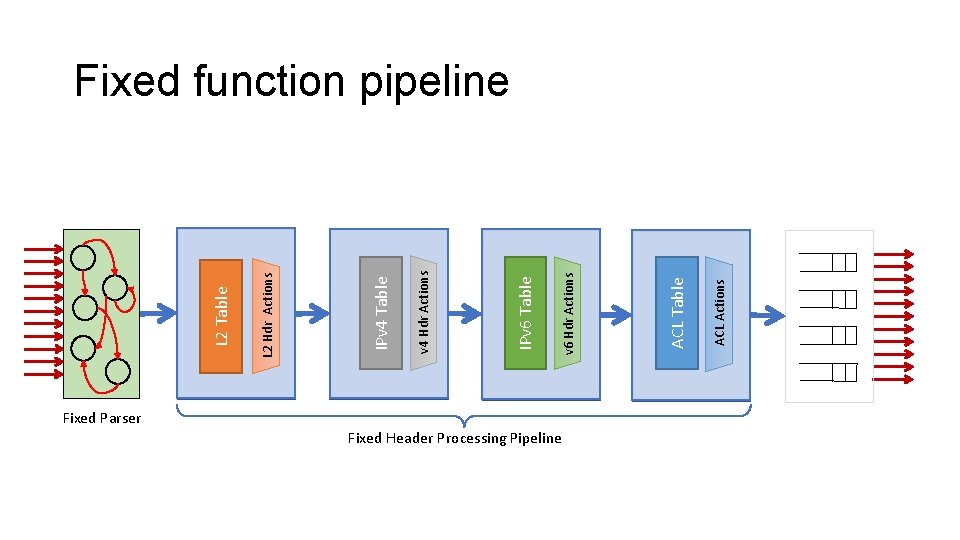
(3) Packet lookup • Typical structure: Sequence of tables (Ex: L 2, L 3, ACL tables) • Exact match lookup • Longest prefix match • Wildcard lookups Interesting algorithmic problems! • Outcome: a (set of) output ports, possible header rewrites • Wide range of table sizes (# entries) and widths (headers) • Header modifications possible (we saw examples earlier) • TTL decrements, IP checksum re-computation • Encapsulate/decapsulate tunneling headers (MPLS, NV-GRE, …) • MAC source address rewrite
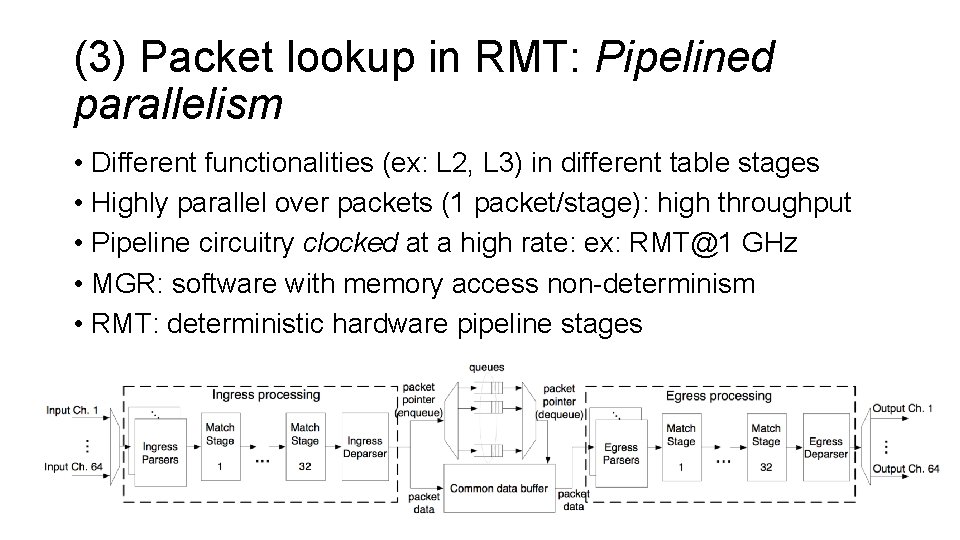
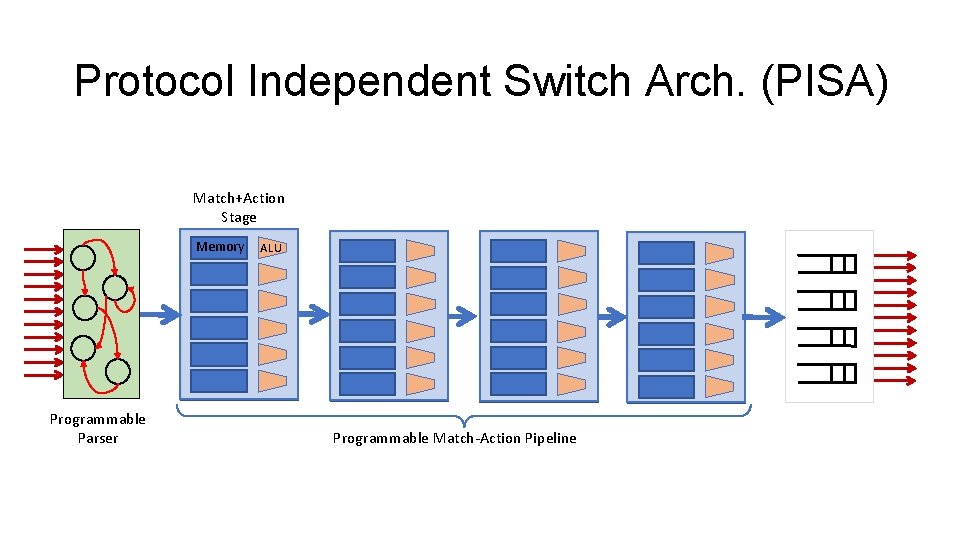
(3) Packet lookup in RMT: Pipelined parallelism • Different functionalities (ex: L 2, L 3) in different table stages • Highly parallel over packets (1 packet/stage): high throughput • Pipeline circuitry clocked at a high rate: ex: RMT@1 GHz • MGR: software with memory access non-determinism • RMT: deterministic hardware pipeline stages
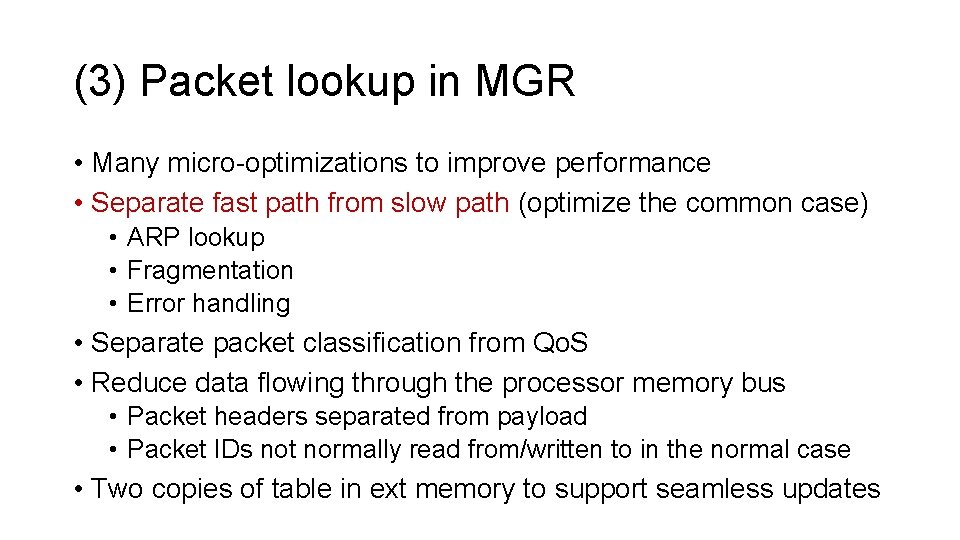
(3) Packet lookup in MGR • A forwarding engine card separate from line cards • Scale forwarding and interface capacity separately • Use Alpha 21164 (a 415 MHz generic processor) • Programmed in assembly
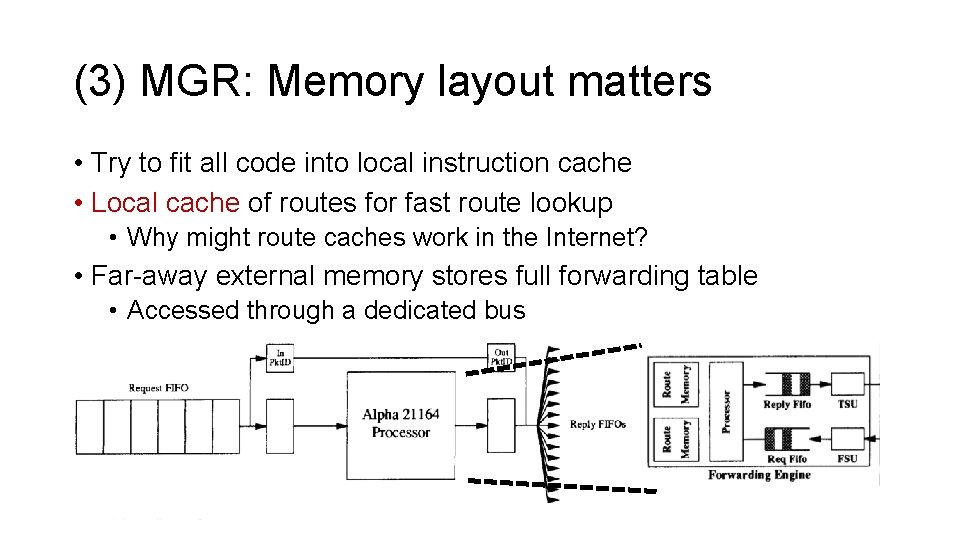
(3) MGR: Memory layout matters • Try to fit all code into local instruction cache • Local cache of routes for fast route lookup • Why might route caches work in the Internet? • Far-away external memory stores full forwarding table • Accessed through a dedicated bus
(3) Packet lookup in MGR • Many micro-optimizations to improve performance • Separate fast path from slow path (optimize the common case) • ARP lookup • Fragmentation • Error handling • Separate packet classification from Qo. S • Reduce data flowing through the processor memory bus • Packet headers separated from payload • Packet IDs not normally read from/written to in the normal case • Two copies of table in ext memory to support seamless updates
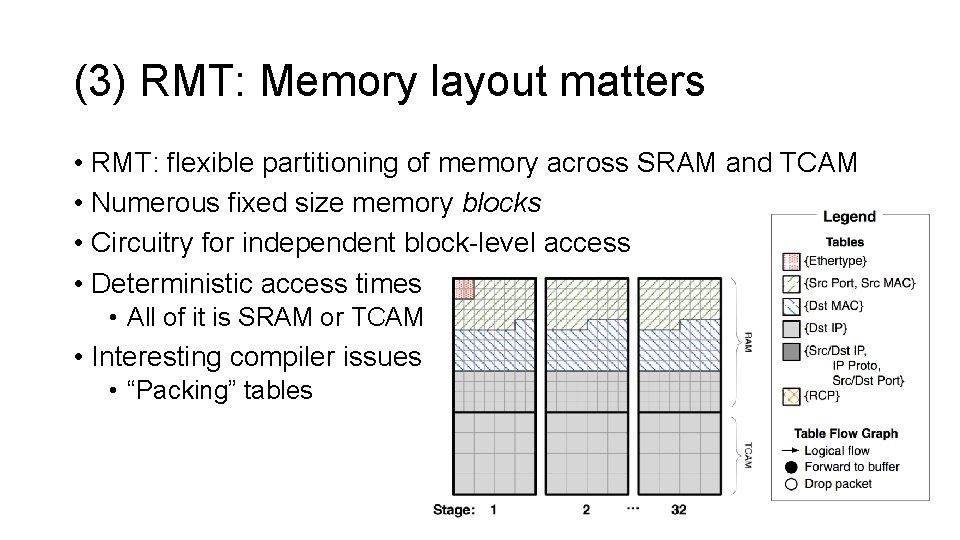
(3) RMT: Memory layout matters • RMT: flexible partitioning of memory across SRAM and TCAM • Numerous fixed size memory blocks • Circuitry for independent block-level access • Deterministic access times • All of it is SRAM or TCAM • Interesting compiler issues • “Packing” tables
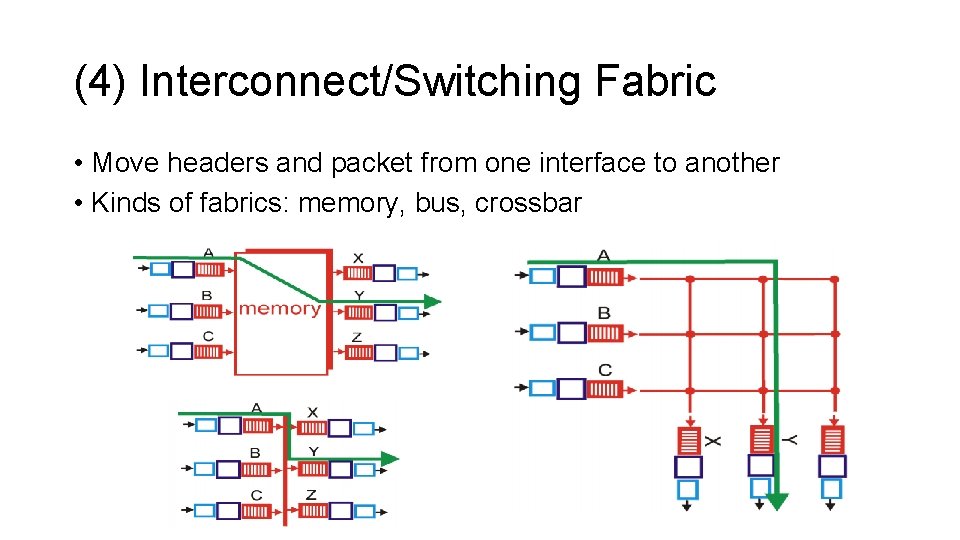
(4) Interconnect/Switching Fabric • Move headers and packet from one interface to another • Kinds of fabrics: memory, bus, crossbar
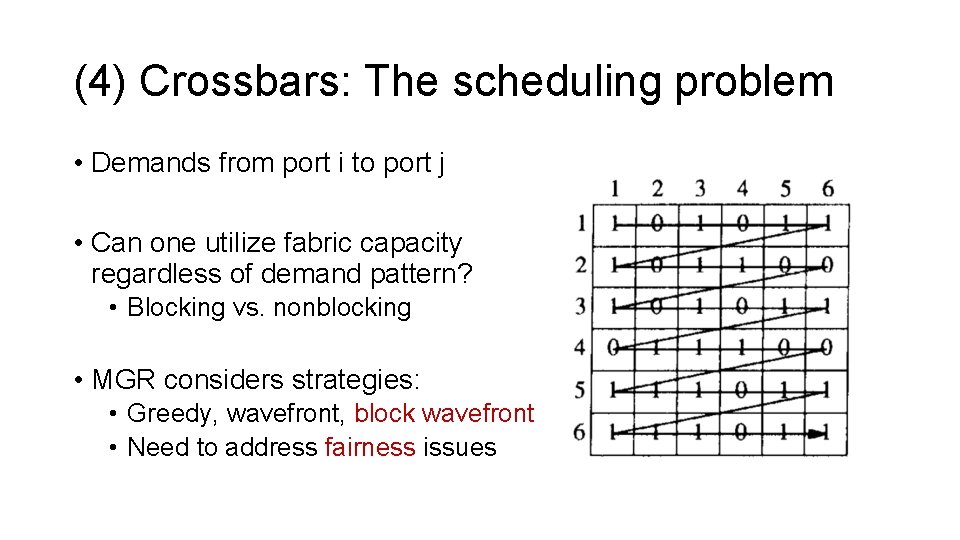
(4) Crossbars: The scheduling problem • Demands from port i to port j • Can one utilize fabric capacity regardless of demand pattern? • Blocking vs. nonblocking • MGR considers strategies: • Greedy, wavefront, block wavefront • Need to address fairness issues
(4) RMT switching fabric • RMT uses shared memory as the fabric to hold packet headers and payloads between any two interfaces • Tradeoff • More wires and power • But implement traffic and buffer management in one place
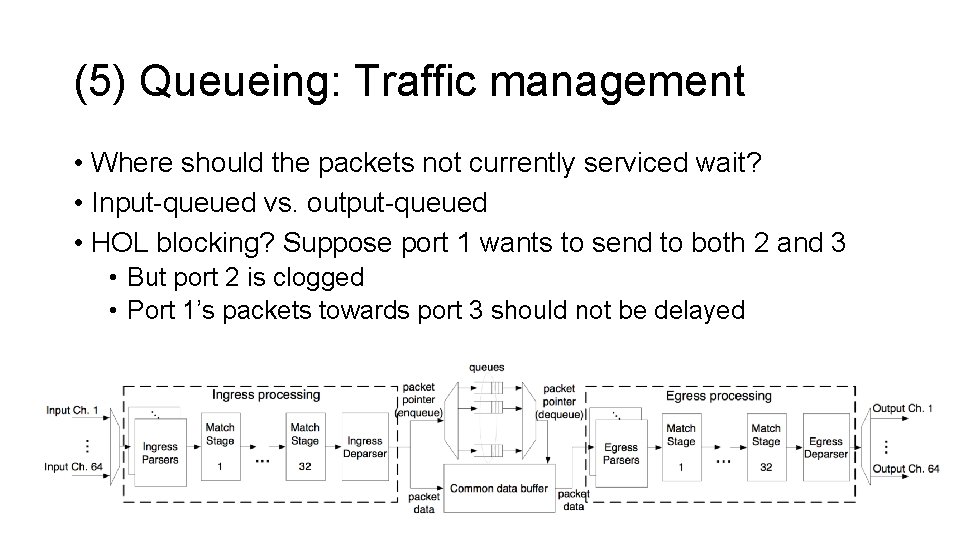
(5) Queueing: Traffic management • Where should the packets not currently serviced wait? • Input-queued vs. output-queued • HOL blocking? Suppose port 1 wants to send to both 2 and 3 • But port 2 is clogged • Port 1’s packets towards port 3 should not be delayed
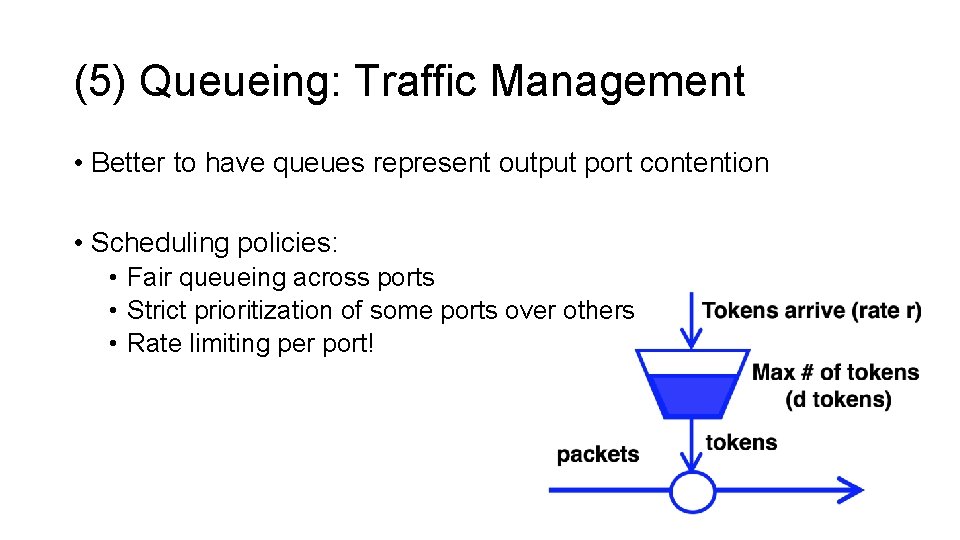
(5) Queueing: Traffic Management • Better to have queues represent output port contention • Scheduling policies: • Fair queueing across ports • Strict prioritization of some ports over others • Rate limiting per port!
(5) Queueing: Buffer Management • Typical buffer management: Tail-drop • How should buffer memory be partitioned across ports? • Static partitioning: if port 1 has no packets, don’t drop port 2 • Shared memory with dynamic partitioning • However, need to share fairly: • If output port 1 is congested, why should port 2 traffic suffer? • Algorithmic problems in dynamic memory sizing across ports
(6) Egress processing • Combine headers with payload for transmission • Need to incorporate header modifications • … also called “deparsing” • Multicast: egress-specific packet processing • Ex: source MAC address • Multicast makes almost everything inside the switch (interconnect, queueing, lookups) more complex
Fixed Parser Fixed Header Processing Pipeline ACL Actions ACL Table v 6 Hdr Actions IPv 6 Table v 4 Hdr Actions IPv 4 Table L 2 Hdr Actions L 2 Table Fixed function pipeline
Protocol Independent Switch Arch. (PISA) Match+Action Stage Memory Programmable Parser ALU Programmable Match-Action Pipeline