
Router Architecture 1 Contents Overview of routers n
- Slides: 54
Router Architecture 張燕光 成大資 1
Contents Overview of routers n Functions of a router n Types of routers n Elements of a router n Packet flow n Packet processing: fast vs slow path n Router architectures n Summary n 2
Router Overview n n n Handle packet forward and routing protocol Traditionally, routers were implemented purely with software running on a PC based on a general purpose CPU with a number of interfaces. Such a device can receive packets on one of its interfaces, perform routing functions, and send packets out on another interface. As Internet traffics grow rapidly, type/size of routers changed since PC-based routers are limited by the performance of CPU and memory Fortunately, advances in silicon technology have made it possible to build hardware-based routers capable of handling high data rates. 3
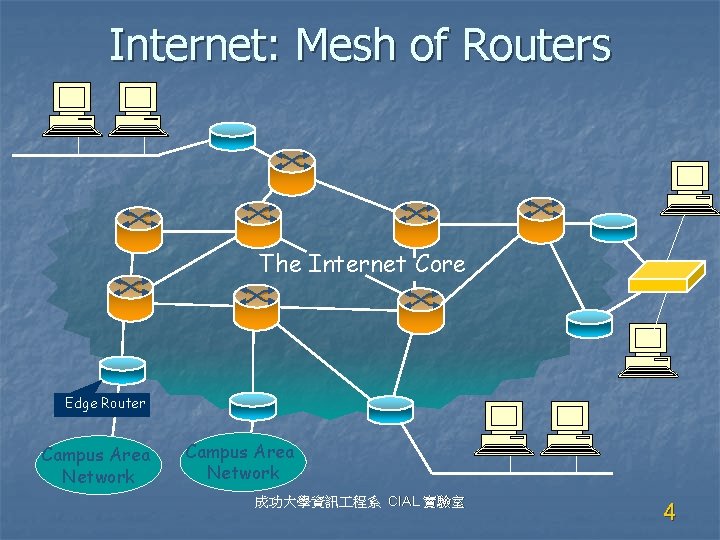
Internet: Mesh of Routers The Internet Core Edge Router Campus Area Network 成功大學資訊 程系 CIAL 實驗室 4
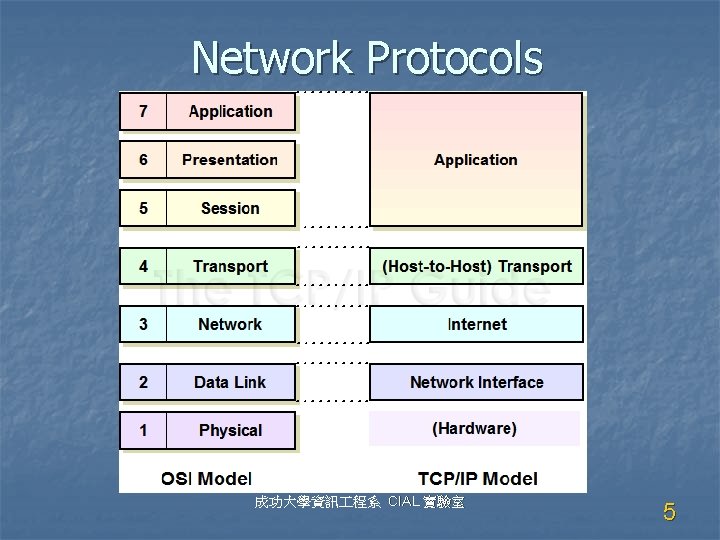
Network Protocols 成功大學資訊 程系 CIAL 實驗室 5
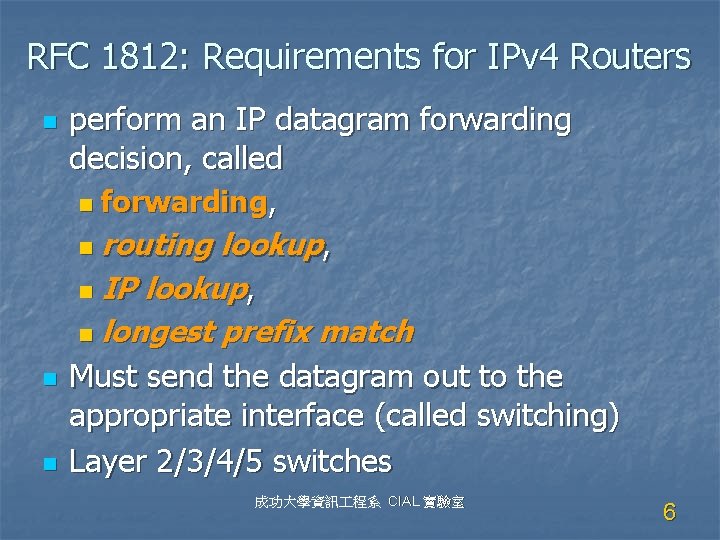
RFC 1812: Requirements for IPv 4 Routers n perform an IP datagram forwarding decision, called n forwarding, routing lookup, n IP lookup, n longest prefix match Must send the datagram out to the appropriate interface (called switching) Layer 2/3/4/5 switches n n n 成功大學資訊 程系 CIAL 實驗室 6
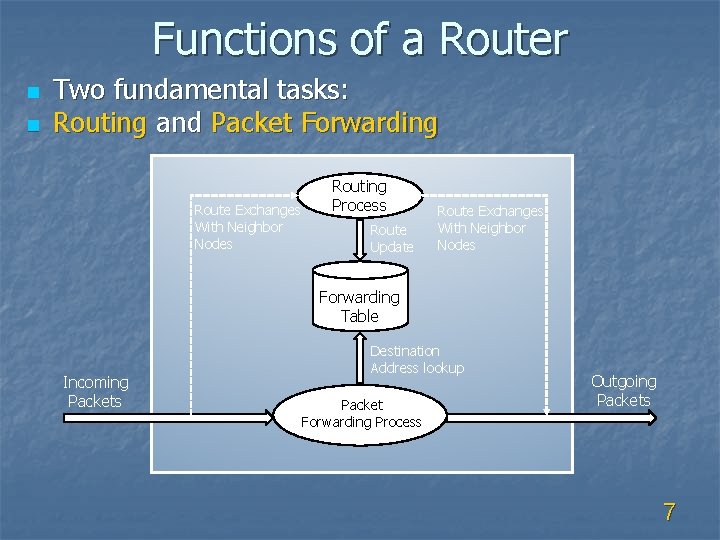
Functions of a Router n n Two fundamental tasks: Routing and Packet Forwarding Route Exchanges With Neighbor Nodes Routing Process Route Update Route Exchanges With Neighbor Nodes Forwarding Table Incoming Packets Destination Address lookup Packet Forwarding Process Outgoing Packets 7
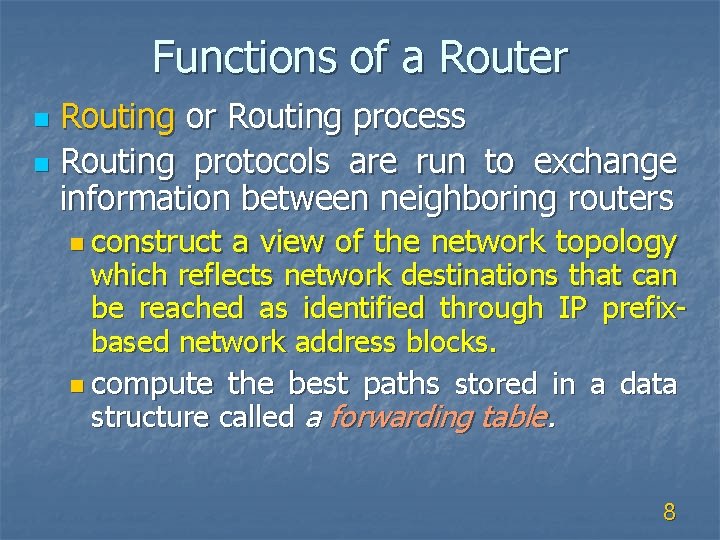
Functions of a Router Routing or Routing process n Routing protocols are run to exchange information between neighboring routers n n construct a view of the network topology which reflects network destinations that can be reached as identified through IP prefixbased network address blocks. n compute the best paths stored in a data structure called a forwarding table. 8
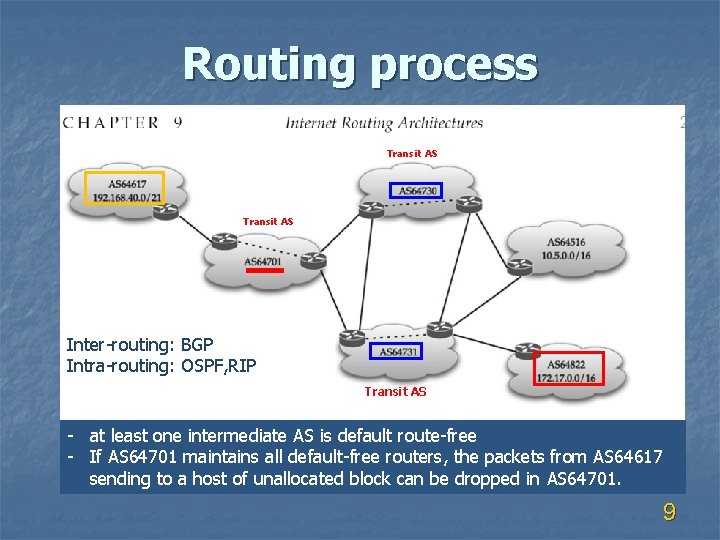
Routing process Transit AS Inter-routing: BGP Intra-routing: OSPF, RIP Transit AS - at least one intermediate AS is default route-free - If AS 64701 maintains all default-free routers, the packets from AS 64617 sending to a host of unallocated block can be dropped in AS 64701. 9
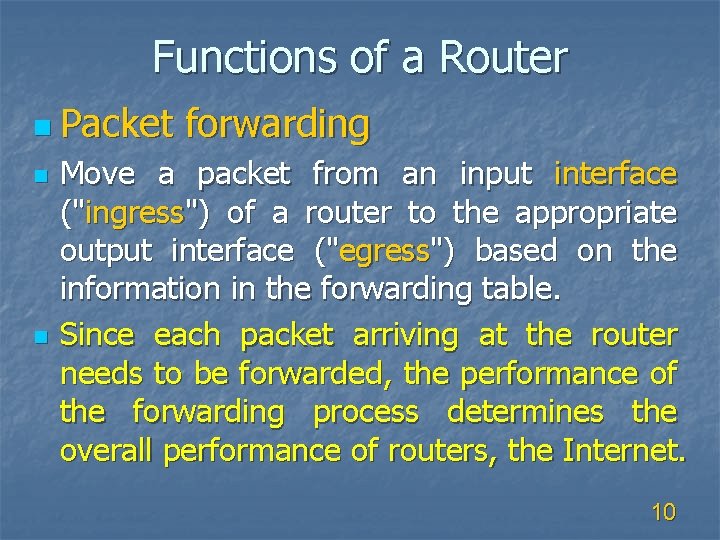
Functions of a Router n Packet n n forwarding Move a packet from an input interface ("ingress'') of a router to the appropriate output interface ("egress") based on the information in the forwarding table. Since each packet arriving at the router needs to be forwarded, the performance of the forwarding process determines the overall performance of routers, the Internet. 10
Functions of a Router n packet forwarding process is further divided into two subgroups: basic and complex Basic forwarding defines the minimal set of functions a router should implement in order to transfer packets between interfaces. n Complex forwarding functions represent the additional processing required by the routers, depending on their deployment environments and their usage. n 11
Basic Forwarding Functions IP Header Validation n Packet Lifetime Control n Checksum Recalculation n Route Lookup n Fragmentation n Handling IP Options n When there are routing or packet errors, routers use ICMP messages to communicate the information. n 12
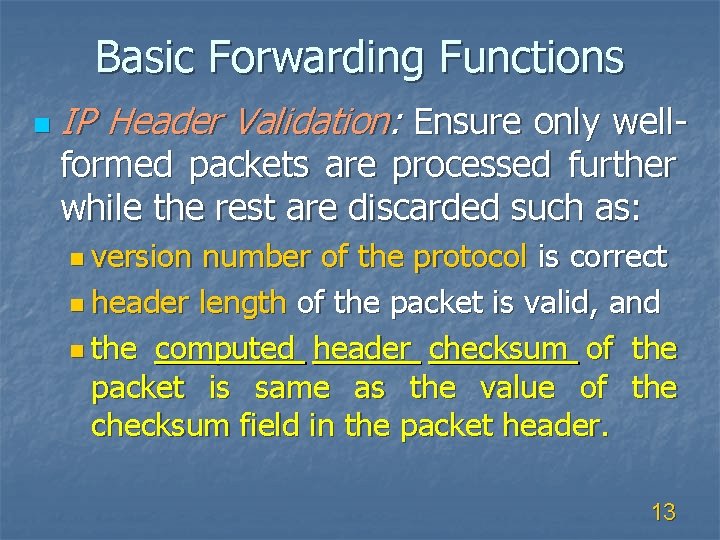
Basic Forwarding Functions n IP Header Validation: Ensure only wellformed packets are processed further while the rest are discarded such as: n version number of the protocol is correct n header length of the packet is valid, and n the computed header checksum of the packet is same as the value of the checksum field in the packet header. 13
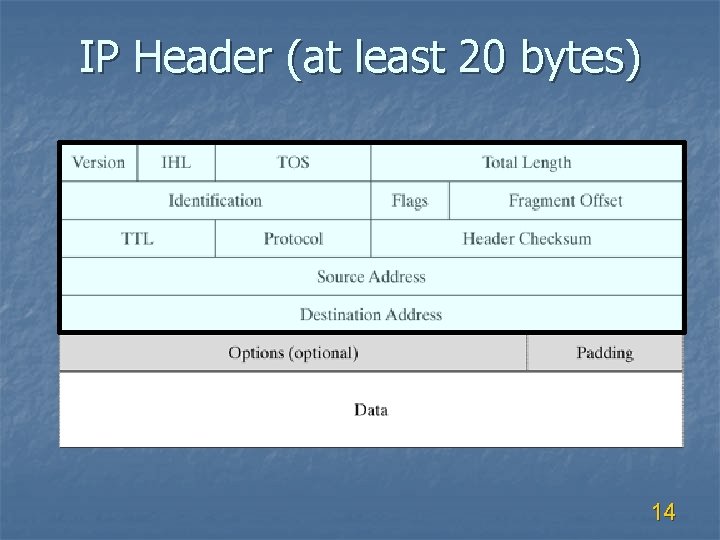
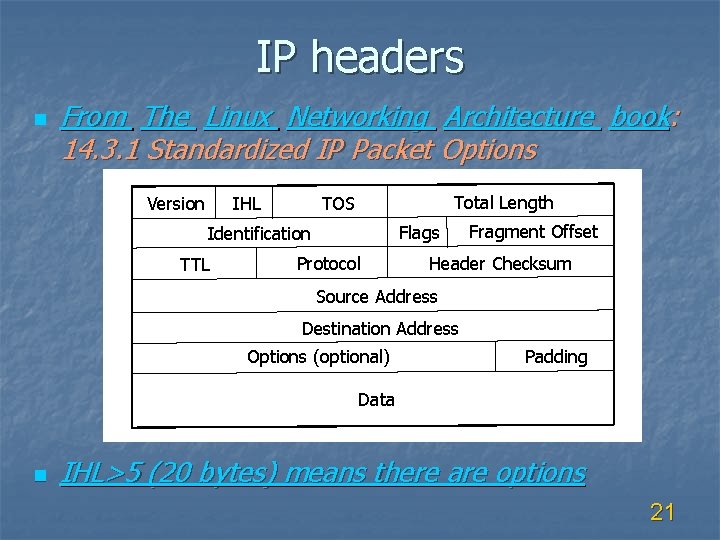
IP Header (at least 20 bytes) 14
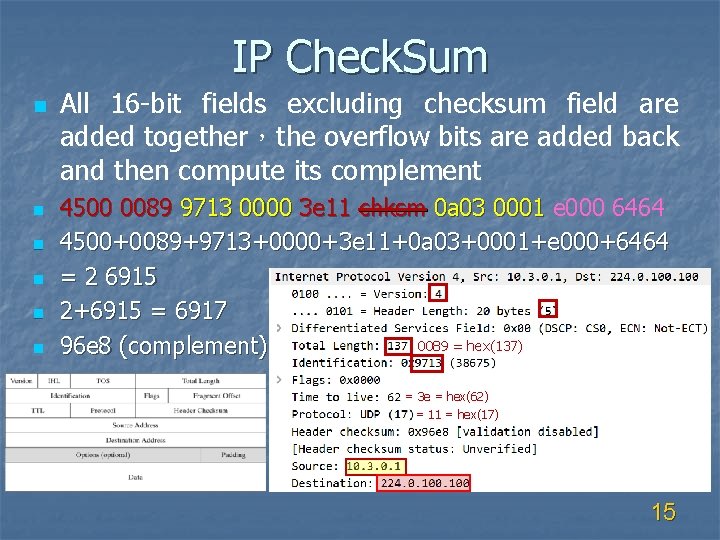
IP Check. Sum n n n All 16 -bit fields excluding checksum field are added together,the overflow bits are added back and then compute its complement 4500 0089 9713 0000 3 e 11 chksm 0 a 03 0001 e 000 6464 4500+0089+9713+0000+3 e 11+0 a 03+0001+e 000+6464 = 2 6915 2+6915 = 6917 0089 = hex(137) 96 e 8 (complement) = 3 e = hex(62) = 11 = hex(17) 15
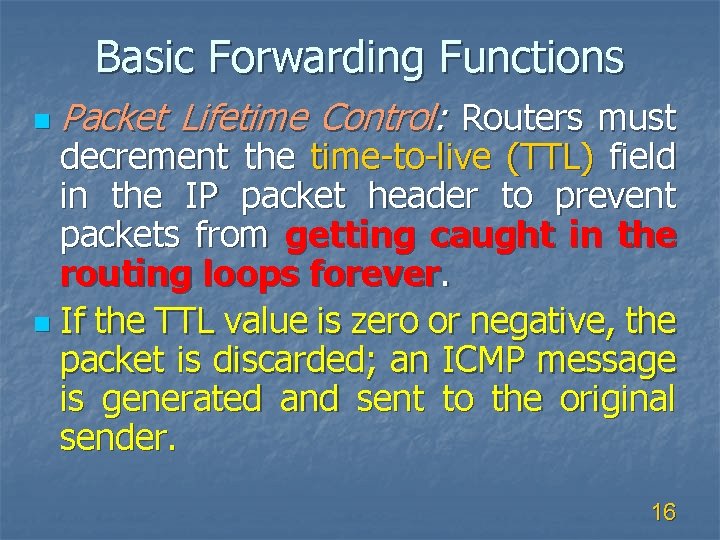
Basic Forwarding Functions n Packet Lifetime Control: Routers must decrement the time-to-live (TTL) field in the IP packet header to prevent packets from getting caught in the routing loops forever. n If the TTL value is zero or negative, the packet is discarded; an ICMP message is generated and sent to the original sender. 16
Basic Forwarding Functions n Checksum Recalculation: Since the value of the TTL is modified, the header checksum needs to be updated. n Instead of computing the entire header checksum again, it is more efficient to compute it incrementally; after all, the TTL value is always decremented by 1. 17
Basic Forwarding Functions n Route Lookup: The destination address of the packet is used to search the forwarding table for determining the output port. n The result of this search will indicate whether the packet is destined for the router to an output port (unicast) or n to a set of multiple output ports ( multicast). n 18
Basic Forwarding Functions n Fragmentation: It is possible that the maximum transmission unit (MTU) of the outgoing link is smaller than the size of the packet that needs to be transmitted. n The packet would need to be split into multiple fragments before transmission. 19
Basic Forwarding Functions n Handling IP Options: The presence of the IP options field indicates that there are special processing needs for the packet at the router. n While such packets might arrive infrequently, a router nonetheless needs to support those processing needs. 20
IP headers n From The Linux Networking Architecture book: 14. 3. 1 Standardized IP Packet Options Version IHL Total Length TOS Flags Identification TTL Protocol Fragment Offset Header Checksum Source Address Destination Address Options (optional) Padding Data n IHL>5 (20 bytes) means there are options 21
Complex Forwarding Functions n Security, different user requirements, and service guarantees based on different service level agreements (SLA) Service differentiation example: watching a high -definition movie streaming directly over the Internet which requires (1) high bandwidth and (2) timely delivery of the data. n The router needs to distinguish such packets so that it can forward them earlier. n This results in the notion of differentiated services, and consequently requires that routers support a variety of mechanisms as follows: n 22
Complex Forwarding Functions n Packet Classification For distinguishing packets, a router might need to examine not only the destination IP address but also other fields such as source address, destination port, and source port, and protocol number. n Matching these headers against certain rules to find the matched rule whose actions are then applied. n 23
Complex Forwarding Functions n Packet Translation As the public IPv 4 address space is being exhausted, there is a need to map several hosts to a single public address. n Thus, a router that acts as a gateway to a network needs to support network address translation (NAT). n NAT maps a public IP address into a set of private IP addresses and vice versa. n This requires a router to maintain a list of connected hosts and their local addresses and to translate the incoming and outgoing packets. n 24
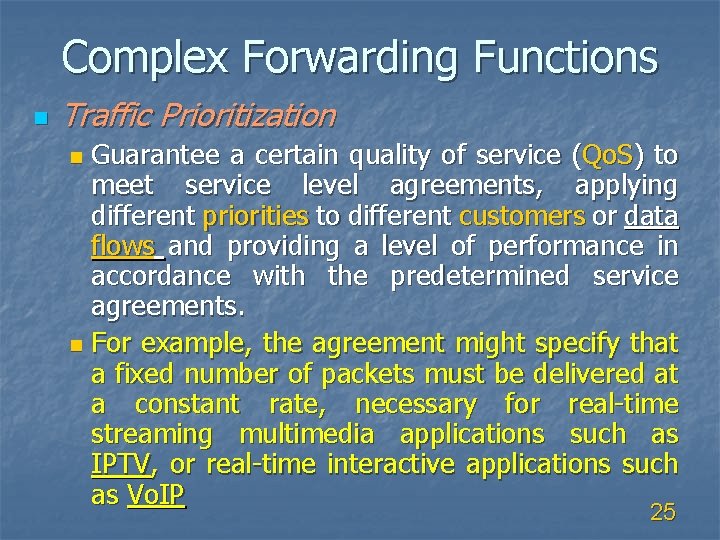
Complex Forwarding Functions n Traffic Prioritization Guarantee a certain quality of service (Qo. S) to meet service level agreements, applying different priorities to different customers or data flows and providing a level of performance in accordance with the predetermined service agreements. n For example, the agreement might specify that a fixed number of packets must be delivered at a constant rate, necessary for real-time streaming multimedia applications such as IPTV, or real-time interactive applications such as Vo. IP n 25
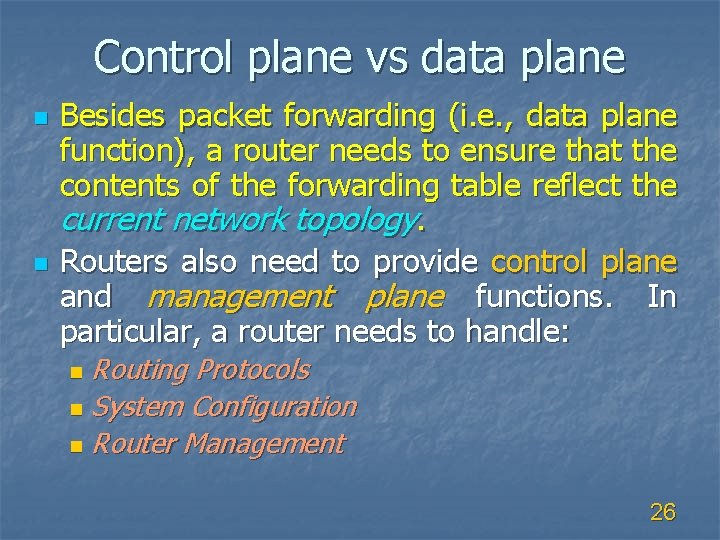
Control plane vs data plane n n Besides packet forwarding (i. e. , data plane function), a router needs to ensure that the contents of the forwarding table reflect the current network topology. Routers also need to provide control plane and management plane functions. In particular, a router needs to handle: Routing Protocols n System Configuration n Router Management n 26
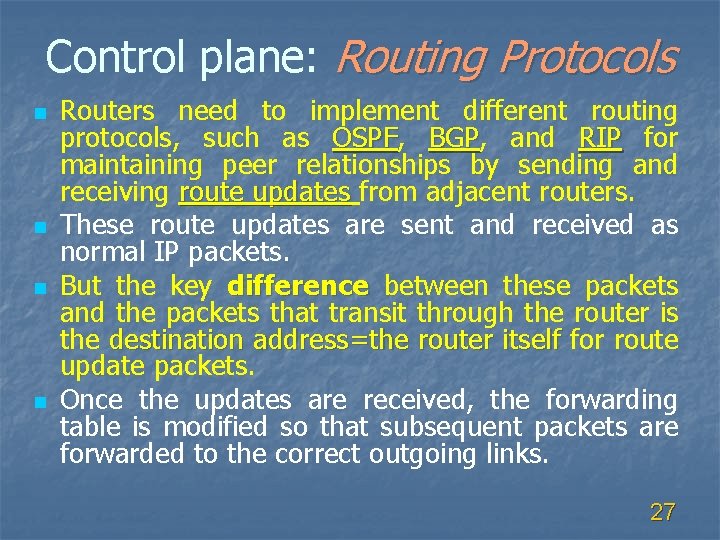
Control plane: Routing Protocols n n Routers need to implement different routing protocols, such as OSPF, OSPF BGP, BGP and RIP for maintaining peer relationships by sending and receiving route updates from adjacent routers. These route updates are sent and received as normal IP packets. But the key difference between these packets and the packets that transit through the router is the destination address=the router itself for route update packets. Once the updates are received, the forwarding table is modified so that subsequent packets are forwarded to the correct outgoing links. 27
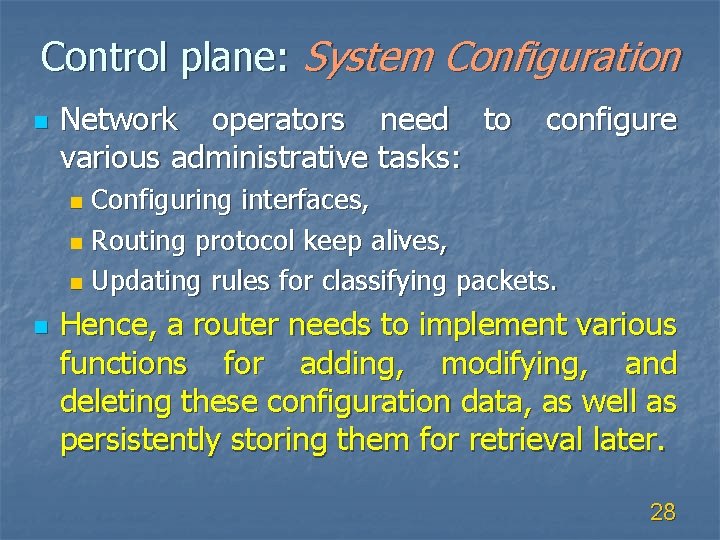
Control plane: System Configuration n Network operators need to various administrative tasks: configure Configuring interfaces, n Routing protocol keep alives, n Updating rules for classifying packets. n n Hence, a router needs to implement various functions for adding, modifying, and deleting these configuration data, as well as persistently storing them for retrieval later. 28
Control plane: Router Management Routers need to be monitored for continuous operations. n These functions include supporting various management functions that are implemented using protocols such as simple network management protocol (SNMP). n 29
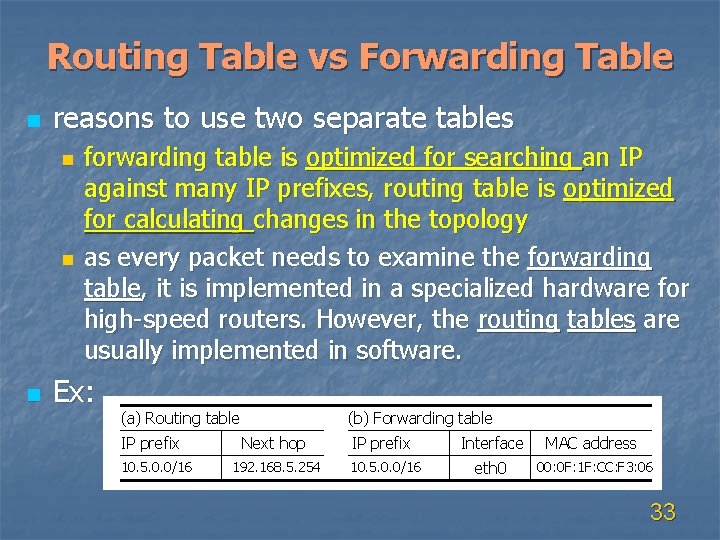
Routing Table vs Forwarding Table The routing function builds a routing table that is used to construct forwarding tables. n Often, in the literature, the terms routing table and forwarding table are used interchangeably to refer to the data structures in a router forwarding packets. n 30
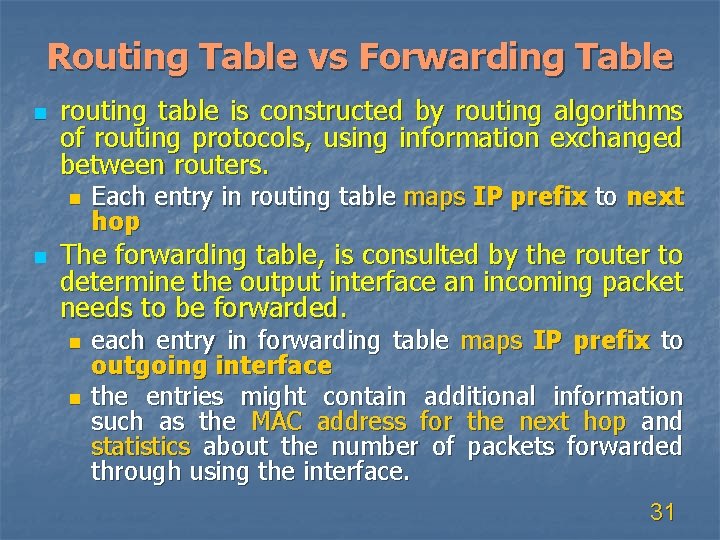
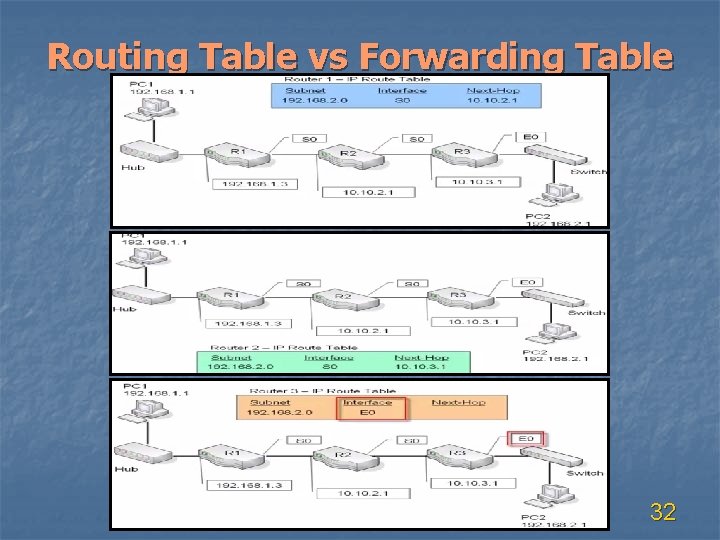
Routing Table vs Forwarding Table n routing table is constructed by routing algorithms of routing protocols, using information exchanged between routers. n n Each entry in routing table maps IP prefix to next hop The forwarding table, is consulted by the router to determine the output interface an incoming packet needs to be forwarded. n n each entry in forwarding table maps IP prefix to outgoing interface the entries might contain additional information such as the MAC address for the next hop and statistics about the number of packets forwarded through using the interface. 31
Routing Table vs Forwarding Table 32
Routing Table vs Forwarding Table n reasons to use two separate tables n n n forwarding table is optimized for searching an IP against many IP prefixes, routing table is optimized for calculating changes in the topology as every packet needs to examine the forwarding table, it is implemented in a specialized hardware for high-speed routers. However, the routing tables are usually implemented in software. Ex: (b) Forwarding table (a) Routing table IP prefix 10. 5. 0. 0/16 Next hop 192. 168. 5. 254 IP prefix 10. 5. 0. 0/16 Interface MAC address eth 0 00: 0 F: 1 F: CC: F 3: 06 33
Different between a routing table and a forwarding table n n The control plane is the "brain" of the router and handles things as management of the device and routing protocols among other things. It is sometimes called a "routing engine" or "supervisor" by vendors. The forwarding plane is responsible for the actual packet forwarding. In bigger routers it is often implemented by specialized chips and very fast memory for route lookups. The routing table (or more than one routing table) resides in control plane. It contains routing information received through routing protocols (OSPF, BGP, . . . ) and from configuration (connected routes, static routes). There may be more than one entry for a given prefix if multiple routing information is received by the control plane. From all these information the "best" path for a prefix is selected and collected in forwarding table. Forwarding table has definitive destination information where a packet is routed for any given IP prefix (or MAC address depending on the layer). This forwarding table is then pushed into the forwarding plane of the router and often distributed into each linecard in bigger chassis based routers. 34
BGP update and routing tables n n n https: //www. isolario. it/Isolario_MRT_data/ http: //archive. routeviews. org/routeviews. sg/bgpdata/2018. 12/RIBS/ n http: //archive. routeviews. org/ https: //www. ripe. net/analyse/internetmeasurements/routing-information-serviceris/ris-raw-data 35
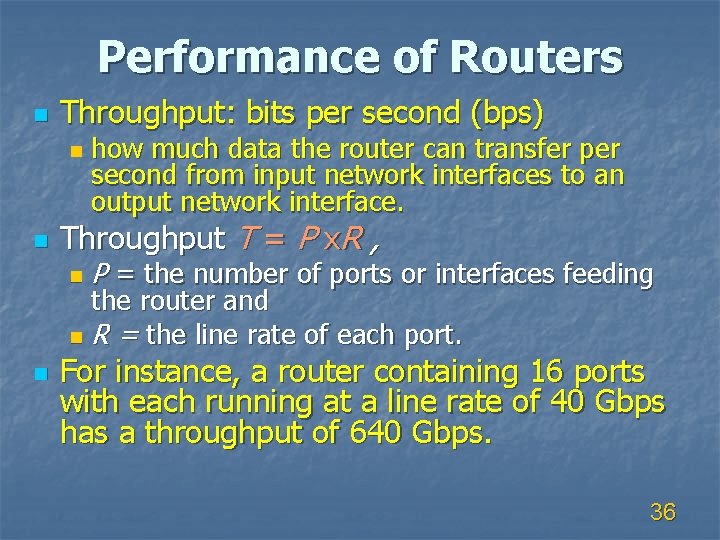
Performance of Routers n Throughput: bits per second (bps) n n how much data the router can transfer per second from input network interfaces to an output network interface. Throughput T = P x. R , n P = the number of ports or interfaces feeding the router and n R = the line rate of each port. n For instance, a router containing 16 ports with each running at a line rate of 40 Gbps has a throughput of 640 Gbps. 36
Performance of Routers n n As routers forward packets, it is more important to know how many packets they are capable of forwarding in a second, which is referred to as packets per second (pps). For instance, a router throughput of 640 Gbps could mean packets of size 40 bytes forwarded at 2 billion pps or packets of size 80 bytes forwarded at 1 billion pps. 37
Performance of Routers n n n What should be the packet size used? In a decade-old study, the average packet size was found to be 300 bytes In recent observations, commonly seen sizes are n n n 40 bytes = 20 bytes (IP header) + 20 bytes (TCP header), ex. TCP acknowledgments, 576 bytes (RFC 879, which is now outdated), 1500 bytes (Ethernet MTU size), 1300 bytes (VPN software), 64 bytes. If a router is designed with any of these sizes other than the smallest size, it might not be able to sustain a long sequence of shorter packets. Thus, most use the minimum of 40 bytes as the standard packet size for such assessment. 38
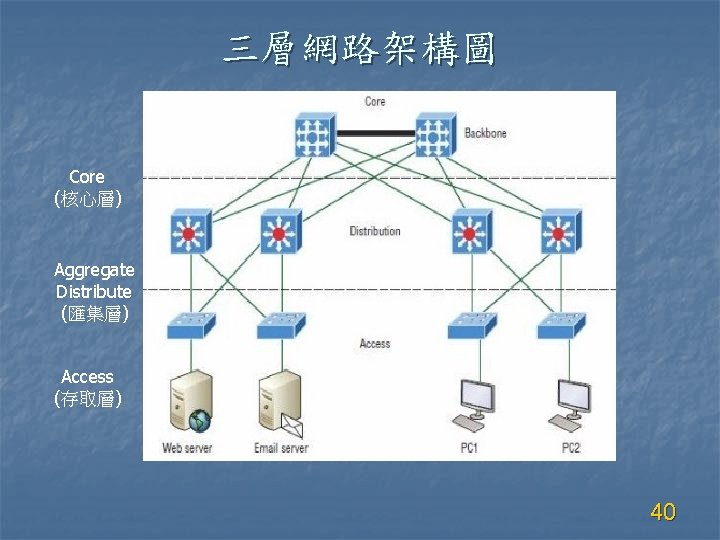
Types of Routers n Routers can be of different complexity based on n where in the network they are deployed n how much traffic they need to sustain. Naturally, this means that routers can be of different types. n three types of routers: core routers, edge routers, and enterprise routers n their requirements will be outlined n 39
三層網路架構圖 Core (核心層) Aggregate Distribute (匯集層) Access (存取層) 40
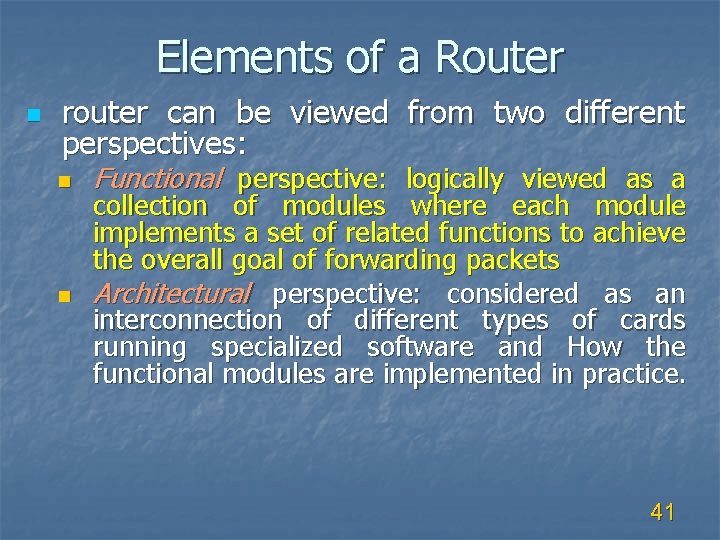
Elements of a Router n router can be viewed from two different perspectives: n n Functional perspective: logically viewed as a collection of modules where each module implements a set of related functions to achieve the overall goal of forwarding packets Architectural perspective: considered as an interconnection of different types of cards running specialized software and How the functional modules are implemented in practice. 41
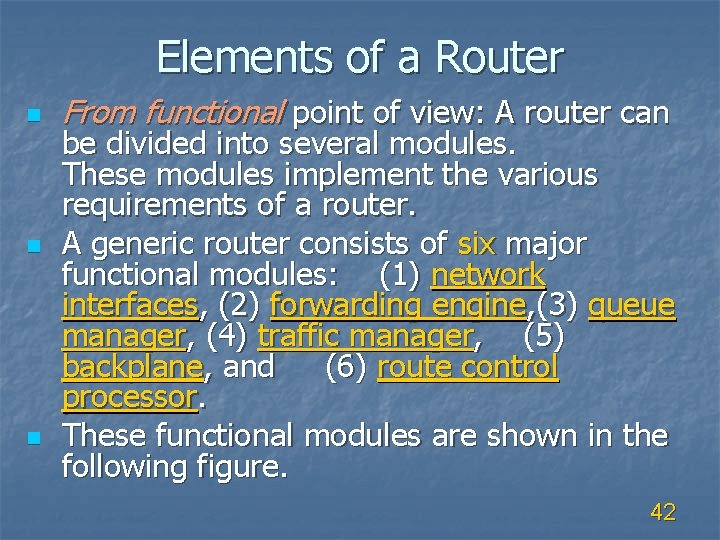
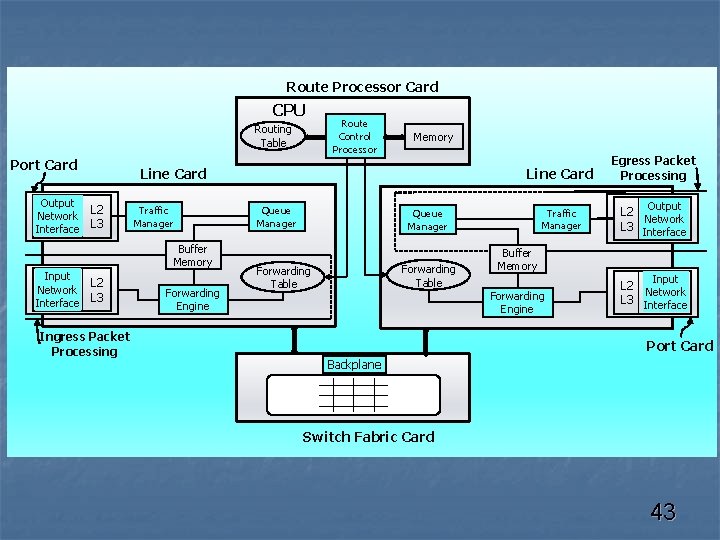
Elements of a Router n n n From functional point of view: A router can be divided into several modules. These modules implement the various requirements of a router. A generic router consists of six major functional modules: (1) network interfaces, (2) forwarding engine, (3) queue manager, (4) traffic manager, (5) backplane, and (6) route control processor. These functional modules are shown in the following figure. 42
Route Processor Card CPU Routing Table Port Card Output Network L 2 Interface L 3 Output Input Network L 2 Interface L 3 Interface Ingress Packet Processing Route Control Processor Memory Line Card Traffic Manager Queue Manager Buffer Memory Forwarding Engine Traffic Manager Queue Manager Forwarding Table Buffer Memory Forwarding Engine Egress Packet Processing Output L 2 Network L 3 Interface Output Input L 2 Network L 3 Interface Port Card Backplane Switch Fabric Card 43
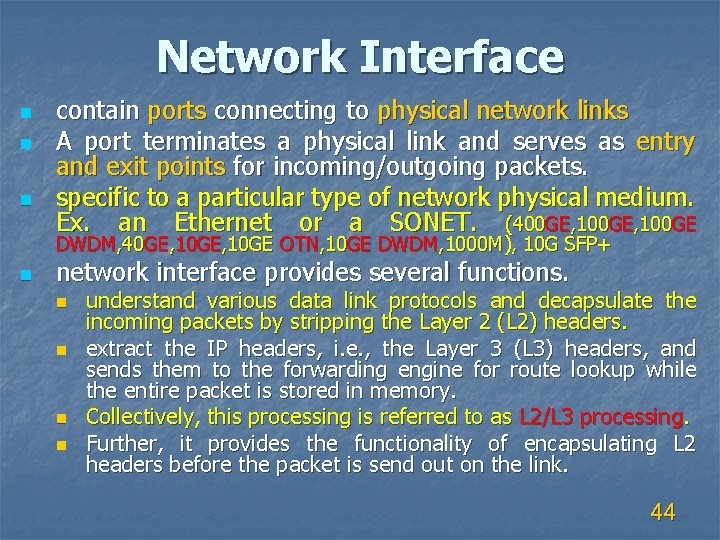
Network Interface n n n contain ports connecting to physical network links A port terminates a physical link and serves as entry and exit points for incoming/outgoing packets. specific to a particular type of network physical medium. Ex. an Ethernet or a SONET. (400 GE, 100 GE DWDM, 40 GE, 10 GE OTN, 10 GE DWDM, 1000 M), 10 G SFP+ n network interface provides several functions. n n understand various data link protocols and decapsulate the incoming packets by stripping the Layer 2 (L 2) headers. extract the IP headers, i. e. , the Layer 3 (L 3) headers, and sends them to the forwarding engine for route lookup while the entire packet is stored in memory. Collectively, this processing is referred to as L 2/L 3 processing. Further, it provides the functionality of encapsulating L 2 headers before the packet is send out on the link. 44
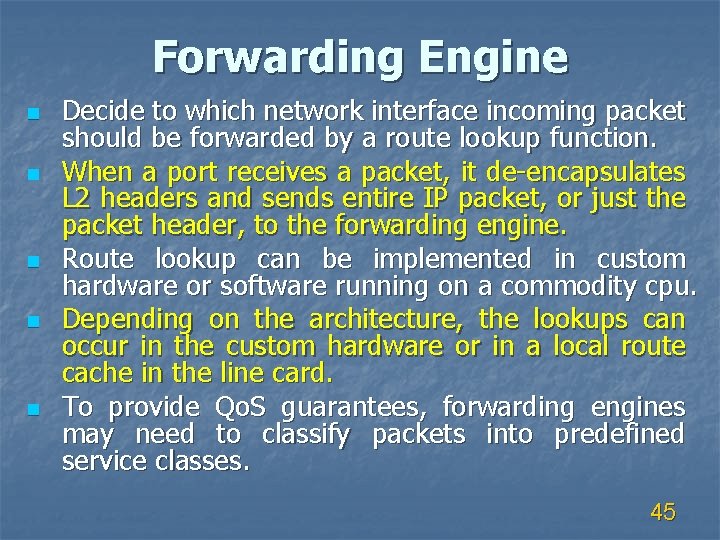
Forwarding Engine n n n Decide to which network interface incoming packet should be forwarded by a route lookup function. When a port receives a packet, it de-encapsulates L 2 headers and sends entire IP packet, or just the packet header, to the forwarding engine. Route lookup can be implemented in custom hardware or software running on a commodity cpu. Depending on the architecture, the lookups can occur in the custom hardware or in a local route cache in the line card. To provide Qo. S guarantees, forwarding engines may need to classify packets into predefined service classes. 45
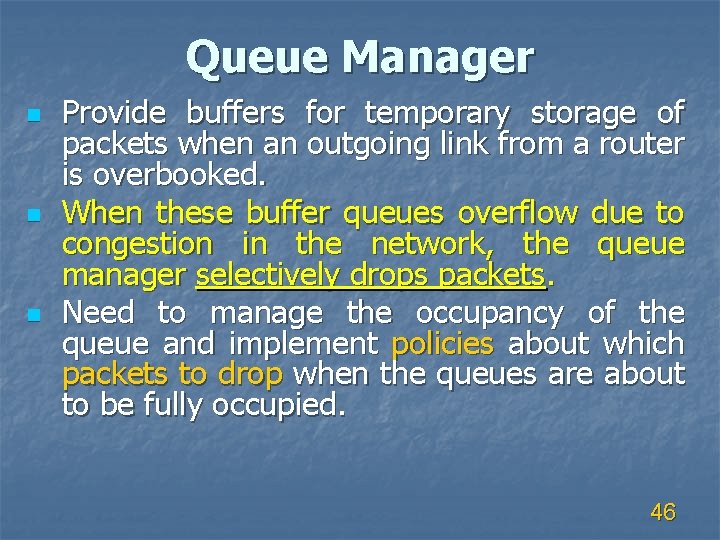
Queue Manager n n n Provide buffers for temporary storage of packets when an outgoing link from a router is overbooked. When these buffer queues overflow due to congestion in the network, the queue manager selectively drops packets. Need to manage the occupancy of the queue and implement policies about which packets to drop when the queues are about to be fully occupied. 46
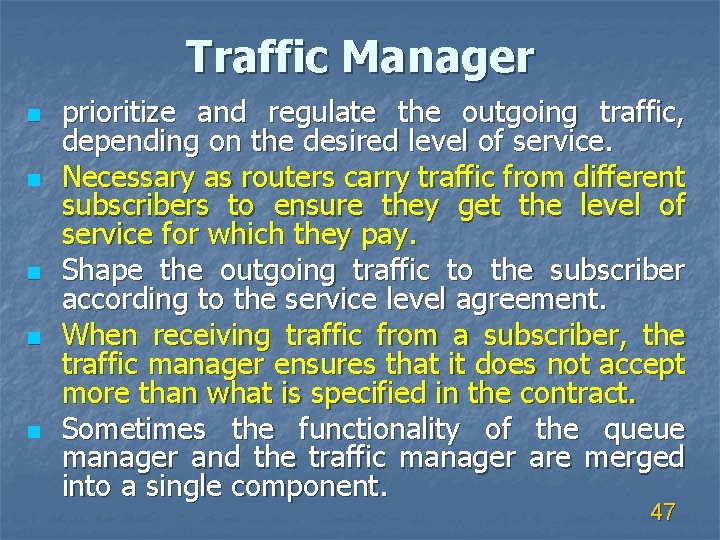
Traffic Manager n n n prioritize and regulate the outgoing traffic, depending on the desired level of service. Necessary as routers carry traffic from different subscribers to ensure they get the level of service for which they pay. Shape the outgoing traffic to the subscriber according to the service level agreement. When receiving traffic from a subscriber, the traffic manager ensures that it does not accept more than what is specified in the contract. Sometimes the functionality of the queue manager and the traffic manager are merged into a single component. 47
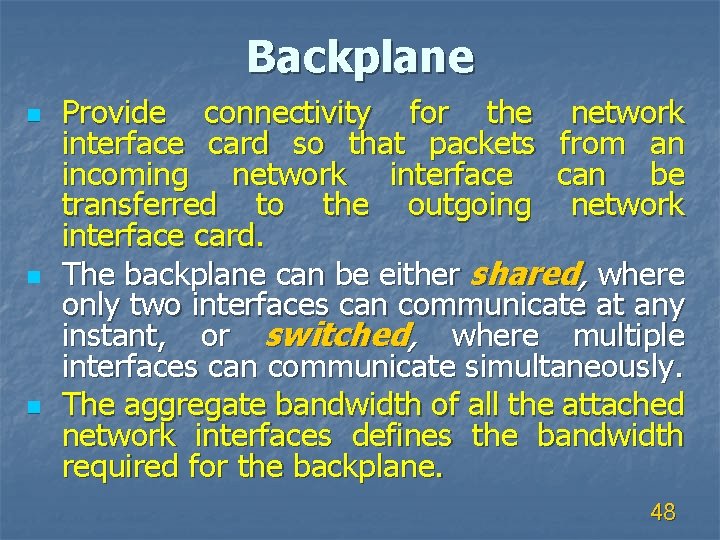
Backplane n n n Provide connectivity for the network interface card so that packets from an incoming network interface can be transferred to the outgoing network interface card. The backplane can be either shared, where only two interfaces can communicate at any instant, or switched, where multiple interfaces can communicate simultaneously. The aggregate bandwidth of all the attached network interfaces defines the bandwidth required for the backplane. 48
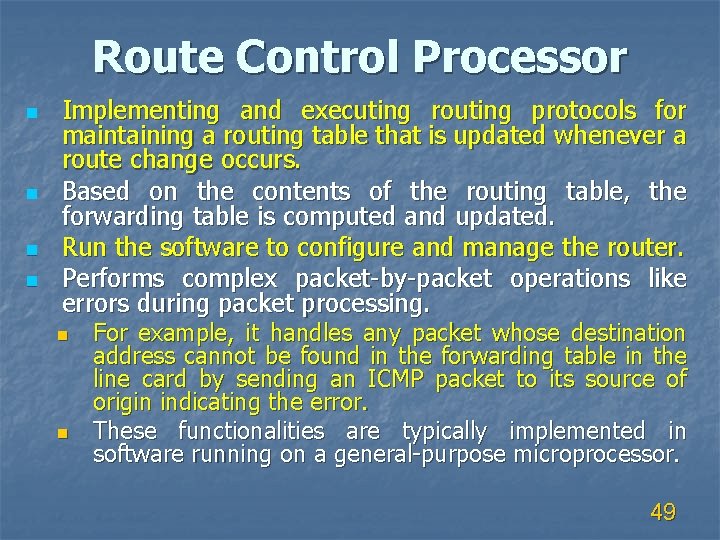
Route Control Processor n n Implementing and executing routing protocols for maintaining a routing table that is updated whenever a route change occurs. Based on the contents of the routing table, the forwarding table is computed and updated. Run the software to configure and manage the router. Performs complex packet-by-packet operations like errors during packet processing. n n For example, it handles any packet whose destination address cannot be found in the forwarding table in the line card by sending an ICMP packet to its source of origin indicating the error. These functionalities are typically implemented in software running on a general-purpose microprocessor. 49
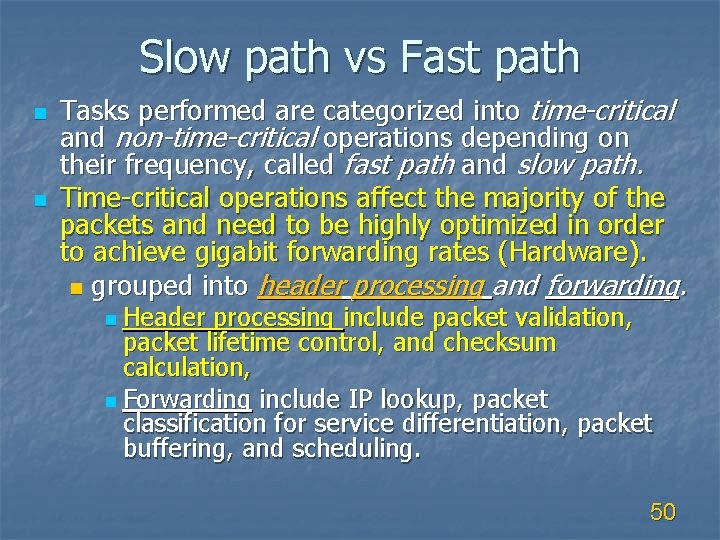
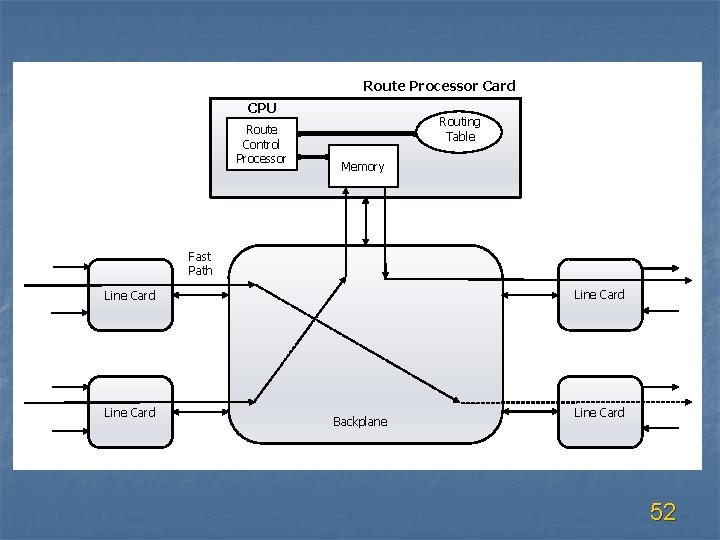
Slow path vs Fast path n n Tasks performed are categorized into time-critical and non-time-critical operations depending on their frequency, called fast path and slow path. Time-critical operations affect the majority of the packets and need to be highly optimized in order to achieve gigabit forwarding rates (Hardware). n grouped into header processing and forwarding. n Header processing include packet validation, packet lifetime control, and checksum calculation, n Forwarding include IP lookup, packet classification for service differentiation, packet buffering, and scheduling. 50
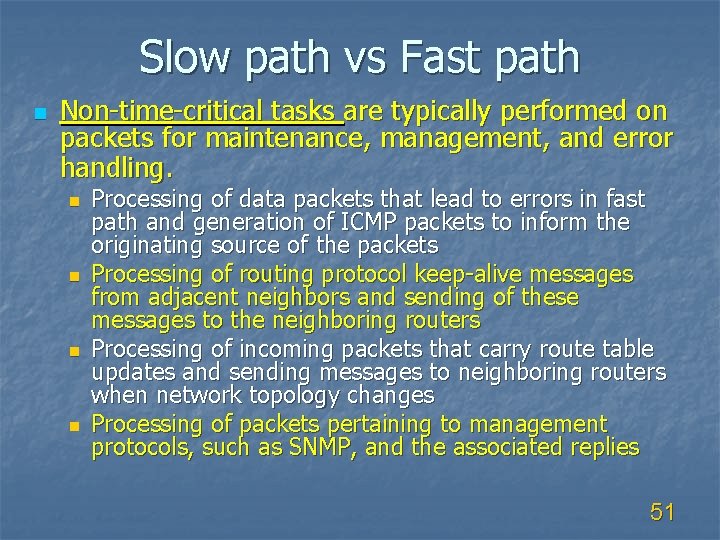
Slow path vs Fast path n Non-time-critical tasks are typically performed on packets for maintenance, management, and error handling. n n Processing of data packets that lead to errors in fast path and generation of ICMP packets to inform the originating source of the packets Processing of routing protocol keep-alive messages from adjacent neighbors and sending of these messages to the neighboring routers Processing of incoming packets that carry route table updates and sending messages to neighboring routers when network topology changes Processing of packets pertaining to management protocols, such as SNMP, and the associated replies 51
Route Processor Card CPU Route Control Processor Routing Table Memory Fast Path Line Card Backplane Line Card 52
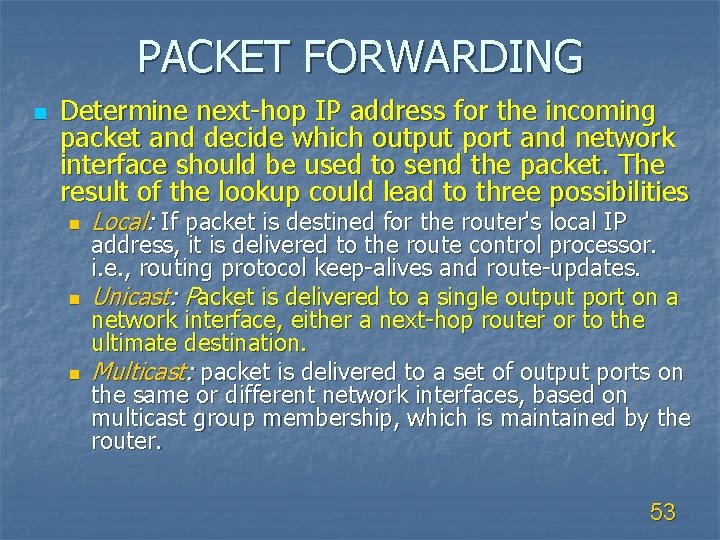
PACKET FORWARDING n Determine next-hop IP address for the incoming packet and decide which output port and network interface should be used to send the packet. The result of the lookup could lead to three possibilities n n n Local: If packet is destined for the router's local IP address, it is delivered to the route control processor. i. e. , routing protocol keep-alives and route-updates. Unicast: Packet is delivered to a single output port on a network interface, either a next-hop router or to the ultimate destination. Multicast: packet is delivered to a set of output ports on the same or different network interfaces, based on multicast group membership, which is maintained by the router. 53
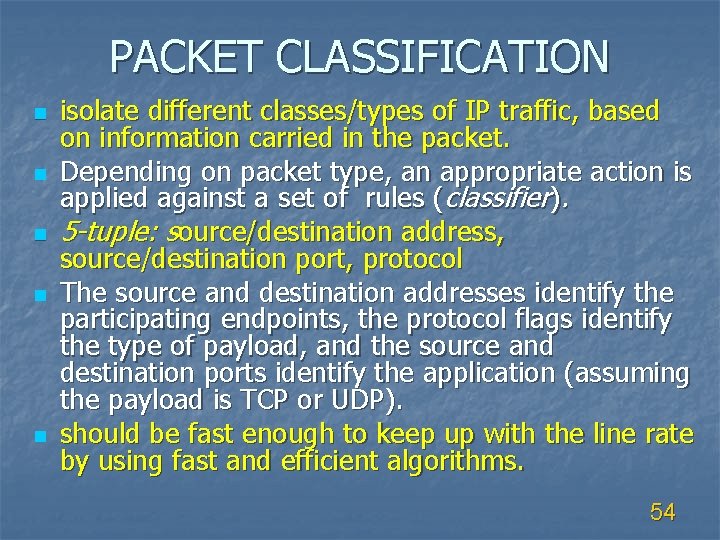
PACKET CLASSIFICATION n n n isolate different classes/types of IP traffic, based on information carried in the packet. Depending on packet type, an appropriate action is applied against a set of rules (classifier). 5 -tuple: source/destination address, source/destination port, protocol The source and destination addresses identify the participating endpoints, the protocol flags identify the type of payload, and the source and destination ports identify the application (assuming the payload is TCP or UDP). should be fast enough to keep up with the line rate by using fast and efficient algorithms. 54