
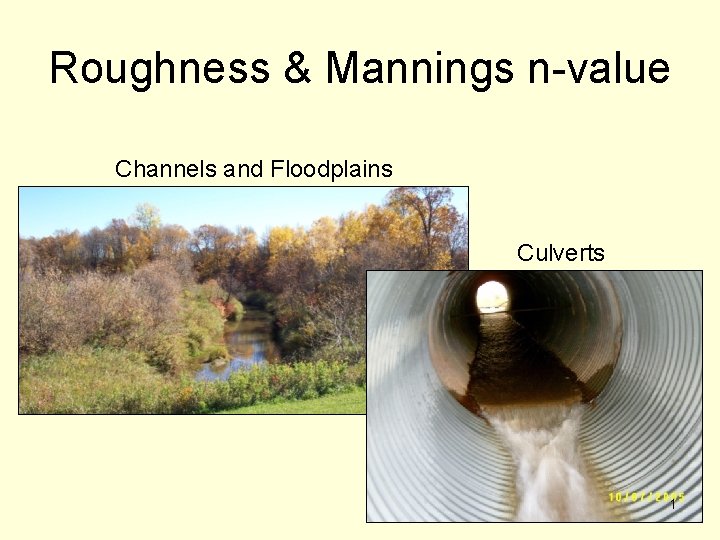
Roughness Mannings nvalue Channels and Floodplains Culverts 1
- Slides: 29
Roughness & Mannings n-value Channels and Floodplains Culverts 1
Teaching Objective • Understand that: – resistance to flow depends on roughness – Manning’s n value is simply a parameter used by hydraulic engineers to represent roughness – Roughness changes with time (e. g. brush growing in channels, culverts aging & deteriorating) • Learn how “n” values affect hydraulic parameters • Obtain basic information on choosing or calculating n values 2
Application • From an analytical standpoint, Mannings n value is a coefficient that needs to be chosen to calculate or model flow • Used for both culverts and open channels 3
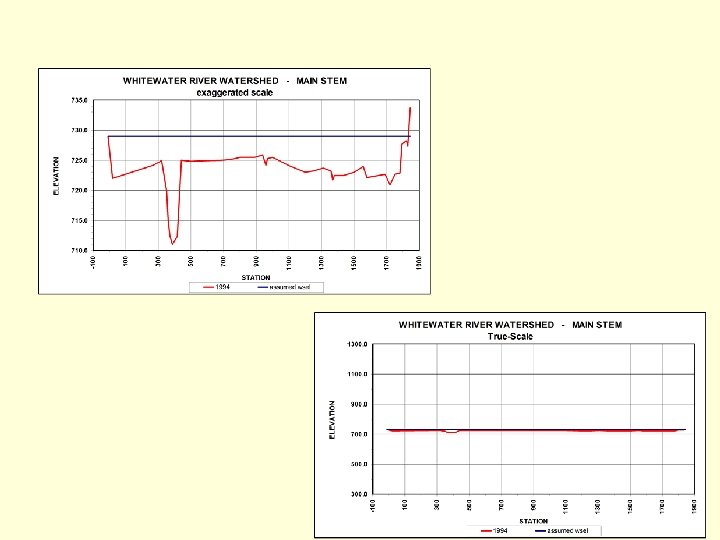
Significance • From a practical standpoint, roughness affects all of the characteristics of flowing water (flow, velocity, water surface elevation) and therefore affects sediment transport, flooding, navigation, ecosystem restoration, etc…. . • The significance of roughness becomes more apparent, perhaps, when we compare a cross section plotted on an exaggerated scale to the same cross section plotted on a true scale. 4
5
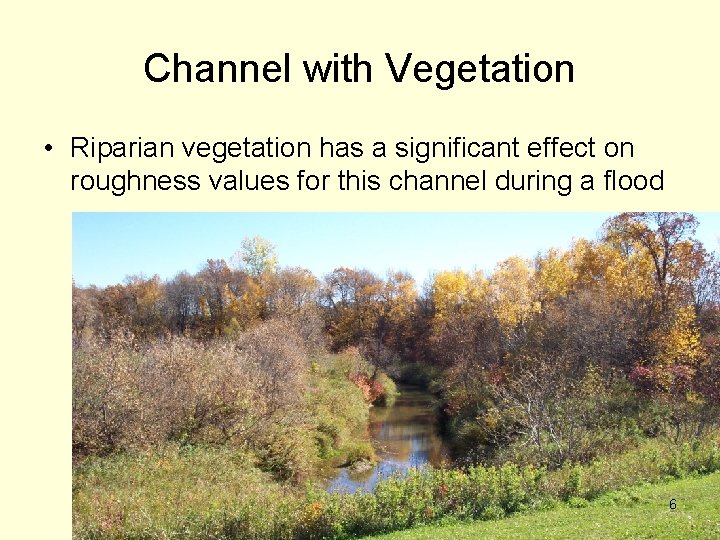
Channel with Vegetation • Riparian vegetation has a significant effect on roughness values for this channel during a flood 6
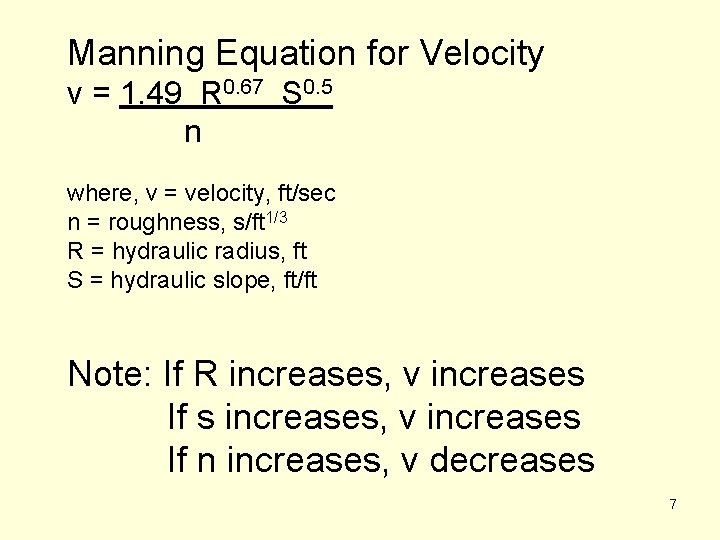
Manning Equation for Velocity v = 1. 49 R 0. 67 S 0. 5 n where, v = velocity, ft/sec n = roughness, s/ft 1/3 R = hydraulic radius, ft S = hydraulic slope, ft/ft Note: If R increases, v increases If s increases, v increases If n increases, v decreases 7
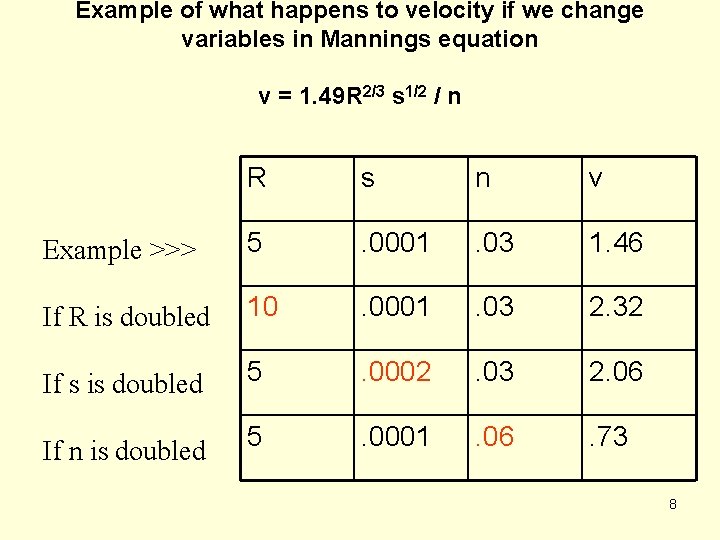
Example of what happens to velocity if we change variables in Mannings equation v = 1. 49 R 2/3 s 1/2 / n R s n v Example >>> 5 . 0001 . 03 1. 46 If R is doubled 10 . 0001 . 03 2. 32 If s is doubled 5 . 0002 . 03 2. 06 5 . 0001 . 06 . 73 If n is doubled 8
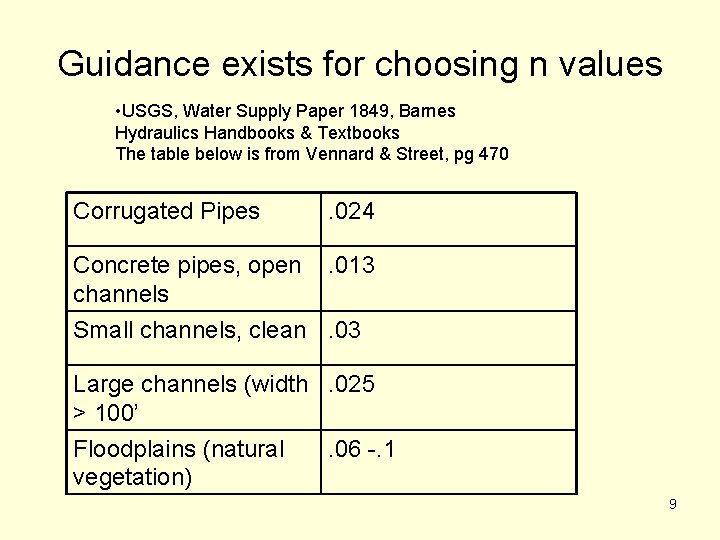
Guidance exists for choosing n values • USGS, Water Supply Paper 1849, Barnes Hydraulics Handbooks & Textbooks The table below is from Vennard & Street, pg 470 Corrugated Pipes . 024 Concrete pipes, open. 013 channels Small channels, clean. 03 Large channels (width. 025 > 100’ Floodplains (natural. 06 -. 1 vegetation) 9
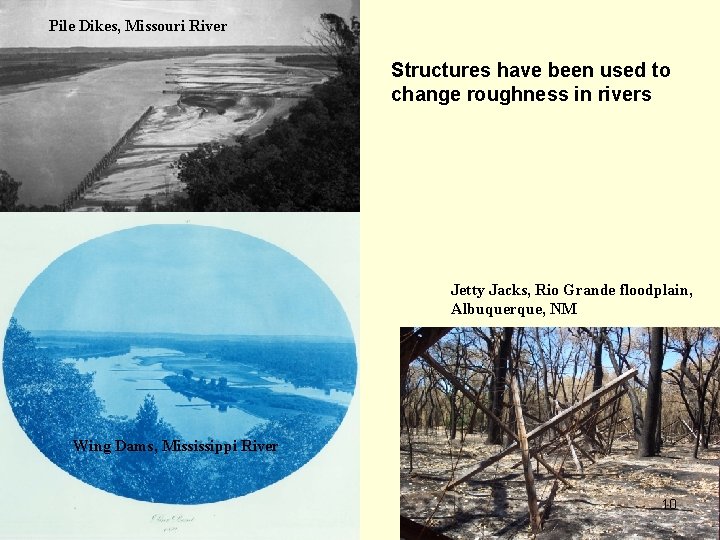
Pile Dikes, Missouri River Structures have been used to change roughness in rivers Jetty Jacks, Rio Grande floodplain, Albuquerque, NM Wing Dams, Mississippi River 10
Culverts 11
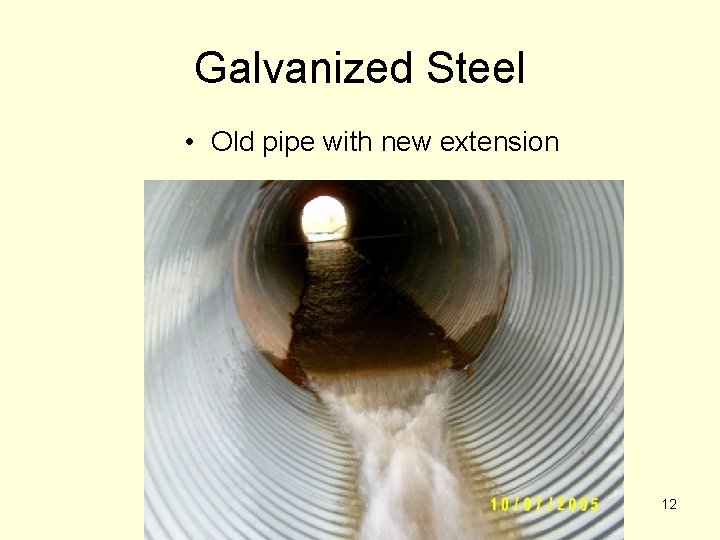
Galvanized Steel • Old pipe with new extension 12
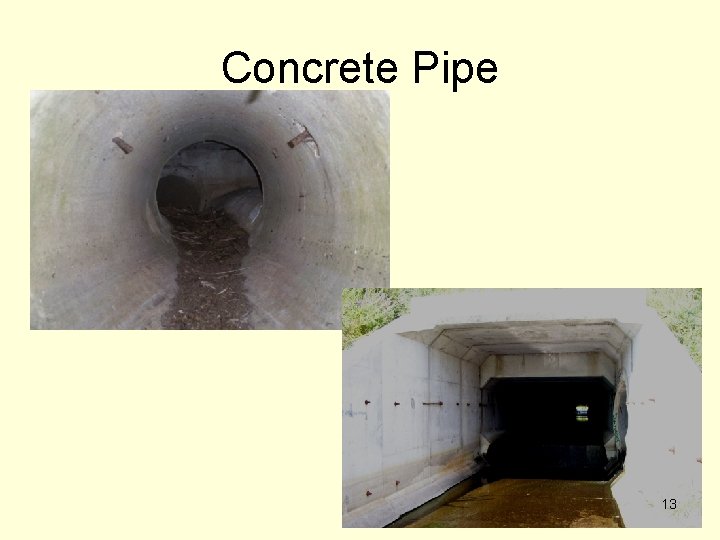
Concrete Pipe 13
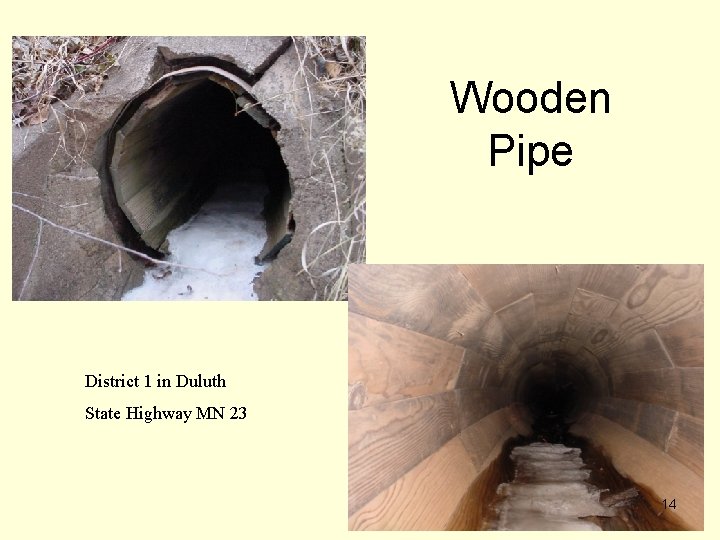
Wooden Pipe District 1 in Duluth State Highway MN 23 14
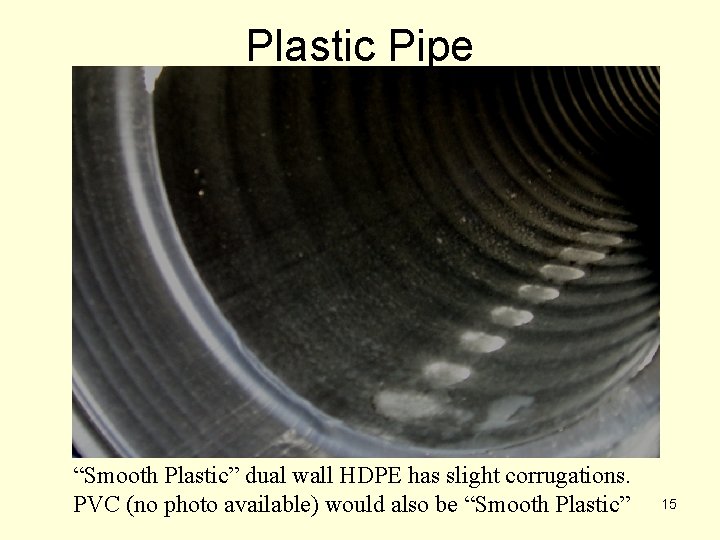
Plastic Pipe “Smooth Plastic” dual wall HDPE has slight corrugations. PVC (no photo available) would also be “Smooth Plastic” 15
Channels & Floodplains 16
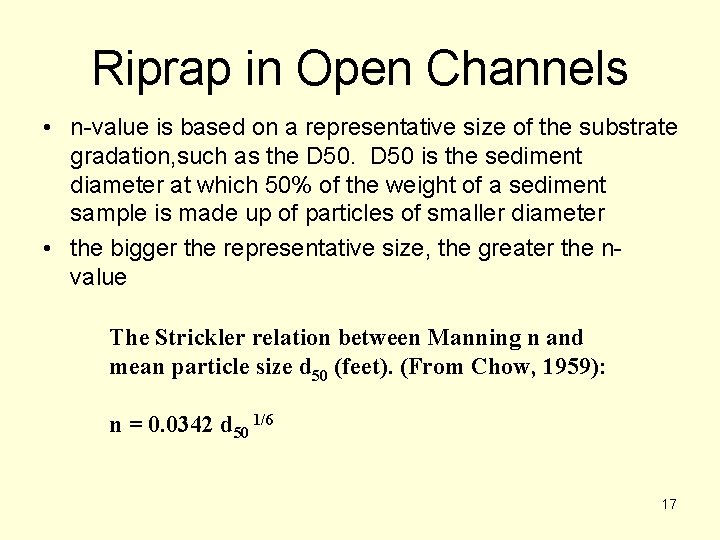
Riprap in Open Channels • n-value is based on a representative size of the substrate gradation, such as the D 50 is the sediment diameter at which 50% of the weight of a sediment sample is made up of particles of smaller diameter • the bigger the representative size, the greater the nvalue The Strickler relation between Manning n and mean particle size d 50 (feet). (From Chow, 1959): n = 0. 0342 d 50 1/6 17
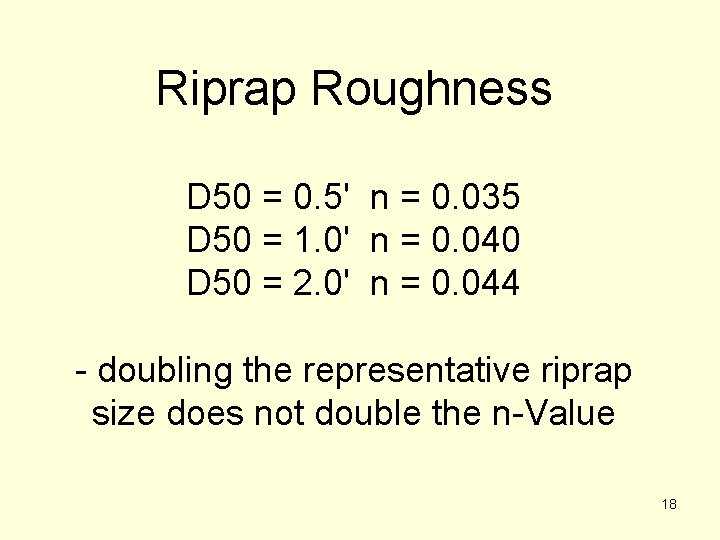
Riprap Roughness D 50 = 0. 5' n = 0. 035 D 50 = 1. 0' n = 0. 040 D 50 = 2. 0' n = 0. 044 - doubling the representative riprap size does not double the n-Value 18
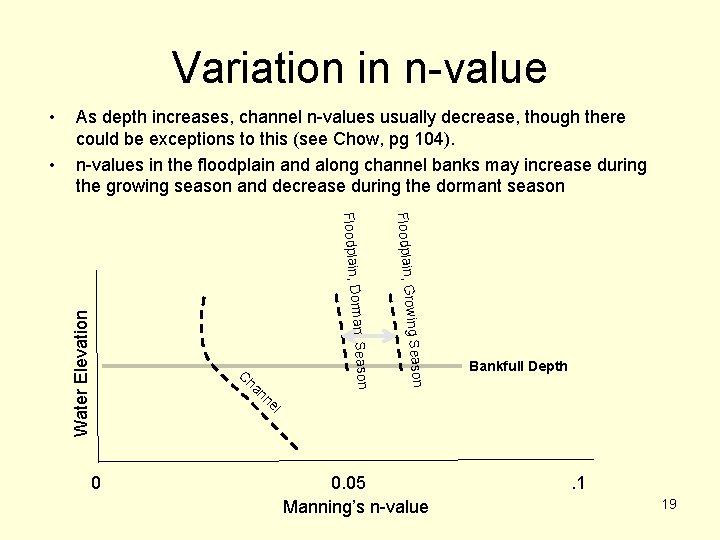
Variation in n-value • As depth increases, channel n-values usually decrease, though there could be exceptions to this (see Chow, pg 104). n-values in the floodplain and along channel banks may increase during the growing season and decrease during the dormant season nn Bankfull Depth n ha rowing Seaso C Floodplain, G n ormant Seaso Floodplain, D Water Elevation • el 0 0. 05 Manning’s n-value . 1 19
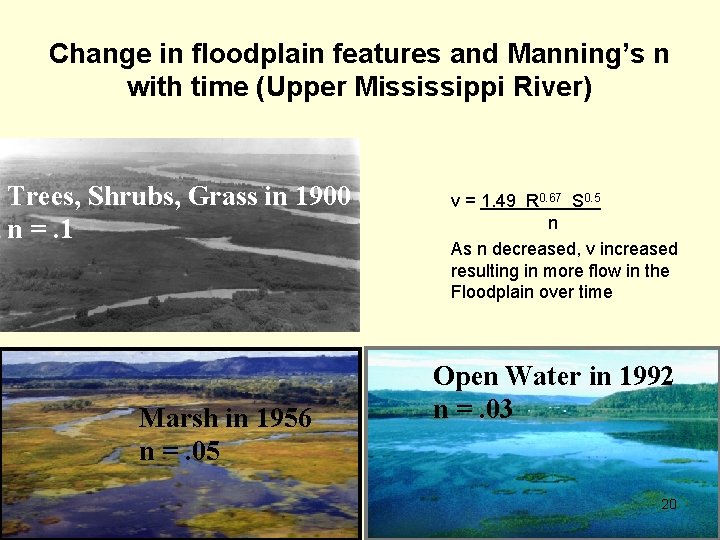
Change in floodplain features and Manning’s n with time (Upper Mississippi River) Trees, Shrubs, Grass in 1900 n =. 1 Marsh in 1956 n =. 05 v = 1. 49 R 0. 67 S 0. 5 n As n decreased, v increased resulting in more flow in the Floodplain over time Open Water in 1992 n =. 03 20
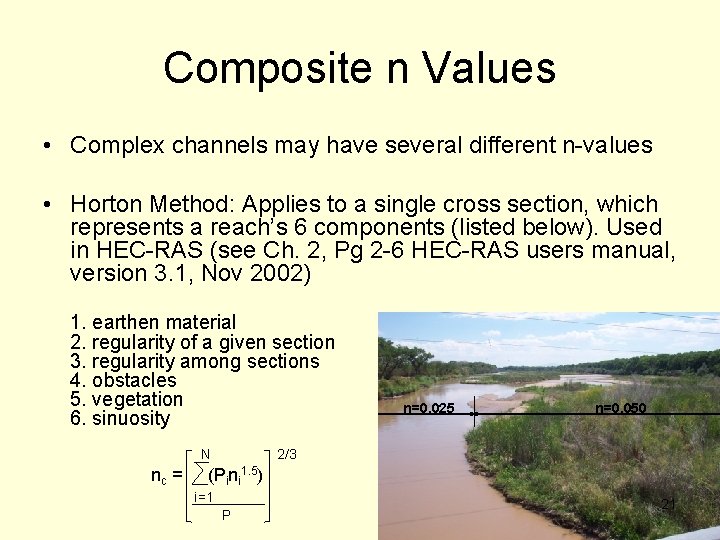
Composite n Values • Complex channels may have several different n-values • Horton Method: Applies to a single cross section, which represents a reach’s 6 components (listed below). Used in HEC-RAS (see Ch. 2, Pg 2 -6 HEC-RAS users manual, version 3. 1, Nov 2002) 1. earthen material 2. regularity of a given section 3. regularity among sections 4. obstacles 5. vegetation 6. sinuosity N nc = n=0. 025 n=0. 050 2/3 (Pini 1. 5) i=1 P 21
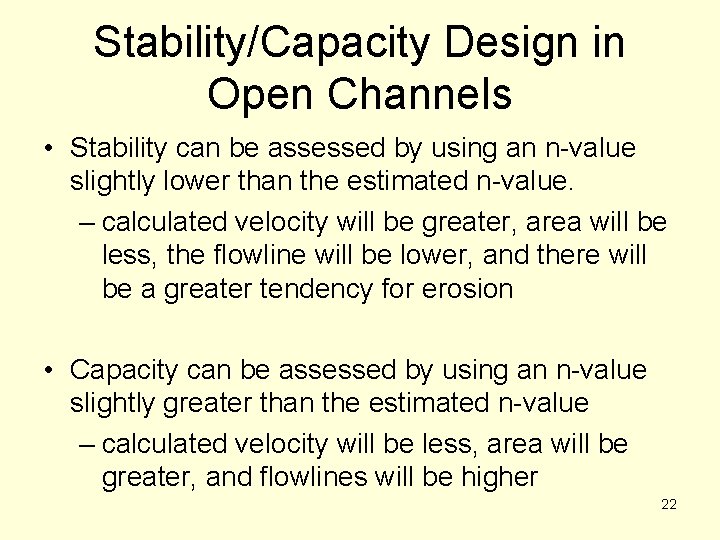
Stability/Capacity Design in Open Channels • Stability can be assessed by using an n-value slightly lower than the estimated n-value. – calculated velocity will be greater, area will be less, the flowline will be lower, and there will be a greater tendency for erosion • Capacity can be assessed by using an n-value slightly greater than the estimated n-value – calculated velocity will be less, area will be greater, and flowlines will be higher 22
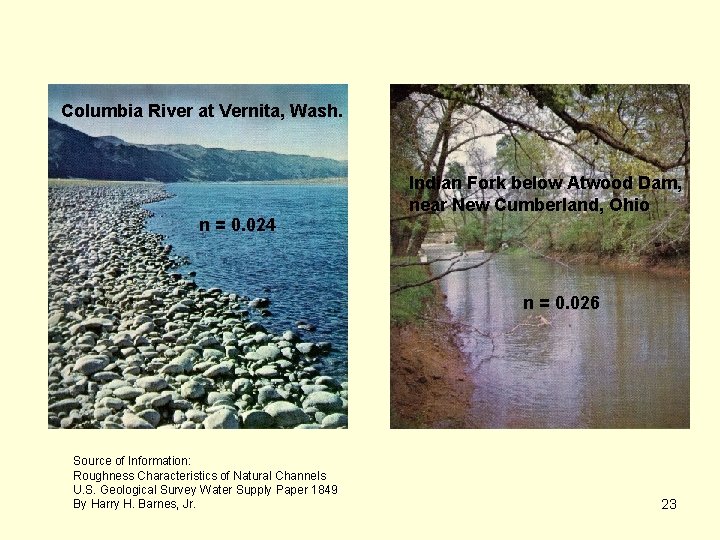
Columbia River at Vernita, Wash. Indian Fork below Atwood Dam, near New Cumberland, Ohio n = 0. 024 n = 0. 026 Source of Information: Roughness Characteristics of Natural Channels U. S. Geological Survey Water Supply Paper 1849 By Harry H. Barnes, Jr. 23
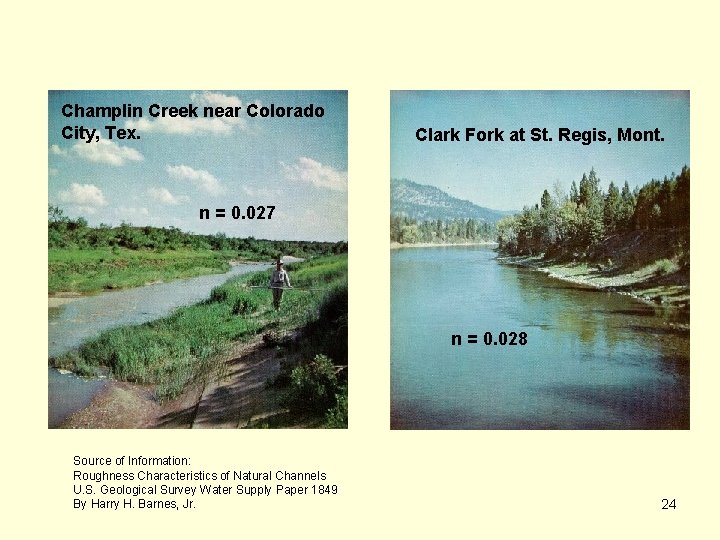
Champlin Creek near Colorado City, Tex. Clark Fork at St. Regis, Mont. n = 0. 027 n = 0. 028 Source of Information: Roughness Characteristics of Natural Channels U. S. Geological Survey Water Supply Paper 1849 By Harry H. Barnes, Jr. 24
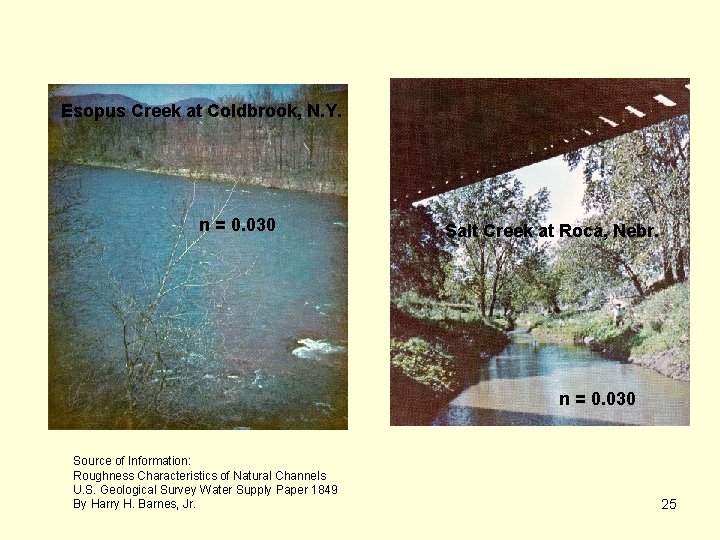
Esopus Creek at Coldbrook, N. Y. n = 0. 030 Salt Creek at Roca, Nebr. n = 0. 030 Source of Information: Roughness Characteristics of Natural Channels U. S. Geological Survey Water Supply Paper 1849 By Harry H. Barnes, Jr. 25
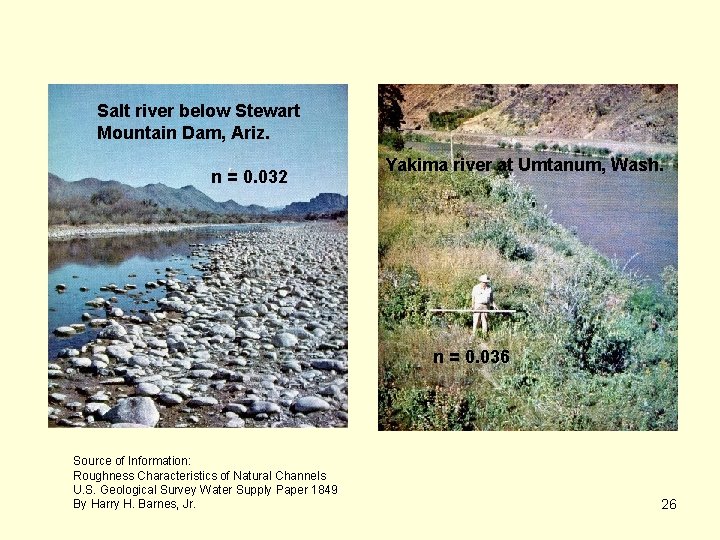
Salt river below Stewart Mountain Dam, Ariz. n = 0. 032 Yakima river at Umtanum, Wash. n = 0. 036 Source of Information: Roughness Characteristics of Natural Channels U. S. Geological Survey Water Supply Paper 1849 By Harry H. Barnes, Jr. 26
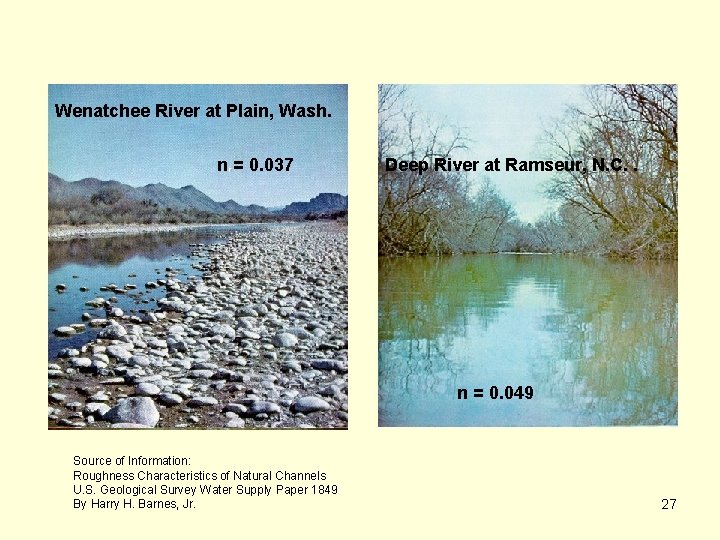
Wenatchee River at Plain, Wash. n = 0. 037 Deep River at Ramseur, N. C. . n = 0. 049 Source of Information: Roughness Characteristics of Natural Channels U. S. Geological Survey Water Supply Paper 1849 By Harry H. Barnes, Jr. 27
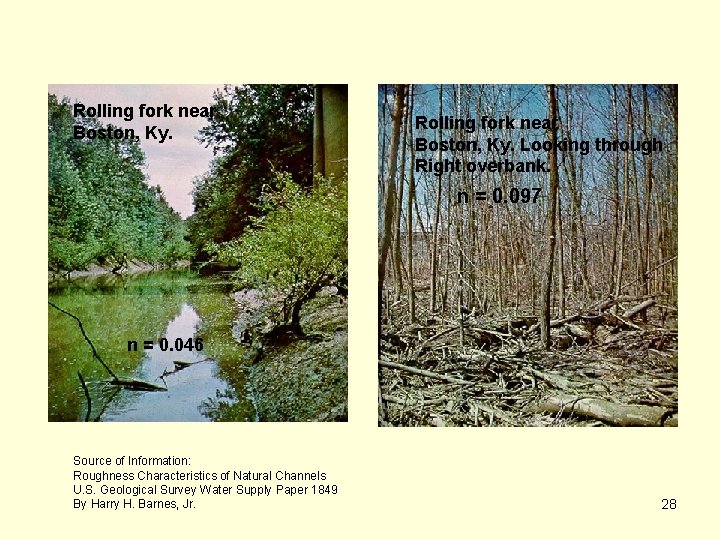
Rolling fork near Boston, Ky. Looking through Right overbank. n = 0. 097 n = 0. 046 Source of Information: Roughness Characteristics of Natural Channels U. S. Geological Survey Water Supply Paper 1849 By Harry H. Barnes, Jr. 28
Summary • • • Hydraulic characteristics are affected by n n values change with time There is guidance on choosing n values Can verify n values by calibrating to data Computer models rely on user input on n values but also employ methods to vary n with depth • Can adjust n values to do sensitivity analysis 29