
Rotator Cuff Pathology Toby Baring Sp R RLH
Rotator Cuff Pathology Toby Baring Sp. R RLH teaching, 19 th Feb 2013
Tendons in the Shoulder • The rotator cuff – a unique structure – 4 tendons combined to make one continuous band • Dynamic stabiliser (Aids movement of the shoulder)
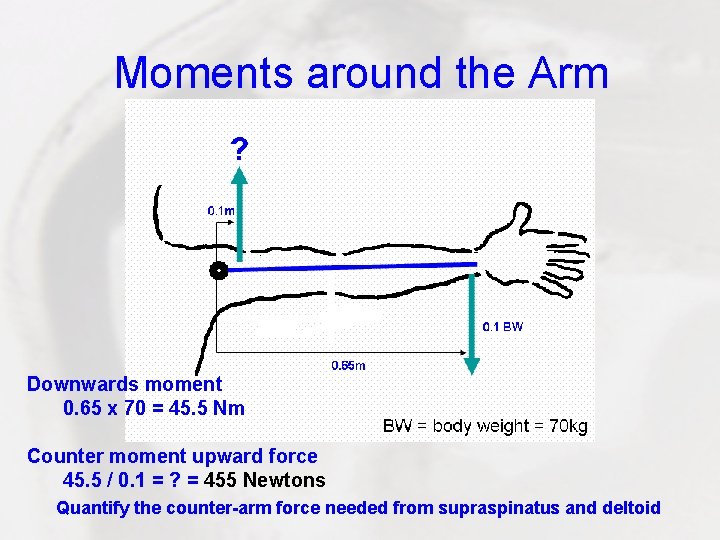
Moments around the Arm Downwards moment 0. 65 x 70 = 45. 5 Nm Counter moment upward force 45. 5 / 0. 1 = ? = 455 Newtons Quantify the counter-arm force needed from supraspinatus and deltoid
In vivo • Rotator cuff not the main abductor – different role • Majority of force comes from deltoid • In vivo studies 1 – stress through supraspinatus = 150 – 250 Newtons 1. Reilly et al. (2003) J Shoulder Elbow Surg
Tendon Strength • Determined by – macroscopic structure of tendon – density of collagen • Digital flexor tendons – 80 MPa 1 • Supraspinatus – 16. 5 MPa 2 1. Pring et al (1985). J Hand Surg [Br] 10(3): 331 -6. 2. Itoi et al (1995). J Orthop Res 13(4): 578 -84.
Rotator Cuff Tears • UTS of the RC = 16. 5 MPa 1 • Cross section of Rotator Cuff ~ 70 mm 2 • 16500 x 0. 07 = 1155 Newtons • Why does the cuff tear? – Ultimate load ~ 1100 Newtons – Physiological loading ~ 250 Newtons = 850 Newton buffer 1. Itoi et al (1995). J Orthop Res 13(4): 578 -84.
Torn tendons • Tears unlikely to occur in normal tendon • Torn tendons are usually degenerate to prior to tear 1 1. Jozsa and Kannus (1997). Scand J Med Sci Sports
Epidemiology • Shoulder complaints in primary care – Incidence: 9 per 1000 patients – 85% have RC pathology • Increasing incidence with age • Increasing incidence of all tendon ruptures over last 100 years 1 • Cadaveric studies show 30% have partial or full thickness tears of the RC 2 • 3 Million Rotator Cuff Tears in this country! 1. Jozsa and Kannus (1997) SJMSS 2. Reilly et al (2006) Ann R Coll Surg Engl 88(2): 116 -21.
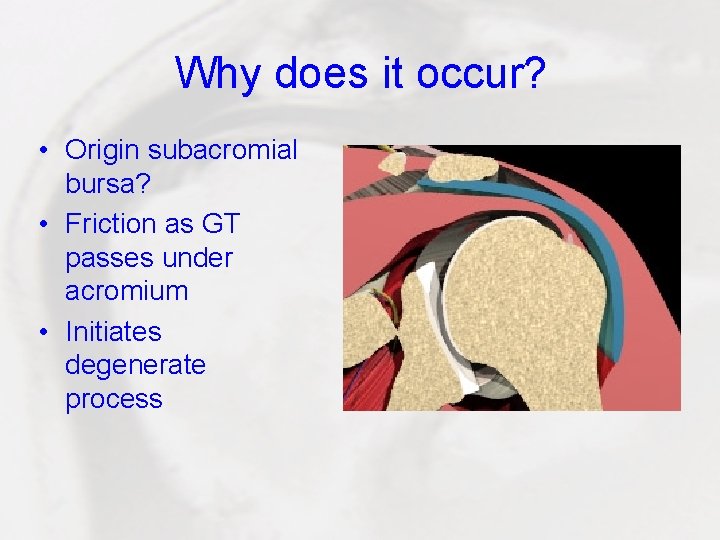
Why does it occur? • Origin subacromial bursa? • Friction as GT passes under acromium • Initiates degenerate process
Rotator Cuff Tendinopathy • Not typical “itis” • No influx of acute inflammatory cells – Macrophages, neutrophils Theory • Non – inflammatory cytokines cause degradation of the collagen matrix • Imbalance of enzymes (MMP – matrix metalloproteinases) involved in normal turnover of the tendon leading to disorganisation of collagen deposition 1 • Hypoxic degenerative change 1. Riley et al 2002 Matrix Biol
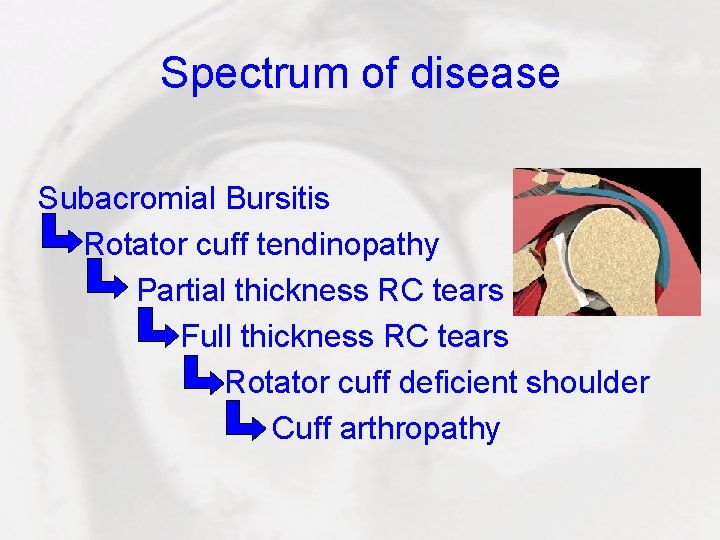
Spectrum of disease Subacromial Bursitis Rotator cuff tendinopathy Partial thickness RC tears Full thickness RC tears Rotator cuff deficient shoulder Cuff arthropathy
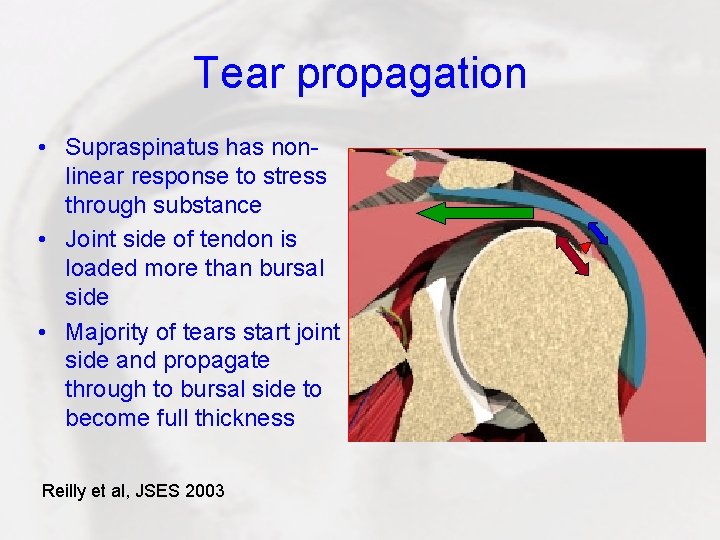
Tear propagation • Supraspinatus has nonlinear response to stress through substance • Joint side of tendon is loaded more than bursal side • Majority of tears start joint side and propagate through to bursal side to become full thickness Reilly et al, JSES 2003
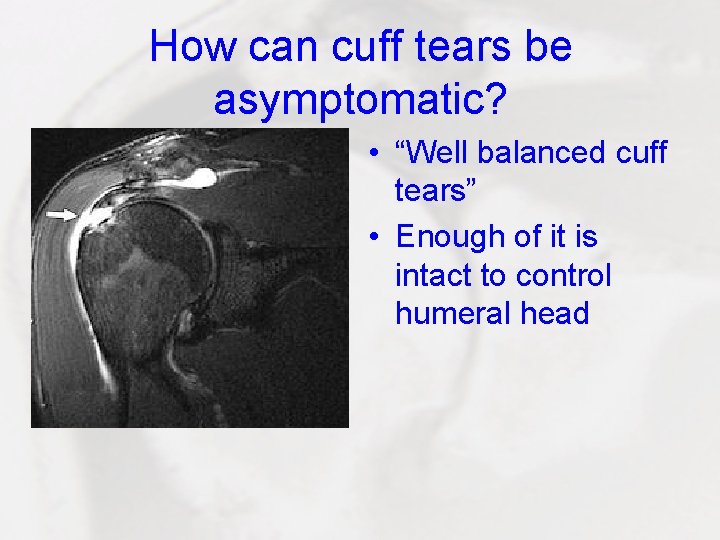
How can cuff tears be asymptomatic? • “Well balanced cuff tears” • Enough of it is intact to control humeral head
Treatment options • • • Physio Injections Decompression Repair +/- SAD Debridement +/- SAD
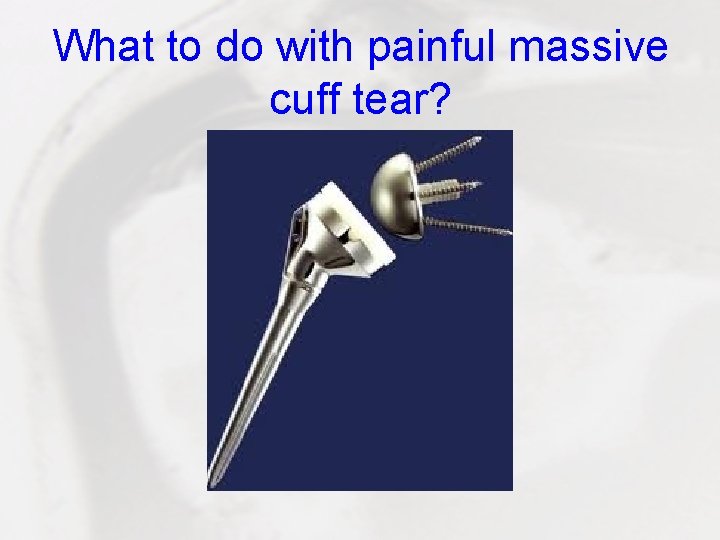
What to do with painful massive cuff tear?
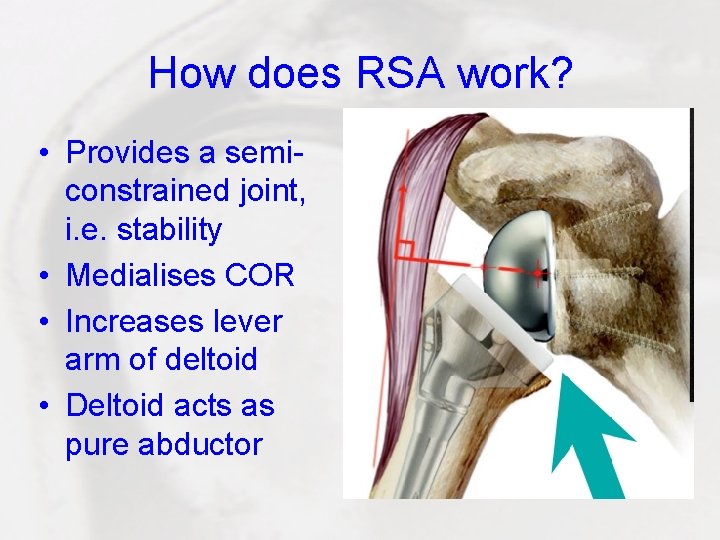
How does RSA work? • Provides a semiconstrained joint, i. e. stability • Medialises COR • Increases lever arm of deltoid • Deltoid acts as pure abductor
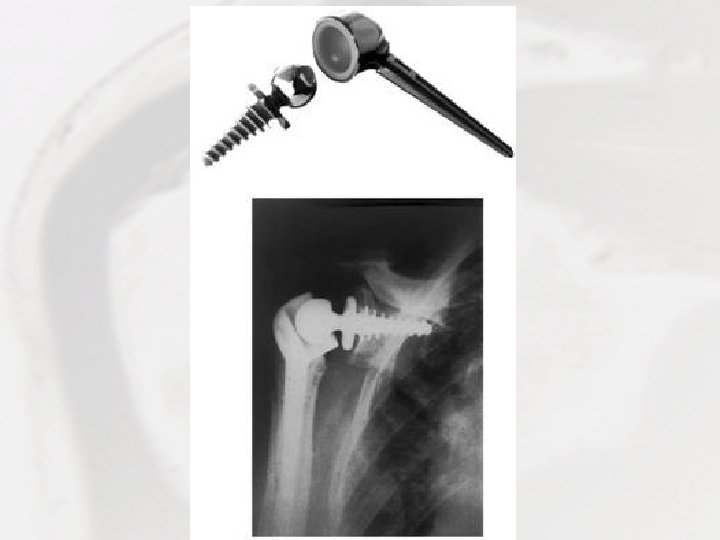
Problems with RSR • Limited internal and external rotation (L’episcopo) • Notching • Acromion fracture • Brachial plexopathy • Limited lifespan • What do you revise to?
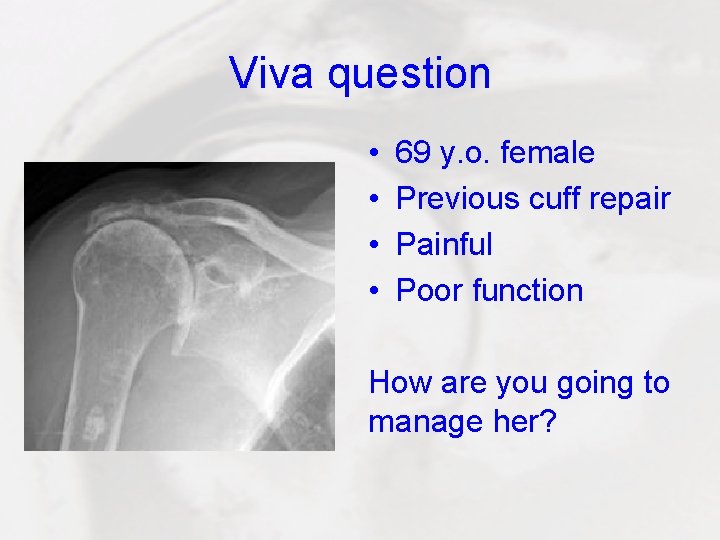
Viva question • • 69 y. o. female Previous cuff repair Painful Poor function How are you going to manage her?
Summary • • • Cuff tears are common Tendons degenerate to become weak Tendons tear once weak Spectrum of disease Step wise approach to management RSA can be beneficial in the right patient
- Slides: 20