
Rotations Warm Up Lesson Presentation Lesson Quiz Holt

- Slides: 10
Rotations Warm Up Lesson Presentation Lesson Quiz Holt. Mc. Dougal Geometry Holt
Rotations Objective Identify and draw rotations. Holt Mc. Dougal Geometry
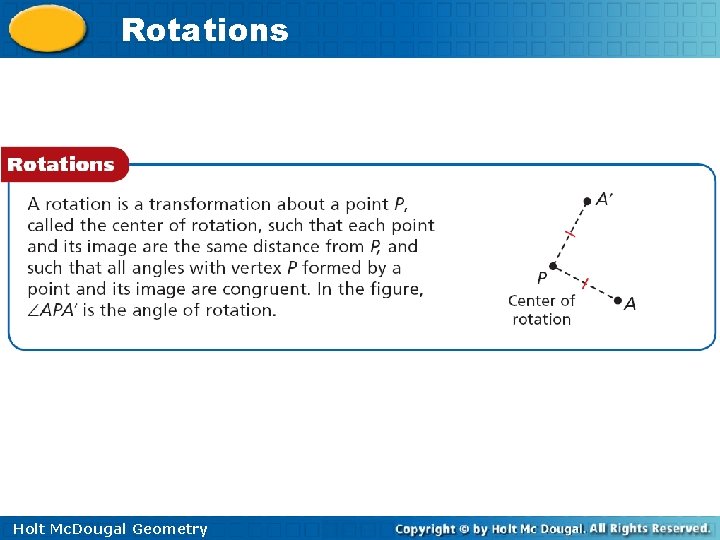
Rotations Remember that a rotation is a transformation that turns a figure around a fixed point, called the center of rotation. A rotation is an isometry, so the image of a rotated figure is congruent to the preimage. Holt Mc. Dougal Geometry
Rotations Example 1: Identifying Rotations Tell whether each transformation appears to be a rotation. Explain. A. B. No; the figure appears to be flipped. Yes; the figure appears to be turned around a point. Holt Mc. Dougal Geometry
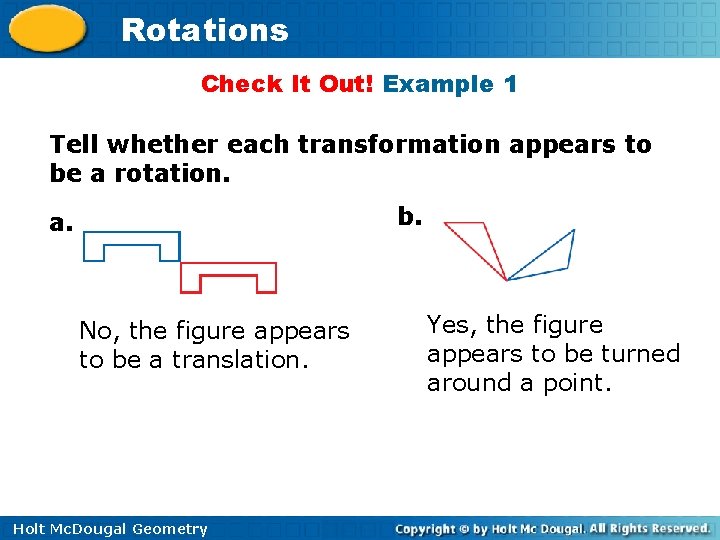
Rotations Check It Out! Example 1 Tell whether each transformation appears to be a rotation. b. a. No, the figure appears to be a translation. Holt Mc. Dougal Geometry Yes, the figure appears to be turned around a point.
Rotations Holt Mc. Dougal Geometry
Rotations Helpful Hint Unless otherwise stated, all rotations in this book are counterclockwise. Holt Mc. Dougal Geometry
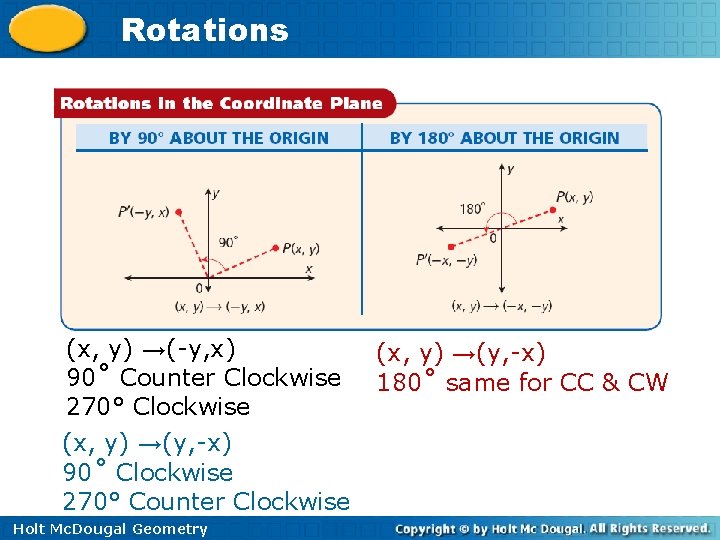
Rotations (x, y) →(-y, x) 90˚ Counter Clockwise 270° Clockwise (x, y) →(y, -x) 90˚ Clockwise 270° Counter Clockwise Holt Mc. Dougal Geometry (x, y) →(y, -x) 180˚ same for CC & CW
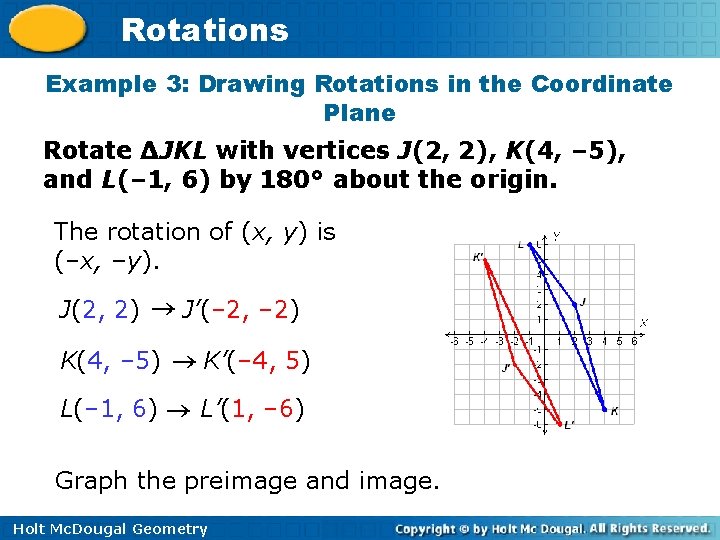
Rotations Example 3: Drawing Rotations in the Coordinate Plane Rotate ΔJKL with vertices J(2, 2), K(4, – 5), and L(– 1, 6) by 180° about the origin. The rotation of (x, y) is (–x, –y). J(2, 2) J’(– 2, – 2) K(4, – 5) K’(– 4, 5) L(– 1, 6) L’(1, – 6) Graph the preimage and image. Holt Mc. Dougal Geometry
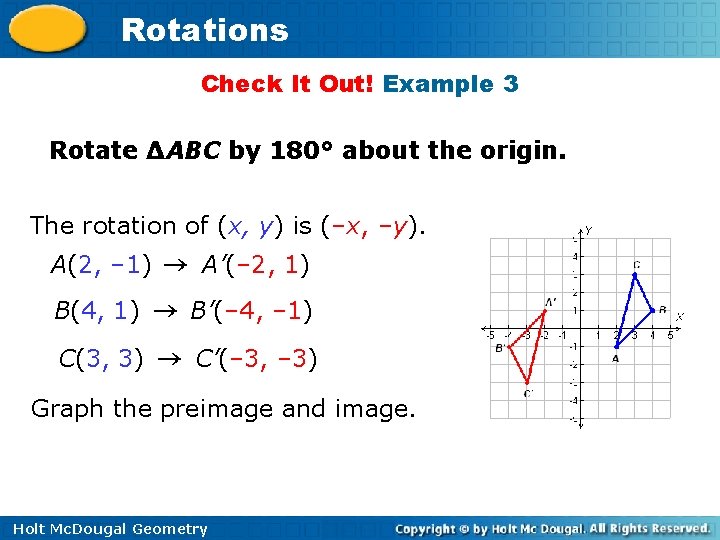
Rotations Check It Out! Example 3 Rotate ∆ABC by 180° about the origin. The rotation of (x, y) is (–x, –y). A(2, – 1) A’(– 2, 1) B(4, 1) B’(– 4, – 1) C(3, 3) C’(– 3, – 3) Graph the preimage and image. Holt Mc. Dougal Geometry