
ROTATIONAL MOTION TORQUE ANGULAR INERTIA AND NEWTONS LAWS
- Slides: 9
ROTATIONAL MOTION: TORQUE, ANGULAR INERTIA AND NEWTON’S LAWS PES 1000 – PHYSICS IN EVERYDAY LIFE
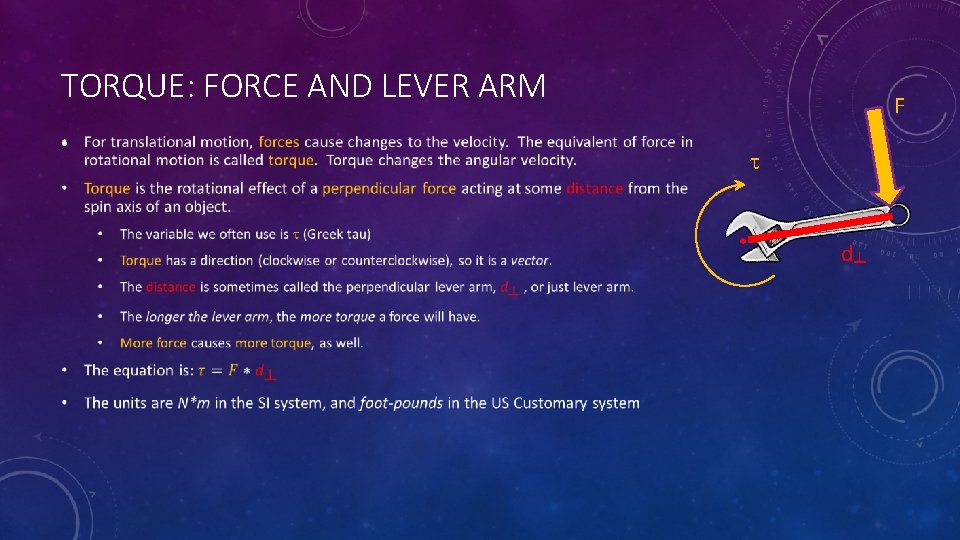
TORQUE: FORCE AND LEVER ARM • F t d┴
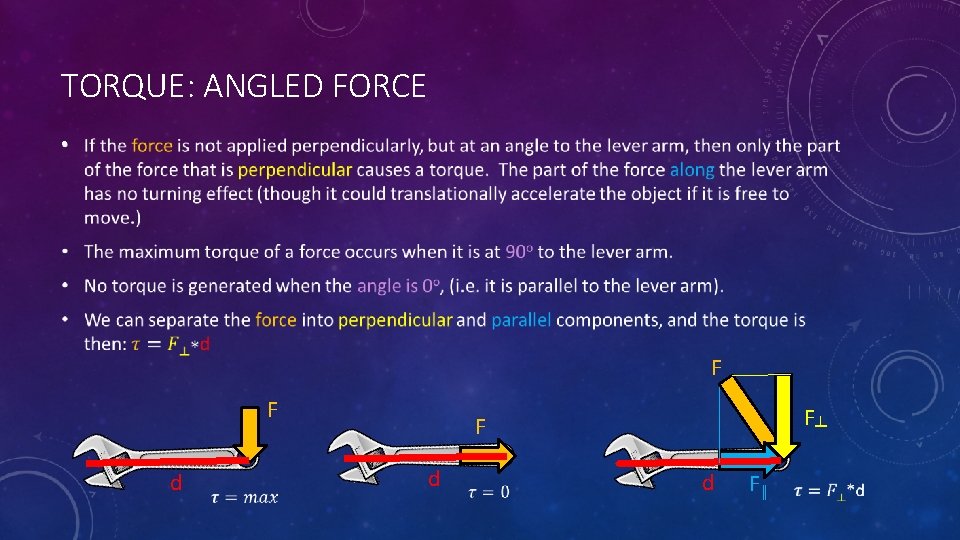
TORQUE: ANGLED FORCE • F F d F┴ F d d F║
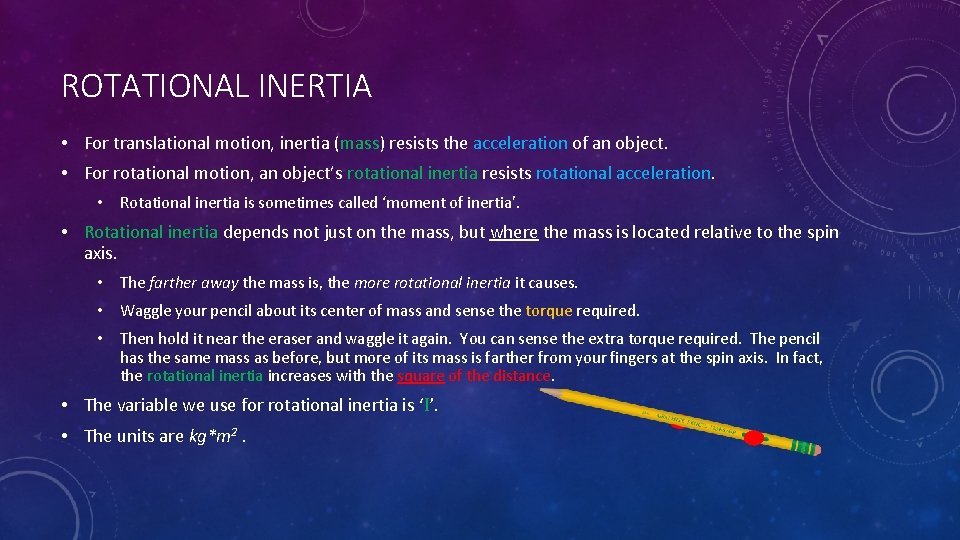
ROTATIONAL INERTIA • For translational motion, inertia (mass) resists the acceleration of an object. • For rotational motion, an object’s rotational inertia resists rotational acceleration. • Rotational inertia is sometimes called ‘moment of inertia’. • Rotational inertia depends not just on the mass, but where the mass is located relative to the spin axis. • The farther away the mass is, the more rotational inertia it causes. • Waggle your pencil about its center of mass and sense the torque required. • Then hold it near the eraser and waggle it again. You can sense the extra torque required. The pencil has the same mass as before, but more of its mass is farther from your fingers at the spin axis. In fact, the rotational inertia increases with the square of the distance. • The variable we use for rotational inertia is ‘I’. • The units are kg*m 2.
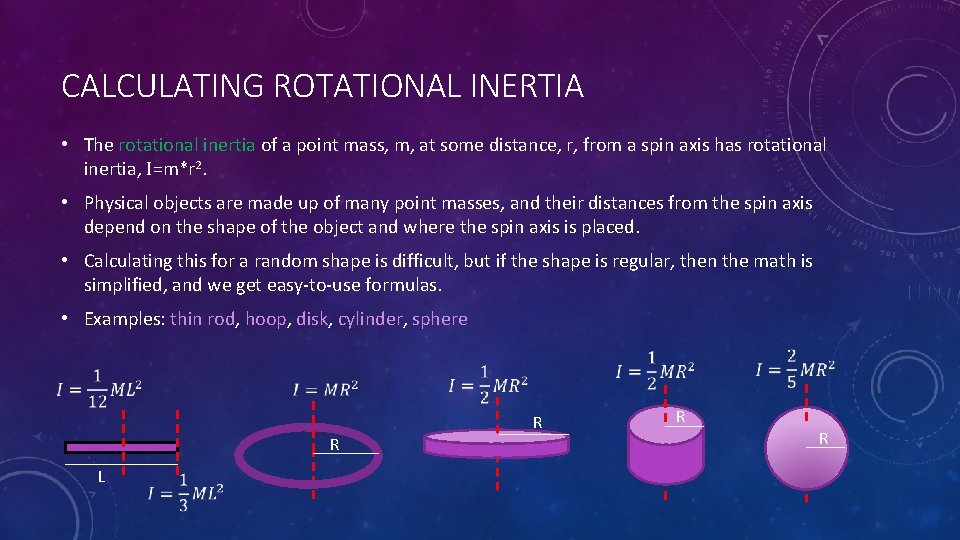
CALCULATING ROTATIONAL INERTIA • The rotational inertia of a point mass, m, at some distance, r, from a spin axis has rotational inertia, I=m*r 2. • Physical objects are made up of many point masses, and their distances from the spin axis depend on the shape of the object and where the spin axis is placed. • Calculating this for a random shape is difficult, but if the shape is regular, then the math is simplified, and we get easy-to-use formulas. • Examples: thin rod, hoop, disk, cylinder, sphere R L R R R
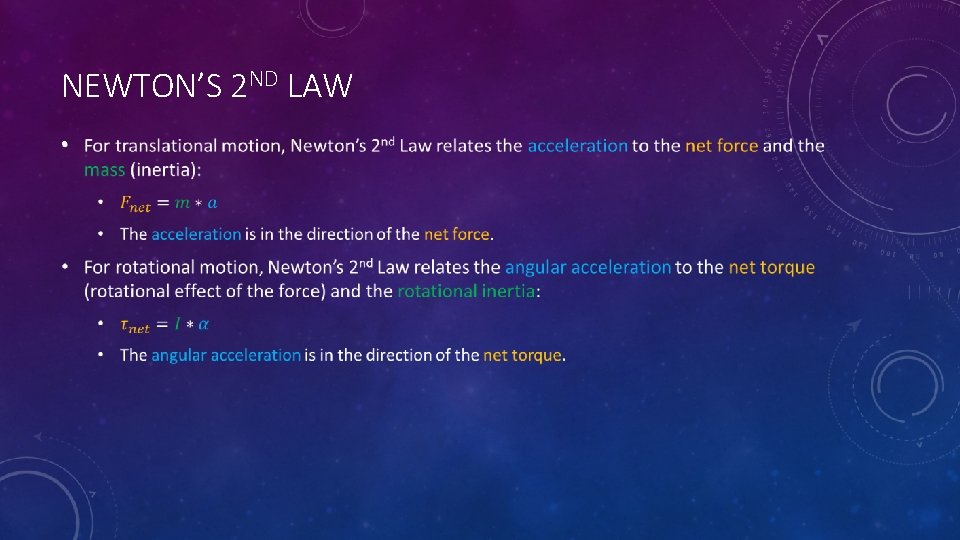
NEWTON’S 2 ND LAW •
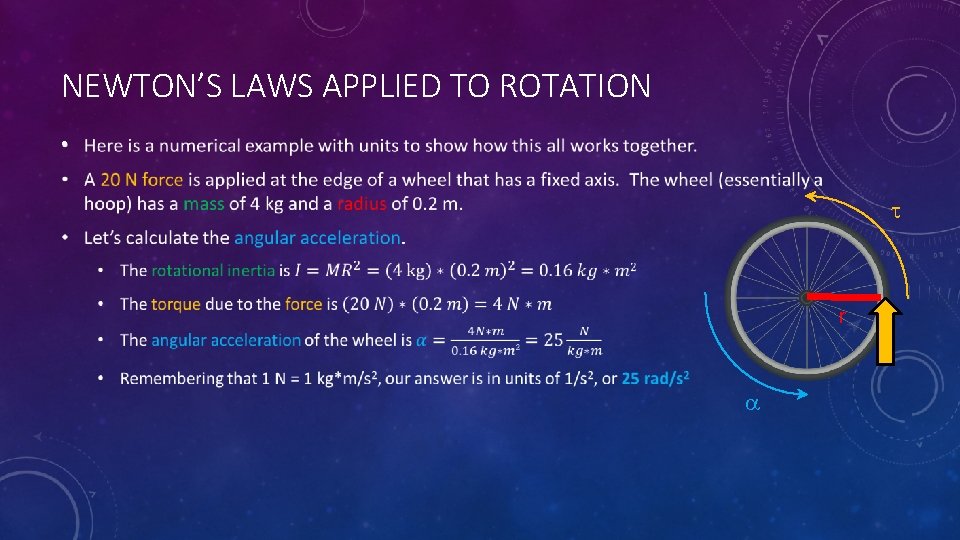
NEWTON’S LAWS APPLIED TO ROTATION • t r a
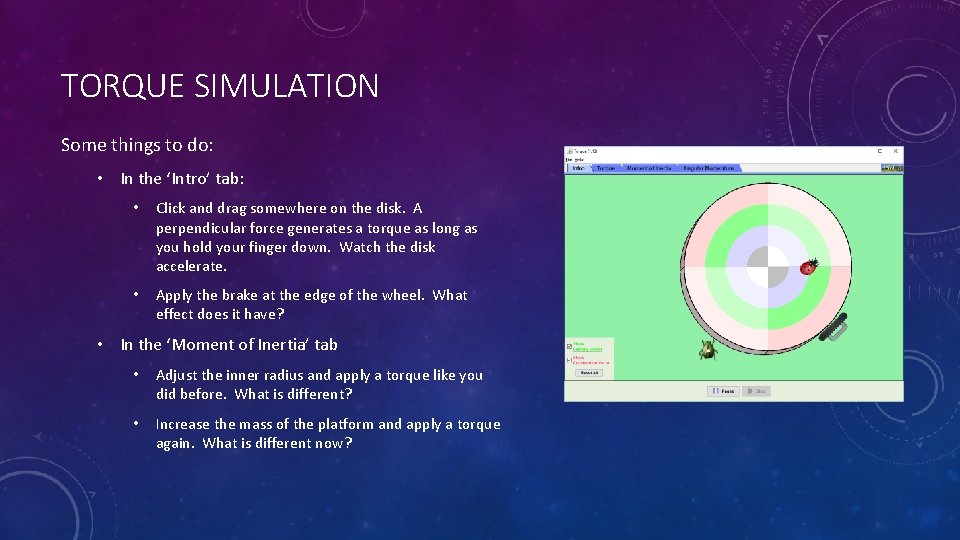
TORQUE SIMULATION Some things to do: • In the ‘Intro’ tab: • Click and drag somewhere on the disk. A perpendicular force generates a torque as long as you hold your finger down. Watch the disk accelerate. • Apply the brake at the edge of the wheel. What effect does it have? • In the ‘Moment of Inertia’ tab • Adjust the inner radius and apply a torque like you did before. What is different? • Increase the mass of the platform and apply a torque again. What is different now?
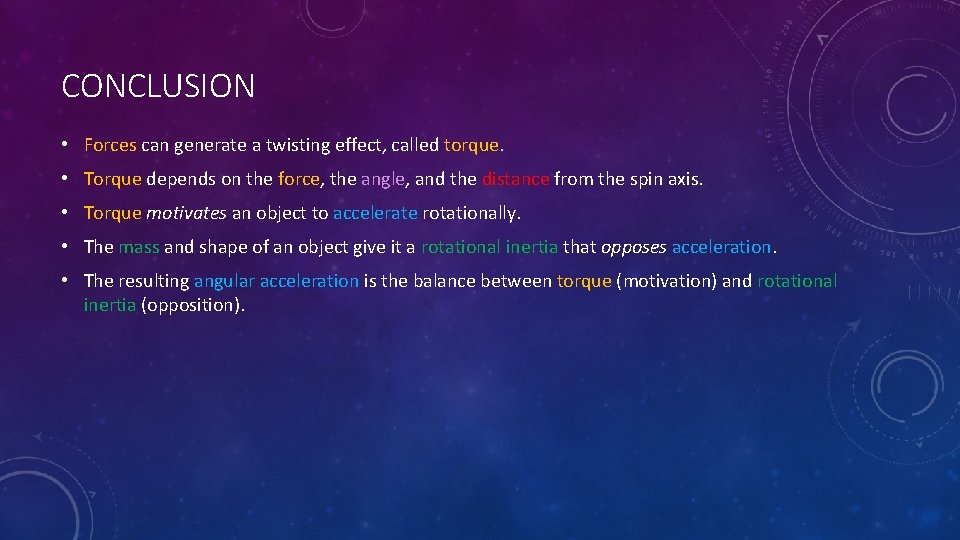
CONCLUSION • Forces can generate a twisting effect, called torque. • Torque depends on the force, the angle, and the distance from the spin axis. • Torque motivates an object to accelerate rotationally. • The mass and shape of an object give it a rotational inertia that opposes acceleration. • The resulting angular acceleration is the balance between torque (motivation) and rotational inertia (opposition).