
Rotational motion AH Physics Motion in a circle

- Slides: 13
Rotational motion AH Physics
Motion in a circle �Circular or rotational motion is common everywhere from electrons orbiting the nucleus to wheels turning to planets orbiting the sun. �It is important to study rotational motion in the same way that we studied linear motion in National 5 and Higher Physics.
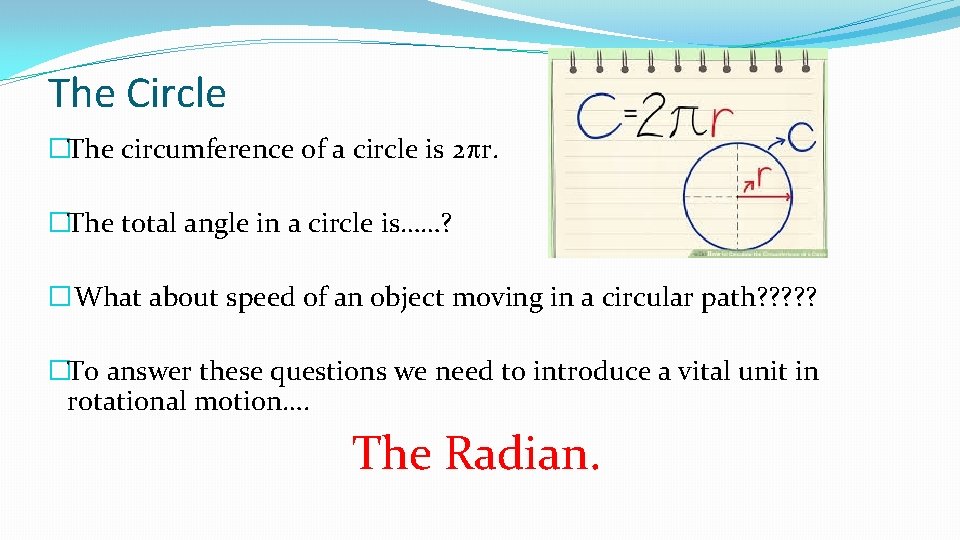
The Circle �The circumference of a circle is 2 pr. �The total angle in a circle is……? � What about speed of an object moving in a circular path? ? ? �To answer these questions we need to introduce a vital unit in rotational motion…. The Radian.
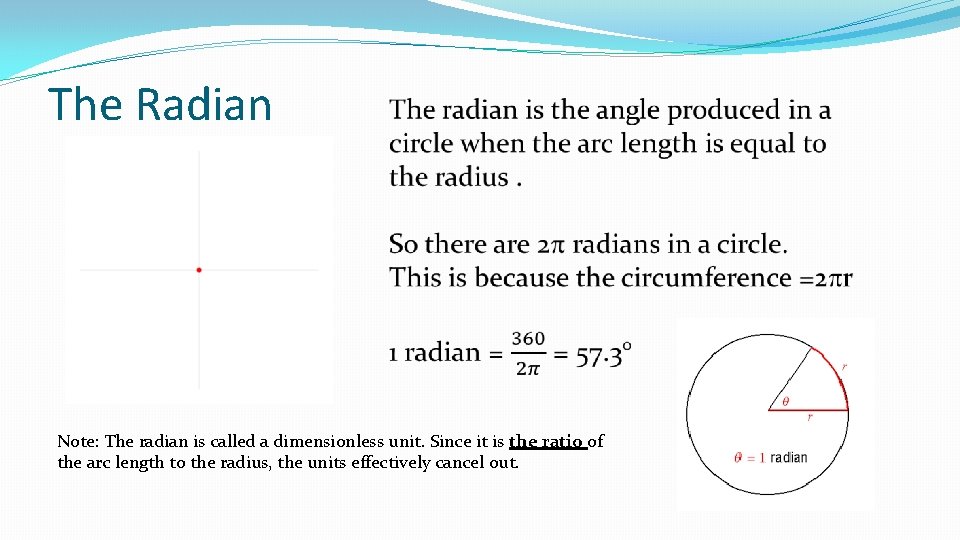
The Radian Note: The radian is called a dimensionless unit. Since it is the ratio of the arc length to the radius, the units effectively cancel out.
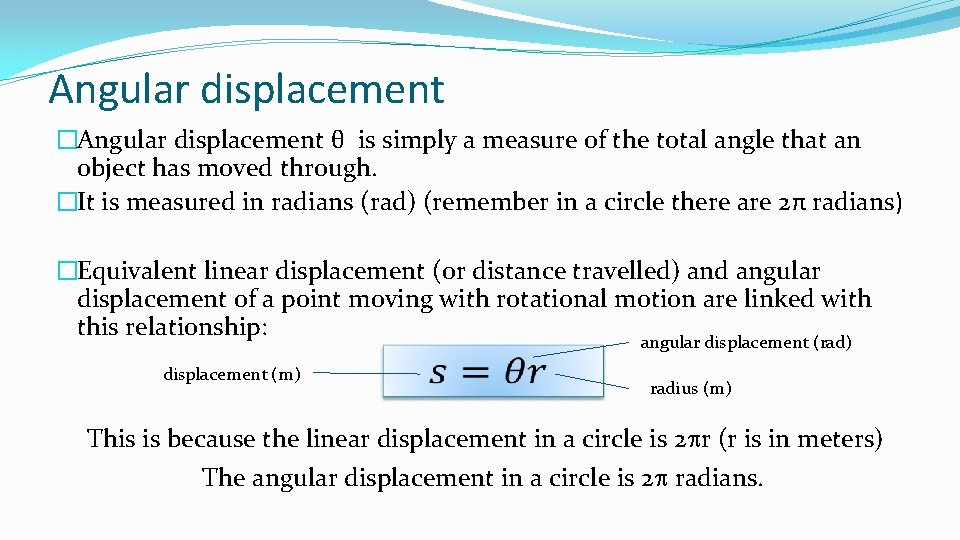
Angular displacement �Angular displacement θ is simply a measure of the total angle that an object has moved through. �It is measured in radians (rad) (remember in a circle there are 2π radians) �Equivalent linear displacement (or distance travelled) and angular displacement of a point moving with rotational motion are linked with this relationship: angular displacement (rad) displacement (m) radius (m) This is because the linear displacement in a circle is 2 pr (r is in meters) The angular displacement in a circle is 2 p radians.
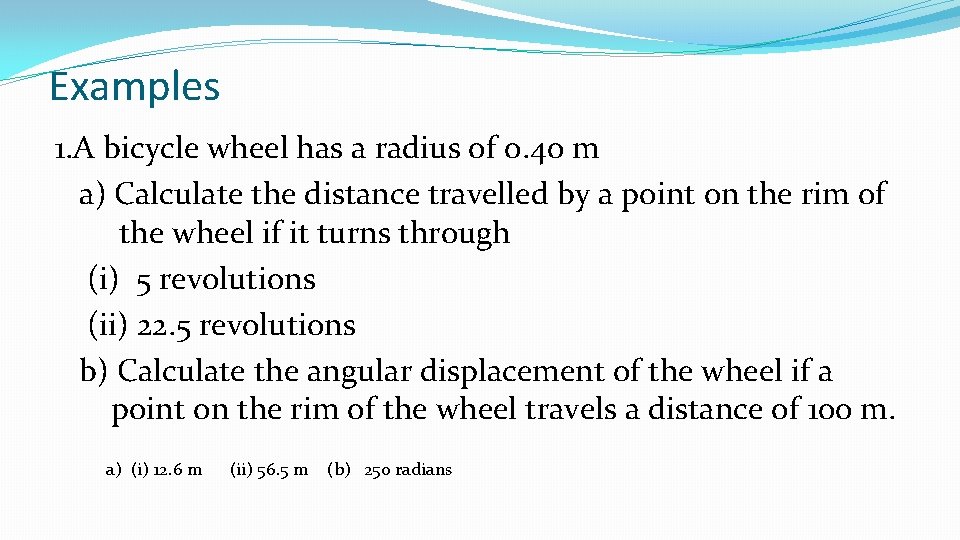
Examples 1. A bicycle wheel has a radius of 0. 40 m a) Calculate the distance travelled by a point on the rim of the wheel if it turns through (i) 5 revolutions (ii) 22. 5 revolutions b) Calculate the angular displacement of the wheel if a point on the rim of the wheel travels a distance of 100 m. a) (i) 12. 6 m (ii) 56. 5 m (b) 250 radians
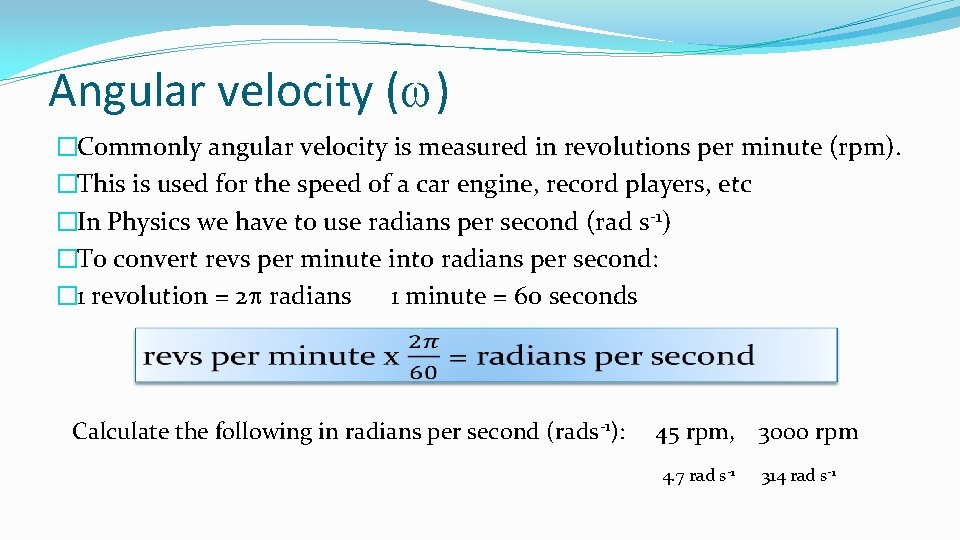
Angular velocity (w) �Commonly angular velocity is measured in revolutions per minute (rpm). �This is used for the speed of a car engine, record players, etc �In Physics we have to use radians per second (rad s -1) �To convert revs per minute into radians per second: � 1 revolution = 2 p radians 1 minute = 60 seconds Calculate the following in radians per second (rads-1): 45 rpm, 4. 7 rad s-1 3000 rpm 314 rad s-1
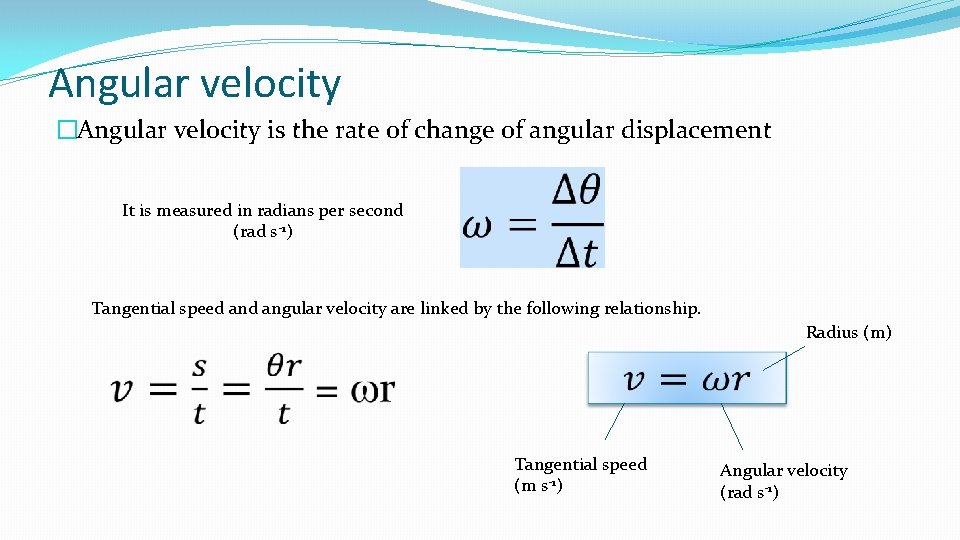
Angular velocity �Angular velocity is the rate of change of angular displacement It is measured in radians per second (rad s-1) Tangential speed angular velocity are linked by the following relationship. Radius (m) Tangential speed (m s-1) Angular velocity (rad s-1)
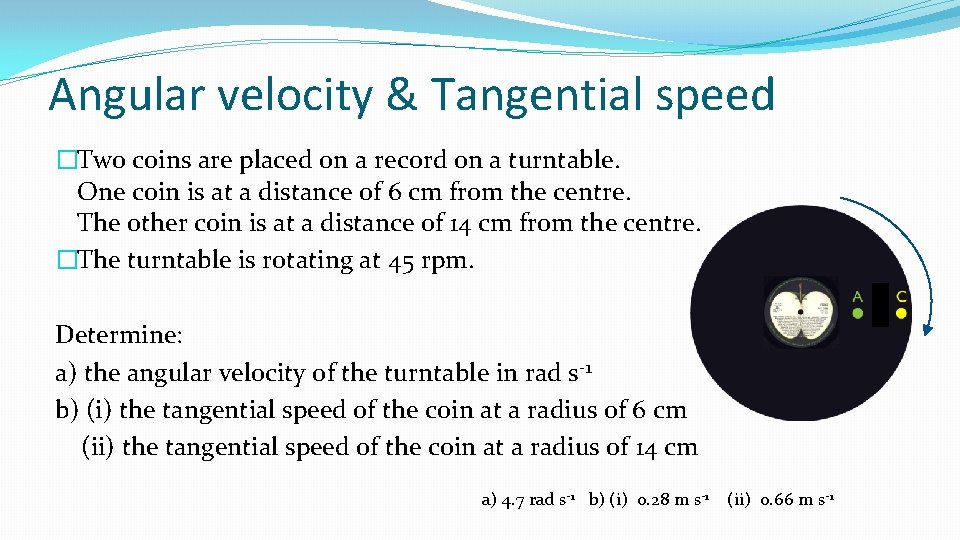
Angular velocity & Tangential speed �Two coins are placed on a record on a turntable. One coin is at a distance of 6 cm from the centre. The other coin is at a distance of 14 cm from the centre. �The turntable is rotating at 45 rpm. Determine: a) the angular velocity of the turntable in rad s-1 b) (i) the tangential speed of the coin at a radius of 6 cm (ii) the tangential speed of the coin at a radius of 14 cm a) 4. 7 rad s-1 b) (i) 0. 28 m s-1 (ii) 0. 66 m s-1
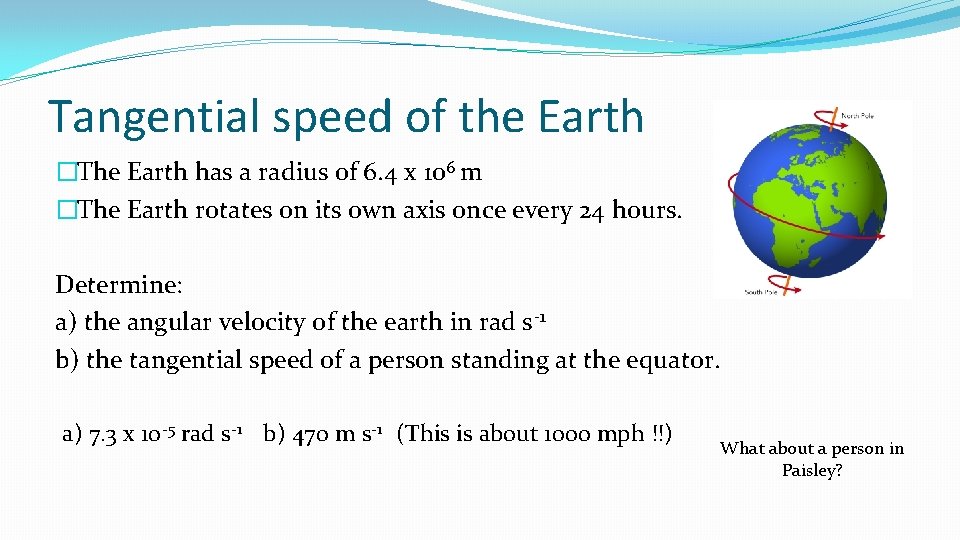
Tangential speed of the Earth �The Earth has a radius of 6. 4 x 10⁶ m �The Earth rotates on its own axis once every 24 hours. Determine: a) the angular velocity of the earth in rad s-1 b) the tangential speed of a person standing at the equator. a) 7. 3 x 10 -5 rad s-1 b) 470 m s-1 (This is about 1000 mph !!) What about a person in Paisley?
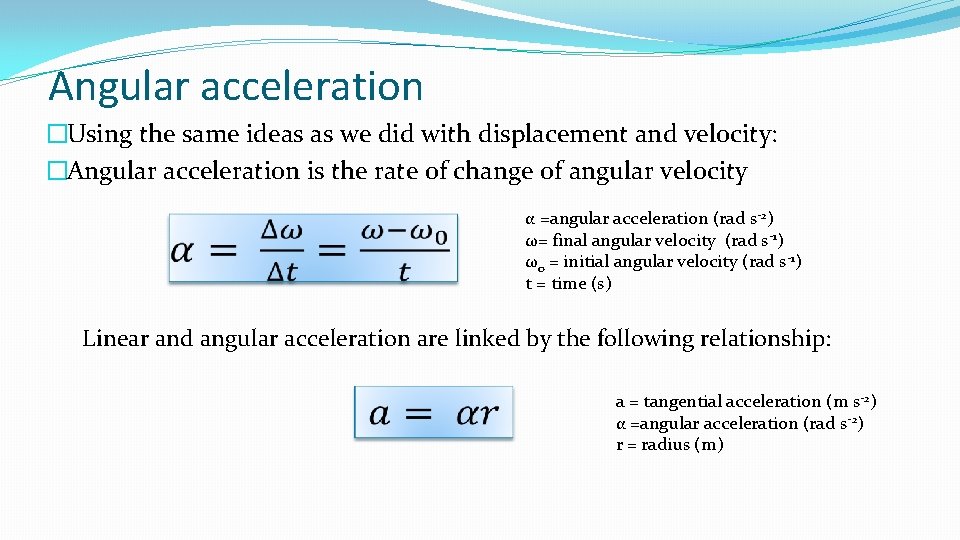
Angular acceleration �Using the same ideas as we did with displacement and velocity: �Angular acceleration is the rate of change of angular velocity α =angular acceleration (rad s-2) ω= final angular velocity (rad s-1) ω0 = initial angular velocity (rad s-1) t = time (s) Linear and angular acceleration are linked by the following relationship: a = tangential acceleration (m s-2) α =angular acceleration (rad s-2) r = radius (m)
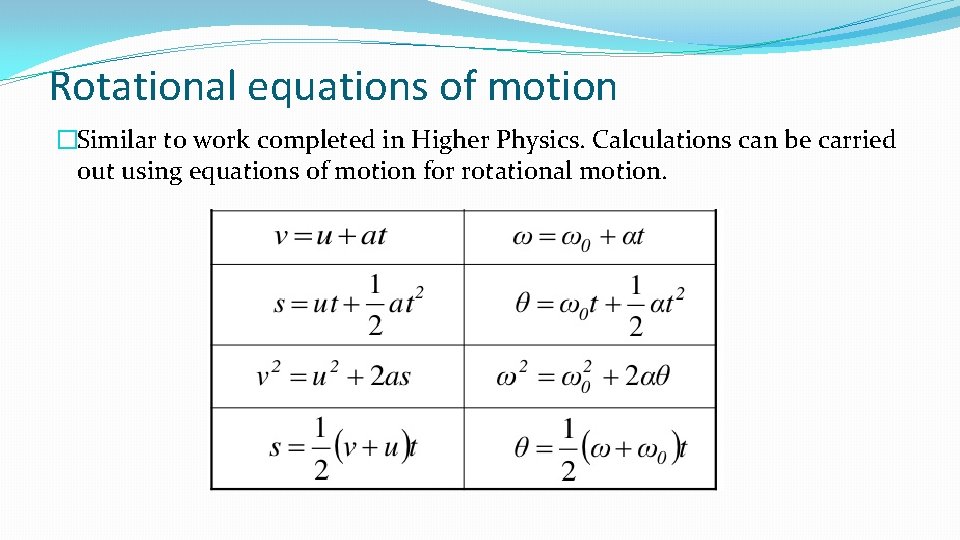
Rotational equations of motion �Similar to work completed in Higher Physics. Calculations can be carried out using equations of motion for rotational motion.
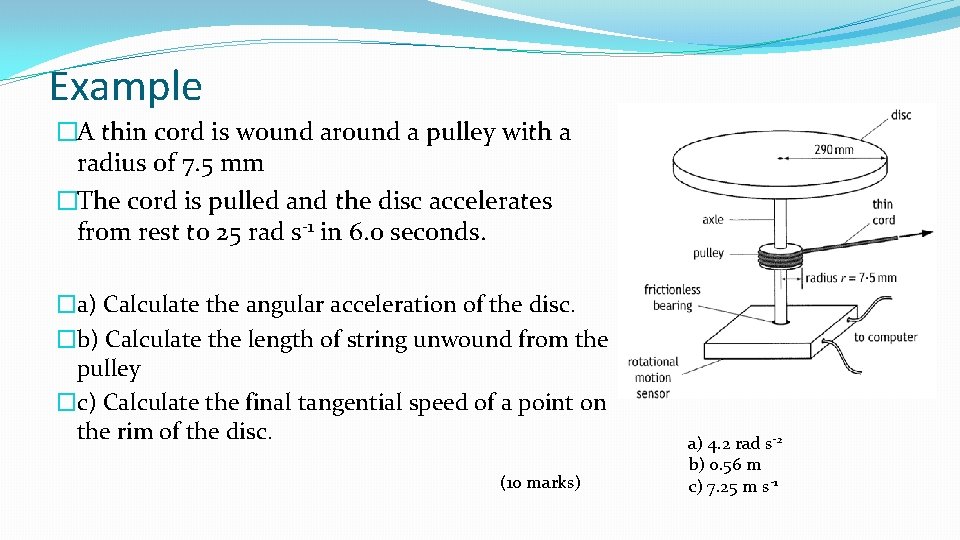
Example �A thin cord is wound around a pulley with a radius of 7. 5 mm �The cord is pulled and the disc accelerates from rest to 25 rad s-1 in 6. 0 seconds. �a) Calculate the angular acceleration of the disc. �b) Calculate the length of string unwound from the pulley �c) Calculate the final tangential speed of a point on the rim of the disc. (10 marks) a) 4. 2 rad s-2 b) 0. 56 m c) 7. 25 m s-1