
Rotational Kinematics and Dynamics Test Friday 921 Circular









- Slides: 37
Rotational Kinematics and Dynamics Test: Friday 9/21
Circular Motion For a particle in uniform circular motion, the velocity vector v remains constant in magnitude, but it continuously changes its direction.
A Particle in Uniform Circular Motion
Angular Position: θ
Angular Position
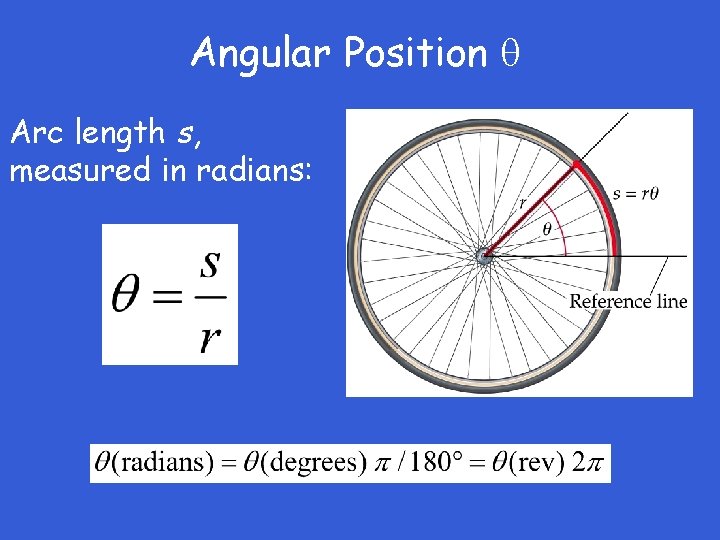
Angular Position Arc length s, measured in radians:
Angular Velocity
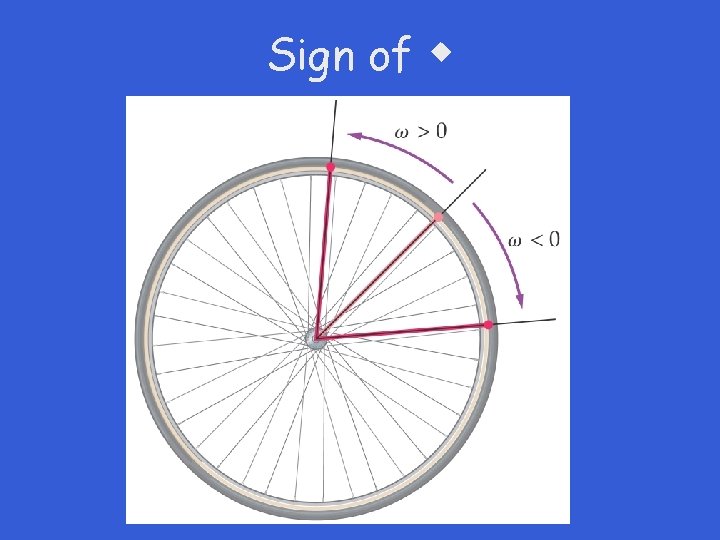
Sign of
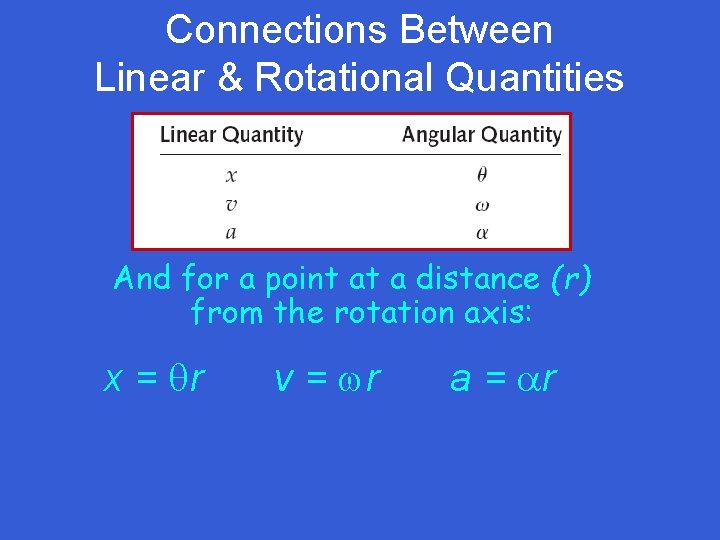
Connections Between Linear & Rotational Quantities
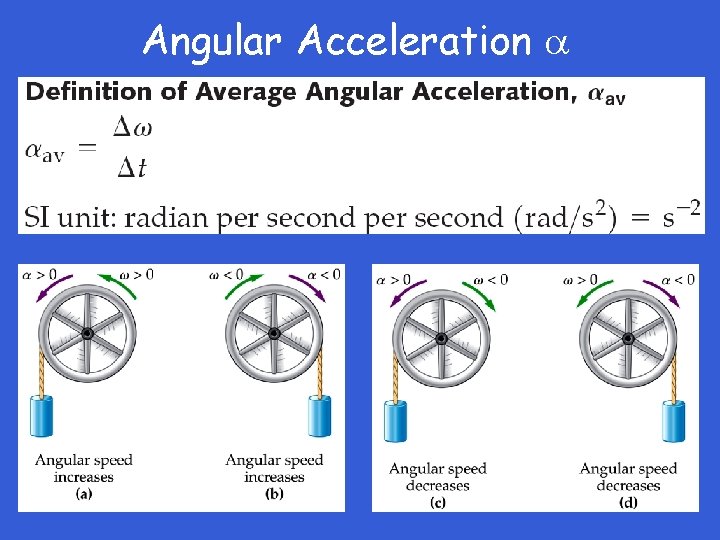
Angular Acceleration
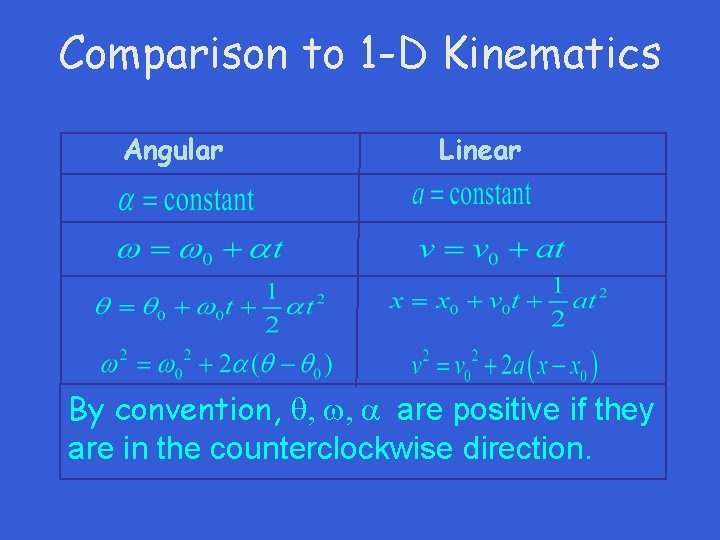
Comparison to 1 -D Kinematics Angular Linear By convention, , , are positive if they are in the counterclockwise direction.
Connections Between Linear & Rotational Quantities And for a point at a distance (r) from the rotation axis: x = r v = r a = r
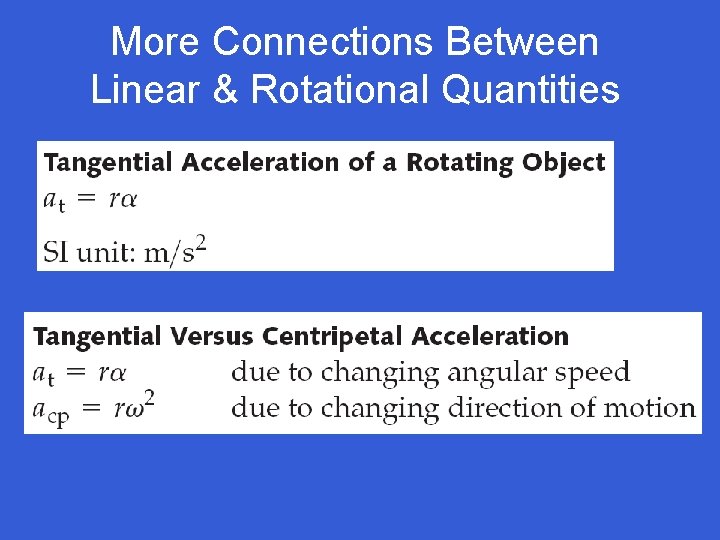
More Connections Between Linear & Rotational Quantities
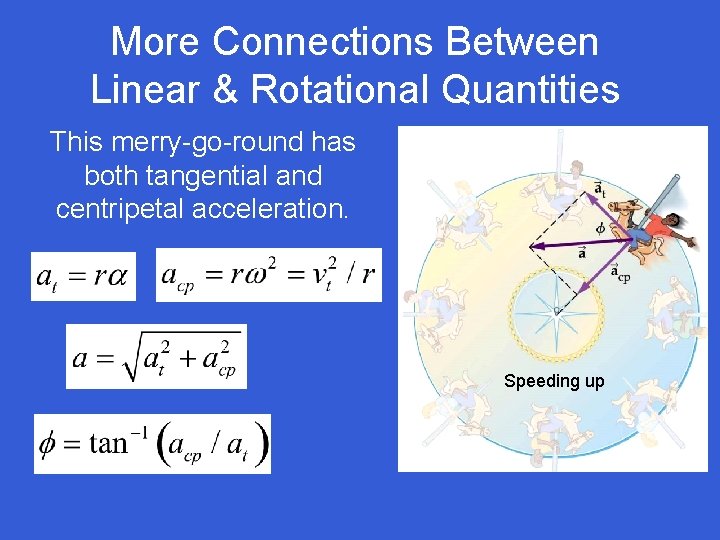
More Connections Between Linear & Rotational Quantities This merry-go-round has both tangential and centripetal acceleration. Speeding up
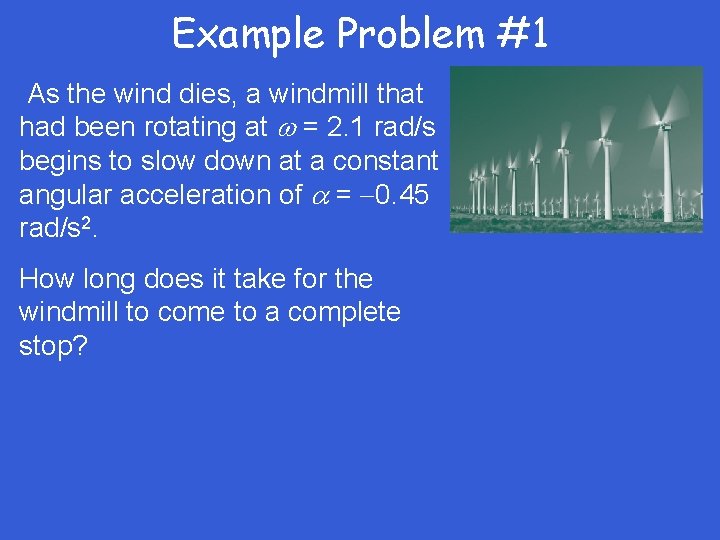
Example Problem #1 As the wind dies, a windmill that had been rotating at w = 2. 1 rad/s begins to slow down at a constant angular acceleration of a = -0. 45 rad/s 2. How long does it take for the windmill to come to a complete stop?
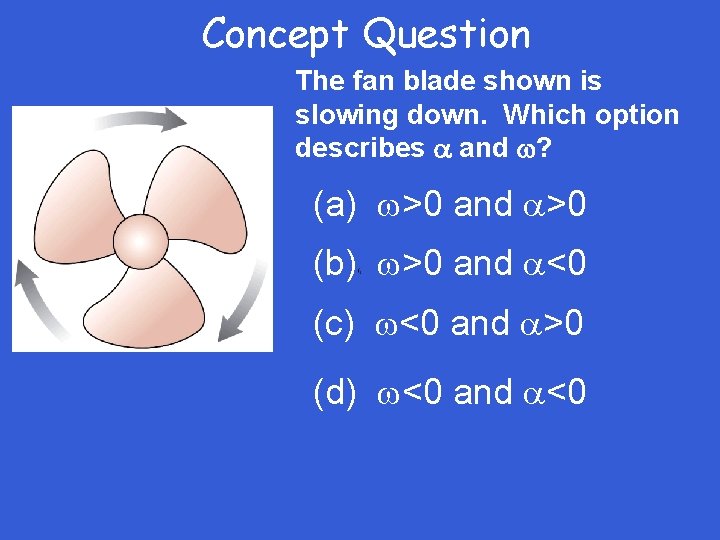
Concept Question The fan blade shown is slowing down. Which option describes a and w? (a) >0 and >0 (b) >0 and <0 (c) <0 and >0 (d) <0 and <0
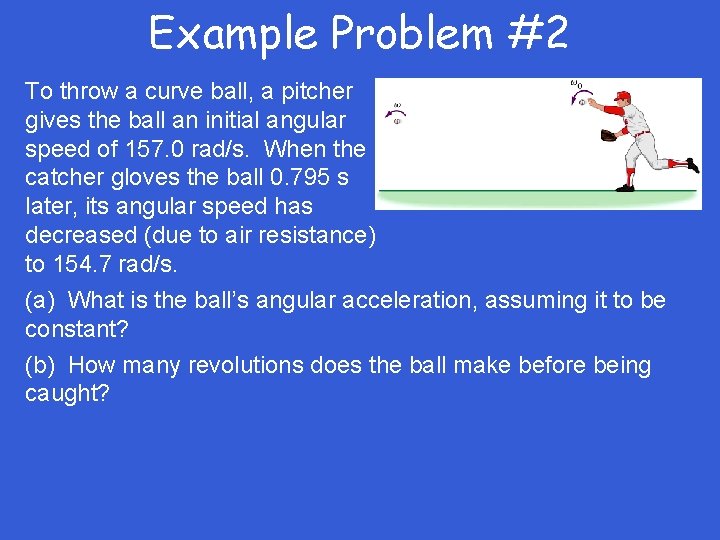
Example Problem #2 To throw a curve ball, a pitcher gives the ball an initial angular speed of 157. 0 rad/s. When the catcher gloves the ball 0. 795 s later, its angular speed has decreased (due to air resistance) to 154. 7 rad/s. (a) What is the ball’s angular acceleration, assuming it to be constant? (b) How many revolutions does the ball make before being caught?
Example Problem #3 A car’s tachometer indicates the angular velocity of the crank shaft in rpm. A car stopped at a traffic light has its engine idling at 500 rpm. When the light turns green, the crankshaft’s angular velocity speeds up at a constant rate to 2500 rpm in a time interval of 3. 0 s. How many revolutions does the crankshaft make in this time interval?
• The next few slides have more example problems if you would like more practice on your own. • The answers will be posted on the website tomorrow
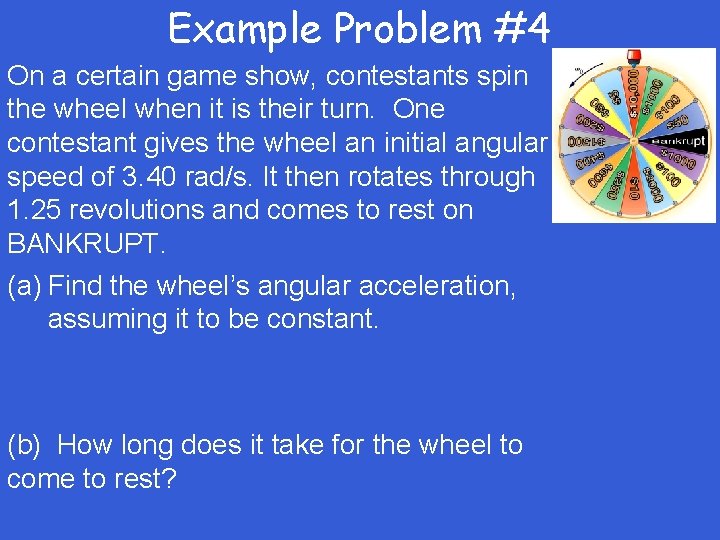
Example Problem #4 On a certain game show, contestants spin the wheel when it is their turn. One contestant gives the wheel an initial angular speed of 3. 40 rad/s. It then rotates through 1. 25 revolutions and comes to rest on BANKRUPT. (a) Find the wheel’s angular acceleration, assuming it to be constant. (b) How long does it take for the wheel to come to rest?
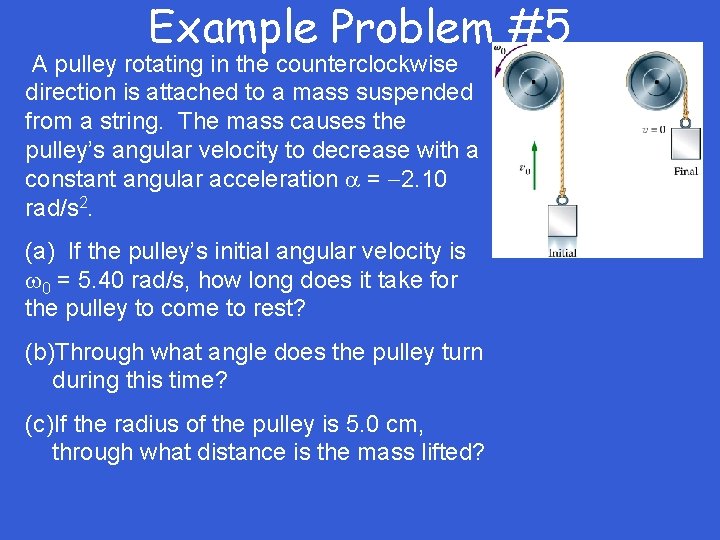
Example Problem #5 A pulley rotating in the counterclockwise direction is attached to a mass suspended from a string. The mass causes the pulley’s angular velocity to decrease with a constant angular acceleration = -2. 10 rad/s 2. (a) If the pulley’s initial angular velocity is 0 = 5. 40 rad/s, how long does it take for the pulley to come to rest? (b)Through what angle does the pulley turn during this time? (c)If the radius of the pulley is 5. 0 cm, through what distance is the mass lifted?
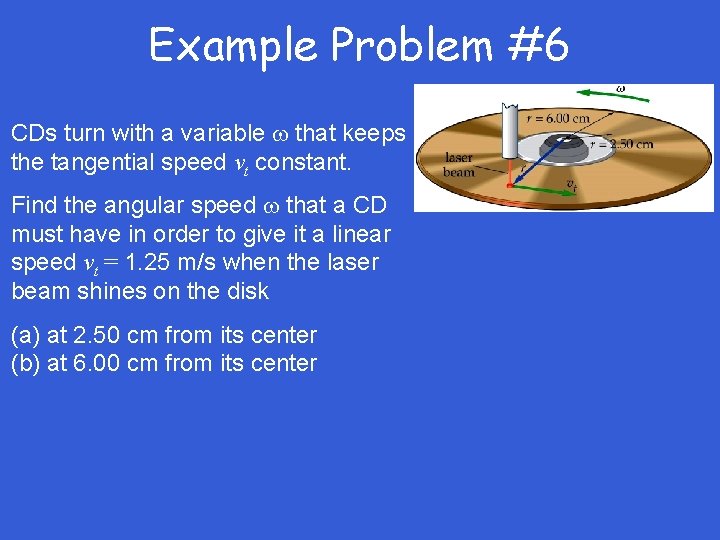
Example Problem #6 CDs turn with a variable that keeps the tangential speed vt constant. Find the angular speed that a CD must have in order to give it a linear speed vt = 1. 25 m/s when the laser beam shines on the disk (a) at 2. 50 cm from its center (b) at 6. 00 cm from its center
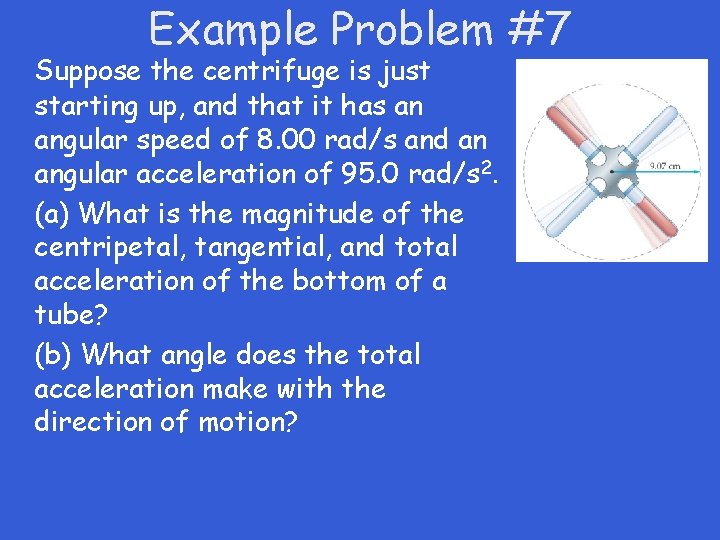
Example Problem #7 Suppose the centrifuge is just starting up, and that it has an angular speed of 8. 00 rad/s and an angular acceleration of 95. 0 rad/s 2. (a) What is the magnitude of the centripetal, tangential, and total acceleration of the bottom of a tube? (b) What angle does the total acceleration make with the direction of motion?
Torque and Rotational Acceleration Inquiry Lab This is an RA grade and you will have a board meeting on Fri. 9/14 • Goal: To explore the relationship between torque and angular acceleration • Board Meeting Expectations: – Data Table and Observations • If you average any data to use in your calculations you must show the average and the standard deviation value for it – – Calculations (1 of each type shown) Graph w/an equation for your line of best fit Explain what the slope represents Explain the relationship between torque and angular acceleration
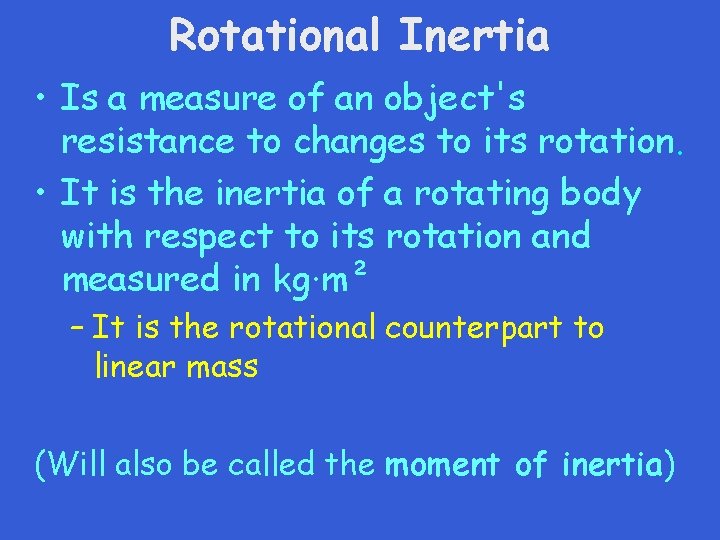
Rotational Inertia • Is a measure of an object's resistance to changes to its rotation. • It is the inertia of a rotating body with respect to its rotation and measured in kg·m² – It is the rotational counterpart to linear mass (Will also be called the moment of inertia)
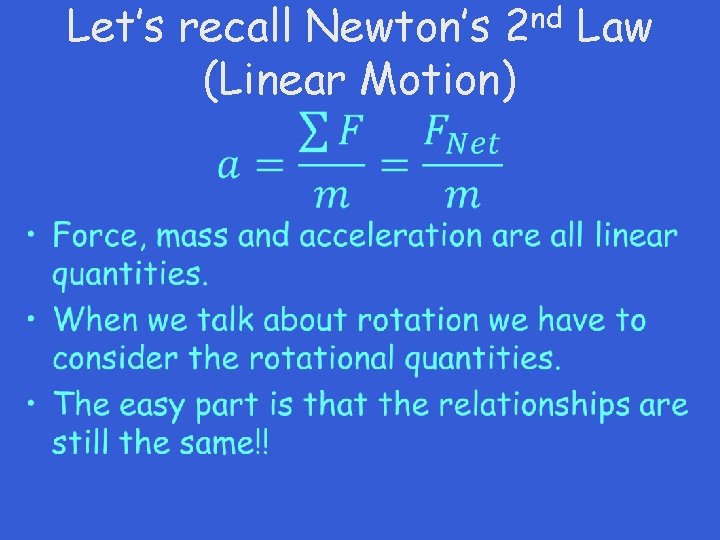
nd 2 • Let’s recall Newton’s (Linear Motion) Law
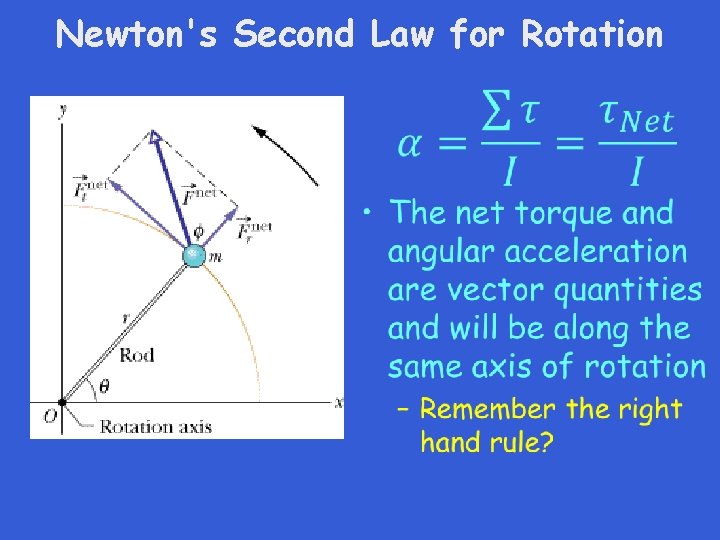
Newton's Second Law for Rotation •
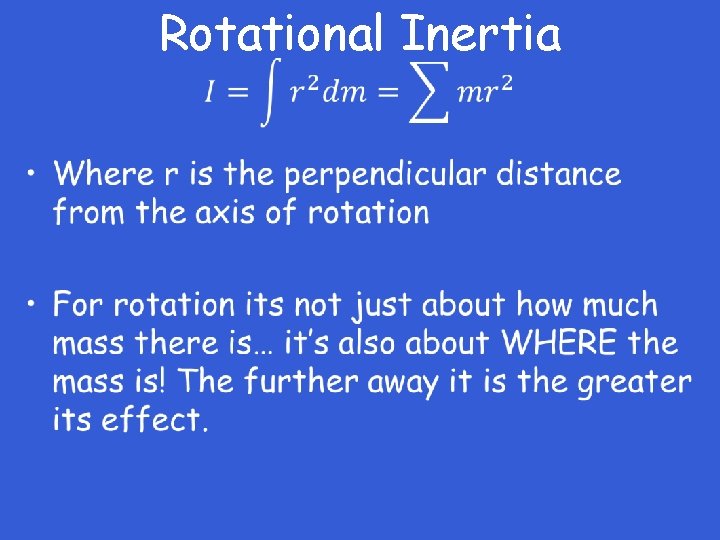
• Rotational Inertia
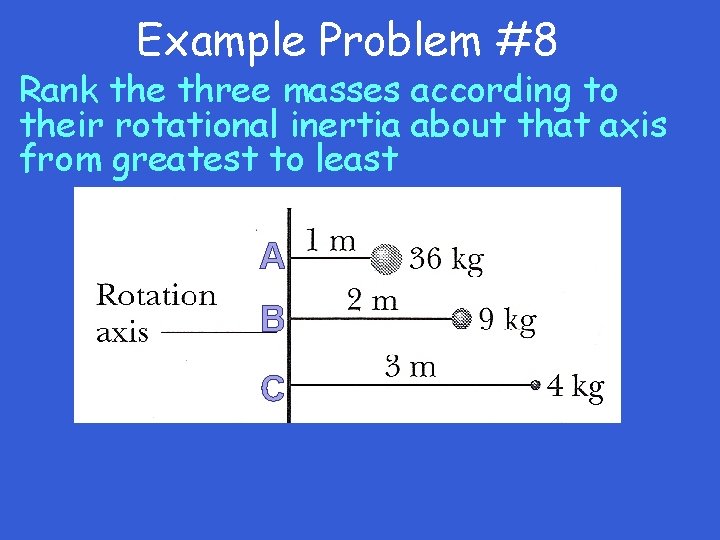
Example Problem #8 Rank the three masses according to their rotational inertia about that axis from greatest to least A B C
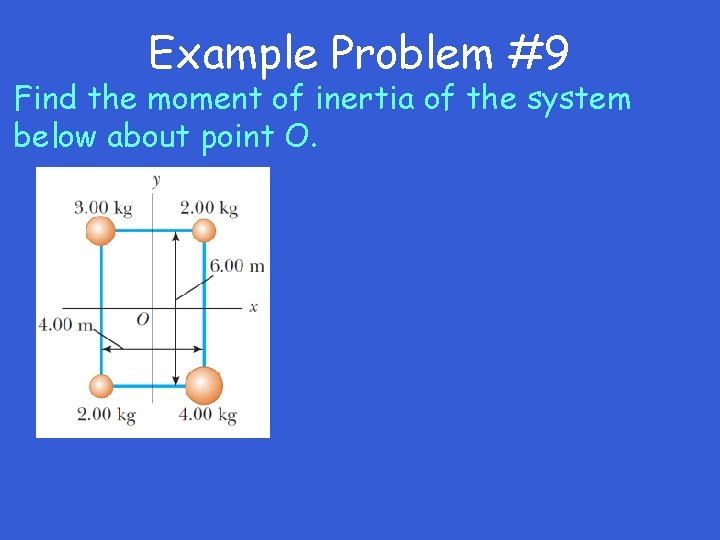
Example Problem #9 Find the moment of inertia of the system below about point O.
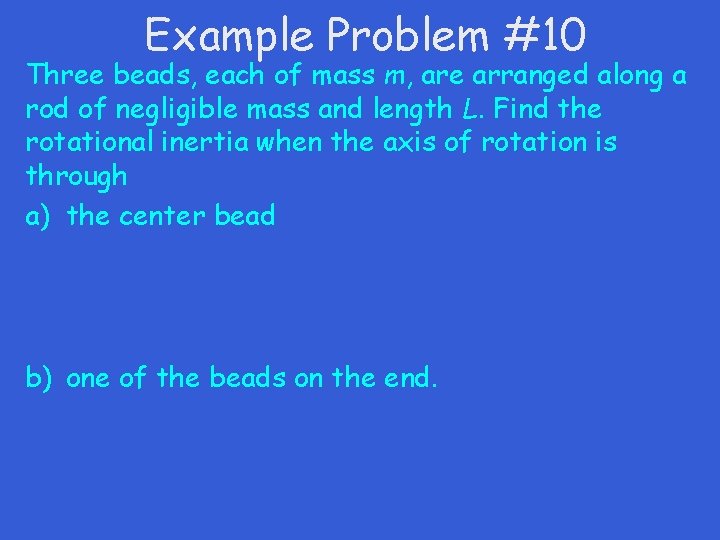
Example Problem #10 Three beads, each of mass m, are arranged along a rod of negligible mass and length L. Find the rotational inertia when the axis of rotation is through a) the center bead b) one of the beads on the end.
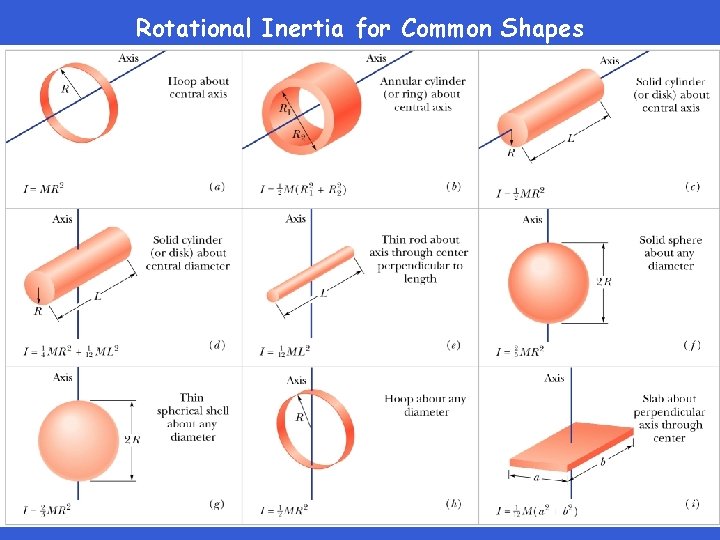
Rotational Inertia for Common Shapes
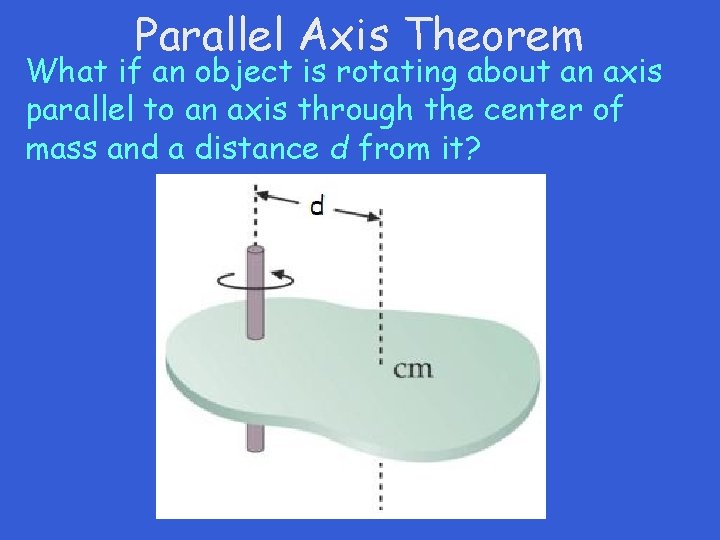
Parallel Axis Theorem What if an object is rotating about an axis parallel to an axis through the center of mass and a distance d from it?
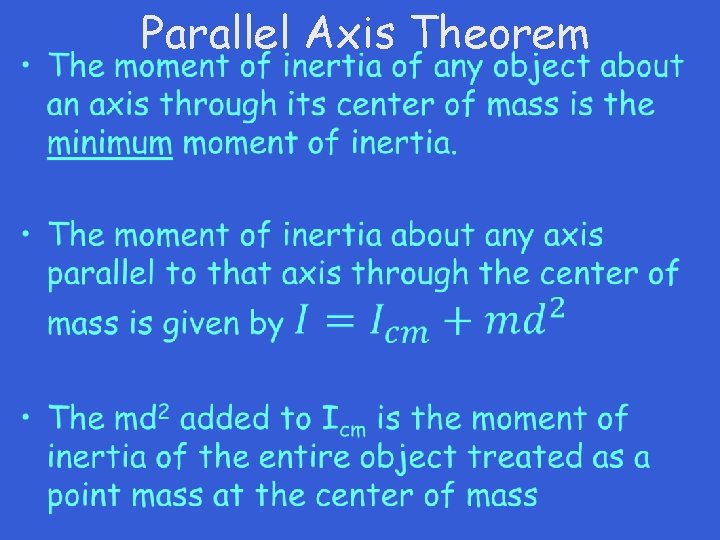
• Parallel Axis Theorem
Using the Parallel Axis Theorem instead…. Example #10 again Three beads, each of mass m, are arranged along a rod of negligible mass and length L. Find the rotational inertia when the axis of rotation is through one of the beads on the end.
APP 1 vs APPC PULLEYS!!
APP 1 vs APPC Let’s just ignore the pulley!! Two unequal masses, m 1 and m 2, are attached to a string that passes over a massless pulley. Determine the linear acceleration of the masses in terms of m 1, m 2, and g. We can’t just ignore the pulley!! Two unequal masses, m 1 and m 2, are attached to a string that passes over a pulley with a mass mp and radius r. Determine the linear acceleration of the masses in terms of m 1, m 2, mp, g, and r.