
Rotational Dynamics Torque Practice Problems Newtons 2 nd
Rotational Dynamics: Torque Practice Problems Newton’s 2 nd law involving rotations
Practice Problem #2 �A person exerts a force of 45. 0 N on the end of a door 84. 0 cm wide. What is the magnitude of the torque if the force is exerted: ◦ Perpendicular to the door? ◦ At a 60. 0° angle to the face of the door?
Practice problem #3 �If the coefficient of static friction between tires and pavement is 0. 75, calculate the minimum torque that must be applied to the 66 cm diameter tire of a 1080 kg automobile in order to “lay rubber” (make the wheels spin, slipping as the car accelerates). Assume each wheel supports an equal share of the weight.
Practice problem #4 �The bolts on the cylinder head of an engine require tightening to a torque of 80. 0 m·N. If a wrench is 30. 0 cm long, what force perpendicular to the wrench must the mechanic exert at its end?
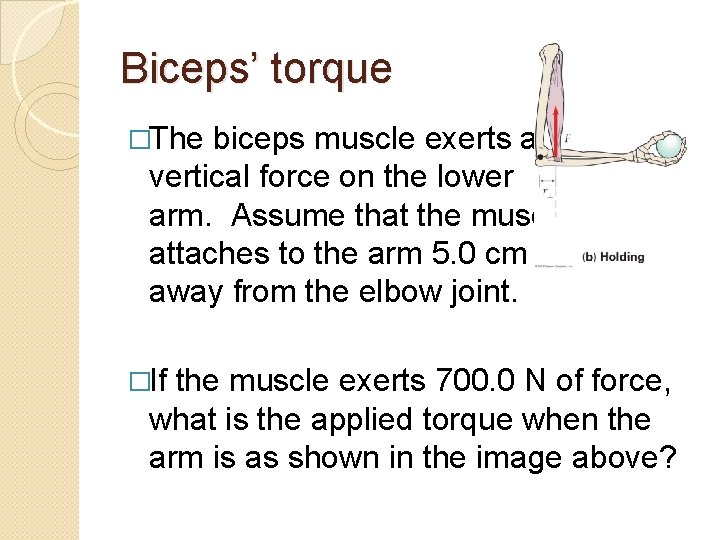
Biceps’ torque �The biceps muscle exerts a vertical force on the lower arm. Assume that the muscle attaches to the arm 5. 0 cm away from the elbow joint. �If the muscle exerts 700. 0 N of force, what is the applied torque when the arm is as shown in the image above?
Net torque �The total sum of each torque acting on a body. �If both torques would/could cause a clockwise rotation or a counter-clockwise rotation, then the net torque is the sum of the magnitudes. �If both torques would/could cause a rotation in opposite directions, the net torque is the difference of the two. �Assign a + and a – direction to the clockwise and counter-clockwise directions (your choice…keep it consistent)
Static Equilibrium �Occurs when both the net torque and the net force are equal to zero. �No rotation and no linear acceleration will occur
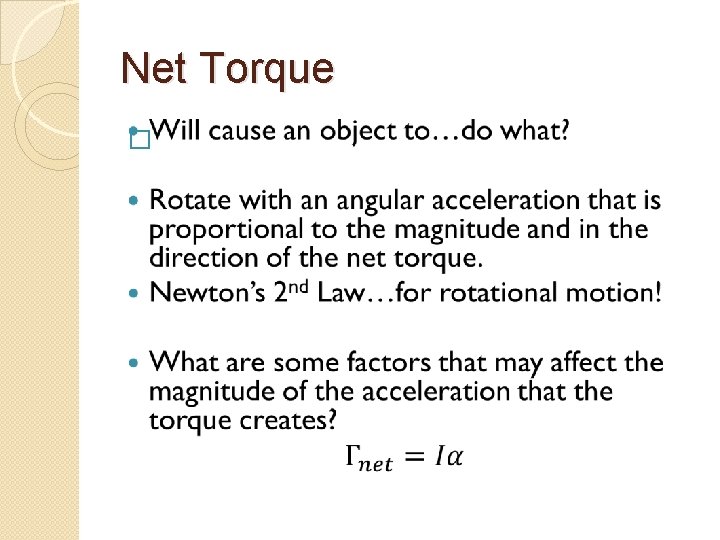
Net Torque �
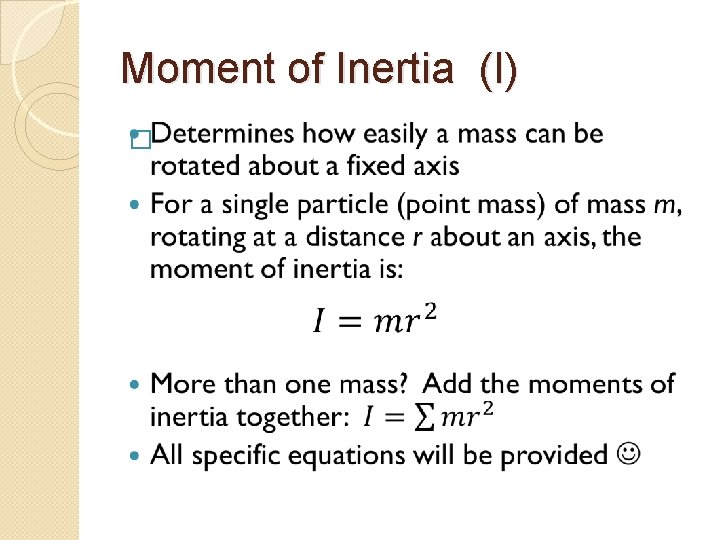
Moment of Inertia (I) �
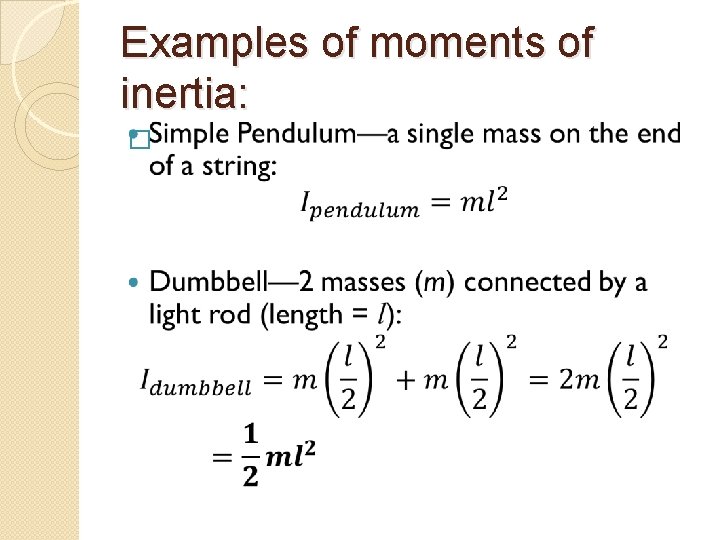
Examples of moments of inertia: �
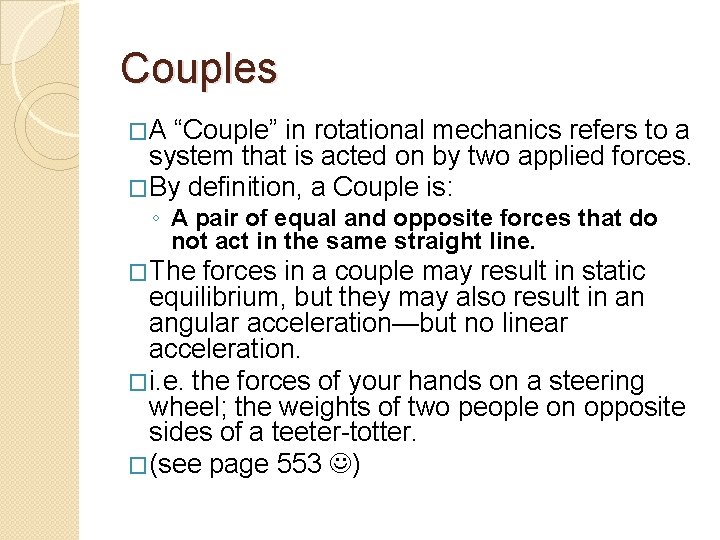
Couples �A “Couple” in rotational mechanics refers to a system that is acted on by two applied forces. �By definition, a Couple is: ◦ A pair of equal and opposite forces that do not act in the same straight line. �The forces in a couple may result in static equilibrium, but they may also result in an angular acceleration—but no linear acceleration. �i. e. the forces of your hands on a steering wheel; the weights of two people on opposite sides of a teeter-totter. �(see page 553 )
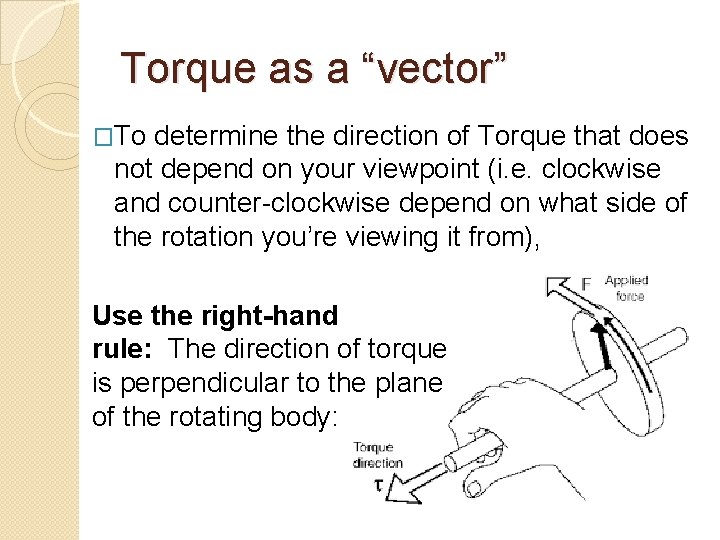
Torque as a “vector” �To determine the direction of Torque that does not depend on your viewpoint (i. e. clockwise and counter-clockwise depend on what side of the rotation you’re viewing it from), Use the right-hand rule: The direction of torque is perpendicular to the plane of the rotating body:
- Slides: 12