
Rotational Dynamics Chapter 11 Important quantities Moment of
- Slides: 19
Rotational Dynamics Chapter 11
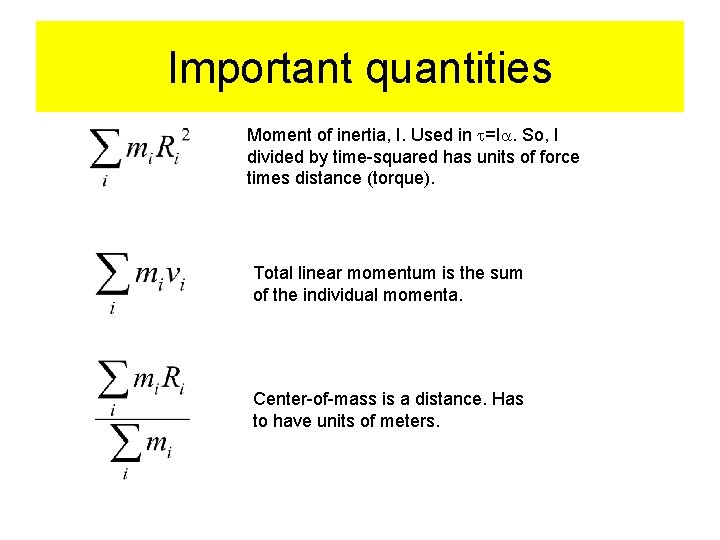
Important quantities Moment of inertia, I. Used in t=Ia. So, I divided by time-squared has units of force times distance (torque). Total linear momentum is the sum of the individual momenta. Center-of-mass is a distance. Has to have units of meters.
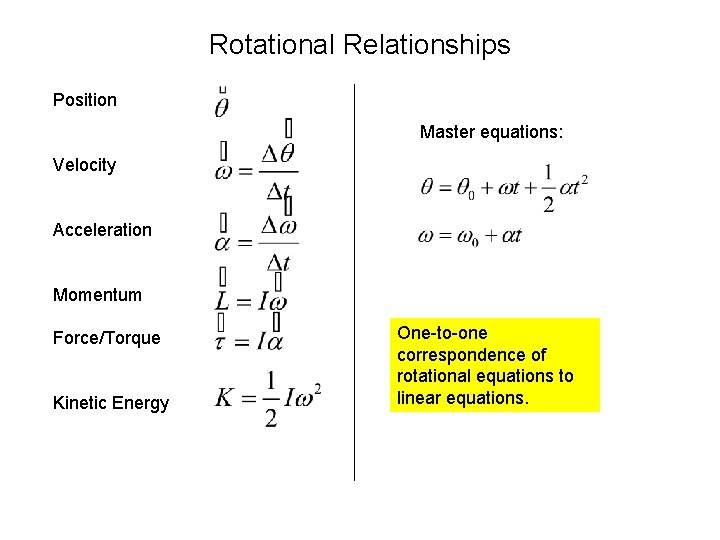
Rotational Relationships Position Master equations: Velocity Acceleration Momentum Force/Torque Kinetic Energy One-to-one correspondence of rotational equations to linear equations.
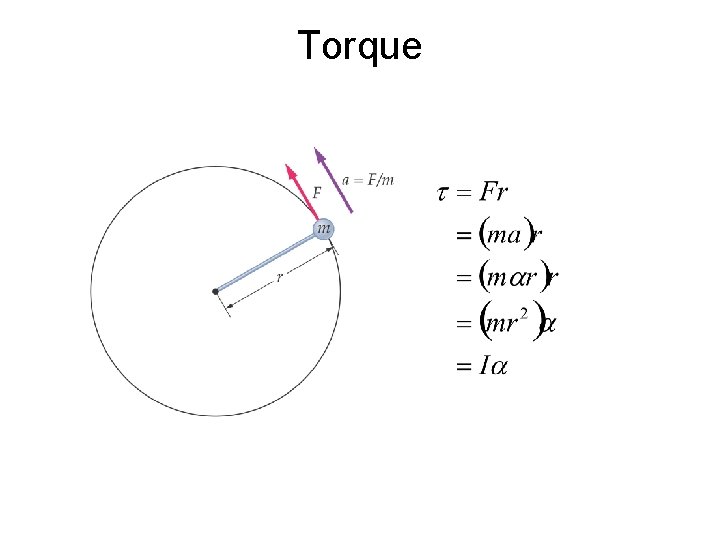
Torque
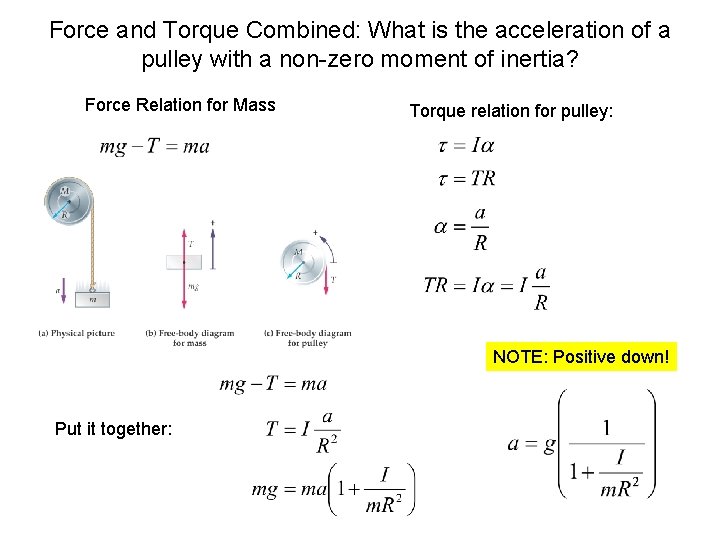
Force and Torque Combined: What is the acceleration of a pulley with a non-zero moment of inertia? Force Relation for Mass Torque relation for pulley: NOTE: Positive down! Put it together:
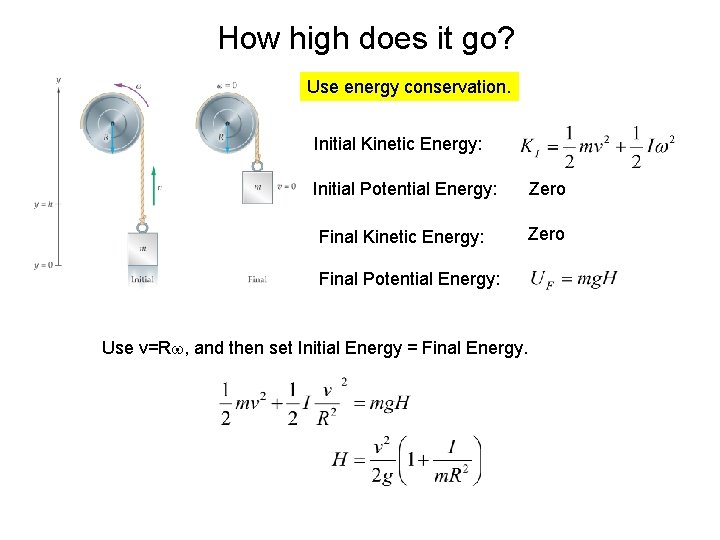
How high does it go? Use energy conservation. Initial Kinetic Energy: Initial Potential Energy: Zero Final Kinetic Energy: Zero Final Potential Energy: Use v=Rw, and then set Initial Energy = Final Energy.
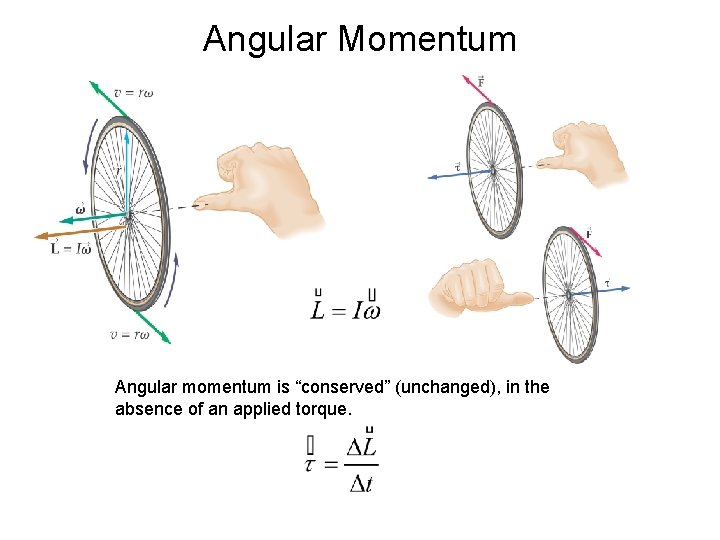
Angular Momentum Angular momentum is “conserved” (unchanged), in the absence of an applied torque.
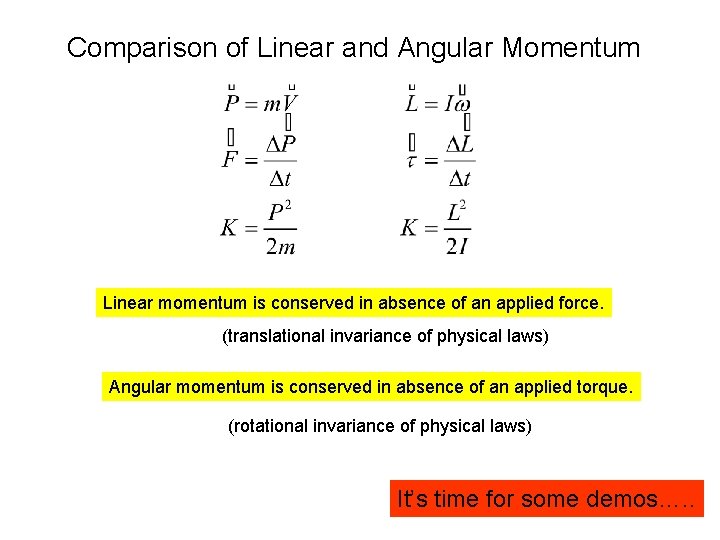
Comparison of Linear and Angular Momentum Linear momentum is conserved in absence of an applied force. (translational invariance of physical laws) Angular momentum is conserved in absence of an applied torque. (rotational invariance of physical laws) It’s time for some demos…. .
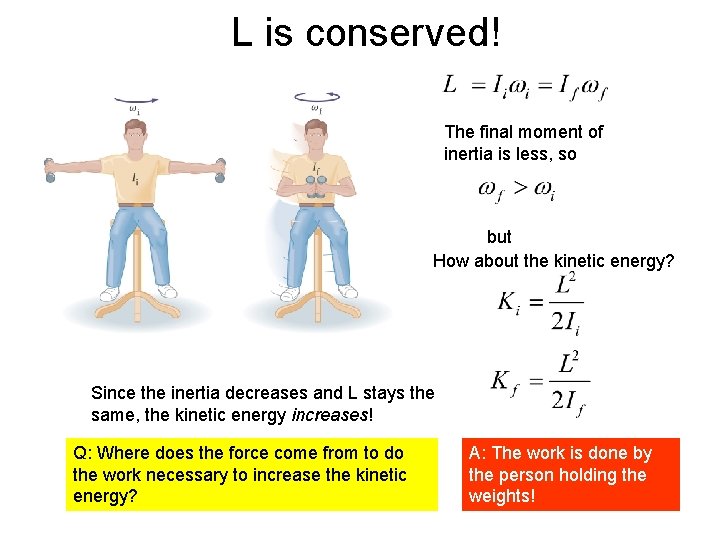
L is conserved! The final moment of inertia is less, so but How about the kinetic energy? Since the inertia decreases and L stays the same, the kinetic energy increases! Q: Where does the force come from to do the work necessary to increase the kinetic energy? A: The work is done by the person holding the weights!
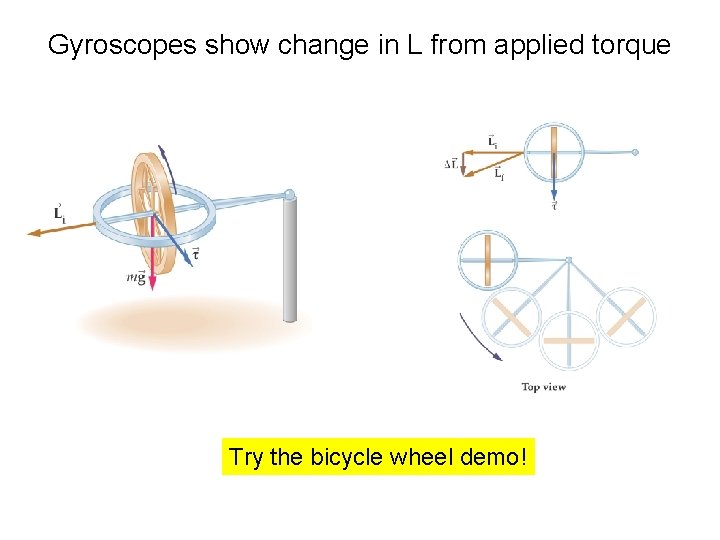
Gyroscopes show change in L from applied torque Try the bicycle wheel demo!
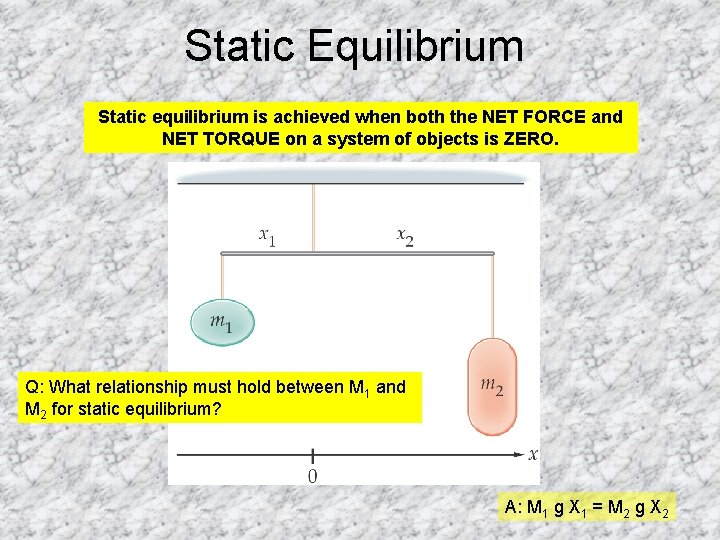
Static Equilibrium Static equilibrium is achieved when both the NET FORCE and NET TORQUE on a system of objects is ZERO. Q: What relationship must hold between M 1 and M 2 for static equilibrium? A: M 1 g X 1 = M 2 g X 2
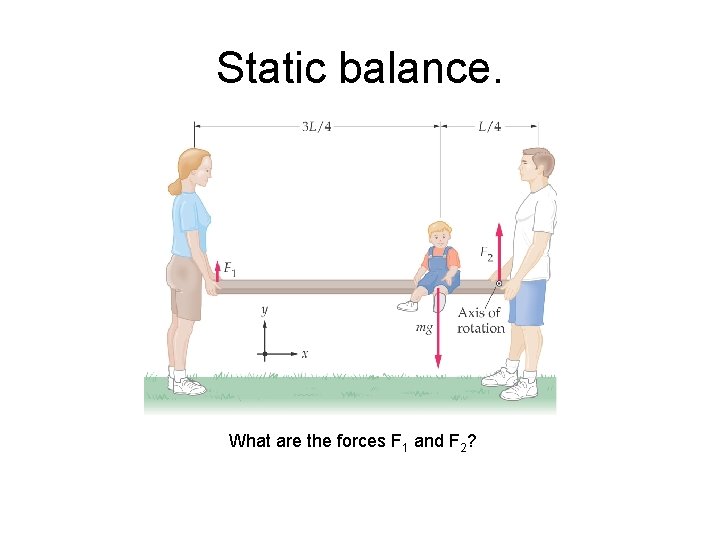
Static balance. What are the forces F 1 and F 2?
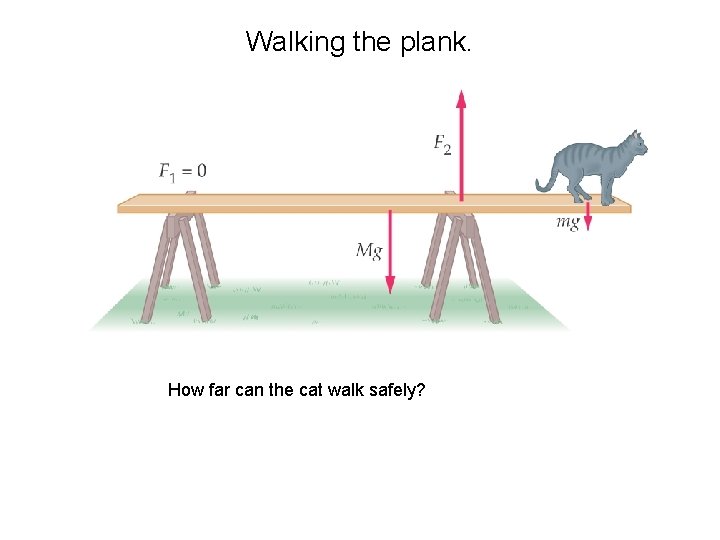
Walking the plank. How far can the cat walk safely?
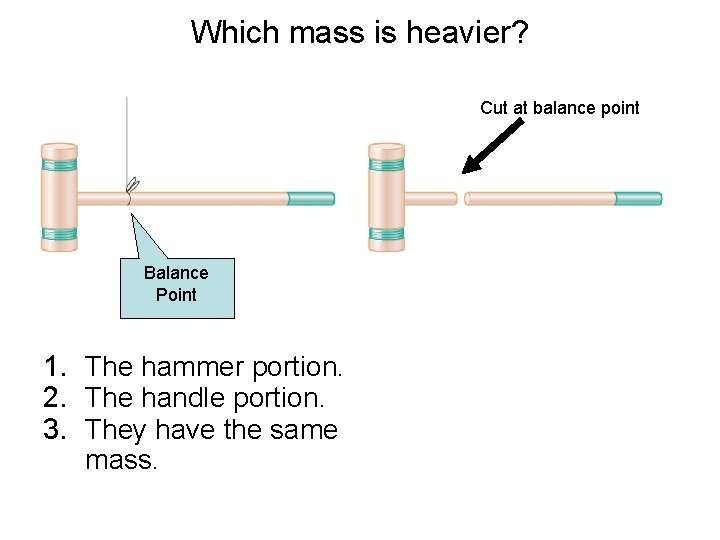
Which mass is heavier? Cut at balance point Balance Point 1. The hammer portion. 2. The handle portion. 3. They have the same mass.
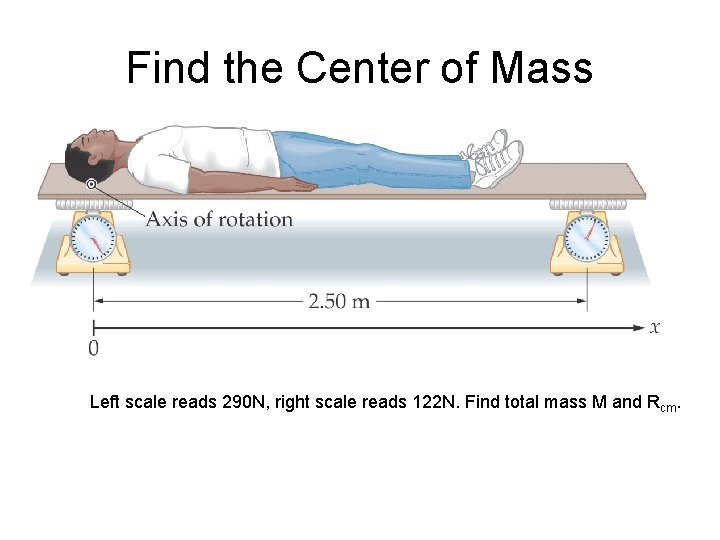
Find the Center of Mass Left scale reads 290 N, right scale reads 122 N. Find total mass M and Rcm.
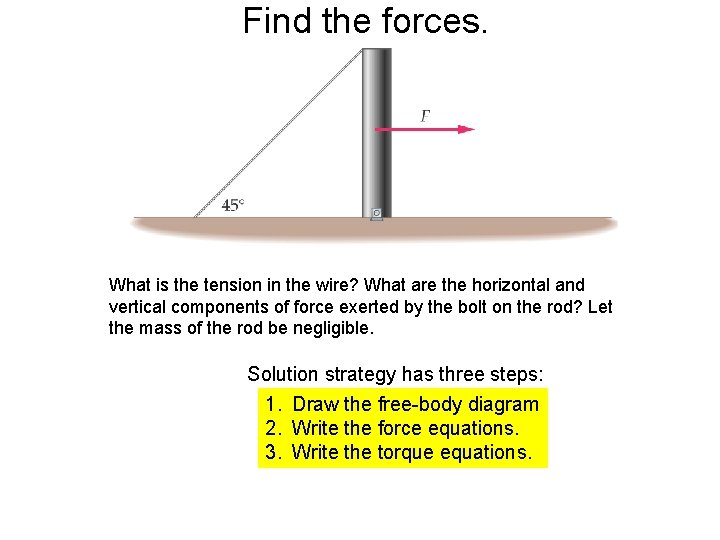
Find the forces. What is the tension in the wire? What are the horizontal and vertical components of force exerted by the bolt on the rod? Let the mass of the rod be negligible. Solution strategy has three steps: 1. Draw the free-body diagram 2. Write the force equations. 3. Write the torque equations.
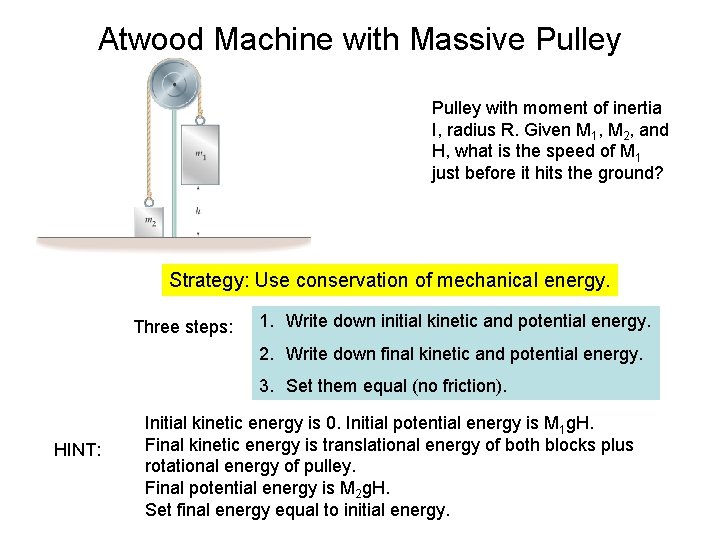
Atwood Machine with Massive Pulley with moment of inertia I, radius R. Given M 1, M 2, and H, what is the speed of M 1 just before it hits the ground? Strategy: Use conservation of mechanical energy. Three steps: 1. Write down initial kinetic and potential energy. 2. Write down final kinetic and potential energy. 3. Set them equal (no friction). HINT: Initial kinetic energy is 0. Initial potential energy is M 1 g. H. Final kinetic energy is translational energy of both blocks plus rotational energy of pulley. Final potential energy is M 2 g. H. Set final energy equal to initial energy.
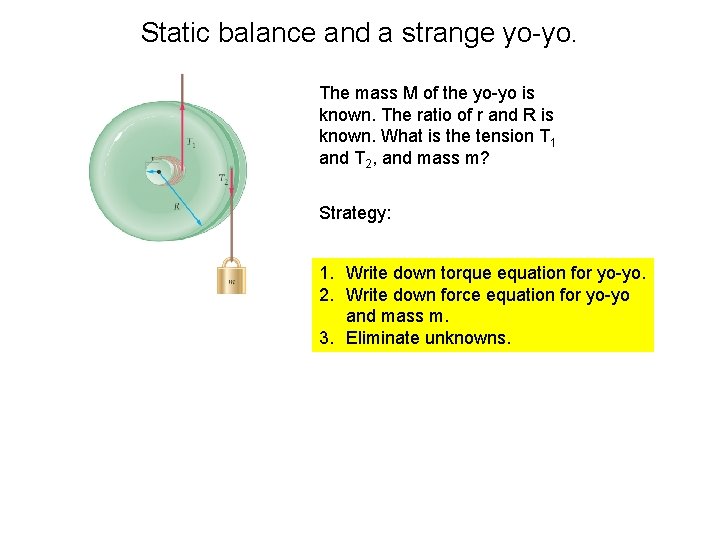
Static balance and a strange yo-yo. The mass M of the yo-yo is known. The ratio of r and R is known. What is the tension T 1 and T 2, and mass m? Strategy: 1. Write down torque equation for yo-yo. 2. Write down force equation for yo-yo and mass m. 3. Eliminate unknowns.
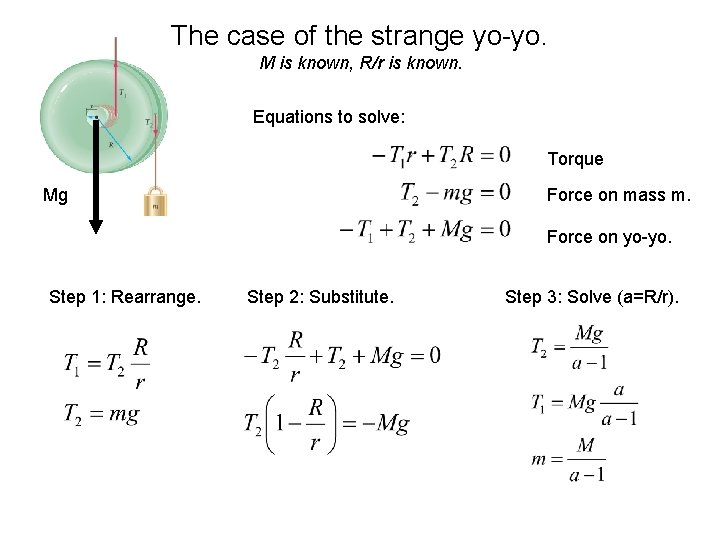
The case of the strange yo-yo. M is known, R/r is known. Equations to solve: Torque Mg Force on mass m. Force on yo-yo. Step 1: Rearrange. Step 2: Substitute. Step 3: Solve (a=R/r).