
Rotational Diamond Anvil Cell Laboratory at ISU Acknowledgments
Rotational Diamond Anvil Cell Laboratory at ISU Acknowledgments: -Army Research Office (W 911 NF-17 -1 -0225 & DURIP W 911 NF-17 -1 -0196) Dr. David Stepp PI: Dist. Prof. Valery I. Levitas Laboratory Manager: Dr. Krishan Kumar Pandey, post doc Department of Aerospace Engineering Iowa State University, Ames, IA
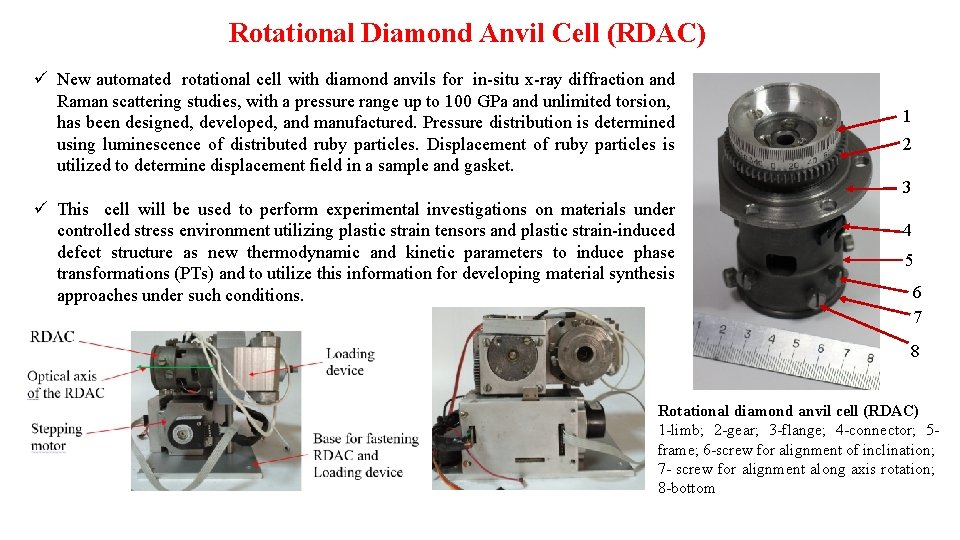
Rotational Diamond Anvil Cell (RDAC) ü New automated rotational cell with diamond anvils for in-situ x-ray diffraction and Raman scattering studies, with a pressure range up to. Laser focusing and 100 GPa and unlimited torsion, has been designed, developed, and manufactured. Pressure distribution is determined signal collection using luminescence of distributed ruby particles. Displacement Objective of ruby particles is utilized to determine displacement field in a sample and gasket. 1 2 3 ü This cell will be used to perform experimental investigations on materials under controlled stress environment utilizing plastic strain tensors and plastic strain-induced defect structure as new thermodynamic and kinetic parameters to induce phase transformations (PTs) and to utilize this information for developing material synthesis approaches under such conditions. 4 5 6 7 8 Rotational diamond anvil cell (RDAC) 1 -limb; 2 -gear; 3 -flange; 4 -connector; 5 frame; 6 -screw for alignment of inclination; 7 - screw for alignment along axis rotation; 8 -bottom

Rotational Diamond Anvil Cell (RDAC) Design Scheme of a RDAC: movable piston (1), case (2), bottom (3), screw (4), hemispheric upper support (5), tooth gear (6), limb (7), flange (8), upper support (9), bottom support (10), hemispheric bottom support (11), hemispheric support (12), textolite plate (13), screw (14), steel plate (15), screws (16– 20), movable diamond anvil (21), unmovable diamond anvil (22). Scheme of the diamond cell: 1—diamond anvil, 2—culet, 3 —gasket, 4—sample. Ref. : N. B. Novikov, L. K. Shvedov, Yu. N. Krivosheya and V. I. Levitas; Journal of Superhard Materials, 2015, Vol. 37, No. 1, pp. 1– 7.

Rotational Diamond Anvil Cell (RDAC) Design Scheme of a RDAC with the loading device: RDAC (1), levers (2), disk springs (3), axis (4), switching device (5), case (6), reducer (7). Ref. : N. B. Novikov, L. K. Shvedov, Yu. N. Krivosheya and V. I. Levitas; Journal of Superhard Materials, 2015, Vol. 37, No. 1, pp. 1– 7.
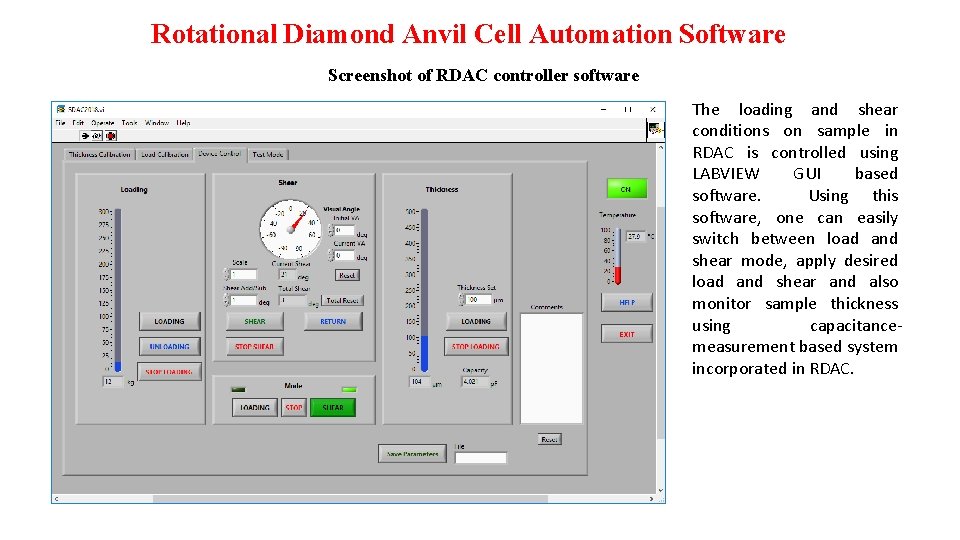
Rotational Diamond Anvil Cell Automation Software Screenshot of RDAC controller software Laser focusing and signal collection Objective The loading and shear conditions on sample in RDAC is controlled using LABVIEW GUI based software. Using this software, one can easily switch between load and shear mode, apply desired load and shear and also monitor sample thickness using capacitancemeasurement based system incorporated in RDAC.

Rotational Diamond Anvil Cell Laboratory Micro-confocal Raman system ü The Micro-confocal Raman system has been designed, assembled and aligned. ü This system is equipped with 532 nm, 300 m. W diode pumped solid state laser (as excitation source) and Andor 500 i spectrometer with Andor i. DUS CCD detector for recording Raman spectra (both Stokes and anti-Stokes) starting from 5 cm-1 onwards with a resolution of ~ 23 cm-1. ü This system is capable of recording Raman signal from sample size as small as 1 micron and with 2 axis motorized stages at sample position, it can be used for 2 D Raman imaging with a resolution of 1 micron. ü This system is also equipped with magnified viewing arrangement with 10 X magnification to precisely align sample position with respect to excitation laser spot. Laser spot on calibration scale as viewed from viewing arrangement in Raman system Confocal Raman signal collection optics Spectrometer RDAC system Motorized actuators for sample alignment

Rotational Diamond Anvil Cell Laboratory Micro-confocal Raman system camera Laser focusing and signal collection Objective laser Confocal collection optics Inside view of confocal collection optics Rotation diamond anvil cell system LED illuminator manual X stage for bringing sample to focal plane and motorized YZ stage for sample alignment with respect to laser and 2 D Raman imaging

Rotational Diamond Anvil Cell Laboratory Optical layout of Micro-confocal Raman system Laser focusing and signal collection Objective

Rotational Diamond Anvil Cell Laboratory Other facilities at RDAC lab Stereo-zoom microscope Mechanical micro-drill machine Electrical discharge machine Rolling mill
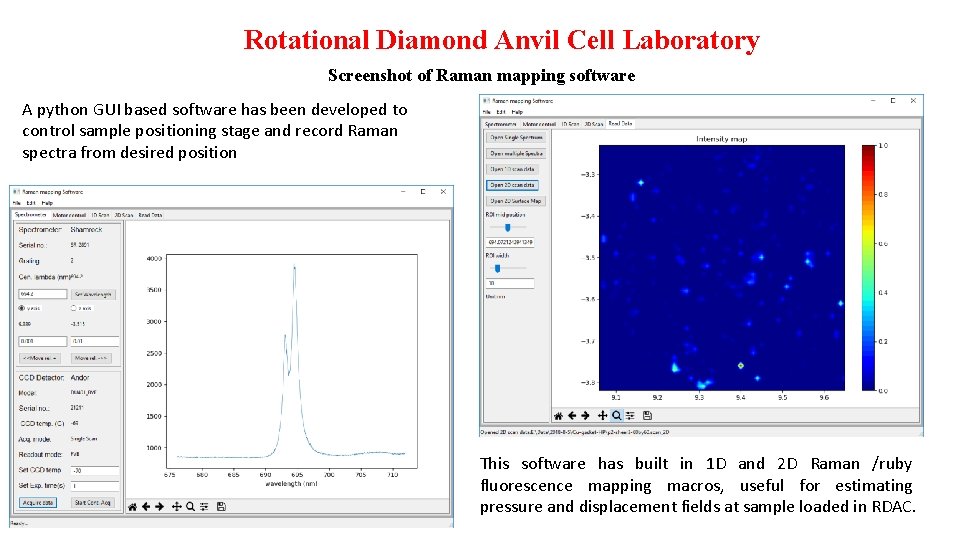
Rotational Diamond Anvil Cell Laboratory Screenshot of Raman mapping software A python GUI based software has been developed to control sample positioning stage and record Raman spectra from desired position Laser focusing and signal collection Objective This software has built in 1 D and 2 D Raman /ruby fluorescence mapping macros, useful for estimating pressure and displacement fields at sample loaded in RDAC.
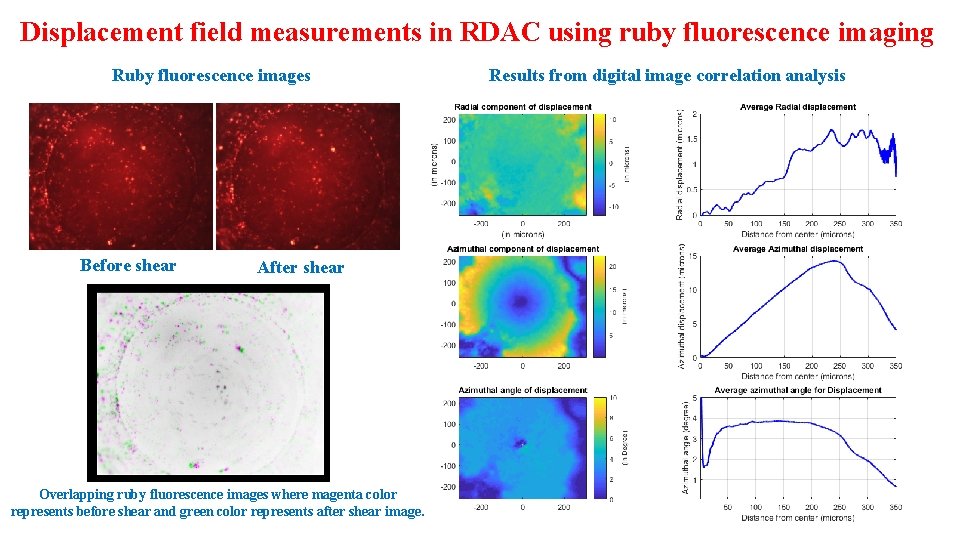
Displacement field measurements in RDAC using ruby fluorescence imaging Ruby fluorescence images Before shear After shear Overlapping ruby fluorescence images where magenta color represents before shear and green color represents after shear image. Results from digital image correlation analysis
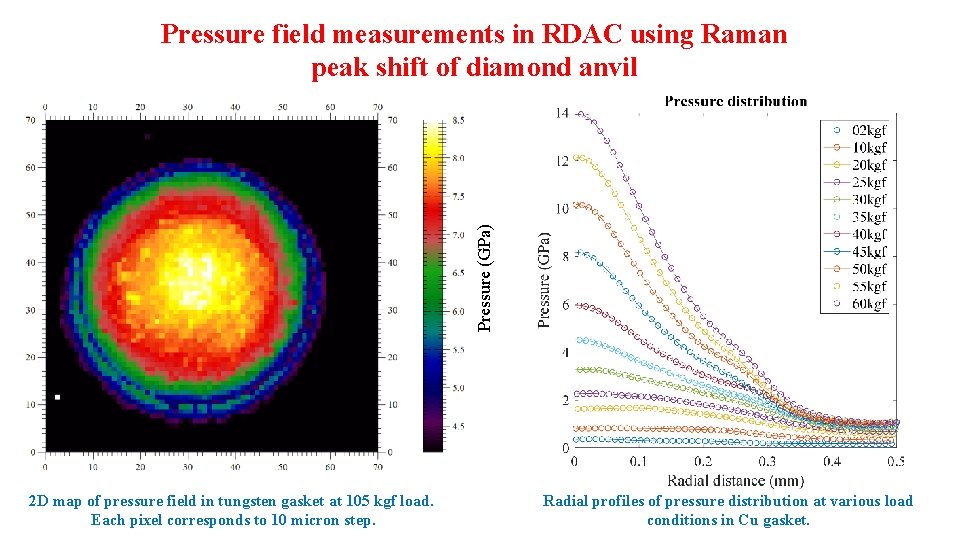
Pressure (GPa) Pressure field measurements in RDAC using Raman peak shift of diamond anvil 2 D map of pressure field in tungsten gasket at 105 kgf load. Each pixel corresponds to 10 micron step. Radial profiles of pressure distribution at various load conditions in Cu gasket.
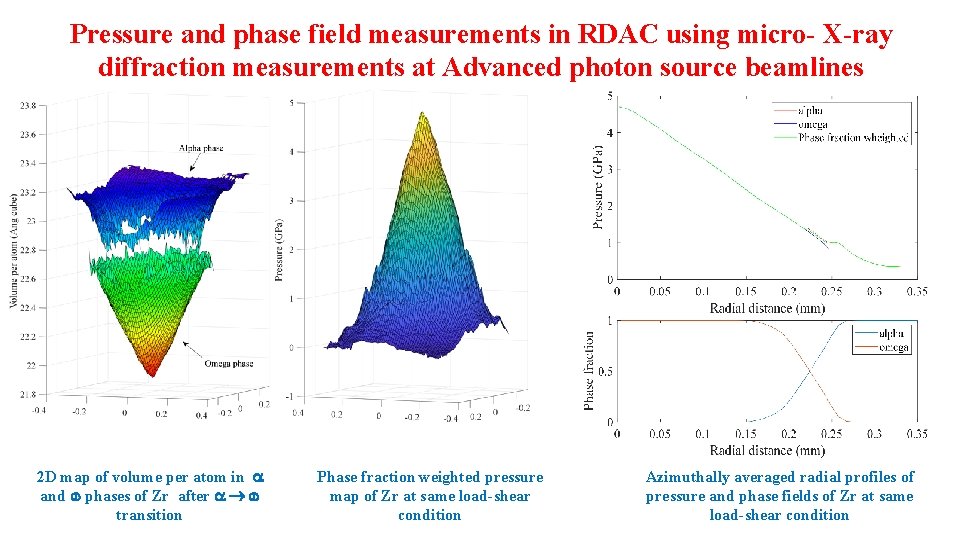
Pressure and phase field measurements in RDAC using micro- X-ray diffraction measurements at Advanced photon source beamlines 2 D map of volume per atom in and phases of Zr after transition Phase fraction weighted pressure map of Zr at same load-shear condition Azimuthally averaged radial profiles of pressure and phase fields of Zr at same load-shear condition
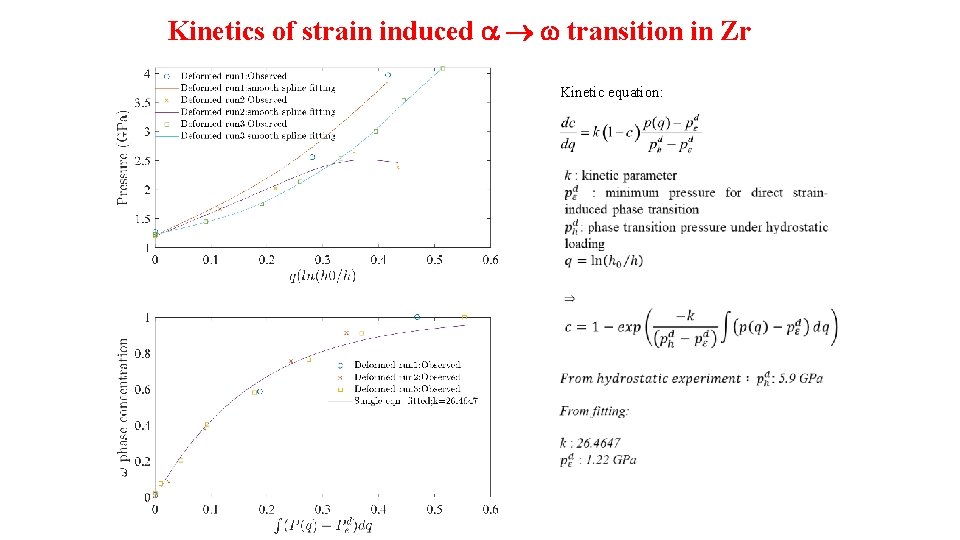
Kinetics of strain induced transition in Zr Kinetic equation:
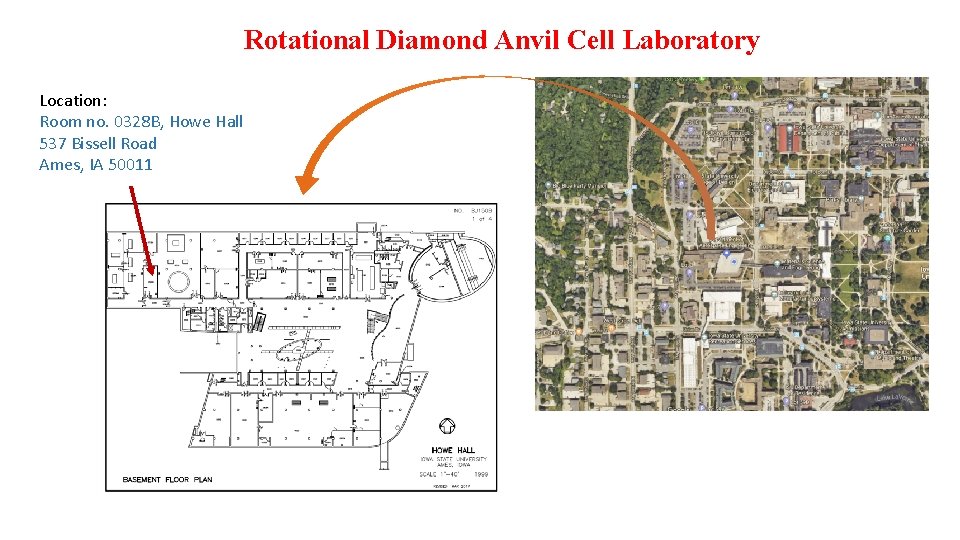
Rotational Diamond Anvil Cell Laboratory Location: Room no. 0328 B, Howe Hall 537 Bissell Road Ames, IA 50011
- Slides: 15