
Rotation Worksheet B Worksheets increase in difficulty and
Rotation – Worksheet B Worksheets increase in difficulty and are in 2 sizes.
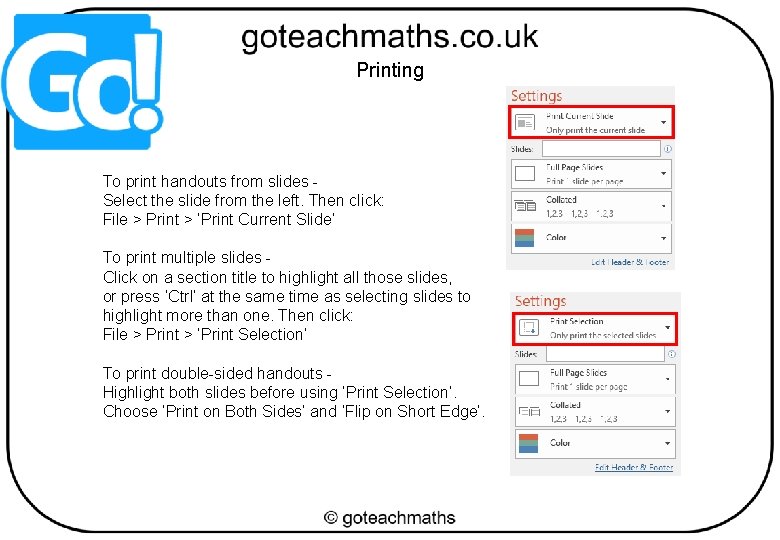
Printing To print handouts from slides Select the slide from the left. Then click: File > Print > ‘Print Current Slide’ To print multiple slides Click on a section title to highlight all those slides, or press ‘Ctrl’ at the same time as selecting slides to highlight more than one. Then click: File > Print > ‘Print Selection’ To print double-sided handouts Highlight both slides before using ‘Print Selection’. Choose ‘Print on Both Sides’ and ‘Flip on Short Edge’.
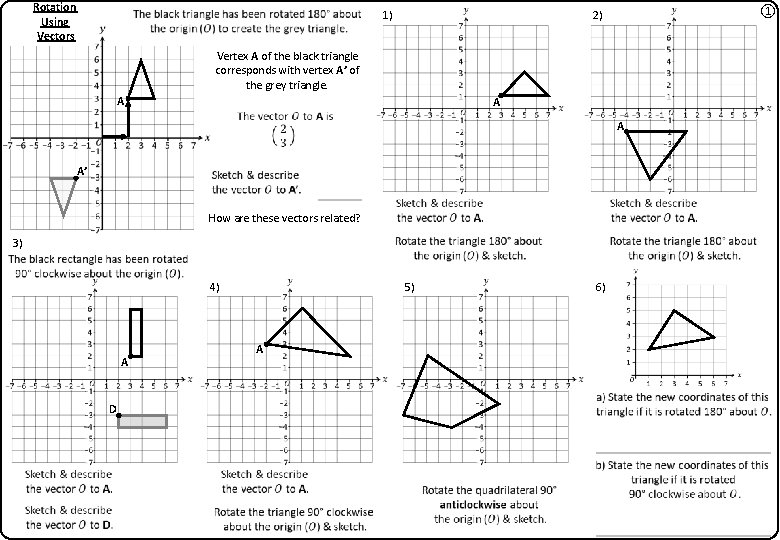
Rotation Using Vectors 1) ① 2) Vertex A of the black triangle corresponds with vertex A’ of the grey triangle. A A’ How are these vectors related? 3) 4) A D 5) A 6)

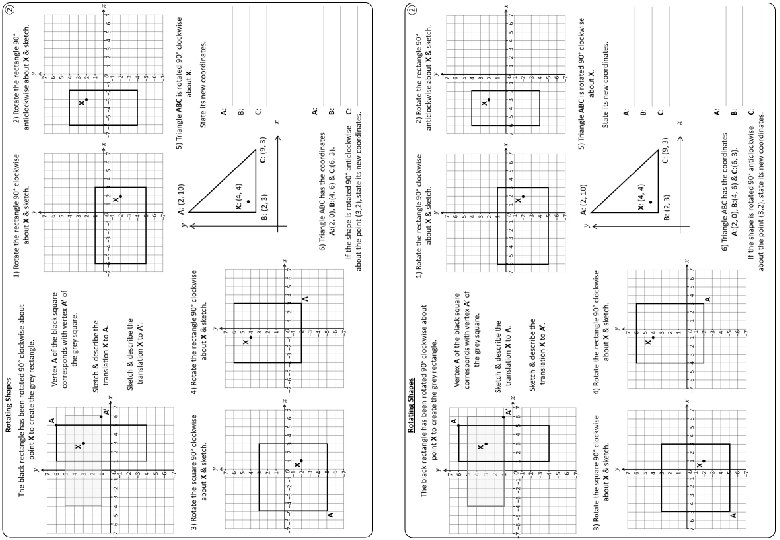
Rotating Shapes 1) Rotate the rectangle 90° clockwise about X & sketch. The black rectangle has been rotated 90° clockwise about point X to create the grey rectangle. A 2) Rotate the rectangle 90° anticlockwise about X & sketch. Vertex A of the black square corresponds with vertex A’ of the grey square. X A’ X Sketch & describe the translation X to A’. A: (2, 10) 3) Rotate the square 90° clockwise about X & sketch. 4) Rotate the rectangle 90° clockwise about X & sketch. 5) Triangle ABC is rotated 90° clockwise about X. State its new coordinates. A: X: (4, 4) X B: (2, 3) X A B: C: (9, 3) A 6) Triangle ABC has the coordinates A: (2, 0), B: (4, 6) & C: (6, 3). C: A: B: If the shape is rotated 90° anticlockwise C: about the point (3, 2), state its new coordinates. ②
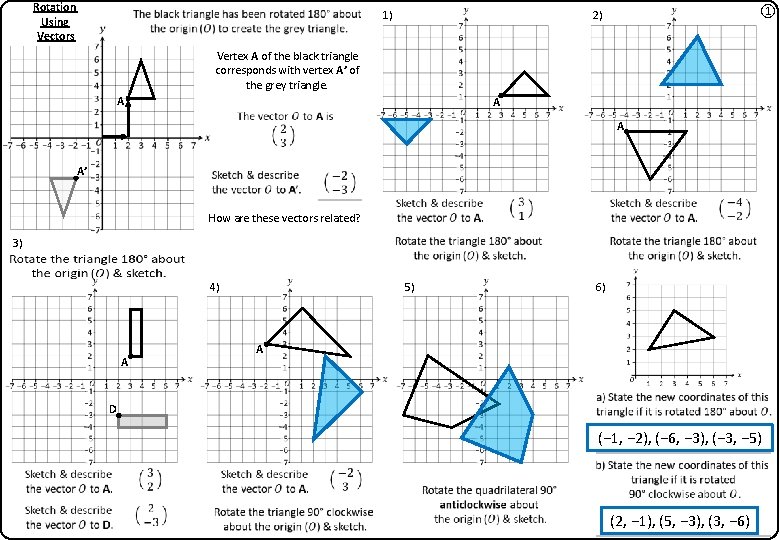
Rotation Using Vectors 1) ① 2) Vertex A of the black triangle corresponds with vertex A’ of the grey triangle. A A’ How are these vectors related? 3) 4) A 5) 6) A D (− 1, − 2), (− 6, − 3), (− 3, − 5) (2, − 1), (5, − 3), (3, − 6)
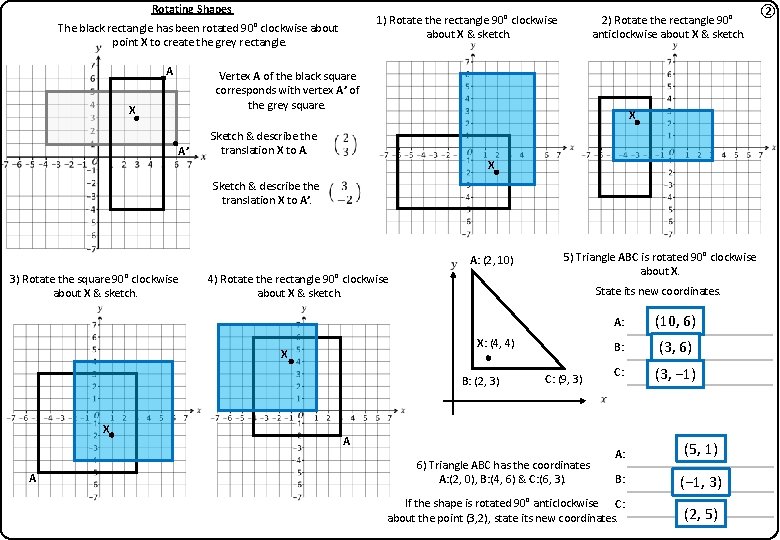
Rotating Shapes 1) Rotate the rectangle 90° clockwise about X & sketch. The black rectangle has been rotated 90° clockwise about point X to create the grey rectangle. A 2) Rotate the rectangle 90° anticlockwise about X & sketch. Vertex A of the black square corresponds with vertex A’ of the grey square. X A’ X Sketch & describe the translation X to A’. A: (2, 10) 3) Rotate the square 90° clockwise about X & sketch. 4) Rotate the rectangle 90° clockwise about X & sketch. State its new coordinates. X: (4, 4) X B: (2, 3) X A 5) Triangle ABC is rotated 90° clockwise about X. C: (9, 3) A 6) Triangle ABC has the coordinates A: (2, 0), B: (4, 6) & C: (6, 3). A: (10, 6) B: (3, 6) C: (3, − 1) A: (5, 1) B: (− 1, 3) If the shape is rotated 90° anticlockwise C: about the point (3, 2), state its new coordinates. (2, 5) ②
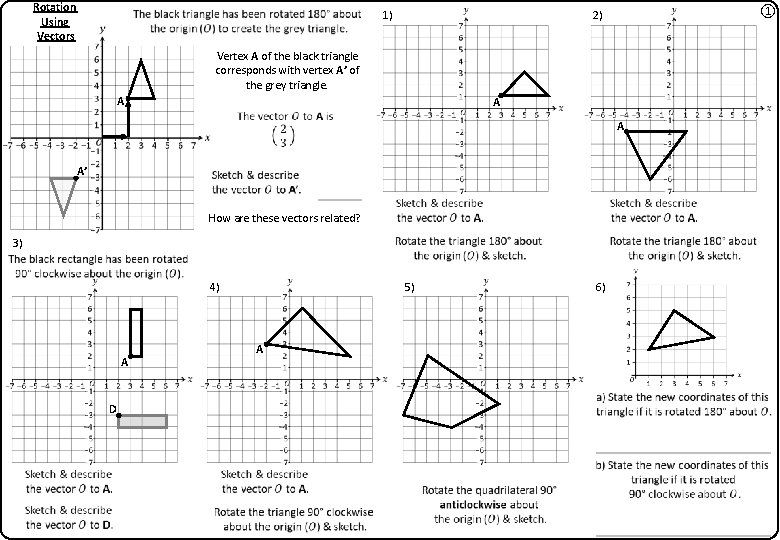
Rotation Using Vectors 1) ① 2) Vertex A of the black triangle corresponds with vertex A’ of the grey triangle. A A’ How are these vectors related? 3) 4) A D 5) A 6)
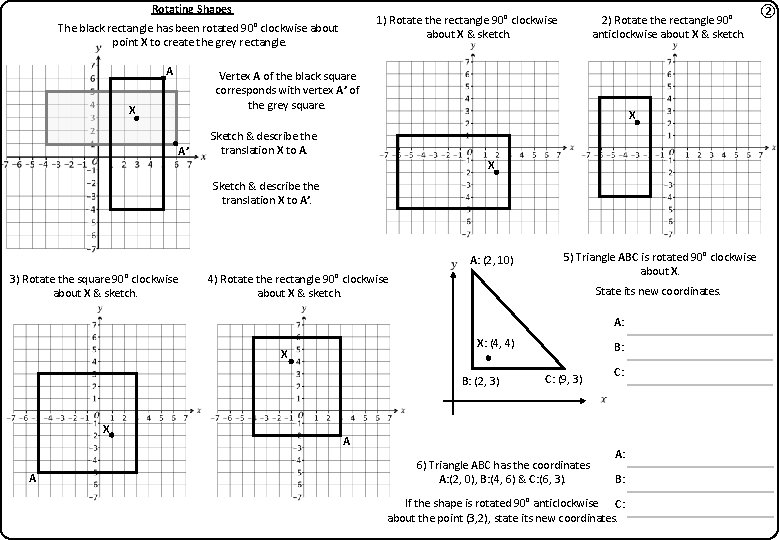
Rotating Shapes 1) Rotate the rectangle 90° clockwise about X & sketch. The black rectangle has been rotated 90° clockwise about point X to create the grey rectangle. A 2) Rotate the rectangle 90° anticlockwise about X & sketch. Vertex A of the black square corresponds with vertex A’ of the grey square. X A’ X Sketch & describe the translation X to A’. A: (2, 10) 3) Rotate the square 90° clockwise about X & sketch. 4) Rotate the rectangle 90° clockwise about X & sketch. 5) Triangle ABC is rotated 90° clockwise about X. State its new coordinates. A: X: (4, 4) X B: (2, 3) X A B: C: (9, 3) A 6) Triangle ABC has the coordinates A: (2, 0), B: (4, 6) & C: (6, 3). C: A: B: If the shape is rotated 90° anticlockwise C: about the point (3, 2), state its new coordinates. ②
Questions? Comments? Suggestions? …or have you found a mistake!? Any feedback would be appreciated . Please feel free to email: tom@goteachmaths. co. uk
- Slides: 11