
Rotation Torque Rolling Angular Momentum Chapters 10 11
- Slides: 39
Rotation Torque, Rolling, & Angular Momentum (Chapters 10 & 11, p. 241 -304)
Rotation: Terminology n Axis of rotation- the line/axis around which an object spins n r – the radius of a spinning thing n (theta) – a variable for the angle that something has rotated through n s – a variable for the linear distance (arc length) that an object at radius “r” would spin through n - angular velocity (the angle-that-is-rotated-through per unit-of-time: radians/second) n - angular acceleration (change in angular-velocity per unit-of-time: radians/second^2) n v – “linear” (or “tangential”) velocity n T - period (the time needed for object to rotate back to “start angle”) n K – as always, the “Kinetic energy” n I – rotational inertia (somewhat analogous to typical, linear inertia) n T - torque (a sort of “rotational force”) n W – work n P – power n l – angular momentum
The Basics of Rotation n n n 1 rev=360 =2π radians Instantaneous angular velocity is derivative of function for angular position: (t) Angular acceleration is the derivative of velocity: (t) The same acceleration-a/displacement-d/velocity-v equations (from kinematics) are used for / / s (the arc length) = r …taking the derivative of above: v= r, and a= r Using centripetal equations (acentripetal / radial=v 2/r) and v= r, we get: aradial= 2 r
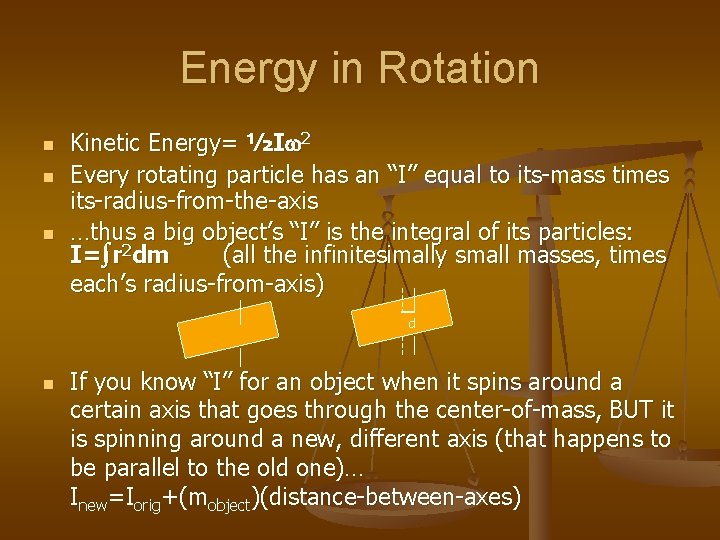
Energy in Rotation n Kinetic Energy= ½I 2 Every rotating particle has an “I” equal to its-mass times its-radius-from-the-axis …thus a big object’s “I” is the integral of its particles: I=∫r 2 dm (all the infinitesimally small masses, times each’s radius-from-axis) d n If you know “I” for an object when it spins around a certain axis that goes through the center-of-mass, BUT it is spinning around a new, different axis (that happens to be parallel to the old one)… Inew=Iorig+(mobject)(distance-between-axes)
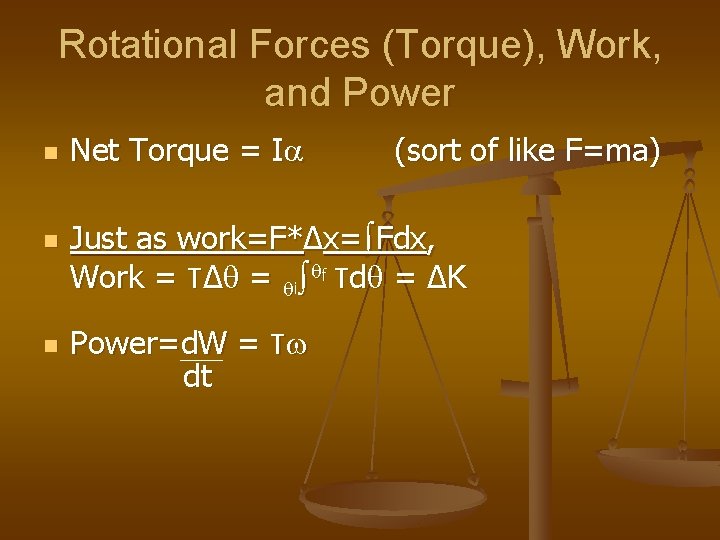
Rotational Forces (Torque), Work, and Power n n n Net Torque = I (sort of like F=ma) Just as work=F*Δx=∫Fdx, Work = TΔ = i∫ f Td = ΔK Power=d. W = T dt
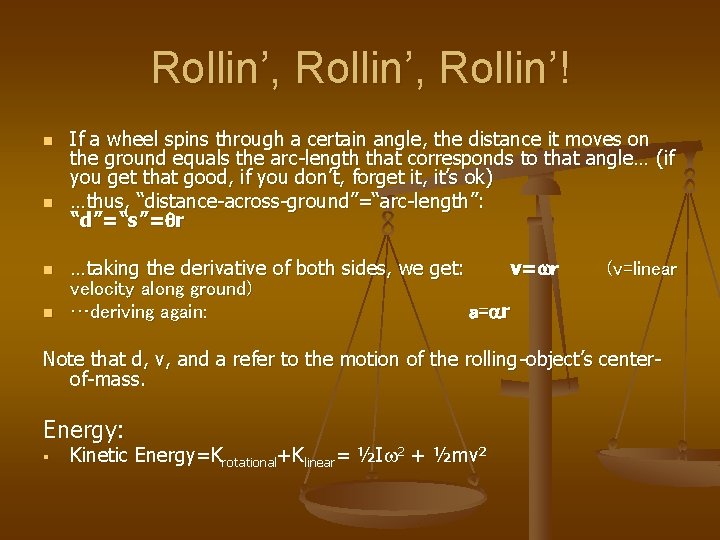
Rollin’, Rollin’! n n If a wheel spins through a certain angle, the distance it moves on the ground equals the arc-length that corresponds to that angle… (if you get that good, if you don’t, forget it, it’s ok) …thus, “distance-across-ground”=“arc-length”: “d”=“s”= r …taking the derivative of both sides, we get: v= r velocity along ground) …deriving again: a= r (v=linear Note that d, v, and a refer to the motion of the rolling-object’s centerof-mass. Energy: § Kinetic Energy=Krotational+Klinear= ½I 2 + ½mv 2
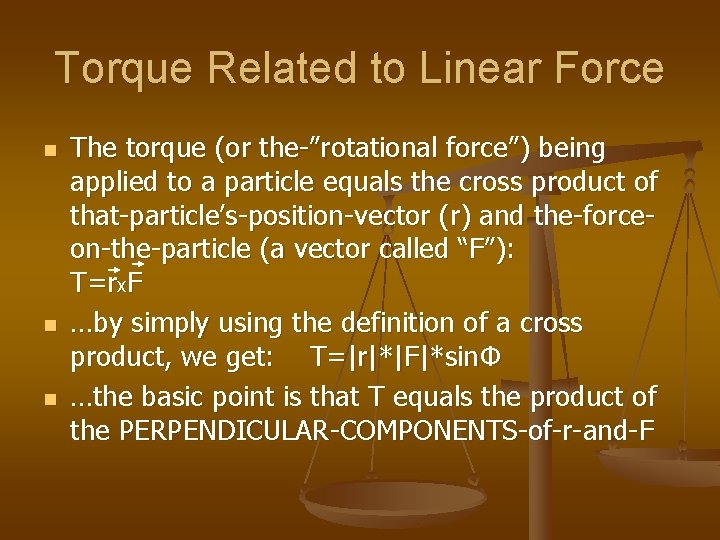
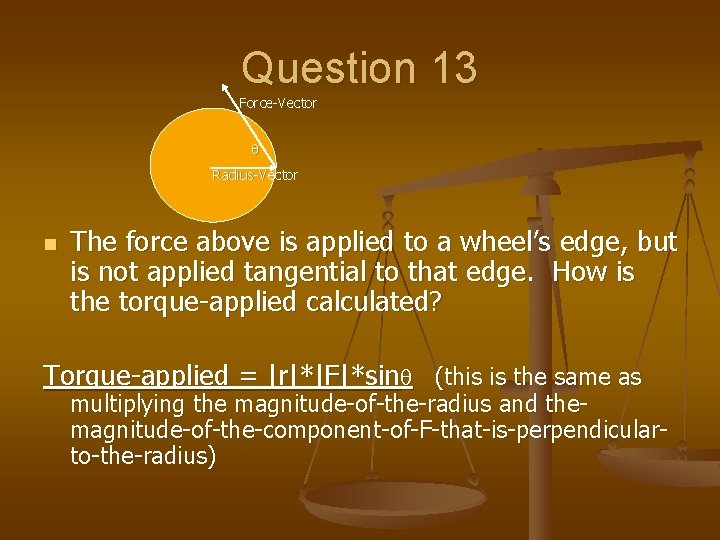
Torque Related to Linear Force n n n The torque (or the-”rotational force”) being applied to a particle equals the cross product of that-particle’s-position-vector (r) and the-forceon-the-particle (a vector called “F”): T=rx. F …by simply using the definition of a cross product, we get: T=|r|*|F|*sinΦ …the basic point is that T equals the product of the PERPENDICULAR-COMPONENTS-of-r-and-F
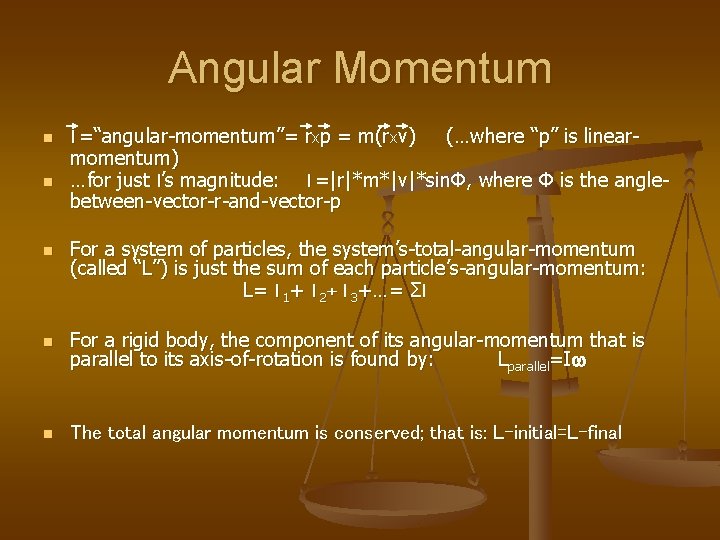
Angular Momentum n n n l =“angular-momentum”= rxp = m(rxv) (…where “p” is linearmomentum) …for just l’s magnitude: l =|r|*m*|v|*sinΦ, where Φ is the anglebetween-vector-r-and-vector-p For a system of particles, the system’s-total-angular-momentum (called “L”) is just the sum of each particle’s-angular-momentum: L= l 1+ l 2+ l 3+…= Σl For a rigid body, the component of its angular-momentum that is parallel to its axis-of-rotation is found by: Lparallel=I The total angular momentum is conserved; that is: L-initial=L-final
Question 1 n What would be the axis of rotation for a car wheel? …for a spinning quarter? The axle; a line that is the diameter of the quarter’s face and that cuts Washington’s face into two parts
Question 2 n While an object’s linear position is its xcoordinate (or coordinates), its angular position is _____. The angle that it is turned to.
Question 3 n Angular displacement is _____. The angle through which the object has been rotated…. Or “the final angularposition minus the initial angular-position”
Question 4 n (a) A wheel spins one full revolution every second. (b) That spinning causes that wheel’s center of mass (and the car it is attached to) to travel 4 feet per second along the road. These are two types of velocities; what is each called? A>>angular velocity; B>>linear velocity
Question 5 n D You mark a point on a wheel’s edge. The point is at an angle theta at time t, such that (t)=3 t^3 + t^2 + t …which of the following is a function describing the angular acceleration of the point? A) alpha=0 B) alpha=9 t^2 + 2 t C) alpha=9 t^2 +2 t +1 D) alpha=18 t +2
Question 6 n If roll of toilet paper rolls along the ground and rotates an angle equal to “theta, ” how much paper will roll off? (how far along the ground will it roll? ) Length-of-paper-to-roll-off = arc-length-that -corresponds-to-theta-radians = radiustimes-theta
Question 7 n Linear velocity equals relates to angular velocity in what way? Linear-velocity = angular-velocity * radius
Question 8 n How does Period relate to angular velocity? And how does it relate to linear velocity? T = (2 pi)/ T=(2 pi*radius)/v
Question 9 n What is the rotational inertia of a cylinder, rolling on it’s side? I=. 5 Mr^2 where r is radius and M is mass
Question 10 n What is the rotational inertia of a rod spun like a baton? I=(1/12)*ML^2, where M is the mass and L is the length
Question 11 n What is the rotational inertia of a tire shaped object, rotating as a tire does on a car wheel? I=. 5 M*(a^2 + b^2), where a is the inner radius, and b is the outer radius
Question 12 n What is the main equation of Newton’s Second Law as applied to rotation? Torque=I*alpha
Question 13 Force-Vector Radius-Vector n The force above is applied to a wheel’s edge, but is not applied tangential to that edge. How is the torque-applied calculated? Torque-applied = |r|*|F|*sin (this is the same as multiplying the magnitude-of-the-radius and themagnitude-of-the-component-of-F-that-is-perpendicularto-the-radius)
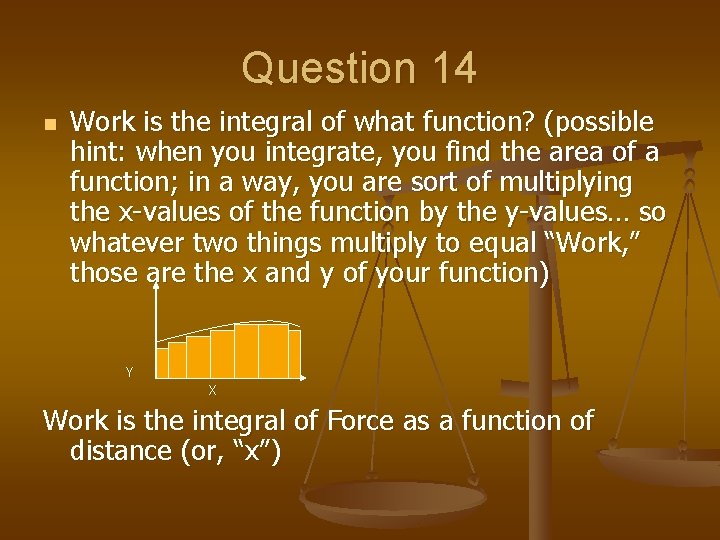
Question 14 n Work is the integral of what function? (possible hint: when you integrate, you find the area of a function; in a way, you are sort of multiplying the x-values of the function by the y-values… so whatever two things multiply to equal “Work, ” those are the x and y of your function) Y X Work is the integral of Force as a function of distance (or, “x”)
Question 15 n Power is the integral of what function? What is the independent variable of this function? Work as a function of time
Question 16 n What is the parallel axis theorem? If the rotational inertia is calculated for an object spinning around a certain axis that goes through the center-of-mass, but then a new, different axis-of-rotation is used (and the new axis is parallel to the old axis, but does not go through the center of mass), then: Inew= Icenter-of-mass+Mass*distance-between-axes
Question 17 n If a wheel rolls smoothly, the distance it will move (linearly, across the ground) will equal the ___-length that corresponds to the angle the wheel rotated through. The arc-length
Question 18 n A rolling wheel experiences which kind of friction? A)static or B)kinetic A) Static (because the wheel never actually moves, or “skids” along the surface… if it were perfect it would simply touch down on the ground, then lift up as it rolled)
Question 19 n What is one way to calculate angularmomentum (l )? (give an equation) It equals “the cross-product of a radiusvector and a linear-momentum-vector”. It also equals “mass multiplied by the crossproduct of radius and linear-velocity”.
Question 20 n If you take the derivative of angularmomentum (with respect to time), what do you get? (possible hint: what do you get when you take the derivative of linearmomentum as a function of time? ) You get the net-torque
Problem 1 n A wheel (of radius=25 cm) makes 2. 5 revolutions every second as it rolls smoothly. What is it’s linear velocity? How long will it take to roll a linear distance of “ 3. 25*pi” meters? And what is it’s rotational period? 1. 25*pi (meters per second) 2. 5 seconds. 4 seconds
Problem 2 n At any time “t” (in seconds) a rotating object is at an angle “theta” (in radians) and Theta= t^4 + 4 t^3 +2 t^2 +5. What is the instantaneous angular acceleration at second-2? What is the average angular acceleration between seconds 1 and 3? 100 radians per second-squared 187 radians per second-squared
Problem 3 n Through what angle will an object rotate given that: it starts at an angular-velocity of pi radians-per-second, it has a constant angular acceleration of 3*pi radians-persecond-squared, and it goes for 2 seconds ? Be sure not to over-think this one. 8*pi radians
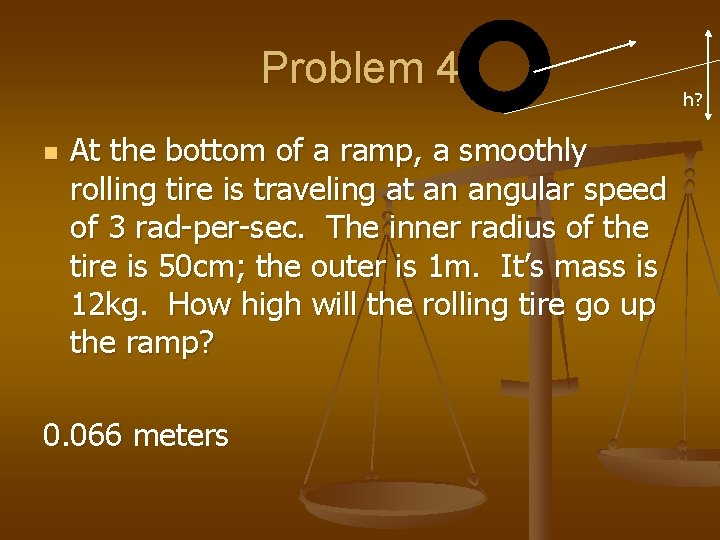
Problem 4 n At the bottom of a ramp, a smoothly rolling tire is traveling at an angular speed of 3 rad-per-sec. The inner radius of the tire is 50 cm; the outer is 1 m. It’s mass is 12 kg. How high will the rolling tire go up the ramp? 0. 066 meters h?
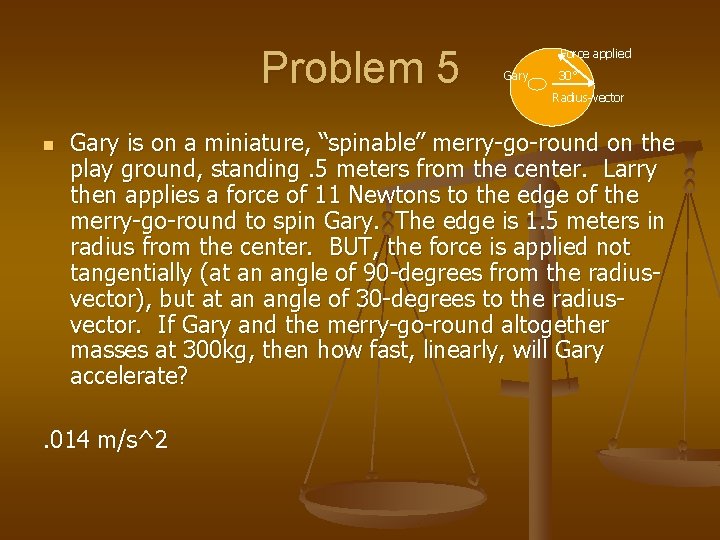
Problem 5 n Force applied Gary 30° Radius-vector Gary is on a miniature, “spinable” merry-go-round on the play ground, standing. 5 meters from the center. Larry then applies a force of 11 Newtons to the edge of the merry-go-round to spin Gary. The edge is 1. 5 meters in radius from the center. BUT, the force is applied not tangentially (at an angle of 90 -degrees from the radiusvector), but at an angle of 30 -degrees to the radiusvector. If Gary and the merry-go-round altogether masses at 300 kg, then how fast, linearly, will Gary accelerate? . 014 m/s^2
Problem 6 n Force= 4 ^2 (where =0 radians just as Larry starts) What will be the overall change in energy of the merrygo-round-AND-Gary system from problem #5, if the above equation gives the Force applied by Larry (still applied at 30 -degrees) as a function of the merry-goround’s angular position “theta” AND IF Larry spins it two full revolutions? +64*pi^3 Joules
Problem 7 n A boy in a marching band is smoothly spinning a. 75 -meter-long baton of uniformly distributed mass about an axis that is perpendicular to the baton and goes through it’s center. It spins at 3*pi rad-per-sec. He lets go of it quickly, without getting in its way or altering its rotation. He then quickly grabs the end of it and spins the baton about a new axis that is parallel to the old one, but that goes through the rod’s end. The baton quickly ends up having a new angular speed (with respect to the new axis) of 1*pi rad-persec. The baton has a mass of 0. 3 kg. What is the minimal amount of work the rod did upon the band-member’s hand? (ignoring gravity and air resistance…) 0. 35 Joules
Problem 8 n At one instant, force-vector “F=4. 0ĵ N” acts on a 0. 25 kg object that has position-vector “r=(2. 0î 2. 0 k) meters” and velocity-vector “v=(5. 0î+5. 0 k) m/s”. About the origin and in unitvector notation, what are (a) the object’s angular momentum and (b) the torque acting on the object? 0 (8. 0 Newton-meters)î + (8. 0 Newton-meters)k
Problem 9 n A wheel is rotating freely at an angular speed of 800 rev/min on a shaft whose rotational inertia is negligible. A second wheel, initially at rest and with twice the rotational inertia of the first, is suddenly coupled to the same shaft. (a) What is the angular speed of the resultant combination of the shaft and two wheels? (b) What fraction of the original rotational kinetic energy is lost? a) 267 rev/min b) 0. 0667
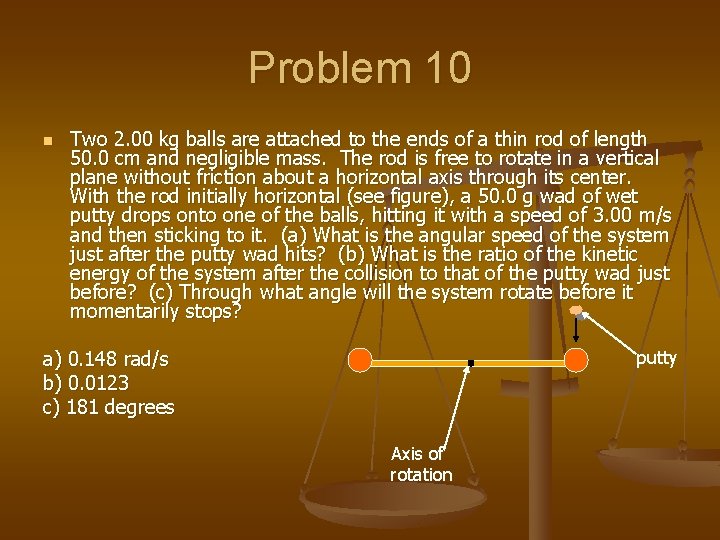
Problem 10 n Two 2. 00 kg balls are attached to the ends of a thin rod of length 50. 0 cm and negligible mass. The rod is free to rotate in a vertical plane without friction about a horizontal axis through its center. With the rod initially horizontal (see figure), a 50. 0 g wad of wet putty drops onto one of the balls, hitting it with a speed of 3. 00 m/s and then sticking to it. (a) What is the angular speed of the system just after the putty wad hits? (b) What is the ratio of the kinetic energy of the system after the collision to that of the putty wad just before? (c) Through what angle will the system rotate before it momentarily stops? putty a) 0. 148 rad/s b) 0. 0123 c) 181 degrees Axis of rotation
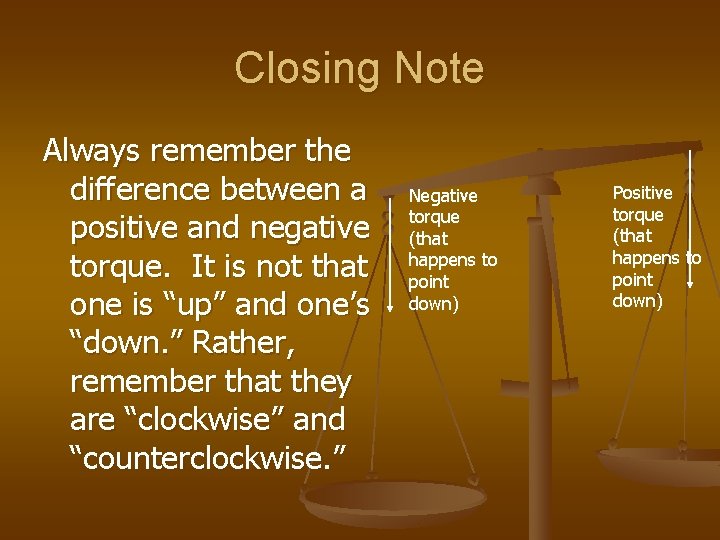
Closing Note Always remember the difference between a positive and negative torque. It is not that one is “up” and one’s “down. ” Rather, remember that they are “clockwise” and “counterclockwise. ” Negative torque (that happens to point down) Positive torque (that happens to point down)