
Rotary Foundation Grants Process An Overview Updated 9
- Slides: 68
Rotary Foundation Grants Process An Overview Updated 9 -21 -2020
Grant Certification Hello District 5220 Rotarians: In July 2013, The Rotary Foundation initiated a new grants process after a three-year pilot program. As part of the new program, districts were mandated to provide training to Rotarians on the various types and requirements for grants. For the first three years of the new process, our district provided this training as part of district events such as the Foundation/Membership Seminar, District Assembly, and Mid-Year Assembly.
As part of the transition to the new grants process, our district established policies related to clubs and training that included the following: � In order to get funding from The Rotary Foundation, including funding for what are called Club Grants, all clubs must be qualified. � To be qualified, each club must have at least three individuals who have participated in training (a club could have more). On an annual basis, one of those individuals must be the club’s president-elect.
� Once a person is trained, he/she does not have to repeat the training. � Training is now provided online and updates will be provided by e-mails to the committee of qualified individuals through Da. C-DB. � Records will be reviewed on a regular basis and clubs will be notified if they have fallen below the three-person requirement or if their presidentelect has not gone through the training.
� Why three people from each club trained? You will see in Module 3 that there a number of requirements placed on each club and we felt it important that those responsibilities not rest with just the “grants person” in each club but with a bigger group. � Why the President-elect? We felt that the PE should have some basic understanding of grants and that one person in the club would have each year the most updated information regarding grants.
Since 2014, The Rotary Foundation has allowed the possibility of online training, and our district has taken advantage of this change. Training now consists of District Rotarians reviewing three modules found on the district website or provided by e-mail from the Grants Committee Chair. The first module (this one) will provide an overview of the two types of grants, the components and requirements of each type, and the funding mechanism for grants.
The second module will describe the key components of a grant and then provide a number of scenarios in which the participant will review various grant situations to determine good practices and areas that need improvement. The third module will list the requirements that clubs need to follow to be qualified and receive funding for grants under the new grants process.
This training is set up so that district Rotarians can view the material on their own time in their own homes. Upon completion, you will need to complete the form found on the district website in the grants training section and mail/e-mail it in. On the form, you will certify that you reviewed all of the training material. Jot down your questions as you go through the material and provide them on the completion form or e-mail to davemantooth@gmail. com. Good Luck—it’s time to start.
The Rotary Foundation’s Mission The cornerstone of the new grants process remains the mission of The Rotary Foundation: “To enable Rotarians to advance world understanding, goodwill, and peace through the improvement of health, the support of education, and the alleviation of poverty. ” Everything that follows ultimately comes back to that mission statement.
Objectives of New Grants Process The Rotary Foundation operated a very effective grants process that included such components as Matching Grants, Group Study Exchange Teams, District Simplified Grants, and Ambassadorial Scholars. After a great deal of discussion and an attempt to align grants within Rotary’s strategic plan, the Foundation made the decision to change the process to better meet the following objectives:
Ø Strengthen the impact of club projects— under the new system, Rotarians and clubs will develop and implement larger projects with greater, more sustainable impact. Ø Sharpen the focus of overall grants activity— now, every grant will be centered on at least one of seven areas of focus (Environment has been added beginning July, 2021).
Ø Transfer more decision making locally—Since 2016 -17, clubs in D 5220 have had a greater say in how Rotary Foundation funding can be used in their local and international projects. Clubs will be in charge of determining how District Designated Funds are utilized (i. e. , those funds from Rotarians and clubs contributed to the Foundation Annual Fund that are returned to the district three years later). This process is described later in this module.
Ø Partner with other organizations—strategic partnerships with nongovernmental organizations and corporations will enhance Rotary’s capacity to address urgent world needs; e. g. , using Rotary’s partnership with the Bill and Melinda Gates Foundation to fight polio as a model to build other partnerships.
Ø Simplify grants processing—only two types of grants (District and Global) under the new system and a faster grant payment process. Ø Increase the visibility and image of Rotary so that Rotary will be recognized as a premier foundation on the world stage, which in turn will help increase membership, donations, and grant activity.
Areas of Focus Under the new grants process, The Rotary Foundation wanted to concentrate the efforts of Rotarians, clubs and districts on fewer key areas in order to increase the impact that Rotary projects would have around the world. After a great deal of discussion, they came up with six Areas of Focus which they felt would: reflect critical humanitarian issues and needs that Rotarians are addressing worldwide; align Rotary with other international development efforts; and strategically further the Foundation’s mission.
Six Areas of Focus Ø Peacebuilding and Ø Promoting Peace Conflict Prevention Ø Disease Prevention and Treatment (communicable diseases, mosquito-borne illnesses, noncommunicable diseases) Ø Fighting Disease Ø Water, Sanitation and Ø Providing Clean Water Hygiene
Ø Maternal and Child Health (access to services & reduction in mortality and morbidity rates) Ø Saving Mothers and Children Ø Basic Education and Literacy (basic education to all, adult literacy, reduction in gender disparity) Ø Supporting Education Ø Community Economic Development (opportunities for productive work, reducing poverty) Ø Growing Local Economies
� In each of the six areas of focus, the Foundation has provided a number of resources that clarify the types of projects that meet Foundation guidelines and help clubs in planning and carrying out projects. � Based on input from Rotarians, the Foundation Board of Directors in 2020 voted to add a seventh Area of Focus—the Environment, beginning July, 2021. Additional information will be forthcoming on the type of projects that will be allowed in this area.
Examples of D 5220 Grants Under the New Grants Process Historically, our district has been very strong in both local and international projects. Rotarians and clubs have been able to adjust fairly easily to the new system and new requirements. Just a few examples of projects in each of the six areas of focus: � Peace and Conflict Resolution—gang awareness and anti-bullying programs in schools in our district; peace poles.
� Disease Prevention/Treatment and Maternal and Child Health—many examples of hospital equipment in Mexico, India, Brazil and Niger; projects to help with Covid-19 during the past year. � Water and Sanitation (a big area in our district)— sand water filters and toilets in the Philippines; community water systems in the Philippines; water filtration systems in elementary schools in Mexico; drilling of wells in Nigeria.
� Basic Education and Literacy—dictionary projects by many clubs in our district; purchase of library books for schools and city libraries; Vocational Training Team for autism students in Romania. � Economic and Community Development— women empowerment projects in Uganda and Nigeria; microcredit project in Romania; support of a multi-project grant to help with hurricane relief in Puerto Rico.
Two Types of Grants � Under the new system, there are now two types of grants: District Grant and Global Grants. � Both types of grants support a wide variety of humanitarian and educational activities in local communities and abroad. � All projects and activities funded by these grants are related to the mission of The Rotary Foundation and include the active participation of Rotarians. � Next up is a discussion of each grant type in detail; how they are funded will follow.
District Grant � Each district is allowed to submit one District Grant each year; the goal in our district is to submit our District Grant to The Rotary Foundation for approval by July of each year so that we increase the amount of time clubs will have to carry out the projects listed in the grant. � The components of a District Grant can include club grants, a district-sponsored grant, contingency funds, administration costs, and funds set aside to sponsor district scholars or district vocational training teams.
District Grant Club Grants � Club Grants provide a means by which clubs can directly determine how Rotary Foundation funding can be used. � Club Grants can take place locally within our district or internationally; they will be much smaller in scope when compared to Global Grants (next section). � In our first eight District Grants submitted to The Rotary Foundation, there were over 50 club grants as part of the application.
� The funding for Club Grants is made up of an allocation from The Rotary Foundation and contributions from the club; clubs receive allocations based on their giving to The Rotary Foundation Annual Fund over the previous two and a half years; club presidents-elect receive their club’s allocation at the Pre-PETS meeting in February. � For all club grants, the club must at least match the amount used from the Foundation allocation.
District Grant—Other Components � � � Contingency funds—The Rotary Foundation allows the district to set aside contingency funds; our district has utilized this opportunity in each of its first seven District Grants to help in disaster situations; the District Grants Committee is responsible for determining how contingency funds might be used during any given Rotary year, and they represent 2. 5% of District Designated Funds. District-sponsored grant—the Grants Committee can also approve a district-sponsored grant. During the past two years, funds have been allocated to support district vocational training teams. Administrative costs—small amount for postage, computer software programs for accounts, bank fees, and similar items.
Global Grants � Must relate to one or more of the Areas of Focus. � Can be used to support humanitarian projects, scholars or vocational training teams (totally or as part of an humanitarian grant). � Provide sustainable and measureable outcomes (discussed further in second Module). � Take place in Rotary countries and geographic areas.
� � � Global Grants must be at least $30, 000 and not more than $400, 000. Must be sponsored by at least one Rotary club or district in the country where the grant project will take place (host) and one or more outside of that country (international); one club in each country must be the lead club and have a grant committee of 3 Rotarians. Districts must be qualified by The Rotary Foundation and all clubs involved must be qualified by the district (see third Module) and in good standing with Rotary International and The Rotary Foundation (i. e. , all financial obligations met and required reports submitted). In addition, members of the 3 -person committee required in the grant must be qualified.
Eligibility Criteria Specific Allowable Activities Ø Construction of infrastructure limited to toilet blocks and sanitation systems, access roads, dams, bridges, storage units, fences and security systems, water/irrigation systems, greenhouses, and low-cost shelters. Ø Renovation, repair and refurbishment of structures currently occupied or operational in which individuals live, work or spend a significant amount of time.
Ø Purchase and distribution of contraceptives for use in disease prevention and maternal health projects. Ø International and domestic travel for scholars, vocational training teams, and project beneficiaries. Ø Direct costs, fees, contracted labor costs, and stipends related to project implementation.
Restrictions on Grants Ø Ø Ø Grants cannot be used to unfairly discriminate against any group, promote a particular political or religious viewpoint, support purely religious functions at churches and other places of worship, support activities that involve abortion, or fund the purchase of arms or ammunition. Continuous or excessive support of any one beneficiary, entity or community. Purchase of land or buildings (because these items could be confiscated by a government and used for another purpose)
Ø New construction of a structure in which individuals live, work or engage in any gainful activity. Ø Operating, administrative or indirect program expenses of another organization. Ø Projects already in progress or completed. Ø Activities primarily implemented by a non. Rotary organization.
Global Grants Humanitarian Projects � Global Grant process is now totally online at rotary. org Member Access. � Guidelines on how to use the system and the information required are now available on the Rotary International My. Rotary website; key components of a Global Grant application are found in the second Module. � All Global Grant applications have to be submitted by clubs through the District Grants Committee before being submitted to The Rotary Foundation.
� Grants Committee meets in July, September, November, January, March, and May on the second Tuesday of each month at Perko’s in Salida to discuss, review and approve proposed grants; attendance is also now available through the Zoom meeting process. � Committee voting structure provides for representatives from each of the district’s 12 areas, but any Rotarian may attend and participate; interested individuals can request to get on the Grants Committee mailing list and receive information on upcoming meetings.
Global Grants Scholarships Ø Historically, the Rotary Foundation and Rotary districts have provided Ambassadorial Scholarships and scholarships through the Rotary Peace Centers to deserving individuals; since 1947, those scholarships have totaled over $532 million. Ø Our current grants process allows districts to award scholarships through the District Grant process or to choose scholars who are eligible to apply for a Global Grant.
Ø Ø The district’s policies regarding scholars can be found on the District 5220 website. Process is open to students living in our district, going to a university in our district, or a foreign student sponsored by a club in our district for graduate-level study. Scholarship awarded for post-graduate studies only. The district policies provide a scholarship to the individual chosen by the Scholarship Committee, and that individual is then eligible to work with the district to apply for a Global Grant of $30, 000 or more if their studies meet Foundation requirements.
If a scholar applies for a Global Grant: Ø It must be tied to one of the seven areas of focus; Ø Student will need to explain how the training and university study will benefit others. Ø District will need to find a cooperating club in the university country.
� Most of the scholars funded by D 5220 have been District Scholars, each receiving a $15, 000 scholarship for postgraduate studies. Some have been international and some at universities in the United States. The scholar recipient in 2020 -21 is studying at CSU Stanislaus. The District conducts a scholarship process that advertises the opportunity in all colleges in the district and provides information to all Rotarians through emails and the District Grants Bulletin. Deadline for scholarship submissions is usually in January.
� During the 2019 -2020 Rotary year, D 5220 chose two scholars that went on to apply for and receive Rotary Foundation Global Grant Scholarships of $35, 000. Both individuals did postgraduate work in the United Kingdom. Both lived in our district, but did undergraduate work outside the district. They learned of our scholarship through a district Rotarian who passed along the information.
Global Grants Vocational Training Teams � Since the 1960’s, the Rotary Foundation has provided a program called Group Study Exchange in which teams of young professionals traveled to another country with a Rotary team leader; the teams visited Rotarians and clubs and also participated in vocational visits in their chosen field. � Under the current grants process, the Foundation wanted to move in a new direction with exchanges in which training and providing overall benefits to a greater number of individuals would be the focus; the title given to the new process is Vocational Training Teams.
� Vocational Training Teams are a group of professionals traveling to another country to provide training or coming to D 5220 to receive training. � The purpose of the visits would be to strengthen the knowledge and skills of individuals and communities by addressing local needs and taking advantage of available strengths. � Each team will develop specific training objectives, a training schedule, and methods to support training recipients in the future.
�A Vocational Training Team must have at least two team members who can be Rotarian or non-Rotarian. � There are no age restrictions. � All participants must have documentable expertise in the areas outlined in the grant. � Training focus. � Each must be tied to at least one of the areas of team must have a team leader with general Rotary knowledge, leadership skills, international experience, and experience in the area of focus.
� Vocational Training Team can be district or club sponsored. � Each year, the District will allocate funding for a district-sponsored Vocational Training Team to be chosen by the incoming District Governor during the DGE year. � Clubs have the option of applying for a Global Grant to fund a Vocational Training Team through the district Grants Committee process.
Rotary Foundation Funding involves three specific questions: Ø What happens to contributions made to The Rotary Foundation Annual Fund? Ø How are funds returned to the district allocated? Ø How are Global Grants funded?
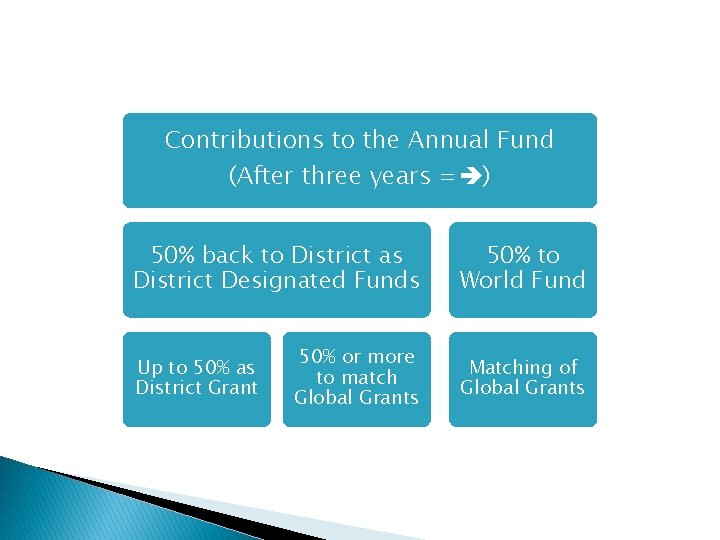
Contributions to the Annual Fund (After three years = ) 50% back to District as District Designated Funds 50% to World Fund 50% or more to match Global Grants Matching of Global Grants Up to 50% as District Grant
Foundation Giving � Each year, Rotarians are asked to contribute to The Rotary Foundation Annual Fund; there a wide variety of recognition programs for such contributions (Paul Harris, Paul Harris Society, Major Donors, etc. ). � The Foundation invests those contributions and the investment income over a three-year period is used to pay the administrative costs of running the Foundation and its programs. Therefore, we can say that every dollar contributed to The Rotary Foundation will be used in some program or to support projects.
� At the end of the three year period, the Foundation keeps 50% of the funds to use in helping to match Global Grant requests; this is called the World Fund. � The other 50% of the funding is returned to the district as District Designated Funds or DDF. For the 2020 -21 Rotary year, that amount is approximately $184, 000 based on contributions made to the Rotary Foundation Annual Fund during 2017 -18. For 2021 -22, that amount will be approximately $173, 000 and $158, 000 in 2022 -2023.
District Designated Funds � The Rotary Foundation allows each district to determine how its District Designated Funds will be allocated. � The District may submit a single District Grant each year (see previous discussion of District Grant) to support one or more projects (ours is over 50 projects). The District Grant can use up to 50% of the District Designated Funds.
Allocation of DDF The district has established policies on how to allocate the District Designated Funds returned to the district based on the following: � 10% or $15, 00 of the DDF will go to the individual selected as the District Scholar, either as part of a Global Grant application or direct scholarship as part of the District Grant (if the selected applicant cannot or does not apply for a Global Grant)
Ø Ø Ø 10% of the DDF or $16, 000 will be used to sponsor a district Vocational Training Team; this amount will serve as the district match for a Global Grant application; 2. 5% of the DDF to be used for contingencies as determined by the District Grants Committee; The remainder of the funding will be allocated to clubs to be used for club grants and/or global grants. Amounts allocated to clubs are based on its giving to the Rotary Foundation Annual fund over the previous 2. 5 years.
Club Spending Plan � Club Presidents-elect will receive their club allocation at the Pre-PETS meeting held by the DGE who will serve as District Governor during their year as Club President. With their allocation, clubs (through a Spending Plan) can decide to allocate funds to club grants (local or international) or to global grants (their own or supporting a global grant from another club).
� The Club Spending Plan will need to be submitted to the District Grants Committee Chair by the June 14, 2021 deadline. Between the Pre-PETS meeting and the deadline, the President-elect will need to work with the current club president, the board, and those in the club involved with grants to determine club priorities. The Club Spending Plan requires the signatures of both the current president and president-elect to ensure continuity between the time the Spending Plan is submitted and the grant projects are carried out.
� Because the Rotary Foundation requires that at least 50% of the funds returned to the district (District Designated Funds) must be used for international global grants, the club in our district as a group have restrictions on how they allocate their funds (i. e. , all of the funds cannot be used for club grants by all of the clubs in the district.
� Clubs that allocate at least 50% of their funding to global grants will be able to use the remainder of the funding for club grants without any reduction. � Clubs that allocate less than 50% of their funding to global grants may have their club grant requests reduced to meet the overall requirements of the Rotary Foundation.
� Clubs intending to use part of all of their allocation for club grants must submit them to the District Grants Committee Chair by the same June 14 deadline. Clubs will be notified if a reduction in the club grant amount is needed. � Beginning with the 2021 -22 Rotary year, clubs that do not submit a Club Spending Plan by June 14 will lose their allocation, and it will be returned to the Grants Committee for distribution to global grants seeking funds.
� Note: Funds allocated to club grants will ultimately provide cash back to the club. That is because every club grant becomes part of an overall District Grant. When the Foundation approves the District Grant, funds are sent to the Grants Committee bank account. Then, when a club completes its club grant and submits a final report that is approved, a cash check is sent from the Grants Committee to the club for its allocation.
� All other grant funds are held in a D 5220 account at the Rotary Foundation. When a club pledges funds to an international global grant, a record of that is maintained and reported at Grants Committee meetings. When the grant is submitted, all of those pledges are transferred from the D 5220 account to the global grant. It is simply a “bank transfer, ” and no cash funds are involved.
Global Grant Matching � Global Grants are funded through a combination of cash contributions, District Designated Funds, and Rotary Foundation World Fund contributions. � Global � Prior Grants range from $30, 000 to $400, 000. to the 2016 -17 Rotary year, clubs could come to the Grants Committee and receive matching funds for grant proposals. The Grants Committee was solely in charge of District Designated Funds and allocated them according to district policies and procedures.
� However, since the beginning of the 2016 -17 Rotary year, individual clubs have greater control of District Designated Funds. � Each club, as part of their spending plan mentioned before, is able to determine how much of their allocation it would like to use for global grants, either as a lead club doing the grant with an international partner or as a supporting club providing funding for the global grant.
� Clubs wishing to do a global grant will need to seek two types of financial support from district clubs, Rotary clubs and districts outside our district, and other sources: cash contributions and District Designated Funds. � The District will hold a Project Fair as part of the District Assembly (usually in May) to provide an opportunity for clubs to share their projects and solicit support.
� The Rotary Foundation, when the Global Grant is approved at that level, will match club District Designated Fund allocations at 100%. The Foundation will accept cash contributions for grants from clubs, Rotarians, and outside agencies, but beginning in July, 2020, the Foundation no longer will match cash contributions. � For example, a $30, 000 Global Grant could be funded with $10, 000 in cash contributions from clubs and Rotarians, $10, 000 in DDF allocations from clubs, and $10, 000 from the Rotary Foundation World Fund.
2020 -21 Grants Cycle � February—Club Presidents-elect receive club allocation and training at the Pre-PETS meeting. � March 5—Club Grant final reports for 202021 due. � March 31—Club Presidents-elect complete online training to guarantee funding. � May—District Assembly with Project Fair
� June 14—Club Spending Plans and Club Grant applications due. � By July—District Application submitted to The Rotary Foundation; once approved, clubs notified to start their club grants. � March, 2021—Final reports for club grants due; once approved, clubs will receive a portion of their club grant.
Summary: Rotarians, Clubs, District and Rotary Foundation � Role played by individual Rotarians: Contributions to The Rotary Foundation; Receive training in Grants Management; Come up with ideas and carry out Club Grants and Global Grants; Recruit scholar applicants and recruit/become a member of Vocational Training Team; Complete required reports for projects/grants.
� Role played by D 5220 Rotary clubs: Encourage contributions from members to The Rotary Foundation each year; Maintain a group of qualified/trained club members in the area of grants management; Plan and carry out a Club Grant each year; and/or Plan a Global Grant in partnership with a Rotary club in another country and in partnership with other clubs in our district; raise funds to make that project a reality.
� Role played by D 5220 Grants Committee and its subcommittees: Provide updated information and assistance on grants to clubs and Rotarians; Review Club Grant applications and submit as part of annual District Grant to The Rotary Foundation; Review Global Grant applications; assist clubs in the submission of Global Grants; Choose a scholar applicant and members of the Vocational Training Team; Make sure all reporting requirements are met by clubs for both Club Grants and Global Grants.
� Role played by The Rotary Foundation: Provide updated information on grants and assistance to Rotarians, clubs and the district through Foundation staff; Provide matching funds for Global Grants; Approve District Grant and Global Grant applications and final reports; monitor grants to ensure that Foundation guidelines are being followed and funds spent in an appropriate manner.
Resources Available � Rotary. org Member Access—Grants Basics with supporting documents � D 5220 Website under “Programs of TRF”—Global Grant guidelines; policies and procedures for scholars, vocational training teams, and grants committee; club grant applications and final report form � Grants Bulletin—regular update on what is happening in the area of grants; sent to all district Rotarians � Contact davemantooth@gmail. com with questions concerning grants or prospective projects.